The Face of a Book

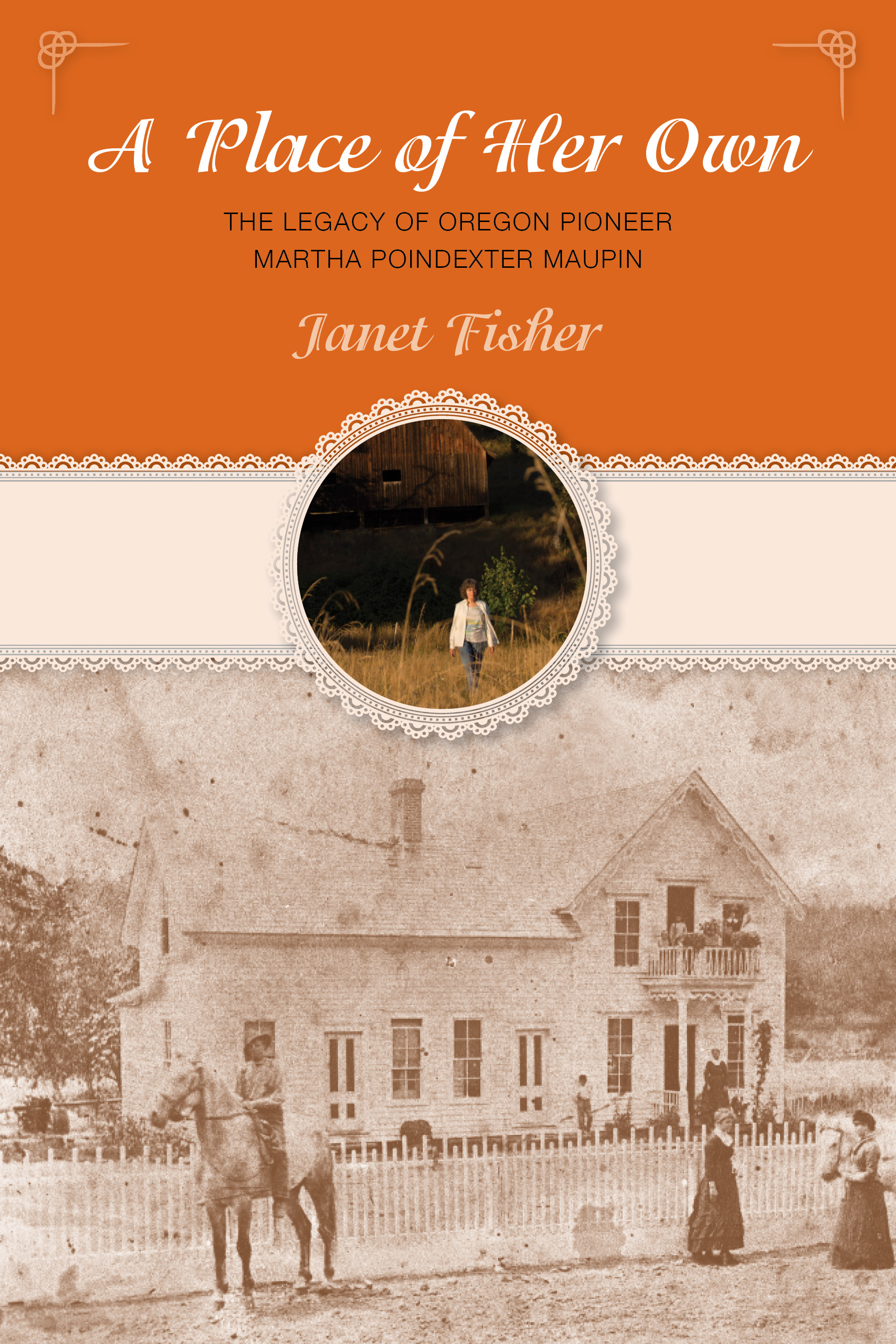
Voila! The cover for my book about great-great-grandmother Martha.

Cover - Place of Her Own

Authors sometimes await cover art for their books a little like mothers look forward to seeing the faces of their babies. You may have an idea what to expect but only a vague image.

I knew my publisher’s cover designers were going to use the old photo of Martha’s Victorian home that once stood on the family farm she bought in 1868. And I knew they planned to incorporate one of several modern pictures taken on the farm by my son-in-law Robin Loznak. I didn’t know which one or how it would be combined.

When I saw the cover I was surprised to see myself in that medallion which appears as the center in a length of ribbon wrapping up my book like a gift. And what a gift for me! My first published book after years of trying. Such a thrill that my great-great-grandmother’s story led the way.

The picture in the medallion shows me walking across a field on the river bottom with the old barn behind, catching a late afternoon sun. The book will have two inserts of photos, one showing old photos like this of the house as well as early portraits of family, and another showing several modern photos by Robin, including the one here.

How exciting to see the face of my book on Amazon, Barnes & Noble, Powell’s, and Indie Bound, right along with all those other real books. It is happening. My baby is beginning to see the light of day. Now I look forward to holding it in my hand—and opening the beribboned package. That’s a few months away, but coming soon. June.

I love the cover’s old-fashioned look, the touch of old lace echoing the intricate scrollwork on the roofline of Martha’s house. It feels perfect for her. I believe she would smile to see it.

COMMENT

Horses and the Maupins

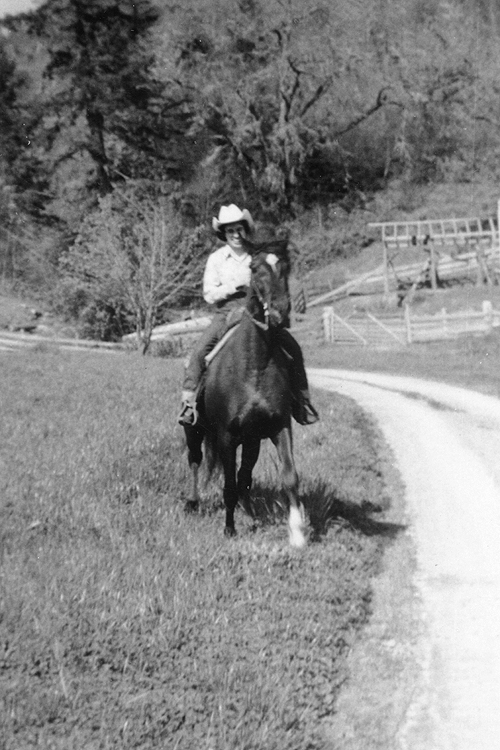
My own love of horses seems to come naturally from my Maupin roots. The photo here shows me as a girl enjoying my favorite mare, Fleet.

fleet-updated

When I began writing the book about my great-great-grandmother Martha Maupin, I first tried to draw on my own knowledge of the Maupins. I grew up on the farm Martha bought in 1868 after the death of her husband, my great-great-grandfather Garrett. The Maupin I remember best was Edith Maupin Edwards, the eldest daughter of Martha’s son Cap. All of Cap’s children grew up on this farm too, and if Edith was an example, as I believe she was, they all loved horses.

Much of my information about Martha came from Edith’s younger sister, Florence, who wrote a 75-page story of the family, in which she describes the Maupin love of fine horses. I knew horses had to be part of the scenario.

I’ll never forget watching my own father ride. We had an old mare named Dusty that my folks bought for my sister, Nancy, when I was five. Gentle. We could climb over and under her, and when we rode she carefully plodded along. Then my father would get on and she became a different animal. Head up, neck arched. Proud. She’d drop about ten years off her age. And he rode with grace and rhythm, moving as a part of the animal. I never saw a man sit a horse the way he did. It’s what inspired me to describe Garrett Maupin’s style in the book.

When I was nine, Edith and her husband Bill brought a stallion to the farm in hopes the old mare would foal. The offspring was to be my horse. A beautiful little filly was born in the middle of the night. Nancy and I slept outside that night near an improvised corral by the house, because old Dusty had seemed restless. In the wee hours Nancy woke me. “She’s having a colt.”

I mumbled, “Who’s having a colt?”

Nancy rushed to wake the folks, and I finally came to my senses. With flashlights we watched the birth. Such a thrill. Dusty had been a fairly silent mare, but when the foal came, she nickered in a low, sweet sound that touched my heart. I named my filly Fleet, and we were pretty inseparable for many years.

Edith planned to help me with training, but I kept getting impatient and one thing led to another. First, the halter, then when she was old enough to ride, the bridle, then the saddle. Once I had her all saddled she just stood there, so what was I to do? I got on. Nothing happened. She didn’t move. Later, she showed her spirit so I seldom had to press her to go. It was more a matter of holding back. I loved that spirit.

Through her papa, Fleet was related to one of Senator Wayne Morse’s fine animals. I showed him a picture once on a visit to Washington, D.C., and he knew immediately she was out of Kentucky Bourbon (I think that’s the name; it comes out of an old memory, but I’ll never forget his delight). I believe that was the American Saddlebred part. She also had a bit of Thoroughbred and enough Tennessee Walker to have the smooth, fast walk. Tall, sleek, feisty—like her papa. But gentle in nature like her mama.

Part of the Maupin legacy.

COMMENT

Birthing a Book

Martha’s book is in production now and I’ve found a rare break in this busy fall to give a progress report. Since last I posted on this blog, I’ve had two more deadlines. And we renamed the book, yet again, with new wording on the subtitle. I really like this one. As the sales department suggests, it shows this book is more than just another biography. There’s a strong link to the present. This title should be the keeper. It’s in the publisher’s catalog and on Amazon.com. It is now:

A Place of Her Own: The Legacy of Oregon Pioneer Martha Poindexter Maupin

Late in September I received the manuscript back from the copyeditor for my review. My friends from my old Montana critique groups would smile to see all the changes made on my commas. They used to call me the comma queen. Ha! Looks as if I know nothing of commas. Actually, I think much of it has to do with style. I have a journalism degree and journalism style is open, the fewer commas the better. The publisher’s style is more closed. But I don’t pretend to have it all figured out. Other than that, the edits were fairly light, but the review took me awhile. I cannot read the book without seeing something that needs tweaked.

Then about  a week ago I received first pages, pdf files showing how the book will actually look, both text and photo pages. How exciting! It really begins to feel real. And it’s beautiful. I love the font on the text. Photos look great. Even the old photos will be in color, which means those lovely brown tones for most of the digitized originals. Assuming the old pictures would be black and white I had turned in a black and white version of Martha’s old house, which I acquired from the local museum. Seeing the beauty in the brown tones, I wished I’d submitted a digitized version of the original—which I have. I suggested that to my production editor Lauren Brancato, in case it might not be too late. She assured me it wasn’t too late and they’ll just swap it out. I won’t go into detail on my trials at finding that photo—like locking myself out of the pickup on my way down the hill to pull it out of a file box I knew was in a safe place at my kids’ house. And it wasn’t there. A lot of scrambling and throwing boxes and voila. We found it. But nowhere near the place I was so sure it was. Anyway, another deadline met.

I must say the people at Globe Pequot Press are wonderful to work with. It’s been a delightful process.

Meanwhile, I’m doing a major redraft of one of my earlier books, and hope to move it onto the viable list soon. And the farm has had its share of challenges, with sudden fall rains threatening the logging operation I needed to pay my bills for the year. Luckily we got the Indian summer I was hoping for and we managed to get the last logs off the mountain. I could identify with the struggles my ancestors faced in salvaging their crops and getting them to market.

So, all that is why there’s been a large gap in my blog posts. Today I am not hurrying to do anything. 🙂

COMMENT

My Early Years on Martha’s Farm

me-at-five - updated

So, here’s going way back in my life to those free and easy days on the farm Martha chose for her family, the farm portrayed in my upcoming book about her, A PLACE OF HER OWN. In the picture above I’m about five, giving a small curtsy in my overalls, ready for a run on the scooter or a game of rope with the dog.

Maybe my sister and I would catch the old horse and create some elaborate adventure of pioneers and covered wagons with excruciating danger lurking behind every tree. Or we’d run in the fields or the orchard, maybe climb the hill with our dad and check on the lambs, or feel the warmth of the barn on a winter day when he milked the cow.

These are the memories that enrich the roots holding me to a piece of land. Imagine my wonder when I learned of my great-great-grandmother coming here long before me, alone with her children, making a stand right here, starting roots I would later touch. Imagine beauty so stunning, work so exhausting, uncertainties so daunting. How to hold on? How to make it work?

Ah, but in those early days of freedom, the joy of being was enough. Get on the scooter and go.

COMMENT

The Tree Link

I’ve been busy watering baby hazelnut trees, our newest crop on Martha’s farm. The picture below shows part of the orchard, set in the lower field along the river, the timbered cliffs in the background. We’ve put in about 700 trees so far, which is about my limit for now, given our watering system. Our budget system. It involves a lot of hoses and me going from tree to tree.

tree link

A couple of years ago when we bought our first trees, I was in for a surprise.

I’d been working on Martha’s book, learning more about her history. She and her husband Garrett, my great-great-grandfather, came over the Oregon Trail in 1850 and settled on their Donation Land Claim in Lane County near what would later become Eugene, Oregon. But after several years troubles sent them south into the next county. They were still renting a place near Elkton in Douglas County when Garrett was killed and Martha made the decision to buy this farm that’s still in the family.

I had visited the Lane County property, imagined them there. Nice rich land.

One morning while at work on the first draft of Martha’s story I got a call from Dwayne Bush, a nurseryman in Eugene I’d called earlier, requesting our first hazelnut trees. He said he’d done his count and would have enough trees for us that year. We talked about when I might pick them up, and I told him I would need directions. “They’re at my River Road Farm,” he said. “Do you know Eugene at all?”

“A little.”

He said I would take River Road north from the Beltline, then turn right on East Beacon Drive. “It kind of curves around, then crosses Spring Creek . . .”

I visualized the map, the place, and felt a growing sense of familiarity. “I think I know exactly where you mean. I think my great-great grandparents owned a farm around there.”

“Really? What was their name?”

“Maupin.”

He recognized the name. “The Maupin DLC, isn’t it?”

I smiled. “Yes, it is. They had six hundred forty acres there.”

“Well, I own a hundred acres of it.”

I clutched the phone, beaming, and told him I was writing a book about them, that I’d just been writing the part where they lived on that farm.

So this nursery stock grown on Martha and Garrett’s Lane County farm came to be planted on Martha’s Douglas County farm. You couldn’t get away with writing fiction like that.

COMMENT

Martha Receives a New Title

Now that Martha is in the hands of the publisher, inevitable changes are happening to make the book ready for debut. First, the title. After the last new title, I indicated there could be yet another change. And so there is. Editor Erin Turner found what she called the seeds of a title in what I already had, but by shifting the words a bit she came up with something much stronger, more dynamic. Here’s the new:

A Place of Her Own: The Pioneer Journey of Martha Poindexter Maupin

I love it. I got misty when Erin first presented it to me, knowing Martha’s story.

People often ask me what the title is. Some write it down. I’m excited to be able to share this one. I like that the main title has impact by itself, and I like that Martha’s full name is included in the subtitle. A lot of Poindexters and Maupins will no doubt appreciate that as well.

While I may continue to give a shortcut reference to the project as Martha, I’ll start talking more about A Place of Her Own, so when the time comes people will know what to watch for.

COMMENT

BOOK NEWS!!!

Woo-hoo!! I sold my book!

My new agent, Rita Rosenkranz, just closed a deal for me with Globe Pequot Press for the story of my great-great-grandmother, entitled Martha: A Pioneer Woman’s Journey to a Place of Her Own. It will be released around June 1, 2014.

This breakthrough has been a long time coming, as many of my friends know. Of the many books I’ve written, this will be my first published. I find it particularly satisfying that my grandmother led the way.

I started researching Martha’s story in 2009, shortly after moving to the farm she bought almost 150 years ago. When I took ownership of the place after my dad died I knew I wanted to write about her. What she acquired in 1868 had become the Martha A. Maupin Century Farm, one of the few Century Farms in Oregon named for a woman. But I didn’t realize what a powerful story she had until I began the search.

In the summer of 2012 I went to the Pacific Northwest Writers Conference in Seattle to pitch the completed book to agents and editors. There I met Rita Rosenkranz, New York agent, who had an idea which publishing house might offer a good home for Martha. From that time on it happened fairly quickly, given Rita’s sharp focus, some clear editorial direction from editor Erin Turner at Globe Pequot, and a little midnight oil for me on revisions. After working our way through the intricacies of acceptance—from editor to publishing board, from negotiation to fine tuning of the contract—we have finally emerged with the fully executed agreement. A deal.

Globe Pequot Press is a mid-sized publishing house with an international reach, founded in 1947, and today providing a wide spectrum of imprints and categories. They offer many titles on the American West, including portrayals of pioneer women like my great-great-grandmother Martha.

My thanks to Rita Rosenkranz and Erin Turner, to my readers—Leslie Budewitz, Judy Emmett, and my daughter Carisa Cegavske—to those who helped dig out information, especially cousin Linda Noel, to everyone who kept the faith.

Cheers! 🙂 🙂 🙂 !!!

COMMENT

The White Hawk

white hawk

Photo by Robin Loznak

Robin finally captured a photo of the white hawk we’ve been looking for, the one that did those aerial dances outside my window when I started putting together Martha’s book, the one that seemed to be leading me to something as my granddaughter and I followed it up the road. That hawk or one like it. We’re been hoping to get its picture. It has been back. The bird seems to visit at critical stages of the project, a haunting creature. But it always slips away before anyone can get a camera. Until today. Robin was on the hill taking pictures of new calves, and there it was, doing its dances over the big field above my house. It’s a Northern Harrier, commonly called a Marsh Hawk. An exquisite presence.

COMMENT

Polishing the Work

Revision is on my mind, since I recently completed another revision on my Grandmother Martha’s story. I’ve been writing for many years, but sometimes the work takes an uptick when I feel I’ve reached a new level. Somebody shows me something new, I take a workshop, join a critique group, get some valuable feedback, something. I apply that to whatever I’m working on. But once that’s done, I look at my other work I still consider viable for publishing, and I want to apply the same treatment to those stories.

One of the recent treatments I mentioned in a previous blog was the matter of trimming. Cutting words. Making everything move a little faster. The industry has changed since I started writing. Paper costs more so publishers want shorter books. People’s lives seem to move faster so their attention spans are shorter. They want shorter books. Writers have to pick up the pace. Some people may write tighter than I do in the beginning. I’ve always focused more on flow and clarity and the art of storytelling. All of that is important, but it’s surprising how easy it is to get along with fewer words.

I’ve started reworking my historical novels. Fortunately historicals are allowed a few more words, given the need to create a world the reader may not be familiar with. However, tightening can help them too.

One thing that happens when I start revising, the threads in the tapestry begin to loosen. I’m not always quite sure the work is holding together. That isn’t necessarily a bad thing. Sometimes I see threads that don’t work for me anymore. On my story of Minoan Crete a question came up and I went online to check it. A funny thing happens when I go online to answer one question. Several more tend to pop up, and I find answers to questions I hadn’t even thought of. With these stories of ancient times much of the basis of the work is archeology. And those archeologists keep digging. They come up with new stuff. I read somewhere that if you get three archeologists in a room and ask a question you’ll get five answers. Of course with a little poetic license I can pretty well pick the answer that works best for my story. But when a lot of scholars are agreeing on a new find, I like to pay attention to that. So some details may need changed.

A cool thing that happened this time. When the threads loosened, the story came to life for me again. I can tell when that happens because ideas begin to flood my mind—often in the wee hours of the morning, but I take inspiration where I can get it. The book is improving. It feels more real. I hope the changes will help me find a home for it.

COMMENT

Photo Dog

For Christmas this year I bought myself a small camera, a Nikon COOLPIX S5100. Now, I’ll never challenge my photographer son-in-law Robin in the picture taking department, but I do enjoy snapping photos. A wall in my office is devoted to framed snapshots of special places I’ve visited, usually to research books.

For my Grandmother Martha’s story I plan to offer old family photos and possibly some new photos as well. Robin has several of the farm he has offered to let me use, and he’ll take more as needed. In one of the book’s interludes describing my research into Martha’s life, I describe a white hawk that visited me early in the process. The creature was doing aerial dances outside my window and took one pass so close I could look right into its eye. Then it zipped up the road toward the upper barn. Oh, to have a camera then! But in lieu of a picture of the hawk, I thought we might do something with the road and the barn.

Just to give Robin an idea I thought I might frame one out to show him, like this one:

DSCN0024

Some days Robin’s dog comes to visit because he knows I take a walk every day. So I take him with me. He was visiting when I first went to frame the shot. And what does he do? He hurries over, right into the frame, and looks for all the world as if he’s posing. I got excited and took a bunch of photos, but I like this one best:

DSCN0016

Maybe a photographer’s dog just knows what to do when you bring out a camera.

COMMENT