COUNTDOWN – 6 DAYS TO LAUNCH

Willamette Falls

As we continue the countdown to the launch of my new book, The Shifting Winds, today’s historical factoids focus on the developing settlement of Willamette Falls, soon to be named Oregon City, the first Euro-American settlement in Oregon’s Willamette Valley and the destination for many American settlers who would cross the Oregon Trail.

Society208-Clackamas County Historical Society Photo, All Rights Reserved

The above lithograph was created in the 1840s by lithographer J. H. Richardson who traveled to Oregon City during the settlement’s early days, one of several artists sent out to record images of the West during that period. The picture shows the bluff and the heavy forest above, which will become familiar to readers of The Shifting Winds.

A dramatic horseshoe-shaped falls gave the place its first name. Long before the white men came, the remarkable cascade drew Native American tribes like the Clowewallas, one of several Chinookan tribes who found excellent fishing at the site, and it became a place for the tribes to gather for trade. Some said the salmon were so thick a person could walk across the river on the salmons’ backs. Men built scaffolds right in the plunging water and climbed up to use spears and dip nets to catch fish struggling to leap the falls for the great return to their spawning grounds upriver.

When British fur traders entered the region they quickly recognized the potential power of the falls, and in 1829 Dr. John McLoughlin, HBC Chief Factor at nearby Fort Vancouver, laid out a two-square-mile claim at the site. By the time the characters of my story arrive, he’s in the process of building a sawmill on an island there.

The construction work brought HBC employees to the place which they called Willamette Falls. Then Americans began to arrive, and contentions stirred at this focal point, as well as across the Oregon territory. When the story opens in 1842, the Oregon country has been jointly occupied by the British and Americans for almost twenty years, because the two nations still can’t agree on a boundary. The British have been entrenched for years with their fur trading operations, and only a few Americans have trickled in—some missionaries, a few mountain men escaping a dying beaver trade in Rockies, and a scattering of emigrants who’ve come by land and sea.

Protagonist Jennie Haviland isn’t happy her father tore her away from her prestigious academy in Utica, New York, to come to this wilderness, but her one hope is that she’ll find a place she can call home in Willamette Falls. As she and her family follow their Indian guides through the dense woods to an overlook of the mighty cascade, she hopes to get her first view of this town. Awed by the spectacle of the falls, she can’t help admiring the beauty, but she doesn’t see a town, only some shacks on the island and a couple of log cabins with a few outbuildings on the flat bench of land below. Homes of isolated settlers? She turns to her father.

“‘But where is the town? Where’s Willamette Falls?’ She wanted to find the town of proper houses.

“The young guide mumbled to Pa again, and Pa nodded. ‘So that’s it,’ Pa said. ‘That’s our settlement.’

“Jennie scanned the tree-cloaked hills. ‘Where?’

“‘Those cabins are it.’ He pointed to the flat bench of land. . . .

“Jennie darted a quick look at the cabins on the flat, then jerked her head back to stare at Pa. ‘What do you mean?’”

NEXT: Mountain Men

COMMENT

Tasting Local History

DSCN0429It’s time for Fort Umpqua Days again, an annual event in my hometown of Elkton, Oregon, when we honor our past and have some fun doing it. It’s Labor Day weekend, Saturday and Sunday, September 5 and 6, pretty much all day, at the Elkton Community Education Center just west of town.

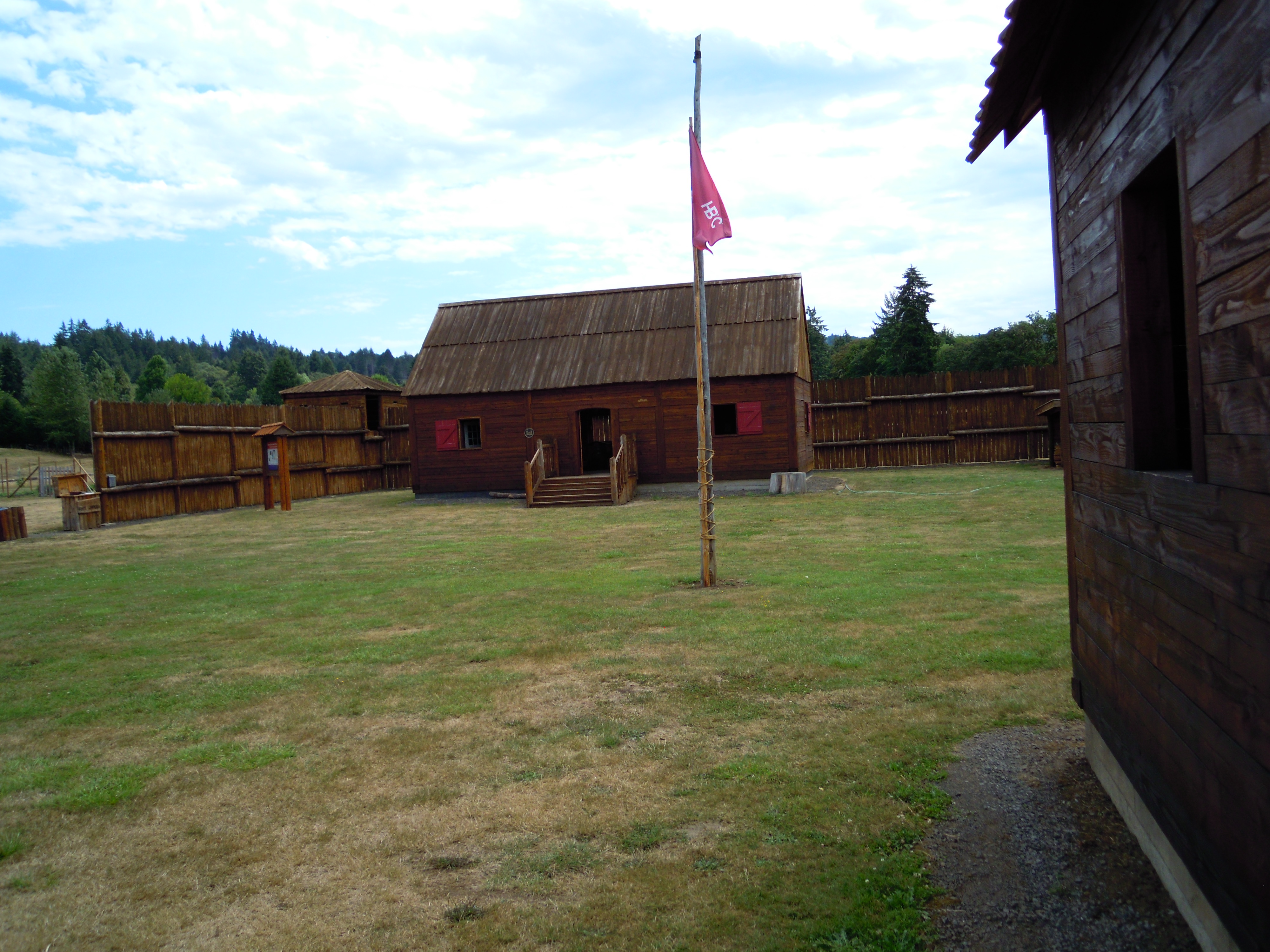
The photo above shows the massive gates for the reconstructed Fort Umpqua, which was the southernmost fort of the British Hudson’s Bay Company in the 19th century. Thanks to the dedication of local people this fort was reconstructed with an eye to authenticity so folks can get a glimpse of life back then.

I’m particularly interested in the period because I write about it. In my first book, A Place of Her Own, my great-great-grandmother comes to Elkton near where the fort stood. The fort has fallen by the time she gets there and the British have left the area following the 1846 settlement of a boundary at the 49th parallel. However, conditions haven’t changed dramatically. It’s a part of her immediate history. And in my next book, a novel called The Shifting Winds, the story opens in 1842 when Oregon was still contested territory between the British and the Americans, and tensions stirred rumors of war. In my story a triangle romance parallels the conflict, when two young men, a Hudson’s Bay Company clerk and an American mountain man, vie for the protagonist, a young pioneer woman who never wanted to leave her New York home in the first place.

So I revel in events like this that help bring history alive. Also, I serve on the writing committee for the annual pageant that’s performed both nights of the event, where we bring out a little history with a bit of humor and music and dance and a whole lot of fun. During the day there are games for the kids down at the fort, crafts for sale, food, black powder demonstrations by our own mountain men, and more.

I’ll have a booth both days where I’ll be selling and signing copies of A Place of Her Own, from 10 a.m. to 5 p.m. If you’re in the neighborhood, welcome to a dip into our past.

COMMENT

NEW BOOK DEAL!!

Society208-Photo courtesy of Clackamas County Historical Society, All Rights Reserved

Woo-hoo!! Another book!

I’m thrilled to announce I sold my second book, this one a historical novel of early Oregon. My agent Rita Rosenkranz just closed the deal with the editor of my previous book, Erin Turner of Globe Pequot Press. It will come out in April 2016 under the TwoDot imprint, the same as A Place of Her Own. The photo above is a lithograph by J. H. Richardson showing Oregon City in the 1840s, the primary setting of the new book, tentatively entitled The Shifting Winds.

It’s the story of reluctant Oregon pioneer Jennie Haviland whose father decides, against her wishes, to take the family west to the wilderness of 1842 Oregon. Two men there vie for Jennie, one British, one American, as their two countries vie for the contested Oregon land. But Jennie wants choices of her own.

The Oregon City shown in the lithograph is the hometown Jennie would have known soon after her family arrived at the end of the long Oregon Trail.

I wrote this book some years ago when my focus first turned to stories of Oregon pioneers. After succeeding in selling the story of my pioneer great-great-grandmother, released in 2014, I brought this one out and gave it a polish, hoping my editor would like it too. And yay! She did! It has always been one of my favorites. I had such fun reworking it and look forward to sharing it now with readers.

Although A Place of Her Own reads like fiction it was sold as non-fiction. This new one brings me over to the world of fiction, in this case, fiction set in the midst of historic events with some real people, like legendary mountain man Joe Meek and Hudson’s Bay Company Chief Factor John McLoughlin. It falls solidly into the category of historical fiction.

Please join me in a cheer for book number two!! 🙂 🙂 🙂

COMMENT

Fort Umpqua Days

Elkton, Oregon, puts on a big Fort Umpqua Days event every year on Labor Day Weekend in celebration of the town’s history.This year it’s Saturday and Sunday, August 30 and 31.the fortThe British Hudson’s Bay Company built Fort Umpqua in 1836 near where Elkton sprouted a few years later. It was the company’s southernmost fort in the Oregon Territory in the days when they essentially ruled the area, chasing the lucrative fur trade–before all those American pioneers started trekking west over the Oregon Trail.

The first fort burned in 1851, and a flood in 1861 washed away what was left of it. A few years ago citizens of the area decided to reconstruct the fort on a site just downriver from the original, and the work continues today with new buildings going up inside the wooden palisade walls, with considerable effort made to keep things authentic. Now the HBC flag flies again.

DSCN0434So, during Fort Umpqua Days we celebrate with a parade and a history pageant, a craft fair, and other events. I’ve enjoyed serving on the writing team for the pageant the last few years, in which the history is told with a bit of humor and a bit of truth. And this year I’ll have an outdoor booth for selling and signing my book about one of those intrepid American pioneers–my own ancestor Martha Poindexter Maupin.

DSCN0429Last year kids came into the fort grounds to learn how people at the old fort cooked and kept gardens and washed their clothes, which was probably a whole lot more fun for the kids than for those guys at the original fort. Inside, there are furs and stories aplenty to whet the imagination.

The event is open to the public and fun for kids of all ages. If you enjoy taking a step into the past, here’s a great place to do it.  🙂

COMMENT