COUNTDOWN – 5 DAYS TO LAUNCH

Mountain Men

With five days to go until the launch of The Shifting Winds, today’s post will focus on those intrepid mountain men who went out into the wilds of the Rocky Mountains to trap beaver for the American fur companies in St. Louis. From the early 1820s until 1840 these trappers worked the mountain streams and developed a lifestyle of their own. Company caravans took supplies to the Rockies for an annual summer rendezvous where they traded for beaver the mountain men had gleaned during the year. So the trappers never had to leave the mountains. Some didn’t go home to the States in all that time, maintaining a tenuous link with civilization as they had once known it.

George profile jpgPhotos courtesy of Douglas County Museum

George Abdill may not look like a mountain man in the pictures above and below, but the spirit of a mountain man lived in George’s heart.

Some years ago when I decided to write a book about the American frontier, with mountain men and pioneers and British fur traders, I went to see George Abdill, director of our local Douglas County Museum at the time. George was a man who held in his mind so much information, a person could ask him a question and he would answer with a chapter. When I told him about the setting and characters of my story, he smiled and sat back in his chair, his tone turning wistful. “If I could go back in time and choose what I would like to be, I would be a mountain man.”

George headshot jpgWow! What a great source for these stories!

He’s not wearing buckskins in the photos. He doesn’t have a powder horn and bullet pouch slung over his shoulder. And he’s not carrying a muzzleloader, but he knew how to shoot one and told me how to reload the single-shot weapon on the run while riding full tilt after buffalo. So, imagine him in buckskins, as he could have surely imagined himself.

The mountain men who trapped beaver in the Rocky Mountains generally wore buckskins because these trappers worked in rough country and the durable buckskin protected their own skin, also because they lived and worked with Native Americans who often wore deerskin clothing themselves. Fringes—or whangs—on the outer arm seams and leg seams offered more than style. The fringes helped the garment shed water by acting as wicks, an important feature for men who waded into streams to trap beaver and faced all kinds of weather.

Here’s how protagonist Jennie Haviland sees American mountain man Jake Johnston on first meeting:

“She managed to push back to arm’s length and quickly surveyed him from the smiling face down over the buckskin-covered length of him to the moccasins on his feet. He wore a buckskin shirt, much like their young Indian guide’s—fringed, embroidered, belted at the waist—but unlike the guide he wore long, trim-fitting buckskin breeches with fringes running down the outer seams. He was armed—a knife in a sheath on his belt, a pistol stuck into the belt, and powder horn and bullet pouch slung over his shoulder. With determination, she pushed back harder and he released his grip on her.

“He spoke with a drawl, still smiling. ‘Ma’am, may I have the utmost pleasure and privilege of welcoming you to the fair Willamette Valley? My name is Jacob Obadiah Johnston.’ He backed up a step, sweeping one hand before himself as he gave her a deep bow, the long fringes on his buckskin sleeve swishing with the motion. Standing straight again, he grinned wider. ‘My friends call me Jake. And you would be . . . ?’

“She could only stand and stare . . .”

The Shifting Winds is the fourth pioneer story I wrote, the fourth serious novel, and its pages are infused with the information and spirit provided by mountain man dreamer George Abdill. I wish he were still alive to thank for all the help he gave me.

NEXT: Joe Meek, Mountain Man Extraordinaire

COMMENT

COUNTDOWN – 6 DAYS TO LAUNCH

Willamette Falls

As we continue the countdown to the launch of my new book, The Shifting Winds, today’s historical factoids focus on the developing settlement of Willamette Falls, soon to be named Oregon City, the first Euro-American settlement in Oregon’s Willamette Valley and the destination for many American settlers who would cross the Oregon Trail.

Society208-Clackamas County Historical Society Photo, All Rights Reserved

The above lithograph was created in the 1840s by lithographer J. H. Richardson who traveled to Oregon City during the settlement’s early days, one of several artists sent out to record images of the West during that period. The picture shows the bluff and the heavy forest above, which will become familiar to readers of The Shifting Winds.

A dramatic horseshoe-shaped falls gave the place its first name. Long before the white men came, the remarkable cascade drew Native American tribes like the Clowewallas, one of several Chinookan tribes who found excellent fishing at the site, and it became a place for the tribes to gather for trade. Some said the salmon were so thick a person could walk across the river on the salmons’ backs. Men built scaffolds right in the plunging water and climbed up to use spears and dip nets to catch fish struggling to leap the falls for the great return to their spawning grounds upriver.

When British fur traders entered the region they quickly recognized the potential power of the falls, and in 1829 Dr. John McLoughlin, HBC Chief Factor at nearby Fort Vancouver, laid out a two-square-mile claim at the site. By the time the characters of my story arrive, he’s in the process of building a sawmill on an island there.

The construction work brought HBC employees to the place which they called Willamette Falls. Then Americans began to arrive, and contentions stirred at this focal point, as well as across the Oregon territory. When the story opens in 1842, the Oregon country has been jointly occupied by the British and Americans for almost twenty years, because the two nations still can’t agree on a boundary. The British have been entrenched for years with their fur trading operations, and only a few Americans have trickled in—some missionaries, a few mountain men escaping a dying beaver trade in Rockies, and a scattering of emigrants who’ve come by land and sea.

Protagonist Jennie Haviland isn’t happy her father tore her away from her prestigious academy in Utica, New York, to come to this wilderness, but her one hope is that she’ll find a place she can call home in Willamette Falls. As she and her family follow their Indian guides through the dense woods to an overlook of the mighty cascade, she hopes to get her first view of this town. Awed by the spectacle of the falls, she can’t help admiring the beauty, but she doesn’t see a town, only some shacks on the island and a couple of log cabins with a few outbuildings on the flat bench of land below. Homes of isolated settlers? She turns to her father.

“‘But where is the town? Where’s Willamette Falls?’ She wanted to find the town of proper houses.

“The young guide mumbled to Pa again, and Pa nodded. ‘So that’s it,’ Pa said. ‘That’s our settlement.’

“Jennie scanned the tree-cloaked hills. ‘Where?’

“‘Those cabins are it.’ He pointed to the flat bench of land. . . .

“Jennie darted a quick look at the cabins on the flat, then jerked her head back to stare at Pa. ‘What do you mean?’”

NEXT: Mountain Men

COMMENT

Stepping into History

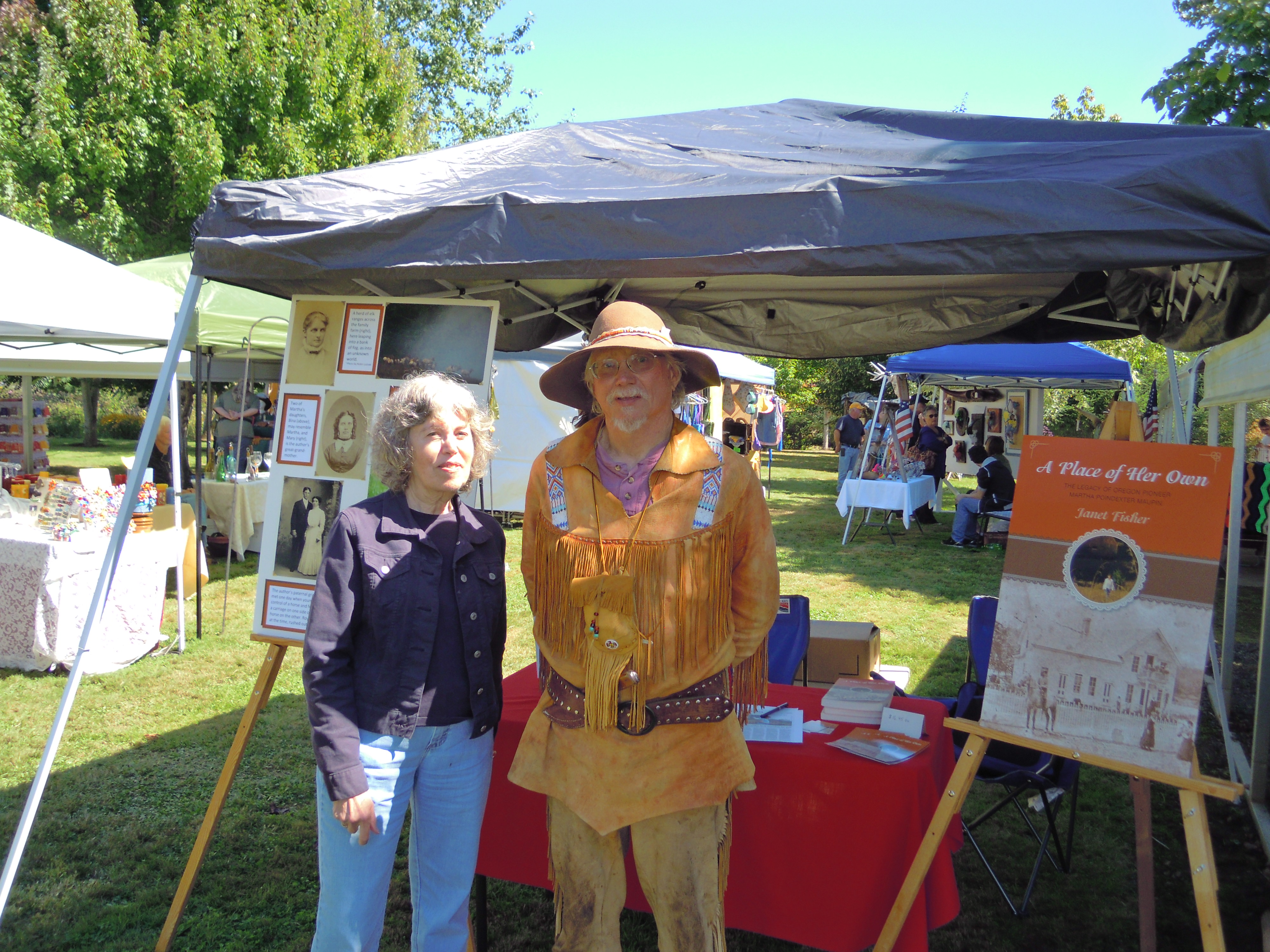
Mt. ManI was selling books outside Fort Umpqua today when a mountain man appeared. He’s one of our local mountain men from nearby Drain, Oregon, Ken Putnam. I had to admire his fancy fringed buckskins, and he agreed to have his picture taken by my booth.

Meanwhile, a few shots rang out from the black powder rifles other mountain men were shooting next to the fort.

It’s quite an event, giving locals a chance to step back into history for a couple of days to imagine what life must have been like in the days of the fort, back in the mid-1800s. And some like Ken get right into the spirit of it.

I especially find all this interesting, given the settings of my books. In Shifting Winds, which comes out in April, a couple of mountain men play significant roles, including one real-life character, the legendary Joe Meek. I do have fun portraying Joe with his storytelling and bravado.

Today was a fine day with perfect weather, the world nicely washed after yesterday’s rain, and we’ll be back at the fort again tomorrow, Sunday the 6th, looking into our wild and woolly past.

COMMENT