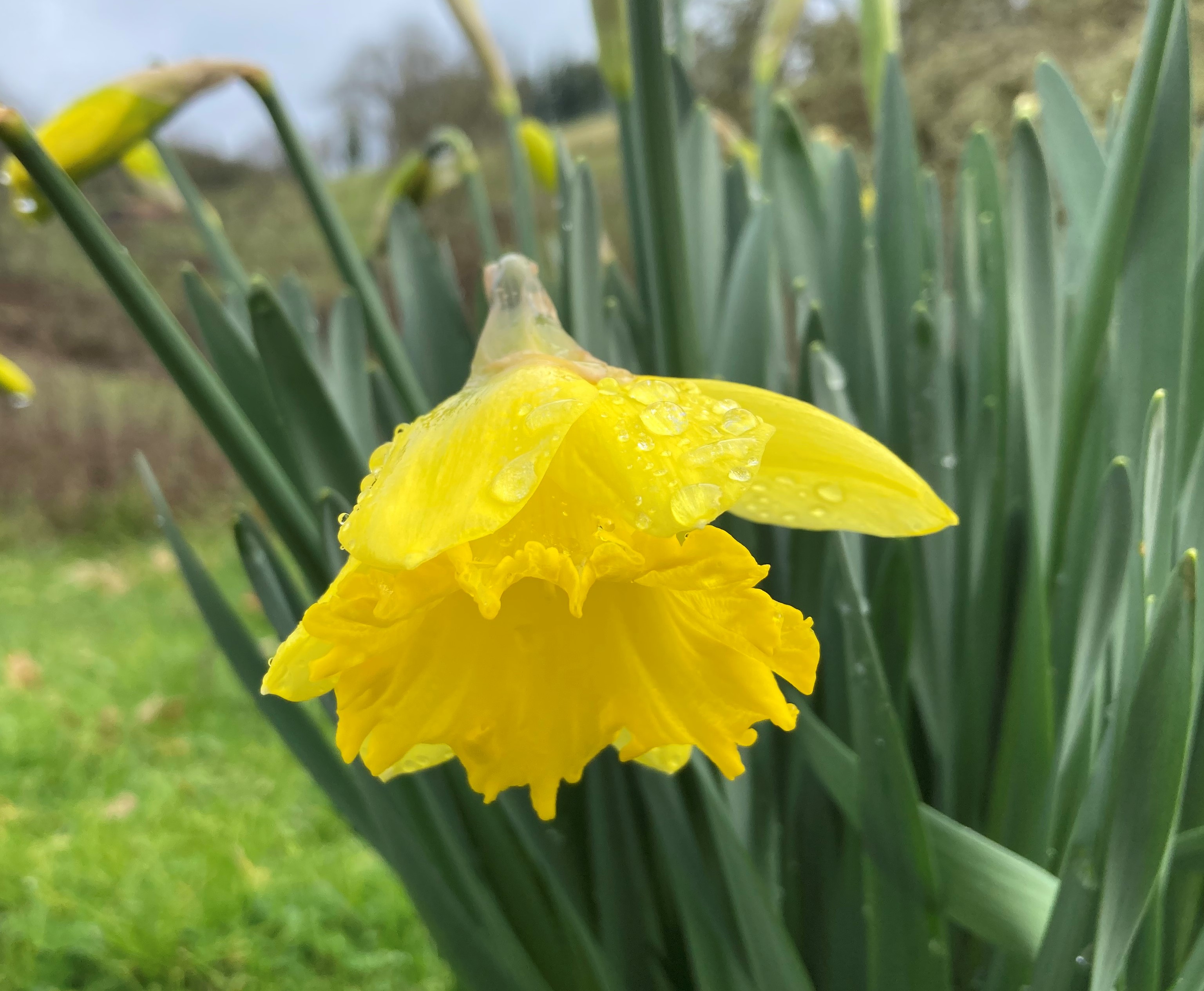
Delicate. Exquisite. Brilliant in yellow. The daffodils of late winter brave every kind of weather. Pounding rain. Skiffs of snow like this morning’s chill. Sometimes they wait. They seem like long-term weather forecasters, setting expectations by the date of their appearance. Will spring be early this year? Or late? But whenever they come out they give me hope. It’s why I call them the hope flower. They let me know. Early or late, spring is coming. It always does.
It’s a little bit like being an author. The delicate lines across many pages. The bravery of putting words out there. The battering critique. The wait. The joy of acceptance.
Followers of my blog know I get a little daffy every year when the daffodils start to rise. I’ve been watching this bloom for quite a while. The swelling bud. Another bud started sooner but something nipped it off before it had a chance to open. And this one dared spread its petals first. Weighted down by drops of rain it bows still. One day soon it should lift its head and glow.
Progress on my work continues. I finished the outline for my next book today. That’s the frame from which the story will flow. It’s the sequel to the one my new agent has ready. Exciting times. Hope rises like daffodils announcing spring.
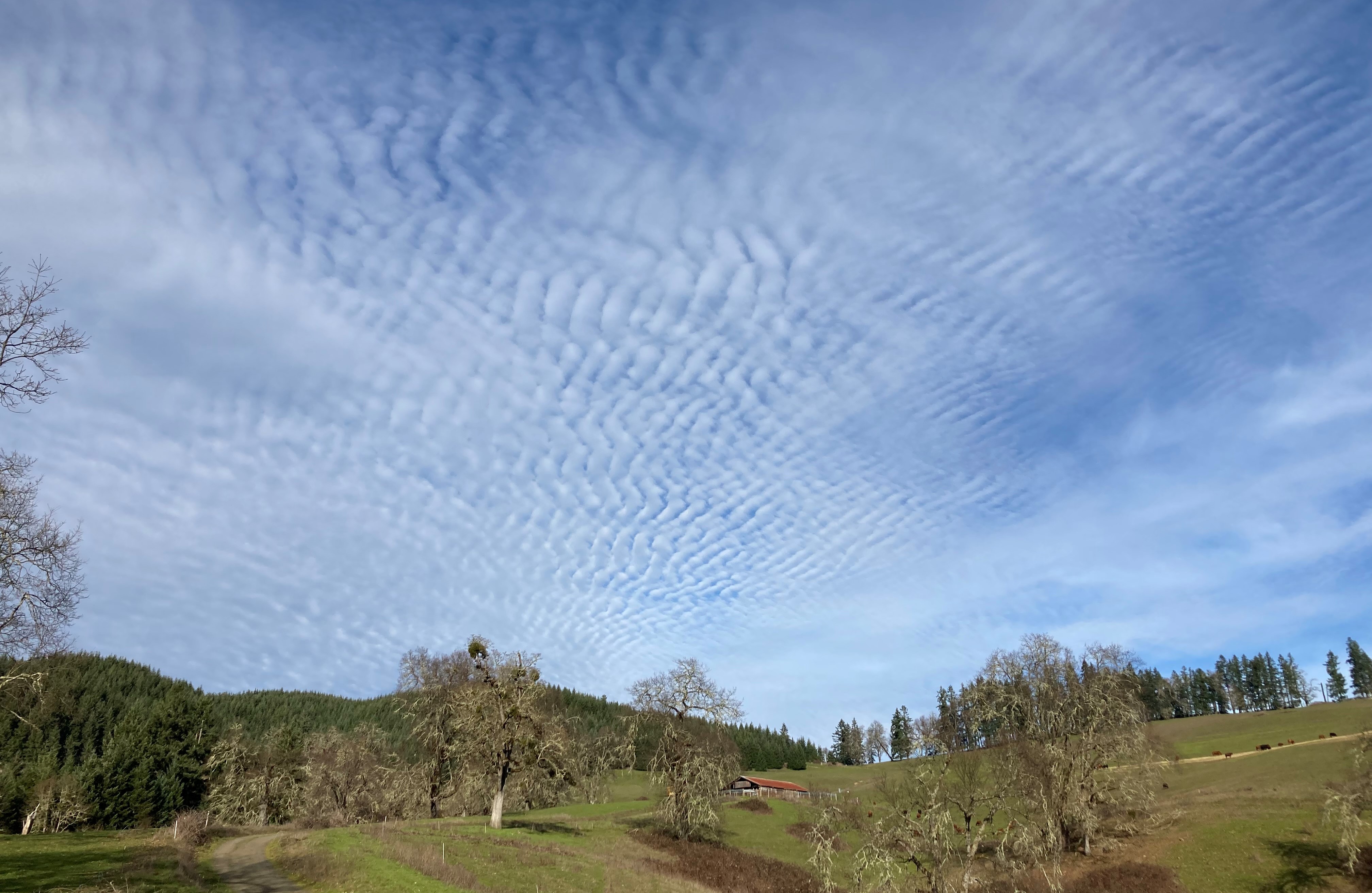
Clouds have something to say, even when I do not know their meaning. On returning from my walk yesterday I looked up and saw this.
I marveled at the pattern and wondered what the clouds had to tell me. But forgot them in the afternoon’s work of building a new story of ancient Ireland. And dinner. And conversation. And a movie.
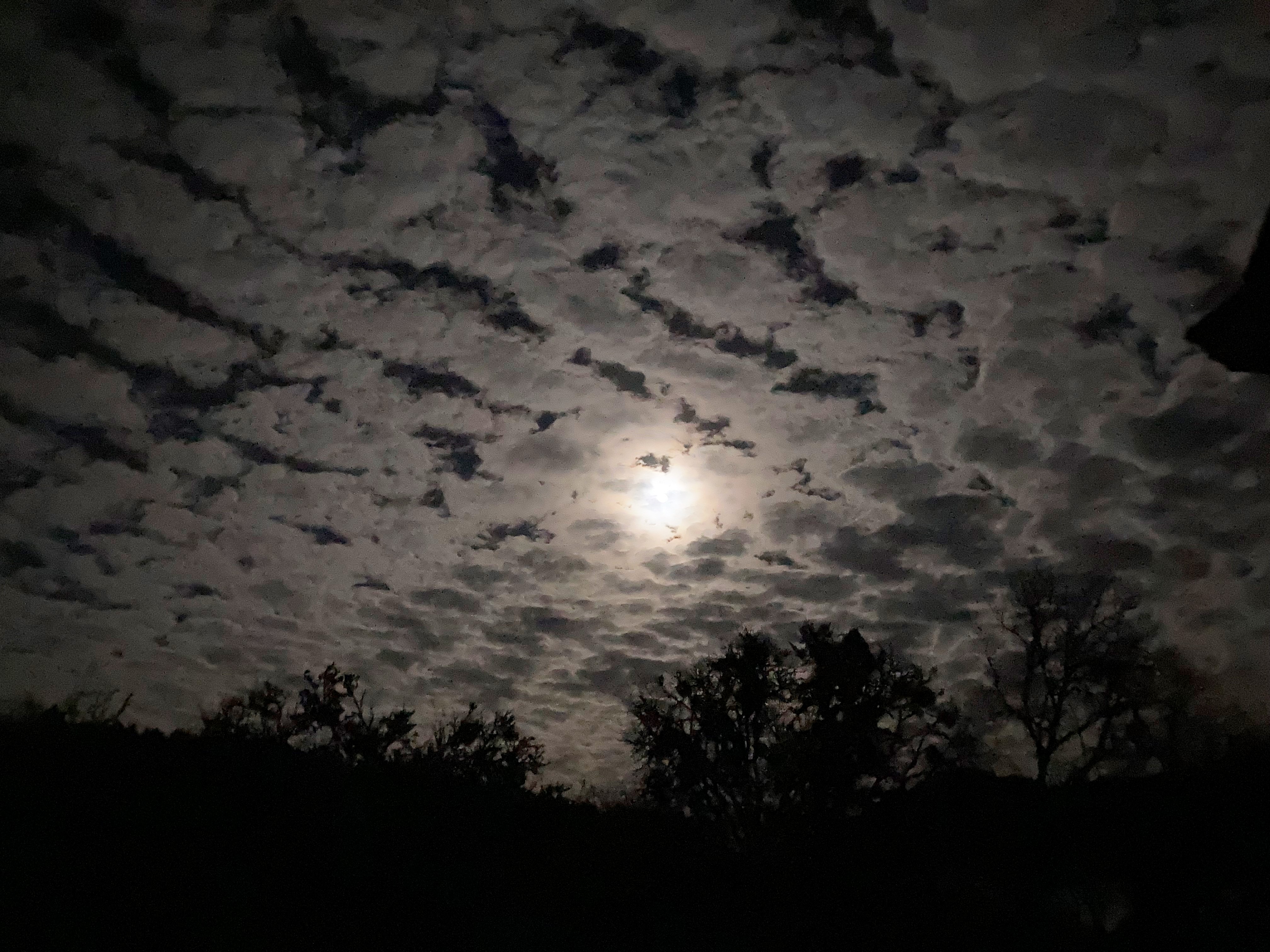
Around ten o’clock I looked out the window and saw a mysterious pattern of clouds still spread across the sky, lit then by the rising moon. I turned out the house lights to see them better. Then knew I must go outside for the full effect.
And saw this.
The magic of it! I stood silent. Let the glory enclose me. In an opening off to my right a star twinkled. A star! When I had immersed myself in the wonder of the eastern sky I turned and strode west and found more stars peeking out from those extraordinary clouds that reached all the way to the western horizon. Every horizon. A full crown. Then back to the rising moon in the east that lightened the entire sky.
I contemplated a photo. Surely it could not grasp this. No, but it offers a glimpse.
Clouds do speak, surely. What do they say? Scientists probably have a name for this. The ancient people of my stories would have accepted the reality. Of Magic.
The day of returning light. After the many long dark nights going deeper and darker it’s always uplifting to know that we’ll start seeing a little more light each day now. From times in the far distant past people have celebrated this day, finding hope and expectation in the light’s return.
Newgrange passage tomb, Ireland
I’ve mentioned before the ancient passage tomb of Newgrange in Ireland, a few miles north of Dublin. Some 5,000 years ago the people built this tomb with little more than stone tools, constructing it with such precision that on Solstice morning rays from the rising sun flash through a high doorway and stream down the narrow, 62-foot-long passage into an interior chamber, filling it with light. For what purpose? We do not know. They did not leave written word to tell us. But we can imagine.
In my new upcoming book set in ancient Ireland I describe the moment and offer the beliefs of my characters. It’s a major locale for multiple scenes. And when you read the story you will experience Solstice morning with them.
The etched kerbstone at Newgrange showing the doors to the passage
The above photo shows the upper door for the light and part of the lower door for people to enter. The carved lines on the threshold stone inspire the protagonist of my story in her artistic creations.
This is the book my new literary agent, Joëlle Delbourgo, has offered to represent. So I look forward with hope that it will soon see the light.
I’ve been thinking quite a lot about the People of the Stones who walk through my stories of ancient Ireland and its neighboring lands. I’m working on a new novel, a sequel to the one I hope to have published next. Always a time for the stirring of the mind.
This past weekend was the annual Fort Umpqua Days celebration in nearby Elkton, Oregon, so I was there with my booth selling my pioneer stories. I had a notebook on display with photos of pioneers as well as ancient settings and my new business cards illustrating my work “From Pioneers to People of the Stones.”
A boy stopped by and saw a picture of the stone circle at the center of my ancient stories, the Bohonagh Stone Circle in Ireland.
“Stonehenge,” he said, then shook his head when he realized it didn’t look quite like Stonehenge.
I turned the page to show him I did have this picture of the circle he knew. We had quite a conversation, maybe a half hour or so.
He had some imaginative ideas about how the ancient people stood those big stones up there. He knew quite a bit about the site.
He’s ten. I told him he should think about being a writer someday. He smiled. “I write comic strips already.” A budding author. And a delight.
So that night when I was looking for an hour’s entertainment before going to bed I searched my recordings on the DVR and saw OPB’s NOVA presentation on Stonehenge. I’d seen it, but I watched again with keen interest. They showed how the first stones of Stonehenge were the smaller bluestones, not the giant Sarsens. A single ring. Dated at about 3000 B.C. Then the giants went up in 2500 B.C., with their lintels on the top, and the bluestones were moved into the interior. I wanted to argue against those bluestones coming all the way from Wales, some 150 miles away, but the guide I talked to at the site convinced me. Archaeologists had found quarries in the Preseli Hills of Wales with the same kind of stone, and there were no such stones around Stonehenge. They had to have come from Wales.
The smaller bluestones show clearly in this photo, lined up inside the taller sarsens.
Then last night I again wanted an hour’s entertainment. And what should I find but another, newer show about Stonehenge. This one showed the same archaeologist who finally found the exact quarry in Wales these bluestones came out of. Problem was, dating on the site indicated that the quarrying for the bluestones happened in 3300 B.C. The stones went up on the Salisbury plain in 3000 B.C. There was a 300-year gap. Where were these stones during those 300 years?
It wasn’t an easy question to answer, but the archaeologist came to believe the stones had been used for a circle near the quarry, then removed to the location on the Salisbury plain where Stonehenge stands today. Many megaliths stand yet today in the vicinity of the quarry. But how to find where this circle of bluestones stood in that interim? This was a needle-in-a-haystack effort for sure. How do you find something that isn’t there anymore? They had to look for the holes left behind, long since covered over by new soil. With many disappointing tries and the use of overhead imagery they finally found where the stones once stood. They could even see the odd shape of one impression that matched a bluestone now at Stonehenge.
For confirmation they used a dating method I’d never heard of where they dig down to see when the sediment last saw the sun, keeping carefully under cover to avoid any current light. The test showed a date of 3300 B.C. as the construction date on the abandoned site. So the stones went directly from the quarry to this site in Wales and 300 years later were moved to the current site.
Why would they move them? And how? Each stone weighs more than a ton. To show how it was possible they built sledges and had 30 children, 13 years old, try to pull the loaded sledge with ropes. The children managed with apparent ease, drawing the heavy stone uphill. Surely ancient adults could do it. As for the why, we can’t really know. There was no sign of battle to suggest they were escaping attack.
Stonehenge looking southward.
One thought was that the site on the Salisbury plain at that time lay on a swath of glacial channels that aligned with the sun on winter solstice. To these ancient People of the Stones this may have appeared to be an auspicious site.
Moving into the minds of ancients who left no writing behind? Well, that’s the kind of thing we fiction writers do.
Imagine yourself in a deep forest of magnificent timber, and then you step into this.
Sun and cloud shadows sweep across row after row of roses in every color imaginable. I can’t resist taking pictures. Close-ups. Wide angles to show the scope of it.
Does this one have a scent? Mm-m.
And this?
I’m just back from a visit with my family in Portland, Oregon. They live in walking distance from Portland’s renowned rose garden in Washington Park, and my daughter promised we could walk there every day if we liked.
So here I am, ready to share with you some of the splendors of that place.
What a treat to be able to take all the time we want to enjoy this and know we can come back day after day. We took this walk several times, strolling through the woods and then immersing ourselves in the garden.
When I’m between writing projects and it’s time to breathe in, what better place than in the midst of roses.
On a clear day you can even see Mount Hood through an opening in the trees. No doubt they kept that gap on purpose.
The park itself is a wonder of natural beauty with the tall timbers and various features.
The nearby Japanese gardens are exquisite. The zoo is a short distance away.
But on this visit we focused on the rose garden because the roses are in their prime now.
My daughter and dog Ani led the way onto the “Queen’s Walk.”
And to the fountain.
It’s the oldest and largest public rose garden in the United States with more than 10,000 rose bushes. New rose varieties are tested at this International Rose Test Garden where some 650 varieties are displayed. Entry is free and dogs are welcome on leash.
So many roses. So many pictures to take. And to choose from for sharing. Here without comment are a few of my favorites. I can’t tell you the varieties. I only observed and photographed what caught my eye.
And so we depart. Back into the woods. Down the hill. Ready to return another day.
Today marks the spring equinox when days and nights are equal. And the earth’s axis lines up so both hemispheres get the same sunlight. We give passing thought to this moment nowadays, though some of us cling to the hope that spring has come. But in the far distant past when most folks depended on these markers for scheduling the vital business of producing crops and other significant events in their lives it was important to observe this phenomenon. Perhaps even more central was the spiritual meaning. It must have represented for many a time of rebirth.
Knowth Passage Tomb, River Boyne Valley, Ireland
Many people know about the solstice alignment of the Newgrange passage tomb in Ireland where the rising sun on winter solstice shines right up the long passageway to the inner chamber, but a few miles up the River Boyne Valley another passage tomb has an east-west alignment which may suggest that its passageways were designed to receive the sun’s light at equinox. This is the large central tomb of Knowth. Alterations of the passages during reconstruction may have affected the course of the light, whether sun or moon, but many of the kerbstones are carved with images of the sun and moon.
Kerbstone at Knowth Passage Tomb
The people who constructed these great monuments surely honored the signs in the skies that affected their lives. I had the privilege of visiting Knowth and Newgrange just last April when I was doing site research for my book set in Ireland and snapped the above photos. You can see part of the large tomb in the upper photo with several of the distinctive satellite tombs around it. Some of the kerbstones can also be seen at the base in that upper photo, and one more clearly in the closeup.
At home this year I think we’re clinging to the hope of spring more than usual as multiple days of heavy rains caused flooding of rivers and streams, while also saturating soils that sent mudslides down the slopes to block roads.
The road up the hill on my farm. Robin Loznak photo.
There’s that old saying about March coming in like a lion and going out like a lamb. Well, we were enjoying day after day of warm spring weather early in March.
The photo below was taken on March 10. Much more lambish than lionish, I’d say.
Early daffodil bloom on a Marchmorning on the farm.
You never know about March. But I think we’re ready for spring and more of those sunny, lamb-like days.
Hey! The daffies are out and the sun is shining. It’s even warm. I had to take my coat off on my walk this afternoon. Everything brimmed with the hope of new life.
The mighty Oregon Oak stands tall against the blue sky, its many clusters of mistletoe clear to see on the branches still bare of leaves.
One of my favorite trees, it’s just up the hill from my house. I pass it often on my daily walks when I do the uphill first.
Grass seems brighter. Sure does feel like spring. Of course nothing is certain about western Oregon weather in late February or even March. Yesterday the wind was hurling rain against my windows. But I’ll happily cling to whatever snippets of spring we get.
I walked on up the hill, feeling good. This morning I finished a long book project–reading through the entire series I had revised, making sure everything flowed together.
I paused to look up into the tree’s branches overhead, tangled as the stories, but every gnarled limb knew its place and carried the tree’s essence to the buds that would one day open and breathe out life. I had felt each of my stories, as if those glimpses into history breathed with life too.
Yesterday was Winter Solstice and I went outside to try to capture a moment of the new morning light. Clouds covered much of the sky but left a few thinner spots where a bit more light promised to shine through. I kept thinking I had the most light I was going to get for a picture of this gnarly oak above my house who’s seen many a solstice morning in its long life. And I took one picture after another that wasn’t quite there.
I almost gave up on a full sun until this happened.
A sudden full spray of sunlight brightened the green moss on the sunny side of the leaning trunk, the two larger branches seeming to reach for the warmth. I let out a cry of joy and snapped this photo. Even in the distance you can see firs and plains caught in the broadening light.
Earlier that morning people at Newgrange in Ireland had waited with great hope as the sun hid behind a low bank of clouds. From my researches I knew what an important day Winter Solstice was for them. Some 5,200 years ago Neolithic people with little more than stone tools had built the stone passage tomb of Newgrange with such precision that on Winter Solstice morning the sun would enter through a small doorway and shine all the way down a narrow passage to an inner chamber and touch waiting ashes and bones of the dead.
You can see the square hole for the sun’s entry just above the people’s heads in my photo of the great tomb. And it still works!
On this solstice morning I watched Irish Central’s livestream of the event at Newgrange. It was a replay of course. They’re eight hours ahead of us, but I still felt the excitement of the moment. Great crowds had arrived for the occasion this year, and a few lucky people were finally allowed to enter the passage, winners of a raffle that had drawn hundreds of thousands of hopefuls. Each winner was allowed to choose one person to experience this phenomenon with them.
Like Oregon where I live, Ireland has its share of rainy mornings so the sun doesn’t enter that passage every year. Would it break through this time? I felt the excitement and optimism shared by the commentators. Then, with sudden splendor, the sun lifted above that dark bank of cloud and shone down the passageway to the inner chamber.
With a thrill I recalled that I had been in that very chamber myself just this year. Back in April. That’s the sun’s doorway into Newgrange behind me in my profile photo. I traipsed past the great carved kerbstone with its mysterious designs cut deep in the surface. I drew in my shoulders to walk through the long, narrow passage where more designs were carved in the stone uprights that hemmed us in. Once in the chamber I gazed up at the corbelled roof to the capstone on top, so meticulously constructed it still doesn’t leak after 5,200 years. We didn’t see the sun come down the passage, but the event was simulated. Our guides struck all the interior lights, leaving us in darkness, and then sent a stream of artificial light down the narrow way to fill the inner chamber.
What amazing symbolism! How important it must have been to the builders to create such a monument. We cannot know the minds of these builders. Yet I think it was the commentators who said, “Nothing ends with darkness and death. New light always follows.” This must have been a powerful belief in the people all those years ago.
Today, in our own way, we can take comfort in longer days and in the light that must follow the darkness. After I got my picture of bright sun on the old oak, I turned and strode down the hill into the sunshine.
One December morning last year I woke to this and snapped a picture which I posted on Facebook with a short comment, “Sunrise! New day. New hope. New promise.”
On this morning’s gray, rainy morning I looked back with some yearning for such a day.
The year in between has had its ups and downs. I took a wonderful trip to Ireland and Hallstatt, Austria, to check on scenes for my latest book–Ireland because it’s the center of the story, Hallstatt because that’s where the Celts were at the time of this dip into the ancient world of the setting. Another highlight came when my daughter Christiane got a job in Portland, Oregon, and she and Aspen moved back west after ten years in Kansas. One more highlight was an excellent writers conference in Seattle where I pitched that latest book, and those pitches went well.
I’ve always been a glass-half-full kind of person. And I need to move forward embracing hope. Without a new novel in the works right now I’m working on a companion book for the series which is related to my newest Irish story. I had already drafted parts of this companion book, but it shifts as my focus shifts. In the last few days I’ve been going back through old travel journals of my first trip to Ireland, reliving some experiences there.
The beauty of the land in its cloak of many greens. The wonder of great stone monuments with their intriguing mysteries, like the passage tomb of Newgrange, below. [The photos below are all from my 2024 trip; I didn’t have a digital camera on the first Irish visit.]
The magic of an exquisite woodland where wind spoke between great oaks. My traipses across green fields with my ready umbrella as boiling clouds opened and let streams of sunshine through to create one of those many Irish rainbows. Stunning cliffs descending into surging waters at the Cliffs of Moher.
And the birds. Oh, the birds! Were they ravens? Or rooks? Or jackdaws? All cousins of the common crow. The latter two weren’t familiar to me. We don’t have those where I live. But whatever the bird we saw great flocks of them sweeping across the historic Hill of Tara and others hovering around the haunting Rock of Cashel where they nested in those stone niches. My daughters joined me on part of that trip and marveled with me. [This morning I spent hours online trying to determine what birds we saw, listening to sample bird calls, reading about the different behaviors, watching videos of onsite tours, and my guess is that the bird shown below outside the Rock of Cashel tower is a jackdaw. And I’m guessing the birds at Tara were rooks.]
In this companion book I want to share the journey, the joys, and the challenges of my research to offer background for the novels.
So in these gray days some streams of sun shine through and I find purpose. May the promise of yesteryear sustain me. I wish such hope and promise for you, my good readers.
The dark days of November have come upon us. A darkness that can bring us down.
Today the forecast looked like rain all day. Then I glanced up from my morning tea and saw that the sun had come out. Better get my walk in fast. But by the time I got bundled up skies had already darkened again. I grabbed my umbrella and went out anyway.
As I tromped down the road through the drizzle remembering October’s warm sunshine my thoughts turned to the stages of writing–the light and the dark. The spark of inspiration. The thrill of creation. You put so much of yourself into the project. It’s a bit like breathing a long breath out. And it’s such a bright, light feeling. So when that’s done what to do next? Well, I guess you have to take some breaths in. Read. Watch movies. Restore.
After I got back to the house from my drizzly walk I thought I would take a picture of the dreary day–just to reinforce and share my gloom. That’s when I snapped the photo at the top and what do you know. The light just had to shine through those heavy clouds and create a sweeping bright spot. Not for long, though.
Still feeling a keen sense of the dark I wrote a draft for this post and when I thought I was finished I looked up and saw that I would have to take another picture. This is what happened.
So there we are. You never know. Out of the dark comes the light. Blue skies. Hope. Inspiration will come again. We’ll find a way through the darkness. Time to breathe in and find peace.