You’ll find me at the Authors and Artists Fair in Eugene tomorrow, Saturday, December 8 from 10 to 5, selling my books, A Place of Her Own and The Shifting Winds. Details on the poster. If you’re in the neighborhood, please stop by. Should be a great event with some great gift items and all for a good cause.
A Place of Her Own

Oakland Lives Its History
The people of Oakland, Oregon, sauntered back in time this weekend to live their rich history during Living History Days, and I joined them with my books that delve into these early times.


Betty Tamm kindly invited me to set up my book signing table in her Triple Oak Wine Vault in downtown Oakland, a unique Tasting Room located in a renovated 1892 bank building. In the photo above she’s displaying the art of spinning, which many in our past have done.

Not every tasting room has a bank vault for wine storage, complete with safety deposit boxes. And despite the sign on the front door you would not have found me back in the deep vault sipping wine. I believe the whole establishment counts as the vault.
I actually had a lovely table in the front of the room to set up my books.

Nancy Anderson and Diane Brown brought historic treasures–exquisite quilts, vintage clothing, old news stories, and more–to be displayed in the Tasting Room, so they joined me at my table and we shared some delightful conversation and a bit of delicious, decadent food.

Things seemed to be going quite well. A good crowd meandered through to taste some wine and check out our handiwork, many of them in costume in this town where history resonates through the streets and in every downtown building. So I gave little thought to the gentleman in hat and boots, a gun on his hip, until he stepped to the door with sudden alarm.
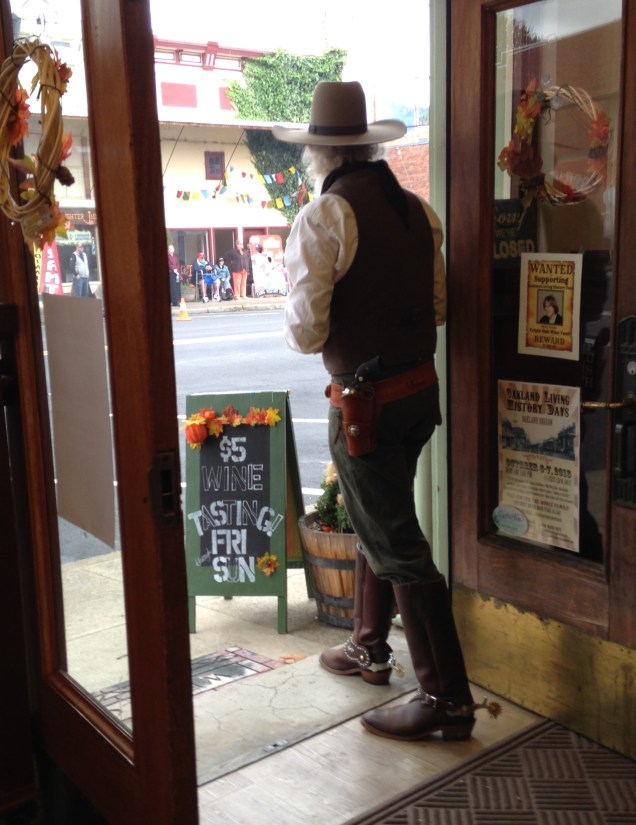
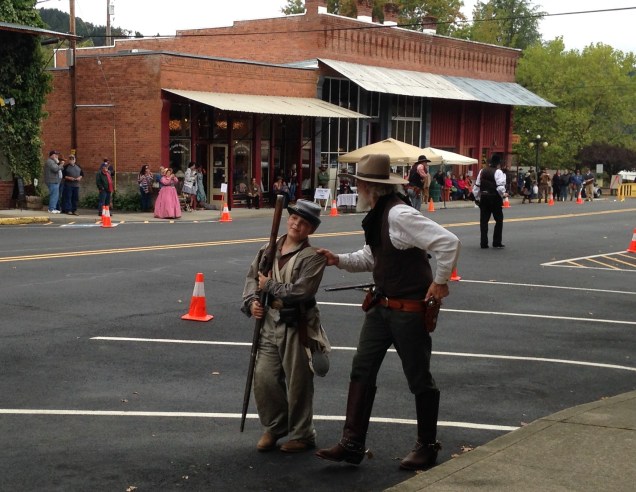
Who knew the North and South would be at it again? But there it was on the historic streets of Oakland, yet one more battle brewing between the union and the confederates.


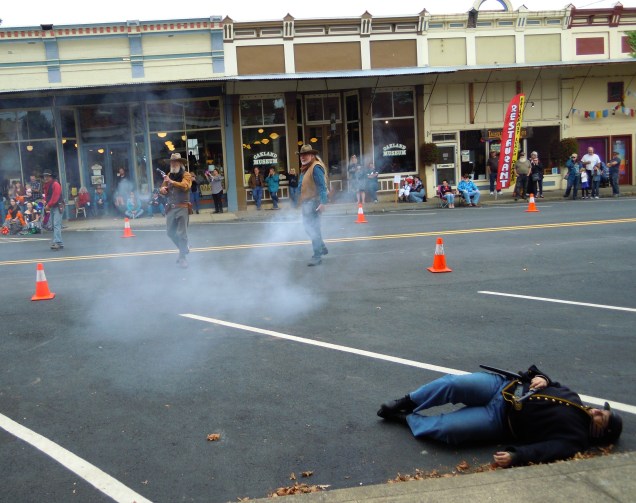

All in all, the weekend event was, as I promised, a rip-roaring good time.
UV Magazine Spread
UV Magazine, Lifestyle Magazine of the Umpqua Valley, did a story for their Fall 2018 edition on the local Roseburg writers group I belong to, An Association of Writers, and I was delighted to be featured with my books. UPDATE: The online version is up now.
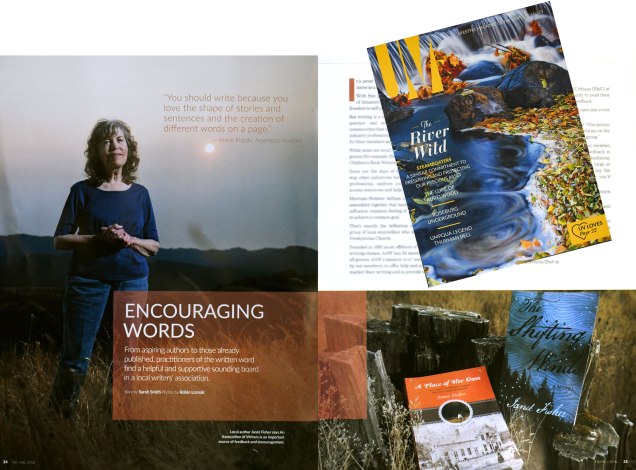
The magazine is a beautifully produced publication that highlights people and activities in the Umpqua River region. A few days after Contributing Writer Sarah Smith asked to interview me and said they would send out a photographer, I learned that my favorite photographer, my son-in-law Robin Loznak, does freelance work for them. I mentioned that to Sarah, who passed the word to Account Executive Nicole Stratton, and the photo assignment went to Robin. A handy gig, since he and my daughter live on the family farm, just down the hill from me.
It just happened that the issue’s cover also features an autumn photo by Robin.
For the photo shoot on the article Robin and I went up to the top of the property and looked down over the big field above my house toward the setting sun. I used this sweeping view in one of the scenes in A Place of Her Own, the story of my great-great-grandmother Martha Maupin, who founded this Sesquicentennial Farm 150 years ago. I haven’t done the paperwork yet to receive that designation officially, but the farm qualifies. It has been a Century Farm since April 1968, the Martha A. Maupin Century Farm, one of the few in Oregon named for a woman.
Besides the fine overlook from the farm’s upper ridge, there was this perfect weathered stump for displaying my two published books.
The UV story talks about the importance of writers groups to authors who otherwise work in isolation. The mutual support helps keep an author going and the feedback helps in polishing the work. Sarah, who wrote the article, relayed my story of how eight people from my Roseburg writers group surprised me by coming to the launch party for my second book, The Shifting Winds. They had quite a drive up the Umpqua River to the little town of Elkton where I held the party. What a pleasure it was to see them walk in that day! The photo below shows them filling a table along with my friend from Elkton High School Bill Isaac.

That’s friendly support! So glad UV Magazine chose to do the article about this fine group and so glad I joined them. Thanks to UV for the focus.
The magazine can be found at businesses in the Umpqua Valley, hotels, restaurants, doctor’s offices, hospital and elsewhere. And you can find them online. This brand-new edition should be up soon.
Going There #9: Shadows in the Stones
Stonehenge impacts. It just does. Despite detractors who want to say this is better, that’s better, you can’t get inside, whatever, there is no other stone circle in the world quite like it. The dressed sarsens with their phenomenal bulk. The horizontal lintels that look as if giants had placed them. The bold position on Britain’s wide Salisbury plain. Power resonates.

I felt that power as we walked toward the great stones, just as my characters feel it in my stories. Stone circles play a significant role in my series when we visit Ireland, and my Éireann characters of the Irish clans have a fascination with this grand megalith so different from their own village circles. Some of the characters have the opportunity to visit. Others envision it.
The site was carved out about 5,000 years ago when people dug a circular ditch. About 500 years later others erected the first stones. Those were the smaller bluestones, a type of stone not found in this area, but which scholars believe were brought all the way from Wales, a herculean task. The quarry has been located and stone cuts matched, pretty strong evidence. But why? No one knows. The giant sarsens came later, and over time the arrangement of the stones saw several changes.
My writer friend Lynn Ash had joined me on my trip the day before our visit to Stonehenge, and we took the obligatory photos.

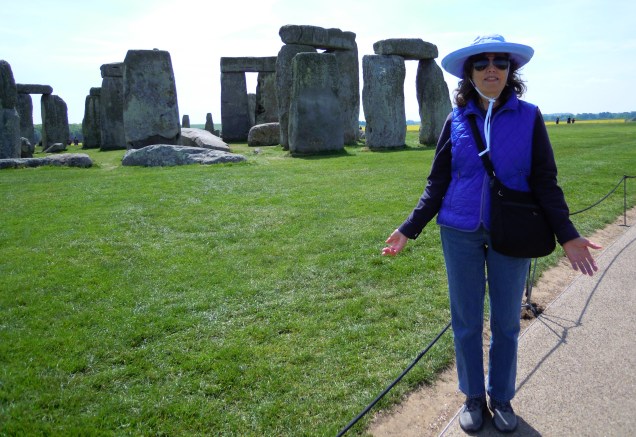
I first saw Stonehenge in 1993 when I was researching another long-abandoned book. That was before the new Visitor Center. You don’t have to pay to see Stonehenge. It’s right out there on the Salisbury plain, visible from the road and from trails that cross the fields. A fence holds you back a ways. But if you want to get as close as Lynn and I are in these photos and experience the Visitor Center (and it is an experience), you pay. Not a small fee. We each paid about $23 for a set time slot to enter, although you can take as long as you want, once inside the compound.
Compared with the wonderful Almendres Cromlech in Portugal (see “Going There #8”), a site that’s free and wide open to whatever the public and weather may do to it, Stonehenge has become a local industry. Yet somehow that doesn’t diminish the experience–when you give yourself to the wonder.


The Visitor Center is remarkably well done. Most intriguing is the 360-degree theater in the round where you stand in the center of the stones while seasons and centuries pass. That makes up a little for the fact that a rope around the real stones keeps you out of the center (except for special occasions, like the summer solstice, when people are allowed in, which you no doubt have to reserve far in advance).
The theater’s effect offers a dramatic experience. Many other fine exhibits explain the site and display archeological finds. Outdoors, typical houses of the early period have been erected, and you can step inside to see where people slept.
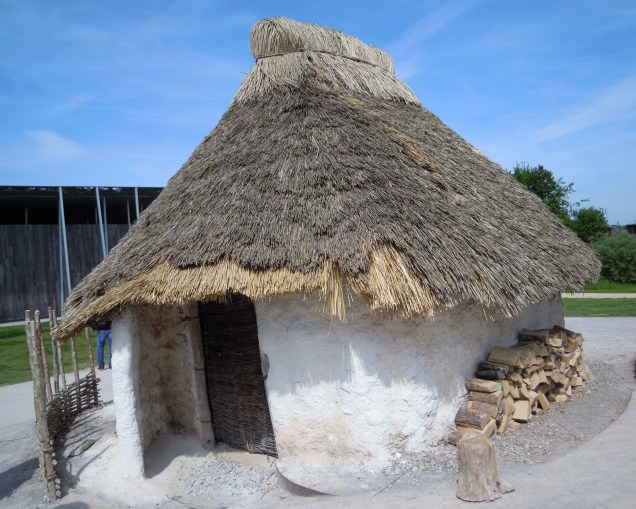
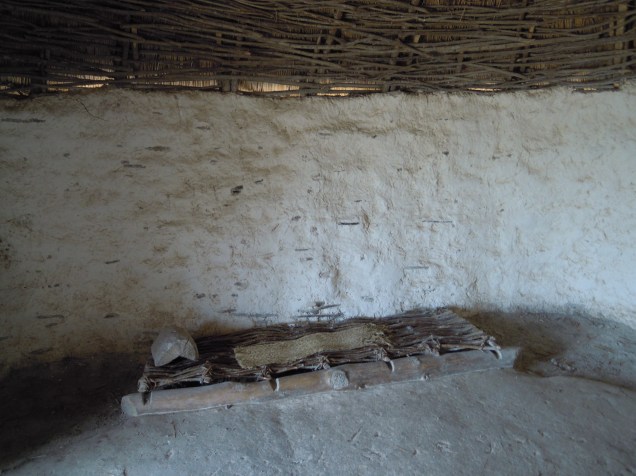
I’m not sure about that pillow. I’m of the flatter pillow school.
A sample stone below shows how the giant sarsens might have been moved to the site in those long-ago days. I had to tap the stone. It’s plastic but illustrates nonetheless.

Lynn and I opted to walk to and from the circle. The Visitor Center is a little over a mile away, leaving the circle to stand free and open in its grand position. The day was gorgeous, and the easy stroll allowed us a long view of the stones and the effect of the approach–as my characters would have experienced it. We took the road going to the circle and went back to the center on a trail through the field. A lovely walk.
We had contemplated going to Avebury afterward, another wonderful site where the village is set among giant stones and you can touch them. I had been there before and enjoyed not only the stones, but a lovely high tea in the tearoom of an elegant manor, and I had lured Lynn into this trip promising her “scones among the stones.”
Well, we didn’t have a car, and bus connections would have given us more bus time than tea time. Taxis were expensive there, and we were exhausted. Lynn had taken the grueling trip across the pond just the day before our Stonehenge excursion and hadn’t slept on the flight or very much the night before her departure. I had only flown from Lisbon, but our meeting at London’s Heathrow airport hadn’t exactly been a snap.
Lynn had seemed worried about navigating that huge airport, but I had reassured her that my flight would land about an hour before hers and I could be waiting for her when she came off the plane. We had our iPhones in case it took a moment for us to find each other. The best laid plans and all that. My flight was late, very late. Hers was early. When I rushed into the airport, trying to connect with her, I got no answer. I got delayed in a huge line at border control. While moving slowly through that line I tried email, texts, phone. No response.
Friendly airport personnel helped us–more angels. As soon I got free of border control and found my bag I headed for her terminal–just as she headed for mine. We were striding across moving walkways when we looked up and saw each other. What a relief! We had bus tickets to Amesbury, the small town near Stonehenge, and the bus station was right between the terminals. We made it in plenty of time. But the distress took a toll.
Now we’d spent so long at Stonehenge we gave up on Avebury, but as we sat resting in our room at the delightful Fairlawn Hotel in Amesbury we decided to take an evening stroll to Woodhenge, a satellite site within easy walking distance. We were surely up to a pleasant walk out through the edge of the lovely town. We didn’t account for traffic that buzzed along beside us like freeway traffic on a narrow road, so close to the sidewalk I felt as if a wobble would put me right in a car’s path. But we survived to see this unusual site. A quiet, peaceful place.
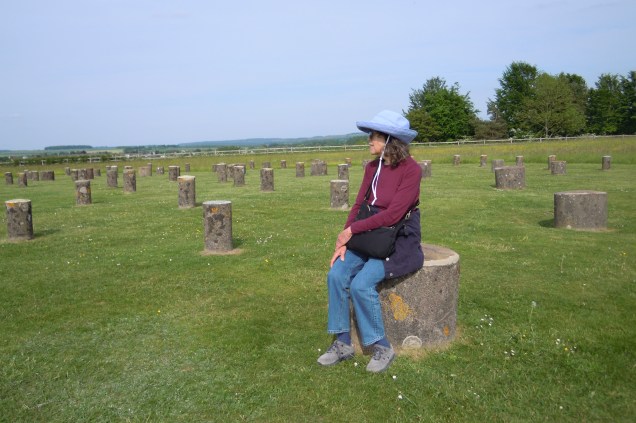
Lynn snapped my picture sitting on the concrete stumps where wooden poles once rose.
On the way back we took a side path to walk a short way along the famous River Avon. That offered another respite of quiet and peace with a generous touch of beauty.

As I put this post together, selecting photos from the many I took, I noticed something in the photo at the top of the post that I hadn’t noticed before–the picture labeled “Stonehenge.” An odd shadow. I give a closer look here. Do you see it? Probably a strange slant of the light against the stones.
But it put me in mind of the shadows that linger across this old world. Sometimes the shadows seem to come alive where the past remains so visible, as in these ancient works in stone. Or the crumbling citadels of Greece and Portugal, where archeologists work to ferret out the hidden secrets.
Bringing the past to life is what I try to do in my stories–whether from our own country’s pioneer past in A Place of Her Own and The Shifting Winds, or in these ancient times of my new series. I would keep searching, keep reaching, trying to see into the shadows to bring out the light of a people who did walk in these places, portrayed as truly as I can through the fictional characters in their imagined lives.
NEXT: Outlaw Hideaway
150 Years!!
Martha’s Century Farm, whose story I told in my book A Place of Her Own, just hit the 150-year mark today.
 On this day of April 24, 150 years ago, Martha A. Maupin purchased a farm on her own, according to the document filed in Douglas County, Oregon, from H. M. Martin To M. A. Maupin, which reads in part:
This Indenture made the 24~ day of April 1868 between Howard M. Martin & his wife Margaret Jane Martin of Elkton precinct, Douglas County, State of Oregon, of the first part and Martha Ann Maupin of the said County and State of the Second part Witnesseth that the party of the first part for and in Consideration of the sum of One thousand dollars lawful money of the United States to them in hand paid at or about the unsealing and delivery of these presents by the party of the second part, the receipt whereof is hereby acknowledged have bargained sold transferred and Conveyed & by these presents do transfer and convey unto the party of the second part her heirs and assigns, forever, all the following described premises to wit Donation Land Claim No. 46 beginning at . . . containing 320 acres more or less situated in the above County and State To have and to hold . . .
 A copy from the first page shows the flowery handwriting of the day (I did my best to transcribe that and took a bit from the second page).
As told in the book, this purchase was no small matter for a woman in 1868. Martha had lost her husband a year and a half before and either could not or would not depend any longer on the aid of family and friends. She chose to make a home for her children and herself. However, she didn’t have the $1,000 she needed to buy this property. A man in nearby Scottsburg had the money to loan her, but he would not negotiate with a woman. Her son Cap, thirteen years old, had to negotiate for the money, but he was too young to own the property. It became her farm, owned by her alone, 320 acres along the Umpqua River.
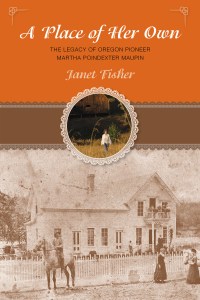 Now, 150 years later, it has become mine, the second woman in the family to own and operate it. I’ve had it for about 10 years now.
In 1968 the property qualified as an Oregon Century Farm, having been in the family for 100 years. Now it has been in the family for 150 years and will qualify as a Sesquicentennial Farm.
A big day for Martha’s farm. I’d like to think she would be pleased.
For more of Martha’s story, you might want to check out the book, if you haven’t already. You can ask for it at your local bookstore or see the sidebar for more options.
Selling Books at Oakland’s Christmas Store
Note: The store will continue to operate as the Oakland Community Store and Learning Center with the same hours as before, Sundays through Thursdays 11 am to 4 pm and Fridays and Saturdays 10 to 6. My books will still be on sale there and I’ll stop by occasionally for signing.
The community of historic Oakland, Oregon, has a new Christmas Store for the holiday season, now open daily for business, featuring unique handcrafted items created by local artists and crafters. My books are on the shelf for sale there and I’ll be in the store on Thursday afternoons, beginning on December 7, from 1 to 4 pm. If you buy a book when I’m not there, you’re welcome to come back on one of those afternoons and I’ll be happy to sign it for you.
 Photo by Victoria Kietzman
This is a new venture led by Victoria Kietzman and the First Friday in Oakland crew. You’ll find selections from many First Friday artists, as well as vintage items. My thanks to Victoria for inviting me to join them with my books.
Some days you may walk into the store and be met by the tantalizing smells of home-baked goodies, so you can stop for a bite and a little tea while you shop. Or if you’re from out of town, you might want to plan on lunch at one of several delightful restaurants in Oakland, and take a stroll through town–where the town itself is a stroll through the past–then drop by the Christmas Store to shop for someone on your Christmas list.
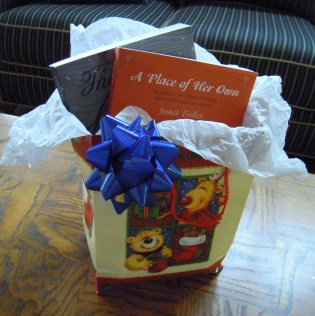 Books do make great gifts. So for book lovers on your list who love a little local history I present my two titles: A Place of Her Own, a story of my pioneer great-great-grandmother who came over the Oregon Trail and ultimately bought a farm on her own in Douglas County; and 2017 Nancy Pearl Book Award Finalist The Shifting Winds, another story of Oregon’s pioneer era.
Gift wrapping service will be available.
You’ll find the Christmas Store at the historic building shown above, all decked out for the holiday, at 208 2nd Street across from the Oakland Post Office. The photo below gives a glimpse inside. Some of the merchandise may change, Victoria said, as artists bring in new creations.
The store is scheduled to be open Sundays through Thursdays from 11 am to 4 pm and Fridays and Saturdays from 10 to 6. Currents plans are to keep the store running until January. I’ll do at least three Thursdays, the 7th, 14th and 21st, and may pop in other times as well.
If you have any questions about the store you can call 541-315-2613. I hope you’ll stop by.

First Friday in Historic Oakland
On a gorgeous golden Friday yesterday I had the privilege of being included with my books at First Friday in Oakland, Oregon.

In the photo above I’m signing a copy of A Place of Her Own for a customer, Holda Crocker, who came with her little helper. My table is right outside Tolly’s, a restaurant with plenty of old-fashioned atmosphere, in the alcove of the right-hand door. Thanks to Victoria Kietzman for taking our picture. Victoria’s the lady who directs this monthly event highlighting local artists.
“My definition of art encompasses a great deal,” Victoria said. “It can be gardening, canning, ceramic, painting, photography, writing, produce, soaps, candles, lotions, music, acting knitting, plants, jewelry, crocheting, macrame, dream catchers and so on. If the hands and mind were involved then it must be art.”
This is the last First Friday for the year. They’ll start up again in May.

Before the day’s event began I took a short walk from Tolly’s and snapped a few pictures. A walk in Oakland’s downtown feels like a walk through the past.
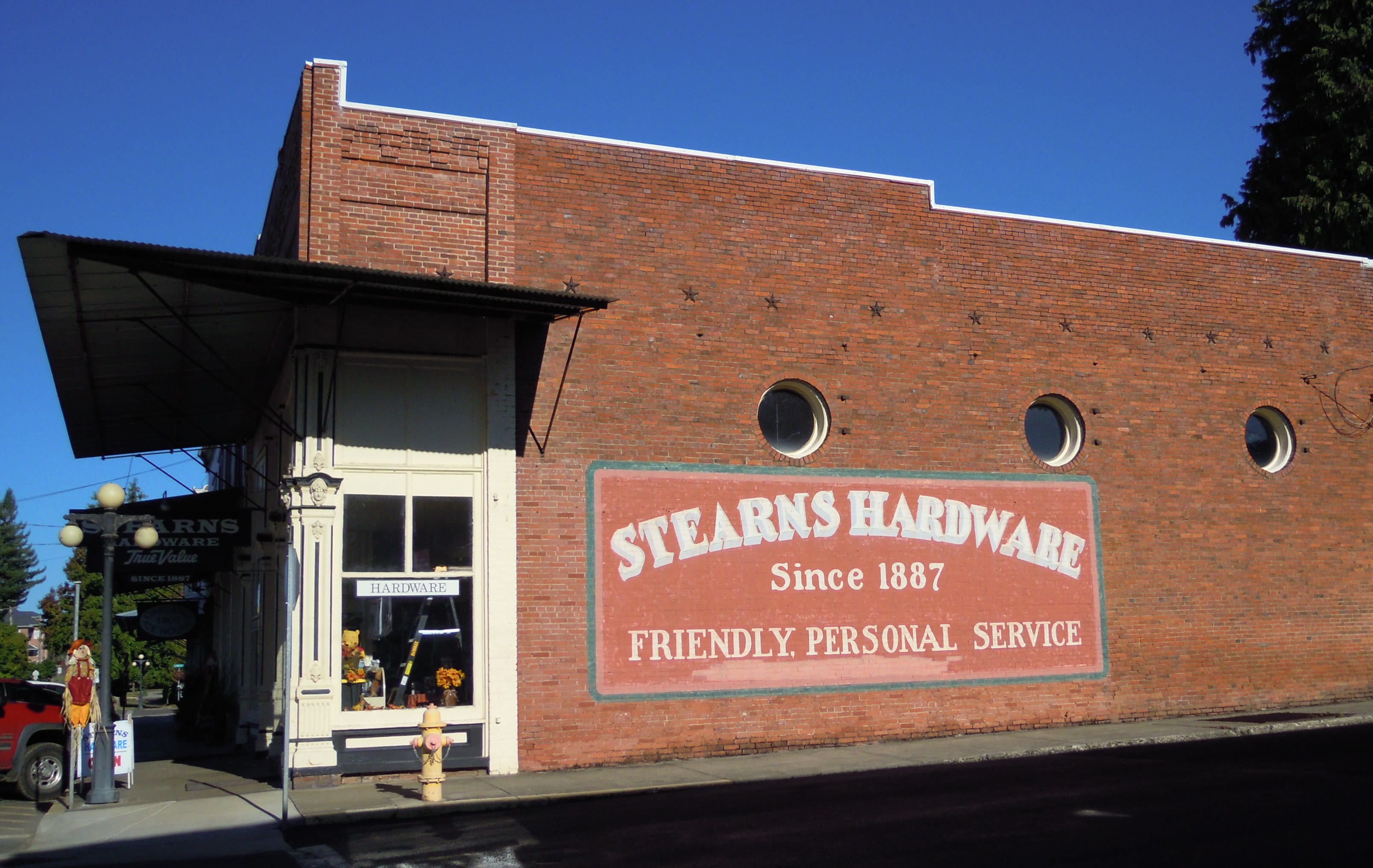
Up the street on the opposite corner you find Stearns Hardware. As the sign shows, the store dates from 1887, and it still sells hardware.
I remember my grandfather talking about shopping there when I was a child.
Beyond Stearns you walk past some cheery seasonal decorations to the Oakland Ice House of 1905 (below), a slightly younger establishment.
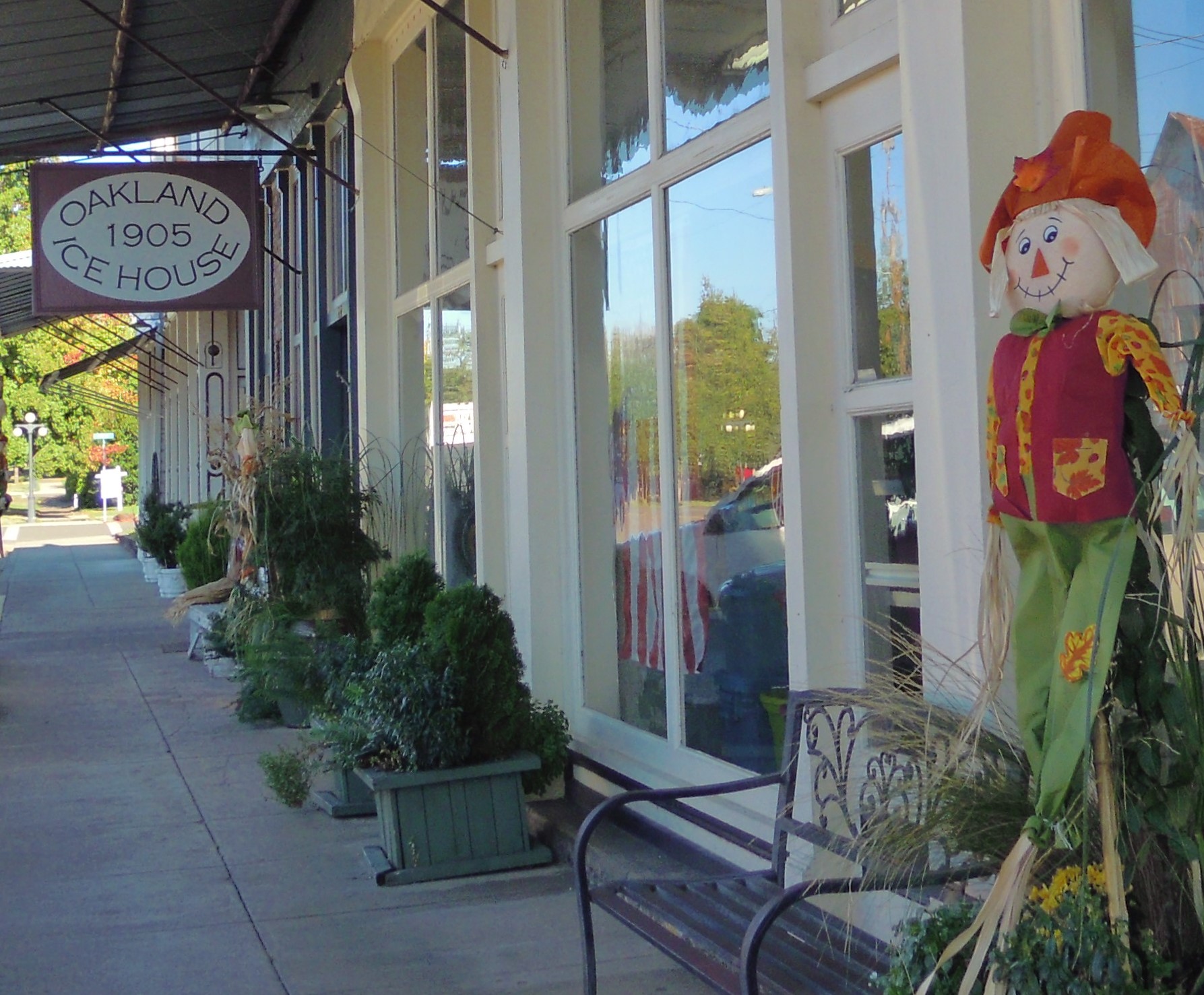
Everything looked quiet at 4:30 in the afternoon.
Across the street the lofty Page & Dimmick Building (below) now houses an antique shop, but the building is an antique itself.
I love the artistry in the brickwork.

When I went back to set up my table it remained quiet for the first half hour or so. I wondered if anyone would come by, though I enjoyed the pleasant breeze whisking down the street on this warm fall day.

Things picked up suddenly, and customers started coming by. I thoroughly enjoyed visiting with folks and it turned out to be a good sales day for me. And when it’s time to leave this historic town you just hop onto a–oh, wait! Wrong event. The stagecoach wasn’t working during First Friday, as it was at Oakland’s Living History Day last fall.
They aren’t doing Living History Day this year but hope to next year. As Victoria said, I’ll have to get out my bonnet then.
Florence Festival 2017
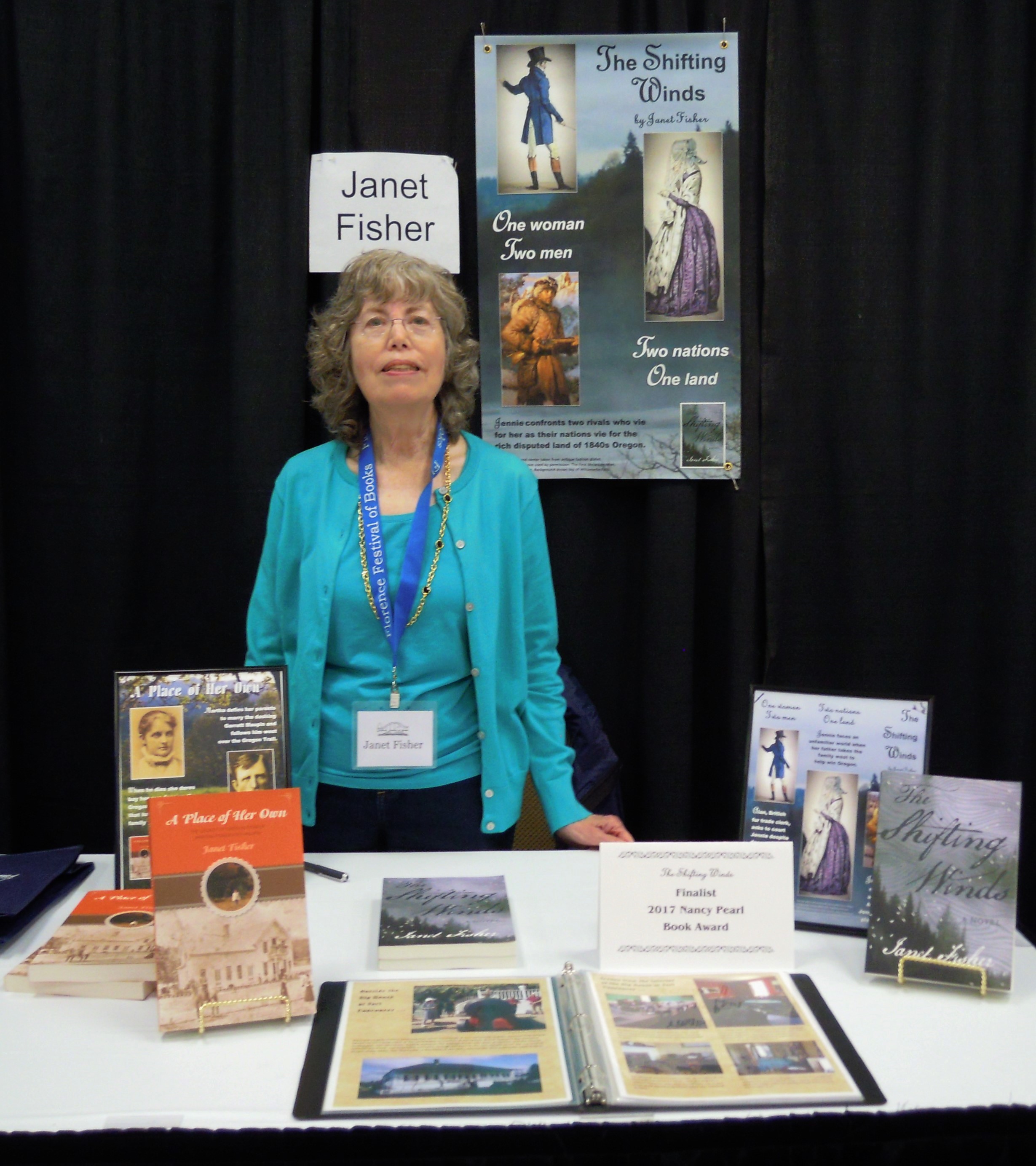 Same place, another year.
We just wrapped up another Florence Festival of Books, and my writer friend Lynn Ash took a picture for the record (She graciously declined when I offered to take a photo of her).
The book stacks had lowered a little and our heads were spinning with stories.
She highlighted her new book, Eugeneana, and also brought The Route from Cultus Lake and Vagabonda. I brought my two, A Place of Her Own and The Shifting Winds.
This annual festival on the Oregon coast brings authors from around the state and beyond, and we’d been talking and selling and signing for six hours. Lots of good book talk, but Lynn and I were ready to check out a local restaurant.
We headed for the Waterfront Depot right on the river, recommended by my neighbor, Todd Hannah, a local fishing guide. Good choice, Todd. Thanks.
Inside the restaurant’s rustic interior we gazed out the broad bay window and watched the late afternoon sun twinkle on stirring blue water while we feasted on exquisite seafood. Can’t beat that for a finale.
Save
My Trek to Newport
I headed north to beautiful Newport, Oregon, Sunday for my afternoon speaking engagement with the Willamette Writers Coast Branch, taking the coast route where the journey is part of the pleasure.
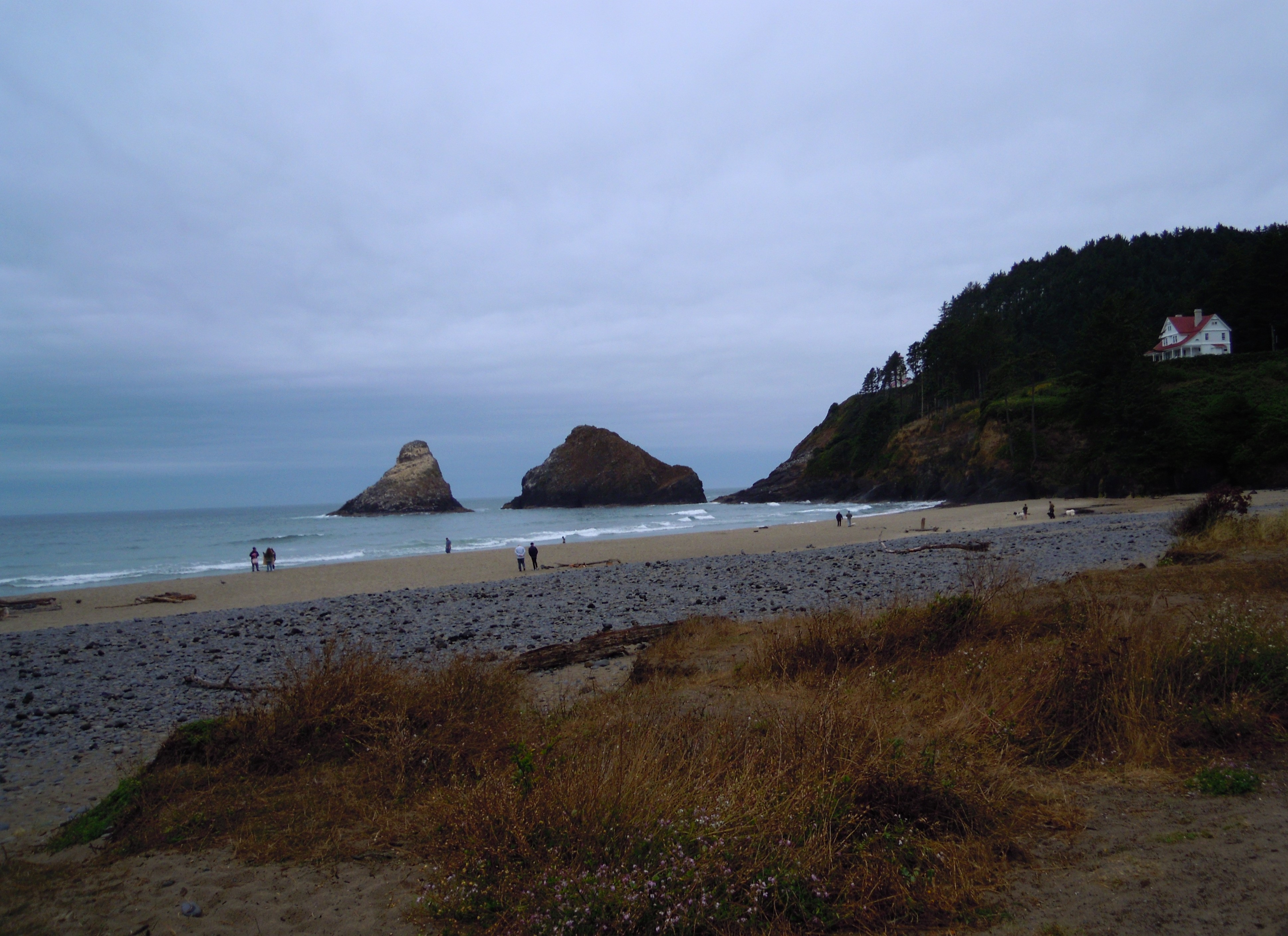
After a quick stop at the Heceta Head beach for a sack lunch, enjoying this view, I continued northward over what must be one of the most spectacular stretches of Highway 101.
The road winds around precipitous folds of towering mountains, threading through dim mossy woods with brief glimpses of light and water, then opening out onto raw windswept slopes to reveal the endless sweep of rippling gray-blue fringed with the ever-surging white crests.
Birds speckle strands and jutting rocks. Mists stir. Gulls soar, their white feathers catching the light to glisten against a somber sky. Time loses importance. You need to savor the wonder like a taste of rich chocolate feeding the soul.
Spits of rain followed me into Newport but didn’t dim my enthusiasm. The event went quite well. The audience–mostly writers–welcomed me with appreciation for my personal story when I described my long road to publication, which finally culminated in my two Oregon Trail stories, A Place of Her Own and The Shifting Winds.
One man who’d been sitting against the back wall came over after my talk and told me how much he enjoyed hearing my words. He’d been afraid it was going to be a boring how-to workshop and instead found the presentation truly inspiring. This is the kind of response that keeps a writer going.
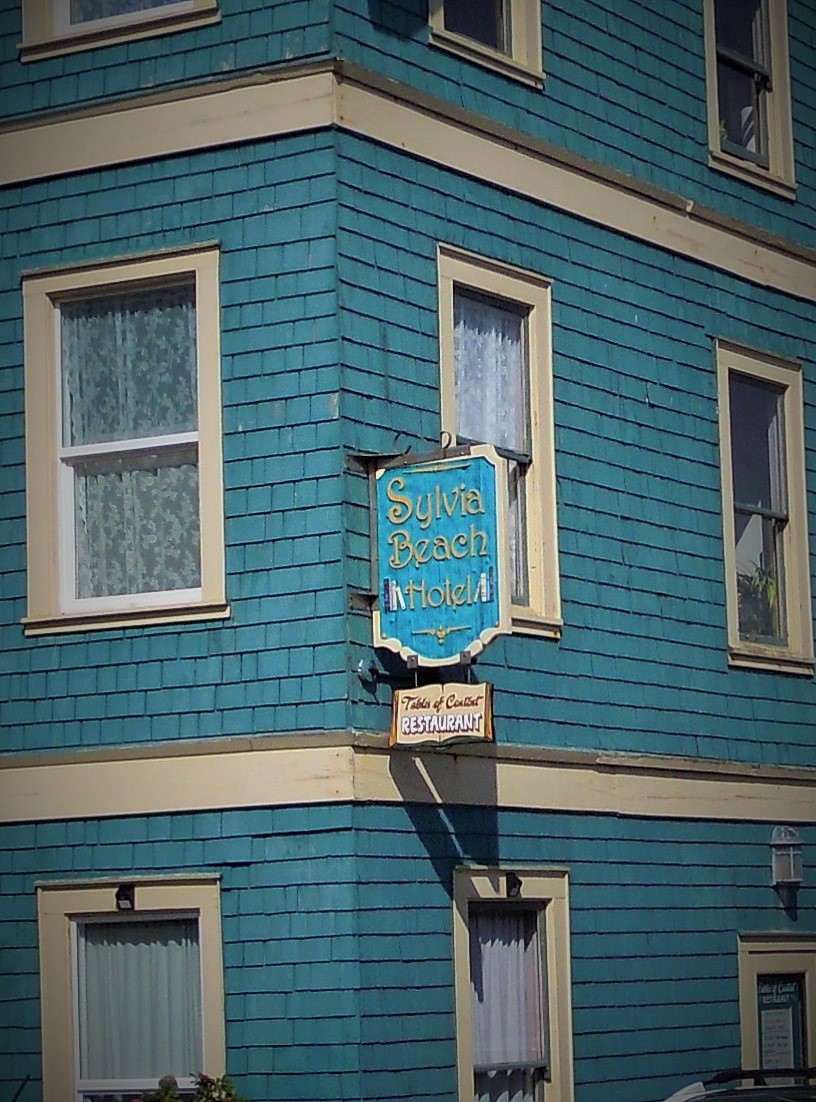
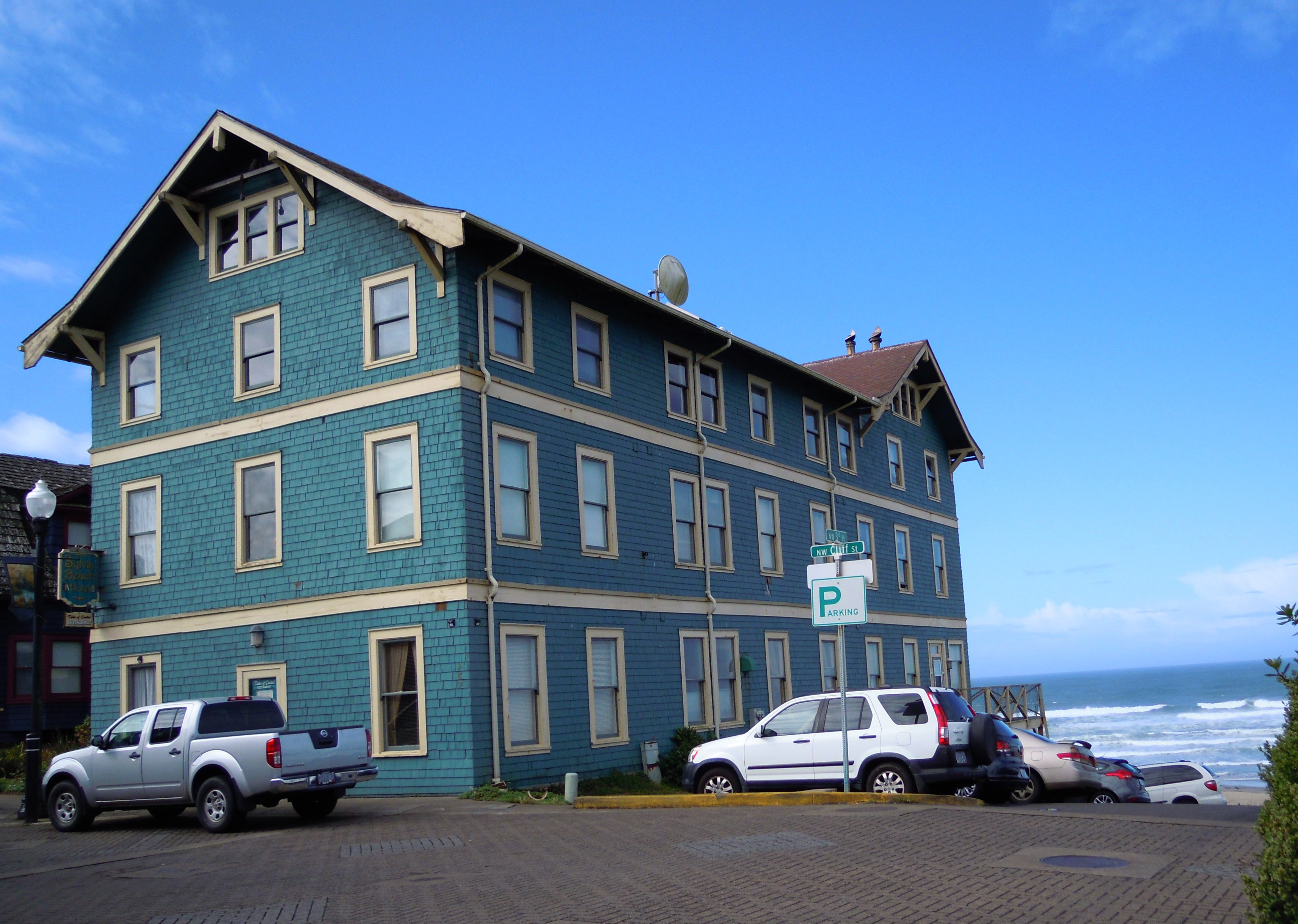
Afterward I checked in at the Sylvia Beach Hotel, which the writers group graciously arranged for me, a charming old hotel right above the beach whose theme is writers. Each room is named for a well-known writer. They have a quiet library upstairs and books scattered throughout.
On the chance I took a notion to do a little writing they provided a typewriter in my room (shown in the photo below). That’s my laptop in its case to the right of the old Underwood–bookends in keyboarding history.

By dinnertime the weather had turned drizzly and cold, so I dressed down from my skirt and pumps into jeans and walking shoes with a warmer top.
When I stepped back outside to head for dinner, wind had picked up quite a bit. Raindrops appeared small. But there were so many of them, and they didn’t exactly drop. They swept straight at me. My umbrella quivered and flapped so hard I thought it might lift off à la Mary Poppins, but somehow it stayed in front of me and without turning inside out. The only change in the rain came when I passed openings between buildings where gusts hit harder.
By the time I reached a cafe the incessant spray had soaked the front of my pant legs. Thankfully the cafe was warm and I enjoyed fish and chips with fresh local rockfish and a side of coleslaw.
Back at the hotel I thought to ask for a hair dryer, which dried my jeans nicely.

I had a room with a view–and a real plant. It was the Lincoln Steffens Room. Though I must confess I’m not familiar with Mr. Steffens’ work, I loved the room. I spent quite a while in that chair in the corner watching the waves play against the sand as the skies dimmed and outdoor lights came on.
I hoped for better weather in the morning.

Skies looked brighter the next day. The hotel offered a delicious breakfast of pecan pancakes with a variety of fruits and fresh-baked goodies in a dining room with wraparound windows overlooking the water.
After a pleasant visit at my table with Freda and Lorayne of Corvallis and a young man from Germany, I wandered downhill for a lovely walk on the beach.
The hotel looms above the sea on its lofty site atop the cliff. A vigorous climb back up those stairs.
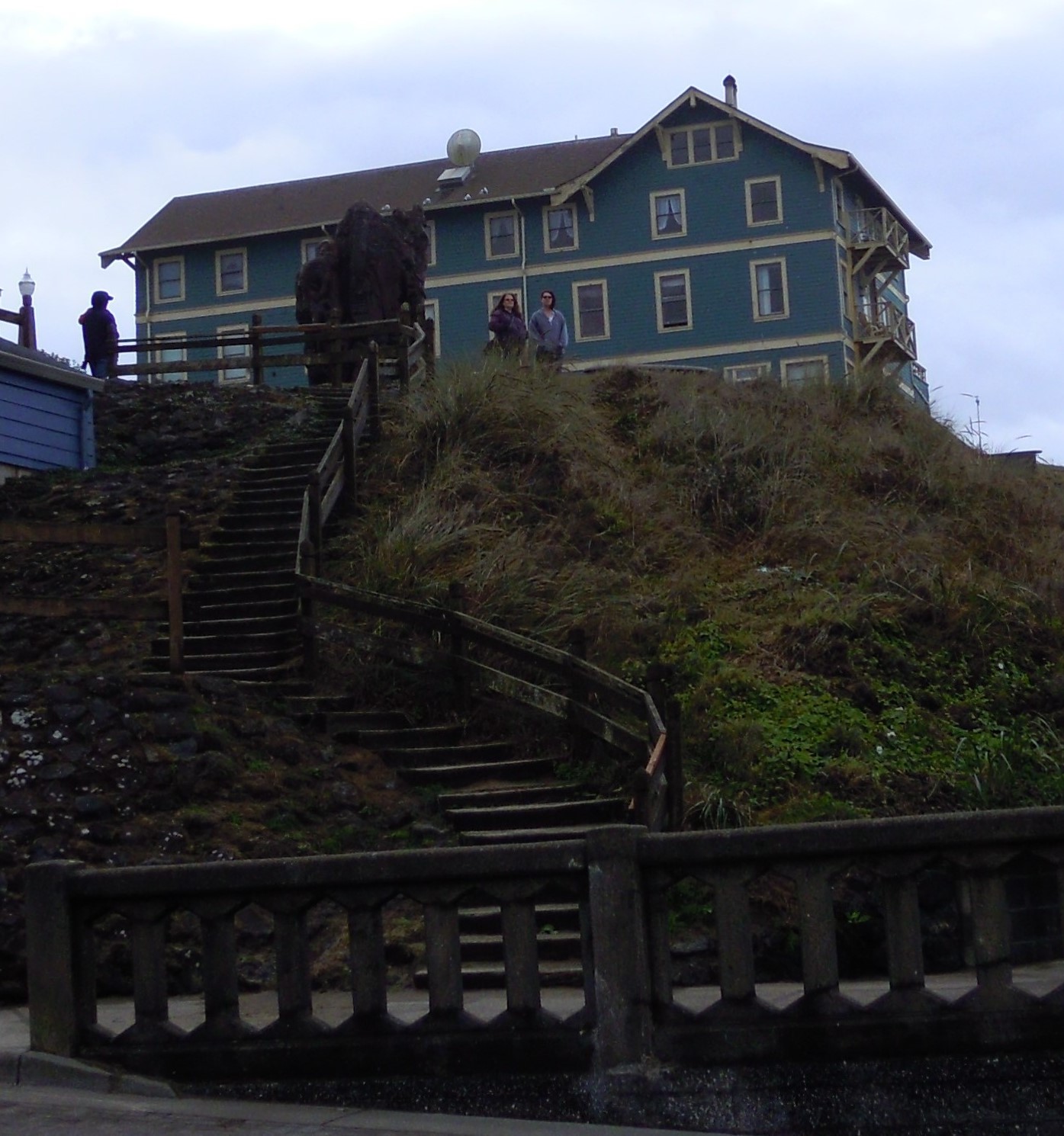
Sun broke through at last and the old hotel looked cheerful in the morning light.
After exploring the town I headed south again, stopping along the way for one last glimpse of Heceta Head and its lighthouse. A delightful trek. My thanks to Sue Lick and Lori Tobias of the Willamette Writers Coast Branch for arranging my visit.

Next Stop Newport
For my next book event I’ll be heading up the north coast again to speak to the Coast Chapter of Willamette Writers in Newport, Oregon. It’s always nice to visit one of the most beautiful areas in the world.
 Photo by Robin Loznak
The above photo was taken a little bit south of Newport as the lowering sun sheens the water below one of Oregon’s historic lighthouses.
My speaking engagement with the Coast Chapter was originally scheduled for last February. In fact, I packed up and headed out that Sunday morning, excited about the trip. I hadn’t gotten far when a spit of snow began to spatter my windshield. I wasn’t too concerned. We don’t get much snow in February and the coast is even less likely to have snow.
That day proved to be an exception. It kept snowing harder. I told myself it wasn’t sticking and I’d get into the temperate coastal zone soon. But it got worse the farther west I drove. Snow did begin sticking. It was not getting better toward the west. I wasn’t set up for snow and finally decided I’d better turn around while I still had hopes of returning home safely.
Happily, we rescheduled. I’ll be there for their September meeting this coming Sunday, the 17th, from 2 to 4 pm at the Newport Public Library, 35 NW Nye Street. And we don’t expect snow.
I’m going to talk about my long road to publication of my two Oregon Trail stories, 2017 Nancy Pearl Book Award Finalist The Shifting Winds, and the one that started it all, A Place of Her Own, with a few words on what’s waiting in the wings. A slideshow will offer a backdrop of photos related to the two books. After some Q&A I’ll have books available to sell and sign. Because I’ll be talking to fellow writers I hope I can offer some ideas and encouragement that might help others on their writing journeys.
I’m also a member of Willamette Writers, which has branches throughout Oregon. When I lived in Portland I met with the Portland chapter and now meet with the Mid-Valley chapter in Eugene.
Thanks to Robin, I have one more photo to share, another of those glorious sunsets on the Oregon coast. Looking forward to my upcoming visit. If you’re in the area, please think about stopping by the Newport library for some book talk in a beautiful place.
 Photo by Robin Loznak
