Lovely Crowd at Annie’s

A lovely crowd turned out for my book reading and signing at Annie Bloom’s Books in Portland. It was such a cold, rainy evening. Icy rain hammered me as I drove into the city. I wondered if anyone would come out on such a night. But Portlanders don’t let anything like a little rain stop them. The people came.

Annie's 3.15.16Here is Annie’s as I arrived early on that wet evening. But a warm welcome awaited inside.

Molly Bloom, the silky black cat who rules the store, soon made her presence known, and I was determined to get her picture this time. I never got my own picture of her last time I had an event there with my first book, A Place of Her Own. So I must confess the rest of my pictures of the event are of Molly. None of the crowd. None of me speaking. Just Molly.
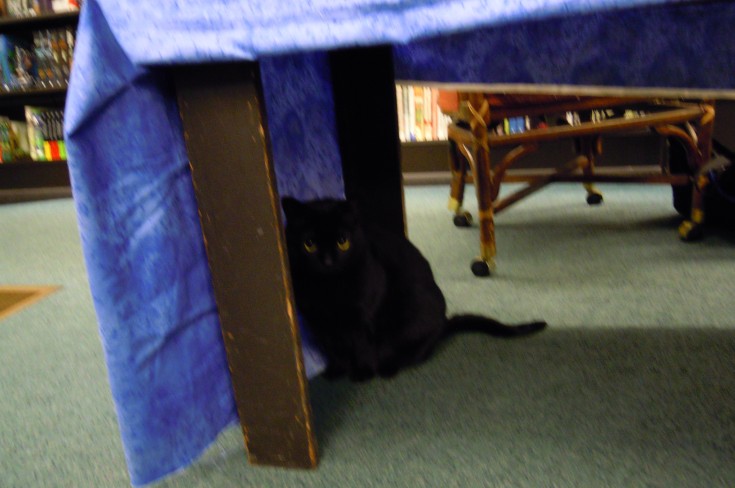
Annie's.Molly hidingShe seemed a little shy at first. “I’m not quite ready to go out there yet.” I knew the feeling. Here she has tucked herself under the table where I sat to do my reading, a little different from other venues where I usually stand. But it was pleasant, conversational.

I do want to thank my cousin-in-law Judy Fisher, who helped with serving wine after my presentation. She and my cousin Jack came over from Lake Oswego, and it was great to see them. And a special thanks to Stephanie, the human at Annie’s who handled the event and introduced me.

I had some surprises. A friend who had known my father came. She had worked with him when he served on the State Board of Education years ago, and even had dinner once at my parents’ house at the farm. Also in attendance was someone who had worked on the archeological digs at Champoeg, a significant locale in the story of The Shifting Winds.

Annie's.Molly checkingMolly kept busy before we started. “I just need to check something over here in the stacks.”

As I began to do my reading Molly started working the crowd in earnest. She traipsed around the chairs. She paused for gentle strokes on her silky fur. She leaped into laps. My camera was on the corner of my table. I considered stopping midsentence to get a better picture, but decided that would break the flow, and it was an intense scene. I could have asked someone beforehand to do pictures, but didn’t. Even with Molly’s antics the reading was well received.

And we had a great Q & A. Many of the people knew the history that surrounds my story, so we had a vibrant interaction. Quite a few were interested in A Place of Her Own too. All in all, a delightful event. And afterward Molly was all worn out.

Annie's.Molly sleepingSigh. “It’s a big job running an event like this. But I am content. It went well.”

My thanks to everyone at Annie’s. This was my go-to bookstore when I lived in Portland, just up the street, and I always love going back there. It’s such a pleasure to be able to share my own work in this warm and friendly place. Like Molly, I was content.

NEXT UP: News on an exciting upcoming event.
COMMENT


COUNTDOWN – 3 DAYS TO LAUNCH

Fort Vancouver

In today’s post counting down to the book launch of The Shifting Winds, we’ll visit the Hudson’s Bay Company’s Fort Vancouver, a thriving center of British civilization in the wilderness of the Oregon Country in the nineteenth century. When the story begins, this fort has been the center of the fur trade in the Pacific Northwest for seventeen years, having been established in 1825. Today, the city of Vancouver, Washington, has grown up around the site, and with archeological investigation and in-depth study of early drawings and descriptions, an elaborate reconstruction project has brought back the palisade walls and many of the buildings, offering a glimpse into the fort’s glory days. It’s now a National Historic Site maintained by the National Park Service.

(Troy Wayrynen/picturesbytroy)

National Park Service photo by Troy Wayrynen

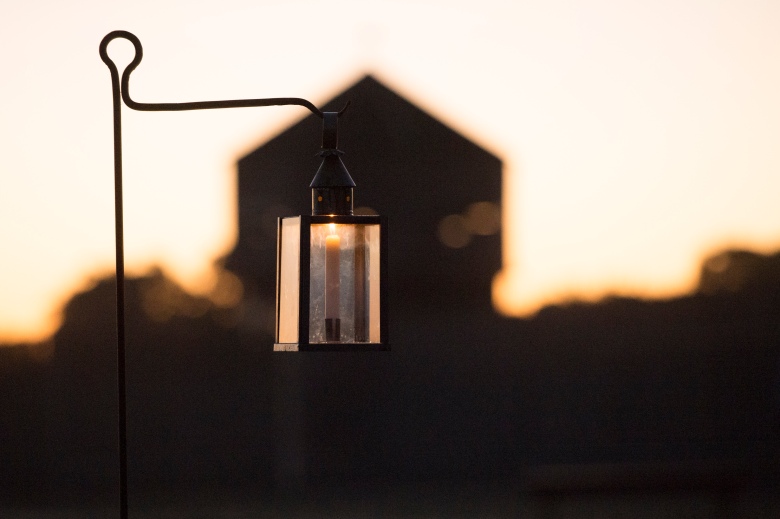
The above photo provides an artistic portrayal of a finely crafted lantern with the fort bastion behind. This fort was no rustic outpost. The commander’s residence, an elegant two-story house which he shared with his second in command, looked like a mansion to protagonist Jennie Haviland. The house included a public sitting room and formal dining hall for gentlemen, where substantial meals were served, sometimes with wine, but no “spiritous liquors.” Within the palisade walls the company was a self-sufficient establishment with workshops for carpenters, blacksmiths, coopers and others, as well as a school house, a chapel, a brick and stone powder house, and more. Outside, farming activities required more employees than the fur enterprise.

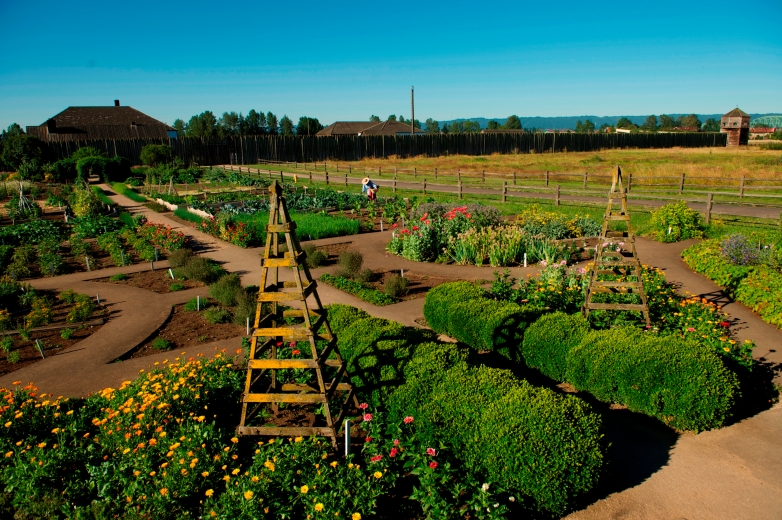
Nancy Funk, wearing period clothing, takes care of a garden at the Fort Vancouver National Historic Site in Vancouver, Washington. (Troy Wayrynen/picturesbytroy)

National Park Service photo by Troy Wayrynen

In the above photo taken at the beautifully reconstructed site, you can see some of the gardens typical of the fort’s past, and behind the gardens, the palisade walls with bastion at the corner. The large hip-roofed building on the far left with the chimney is the Big House where Dr. John McLoughlin lived as Chief Factor of the fort.

When the Company sent Dr. McLoughlin out to the Oregon Country, he selected this site for the Company’s western headquarters because he found a broad fertile plain there and he intended to grow things while conducting the fur trade. Grain, fruits, and vegetables flourished on this land, as well as livestock. He also wanted a site on the north side of the Columbia River because the British had recently made an offer to the United States to resolve a contentious boundary dispute, agreeing to set the boundary between the two nations along the Columbia. That would have essentially given today’s Washington State to the British. I guess we all know that offer was not accepted.

The Company initially built the fort a short distance inland from the final location, but after four years they moved it closer to the river and gradually developed the remarkable establishment it became.

village

National Park Service photo

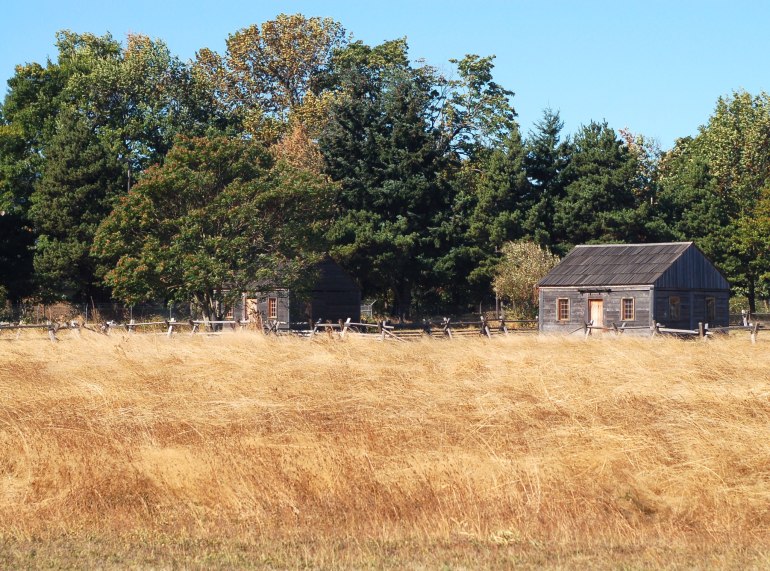
The Company employed many people, and while some lived inside the fort walls, many more lived in a village just outside. Some of the reconstructed buildings of the village are shown in the above photo.

When Jennie visits the fort in our story, she’s curious about the houses outside the walls and asks her escort Alan Radford about them. He tells her they’re the workmen’s cabins, and she asks, “‘Do you live in one of these cabins?”

“Oh no. I live inside the fort. The gentlemen live inside.’

“‘Oh.’ She puzzled over that. ‘How do you decide?’

“‘Decide?’

“‘Yes. How do you decide who’s a gentleman?’

“‘Well, the officers and clerks are gentlemen, and the common workers are not. It’s simple enough.’”

Jennie finds that surprising but focuses on the fort as the wagon carries them inside. She’s amazed. “‘It’s like a small city right here inside the walls.’

“Lights glittered around her now, twinkling from the many windows of the fort buildings—glass windows, real glass windows. And the buildings! There were real frame buildings. Not simple little crude log cabins like those at Willamette Falls. . . . The frame house directly in front of her . . . had proper white weatherboarded walls, a proper shingled hip roof, shutters beside the tall glass windows, and a wide veranda that crossed the entire front, with a gracefully curved staircase forming a half circle from the veranda to the ground.”

Jennie has been invited to stay in that house, the Big House, as the guest of Dr. and Mrs. McLoughlin, but discussion ensues about where American mountain man Jake Johnston will stay. He has traveled with their party from Willamette Falls for his own reasons. With sudden decisiveness, Dr. McLoughlin says Jake will stay in the Bachelor’s Quarters next to the Big House. But Alan doesn’t appear to like that decision. When he begrudgingly leaves to make arrangements, Jennie quietly asks Jake what’s wrong.

Jake’s response: “‘With Radford? Well, it’s only gentlemen who are allowed to stay inside the fort, and I don’t think Radford considers me a gentleman.’ Jake grinned at her, and her brows rose. She wasn’t sure Jake was a gentleman either, but she was surprised at the rigidity.”

NEXT: Dr. John McLoughlin

COMMENT

COUNTDOWN – 4 DAYS TO LAUNCH

Joe Meek, Mountain Man Extraordinaire

Today on our countdown to launch I want to introduce one of the real historic characters who plays a significant role in my book, mountain man Joe Meek. In the story he’s a good friend of the fictional mountain man Jake Johnston. And when I say character, I do mean.

joe mural smallerPhoto courtesy of Oregon State Archives

The above photo is of a large mural in the Oregon State Capitol building. That’s Joe Meek in the red shirt, rifle in hand, yelling to catch the attention of men mingling around him. An uncertain voice vote has left the historic Champoeg meeting in confusion as to whether the Americans will set up a government and have the protection of law in this isolated land. In order to get a true count, Joe calls out with his immortal words, “Who’s fer a divide?” A hush settles over the crowd, and Joe calls out again. “All fer the report of the committee and an organization, follow me!”

Some thirty years after the days portrayed in The Shifting Winds Joe Meek sat down with author Mrs. Frances Fuller Victor and relayed to her the story of his life as a mountain man and as a settler in Oregon. Her book that came out of these discussions, The River of the West, was published in 1870. The man was an inveterate storyteller, and while some folks in his day suggested the stories may have occasionally stretched, he often enjoyed an appreciative audience. From Victor’s book I gleaned several of Joe’s stories about his exciting days in the Rockies. As indicated in the Afterword of The Shifting Winds, the stories “are as true as Joe chose to make them.”

Whatever the truth of his tales, he found purpose in Oregon. He would become sheriff, then territorial marshal, and he had connections in high places. There was more to Joe than first impressions might suggest.

In Chapter One, just after meeting Jake Johnston, protagonist Jennie Haviland meets Joe:

“Another man approached, dressed almost the same [as Johnston], his dirty buckskins showing more wear, the fringes more ragged, his dark straggly hair longer, and this one had a brushy tangle of beard covering his chin. He stepped up beside the other and stood before her with a broad smile, and she felt herself surrounded by the two of them.”

Jennie’s little brothers dutifully introduce themselves, but thirteen-year-old Eddie can no longer contain his excitement. He turns to Joe.

“‘Are you Joe Meek, the Joe Meek? The famous mountain man in the wax museum in St. Louis fighting the bear?’

“Mr. Meek grinned. ‘One and the same, but don’t ye let that statue fool ye none, boy. Old Joe didn’t lose nary a finger from that ol’ bar, do ye hear, now?’ The man held up both hands, fingers stretched to show he still had all ten.

“‘But did you really fight a bear?’ Eddie asked.

“Mr. Meek began to laugh and slapped the other man on the shoulder. ‘Do ye hear that, Old Jake?’ He was so caught up in laughter he didn’t attempt to speak further.

“Jake Johnston smiled at Eddie. ‘This man has fought more bears than any man I know.’

“Mr. Meek lifted a hand. ‘Why, bar fightin’—that’s what this old coon is famous fer.’”

And the stories go on.

NEXT: Fort Vancouver

COMMENT

COUNTDOWN – 5 DAYS TO LAUNCH

Mountain Men

With five days to go until the launch of The Shifting Winds, today’s post will focus on those intrepid mountain men who went out into the wilds of the Rocky Mountains to trap beaver for the American fur companies in St. Louis. From the early 1820s until 1840 these trappers worked the mountain streams and developed a lifestyle of their own. Company caravans took supplies to the Rockies for an annual summer rendezvous where they traded for beaver the mountain men had gleaned during the year. So the trappers never had to leave the mountains. Some didn’t go home to the States in all that time, maintaining a tenuous link with civilization as they had once known it.

George profile jpgPhotos courtesy of Douglas County Museum

George Abdill may not look like a mountain man in the pictures above and below, but the spirit of a mountain man lived in George’s heart.

Some years ago when I decided to write a book about the American frontier, with mountain men and pioneers and British fur traders, I went to see George Abdill, director of our local Douglas County Museum at the time. George was a man who held in his mind so much information, a person could ask him a question and he would answer with a chapter. When I told him about the setting and characters of my story, he smiled and sat back in his chair, his tone turning wistful. “If I could go back in time and choose what I would like to be, I would be a mountain man.”

George headshot jpgWow! What a great source for these stories!

He’s not wearing buckskins in the photos. He doesn’t have a powder horn and bullet pouch slung over his shoulder. And he’s not carrying a muzzleloader, but he knew how to shoot one and told me how to reload the single-shot weapon on the run while riding full tilt after buffalo. So, imagine him in buckskins, as he could have surely imagined himself.

The mountain men who trapped beaver in the Rocky Mountains generally wore buckskins because these trappers worked in rough country and the durable buckskin protected their own skin, also because they lived and worked with Native Americans who often wore deerskin clothing themselves. Fringes—or whangs—on the outer arm seams and leg seams offered more than style. The fringes helped the garment shed water by acting as wicks, an important feature for men who waded into streams to trap beaver and faced all kinds of weather.

Here’s how protagonist Jennie Haviland sees American mountain man Jake Johnston on first meeting:

“She managed to push back to arm’s length and quickly surveyed him from the smiling face down over the buckskin-covered length of him to the moccasins on his feet. He wore a buckskin shirt, much like their young Indian guide’s—fringed, embroidered, belted at the waist—but unlike the guide he wore long, trim-fitting buckskin breeches with fringes running down the outer seams. He was armed—a knife in a sheath on his belt, a pistol stuck into the belt, and powder horn and bullet pouch slung over his shoulder. With determination, she pushed back harder and he released his grip on her.

“He spoke with a drawl, still smiling. ‘Ma’am, may I have the utmost pleasure and privilege of welcoming you to the fair Willamette Valley? My name is Jacob Obadiah Johnston.’ He backed up a step, sweeping one hand before himself as he gave her a deep bow, the long fringes on his buckskin sleeve swishing with the motion. Standing straight again, he grinned wider. ‘My friends call me Jake. And you would be . . . ?’

“She could only stand and stare . . .”

The Shifting Winds is the fourth pioneer story I wrote, the fourth serious novel, and its pages are infused with the information and spirit provided by mountain man dreamer George Abdill. I wish he were still alive to thank for all the help he gave me.

NEXT: Joe Meek, Mountain Man Extraordinaire

COMMENT

NEW BOOK DEAL!!

Society208-Photo courtesy of Clackamas County Historical Society, All Rights Reserved

Woo-hoo!! Another book!

I’m thrilled to announce I sold my second book, this one a historical novel of early Oregon. My agent Rita Rosenkranz just closed the deal with the editor of my previous book, Erin Turner of Globe Pequot Press. It will come out in April 2016 under the TwoDot imprint, the same as A Place of Her Own. The photo above is a lithograph by J. H. Richardson showing Oregon City in the 1840s, the primary setting of the new book, tentatively entitled The Shifting Winds.

It’s the story of reluctant Oregon pioneer Jennie Haviland whose father decides, against her wishes, to take the family west to the wilderness of 1842 Oregon. Two men there vie for Jennie, one British, one American, as their two countries vie for the contested Oregon land. But Jennie wants choices of her own.

The Oregon City shown in the lithograph is the hometown Jennie would have known soon after her family arrived at the end of the long Oregon Trail.

I wrote this book some years ago when my focus first turned to stories of Oregon pioneers. After succeeding in selling the story of my pioneer great-great-grandmother, released in 2014, I brought this one out and gave it a polish, hoping my editor would like it too. And yay! She did! It has always been one of my favorites. I had such fun reworking it and look forward to sharing it now with readers.

Although A Place of Her Own reads like fiction it was sold as non-fiction. This new one brings me over to the world of fiction, in this case, fiction set in the midst of historic events with some real people, like legendary mountain man Joe Meek and Hudson’s Bay Company Chief Factor John McLoughlin. It falls solidly into the category of historical fiction.

Please join me in a cheer for book number two!! 🙂 🙂 🙂

COMMENT