COUNTDOWN – 4 DAYS TO LAUNCH

Joe Meek, Mountain Man Extraordinaire

Today on our countdown to launch I want to introduce one of the real historic characters who plays a significant role in my book, mountain man Joe Meek. In the story he’s a good friend of the fictional mountain man Jake Johnston. And when I say character, I do mean.

joe mural smallerPhoto courtesy of Oregon State Archives

The above photo is of a large mural in the Oregon State Capitol building. That’s Joe Meek in the red shirt, rifle in hand, yelling to catch the attention of men mingling around him. An uncertain voice vote has left the historic Champoeg meeting in confusion as to whether the Americans will set up a government and have the protection of law in this isolated land. In order to get a true count, Joe calls out with his immortal words, “Who’s fer a divide?” A hush settles over the crowd, and Joe calls out again. “All fer the report of the committee and an organization, follow me!”

Some thirty years after the days portrayed in The Shifting Winds Joe Meek sat down with author Mrs. Frances Fuller Victor and relayed to her the story of his life as a mountain man and as a settler in Oregon. Her book that came out of these discussions, The River of the West, was published in 1870. The man was an inveterate storyteller, and while some folks in his day suggested the stories may have occasionally stretched, he often enjoyed an appreciative audience. From Victor’s book I gleaned several of Joe’s stories about his exciting days in the Rockies. As indicated in the Afterword of The Shifting Winds, the stories “are as true as Joe chose to make them.”

Whatever the truth of his tales, he found purpose in Oregon. He would become sheriff, then territorial marshal, and he had connections in high places. There was more to Joe than first impressions might suggest.

In Chapter One, just after meeting Jake Johnston, protagonist Jennie Haviland meets Joe:

“Another man approached, dressed almost the same [as Johnston], his dirty buckskins showing more wear, the fringes more ragged, his dark straggly hair longer, and this one had a brushy tangle of beard covering his chin. He stepped up beside the other and stood before her with a broad smile, and she felt herself surrounded by the two of them.”

Jennie’s little brothers dutifully introduce themselves, but thirteen-year-old Eddie can no longer contain his excitement. He turns to Joe.

“‘Are you Joe Meek, the Joe Meek? The famous mountain man in the wax museum in St. Louis fighting the bear?’

“Mr. Meek grinned. ‘One and the same, but don’t ye let that statue fool ye none, boy. Old Joe didn’t lose nary a finger from that ol’ bar, do ye hear, now?’ The man held up both hands, fingers stretched to show he still had all ten.

“‘But did you really fight a bear?’ Eddie asked.

“Mr. Meek began to laugh and slapped the other man on the shoulder. ‘Do ye hear that, Old Jake?’ He was so caught up in laughter he didn’t attempt to speak further.

“Jake Johnston smiled at Eddie. ‘This man has fought more bears than any man I know.’

“Mr. Meek lifted a hand. ‘Why, bar fightin’—that’s what this old coon is famous fer.’”

And the stories go on.

NEXT: Fort Vancouver

COMMENT

COUNTDOWN – 5 DAYS TO LAUNCH

Mountain Men

With five days to go until the launch of The Shifting Winds, today’s post will focus on those intrepid mountain men who went out into the wilds of the Rocky Mountains to trap beaver for the American fur companies in St. Louis. From the early 1820s until 1840 these trappers worked the mountain streams and developed a lifestyle of their own. Company caravans took supplies to the Rockies for an annual summer rendezvous where they traded for beaver the mountain men had gleaned during the year. So the trappers never had to leave the mountains. Some didn’t go home to the States in all that time, maintaining a tenuous link with civilization as they had once known it.

George profile jpgPhotos courtesy of Douglas County Museum

George Abdill may not look like a mountain man in the pictures above and below, but the spirit of a mountain man lived in George’s heart.

Some years ago when I decided to write a book about the American frontier, with mountain men and pioneers and British fur traders, I went to see George Abdill, director of our local Douglas County Museum at the time. George was a man who held in his mind so much information, a person could ask him a question and he would answer with a chapter. When I told him about the setting and characters of my story, he smiled and sat back in his chair, his tone turning wistful. “If I could go back in time and choose what I would like to be, I would be a mountain man.”

George headshot jpgWow! What a great source for these stories!

He’s not wearing buckskins in the photos. He doesn’t have a powder horn and bullet pouch slung over his shoulder. And he’s not carrying a muzzleloader, but he knew how to shoot one and told me how to reload the single-shot weapon on the run while riding full tilt after buffalo. So, imagine him in buckskins, as he could have surely imagined himself.

The mountain men who trapped beaver in the Rocky Mountains generally wore buckskins because these trappers worked in rough country and the durable buckskin protected their own skin, also because they lived and worked with Native Americans who often wore deerskin clothing themselves. Fringes—or whangs—on the outer arm seams and leg seams offered more than style. The fringes helped the garment shed water by acting as wicks, an important feature for men who waded into streams to trap beaver and faced all kinds of weather.

Here’s how protagonist Jennie Haviland sees American mountain man Jake Johnston on first meeting:

“She managed to push back to arm’s length and quickly surveyed him from the smiling face down over the buckskin-covered length of him to the moccasins on his feet. He wore a buckskin shirt, much like their young Indian guide’s—fringed, embroidered, belted at the waist—but unlike the guide he wore long, trim-fitting buckskin breeches with fringes running down the outer seams. He was armed—a knife in a sheath on his belt, a pistol stuck into the belt, and powder horn and bullet pouch slung over his shoulder. With determination, she pushed back harder and he released his grip on her.

“He spoke with a drawl, still smiling. ‘Ma’am, may I have the utmost pleasure and privilege of welcoming you to the fair Willamette Valley? My name is Jacob Obadiah Johnston.’ He backed up a step, sweeping one hand before himself as he gave her a deep bow, the long fringes on his buckskin sleeve swishing with the motion. Standing straight again, he grinned wider. ‘My friends call me Jake. And you would be . . . ?’

“She could only stand and stare . . .”

The Shifting Winds is the fourth pioneer story I wrote, the fourth serious novel, and its pages are infused with the information and spirit provided by mountain man dreamer George Abdill. I wish he were still alive to thank for all the help he gave me.

NEXT: Joe Meek, Mountain Man Extraordinaire

COMMENT

COUNTDOWN – 6 DAYS TO LAUNCH

Willamette Falls

As we continue the countdown to the launch of my new book, The Shifting Winds, today’s historical factoids focus on the developing settlement of Willamette Falls, soon to be named Oregon City, the first Euro-American settlement in Oregon’s Willamette Valley and the destination for many American settlers who would cross the Oregon Trail.

Society208-Clackamas County Historical Society Photo, All Rights Reserved

The above lithograph was created in the 1840s by lithographer J. H. Richardson who traveled to Oregon City during the settlement’s early days, one of several artists sent out to record images of the West during that period. The picture shows the bluff and the heavy forest above, which will become familiar to readers of The Shifting Winds.

A dramatic horseshoe-shaped falls gave the place its first name. Long before the white men came, the remarkable cascade drew Native American tribes like the Clowewallas, one of several Chinookan tribes who found excellent fishing at the site, and it became a place for the tribes to gather for trade. Some said the salmon were so thick a person could walk across the river on the salmons’ backs. Men built scaffolds right in the plunging water and climbed up to use spears and dip nets to catch fish struggling to leap the falls for the great return to their spawning grounds upriver.

When British fur traders entered the region they quickly recognized the potential power of the falls, and in 1829 Dr. John McLoughlin, HBC Chief Factor at nearby Fort Vancouver, laid out a two-square-mile claim at the site. By the time the characters of my story arrive, he’s in the process of building a sawmill on an island there.

The construction work brought HBC employees to the place which they called Willamette Falls. Then Americans began to arrive, and contentions stirred at this focal point, as well as across the Oregon territory. When the story opens in 1842, the Oregon country has been jointly occupied by the British and Americans for almost twenty years, because the two nations still can’t agree on a boundary. The British have been entrenched for years with their fur trading operations, and only a few Americans have trickled in—some missionaries, a few mountain men escaping a dying beaver trade in Rockies, and a scattering of emigrants who’ve come by land and sea.

Protagonist Jennie Haviland isn’t happy her father tore her away from her prestigious academy in Utica, New York, to come to this wilderness, but her one hope is that she’ll find a place she can call home in Willamette Falls. As she and her family follow their Indian guides through the dense woods to an overlook of the mighty cascade, she hopes to get her first view of this town. Awed by the spectacle of the falls, she can’t help admiring the beauty, but she doesn’t see a town, only some shacks on the island and a couple of log cabins with a few outbuildings on the flat bench of land below. Homes of isolated settlers? She turns to her father.

“‘But where is the town? Where’s Willamette Falls?’ She wanted to find the town of proper houses.

“The young guide mumbled to Pa again, and Pa nodded. ‘So that’s it,’ Pa said. ‘That’s our settlement.’

“Jennie scanned the tree-cloaked hills. ‘Where?’

“‘Those cabins are it.’ He pointed to the flat bench of land. . . .

“Jennie darted a quick look at the cabins on the flat, then jerked her head back to stare at Pa. ‘What do you mean?’”

NEXT: Mountain Men

COMMENT

COUNTDOWN – 7 DAYS TO LAUNCH

First Travelers on the Oregon Trail

The launch for my new historical novel, The Shifting Winds, is now seven days away, one week, and I plan to do a blog post each day from now until the day before the event. For each post I’d like to share some historical factoids that relate in some way to the book, from today’s brief overview of the first travelers on the Oregon Trail to bits of information on mountain men, the Hudson’s Bay Company, and other background elements that may work into a tapestry of color surrounding the story.

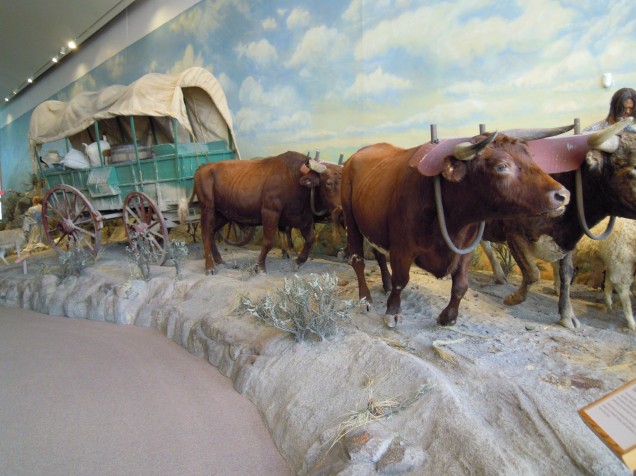
469.diorama oxen & wagonThe photo above was taken at the National Historic Oregon Trail Interpretive Center at Baker City, Oregon, a diorama showing a typical oxen-drawn wagon on the trail west.

Jennie Haviland, protagonist of The Shifting Winds, comes west across the Oregon Trail in 1842 with one of the earliest wagon trains of emigrants from the States. But fur traders first blazed that trail across the continent. As early as 1812 men employed by John Jacob Astor, founder of Fort Astoria, were probably the first white men to locate South Pass, a remarkably gentle passage across the otherwise rugged Rocky Mountains which made it possible for later emigrants to cross the Continental Divide with ease.

Missionaries began to make their way across the trail in the 1830’s, stopping along the way at the Rocky Mountain Rendezvous, the raucous summer gatherings of American mountain men and traders. In the words of mountain man Joe Meek in our story, “My heavens! That was the time fer big doin’s, mind ye, when the company sent out supplies, and after bein’ temperate all year, we let loose a mite, we did. A man would spend mebbe a thousand dollars a day on—” Jennie’s pa interrupts before Joe can say more.

The first white women to cross the trail, missionaries Narcissa Whitman and Eliza Spalding, traveled by wagon in 1836 with their husbands, Marcus Whitman and Henry Spalding. After a few days at the rendezvous, which must have brought a little shock to their sensibilities, they took the wagons as far as Fort Hall in what is now eastern Idaho, the first to take wagons that far. Beyond that point they used pack animals.

481.Ft Hll exterior

The picture above shows the Fort Hall replica my daughter, granddaughter, and I visited when we backtracked the trail taken by our ancestors.

By 1840 as beaver played out in the Rockies, the American mountain men held their last rendezvous and some headed for Oregon. Joe Meek and his friend Robert Newell managed to get three wagons from Fort Hall to Walla Walla, the first to take wagons overland as far as the Columbia River.

As promoters sang the praises of Oregon, hoping to gain the land with settlement, more emigrants dared take the trek. A fair-sized party of seventy or so left the States in 1841, but about half the party went to California, all of them leaving their wagons at Fort Hall.

That brings us to 1842 when just over a hundred emigrants took the journey, the group my fictional Haviland family joined. This group also left the wagons at Fort Hall and went by foot and horseback to the Columbia River, where some proceeded either by boat or raft down the river, while others like the Havilands took horses over the Cascade Mountains.

The story of The Shifting Winds opens as the family approaches their destination, Willamette Falls, soon to be named Oregon City. Jennie expects to see a thriving town there, a semblance of civilization in this godforsaken wilderness, but she has a few surprises in store.

NEXT: Willamette Falls

COMMENT

NEW BOOKS!!!

912.new.booksBoxes of books came today! What a thrill to actually hold one of these real books in my hands and flip through the pages. My good old story I have loved for so long. Now in print so other people can read it and come to know some of my favorite characters. And the books are beautiful! I love what the publisher did with the cover.

My agent emailed me over the weekend to tell me she had gotten her copies, so I suspected mine might come today. I gave a talk at my Roseburg writers’ group this morning and had to leave home before the books came. But when I got back they were waiting on the porch for me. Ah! What a sight!

Checking an old blog post, I see that boxes of my first book came early the month before the release date too. And for those of you who have pre-ordered The Shifting Winds from one of the online outlets, you may actually get your book before March 1. I don’t know, but I think people started getting them earlier last time.

Oh, what fun! This is one of those moments for a writer. Sheer pleasure. I am so looking forward to sharing. 🙂

COMMENT

Outtakes #10 – A Place of Her Own

This Outtake comes from one of my personal chapters in A Place of Her Own, a segment leading to a Tribute to My Father that I’ve already used for a post. The scene describes a day my daughter Carisa and I walked up my father’s mountain and found ourselves in bear country. Most of my scenes were cut to focus on Martha’s story, including this and the tribute, but maybe you’ll enjoy this, and if you haven’t seen the tribute, you can visit that here. Clip…..

Bear-TrailcamRobin Loznak caught one of our bears with his trail-cam one night in October last year, a nice black bear posing for its portrait on the mountain. I prefer to see them this way.

~~~

The west hills, September 2010. The golden grass stood so high the dogs couldn’t see their way. One a yellow lab, the other a black lab mix, they weren’t small dogs, but the grass came well over their heads. Heavy rains last spring had produced rich forage for the cows this year, and they hadn’t been on this pasture lately, making our walk difficult, except for a few beaten trails. Deer probably. Maybe elk. Or bear.

The scent of rain filled the air now, and a soft sprinkle started again after scattered morning showers. My daughter Carisa and I tromped through the thick, damp growth behind the dogs. I wanted to check out the most recent timber planting to see how it was doing, and I wanted to check out this part of the farm, wondering if Martha had done the same in her first year here.

When I was a kid we called this pasture Horse Heaven Hills. I didn’t know why the name. Maybe because the grass grew so sweet here, the animals experienced the place as their own heaven? It always seemed a bit sublime to me. For a long time I planned to build my house over here, but when my dad cut the timber that would have circled behind the house, I began to look elsewhere.

Turning, I could see how the pasture meandered up the hill in steps and ridges, down to the bluff on one side, up to Wildcat Canyon above–a deep slice into the forested ridgetop. The land was more rugged on this side of the property than the softer ridge where my house sat. A middle ridge ran between this and my house, beyond our view now.

While I found hills and hollows in the parts of Missouri and Illinois where Martha lived and traveled, there was nothing you could call a mountain, nothing to prepare her for the terrible mountains of the West she had to cross, nothing to prepare her even for the hills of her own farm. This wasn’t anything like the rugged crests of the Rockies or Cascades. I doubted it was technically a mountain, though I hadn’t found a clear definition of the term. This rose about eight hundred fifty feet from the valley floor to the top. But to my dad this hill on our farm was always the mountain. His mountain. Maybe that was because Martha saw it as a mountain and the designation continued with the family. Hills to her would be like the gentle rises in Missouri and Illinois. The farm’s elevated land of sharp slopes and sweeping ridges was in her eyes a mountain. Before my dad, Martha’s mountain.

Dipping under a hot wire to reach our newest timber planting, Carisa and I found new firs growing well despite competition. We approached a mound of blackberry vines crouched on the land like a huge thorny web, and took advantage of its better part. Something had cleared the way into the bush. We had a little snack of the delicious berries. Then I saw a pile of scat full of berry seeds. Big scat. “What’s this?” I asked. We peered closer. Goose bumps rose on my skin. “It doesn’t look fresh.”

We stood taller and looked around. A bear had been here, a large one, but not recently. With all our noise and our two dogs, it probably wouldn’t come back now. We shrugged and happily continued our snack.

Photo by Robin Loznak And of course there’s this all-time favorite Robin Loznak photo of other wildlife on the family farm, one of several photos included in A Place of Her Own. The Roosevelt elk herd ranges across the mountain, and on rare occasions even slips down to the river bottom.

COMMENT

Outtakes #9 – A Place of Her Own

This Outtake reveals another short bit taken from the end of an Oregon Trail scene at the top of p. 124 in A Place of Her Own. The Maupins have survived the precipitous drop down Laurel Hill and have just come into the rich prairies west of the Cascade foothills. The cut is just 176 words, but words are words. And I desperately needed to take more out. At least it gave me more in one fell swoop than the single filler words I snipped throughout the manuscript. Clip…..


The photo above, by Robin Loznak, appears in A Place of Her Own, illustrating Douglas Firs on the family farm. Similar trees of this species would have been growing in the area depicted in this scene, though no doubt larger than these. Pioneers trekking into what is now the State of Oregon found Doug firs some 300 feet tall. Two or three men could lie head-to-foot across the diameter of a stump from one of these giants that might have been as much as 800 years old.

~~~

Near evening a cabin appeared, nestled against a grove of firs at the edge of a broad meadow. The scent of a hearth fire reached Martha’s nose, and she took a long, satisfying breath of it. People began spilling out the cabin door, running toward the wayworn travelers. A man reached them first. He lifted his hat and rubbed a hand across his thin, curly hair. “Welcome to Oregon.”

A united but somewhat ragged thank you answered him back.

He introduced himself and his wife, who came up behind him, and Garrett introduced the family. The woman went straight to Martha and gripped both her hands. “My dear, what a journey for you. When are you due?”

“December.”

The woman smiled and nodded. “Oh, you’ll be settled by then. Come sit a spell and have some supper with us.”

“That’s so nice of you,” Martha said. “You must see a lot of travelers, living here.”

The woman laughed. “We do, and we love it. We all took that trip, God bless us, and we all understand.”

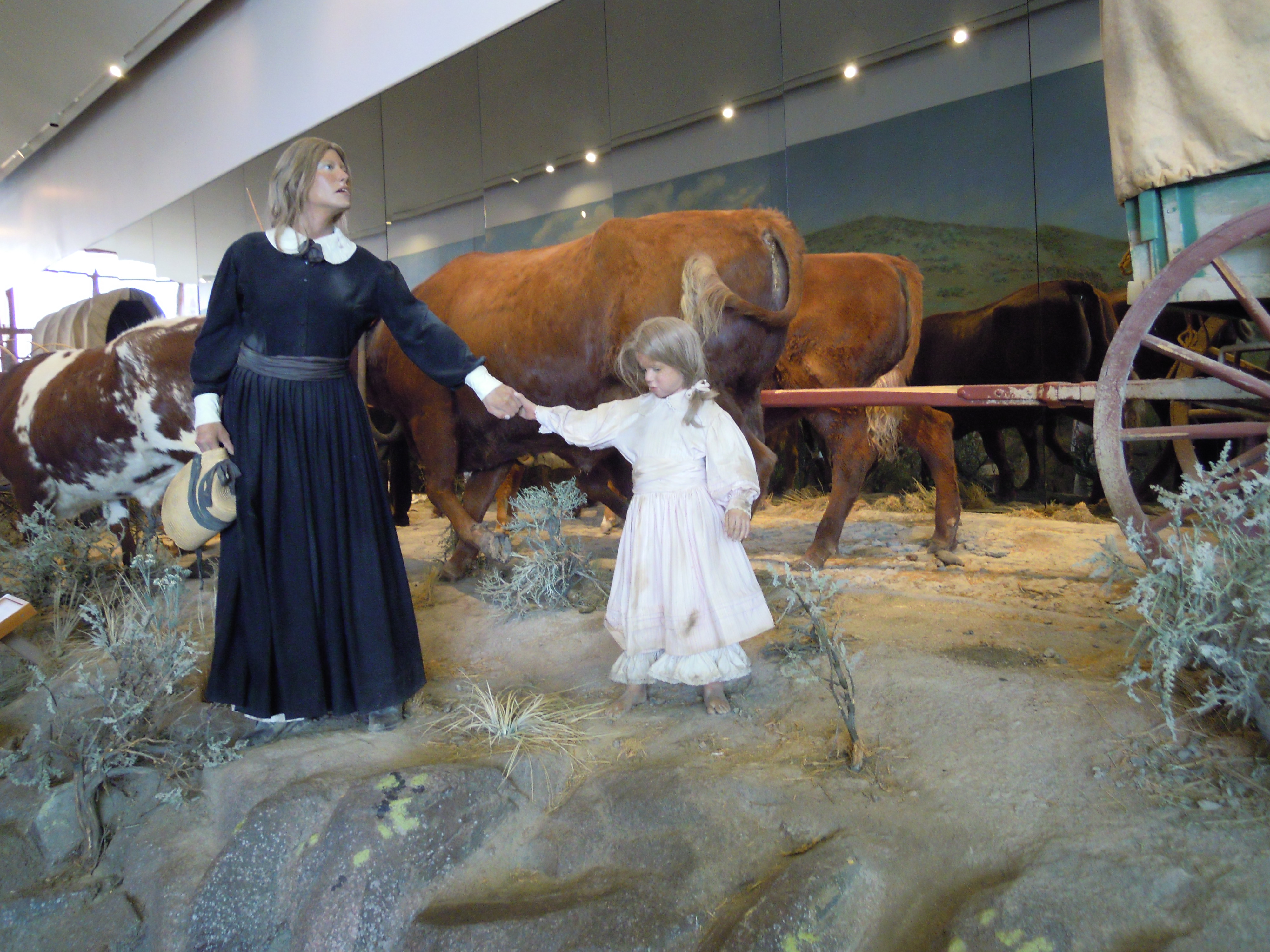
468.diorama mother & childThis photo taken at the Interpretive Center in Baker, Oregon, shows a part of the continuing diorama depicting a wagon train on the Oregon Trail. The woman makes me think of Martha and her little Nora, oldest of her two at the time. My heart tightens as I imagine the strain of traveling that perilous trail with such a precious, vulnerable child. Another even tinier. A third on the way. What a thrill to know in this short Outtake that they have almost made it through. Of course, Martha would have been full in her pregnancy by then.

COMMENT

Outtakes #8 – A Place of Her Own

Returning to my Outtakes series, this post includes another scene slashed from the Oregon Trail chapter of A Place of Her Own, except that a few lines of it were salvaged for a scene that did make the cut. Although there’s some excitement here you may enjoy, I snipped this because I didn’t feel I had an adequate picture of the scene in my mind, and I still needed to trim more words to reach the target word count. This gave me 415. Clip…..

469.diorama oxen & wagonThe photo was taken at the National Historic Oregon Trail Interpretive Center near Baker City, Oregon, one of the fine dioramas inside the center, which gives an authentic impression of that dusty trail.

~~~

Martha stumbled over the rocky road, Nora in one hand, Louisa in the other arm. The wagons jolted, wheels bumping over the rocks. Alkali dust covered everything. Garrett’s growing hair and beard looked white, matted with the white dust. He stopped the oxen and Martha stood where she was, covering her mouth in hopes of drawing clean air, but it didn’t work. Garrett poured water from his pouch onto a cloth, and wiped it over the noses of the oxen, cleaning off a little of the dust.

The animals nodded their massive heads, as if to thank him, and one nuzzled him a little. Old Bob loved to be stroked under his chin, and Garrett obliged for a moment. Zack raised his dust-smudged nose and snorted. He started forward, pushing past Garrett. The loose cattle caught whatever scent Zack smelled and moved ahead with the same urgency, passing Martha and the girls like a stream dividing around three stones.

She heard Garrett’s frantic voice. “Stop them! Don’t let them drink the water. It’s alkali. Stop them!”

“Come on,” Martha said to Nora, dragging her along.

The wagon held back the oxen from going faster than Martha on the rocky path, even with Nora in tow. She contemplated putting the children in the moving wagon, but what if the oxen tipped it over in their frenzy? Careful not to trip on a rock, she ran on. The loose cattle were all ahead now. Larry galloped up, then Newt, hooting and shouting, trying to turn them back. Martha worked her way around the outer edge until she was above the sickly looking water hole. She put the children on a big rock and climbed up after them. The cattle wouldn’t come up here, but she could yell at them from this high place.

She waved her arms and yelled as loud as she could, and the girls did the same, their high-pitched shrieks as loud as her shouts. Garrett was at the water, driving the poor creatures back. So thirsty. So desperate for water. But the alkali water could kill them in a matter of hours. The trail along here was littered with the bones of oxen and fresher dead beasts–along with discarded trunks and furniture . . . and another human grave.

A chill raked Martha despite the heat.

She yelled again, wanting to cry out her own despair, embracing the excuse, until finally the men turned the cattle and managed to move them on.

COMMENT

Portraits of a Century Farm ~ Where Wild Meets Tamed

A herd of Roosevelt elk ranges across the Century Farm my great-great-grandmother Martha bought in 1868. We usually see them in the wilder places of this family farm, on the hill closer to the backcountry timberland where they can duck and hide. But yesterday they visited the orchard along the river, and my son-in-law Robin Loznak had his big camera in hand. With one of his shots I’ve added this post for our series, “Portraits of a Century Farm,” which combines Robin’s exquisite photography with some poetic words from me. Through these portraits we honor Martha’s legacy, with a nod to my book A Place of Her Own that tells her story. See more of Robin’s photos from this encounter on his blog.

web-elk-4(2)Where Wild Meets Tamed

We tame the land, a legacy
From ancestors trekking mighty miles
To stake their hopes in places wild,
Where soils lay rich
Beside washing rivers
Far from home.

And here we stand
In the old orchard,
Tamed in careful rows,
Timeworn trees whispering memories
Of sweet harvests.

Yet in this place
The wild
Walks in,
Stands,
Claims its home,
Our home now too.

Where wild meets tamed,
We live together,
While sentinels
Of wild’s past
Endure.

COMMENT

Outtakes #7 – A Place of Her Own

Continuing the Outtakes of words cut from A Place of Her Own before publication, we come to this short segment, which is an extension of the Oregon Trail scene that ends at the upper third of page 115. Martha knows she’s pregnant by this time, but she isn’t sure Garrett knows. Although I kept a few of these words, I clipped this description of lowering a wagon down a steep hill because there’s another more powerful scene of lowering a wagon down the longer, steeper Laurel Hill on pages 121-122. Also, before visiting the site I didn’t have a clear picture of the setting in mind and decided I’d better leave the scene out. More words cut. Word count dropping, dropping. Clip…..

520.Windlass HillWindlass Hill, the site of this scene, may not look so high or so steep, unless you think of getting a covered wagon down it. I took this photo on our 2014 family trip backtracking the Oregon Trail following the release of the book.

~~~

The higher [Martha] climbed, the more she could see the incredible landscape around them. . . . Garrett caught up with her just as she reached the top, and she stood aside to let him lead. He didn’t say anything. He said little these days that didn’t have to be said, as if the words might drain his energy and he had to save it all for the daily ordeals. She felt something of that herself. She could scarcely catch breath to breathe, let alone use it to talk.

She plodded after him across the high tableland, until the beaten wagon tracks seemed to lead right off into the sky ahead. Garrett stopped the wagon at the edge of the rim, and she hurried to his side. Her heart lunged when she looked down. The land dropped away in front of them in a long, steep bank. Surely he didn’t plan to go down here. But wide scraped tracks led right down the slope to a tree-filled hollow at the bottom.

Garrett unhitched the oxen and began to tie heavy ropes around the wagon’s axles. Larry brought her the children and went to help him. They locked the back wheels by sticking a pole through the spokes from one wheel to the other. Newt held the oxen until Garrett looped the ropes around their yokes. Then with the oxen behind, holding the wagon from falling, the men slowly let out the rope and lowered the cloth-topped vessel down the sandy incline. Martha didn’t think she breathed once until it settled, rocking a little, on the valley floor. But she must have.

“Let’s get down and get on our way,” Garrett said.

Larry motioned for Newt. “We’ll bring the cattle.”

“Help us with the girls first,” Garrett said, “and lead the oxen down. I’d better give Martha a hand.”

When he reached toward her, she took his hand, thankful for his firm grip as they scrambled down the bluff. Did he know the treasure she held inside her? She hadn’t spoken of it yet. Could he tell? If he’d marked the days and noticed her lack of monthlies, maybe he knew. But he hadn’t touched her in that way for so long, how would he? Every night they fell into bed exhausted. Maybe he remembered from before. Maybe he read it in her, the way he read other things of nature.

As soon as he had the oxen hitched again and heard the boys bringing the cattle, he started out once more. Martha had thought they might rest awhile in the pretty hollow, but they had a few hours of daylight. With the girls back in the wagon, she started after him, every step sending up a wave of pain, from her feet feeling every rock through the thinning soles of her boots, up into her ankles and knees.

~~~

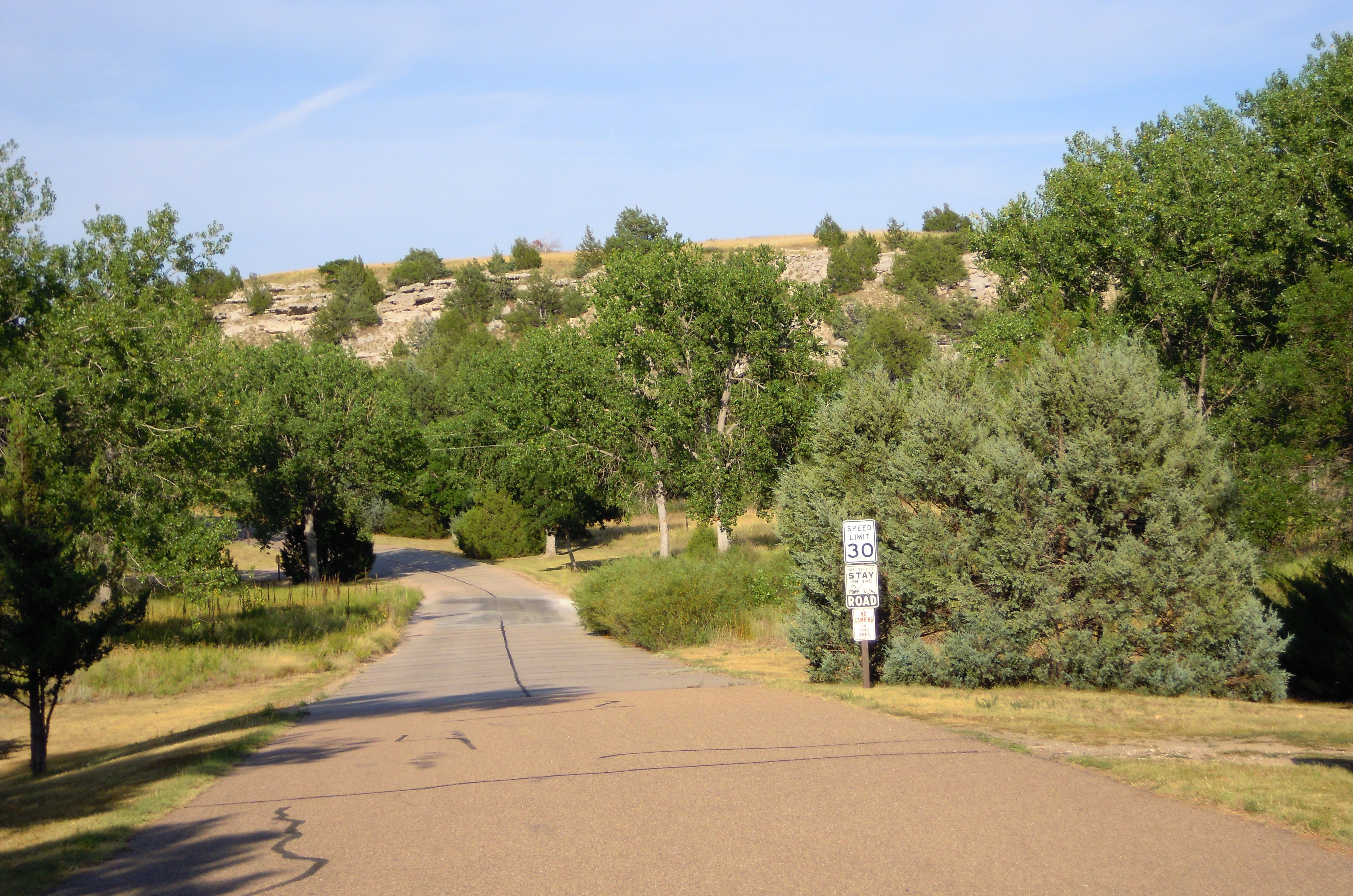
517.ash hollow bluffAsh Hollow lay near Windlass Hill, but farther than I imagined when I wrote the scene, and clearly a more rugged drop from the high tableland. Water in the lovely Ash Hollow became known as a source of the dreaded cholera that ravaged emigrants trekking west. The Maupins were lucky to be spared this deadly disease.

COMMENT