Outtakes #6 – A Place of Her Own

This post concludes the opening scene cut from the Oregon Trail chapter of A Place of Her Own, picking up where last week’s post left off and showing one more setback in Martha’s dreams of an idyllic life with Garrett. Martha has just led her eldest brother Ambrose out to the shed where the family’s wagon awaits the long journey west, the cloth cover not yet attached. As noted for Outtakes #5, the scene is divided into two parts due to its length–more than 1,900 words total, the cutting of which helped me in my struggle to reduce the word count for this book. Clip….

464.two wagons


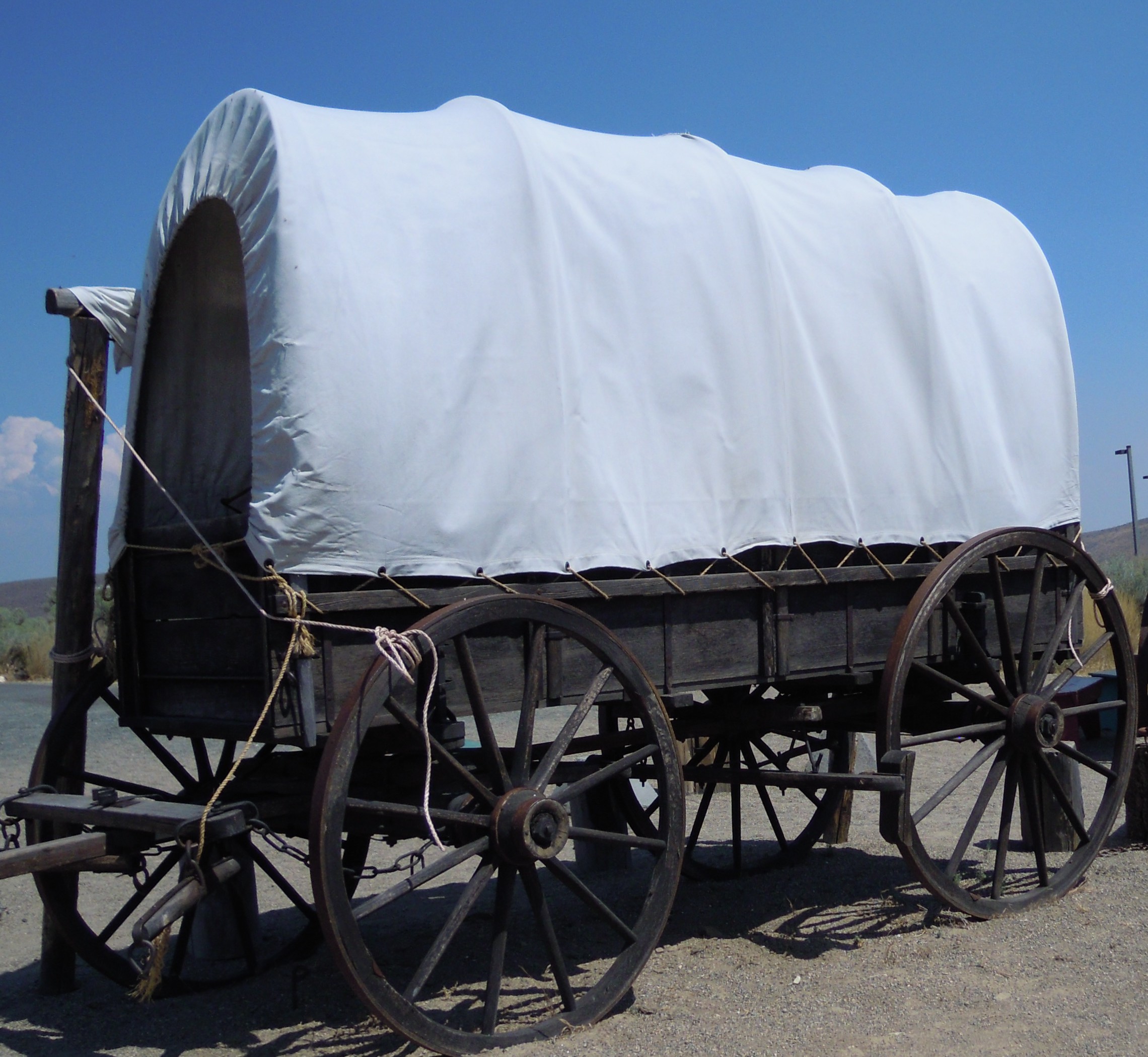
Martha tells her brother about the wagon Garrett built and all that she must do to have it ready for their trip west.

Photo taken by the author at the Interpretive Center at Baker City, Oregon.


Oregon Trail Preparations – Part II

Opening the shed door, she pulled it wide so the sun would cast a light on their prairie ship. The long narrow wagon bed was made of sturdy planks, but not heavy. “It’s tough wood,” she said. “But light enough the oxen can pull it over rough ground, and the yokes are light too.”

He ran his fingers across the joints. “Your husband does fine work.”

A glow flushed her cheeks at his compliment. “He’s particular about it.”

Wooden bows curved up from the wagon bed, ready for the cloth cover. “I have the cover almost done,” she said. “It’ll be two layers, a tougher linen for outside, softer muslin inside.” She showed him her calloused fingers. “It’s not easy to run stitches through that linen. I’ll be glad when it’s done. I’m making pockets on the inside to put things in. There’s so much to carry, but we can’t make it too heavy.”

He nodded. “Lots to think about.”

“Oh yes. Thoughts come to me, even in the night. I have to remember every little thing, this thing and another, and how I’m going to pack it so it’s safe. Ambrose, a person can die out there if they don’t have just what they need.”

“I suppose.”

“I still have to get the food ready and bags to hold it all.” She ticked off the list in her mind–hams and bacon, cheese, rice, coffee, tea, beans, flour, cornmeal, crackers, hard biscuits, lard, dried apples and peaches and prunes. They’d take cows with them and make butter on the way, maybe a couple of chickens in a crate. They’d need pickles to protect them from scurvy on the plains where they’d have no fresh fruits or vegetables. Garrett would bring in game.

She went on. “Besides the food, we need medicines–a box of physic pills, castor oil, peppermint, whiskey.” She also had clothes to make. A new flannel dress, some jeans pants for Garrett. New stockings to knit. More yarn for knitting on the trail. Dresses all cut out for the girls and some muslin shirts for Garrett, ready to pick up and sew when she had a spare moment along the way. Sarah Catherine and her mother had helped. It was good Sarah and young Perry would be staying with their mother.

Ambrose chuckled. “I can see your mind working now. You’ll be all right, Martha. A lot of people are going, and if they can make it you can. You have a good mind.” He rubbed a hand over the wagon’s smooth joints. “And your husband is–well, let’s say if I was going into the wilderness, I’d be happy to be in his company.”

She lifted her chin and glanced out the shed door. “He is a frontiersman, all right. You should see him in his buckskins when he goes out hunting, carrying that long rifle. I don’t remember a time he ever came home empty-handed.”

“You’ll be glad for that out on the prairies.”

Sugar nickered, and Martha went outside to see who she was talking to. The mare stood with head high, ears sharply forward, looking toward the big house. The distant sound of baying hounds echoed through the trees. Riders emerged. Garrett and the boys. Already. “They must have worked things out pretty fast.”

When the three came closer, she frowned. Garrett wasn’t riding with his usual flowing grace. He looked tight, out of rhythm with the horse. Galloping up to the cabin, he pulled his horse up short and swung to the ground, jaw clenched, eyes hard. Without looking at Martha, he led the animal straight to the shed and began unsaddling.

She hurried to his side. “What wrong?”

He kept his eyes on the cinch he was undoing, and his voice rasped with anger. “I’m not going anywhere with that bunch. We aren’t going this year.”

Martha looked at the new wagon, then back at her husband. “What do you mean?”

“Larry and Newt–they’re gonna go this year–just horseback, maybe take a packhorse, maybe not.”

Martha had been working so hard, hurrying to get it all done. She felt as if she’d been running across the grass and tripped on an unseen stone and the ground had come up to hit her in the face. Aware of her brothers walking up behind with their own horses, she turned to see if either of them could make sense of this for her.

Larry spoke before she could ask. “We’ll check out Oregon and let you know what we find.”

“But . . . but what happened with the Ray County company?”

“There were . . .” Larry shrugged. “. . . disagreements.”

“Can’t we find another company?” Martha’s voice rose. “We’ve done so much work to get ready, and with–”

Garrett cut her off. “Then we’ll be good and ready next year.” He gave the horse a rubdown, pulled some hay down from the loft of the shed and piled it on the ground, then stomped away, retreating into the house.

Martha stood staring after him, trying to take in what he’d said. She’d been uncertain about this trip in the first place, wondering about the timing, among so many other doubts. Louisa was a baby. It wouldn’t be easy with a baby as well as a toddler. Nora wouldn’t be three until September. And there was his pa’s estate. How could Garrett leave before that was settled? But when he insisted they would do the trip this year, she’d nursed her own wanderlust and actually developed a growing excitement about it. Now they were just going to drop the plan?

Larry put a hand on her shoulder. “It wouldn’t be good for Garrett to go with that company. They’re a persnickety bunch, all full of dos and don’ts, and you know how Garrett is.”

Newt let out a soft laugh. “I thought he was going to hit that guy when he–”

“Newt.” Larry’s sharp voice stopped his brother.

Martha pinched her brow, lifting her hands. “But can’t we find another company? Can’t we go over to St. Joseph or Independence–one of those jumping off places–like other folks do? Ray County isn’t far, and Garrett thought it’d be good to travel with folks from home, but other people go to those towns and find companies there.”

Larry shook his head, looking at the ground between them. “He seems to have his mind set. Besides, he says he’d better stay on account of the estate. It isn’t quite done yet.”

“The estate?” Martha said. “I asked him about that before and he shrugged it off. Now it’s important? Why? Because he’s mad at somebody?”

Larry’s eyes began to smile. “That’s about it.”
COMMENT

Outtakes #5 – A Place of Her Own

The following is part of a scene that originally opened the Oregon Trail chapter of A Place of Her Own, and now becomes a part of this Outtakes series of scenes cut from the book. The segment shows Martha with her oldest brother Ambrose, who moved from Illinois to Missouri sometime before the 1850 census. It’s a pleasant scene and tells about the preparations for that amazing trek west to Oregon. But altogether it’s over 1,900 words, and it didn’t move the story sufficiently to hold its place. This was the cut that convinced me I could actually trim the book by the necessary 22,000 words. Yay! Clip…..

Note: I’m dividing the scene into Part I and Part II because it’s so long.

464.two wagons


Garrett built a wagon like this for their family, and Martha sewed the cover.

Photo taken by the author at the National Historic Oregon Trail Interpretive Center at Baker City, Oregon.


Oregon Trail Preparations – Part I

Ray County, Missouri, April 1849. Their small Missouri cabin echoed with quiet as Martha sat next to her oldest brother Ambrose before the low fire. Only the steady whisk of the rockers sounded above the soft snap of coals as Ambrose leaned back in Martha’s rocking chair and moved slowly back and forth, while she perched on the edge of a stool and poked at the fire. The homey scent of the hearth wafted through the room.

Garrett had left for town with Larry and Newt, while Ambrose stayed behind with her. “They didn’t need me,” Ambrose said. “I thought this was a good chance to visit with you.”

Garrett and the boys went to talk with some folks who were trying to put together a company from Ray County to travel together to Oregon. Martha was glad Ambrose rode over from Carroll County with the younger two. Although she regretted Doc didn’t join them, she appreciated a chance to spend time with her oldest brother.

Larry and Newt had come to Missouri early this spring, still full of excitement about Oregon. A veritable land of milk and honey, to hear them tell it. Garrett wanted to sell the Missouri place and get on his way. But it wasn’t that easy.

Ambrose and his wife Polly had finally moved to Missouri the year before and lived with their family in the cabin Simpson built for himself on Doc’s second forty over in Carroll County. Oregon fever hadn’t quite hit Doc or Ambrose, but Martha had trouble imagining her next step west without Doc.

Garrett had been working on him. “The future’s in Oregon, Doc. Too many people in Missouri.”

“Well, there’s California.”

Last December when President Polk confirmed rumors about gold in California, Martha had seen the sudden glint in Garrett’s eyes, as if reflecting a bit of that gold.

“Not the best place for families, though,” Doc had said.

Now, glancing at their new baby Louisa in her cradle, born that very month of December, Martha remembered wondering if Garrett might just go without her and the girls. But his talk still focused on Oregon.

She smiled at Ambrose. A soft-spoken man, he exuded a kind of self-assurance that put her at ease, a trace of gray in his beard and hair giving him a distinguished look. “I’m glad you’re here,” she said, meaning it more than she knew how to say. He’d been like a pa to her these last few months, now that their own pa was gone. Heaving a sigh, she stood and looked out the gleaming glass window of her cabin to the pasture where her mare Sugar grazed, Howard’s gift. “I wish I could have been there when Pa went. And Ma, so soon after. Do you think they ever forgave me?”

“They loved you.”

A heavy band seemed to tighten across her chest. “I know, but did they forgive me?”

She turned to see her brother’s gentle expression, the warmth in his eyes, the slightest curve of his lips as he spoke. “It’s hard to say with them. You know they never said a lot about things like that. But you can’t change it now, Martha.”

She looked out at Sugar again. “No.”

“I’ve no doubt Doc thought he was in the right to give your consent. Pa did tell him he had full responsibility for you. I heard him. Now, Pa may not have thought through what that could mean, but he said it.” Ambrose got up and came to her, setting a tender hand on her shoulder. “It isn’t easy to get through life without some trials with those you love. But when it’s done and you can’t do any more about it you can’t dwell on the trials–just the love. Somehow I think they understand now.”

Martha batted her eyes, moist with tears. “You boys all scattered soon after, didn’t you? You came here, now Larry and Newt.”

“And Simpson followed Stephen to Scott County. I don’t know what Ben will do.”

Lifting her shoulders high, then dropping them, Martha turned and grasped Ambrose’s arm. “Let me show you what we’ve done to get ready for Oregon. It’s going to be an amazing trip, Ambrose. I wish you’d think about it.”

He laughed, a hand on his soft beard. “I’ll think about it, but I hear they need a Justice of the Peace in Carroll County, and I think I’ll give that a try for now.”

“Justice of the Peace?” She smiled. “You’d be good at that. Come on outside. I’ll show you the wagon.” She tiptoed over to where the girls were napping–Louisa in the cradle, Nora on the small mat beside. Sleeping soundly. Nodding to Ambrose, she slipped out of the cabin to lead him to the shed out back, leaving the cabin door open so she could hear if the girls woke. “They should sleep awhile longer. Come see. We’ve done a lot of work already.”

Part II next week…

COMMENT

Backtracking the Oregon Trail #9

Day Five ~ Back to the Beginning

464.two wagonsThe land was mostly dry and dusty. . . . The Platte River making its lazy way between sandy bluffs, curving along a wide swath of bottomland. The shallow stream could sometimes be as much as two miles wide and a few inches deep. . . . Islands and sandbars, quicksand. Muddy, warm.
They were finally on their way. . . . The weight of troubles slipped from her shoulders as she looked west toward a new land and new possibilities. . . .
A Place of Her Own: The Legacy of Oregon Pioneer Martha Poindexter Maupin, Janet Fisher. (Guilford, CT, Helena, MT: TwoDot/Globe Pequot Press, 2014), pp. 109-110, 104.

Saturday, May 25. Still traveling up the Platte. The road is a little monotonous. The scenery does not change much. The river has a winding course and contains many islands. Some are little more than sand bars, others are covered with low willows. The road is at times along the river bank, and again near the bluffs on our left.
—The diary of Margaret A. Frink, in Covered Wagon Women: Diaries and Letters from the Western Trails, 1840-1890. Vol. 2, 1850, Kenneth L. Holmes, ed. (Glendale, CA: The Arthur H. Clark Co., 1990), p. 89.

Took up camp after dinner & started up the Platte. . . . The road is level being between the bluffs & the river. The Bluffs are very high & picturesque. The river ranks among the first class as to width but is very shallow as indicated by the many islands with which it is filled.
—The diary of Celinda Hines, in Covered Wagon Women: Diaries and Letters from the Western Trails, 1840-1890. Vol. 6, 1853-1854, Kenneth L. Holmes, ed. (Glendale, CA: The Arthur H. Clark Co., 1986), p. 89.

June 17th Traveled near the Platte all day and encamped near it at night. This is a turbid river, no trees of any size to be seen. We make out to use the water by sprinkling in a little corn meal This makes it a little cleaner.
—The diary of Rachel Taylor, in Covered Wagon Women: Diaries and Letters from the Western Trails, 1840-1890. Vol. 6, 1853-1854, Kenneth L. Holmes, ed. (Glendale, CA: The Arthur H. Clark Co., 1986), p. 164.

May 10th [at St. Joseph] Crossed the [Missouri] river without any difficulty . . . The surrounding scenery is delightful The soil is fertile and lacks nothing but improvement to make it one of the first places in the world in agriculture;; My sister and I ascended to the summit of a hill and with the aid of a spy-glass took a farewell view of St. Joe. and the United States.:
—The diary of Abigail Jane Scott, in Covered Wagon Women: Diaries and Letters from the Western Trails, 1840-1890. Vol. 5, 1852, The Oregon Trail, Kenneth L. Holmes and David C. Duniway, eds. (Glendale, CA: The Arthur H. Clark Co., 1986), p. 49.

I could not begin to tell you how many their [are] in St Joseph that are going to Oregon and California but thousands of them it is a sight to se the tents and wagons on the banks of the river and through the country
—The diary of Mary M. Colby, in Covered Wagon Women: Diaries and Letters from the Western Trails, 1840-1890. Vol. 2, 1850, Kenneth L. Holmes, ed. (Glendale, CA: The Arthur H. Clark Co., 1990), p. 48.

462.one lg wagonBy Day Five we had to push forward without delay. We followed the trail a ways, along the main fork of the Platte River, lush and green now with farming, bluffs on either side. You can tell where the river is by the line of trees that marks it.

Martha wouldn’t recognize this any more than she could have recognized the land along the North Platte. She would have remembered a much drier place with fewer trees, and those often limited to the islands of the wide, meandering waterway.

Pushing eastward into the tall grass country, we saw more farms where Martha would recall prairie grasses that could grow six feet tall, and flowers in swashes of color reaching into an arc of blue sky.

509.chimney rock & sunflowersThe native North American prairies west of Missouri changed gradually going westerly—from tall grass to mixed grass to the short grass of the high desert. From the diaries it sounded as if the tall grass had pretty well played out by Fort Kearney, soon after they reached the Platte. Somewhere in there you begin reading about lack of wood and the need for that substitute fuel offered by the buffalo that ranged across the region—buffalo chips. Different companies of wagons spread out so their livestock wouldn’t overgraze along a single track, here where the land stretched wide enough so they could.

I didn’t take any pictures on Day Five, maybe because the landscape seemed monotonous, mostly flat, green, looking nothing like the place described in the diaries. A monotony of a different kind. As we continued eastward the flat land spread farther to the horizon so the bluffs on each side sometimes disappeared in the distance. And a gradual greening occurred the farther east we drove—probably as that earlier vegetation once changed from shorter mixed grasses to the tall prairie grass, going the opposite direction the emigrants were.

The Weston plow, invented in the late 1850s, changed this landscape. Before the Weston, no plow could cut through the tough root system of the tall grasses. But this new plow had the power to turn the turf over. Farming was born in the tall grass prairie. A few industrious souls today are trying to return portions of this land back to its native state, but they have strong competition from agribusiness.

We left the trail around Kearney for the shortest route to our destination, finally reaching the Missouri River and St. Joseph, one of the popular jumping-off places for emigrants embarking upon the Oregon Trail.

463.wagons high plainsFolks couldn’t just march west when they had a mind to. They faced a small window of time when it was advisable to go—to jump off into the wilderness and one of the most profound adventures of their lives. They had to wait until the prairies greened up in the spring to offer feed for their livestock, and they had to cross the last mountain before the winter snows. Towns like St. Joe, Independence, and Westport (which became Kansas City) grew up where people waited, and businessmen set up shops to offer supplies in case folks still needed goods. Business could be brisk while folks waited and shored up the wagons.

Reading the diaries you feel the gradual shift as the bright hope at the outset begins to fade. Exclamations of “beautiful scenery” and “good roads” turn to words like “tedious” and “monotonous.” The good roads turn dusty. The lush grass becomes scanty. The way ahead feels longer, less certain. I am reminded of Joseph Campbell’s heroic journey. Isn’t that the way of every major endeavor? We leave the familiar because something compels us. And if we knew in the beginning how hard the road would be, we might never have the courage to go. Hope compels us, and though things get rough in the middle, we come out on the other side, having triumphed or at least having learned something.

502.painted wagon & oxen scotts bluffNearing the end of our journey we decided to stop in St. Joe for dinner. We were so ready for a decent meal. Our own struggles paled in comparison to those of the intrepid pioneers, but we were anxious for a few of the comforts.

Christiane had hoped to arrive at her house before dark, having rented the place sight unseen, except for pictures.

Maybe with a quick meal we could have made it, but our desire for something better outweighed her plan. We enjoyed a delicious sit-down dinner and reached Kansas City in the dark.

The map of freeways and streets looked as if a drunken spider had gone on a spree and built a crazy web. It took careful watching for signs, but our directions led us right to the house, and we were pleased to see the canopy of large trees in the neighborhood. When we stopped in the driveway and opened the car doors, a strange sound reverberated around us. It seemed almost like an electronic buzz and I wanted whoever was doing it to turn off the music or machine or whatever was making that noise. We were so exhausted we just wanted to go in and make our beds on the floor—to sleep and await the moving pod and real beds the next day. But what was that sound?

We learned there were huge cicadas, and maybe some tree frogs adding to the chorus, and over time we began to get used to them. We could barely hear them inside the house with doors and windows closed. So they didn’t keep us awake. They did make our chirpy critters back home seem like soft crooners.

So our journey ended near where Martha’s started. She began with hopes high, marching out onto the wild prairie. We entered the city—one of those jumping-off places—tracking a wild network of freeways in the dark. But we shared her sense of hope for new adventures and possibilities.

Scotts Bluff National Monument: Landmark on the Overland Trails, A History and Guide, Dean Knudsen, Historian, National Park Service, pp. 34-36.

Women’s Voices from the Oregon Trail, Susan G. Butruille. (Boise, ID: Tamarack Books, 1993), pp. 21-22.

NEXT: Afterword

COMMENT

Backtracking the Oregon Trail #8

Day Four ~ The North Platte River

516.north platte westNorth Platte River looking west

Martha looked up the long dry slope they had to climb. Bluffs came right to the river’s edge here, so they couldn’t pass. They had to go around and that meant up. She clasped a child in each hand and started walking. . . .
Thank goodness for the women. What would she do without other women to laugh with and share stories with? Much as she loved Garrett and her brothers, they didn’t see life in quite the same way.
A Place of Her Own: The Legacy of Oregon Pioneer Martha Poindexter Maupin, Janet Fisher. (Guilford, CT, Helena, MT: TwoDot/Globe Pequot Press, 2014), p. 113, 110.

It is singular that on the north side of the Platte here is not a vestige of a tree in sight—save one “Lone Tree” for 200 miles & yet on the South side there is an abundance of Cedar fastened in the rock Bluffs & some Cottonwood. But the feed for cattle to all appearance is much better on the N. side
—The diary of Polly Coon, in Covered Wagon Women: Diaries and Letters from the Western Trails, 1840-1890. Vol. 5, 1852, The Oregon Trail, Kenneth L. Holmes and David C. Duniway, eds. (Glendale, CA: The Arthur H. Clark Co., 1986), p. 191.

13th Monday . . . the road soon leaves the bottom & leads upon the bluffs which are here of a rocky formation which seems to be a mixture of sand & lime In about three miles we came to Ash hollow so called from the ash trees which grow there. We had looked to this place as one where we should have plenty of wood & water . . . The glen is very picturesque rocks rise almost perpendicular two hundred ft or more We had scarcely encamped in a prettier place . . . 
—The diary of Celinda Hines, in Covered Wagon Women: Diaries and Letters from the Western Trails, 1840-1890. Vol. 6, 1853-1854, Kenneth L. Holmes, ed. (Glendale, CA: The Arthur H. Clark Co., 1986), pp. 91-92.

june 23 [Sunday] we camped in ash holler fifteen miles from whare we campe before and their was a tremendous thunder sawer one role after nother till it killed a horse that was onley one rod from our wagon that night Sarah was taken sick we had no super
June 24 we camped on the north fork of the plat river and sarah was very sick . . . I soon saw she would die and she did die before noon o how lonely I felt to think I was all the woman in company and too [sm]all babes left in my care it seams to me as if I would be hapy if I only had one woman with me
—The diary of Sarah Davis, in Covered Wagon Women: Diaries and Letters from the Western Trails, 1840-1890. Vol. 2, 1850, Kenneth L. Holmes, ed. (Glendale, CA: The Arthur H. Clark Co., 1990), pp. 179-180.

July 21. We again are pursuing our teadious journey. For the first 3 miles it was up hill then we came to a ridge. This extended to Ash hollow & when we came to it we found ourselves on the top of a high hill, precipices & deep ravines. In these ravines & on either side of the bluffs are trees growing in crevises, ash & red cedar. It is the most romantic place we have seen yet.
—The diary of Lucena Parsons, in Covered Wagon Women: Diaries and Letters from the Western Trails, 1840-1890. Vol. 2, 1850, Kenneth L. Holmes, ed. (Glendale, CA: The Arthur H. Clark Co., 1990), p. 251.

515.north platte eastNorth Platte River looking east

Martha wouldn’t recognize today’s North Platte River. With passage of the Homestead Act in 1862, people started taking a second look at that land west of Missouri. And completion of the transcontinental railroad in 1869 insured easier transportation to markets.

Instead of seeing the Platte River Valley as a long impediment to a West Coast destination, folks began to see the farming possibilities right there. Add more water with irrigation and the possibilities increased dramatically. So farmers came. They dug plows into the rich soil, built irrigation canals—and changed the character of the valley.

As we traveled along the North Platte, I felt the need to conjure up long-departed images. Massive herds of buffalo. Grassy plains. And where exotic trees and shrubs flourish along the riverbanks today, I imagined a land with few trees in sight and scarcely a stick of wood for a campfire. The buffalo herds may have eaten down the grass along the way, but they left a perfectly good substitute for campfire fuel—buffalo chips. Yes, that’s manure. Folks said it didn’t smell so bad and didn’t give the food a bad taste when used for cooking.

517.ash hollow bluffBluff above Ash Hollow

As you drive along the high plateaus you can still see some of the drier landscape the emigrants might have seen. Maybe the soil is too thin up there for farming, so this land has been left to its earlier state. The land has broken away on the edges of some of those plateaus, as if chopped away by a cleaver, baring the rocky interior, like the one overlooking Ash Hollow (above). Soil looks pretty thin at the top.

Before reaching Ash Hollow, most emigrants, traveling on the south bank of the main fork, had to cross the South Platte to make their way over a high plateau to the North Platte where the trail continued. At that river crossing they found that the lazy Platte had turned quite rough, although it was shallow enough to ford. From that harrowing plunge across the water, they met with the strenuous climb to the plateau.

520.Windlass HillWindlass Hill

But after following the trail across that high plateau they found no good way down. The gentlest slope appeared to be Windlass Hill. So they stopped at the top of this hill and lowered the wagons with ropes. There would be worse to come, but anytime you have to lower a wagon with ropes it’s a treacherous undertaking. Quite a bit of excitement after the flat prairie they’d followed for many long days. When they got to the Oregon Cascade Mountains and saw Laurel Hill, though, this one would pale in comparison.

From Windlass Hill they made their way to nearby Ash Hollow where even in that day a refreshing grove of trees awaited them. But the Ash Hollow springs held a deadly secret. In bad cholera years that spring water harbored the lethal cholera bacteria. It could strike with sudden force, killing a healthy person overnight. The diary of Sarah Davis (above) touches my heart on so many levels.

We weren’t able to get into Ash Hollow park but could see a little of it from the gate. The park was closed the day we passed through. I had hoped to meet with someone who would let us in, but we got there too late in the day.

519.bunny windlass hillI don’t know if this is a native bunny species that we saw at Windlass Hill, but we observed many of them and would see them frequently—right outside the door—in Christiane and Calliope’s new home.

We stayed that night in the town of North Platte, Nebraska, which lies just east of where the main Platte River splits into the North Platte and South Platte. We were relieved to get in before dark that evening and rested up for the final day of travel.

Women’s Voices from the Oregon Trail, Susan G. Butruille. (Boise, ID: Tamarack Books, 1993), pp. 165-166.

NEXT: We’ll head over that flat prairie along the main fork of the Platte, then take the shortest route to the Missouri River, back to the Oregon Trail’s beginning.

COMMENT

Backtracking the Oregon Trail #7

Day Four ~ Chimney Rock

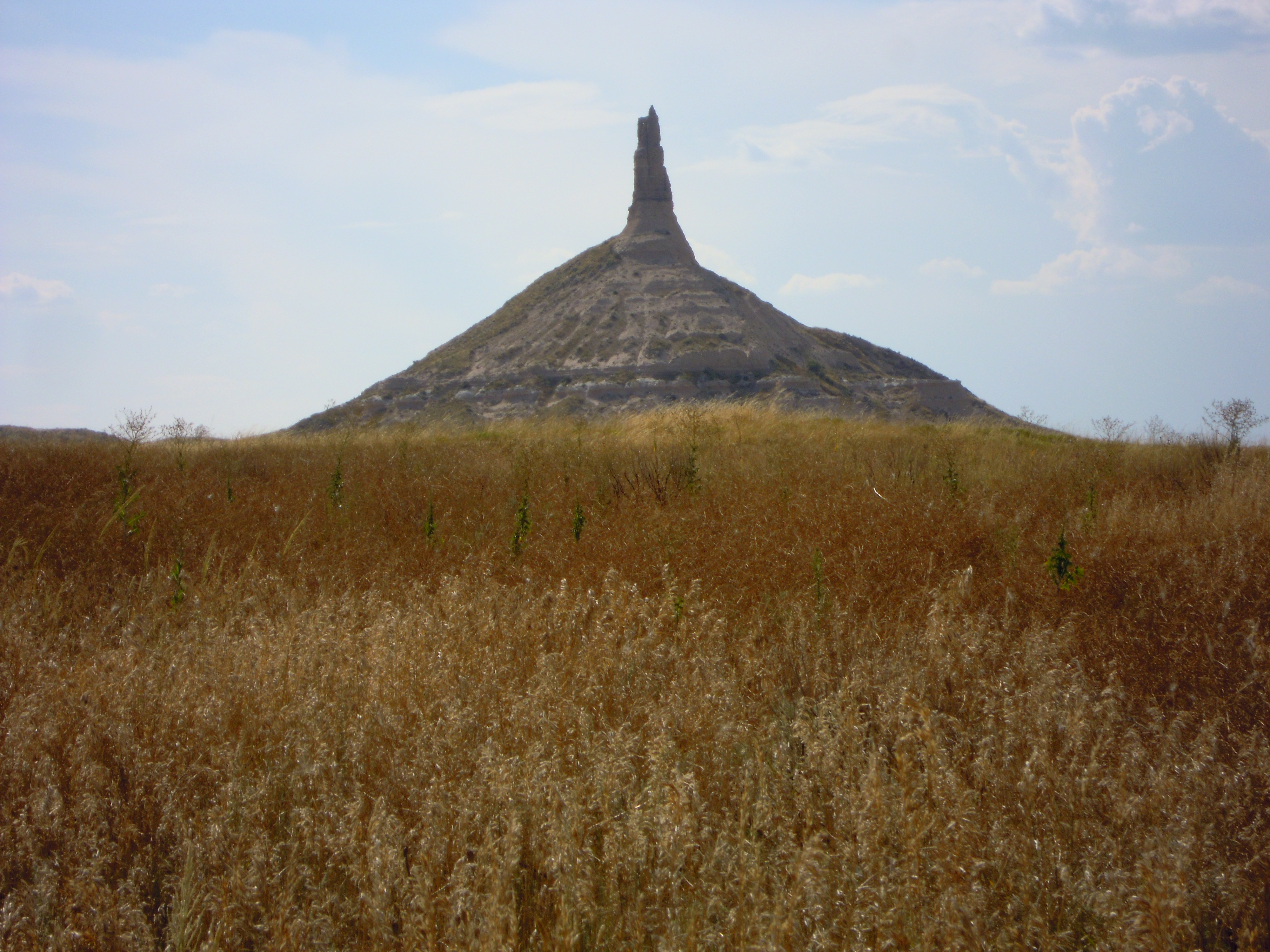
508.chimney rockHer left boot was getting a hole in it, letting the gritty dust in to nestle between sole and foot and bite in worse than the grit outside the sole. . . . Step after step . . . past natural wonders . . . Chimney Rock . . . Scotts Bluff. . . . She couldn’t get her breath. She was three months pregnant.
A Place of Her Own: The Legacy of Oregon Pioneer Martha Poindexter Maupin, Janet Fisher. (Guilford, CT, Helena, MT: TwoDot/Globe Pequot Press, 2014), p. 116.

Wednesday, June 5. The weather to-day was quite hot and oppressive. We had to cross a long stretch without water. The road we took led us close to the base of Chimney Rock, where we stopped for some time to satisfy our curiosity. The base is shaped like a large cone, from the top of which rises a tall tower or chimney, resembling the chimney of a manufacturing establishment. . . . It is composed of marl and soft sandstone, which is easily worn away. Mr. Frink carved our names upon the chimney, where are hundreds of others.
—The diary of Margaret A. Frink, in Covered Wagon Women: Diaries and Letters from the Western Trails, 1840-1890. Vol. 2, 1850, Kenneth L. Holmes, ed. (Glendale, CA: The Arthur H. Clark Co., 1990), p. 95.

Came opposite Chimney Rock which has been sight since yesterday. It has been seen 30 miles off on a clear day. Three of us went to it. I was struck with amazement at the grandeur of the scene.
—The diary of Lucena Parsons, in Covered Wagon Women: Diaries and Letters from the Western Trails, 1840-1890. Vol. 2, 1850, Kenneth L. Holmes, ed. (Glendale, CA: The Arthur H. Clark Co., 1990), p. 253.

June 14th Traveled twenty four miles:. We have seen very romantic scenery all day; The Chimney rock has been in full view all day:; It is represented as being three hundred feet high but from the road we are traveling it does not appear to be more than one hundred feet.;. Palmer in speaking of this rock very truly says that it has the unpoetical appearance of a hay stack with a pole extending far above its top
—The diary of Abigail Jane Scott, in Covered Wagon Women: Diaries and Letters from the Western Trails, 1840-1890. Vol. 5, 1852, The Oregon Trail, Kenneth L. Holmes and David C. Duniway, eds. (Glendale, CA: The Arthur H. Clark Co., 1986), pp. 65-66.

To day we come to the river opposite Chimney Rock which has been visible most of the way for the last 35 miles It is said to be 3 miles from the opposite side of the river but on these level prairies we cannot judge much of distances by the eye It does not appear more than half a mile It consists of a large square column of clay and sand mixed together with a base of conical form apperantly composed of sand, round base cone. and appears as if the column had been set up and the sand heaped around it to sustain it It is said to be 500 feet high but doubt it some
—The diary of Cecelia Adams & Parthenia Blank, in Covered Wagon Women: Diaries and Letters from the Western Trails, 1840-1890. Vol. 5, 1852, The Oregon Trail, Kenneth L. Holmes and David C. Duniway, eds. (Glendale, CA: The Arthur H. Clark Co., 1986), p. 271.

At night we came to Chimney rock which had been visible to us for 15 miles. . . . We camped near the river about two miles from the rock. After tea uncles, Mr Long, Julia Martha & I went to see it by moonlight The sight was awfully sublime The sides of the base on which the pillar rests are so steep that it was with the utmost difficulty we could climb up it at all. We however succeeded in climbing up some distance. We found it covered with names We got back to the camp about 10 O’clock
—The diary of Celinda Hines, in Covered Wagon Women: Diaries and Letters from the Western Trails, 1840-1890. Vol. 6, 1853-1854, Kenneth L. Holmes, ed. (Glendale, CA: The Arthur H. Clark Co., 1986), pp. 92-93.

502.painted wagon & oxen scotts bluffDownriver from Scotts Bluff my family and I finally came upon another of the famous landmarks along the Oregon Trail, Chimney Rock. Traveling eastward, we didn’t see it right away. But perhaps even more than Scotts Bluff, this one cannot be mistaken once seen. Many a pioneer commented on this remarkable feature that points a jagged finger to the rich blue skies.

The pinnacle rose before us, one of the more amazing sights on our journey from Oregon to Kansas City, as we retraced the footsteps of our pioneer ancestors who took this trail westward. My daughter Christiane and I had seen it years ago when our family took a camping trailer over this route. And having traveled the trail again in my mind as I wrote Martha’s story, A Place of Her Own, I thrilled to see it firsthand once more and show my granddaughter as well.

By the time we reached the visitor center for this geological marvel, the thermometer was inching up to 100. And at this site we didn’t see a speck of shade. We dismissed any notion of trekking to the monument’s edge, but I hurried into the visitor center while my daughter and granddaughter stayed with the dog in the air-conditioned car, the motor running. I had previously sent a copy of my book to be reviewed for their gift shop and stopped in to introduce myself.

Thinking about our pioneers ancestors, I could only imagine how miserable it would have been for these people and their animals to trudge across the barren land here on days such as this. The photo above of a painted wagon and oxen from the Scotts Bluff site helps bring the image to life.

As with Scotts Bluff, the sediments on the unusual Chimney Rock landmark show the many layers set down by nature over time. Travelers along the Oregon Trail must have wondered how these imposing features happened to be here. The formations appear to hold the strength of the ages, but they’re gradually disintegrating, much as they’ve been doing for thousands of years.

Scientists say it all started with a major geological uplift along North America’s west coast 70 million years ago. A huge inland sea once covered this central part of North America, but that land rise on the coast created the Rocky Mountains, displacing the inland sea. Water on the east side began to wash into the Mississippi River Basin. Wind and water carried huge amounts of sediment from the Rockies and deposited it here in layers of sand and silt, the accumulated weight compressing the deposits into sandstone and siltstone. Periodic volcanic activity added layers of ash.

Then about 10 million years ago the uplift increased, and streams moved faster, carving deep into the deposits. Here and there, denser stone held firm, where hard capstones of limestone at the top held down the layers so they still show like a layer cake of varied flavors.

509.chimney rock & sunflowersWe saw lots of wild sunflowers along the way. They looked pretty next to these unidentified white flowers near Chimney Rock (directly above). We saw many bunnies and a magpie or two, but none of the prairie rattlesnakes that signs warned us about.

Life forms no longer seen in this area walked these lands 30 million years ago. Their fossils have been preserved in the sand and silt layers—animals like rhinos, camels, giant hogs, and a few stranger creatures, as well as huge turtles.

Humans began appearing around 10,000 years ago, or possibly earlier. People developed agriculture along the North Platte River, then abandoned the area around 1400 AD, probably due to drought. Later, eastern tribes were pressed into the area by European settlement. When the Spanish reintroduced the horse to this continent in the 16th century, that animal changed the lives of the tribes then living on the plains, providing mobility and prowess in battle. These were the people American emigrants met on their way west over the Oregon Trail.

Scotts Bluff National Monument: Landmark on the Overland Trails, A History and Guide, Dean Knudsen, Historian, National Park Service, pp. 2-7.

NEXT: The North Platte and Ash Hollow

COMMENT


Look for the Wagon ~ Soon

462.one lg wagonThe first post in my new category, “Backtracking the Oregon Trail,” should be ready within the next 2 or 3 days. I’ve collected some quotes from diaries of women who traveled over that trail in the mid-1800s. Putting those together with quotes from Martha’s story, I hope to offer a few brushstrokes of color to show moments of their journeys as I describe highlights of our own trip retracing their footsteps. I hope you’ll join us.

COMMENT