It’s in Dublin! And I needed to see it! Gold has a place at the heart of my new Irish story. So I set aside a day for this. Welcome to my traipse through Ireland’s glorious golden past.
This intricate gold neck ornament, made in Ireland, comes from the Late Bronze Age, somewhere between 1000 and 500 B.C., during the period of my story.
So much brilliant ancient goldwork has been found in Irish bogs and waters, hoards of it. And the National Museum of Ireland–Archaeology has a dazzling display, including the samples shown in this post. I would spend hours there, stepping into Ireland’s ancient glory.
The lunula goes back to 2300-2000 B.C., named for its crescent moon shape.The museum has many on display, this one showing a good example of the intricate incised markings.
The lunula, like the one above, appears in my story on the necks of clan mothers and future clan mothers in ancient Éire. A lovely ornament made from thin hammered sheets of gold with the incised designs.
When I proceeded to write my newest novel, I first had to decide where to set it. Where did I want to spend the next months, maybe years–at least in story if not in person? The answer came quickly. Ireland.
The next question. When?
I pulled out books and notebooks I’d gathered for other work and began poring through them for intriguing periods in Ireland. One thing jumped out at me. Gold! Historians describe the period around 800 B.C. as a time of a sudden uptick in rich production of gold in Ireland, a veritable revolution in goldwork. This was also a period when the early proto-Celtic culture was thriving in faraway Hallstatt, Austria. I knew how the Irish love their Celts. They wouldn’t be in Ireland in 800 B.C., but could I find a way to bring them into the story?
My decision was soon made. My new book would open during this explosion of fine goldwork, and my protagonist would be a goldsmith–a rare thing for a girl.
So this spring in Dublin I stepped down into the center of the museum where a glittering world of gold surrounded me to learn what goldsmiths were doing in those momentous days.
Gold dress fasteners c. 800-700 B.C.Gold bracelets and dress fastener c. 800-700 B.C.Gold foil-covered sunflower pins c. 800-700 B.C.Gold foil-covered bulla probably worn on a cord around the neck c. 800-700 B.C.Part of a gold bobbin-shaped ear spool possibly to be worn decoratively over the ears c. 800-700 B.C.Lock rings, hair ornaments that appear to be incised, but the lines are made of tiny wires soldered on. c. 800-700 B.C.
The soldered wires in the lock rings are so tiny they barely show in my photos. The enlarged one from the upper left of the photo above it may show the lines better, the curve. Such delicate, intricate work illustrates the fine skill of goldsmiths in this period. If they did this as Levaen did, they hammered the gold into a thin sheet, then rolled from the edge to create the wires and bonded them in place with soldering particles.
This small sample of the museum’s 800-700 B.C. goldwork that fits into my story’s timeline shows no brooch like the one my protagonist Levaen makes in the book, nor did I find anything like it. I began to worry about that, but Carisa, my daughter and beta reader, pointed out that there was no reason Levaen’s fictional goldwork should show up in the Dublin museum, and I remembered that the story presents Levaen’s brooch pattern as special in her own time. What the museum exhibits showed, especially the lock rings with their thin wires, was that the actual goldsmiths of that era were familiar with techniques like the thin wires and soldering Levaen uses to create her brooches.
Going farther back to 1200-1000 B.C. are three twisted gold bracelets and two gold grooved bands.And a gold torc with ribbed rings and bracelets from 1200-1000 B.C.
One exhibit offered a portrayal of how some of these golden objects might have been worn. This illustration features goldwork from the Late Bronze Age, roughly 1000 to 500 B.C., a neck ornament like the one in the photo at the top of the post, along with ear spools of sheet gold, and arm and wrist bracelets pictured above.
Of course these items could have been worn by either men or women or both. There might have been chiefs or chieftainesses. Or perhaps the general public would have donned such brilliance for special occasions. We can only wonder and imagine.
There was so much more gold in the museum’s collection, but some bronze too, that caught my eye.
Swords from 900-500 B.C. Some look like leaf-shaped Hallstatt swords but they’re not labeled as such.
No one knows when the Celts came to Ireland. We only know the language came, so they must have come. But they would not have been in Ireland in any numbers at the time of my story. A few Hallstatt swords possibly came earlier, by trade or other means. Enough to tantalize but not to prove anything.
There’s no intrinsic method of dating metal, so dating depends on surrounding materials that can be dated. In fact, on at least one occasion they found a lunula in a wooden box, which identified the time of its use by testing the wood. Surely a precious object. Dating offered with the museum exhibits of gold and bronze would have been confirmed by surrounding material, but they give a broad span as noted in captions here.
Many objects in the exhibits are labeled as parts of the hoards that included them, deposits placed into bogs or lakes or streams. Why the ancients deposited such hoards, no one knows. Bogs may well have been lakes at the time of the deposits and later dried up, so all deposits may have been placed into the waters. Or some dry or partly drained bogs may have been dug into and the items buried. Were the treasures cached in a time of escape from some crisis? Or were these offerings to their deities? All we can do is guess. We have no writing, no histories, to tell us.
The hoards weren’t all glorious gold. Many practical items were included. A lot of bronze. Practical axe heads, chisels, horns, cauldrons. And swords and spear heads.
Some items are just delightful objects like the one pictured below. I so enjoyed seeing it, I chose to share it here, even though it’s later than my story.
Miniature 7-inch-long gold ship with sailing mast and oars from the 1st century B.C.
When you’re already living in the Bronze Age and something appears to be old in the extreme, you have really fallen back in time from our perspective. One of my characters experiences that phenomenon, and when I followed her into Portugal’s interior I fell back with her.
After Zambujal I planned to spend six nights in the charming historic city of Évora in the Alentejo region of central Portugal. I had three focal points–first, the nearby megaliths with their ancient stone circle; second, the Escoural Grotto with its paleolithic cave drawings; and third, the cork oak forests that have played a significant role in the area for millennia. Vanessa, the hostess of my hotel, was arranging tours for all three.
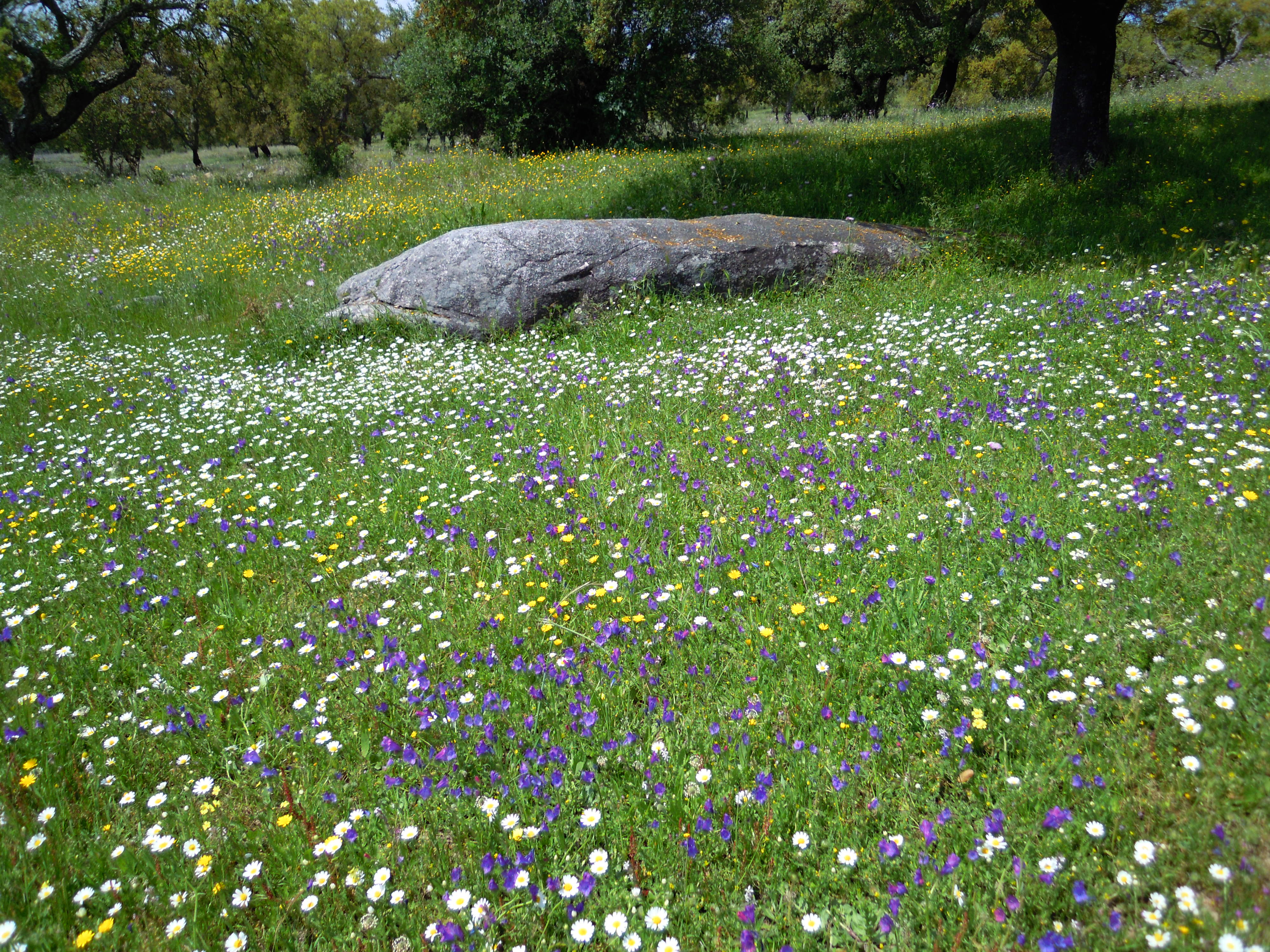
Taking the train, I left the green coastal hills around Zambujal to enter the dryer lands of the interior. But late spring rains had kept the land unusually green for May. I soon began to see sweeping cork oak forests covering the broad plains and rolling hills, the forest floors carpeted with flowers of yellow and white and many shades of blue amid the green. An occasional boulder rose among the wide-spaced trees, reminding me of Portugal’s ancient monuments.
Flowers and Stone in Cork Forest
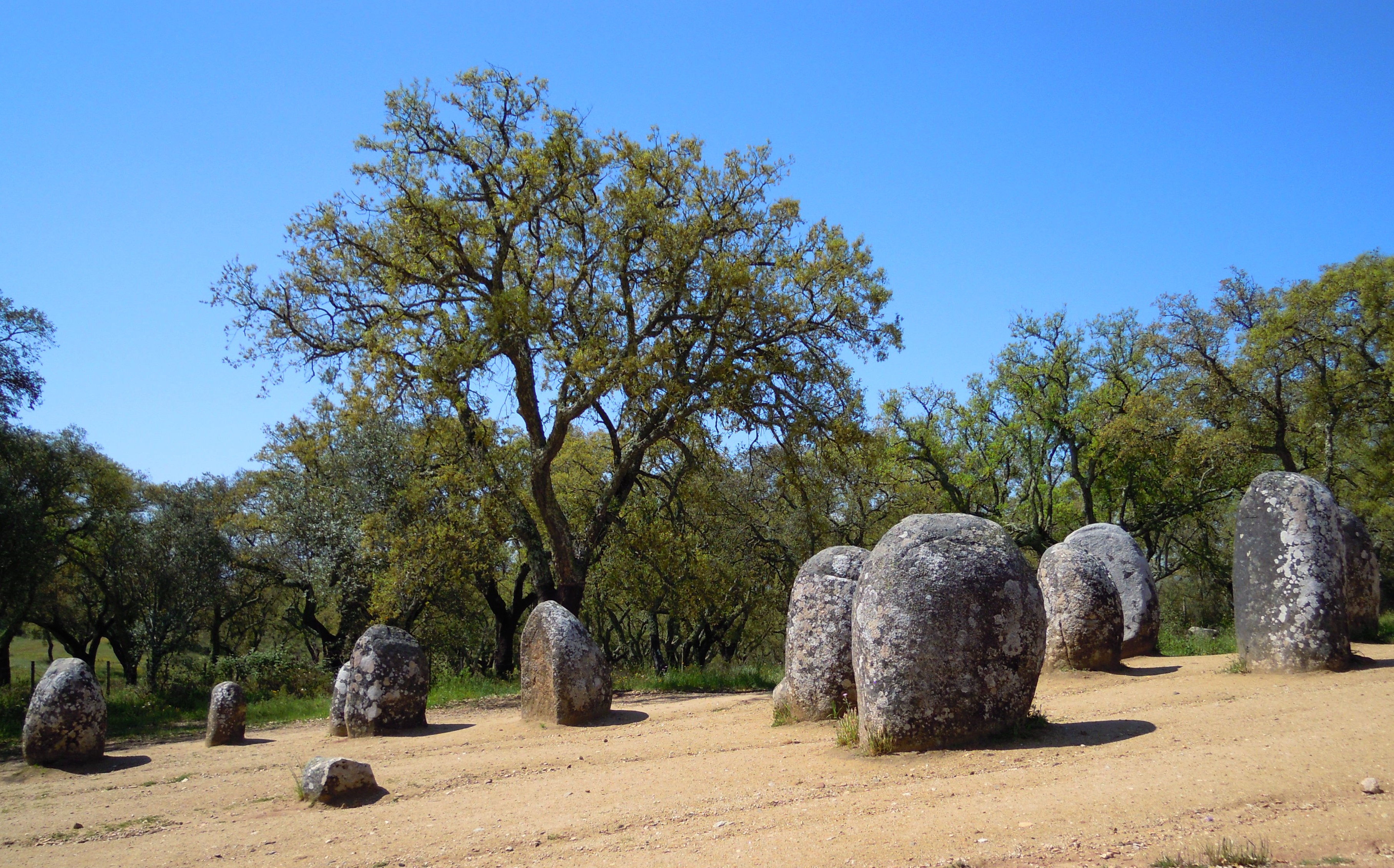
Cromlech of Almendres and Cork Oaks
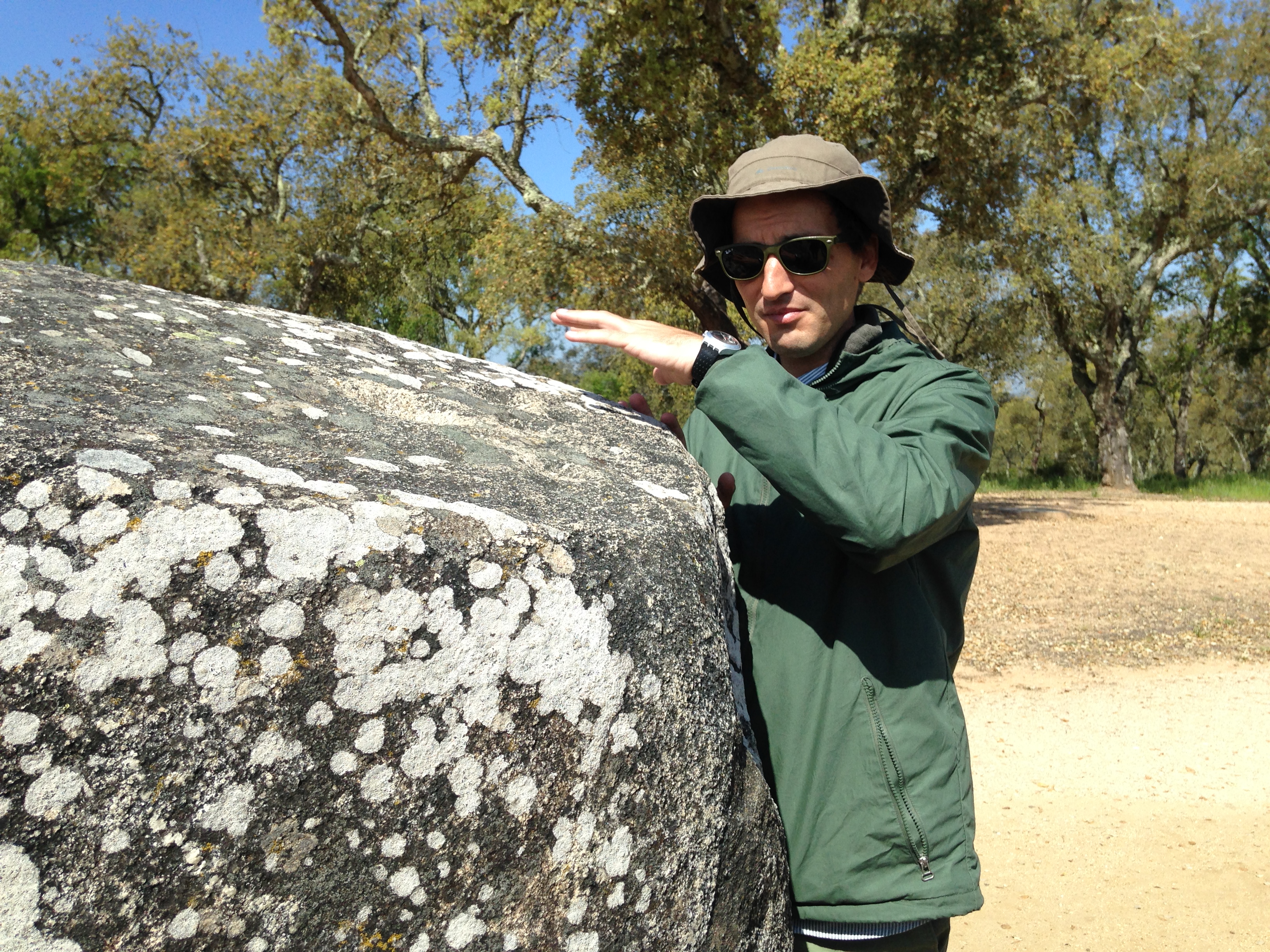
My tour group for the megaliths met the next morning in downtown Évora, a few minutes’ walk from my hotel, the Solar de Monfalim. Our friendly guide, archeologist Mário Carvalho, welcomed six of us, Canadians, Australians, and two from the US, and we all headed out with his driver in a van. This being my main interest in the Évora vicinity, Vanessa had scheduled it first. She was still having a little trouble with the cork forest visit because another party had cancelled and I would have to pay more. As Mário chatted with us on the way to the stone circle, asking where we’d been and where we were going, I mentioned my uncertain cork forest tour.
“The megaliths are right in the middle of cork oak forests,” he said. He didn’t think I needed another tour. He turned out to be well informed about cork oak trees and harvests, as well as megaliths, and I decided to count this as two tours in one.
When I told him I had been to Zambujal, he was excited to hear about my unexpected visit with Sónia and Fábio. Mário also took an interest in my books and offered to answer any questions he could, now or after I returned home. I was thrilled to find another excellent source.
The stones of Almendres Cromlech struck me with their numbers and their dramatic setting.
Almendres Cromlech Facing East
This circle has almost one hundred stones, dancing together in intertwined rings, more than I’d seen in any other stone circle. My camera frame holds only a part of them, looking off to the east. It’s an ellipsis rather than a true circle, Mário told us, and like most, it sits near the top of the slope but not quite at the crest. Besides its size, the Almendres Cromlech carries the power of its age. My character feels that, so I did, just knowing.
Almendres Cromlech in Cork Forest
It’s older than Stonehenge. Almendres Cromlech dates back 6,000 to 8,000 years. The first bluestone ring of Stonehenge is a young 4,500 years old, the great sarsens even younger.
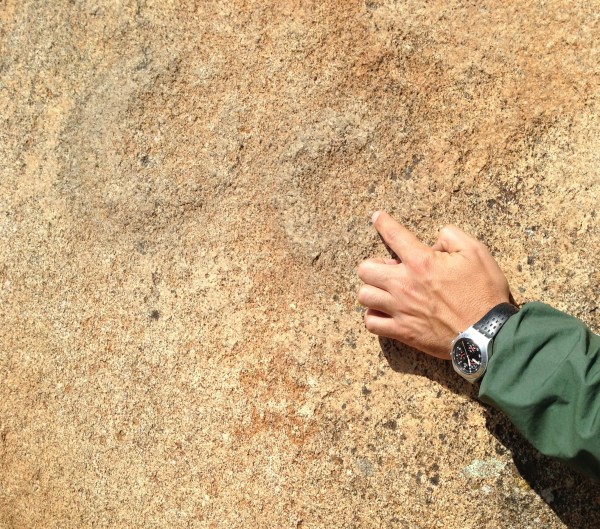
Mário Points Out Cup Marks
More Markings on Stone
Many of these stones at Almendres Cromlech bear markings–cups, circles, half-circles, curved lines like shepherd crooks. Similar markings have been found in other archaic settings.
Mário contemplated possible meanings, the circular lines representing the moon and the shepherd crooks having to do with grasping truth in the same way a shepherd grasps his sheep. Many scholars believe the stone circles helped their builders gauge the astronomical events of the passage of the moon and sun.
Solitary Almendres Menhir
The single Almendres Menhir stands out from the others, far enough that we had to drive to reach it because we couldn’t walk through the property owner’s fields.
This solitary stone was integral to the whole as it provided alignment for determining the equinoxes and solstices.
From that site we went on to the Dolmen of Zambujeiro. Curious at the name which sounds so much like Zambujal, I asked Mário its meaning. “Zambujeiro means a wild olive tree,” he said.
“So, what does Zambujal mean?”
“A group of wild olive trees.”
Ah ha! I had wondered and searched online but never found the definition. I asked if they would have had cork oaks at Zambujal at the time of my story, and he assured me they would have. I was glad to hear that because I needed a large gnarly tree for a grisly scene there.
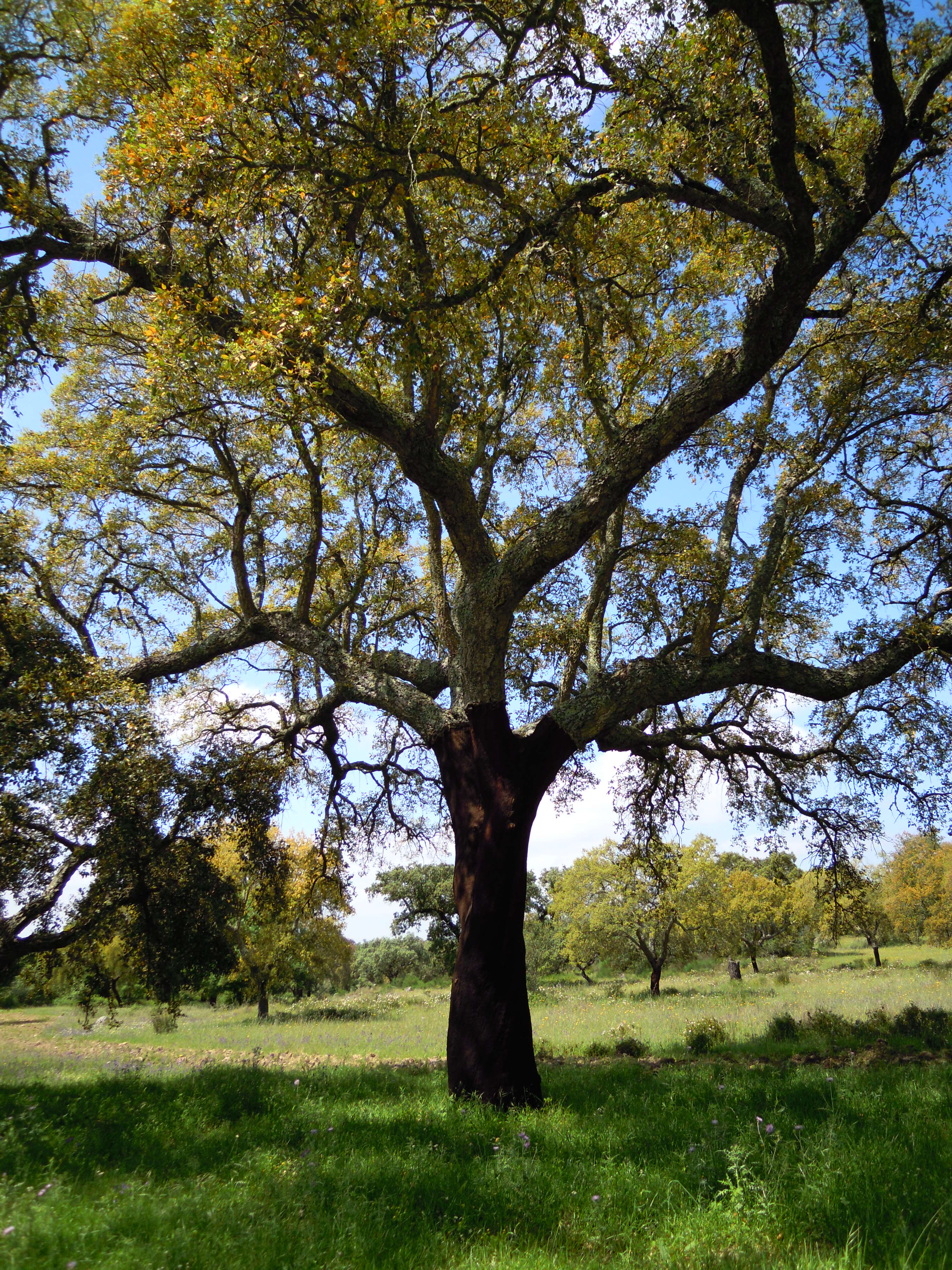
Harvested Cork Oak Tree
The trunk of the above tree lies in shadow, but if you look closely at the area just above the crotch you’ll see that below a defined line the bark is darker and redder. That part has been stripped of cork. The tree remains unharmed, but can’t be harvested again for another nine years. Portugal is the primary provider of the world’s cork, so the cork in your wine bottle may well have come from a tree like this in Portugal. These mighty trees can live for a couple of hundred years and add beauty as well as value to the land.
The trees are fire resistant but owners still carefully protect them by digging fire breaks and grazing to keep the grass down. Horned spotted cattle have been grazing these lands for many years, and horses have long been a part of the Iberian culture as well.
Cattle Grazing in Cork Oak Forest
Iberian Horse
Iberian horses play a large role in several stories of my series, so I couldn’t resist photographing this beauty.
Our morning with Mário was wonderful. We had a compatible group and he was a great guide, never rushing us, always happy to answer our many questions. A delightful and informative tour. The experience gave me an excellent sense of the place I’m writing about.
For Mário’s sake, I do want to pass along his concern. The ground under the stone circle is weathering away. The stones may fall. The roads to the site are in terrible repair. Yet no one has authority to care for the site or the roads. It’s private property. He hopes one day the government will take it over and preserve it before too much damage occurs to this world treasure. I hope so too.
Escoural Grotto
Vanessa scheduled a tour for me the next day to see the ancient cave drawings at the Escoural Grotto. Since there was no public transportation available she arranged for a taxi. The driver asked if he could bring his daughter. She had never seen the grotto and wanted to take this opportunity. That worked out well, because this 20-year-old daughter spoke excellent English and his was limited. The grotto was a 17-mile drive one way, so I knew it wouldn’t be cheap, but I had just saved a lot of money by cancelling the cork forest tour.
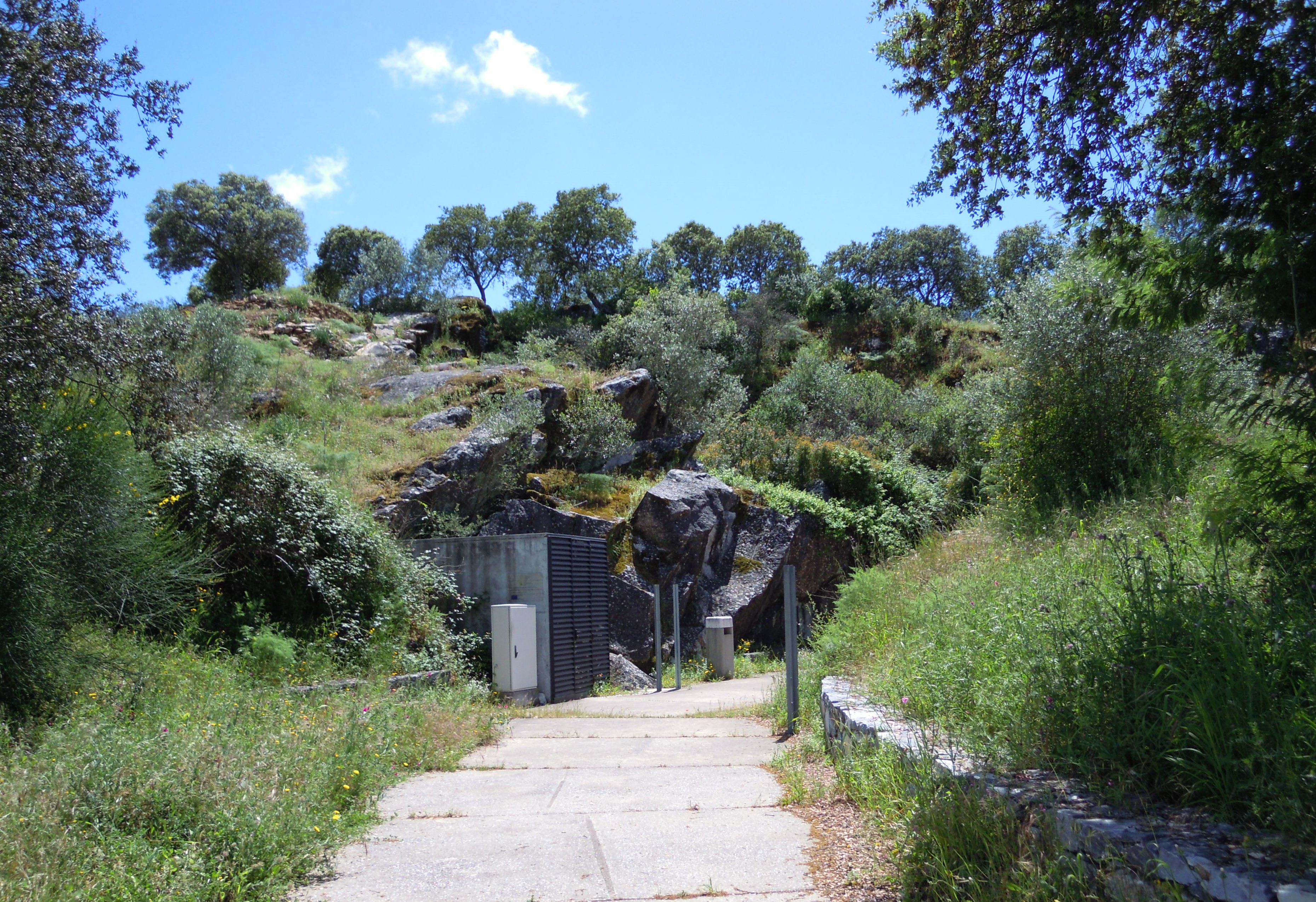
Entrance to Escoural Grotto
The cave mouth opens against a steep slope embedded with limestone boulders. A small enclosure covers the opening. Our guide led the three of us in–the taxi driver, his daughter, and me–and gave us hardhats. I was glad for that hat more than once. We weren’t allowed to take pictures, so I must offer word pictures.
It’s a small cave, intimate.
We worked our way through the cramped space down wooden steps and walkways. My hardhat bounced off hovering rock overhead. A few bats clung to the higher walls. The electric lighting may have added a yellow hue, but the cave walls looked golden compared to the gray rock outside. I had the impression of thick butterscotch frosting, whipped in wild swirls, hardened and broken off in places to reveal flat nubbly cuts that melted back a little, softening over time. On some of these flat slabs thin ridges ran down like rivulets of water that had turned rigid.
I didn’t see the pictures until our guide turned a light onto them. Then I saw the black charcoal outline of a horse with a deep belly. It looked pregnant, and I mentioned that. She believed the figure represented fertility. Only the lines between the rivulets remained. We went farther below and had to bend down to look at a slab slanted inward. On that slab scratches had been cut into the rock surface creating the outlines of several horses with heads raised, active, alert. Another drawing represented a horned animal.
The depth of time resonated. Into this ancient place of artistic expression my character felt herself falling back tens of thousands of years. And I did, knowing that.
The Knoll
I had one more place I needed to see. The town of Escoural itself. Just three more miles up the road from the grotto. When we left the cave site my taxi driver started to turn toward Évora. “I still need to see Escoural,” I told him.
He wrinkled his brow. “Is nothing there.”
I explained that it was a significant place in one of my books and I needed to see it. His daughter tried to explain. He hesitated but finally turned toward Escoural. The meter was rising. It would soon hit our agreed price and we still had to go all the way back, but I had many chapters in that location. I had seen it on Google Maps, but I really wanted to see the land. Not the town. There was no town back then, but there was a knoll where I wanted to put a fictional village. And I wanted to see the land around it.
We drove into a town whose sleepy streets I had traveled virtually and it all looked familiar. He turned to me. “See? There’s nothing here.”
That’s the idea, I told him. It’s the middle of nowhere. Exactly what I want.
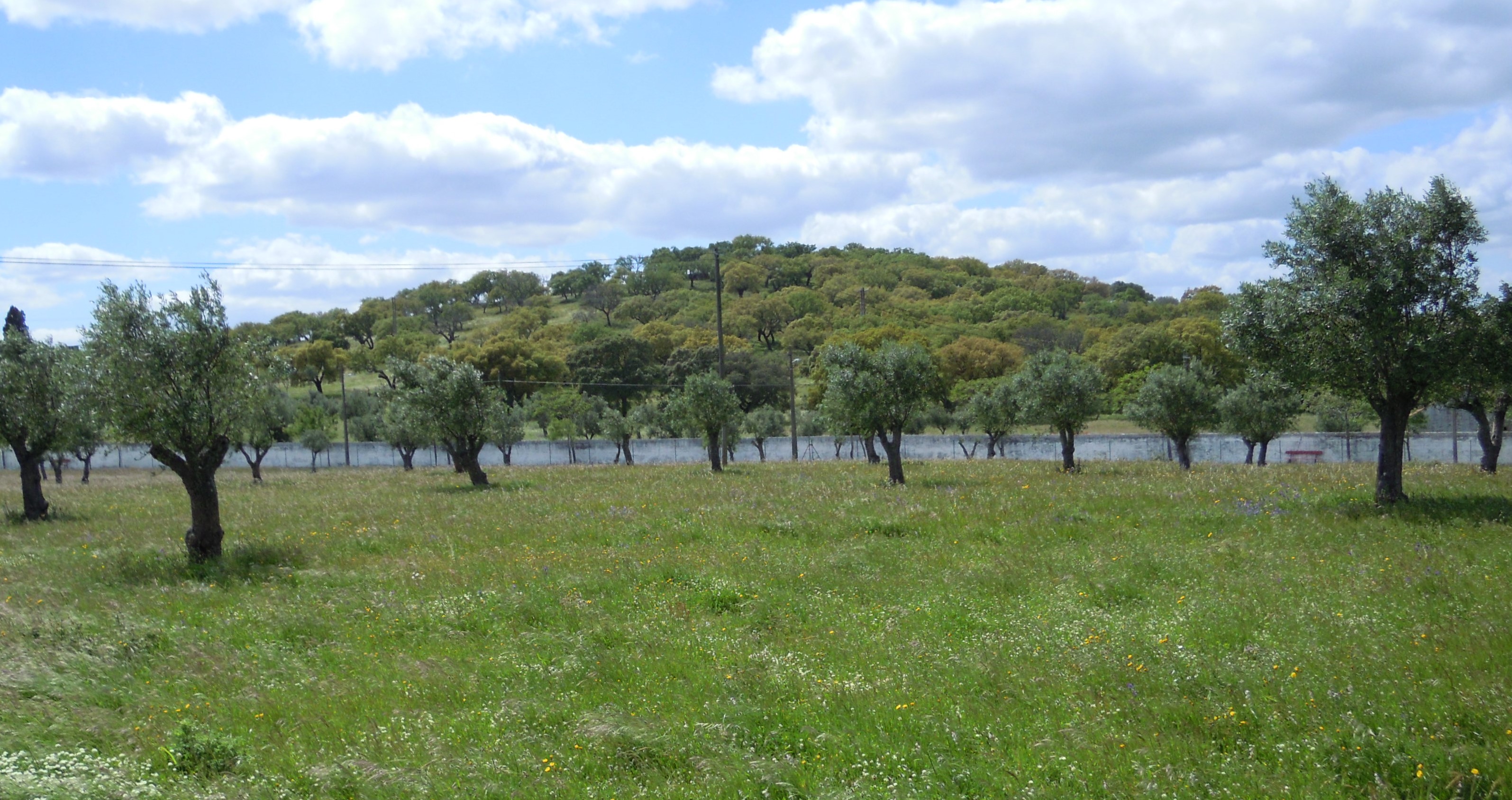
A Knoll in the Middle of Nowhere
About that time I saw my knoll and got excited. “There! Please turn that way.” His daughter had to convince him. And when we came away from the houses and I had a full view of the knoll I asked him to stop so I could get out and snap a picture. It took him a moment to respond and I asked again. I’m sure he was thinking, What is the matter with this crazy lady wanting to stop and look at nothing? He stopped. I got out and took my picture. And a few more. Laughing, I told his daughter, “Escoural hasn’t had this much enthusiasm in years.”
Évora
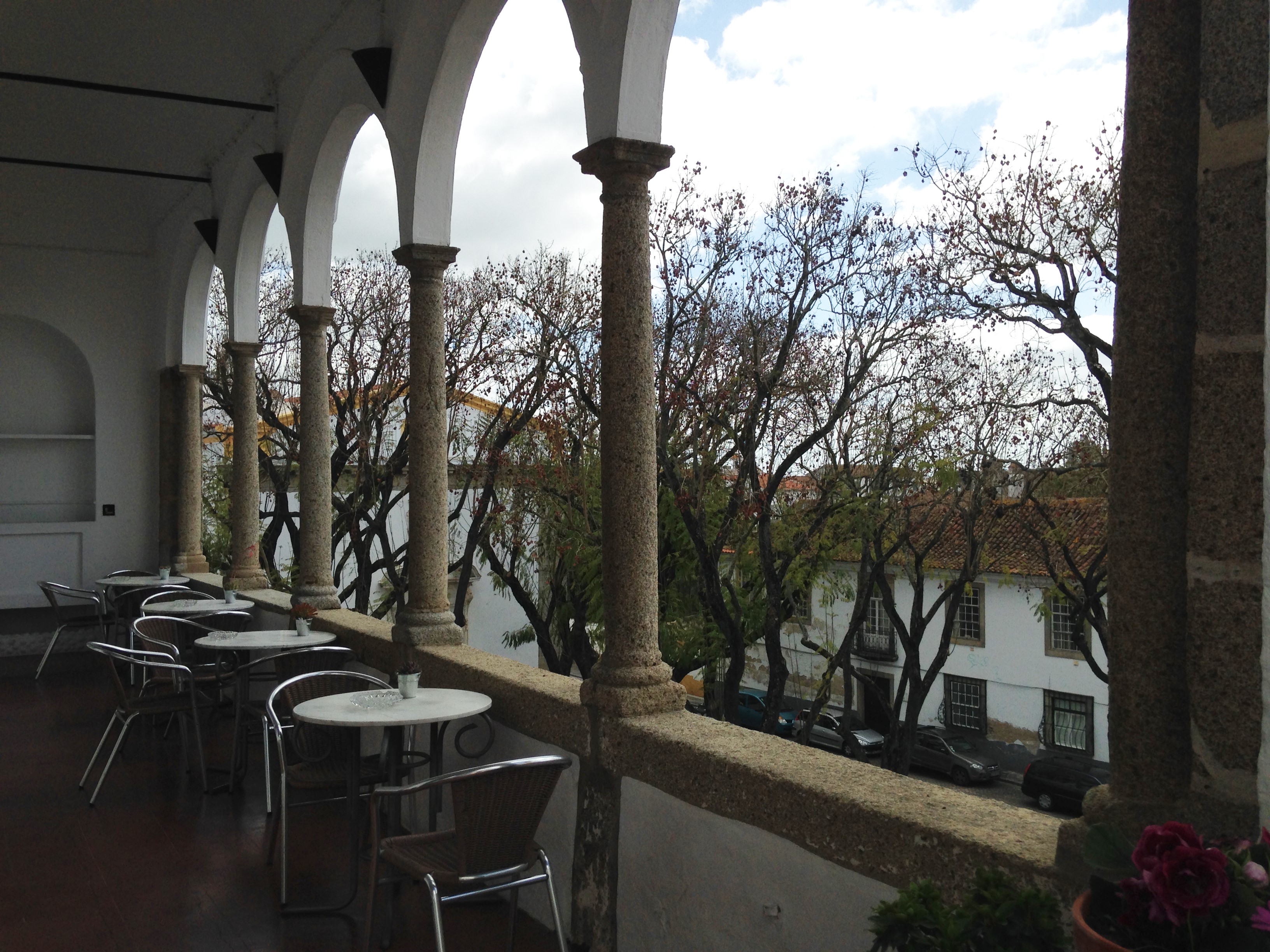
The rest of my time in Évora I explored the town. I checked out the Roman temple and the museum and the bone chapel and found Vasco da Gama’s house. But much of the time I sat on the lovely balcony of my hotel and took notes and sorted out my thoughts about all I had seen, fitting some changes into the excerpts I’d brought while the memories of my experiences were fresh.
Balcony of Hotel Solar de Monfalim
Portugal had been good to me. Alone, I had felt the raw edge of a culture where communication often confounded me. But that taught me something too, which will work its way into my stories. Most of all I thrilled to ancient wonders and the warmth of people who so willingly shared those with me.