Mountain Men to Swordsmen ~ or Swordswomen

As many of my followers know, my writing focus has turned from PIONEERS TO PEOPLE OF THE STONES. My first published book portrays the story of my great-great-grandmother who came west over the Oregon Trail and ultimately settled on the farm I now own. Entitled A Place of Her Own that book opened the door for another pioneer story, this time a novel about a young woman who’s a reluctant pioneer in Oregon. Her first day at their destination she meets two mountain men, the historic Joe Meek and the fictional Jake Johnston. These two mountain men play a pivotal role in the story, The Shifting Winds.

I’ve been writing posts for this blog since 2012, and the most viewed of all my many posts is The TRUE Shifting Winds ~ 3: Mountain Men.
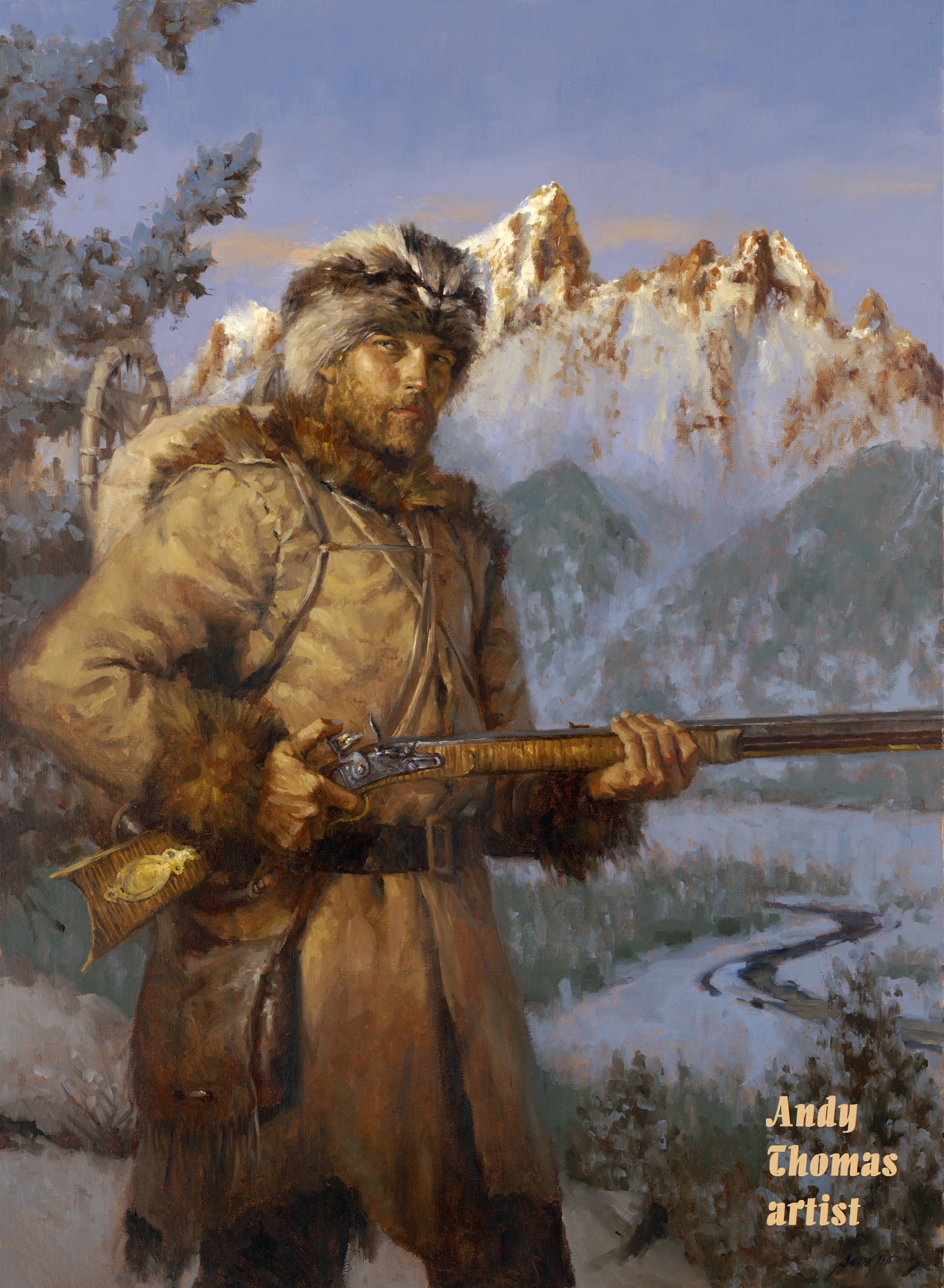
The painting here was done by artist Andy Thomas, used by the artist’s permission to portray mountain men in my promotion of The Shifting Winds. Dubbed by Thomas the “first mountain man,” the work portrays one of the notable American fur trappers John Colter, whose story can be found on the popular above-mentioned post.

What is it about these mountain men that still fascinates folks today? Reenactors and enthusiasts called “black powder men” gather regularly to dress up and shoot their historic black-powder weapons.

The original mountain men came out of the fur trade era of the mid-1800s when Britain and US were vying for the Oregon Territory. The British had a firm grip on the fur trade in the west with their Hudson’s Bay Company headquartered in what is now Vancouver, Washington. The Americans focused their attention on the Rocky Mountains, east of the contested area, and they developed a system where the trappers could stay in the mountains year round and gather at a rendezvous every summer to trade their furs.
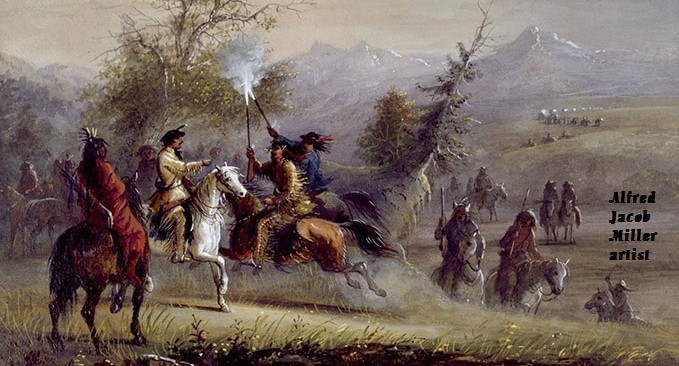
The above painting shows the arrival of the caravan bringing supplies to the mountain rendezvous, painted by Alfred Jacob Miller who went west to document the event. The rendezvous became a raucous time for the trappers who became known as mountain men. A colorful group, they were tough. They had to be to survive. And they enjoyed certain freedoms to live as they chose, as long as they honored the limits of the wilderness and the people who lived there. They made friends with some Native Americans, fought with others. Always on the lookout for ever-present danger.

Since the release of my two pioneer stories my focus has turned to the more ancient people of Ireland, who call themselves People of the Stones for the sacred stone circles and other megaliths they honor.
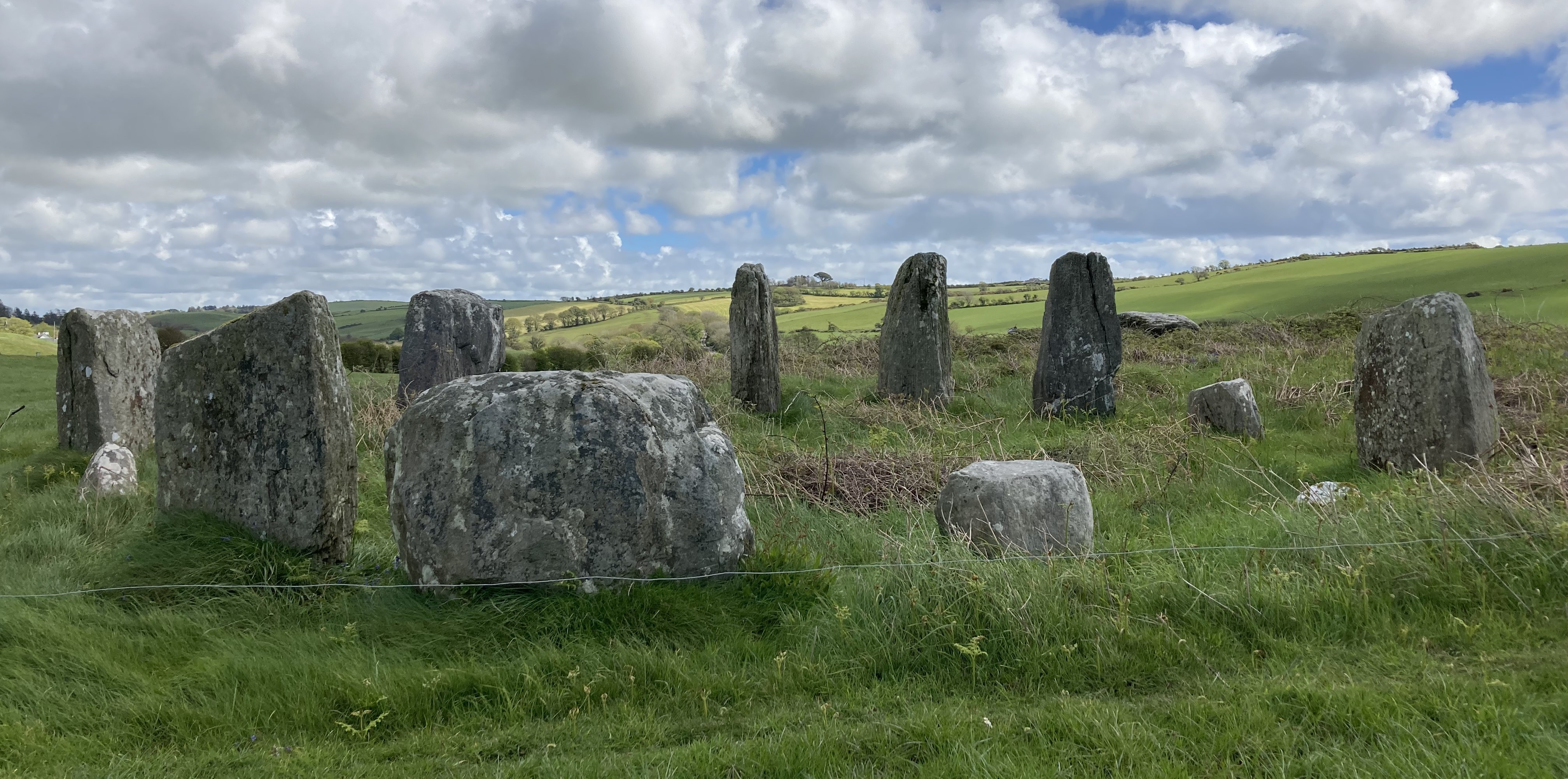
And in those ancient settings enemies were met not with guns but with swords. And the brilliant sword fighter might be a woman rather than a man.

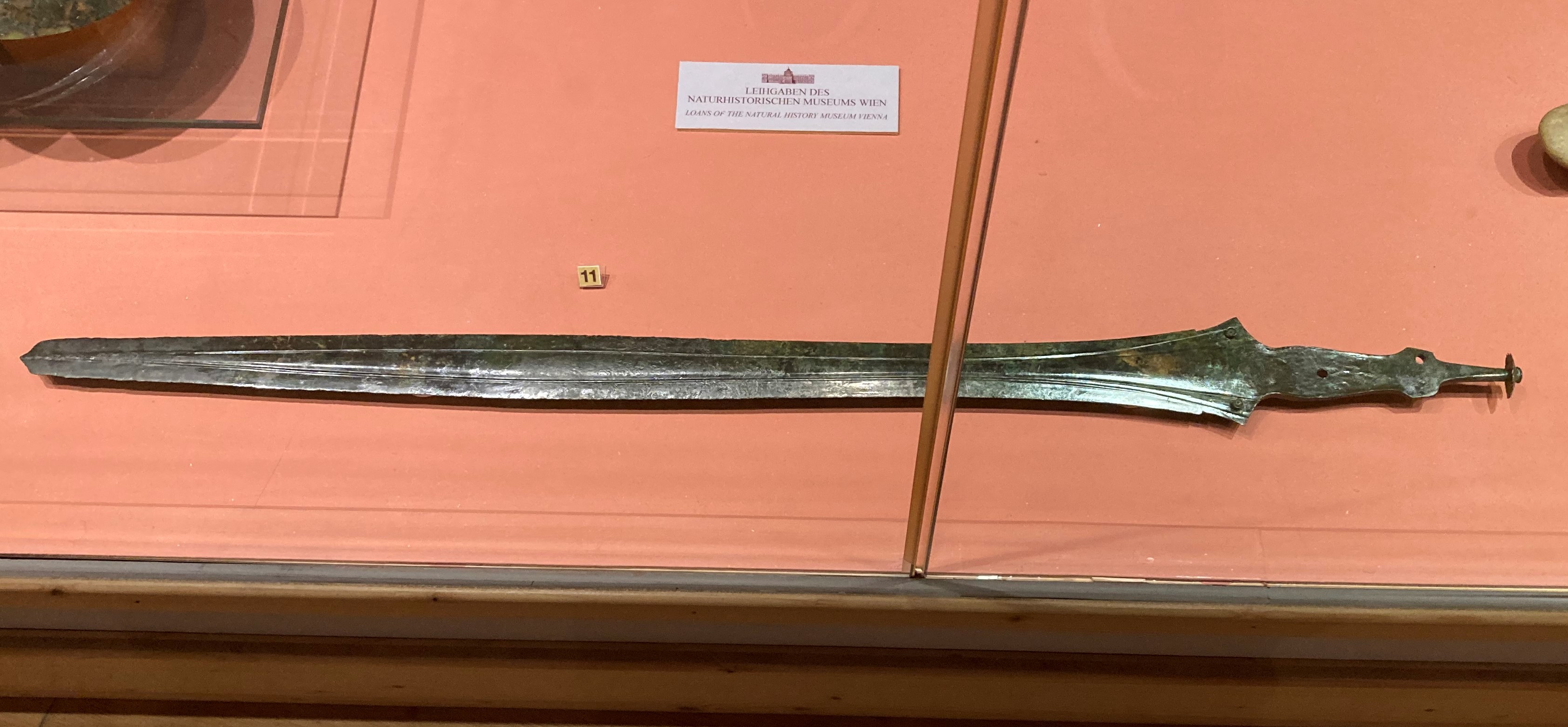
Shown below is one of the famous Hallstatt bronze swords, the chosen weapon of the Proto-Celts who in 750 BC flourished in their high mountain home above today’s picturesque modern village of Hallstatt, Austria. This sword crafted by one of the smiths in those long-ago days is on display at the wonderful Hallstatt museum.
The Irish do love their Celts, but my story opens in Ireland in 750 BC before the Celts could have arrived in Ireland in any numbers, and they probably didn’t call themselves Celts that early. My female protagonist, caught in a dilemma in her Irish homeland, will travel far to seek help and learn the craft not only of making such a sword but of fighting with it too. However, she has to pose as a man there, because her trainer wouldn’t teach her if he knew she was a woman.

Welcome also to my site at Instagram.

Introducing My New Agent

I’m delighted to announce that I just signed with an agent to represent me on my newest historical novel set in ancient Ireland. Her name is Joëlle Delbourgo, her agency a boutique literary agency based in the greater New York City area.

Joëlle Delbourgo

Only three days after my return from the Seattle conference I got a surprise email from Joëlle, President and Founder of Joëlle Delbourgo Associates, who I had queried a couple of months before. I had sent her ten pages of my book as she requests for all submissions. Now she wanted a full manuscript.

She has a stellar background. She founded her agency in 1999. For more than twenty years before that she was a senior editorial executive at HarperCollins and Ballantine Books, a division of Random House, so she knows both sides of the publishing world. Her list of sales is impressive.

With considerable excitement I sent her my manuscript. In less than two weeks she wrote to tell me she loved my book. She wanted to talk.

We had a wonderful conversation by phone. She knew my characters. She knew my story so well she pinpointed several specific issues that can make it stronger. And she offered to represent me. I was thrilled.

It just so happened that she had traveled to Ireland last summer for the first time so she knows the land of my characters too. I’m convinced there’s a bit of magic in those green hills.

Going There #3: Gold! Gold! Irish Gold!

It’s in Dublin! And I needed to see it! Gold has a place at the heart of my new Irish story. So I set aside a day for this. Welcome to my traipse through Ireland’s glorious golden past.

This intricate gold neck ornament, made in Ireland, comes from the Late Bronze Age, somewhere between 1000 and 500 B.C., during the period of my story.

So much brilliant ancient goldwork has been found in Irish bogs and waters, hoards of it. And the National Museum of Ireland–Archaeology has a dazzling display, including the samples shown in this post. I would spend hours there, stepping into Ireland’s ancient glory.

The lunula goes back to 2300-2000 B.C., named for its crescent moon shape. The museum has many on display, this one showing a good example of the intricate incised markings.

The lunula, like the one above, appears in my story on the necks of clan mothers and future clan mothers in ancient Éire. A lovely ornament made from thin hammered sheets of gold with the incised designs.

When I proceeded to write my newest novel, I first had to decide where to set it. Where did I want to spend the next months, maybe years–at least in story if not in person? The answer came quickly. Ireland.

The next question. When?

I pulled out books and notebooks I’d gathered for other work and began poring through them for intriguing periods in Ireland. One thing jumped out at me. Gold! Historians describe the period around 800 B.C. as a time of a sudden uptick in rich production of gold in Ireland, a veritable revolution in goldwork. This was also a period when the early proto-Celtic culture was thriving in faraway Hallstatt, Austria. I knew how the Irish love their Celts. They wouldn’t be in Ireland in 800 B.C., but could I find a way to bring them into the story?

My decision was soon made. My new book would open during this explosion of fine goldwork, and my protagonist would be a goldsmith–a rare thing for a girl.

So this spring in Dublin I stepped down into the center of the museum where a glittering world of gold surrounded me to learn what goldsmiths were doing in those momentous days.

Gold dress fasteners c. 800-700 B.C.
Gold bracelets and dress fastener c. 800-700 B.C.
Gold foil-covered sunflower pins c. 800-700 B.C.
Gold foil-covered bulla probably worn on a cord around the neck c. 800-700 B.C.
Part of a gold bobbin-shaped ear spool possibly to be worn decoratively over the ears c. 800-700 B.C.
Lock rings, hair ornaments that appear to be incised, but the lines are made of tiny wires soldered on. c. 800-700 B.C.

The soldered wires in the lock rings are so tiny they barely show in my photos. The enlarged one from the upper left of the photo above it may show the lines better, the curve. Such delicate, intricate work illustrates the fine skill of goldsmiths in this period. If they did this as Levaen did, they hammered the gold into a thin sheet, then rolled from the edge to create the wires and bonded them in place with soldering particles.

This small sample of the museum’s 800-700 B.C. goldwork that fits into my story’s timeline shows no brooch like the one my protagonist Levaen makes in the book, nor did I find anything like it. I began to worry about that, but Carisa, my daughter and beta reader, pointed out that there was no reason Levaen’s fictional goldwork should show up in the Dublin museum, and I remembered that the story presents Levaen’s brooch pattern as special in her own time. What the museum exhibits showed, especially the lock rings with their thin wires, was that the actual goldsmiths of that era were familiar with techniques like the thin wires and soldering Levaen uses to create her brooches.

Going farther back to 1200-1000 B.C. are three twisted gold bracelets and two gold grooved bands.
And a gold torc with ribbed rings and bracelets from 1200-1000 B.C.

One exhibit offered a portrayal of how some of these golden objects might have been worn. This illustration features goldwork from the Late Bronze Age, roughly 1000 to 500 B.C., a neck ornament like the one in the photo at the top of the post, along with ear spools of sheet gold, and arm and wrist bracelets pictured above.

Of course these items could have been worn by either men or women or both. There might have been chiefs or chieftainesses. Or perhaps the general public would have donned such brilliance for special occasions. We can only wonder and imagine.

There was so much more gold in the museum’s collection, but some bronze too, that caught my eye.

Swords from 900-500 B.C. Some look like leaf-shaped Hallstatt swords but they’re not labeled as such.

No one knows when the Celts came to Ireland. We only know the language came, so they must have come. But they would not have been in Ireland in any numbers at the time of my story. A few Hallstatt swords possibly came earlier, by trade or other means. Enough to tantalize but not to prove anything.

There’s no intrinsic method of dating metal, so dating depends on surrounding materials that can be dated. In fact, on at least one occasion they found a lunula in a wooden box, which identified the time of its use by testing the wood. Surely a precious object. Dating offered with the museum exhibits of gold and bronze would have been confirmed by surrounding material, but they give a broad span as noted in captions here.

Many objects in the exhibits are labeled as parts of the hoards that included them, deposits placed into bogs or lakes or streams. Why the ancients deposited such hoards, no one knows. Bogs may well have been lakes at the time of the deposits and later dried up, so all deposits may have been placed into the waters. Or some dry or partly drained bogs may have been dug into and the items buried. Were the treasures cached in a time of escape from some crisis? Or were these offerings to their deities? All we can do is guess. We have no writing, no histories, to tell us.

The hoards weren’t all glorious gold. Many practical items were included. A lot of bronze. Practical axe heads, chisels, horns, cauldrons. And swords and spear heads.

Some items are just delightful objects like the one pictured below. I so enjoyed seeing it, I chose to share it here, even though it’s later than my story.

Miniature 7-inch-long gold ship with sailing mast and oars from the 1st century B.C.

NEXT: Gold Mountains and Memories