Going There #9: Rooms with a View

Yes, of course, there are views, and then there are views. But I have stayed in many a hotel where you’re lucky to have a street to look at. On this trip to Ireland and Austria I stayed in six hotels and five had something interesting out the window. I did not request a view. None of these offered the option.

So, welcome to my tour with a view in mind.

At the Castle Hotel in Dublin my room was on the fourth floor–which meant the fifth, because they start counting one up from the ground floor. A small room, it had all I needed and was fresh and clean. When I peered out the window I smiled.

As buildings go, that was pretty spectacular. It’s the Abbey Presbyterian Church, a stone Gothic Revival structure built in 1862 to 1864. A bird perched on the top right peak as I took the picture, and I later noticed the green nest hunkered below, where birds fluttered in and out from time to time. During my stay when I retreated to the room to put my feet up I took pleasure in the strength of those fine walls and the artistic design. And the birds.

Next stop in Limerick my room at the Old Quarter Townhouse was big enough for a party. It was new and modern–or at least modernized. I looked out the window there and spread my arms, hands uplifted.

There seemed to be a theme here. This one is Saint Michael’s Catholic Church, a limestone structure originally constructed in 1779 to 1781, remodeled in 1805, then rebuilt again in the Italianate style in 1881. This too became a pleasant outlook in the changing lights during my time in Limerick.

On my return to Rosscarbery Catherine O’Sullivan at the familiar Rosalithir B&B happily welcomed me to my newly remodeled room. Everything crisp and bright. And I was so happy to get a front room. The house is on a farm in the middle of green pastures, so all the rooms look out on lovely scenes, framed by the graceful windows and drapes, but the front room looks toward that special notch where the sea glistens blue when the sun is right.

Open the windows and lean out and you see even more.

I peered across the attractive yard wall, past the ancient wall of stone, and out over the wide green pasture to the gap in the bluff that opens to the glimmering sea in the notch. A lovely outlook, much the same as my story characters of the Golden Eagle Clan see from their sacred stone circle, shown below. And from their village one ridge over from the other outlook below, where you can see the gap in the bluff beyond the horse pen.

I felt at home.

In Salzburg I stayed in the guest house in a seminary, Gästehaus im Priesterseminar, which has a historic connection with the adjoining church. Through large windows along the hallway to my room I could see the grand rooftop of that church.

These are domes of the Holy Trinity Church, which borders the seminary on one side, built between 1694 and 1702 to connect with the seminary. So not the view from the room, but from the hall on the way to the room.

From the window in my room I could see this.

It’s the former Palais Überacker built in 1732 by the Counts of Überacker because they wanted a residence close to court, the Mirabell Palace being a very short walk away. It’s just a bank now, but the renovation kept most of the Baroque facade, offering a pleasant outlook from my lovely pristine room.

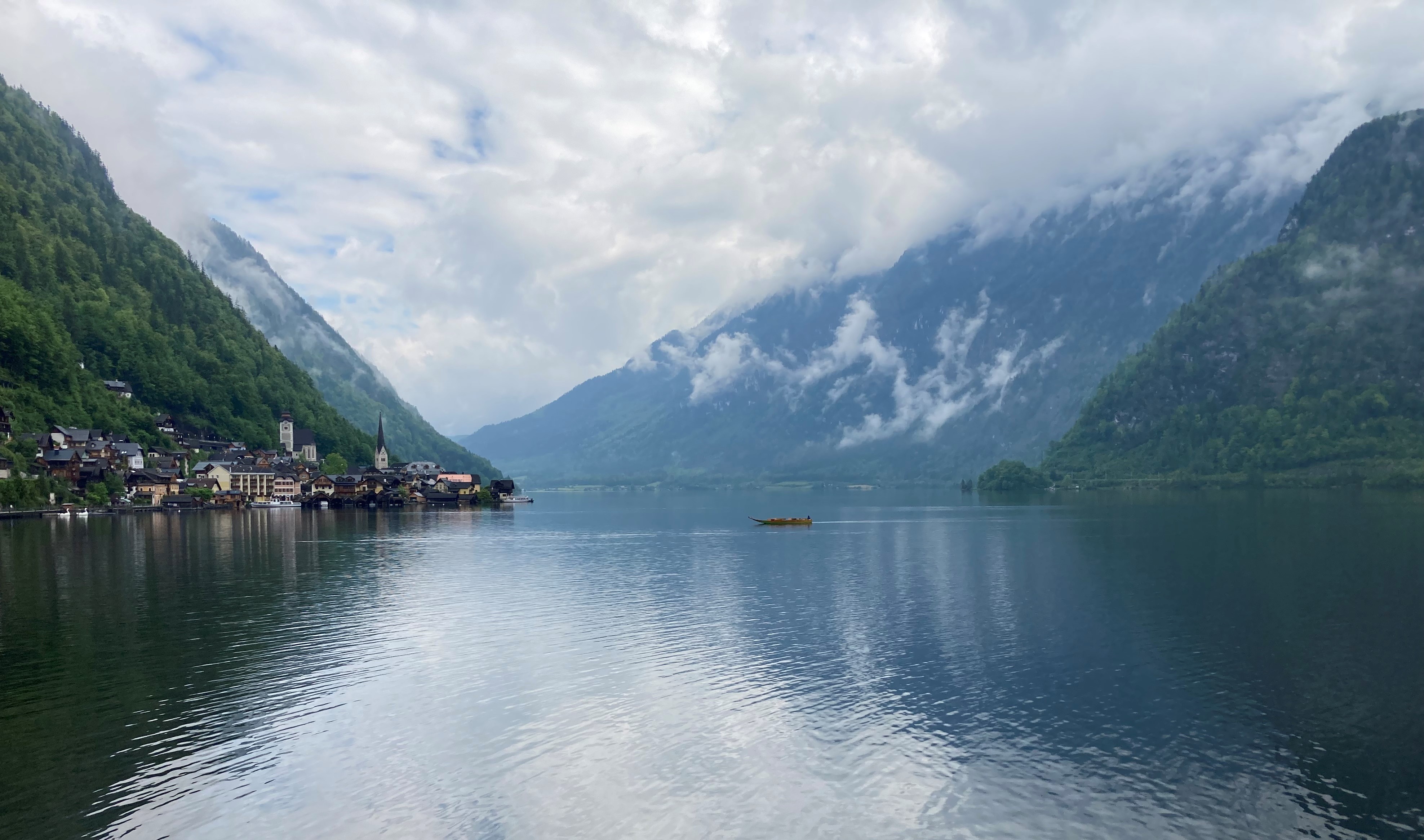
Last but surely not least was Hallstatt. I knew my hotel there was right on the lake. But not every room could look toward the water. And I didn’t know whether mine would. As noted above there was no option to select a view. So when I stepped into the room my jaw dropped. This was my first sight of the outlook I would have.

The lake! The private deck! I rushed to the door onto the deck and went out.

I could see it all. The shimmering water. The fairytale village. The sheer mountains framing the scene. I could see it from my private deck. From my bed. In daylight and dark.

A room with a view. Ah yes. I loved every view. From Dublin to Limerick to Rosscarbery to Salzburg to this of Hallstatt. And I will treasure the memories like a string of cherished jewels.

NEXT: Reflections

Going There #4: Gold Mountains and Memories

So where did Ireland get all that gold found in the hoards in the bogs and waters now displayed so beautifully in the national museum? Ireland doesn’t have a lot of gold deposits today, but one place stands out as a possibility. The Wicklow Mountains. It’s the largest mountain range in Ireland, and they did have a gold rush in the 18th century. That’s A.D.

In my story I call them the Gold Mountains because scholars believe there may have been more gold in those hills in the ancient times I write about. On my last full day in Dublin I joined a tour there.

This is the upper lake of Glendalough (glendalough means two lakes) in the Wicklow Mountains. A fair walk to get there, but a pleasant walk, and the goal proved worth it.

The protagonist in my story charts a course between the Gold Mountains and the sea, with hopes they’ll keep her from getting lost.

I got lost in these mountains myself on a previous trip when my friend Tilly and I rented a car and I drove us up this way in search of our B&B we’d reserved. Somehow I got off a roundabout in the wrong place and got us into the back country where roads wound every which way and signs were scarce. We saw a couple of men working on some machinery near the road and stopped to ask directions. They explained it all in great detail. I listened intently, trying to follow what they were saying. The Irish tend to talk fast and they put a little different twist on the English language than we do, but this was more than I’d encountered. After we thanked them and drove off, I asked Tilly, “Did you understand what they said?”

She gave me a wry smile. “Not a word.”

A little farther along I saw a sign to Roundwood. I remembered the name as a town somewhere near the B&B and followed the route in that direction. We could go to Roundwood and ask somebody there how to find the B&B. As we made our way over narrow roads I glanced to my left and saw a building that looked very much like pictures of our B&B. Then a sign with its name. Irish luck. We were there. That evening we drove on to Roundwood for dinner. I told our server where we were staying. She had never heard of it.

Part of our destination on my Glendalough tour this year was the monastery founded by a Saint Kevin in the sixth century A.D., practically modern compared with other sites on my itinerary. The ruins were interesting, the setting gorgeous.

When the tour bus passed through the town of Roundwood I believe I saw the restaurant where Tilly and I had dinner on that night those many years ago. I smiled, the memory warming my heart. Those memories are pure gold.

The upper lake was the best of the tour, but I did enjoy seeing the mountains again while the bus driver drove.

Back in Dublin the driver recommended we visit Saint Stephen’s Green on our own, a jewel in the center of the city. I did that. I remembered the serene beauty in the midst of the bustling city. I had seen it on previous trips. It wasn’t a sunny day this time but the park was beautiful anyway. Green gold, you might say.

And I had to add a photo of typical Dublin townhouse doors.

And back to the now-familiar O’Connell Street with its landmark Spire behind the statue.

Note the bird on the statue’s head. The next day I would be checking out of my wonderful Castle Hotel, which is just up that street, then onto my next base, the city of Limerick, which I’m told has nothing to do with those rollicking poems.

I would not forget the golden memories of my Dublin visit–from Newgrange to Bray to the ancient gold of the museum, to Glendalough, and to the best of Dublin itself.

NEXT: Rivers, Cliffs, the Rock, and the Hat

Going There 2024 – Overview

Every place seems to have a certain personality, a character you can only know in its presence, so when I write a story and spend any amount of time in a particular place I want to reflect the sense of it. That’s why I want to go there, to know it, and thus better knowing it, let my reader know and feel what I felt there.

As my followers may remember I recently completed a historical novel set in ancient Ireland and surrounding lands. I had already visited many of these places when researching the series that’s related to this story, but happenings differ and characters may look at their world from different perspectives. Can she, for instance, see the river from there?

This is Newgrange, the ancient passage tomb built some 5,000 years ago by Neolithic people who walked there long before my characters. It’s older than Stonehenge, older than the pyramids of Egypt. My story opens in 750 BC. And yes, she can see the river from this spot outside the tomb. She won’t try to ford it, though. It’s much too deep and swift. I’ve seen that now. She’ll take a boat across, as I’d written it.

I have visited Newgrange twice before, in 1993 and in 2004, but not only was I working on different stories then, I did not have a digital camera that would allow me to share such a photo here on my website or on other social media. I carried my small Nikon digital camera I took on my 2018 trip and a newer iPhone than I had then. And I sought out better pictures as well as research photos to help me hone my descriptions.

Late last year I began contemplating this trip. I decided I would limit it to Ireland, home of my protagonist, and Hallstatt, Austria, homeland of the proto-Celts, where she spends a considerable amount of time. For quick stops I can take trips by Google Map, but for long stays I want to soak a place in. I had visited the charming village of Hallstatt once before in 2006 when I traveled there with my Austrian friend Tilly. But I was researching a different book then, one that fell by the wayside. Now I wanted to see Hallstatt with the new book in mind.

I had forgotten how steep the mountains, how stark the limestone cliffs, how sparkling the lake. Yes, the quaint houses will ever climb that bluff, the iconic church steeple pierce the sky. But as I wandered the single street, climbed the many steps, found the waterfall I knew was there and included in my story, I enjoyed a sense of it I did not have before.

I didn’t rent a car so in Ireland I picked bases from where I could take tours or just go on my own by bus or train. I started with eight nights in Dublin. Then to Limerick for five nights. And a five-night return to the heart of my story, Rosscarbery, staying at the Rosalithir B&B with my wonderful hosts Catherine and Finbarr O’Sullivan. My third visit with them. The last visit in 2018 had been much too short and left me with critical questions on the setting. The new visit would answer questions I didn’t even know I had. A vital visit for understanding the lay of the land. And the water. The beach.

This was the rugged eastern headland I needed for one of my stories. Golden Eagle Bay in the world of my characters was broader than I thought on my brief stop in 2018. It took me several walks, especially over the newly improved Cliff Walk on the western headland to figure it out. From there I looked back and the setting became quite clear, the revisions I would have to make.

It was moments like this that I confirmed my need for this trip. Yes, it was time to travel again. Yes, I wanted to revisit these special places, but with that discovery and more I found answers to questions I hadn’t thought to ask.

In the next several blog posts I’ll share the journey–from Dublin to Salzburg, Austria, where I stayed a couple of nights on either side of my Hallstatt excursion because of its access to an airport. A lovely spot itself where I stayed in an amazing 17th century seminary converted into a hotel. The adjoining church even had a domed roof.

I’ll add the posts to the new “Going There” list on the sidebar as I publish each one.