Friendly Gathering at Museum

A friendly gathering came out to the Douglas County Museum for my first Roseburg reading and signing. It’s a lovely venue, and Karen Bratton, Research Librarian and Collections Manager, put together a pleasant setting for this event. Thanks so much, Karen.

People really seemed to enjoy the slide show of photos related to my book The Shifting Winds. My son-in-law Robin Loznak ran that for me. He has been encouraging me to do visuals, and I was glad we had such a fine setup at the museum to show those. Thanks, Robin. It was fun seeing the pictures on the large screen, especially the ones I had taken when backtracking the Oregon Trail with family.
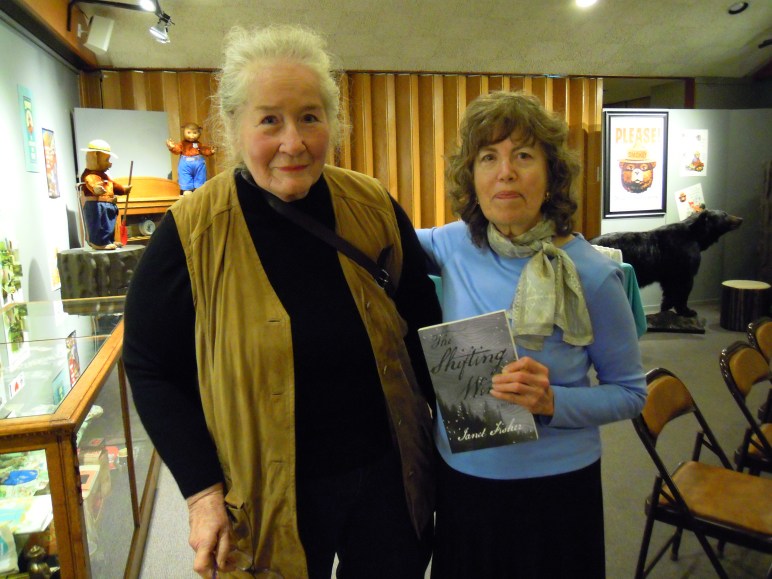
joyce and meThe highlight for me was having Joyce Abdill there, wife of the late George Abdill, the man who’d offered so much information that infused this book. That’s Joyce and me above. George was the first director of this museum where the event was held and my first source for several books I wrote about the pioneer and fur trade era. Joyce shared some stories about George and how they met.

Years ago Joyce also played a part in advancing my writing career, in that she helped me get my first two agents. As a sales rep in the book industry she knew people and helped make those connections. And while those agents did not sell my books, their acceptance of this early work gave me a hope that kept me going until I did finally break through into publication. I very much appreciate Joyce for that and for her encouragement. I was delighted to have her input at this event, not only her prepared remarks but her contributions to the Q & A. And we had a lot of fun chatting. I was glad to introduce her to some of my good friends there.

bear refreshmentsOur room for the event had a historic display of Smokey the Bear items, so as we entered the room we were greeted by a fine specimen of a black bear near the refreshment table. I knew he was there. I had visited a few days before, but I still stopped short when I walked into the room last evening and met him face to face.

But my biggest surprise of the evening was when a couple walked up, and the woman told me she was my roommate our freshman year at Oregon State. She moved to Roseburg a few years ago and had seen news of my books. I hadn’t seen her since we left college.

Robin took the photo of Joyce and me with my camera, and I took the bear shot.

COMMENT

Event Tonight at the Museum

I’ll be in Roseburg tonight at 6:30 for a reading and signing of my new book The Shifting Winds. I’m looking forward to this event at the Douglas County Museum where this book was essentially born.

900.DCMuseumWhen I decided to write the first of several pioneer/fur trade stories some years ago, I went to see the late George Abdill, first director of this museum, looking for information on my subject. As I noted in an earlier post, he was exactly the right guy to talk to. This was a favorite era of his and his knowledge set my course on these books, including The Shifting Winds. He gave me volumes of information on his own, and directed me to many books and other sources of information. My researches led me not only to the Douglas County Library, but to the Multnomah County and Oregon Historical Society libraries in Portland, the Clackamas Historical Society and McLoughlin House in Oregon City, the backroads around Oregon City, up the river to Champoeg, and to the reconstructed Fort Vancouver in Vancouver, Washington.

George profile jpgPhoto courtesy of Douglas County Museum

I will offer a brief tribute to George tonight, and to his wife, Joyce, who plans to be there and say a few words. Joyce also helped me by connecting me with my first two agents, and those agents gave me a sense of hope that one day I would find the breakthrough I needed to get a publisher. I am thankful to Joyce for that and for her continued encouragement.

Also tonight, with the help of my son-in-law Robin Loznak, I’ll present a running slide show of photos related to the story–Oregon Trail shots taken when I traveled east to Kansas City with my daughter and granddaughter and backtracked that harrowing trail, a few shots at Fort Vancouver the characters visit in the story, as well as pictures of the main setting of Oregon City and a couple of the story’s real-life characters, Joe Meek and Dr. John McLoughlin.  Then, just for fun, we’ll show photos from a signing event I had near the beginning of the Oregon Trail in Lexington, Missouri, when a shirttail cousin, reenactor Robbie Maupin, rode in with a band of Rough Riders to visit the event. The man does know how to make an entrance. In that small town that looked like a place out of the past, these riders helped take us back to a time close to the days of The Shifting Winds.

After the tribute to George and Joyce’s remarks, I’ll do a short reading from The Shifting Winds, then sign some books. I will also have copies of my first book, A Place of Her Own. If you purchased one of these books elsewhere and would like them signed, feel free to bring them and I’ll happily sign them too.

The event will last from 6:30 to 8:30, and folks at the museum will be offering refreshments of cookies and coffee. My thanks to Karen Bratton, Research Librarian and Collections Manager, for setting all this up, and to Museum Director Gardner Chappell. The museum seems a perfect venue for this book, which got its start there.

The event is open to the public. Welcome.

COMMENT


COUNTDOWN – 5 DAYS TO LAUNCH

Mountain Men

With five days to go until the launch of The Shifting Winds, today’s post will focus on those intrepid mountain men who went out into the wilds of the Rocky Mountains to trap beaver for the American fur companies in St. Louis. From the early 1820s until 1840 these trappers worked the mountain streams and developed a lifestyle of their own. Company caravans took supplies to the Rockies for an annual summer rendezvous where they traded for beaver the mountain men had gleaned during the year. So the trappers never had to leave the mountains. Some didn’t go home to the States in all that time, maintaining a tenuous link with civilization as they had once known it.

George profile jpgPhotos courtesy of Douglas County Museum

George Abdill may not look like a mountain man in the pictures above and below, but the spirit of a mountain man lived in George’s heart.

Some years ago when I decided to write a book about the American frontier, with mountain men and pioneers and British fur traders, I went to see George Abdill, director of our local Douglas County Museum at the time. George was a man who held in his mind so much information, a person could ask him a question and he would answer with a chapter. When I told him about the setting and characters of my story, he smiled and sat back in his chair, his tone turning wistful. “If I could go back in time and choose what I would like to be, I would be a mountain man.”

George headshot jpgWow! What a great source for these stories!

He’s not wearing buckskins in the photos. He doesn’t have a powder horn and bullet pouch slung over his shoulder. And he’s not carrying a muzzleloader, but he knew how to shoot one and told me how to reload the single-shot weapon on the run while riding full tilt after buffalo. So, imagine him in buckskins, as he could have surely imagined himself.

The mountain men who trapped beaver in the Rocky Mountains generally wore buckskins because these trappers worked in rough country and the durable buckskin protected their own skin, also because they lived and worked with Native Americans who often wore deerskin clothing themselves. Fringes—or whangs—on the outer arm seams and leg seams offered more than style. The fringes helped the garment shed water by acting as wicks, an important feature for men who waded into streams to trap beaver and faced all kinds of weather.

Here’s how protagonist Jennie Haviland sees American mountain man Jake Johnston on first meeting:

“She managed to push back to arm’s length and quickly surveyed him from the smiling face down over the buckskin-covered length of him to the moccasins on his feet. He wore a buckskin shirt, much like their young Indian guide’s—fringed, embroidered, belted at the waist—but unlike the guide he wore long, trim-fitting buckskin breeches with fringes running down the outer seams. He was armed—a knife in a sheath on his belt, a pistol stuck into the belt, and powder horn and bullet pouch slung over his shoulder. With determination, she pushed back harder and he released his grip on her.

“He spoke with a drawl, still smiling. ‘Ma’am, may I have the utmost pleasure and privilege of welcoming you to the fair Willamette Valley? My name is Jacob Obadiah Johnston.’ He backed up a step, sweeping one hand before himself as he gave her a deep bow, the long fringes on his buckskin sleeve swishing with the motion. Standing straight again, he grinned wider. ‘My friends call me Jake. And you would be . . . ?’

“She could only stand and stare . . .”

The Shifting Winds is the fourth pioneer story I wrote, the fourth serious novel, and its pages are infused with the information and spirit provided by mountain man dreamer George Abdill. I wish he were still alive to thank for all the help he gave me.

NEXT: Joe Meek, Mountain Man Extraordinaire

COMMENT