Calving Time at Martha’s Farm

Photo I took April 14 in 2018. I love the little white heart on the face of the nearest one.

April is usually the beginning month for calving here, although many farmers choose to calve earlier. The cows on our farm are gentle. They let you walk right through the herd, even when a cow is calving, although I keep an eye out for a nervous mama. They aren’t my cows. Ed and Mary Cooley rent pasture on the farm as they did when my dad was still here. But I get to enjoy the babies. I think these cows are gentle because Ed spends time with them, moving them from pasture to pasture, often daily. And in winter and early spring he adds hay to their pasture for feed.

An hours-old calf gets a lick from its mother on Friday, April 15, 2011. (Credit Image: © Robin Loznak)

The above picture by my son-in-law Robin appeared in my book A Place of Her Own, the story of my great-great-grandmother Martha Maupin who founded this farm in 1868, now a sesquicentennial farm. The picture illustrated a moment described in one of the Interludes in the book that told of my search for Martha’s story. My dad, Gene Fisher, farmed the place for 75 of those 150 years, more than any other owner in the family’s history. The fourth and last Interlude closes with the morning after he died.

The morning broke, bright and sunny. . . . We looked out the kitchen window to the apple tree across the nearby creek. A new black calf stood on wobbly legs beneath the tree, his mother gently licking his back. The first calf of the season had been born in the night. . . . I wished I could share with Martha the hope I found in this place and in the wonderful creatures who lived here with us. After the long dark night, there would be a bright new morning.

And new calves.

(The Globe Pequot Publishing Group, pp. 202-203)

The same little one as pictured at the top . . . with Mama watching. Or coming my way? Here’s looking at you.

Sign of Spring

Daffodils are budding out and it’s still January! Temperature outside my Oregon home hit mid-60s by noon. See the swelling buds? Are these signs of an early spring? I’ve been needing spring. I hope it is.

This row of daffodils always blooms before the others near my house. Every year I look to them for a sign of hope that winter is passing and spring will soon come.

Of course in January we know winter can still throw plenty at us. Daffodils will be okay. They’re tougher than they look. They can take whatever weather they meet. We’ll be okay too, though we need these little signs of hope. Some sooner, some later.

Last year they were so late. Remember my daffodil saga last year when these only started to bud out on a snowy March day? Then the delight when the first bloom finally appeared? I’ve been feeling winter this year. Some years it just seems long whether it is or not. In any case I am definitely ready for an early spring.

I took the closeup this morning, the other late this afternoon. Thank you, little daffodil buds, for a boost of hope today.

Hazelnut Time

Remember these little guys? Remember their story, how they were started on Martha and Garrett Maupin’s Donation Land Claim in Lane County to be planted here on Martha’s farm in Douglas County? The story is here. I was working on my great-great-grandmother Martha’s story, A Place of Her Own*, at the time and was sure surprised to find that link.

Well, look at us now (below). These trees are producing nuts that are headed to market.

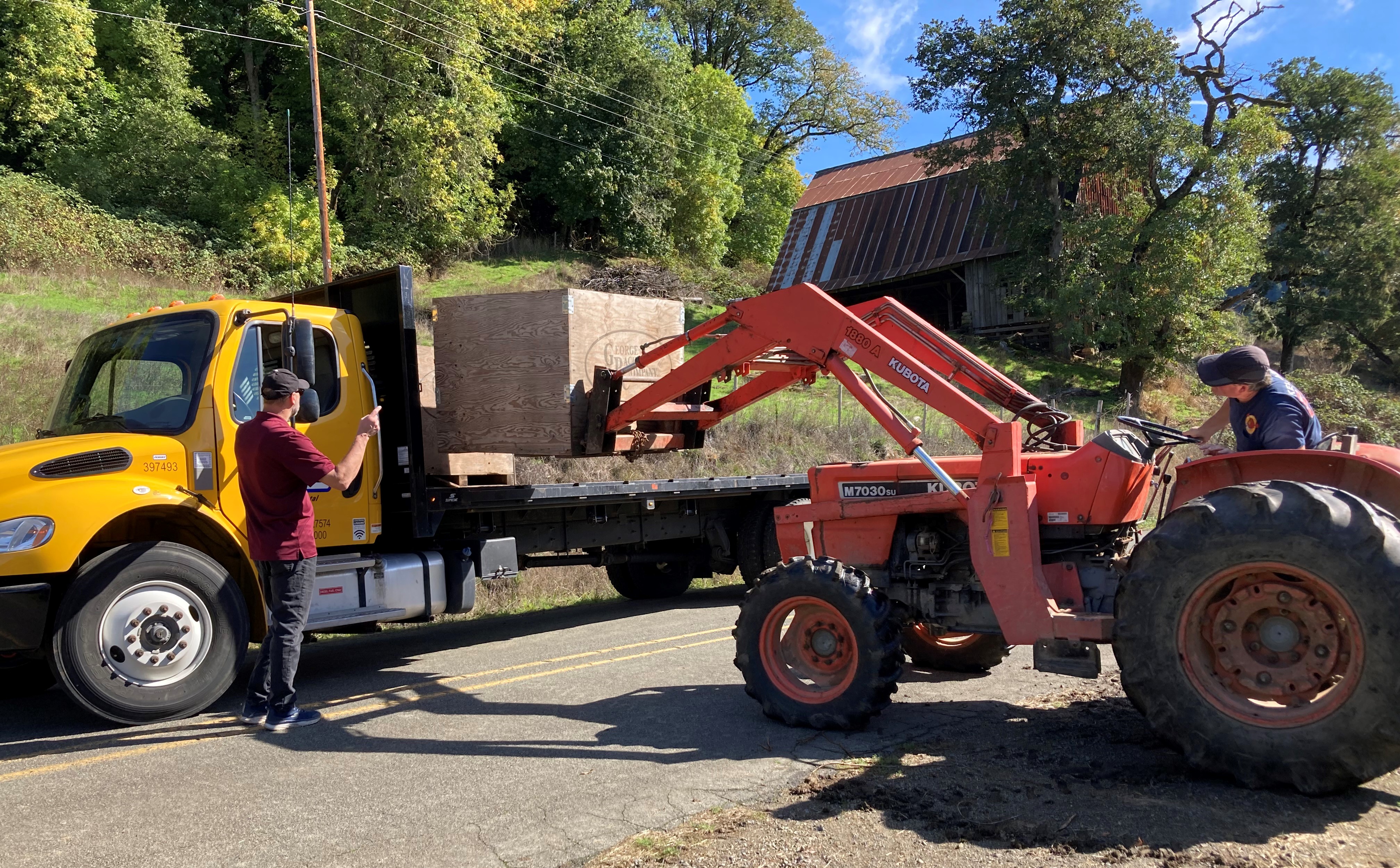
We have a nice coop in our area, the Northwest Hazelnut Company/George Packing Company, Inc. They bring us bins, we fill them, they take them away for processing.

Here my son-in-law Robin Loznak checks out our first bin as we wait for the truck to come pick up our bins. He and my daughter Carisa partner with me on this project. He does most of the work now–mowing and harvesting–although on this first seven acres I spent several summers watering those babies by hand with multiple hoses. I almost knew them by name. I did that until they got too big for me to reach over them and drag the hoses across to the next row. At that point Robin took over the watering with a big water tank drawn by the tractor. He put in the next orchard, 15 acres, and installed a water system for that. This first orchard has dug deep roots by now.

Robin carefully eyes the bin while Troy Mueller from the Northwest Hazelnut /George Packing Company guides him in. The farm’s old 1933 vintage barn can be seen in the background of this photo and the one above it.

A few tidbits for the curious: Oregon grows 99 percent of all the hazelnuts produced in America. Turkey and Italy are the only countries that grow more than we do. Turkey grows by far the most at about 70 percent worldwide. This may be one reason hazelnut farmers are so welcome in the state. Every Oregon hazelnut farmer adds to the state’s market share. Besides just being helpful, friendly people.

Oh, and for people who are wondering. A filbert is just a hazelnut by a different name.

*A Place of Her Own: The Legacy of Oregon Pioneer Martha Poindexter Maupin portrays the story of my remarkable great-great-grandmother who came west over the Oregon Trail. I grew up on this farm Martha bought more than 150 years ago. I’m now the second woman to own and operate this family treasure. I would never have done it without the help of my kids.

Preserving Martha’s Farm

kellogg-fire-robin-photoRobin Loznak Photo

A fierce hot August led to brittle dry hills where my great-great-grandmother Martha Maupin bought her own farm almost 150 years ago. On a neighboring hill an unknown spark lit the tinder yesterday, and flames soon swept across 60 acres less than a mile from the edge of the property–about a mile and a half from my house on this family farm.

My kids and I happened to be in Eugene, Oregon, where my grandson Alex Loznak is one of 21 plaintiffs who are suing the government to demand effective action to combat climate change. In his speech on the federal courthouse steps after the hearing Alex said, in part:

Today my great-great-great-great grandmother’s legacy is threatened by the changing climate, by droughts and fires and heatwaves that threaten to undo all of the work my family has put into our land. So I’m standing here to demand that our federal government act with the same courage and vision that my ancestor Martha employed, and preserve our planet just as my family has preserved our farm. [My bold]

alex-at-sept-hearing-robinRobin Loznak Photo

Later in the afternoon we were sitting outside a restaurant near the courthouse with other supporters of this case when my son-in-law Robin, who took these pictures, noticed a story on his cell that there was a fire on Highway 138 close to the family farm. He and my daughter Carisa had to take Alex to the airport to go back to New York where he’s a student at Columbia University, and I headed for home, not knowing what I would find.

On the long drive from Eugene I easily imagined many scenarios and contemplated what I would retrieve from my house if I was able to reach it. What was important? My computer which has all my work on it. My daughter’s films and puppets. Not much else. Our work.

As many of you know, Martha’s story was the subject of my book A Place of Her Own. This is the ancestor Alex is talking about, and it’s her farm, now mine, that stands so close to the reported wildfire. She purchased this in 1868 after her husband was killed and she needed a way to care for her family. It’s the Martha A. Maupin Century Farm, one of the few Century Farms in Oregon named for a woman. If I can hang on another year and a half it will be a Sesquicentennial Farm. But what if flames ravaged its resources?

kellogg-fire-robin-2Robin Loznak Photo

As I approached the roadblock at the Kellogg bridge, my breath nearly stopped. Lines of flame rose on the peaks straight ahead and far to my left. I learned firefighters had put out the fire on my side of the highway, and it had spread westerly. They let me head for home. I watched the scene from my kids’ house and then my own as the sky grew dark. A stunning view. Helicopters poured water from the Umpqua River and air tankers dumped fire retardant. Late that night the billowing flames had been reduced to twinkling embers, like golden stars dropped from the sky. I went to bed and slept.

Thanks to the fine work of the brave firefighters of the Douglas Forest Protective Association and other local responders the fire has been contained. I woke to quiet. Thin smoke drifted above a darker swath on the hillside.

My grandson’s words echoed. “Droughts and fires and heatwaves . . .”

Now, in the afternoon, a helicopter flies by on its way to the site. Smoke still rises. The throb of helicopters continues. I remain watchful.

COMMENT