Backtracking the Oregon Trail #2

Day Two ~ The Blue Mountains

469.diorama oxen & wagon[The roads] were harder than before. Steeper. Rockier. Dustier. Rivers wilder. There was an occasional tree now, sometimes wooded areas even, with tall conifers and cottonwoods. . . . The trail here was littered with the bones of oxen and fresher dead beasts—along with discarded trunks and furniture—and another human grave. A chill raked Martha despite the heat. The smell of death assaulted her nose.
—A Place of Her Own: The Legacy of Oregon Pioneer Martha Poindexter Maupin, Janet Fisher. (Guilford, CT, Helena, MT: TwoDot/Globe Pequot Press, 2014), p. 119.

Sep 3d We came, I think, eleven miles; over the mountains; the scenery was delightful all day but the road was extremely hilly and rough . . .
September 4th We came, I think, fourteen miles this day over the principal range of the Blue mountains, traveling all day through a densely timbered region . . .
—The diary of Abigail Jane Scott, in Covered Wagon Women: Diaries and Letters from the Western Trails, 1840-1890. Vol. 5, 1852, The Oregon Trail, Kenneth L. Holmes and David C. Duniway, eds. (Glendale, CA: The Arthur H. Clark Co., 1986), pp. 121-122.

3d Sunday . . . Traveled along the west side of the valley at foot of mount about 3 miles when we came to a small stream and then commenced ascending the mountain, very steep in many places and continues to ascend for about 6 miles. very hard drive but at the top found the grass burnt off and there was no water, so had to go on till we came to Grand Ronde [River], ten miles, worst hill to go down that we have found yet. long, steep and rocky. . . .
5th Tuesday . . . Hard times. many cattle are failing and all are very poor and a good many get lost among the thick timber. . . . Traveled on about 7 miles on a mountain ridge sometimes on one side sometimes on the other. pretty sidling in places . . . begin to hope we are getting out of the mounts.
—The diary of Cecelia Adams & Parthenia Blank, Covered Wagon Women: Diaries and Letters from the Western Trails, 1840-1890. Vol. 5, 1852, The Oregon Trail, Kenneth L. Holmes and David C. Duniway, eds. (Glendale, CA: The Arthur H. Clark Co., 1986), pp. 302-303.

Tues Sept 21 Traveled 20 miles. . . . Here we commence climbing the Blue Mountains. . . . Had to camp without water. Found hard hills to day and very stony. Saw 5 graves and 5 dead cattle.
—The diary of Martha S. Read, Covered Wagon Women: Diaries and Letters from the Western Trails, 1840-1890. Vol. 5, 1852, The Oregon Trail, Kenneth L. Holmes and David C. Duniway, eds. (Glendale, CA: The Arthur H. Clark Co., 1986), p. 245.
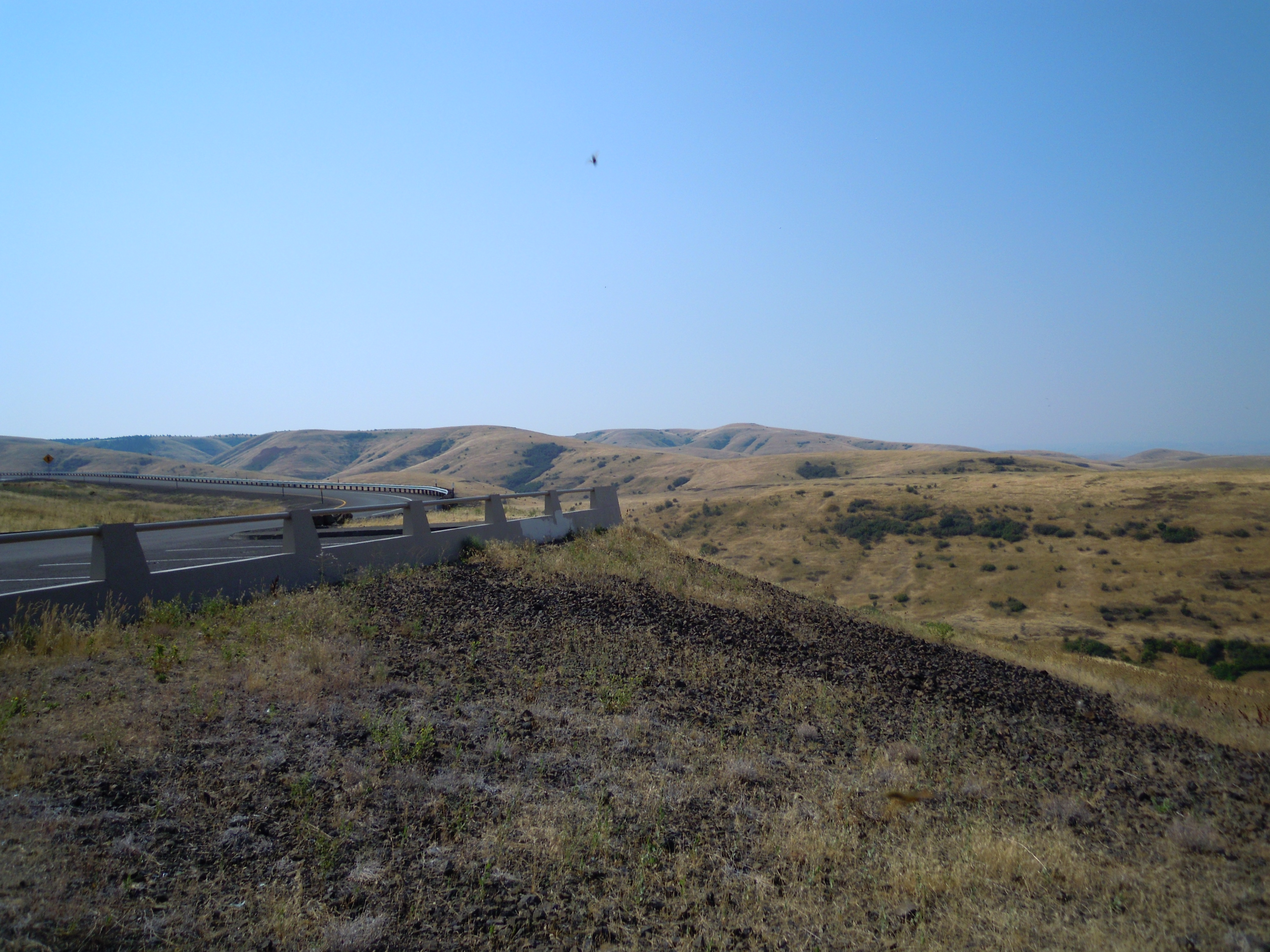
455.road uphill  blue mtsA formidable barrier loomed in front of us as we drove southeast from Pendleton, following the Oregon Trail pretty closely. Rising suddenly from a wide, flat landscape, the ridge looked barren except for a few tree clumps in the hollows. The highway took a wide sweep to zigzag up the hill. You could feel it on the heavily loaded car. Ears popped. My breath caught, imagining wagons rolling down this grade from the other direction.

We soon climbed into rugged timbered mountains. Mostly pines. And worked our way across, with lots of ups and down. Ridge after ridge. These were the Blue Mountains, the worst mountains the emigrants had crossed so far on their entire journey.

You don’t give much thought to those rising and falling grades while driving a car on a smooth highway—although we saw a few cars stopped with raised hoods. But when you let your thoughts drift back to a time when every rise meant a long, hard pull for weary oxen and every drop meant the danger of a wagon rolling out of control—forward or sideways. And every stone on a gravelly track meant the risk of losing a wheel or even overturning the whole vessel. Then the ups and downs become a whole lot more serious.
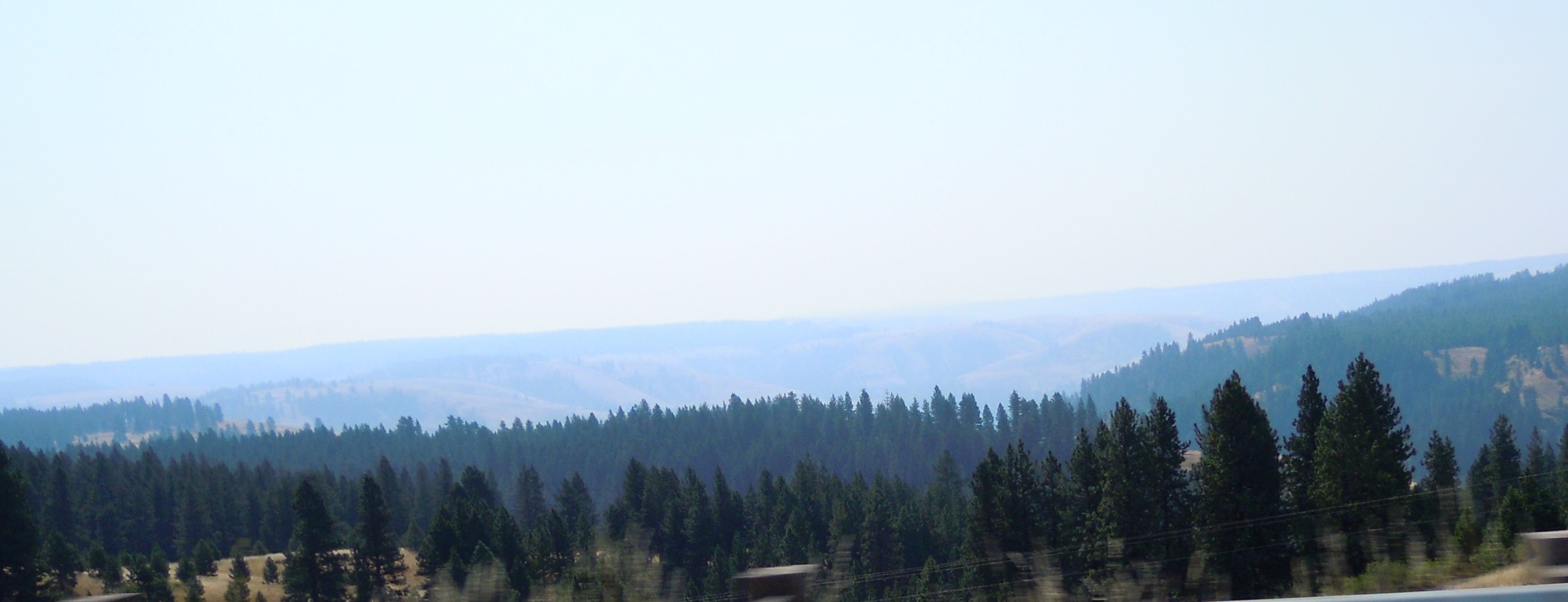
458.blue mts long view (crop)And think of where they were on that incredible journey. They were nearing the end. They’ve been trudging across a seemingly endless track for almost 2,000 miles. How daunting for them to reach the roughest part now. The oxen are so weary, many are just giving it up. Not enough food. Sore feet. Loads feeling heavier by the day. Now this. They drop and die. And sometimes people do too. Still, in their weariness, some diarists remarked on the splendid beauty of it. The fine timber.

After a long haul across this range we came alongside a gravelly creek which tumbled into a large flat expanse surrounded by a ring of mountains. Out ahead we could see where we would have to climb another ridge. This was the Grande Ronde Valley, admired by many travelers. The name comes from the French grande ronde, meaning “fine large valley” or “big round valley,” so named by the early French-Canadian trappers. A respite before the next rise. The Grande Ronde River mentioned in the above diary flows out of the Blue Mountains.

Our next climb brought us into sparse pine woods, which offered scattered shade amid jutting rock bluffs and scanty tufts of dry grass. This ridge wasn’t nearly as rugged or deep as the last. Reverse the direction of travel and you realize this was only a hint of worse to come for those westbound pioneers. Could they even imagine what was awaiting them in the ridge ahead?

[The photo at the top was taken in the National Historic Oregon Trail Interpretive Center near Baker City, Oregon]

NEXT: A stopover at the interpretive center just outside Baker City, a highlight on our journey

COMMENT


Festival Time in Cottage Grove

635.kalapuya bksI’ll be visiting another bookstore on another Main Street in America Saturday–this one in Cottage Grove, Oregon. The small town of Cottage Grove boasts three bookstores on its historic Main Street. My next book signing and reading will be held at Kalapuya Books this time, located at 637 E Main, September 20 from 2 to 4 in the afternoon.

It’s Oregon Covered Bridge Festival time, so when the Kalapuya event is done, I’ll trek on over to Bohemia Park on the other side of the railroad tracks for a Meet & Greet the Author from 5 to 6 at the Cottage Grove Souvenir Booth. They’ll have copies of my book A Place of Her Own for sale as well, which I’ll be happy to sign.

It should be a fun day with lots to do. And familiar territory for me, since I lived in Cottage Grove for several years before moving to the family farm featured in my book. If you live nearby I hope you’ll stop by and join us.

COMMENT

Backtracking the Oregon Trail #1

Introduction

I recently returned from a road trip with my daughter Christiane and granddaughter Calliope. Christiane got a new job as Assistant Professor at Kansas City Art Institute and was moving back to the Kansas City area. I decided to join her on the drive east to help with my granddaughter, who’s nine years old, then help set up their new house before flying home. On our eastbound route we chose to backtrack Martha’s journey over the Oregon Trail as roads and time allowed.

It took us five days to cross what took five months for my great-great-grandparents Martha and Garrett Maupin. And for my flight home I was in the air about five hours.

I’m adding this new category to my blog to describe our trip, offering related quotes from my book about Martha, A Place of Her Own: The Legacy of Oregon Pioneer Martha Poindexter Maupin, as well as quotes from the diaries of other pioneer women who made that journey. The diaries are taken from a series called Covered Wagon Women, edited by Kenneth L. Holmes. Like Holmes I present these diaries as written, using the spellings and punctuations of the original writers. A few additional sources add information. This is the first of ten posts in our story.

462.one lg wagonDay One ~ The Dalles

[T]he heat of the day radiated with scorching fury. . . . Now Martha worried about their own food supply. Her food bags had gone flabby for lack of contents. They’d traded with some Indians–shirts for fish–large dried salmon to add to the meat supply. But they were nearly out of flour. How long until they reached The Dalles, where they might buy more?
—A Place of Her Own: The Legacy of Oregon Pioneer Martha Poindexter Maupin, Janet Fisher. (Guilford, CT, Helena, MT: TwoDot/Globe Pequot Press, 2014), pp. 119-120.

Here the Doct. met us on his way back from the Dalls. . . . He brought some flour, pork, Salt, and saleratus. Prices are coming down at the dalls. flour can be had at 15 cts. Pork at 37½, Salt at 25, Salertus 25, Sugar 25 to 30 . . . Have long been convinced that we are too late to cross the Cascade Mountains with safety so we concluded to leave our cattle and wagon at the Dalls and proceed down by water. . . . Traveled to the Dalls, 5 miles, and found a boat ready for sail
—The diary of Cecelia Adams & Parthenia Blank, in Covered Wagon Women: Diaries and Letters from the Western Trails, 1840-1890. Vol. 5, 1852, The Oregon Trail, Kenneth L. Holmes and David C. Duniway, eds. (Glendale, CA: The Arthur H. Clark Co., 1986), pp. 308, 310.

We this morning sent two of the wagons by the way of the Dalles to be sent to Oregon City by water
—The diary of Abigail Jane Scott, in Covered Wagon Women: Diaries and Letters from the Western Trails, 1840-1890. Vol. 5, 1852, The Oregon Trail, Kenneth L. Holmes and David C. Duniway, eds. (Glendale, CA: The Arthur H. Clark Co., 1986), pp. 129-130.

461.circle wagonsWe crammed everything into the car that we possibly could, to add to what Christiane had sent by U-Haul pod. Martha and Garrett crammed everything into the wagon they possibly could, and left behind anything that wouldn’t fit or that would be too heavy for the oxen to pull.

Starting out on the main roads, we planned to meet up with Martha and Garrett’s route at The Dalles, Oregon. The Dalles was one of those mileposts for the American emigrants, a place to replenish depleted supplies and to stop and rest before the most harrowing part of the journey. While the Rocky Mountains offered a gentle pass across their summit, the Cascade Mountains did not. The first several wagon trains in the early 1840s stopped well before this rugged range. Wagons were dismantled, broken down, left behind—either at The Dalles or before—and people took boats down the treacherous Columbia River or followed long, perilous trails on horseback over the mountains.

But wagons carried a lot of stuff they wanted. And getting those treasures to the west side without the wagons proved a problem. Some ferried the loaded wagon boxes down the river, or reloaded the goods onto boats. But many wanted to take the wagons west with them. Men decided to cut a road over the Cascades south of Mount Hood. They called it Barlow Road. Not much of a road, but hardy folks like the Maupins took their wagons across the Cascades over it, all the way to their destination in Oregon’s lush Willamette Valley. I had previously visited part of that route just prior to writing Martha’s story, so we bypassed that and went straight toward The Dalles.

We had talked about eating dinner at The Dalles, but were getting hungry before we got there. I couldn’t help being reminded of Martha’s concerns about their food supply before reaching The Dalles. We decided to stop for dinner at Hood River instead. The car has a temperature gauge, and had been warning us, but we were comfortable with the air conditioner blowing. The numbers had hit 98 in Portland, unusually high for that city, and reached 100 by Troutdale on the city’s eastern perimeter. At Hood River it had climbed to 102.

We stepped out of the car. Heat pressed down like a living force. We had Christiane and Calliope’s dog Penny with us. We couldn’t leave the dog in the car, even in the shade. Looking for a place where we could eat outside and tie her next to us, we finally found a possibility. The restaurant had tables on a covered patio and the waitress set a place for us—in the sun! No way could I sit in the sun to eat when it was 102 in the shade. Nor could they promise food in less than 30 to 40 minutes. I figured we’d be cooked ourselves in that amount of time.

Our thoughts of a nice dinner evaporated like water on a sizzling sidewalk. We pushed on to The Dalles. It was drive-through time. Eat in the car with an occasional blast of cool air from the AC.

464.two wagonsAgain I thought of Martha and the relentless heat bearing down on her, often without shade except for a little alongside the wagon. No blast of cool air from anywhere. How desperate she must have been for a tree, a stream of water, anything to provide relief. At least, here on the east side of the Cascades it was a dry heat. But when it’s over 100 it still takes your breath away.

Anyway, a quick dinner got us back on the road faster and we drove on toward our first night’s destination in Pendleton, Oregon. It had taken us longer than expected to load up that morning, and the estimated travel times we got online appeared to be a little optimistic. We wouldn’t reach Pendleton before dark. A sense of urgency compelled us. But with the long summer days, we saw most of our route, dark settling just before Pendleton so when we approached it, the town appeared like a jewel of lights nestled in dark velvet.

[The photos for this post were taken outside the National Historic Oregon Trail Interpretive Center in Baker City, Oregon, which we would visit on Day Two. All photos in the series are by the author.]

NEXT: First thing the following morning, we reach the Blue Mountains, the most difficult road the emigrants have seen on their entire journey.

COMMENT

Look for the Wagon ~ Soon

462.one lg wagonThe first post in my new category, “Backtracking the Oregon Trail,” should be ready within the next 2 or 3 days. I’ve collected some quotes from diaries of women who traveled over that trail in the mid-1800s. Putting those together with quotes from Martha’s story, I hope to offer a few brushstrokes of color to show moments of their journeys as I describe highlights of our own trip retracing their footsteps. I hope you’ll join us.

COMMENT

Fun at Fort Umpqua Days

Elkton history enjoyed a dash of fun at the annual Fort Umpqua Days celebration Saturday and Sunday. From the parade Saturday morning until the final show of the pageant in the ECEC Amphitheater in the Park, history echoed through the festivities with this year’s theme, “Woods to Wine.”

605.fort umpqua boothIn my booth there I enjoyed presenting my own bit of local history with my book, A Place of Her Own: The Legacy of Oregon Pioneer Martha Poindexter Maupin. Robin Loznak took this picture of me.

Right next door to me was Leta Lovelace Neiderheiser with her history of her famous pioneer ancestor, Jesse Applegate: A Dialogue With Destiny. Nice meeting her.

606.cousins at fort umpqua

I was also pleased to meet another cousin, Cheryl Miller, a third cousin whose line runs through Martha’s son Cap and Cap’s daughter Lois. Cheryl and her husband live in Cottage Grove, where she works in Safeway. During my years in Cottage Grove I had no idea I lived near cousins. I’ve met so many since this book came out, it’s one of the pleasures I hadn’t expected.

435.campfireWhile people in the booths kept busy on the hill, down at the old Fort Umpqua replica near the river, kids were delighting in getting a taste of history, pumping water to wash clothes, cooking in a Dutch oven over an open fire, and other activities.

Then each evening we gathered at the amphitheater for the pageant “Echoes of the Umpqua 2014: Woods to Wine.” The theme recognized the shift in the local economy from one based on timber and logging to one highlighted by the winery business. Just last year the federal government designated Elkton an American Viticulture Area (AVA) in recognition of the high quality cool climate wine grapes produced by local wineries and vineyards. As usual, the pageant presentation had some fun with the history. I enjoyed being on the writing committee for the play–although we’re sworn to secrecy on who wrote which part. 🙂

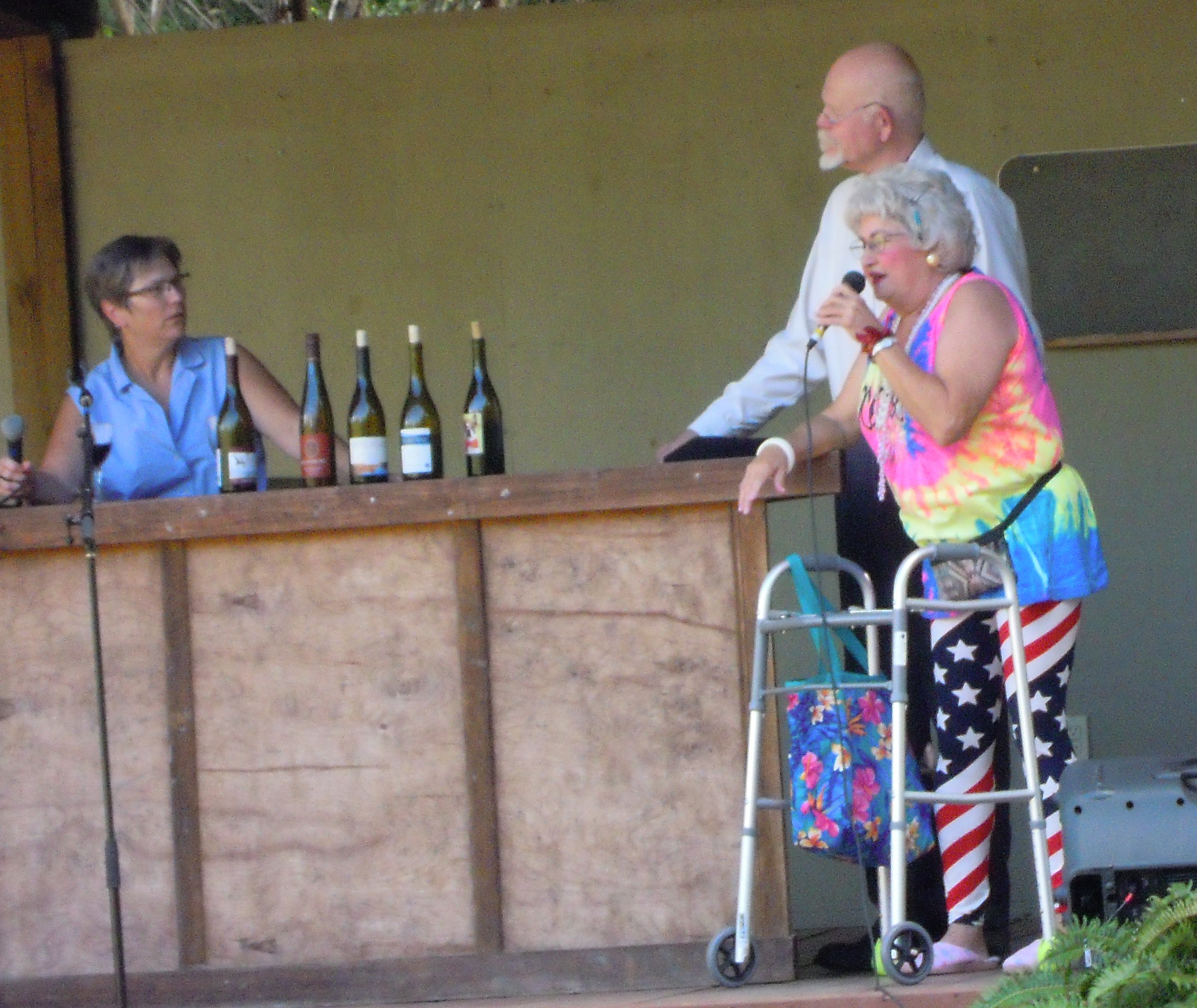
607.gram & gramps pageantA right sassy granny enjoys a taste of the local wine and reminisces about the good old days when loggers ruled. Did somebody mention lady loggers?

We flash back to those early days when a new teacher comes to town and struggles with an unfamiliar culture of loggers and farmers who expect their kids to skip school while helping out with the harvests. How can she possibly teach them?

608.pageant square dance


But a square dance is fun. And she can’t help noticing the charming young logger who enjoys a bit of Shakespeare.


611.pageant musicians


The band offers some good old-time music. And as the saying goes, a good time was had by all. 🙂


COMMENT


Fort Umpqua Days

Elkton, Oregon, puts on a big Fort Umpqua Days event every year on Labor Day Weekend in celebration of the town’s history.This year it’s Saturday and Sunday, August 30 and 31.the fortThe British Hudson’s Bay Company built Fort Umpqua in 1836 near where Elkton sprouted a few years later. It was the company’s southernmost fort in the Oregon Territory in the days when they essentially ruled the area, chasing the lucrative fur trade–before all those American pioneers started trekking west over the Oregon Trail.

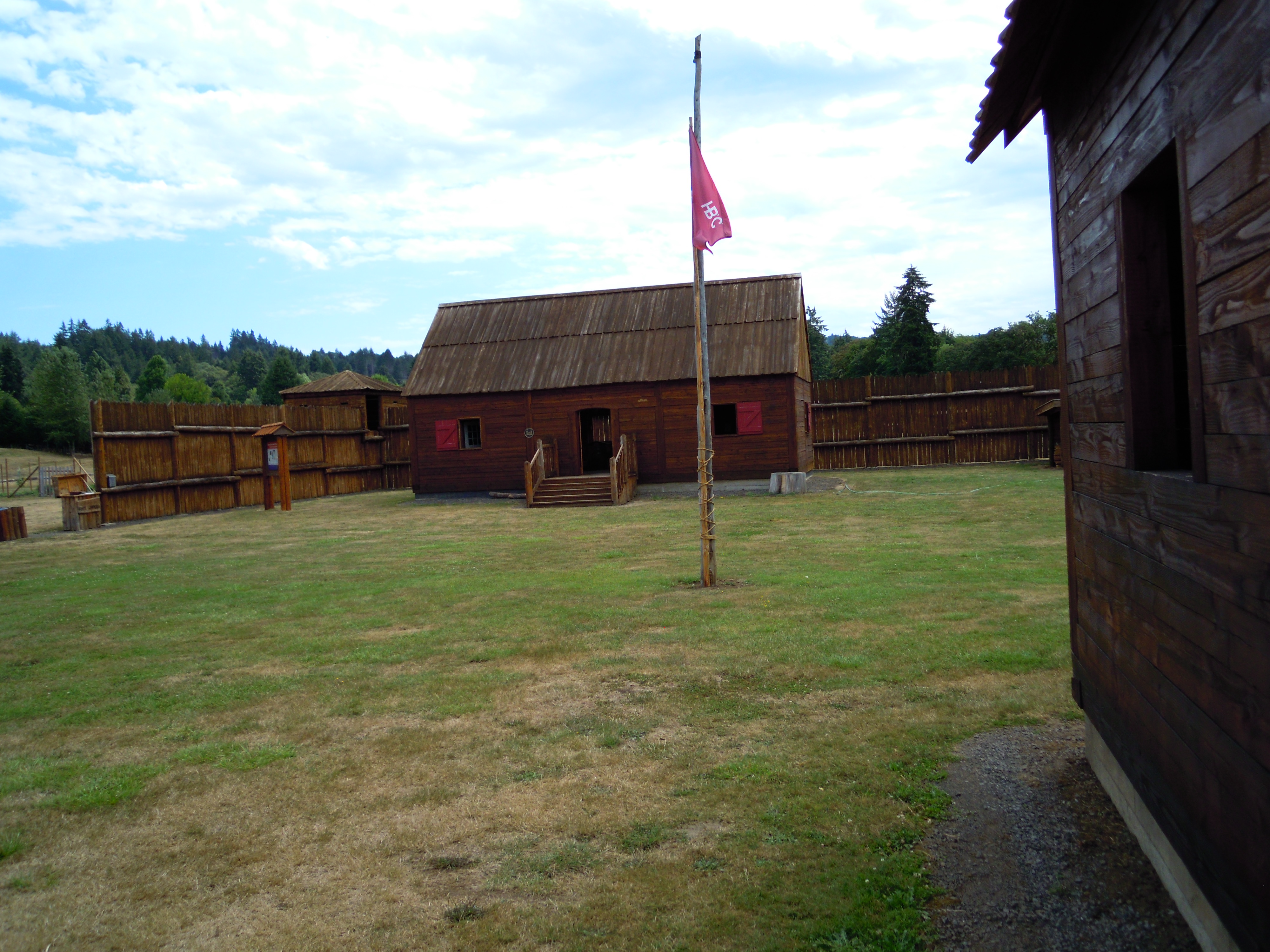
The first fort burned in 1851, and a flood in 1861 washed away what was left of it. A few years ago citizens of the area decided to reconstruct the fort on a site just downriver from the original, and the work continues today with new buildings going up inside the wooden palisade walls, with considerable effort made to keep things authentic. Now the HBC flag flies again.

DSCN0434So, during Fort Umpqua Days we celebrate with a parade and a history pageant, a craft fair, and other events. I’ve enjoyed serving on the writing team for the pageant the last few years, in which the history is told with a bit of humor and a bit of truth. And this year I’ll have an outdoor booth for selling and signing my book about one of those intrepid American pioneers–my own ancestor Martha Poindexter Maupin.

DSCN0429Last year kids came into the fort grounds to learn how people at the old fort cooked and kept gardens and washed their clothes, which was probably a whole lot more fun for the kids than for those guys at the original fort. Inside, there are furs and stories aplenty to whet the imagination.

The event is open to the public and fun for kids of all ages. If you enjoy taking a step into the past, here’s a great place to do it.  🙂

COMMENT