Backtracking the Oregon Trail #9

Day Five ~ Back to the Beginning

464.two wagonsThe land was mostly dry and dusty. . . . The Platte River making its lazy way between sandy bluffs, curving along a wide swath of bottomland. The shallow stream could sometimes be as much as two miles wide and a few inches deep. . . . Islands and sandbars, quicksand. Muddy, warm.
They were finally on their way. . . . The weight of troubles slipped from her shoulders as she looked west toward a new land and new possibilities. . . .
A Place of Her Own: The Legacy of Oregon Pioneer Martha Poindexter Maupin, Janet Fisher. (Guilford, CT, Helena, MT: TwoDot/Globe Pequot Press, 2014), pp. 109-110, 104.

Saturday, May 25. Still traveling up the Platte. The road is a little monotonous. The scenery does not change much. The river has a winding course and contains many islands. Some are little more than sand bars, others are covered with low willows. The road is at times along the river bank, and again near the bluffs on our left.
—The diary of Margaret A. Frink, in Covered Wagon Women: Diaries and Letters from the Western Trails, 1840-1890. Vol. 2, 1850, Kenneth L. Holmes, ed. (Glendale, CA: The Arthur H. Clark Co., 1990), p. 89.

Took up camp after dinner & started up the Platte. . . . The road is level being between the bluffs & the river. The Bluffs are very high & picturesque. The river ranks among the first class as to width but is very shallow as indicated by the many islands with which it is filled.
—The diary of Celinda Hines, in Covered Wagon Women: Diaries and Letters from the Western Trails, 1840-1890. Vol. 6, 1853-1854, Kenneth L. Holmes, ed. (Glendale, CA: The Arthur H. Clark Co., 1986), p. 89.

June 17th Traveled near the Platte all day and encamped near it at night. This is a turbid river, no trees of any size to be seen. We make out to use the water by sprinkling in a little corn meal This makes it a little cleaner.
—The diary of Rachel Taylor, in Covered Wagon Women: Diaries and Letters from the Western Trails, 1840-1890. Vol. 6, 1853-1854, Kenneth L. Holmes, ed. (Glendale, CA: The Arthur H. Clark Co., 1986), p. 164.

May 10th [at St. Joseph] Crossed the [Missouri] river without any difficulty . . . The surrounding scenery is delightful The soil is fertile and lacks nothing but improvement to make it one of the first places in the world in agriculture;; My sister and I ascended to the summit of a hill and with the aid of a spy-glass took a farewell view of St. Joe. and the United States.:
—The diary of Abigail Jane Scott, in Covered Wagon Women: Diaries and Letters from the Western Trails, 1840-1890. Vol. 5, 1852, The Oregon Trail, Kenneth L. Holmes and David C. Duniway, eds. (Glendale, CA: The Arthur H. Clark Co., 1986), p. 49.

I could not begin to tell you how many their [are] in St Joseph that are going to Oregon and California but thousands of them it is a sight to se the tents and wagons on the banks of the river and through the country
—The diary of Mary M. Colby, in Covered Wagon Women: Diaries and Letters from the Western Trails, 1840-1890. Vol. 2, 1850, Kenneth L. Holmes, ed. (Glendale, CA: The Arthur H. Clark Co., 1990), p. 48.

462.one lg wagonBy Day Five we had to push forward without delay. We followed the trail a ways, along the main fork of the Platte River, lush and green now with farming, bluffs on either side. You can tell where the river is by the line of trees that marks it.

Martha wouldn’t recognize this any more than she could have recognized the land along the North Platte. She would have remembered a much drier place with fewer trees, and those often limited to the islands of the wide, meandering waterway.

Pushing eastward into the tall grass country, we saw more farms where Martha would recall prairie grasses that could grow six feet tall, and flowers in swashes of color reaching into an arc of blue sky.

509.chimney rock & sunflowersThe native North American prairies west of Missouri changed gradually going westerly—from tall grass to mixed grass to the short grass of the high desert. From the diaries it sounded as if the tall grass had pretty well played out by Fort Kearney, soon after they reached the Platte. Somewhere in there you begin reading about lack of wood and the need for that substitute fuel offered by the buffalo that ranged across the region—buffalo chips. Different companies of wagons spread out so their livestock wouldn’t overgraze along a single track, here where the land stretched wide enough so they could.

I didn’t take any pictures on Day Five, maybe because the landscape seemed monotonous, mostly flat, green, looking nothing like the place described in the diaries. A monotony of a different kind. As we continued eastward the flat land spread farther to the horizon so the bluffs on each side sometimes disappeared in the distance. And a gradual greening occurred the farther east we drove—probably as that earlier vegetation once changed from shorter mixed grasses to the tall prairie grass, going the opposite direction the emigrants were.

The Weston plow, invented in the late 1850s, changed this landscape. Before the Weston, no plow could cut through the tough root system of the tall grasses. But this new plow had the power to turn the turf over. Farming was born in the tall grass prairie. A few industrious souls today are trying to return portions of this land back to its native state, but they have strong competition from agribusiness.

We left the trail around Kearney for the shortest route to our destination, finally reaching the Missouri River and St. Joseph, one of the popular jumping-off places for emigrants embarking upon the Oregon Trail.

463.wagons high plainsFolks couldn’t just march west when they had a mind to. They faced a small window of time when it was advisable to go—to jump off into the wilderness and one of the most profound adventures of their lives. They had to wait until the prairies greened up in the spring to offer feed for their livestock, and they had to cross the last mountain before the winter snows. Towns like St. Joe, Independence, and Westport (which became Kansas City) grew up where people waited, and businessmen set up shops to offer supplies in case folks still needed goods. Business could be brisk while folks waited and shored up the wagons.

Reading the diaries you feel the gradual shift as the bright hope at the outset begins to fade. Exclamations of “beautiful scenery” and “good roads” turn to words like “tedious” and “monotonous.” The good roads turn dusty. The lush grass becomes scanty. The way ahead feels longer, less certain. I am reminded of Joseph Campbell’s heroic journey. Isn’t that the way of every major endeavor? We leave the familiar because something compels us. And if we knew in the beginning how hard the road would be, we might never have the courage to go. Hope compels us, and though things get rough in the middle, we come out on the other side, having triumphed or at least having learned something.

502.painted wagon & oxen scotts bluffNearing the end of our journey we decided to stop in St. Joe for dinner. We were so ready for a decent meal. Our own struggles paled in comparison to those of the intrepid pioneers, but we were anxious for a few of the comforts.

Christiane had hoped to arrive at her house before dark, having rented the place sight unseen, except for pictures.

Maybe with a quick meal we could have made it, but our desire for something better outweighed her plan. We enjoyed a delicious sit-down dinner and reached Kansas City in the dark.

The map of freeways and streets looked as if a drunken spider had gone on a spree and built a crazy web. It took careful watching for signs, but our directions led us right to the house, and we were pleased to see the canopy of large trees in the neighborhood. When we stopped in the driveway and opened the car doors, a strange sound reverberated around us. It seemed almost like an electronic buzz and I wanted whoever was doing it to turn off the music or machine or whatever was making that noise. We were so exhausted we just wanted to go in and make our beds on the floor—to sleep and await the moving pod and real beds the next day. But what was that sound?

We learned there were huge cicadas, and maybe some tree frogs adding to the chorus, and over time we began to get used to them. We could barely hear them inside the house with doors and windows closed. So they didn’t keep us awake. They did make our chirpy critters back home seem like soft crooners.

So our journey ended near where Martha’s started. She began with hopes high, marching out onto the wild prairie. We entered the city—one of those jumping-off places—tracking a wild network of freeways in the dark. But we shared her sense of hope for new adventures and possibilities.

Scotts Bluff National Monument: Landmark on the Overland Trails, A History and Guide, Dean Knudsen, Historian, National Park Service, pp. 34-36.

Women’s Voices from the Oregon Trail, Susan G. Butruille. (Boise, ID: Tamarack Books, 1993), pp. 21-22.

NEXT: Afterword
COMMENT

Backtracking the Oregon Trail #7

Day Four ~ Chimney Rock

508.chimney rockHer left boot was getting a hole in it, letting the gritty dust in to nestle between sole and foot and bite in worse than the grit outside the sole. . . . Step after step . . . past natural wonders . . . Chimney Rock . . . Scotts Bluff. . . . She couldn’t get her breath. She was three months pregnant.
A Place of Her Own: The Legacy of Oregon Pioneer Martha Poindexter Maupin, Janet Fisher. (Guilford, CT, Helena, MT: TwoDot/Globe Pequot Press, 2014), p. 116.

Wednesday, June 5. The weather to-day was quite hot and oppressive. We had to cross a long stretch without water. The road we took led us close to the base of Chimney Rock, where we stopped for some time to satisfy our curiosity. The base is shaped like a large cone, from the top of which rises a tall tower or chimney, resembling the chimney of a manufacturing establishment. . . . It is composed of marl and soft sandstone, which is easily worn away. Mr. Frink carved our names upon the chimney, where are hundreds of others.
—The diary of Margaret A. Frink, in Covered Wagon Women: Diaries and Letters from the Western Trails, 1840-1890. Vol. 2, 1850, Kenneth L. Holmes, ed. (Glendale, CA: The Arthur H. Clark Co., 1990), p. 95.

Came opposite Chimney Rock which has been sight since yesterday. It has been seen 30 miles off on a clear day. Three of us went to it. I was struck with amazement at the grandeur of the scene.
—The diary of Lucena Parsons, in Covered Wagon Women: Diaries and Letters from the Western Trails, 1840-1890. Vol. 2, 1850, Kenneth L. Holmes, ed. (Glendale, CA: The Arthur H. Clark Co., 1990), p. 253.

June 14th Traveled twenty four miles:. We have seen very romantic scenery all day; The Chimney rock has been in full view all day:; It is represented as being three hundred feet high but from the road we are traveling it does not appear to be more than one hundred feet.;. Palmer in speaking of this rock very truly says that it has the unpoetical appearance of a hay stack with a pole extending far above its top
—The diary of Abigail Jane Scott, in Covered Wagon Women: Diaries and Letters from the Western Trails, 1840-1890. Vol. 5, 1852, The Oregon Trail, Kenneth L. Holmes and David C. Duniway, eds. (Glendale, CA: The Arthur H. Clark Co., 1986), pp. 65-66.

To day we come to the river opposite Chimney Rock which has been visible most of the way for the last 35 miles It is said to be 3 miles from the opposite side of the river but on these level prairies we cannot judge much of distances by the eye It does not appear more than half a mile It consists of a large square column of clay and sand mixed together with a base of conical form apperantly composed of sand, round base cone. and appears as if the column had been set up and the sand heaped around it to sustain it It is said to be 500 feet high but doubt it some
—The diary of Cecelia Adams & Parthenia Blank, in Covered Wagon Women: Diaries and Letters from the Western Trails, 1840-1890. Vol. 5, 1852, The Oregon Trail, Kenneth L. Holmes and David C. Duniway, eds. (Glendale, CA: The Arthur H. Clark Co., 1986), p. 271.

At night we came to Chimney rock which had been visible to us for 15 miles. . . . We camped near the river about two miles from the rock. After tea uncles, Mr Long, Julia Martha & I went to see it by moonlight The sight was awfully sublime The sides of the base on which the pillar rests are so steep that it was with the utmost difficulty we could climb up it at all. We however succeeded in climbing up some distance. We found it covered with names We got back to the camp about 10 O’clock
—The diary of Celinda Hines, in Covered Wagon Women: Diaries and Letters from the Western Trails, 1840-1890. Vol. 6, 1853-1854, Kenneth L. Holmes, ed. (Glendale, CA: The Arthur H. Clark Co., 1986), pp. 92-93.

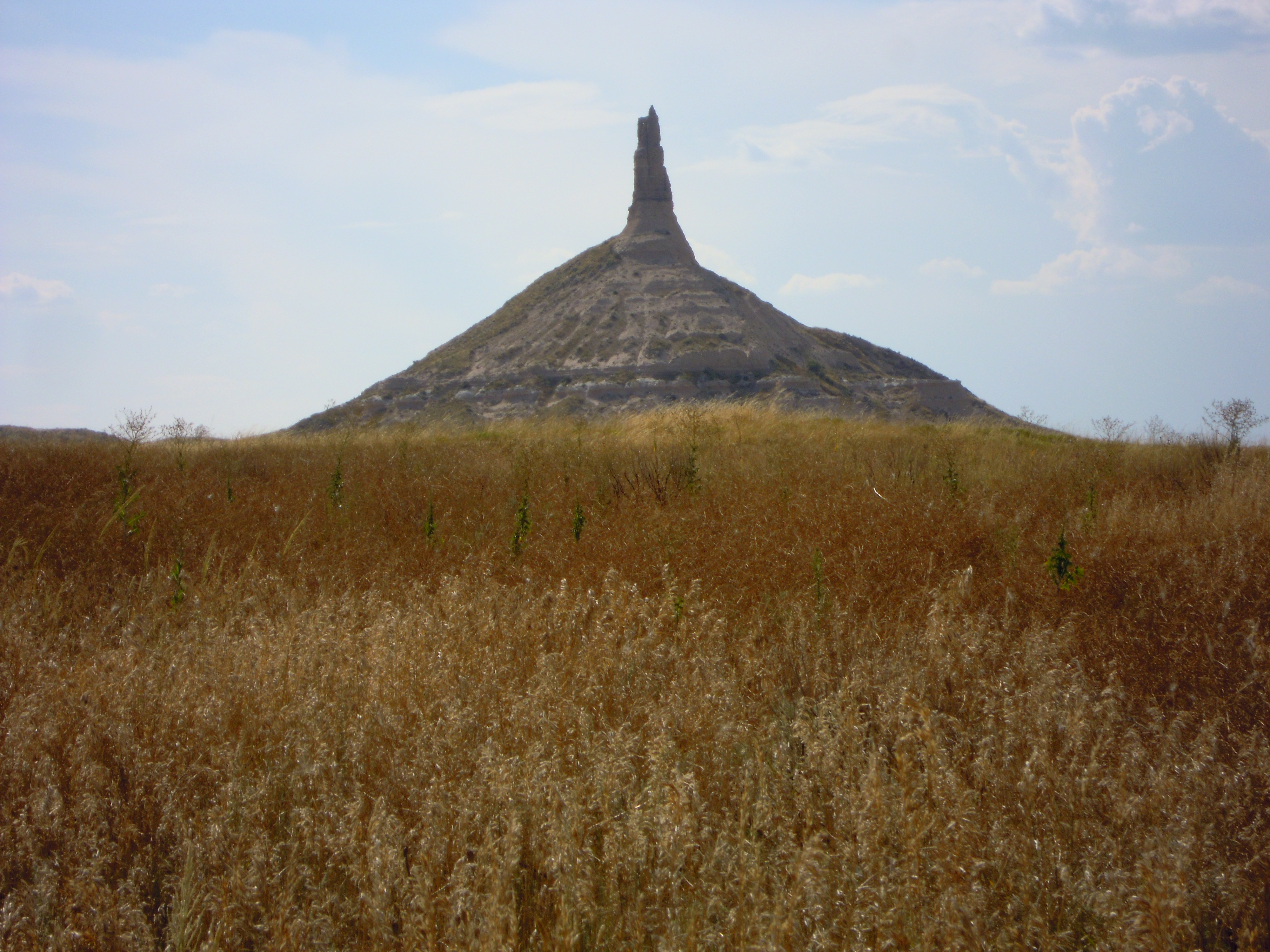
502.painted wagon & oxen scotts bluffDownriver from Scotts Bluff my family and I finally came upon another of the famous landmarks along the Oregon Trail, Chimney Rock. Traveling eastward, we didn’t see it right away. But perhaps even more than Scotts Bluff, this one cannot be mistaken once seen. Many a pioneer commented on this remarkable feature that points a jagged finger to the rich blue skies.

The pinnacle rose before us, one of the more amazing sights on our journey from Oregon to Kansas City, as we retraced the footsteps of our pioneer ancestors who took this trail westward. My daughter Christiane and I had seen it years ago when our family took a camping trailer over this route. And having traveled the trail again in my mind as I wrote Martha’s story, A Place of Her Own, I thrilled to see it firsthand once more and show my granddaughter as well.

By the time we reached the visitor center for this geological marvel, the thermometer was inching up to 100. And at this site we didn’t see a speck of shade. We dismissed any notion of trekking to the monument’s edge, but I hurried into the visitor center while my daughter and granddaughter stayed with the dog in the air-conditioned car, the motor running. I had previously sent a copy of my book to be reviewed for their gift shop and stopped in to introduce myself.

Thinking about our pioneers ancestors, I could only imagine how miserable it would have been for these people and their animals to trudge across the barren land here on days such as this. The photo above of a painted wagon and oxen from the Scotts Bluff site helps bring the image to life.

As with Scotts Bluff, the sediments on the unusual Chimney Rock landmark show the many layers set down by nature over time. Travelers along the Oregon Trail must have wondered how these imposing features happened to be here. The formations appear to hold the strength of the ages, but they’re gradually disintegrating, much as they’ve been doing for thousands of years.

Scientists say it all started with a major geological uplift along North America’s west coast 70 million years ago. A huge inland sea once covered this central part of North America, but that land rise on the coast created the Rocky Mountains, displacing the inland sea. Water on the east side began to wash into the Mississippi River Basin. Wind and water carried huge amounts of sediment from the Rockies and deposited it here in layers of sand and silt, the accumulated weight compressing the deposits into sandstone and siltstone. Periodic volcanic activity added layers of ash.

Then about 10 million years ago the uplift increased, and streams moved faster, carving deep into the deposits. Here and there, denser stone held firm, where hard capstones of limestone at the top held down the layers so they still show like a layer cake of varied flavors.

509.chimney rock & sunflowersWe saw lots of wild sunflowers along the way. They looked pretty next to these unidentified white flowers near Chimney Rock (directly above). We saw many bunnies and a magpie or two, but none of the prairie rattlesnakes that signs warned us about.

Life forms no longer seen in this area walked these lands 30 million years ago. Their fossils have been preserved in the sand and silt layers—animals like rhinos, camels, giant hogs, and a few stranger creatures, as well as huge turtles.

Humans began appearing around 10,000 years ago, or possibly earlier. People developed agriculture along the North Platte River, then abandoned the area around 1400 AD, probably due to drought. Later, eastern tribes were pressed into the area by European settlement. When the Spanish reintroduced the horse to this continent in the 16th century, that animal changed the lives of the tribes then living on the plains, providing mobility and prowess in battle. These were the people American emigrants met on their way west over the Oregon Trail.

Scotts Bluff National Monument: Landmark on the Overland Trails, A History and Guide, Dean Knudsen, Historian, National Park Service, pp. 2-7.

NEXT: The North Platte and Ash Hollow

COMMENT


Portraits of a Century Farm ~ Haunting Gems

Robin Loznak captured this photo on a dewy October morning on the Martha A. Maupin Century Farm in Oregon, as an industrious spider seeks breakfast in her dew-jeweled web before a backdrop of leaves in glorious fall color. She put me in mind of Halloween on this upcoming edge between summer and winter when we recall in one way or another the ancient celebration of the edge between life and death.

web-Fall-Spider01

Haunting Gems

Deadly beauty spins a tale in pearls of light
As days rush by to Halloween.
Death to life, and life to death.
Strands gleam against a sheen of gold,
Leaves soon to scatter off skeletal limbs.

Chill runs in the air and down the spine
With pumpkins glaring in the dark
And children braving hideous things.
Blood, gore, goblins, cackling witches,
And gauzy webs a-streaming.

Look at death and laugh.
Who can be the scariest?
Look at the edge and shiver.
Life to death, and death to life,
Glimmering in our frightful dreams.

Deadly beauty spins a tale in pearls of light.
On this fine autumn day
As life around it ebbs,
One creepy, crawly, skittery, artful, exquisite creature
Hangs waiting for a meal.

COMMENT

Portraits of a Century Farm ~ Threads of Light

Robin Loznak took this picture one September morning a couple of years ago along the hill road of our Century Farm–the Martha A. Maupin Century Farm named for my great-great-grandmother, subject of my new book A Place of Her Own. I imagine Martha walking this road before us, thrilling to the same kind of morning light. Below, I share some reflections.

web-morning-1

Threads of Light

Threads of light weave through a warp of branches,
A living tapestry along a border of dusty tracks
That wind down the quiet mountain.

Seasons pass, summer into fall,
September into October,
And the fabric changes.

Washes of new color gild the fibers,
While rivulets mark the verge
With sinuous patterns.

Leaves drift, scatter.
The weave opens,
And the weft expands as gathering clouds allow.

COMMENT

Festival Time in Cottage Grove

635.kalapuya bksI’ll be visiting another bookstore on another Main Street in America Saturday–this one in Cottage Grove, Oregon. The small town of Cottage Grove boasts three bookstores on its historic Main Street. My next book signing and reading will be held at Kalapuya Books this time, located at 637 E Main, September 20 from 2 to 4 in the afternoon.

It’s Oregon Covered Bridge Festival time, so when the Kalapuya event is done, I’ll trek on over to Bohemia Park on the other side of the railroad tracks for a Meet & Greet the Author from 5 to 6 at the Cottage Grove Souvenir Booth. They’ll have copies of my book A Place of Her Own for sale as well, which I’ll be happy to sign.

It should be a fun day with lots to do. And familiar territory for me, since I lived in Cottage Grove for several years before moving to the family farm featured in my book. If you live nearby I hope you’ll stop by and join us.

COMMENT

Signing at Eugene’s Friday ArtWalk

OLYMPUS DIGITAL CAMERARemember my excitement last May when I visited Eugene bookstores right after my book came out? And I was planning to tell the folks at J. Michaels Books about it? And there the book was already? Right in their window? My blog post about my surprise, “Happy Discoveries,” even got a mention in Brian Juenemann’s Eugene Register-Guard column. Brian writes about the local book scene as marketing director for the Pacific Northwest Booksellers Association.

So, it’s a pleasure to tell you I’m going back to J. Michaels Books this coming Friday, September 5, to do a book signing event during Eugene’s First Friday ArtWalk. I’ll be there from 5 to 7 pm signing my book, A Place of Her Own: The Legacy of Oregon Pioneer Martha Poindexter Maupin.

If you’re in the Eugene area I hope you’ll stop by. The bookstore is located at 160 E. Broadway. That’s between Pearl and Oak. It’s a great street for meandering in and out of cool shops, taking a few minutes for a sidewalk snack or dinner, nice trees to offer shade.

Looking forward to a happy return. 🙂

COMMENT


Fort Umpqua Days

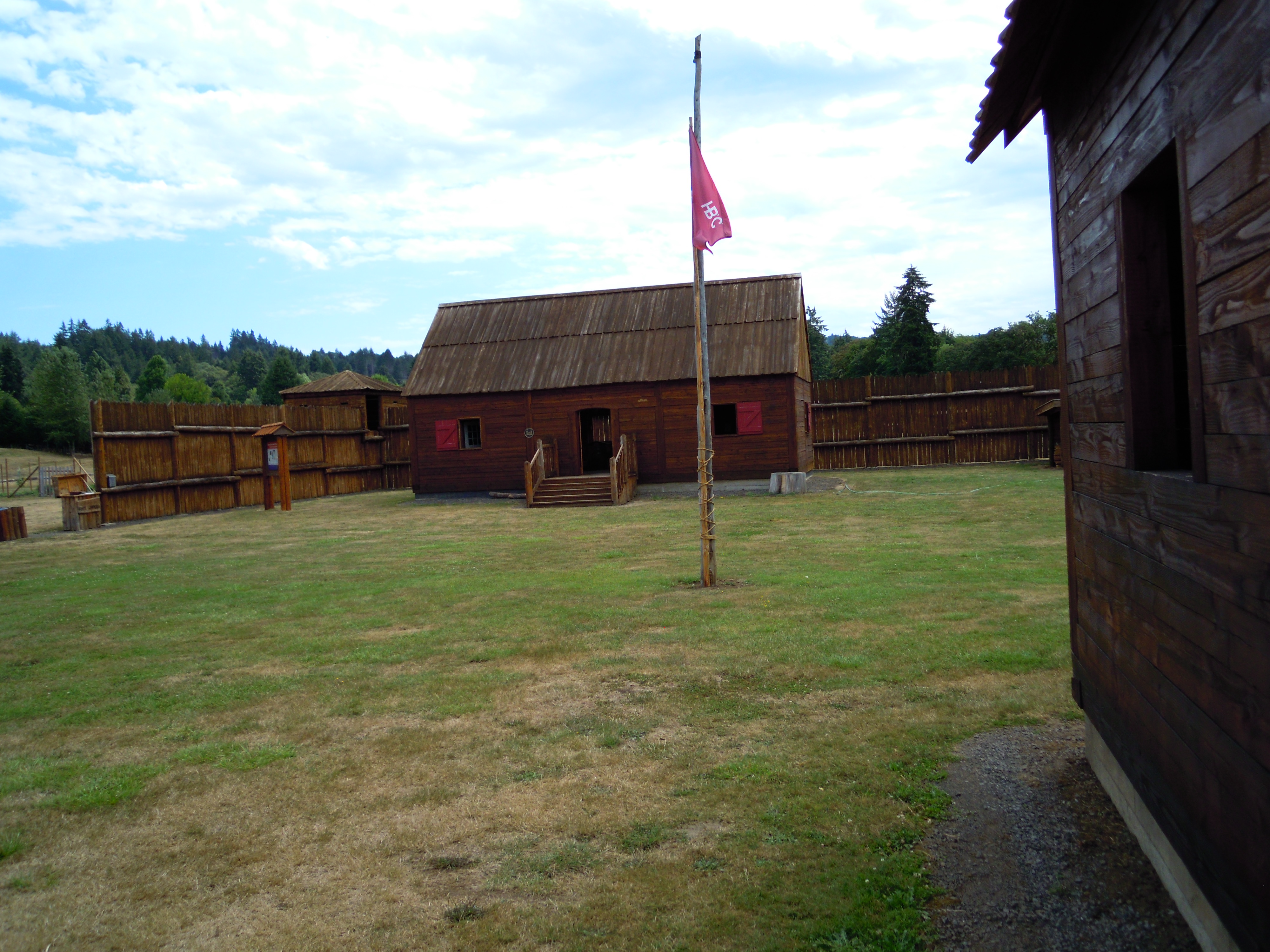
Elkton, Oregon, puts on a big Fort Umpqua Days event every year on Labor Day Weekend in celebration of the town’s history.This year it’s Saturday and Sunday, August 30 and 31.the fortThe British Hudson’s Bay Company built Fort Umpqua in 1836 near where Elkton sprouted a few years later. It was the company’s southernmost fort in the Oregon Territory in the days when they essentially ruled the area, chasing the lucrative fur trade–before all those American pioneers started trekking west over the Oregon Trail.

The first fort burned in 1851, and a flood in 1861 washed away what was left of it. A few years ago citizens of the area decided to reconstruct the fort on a site just downriver from the original, and the work continues today with new buildings going up inside the wooden palisade walls, with considerable effort made to keep things authentic. Now the HBC flag flies again.

DSCN0434So, during Fort Umpqua Days we celebrate with a parade and a history pageant, a craft fair, and other events. I’ve enjoyed serving on the writing team for the pageant the last few years, in which the history is told with a bit of humor and a bit of truth. And this year I’ll have an outdoor booth for selling and signing my book about one of those intrepid American pioneers–my own ancestor Martha Poindexter Maupin.

DSCN0429Last year kids came into the fort grounds to learn how people at the old fort cooked and kept gardens and washed their clothes, which was probably a whole lot more fun for the kids than for those guys at the original fort. Inside, there are furs and stories aplenty to whet the imagination.

The event is open to the public and fun for kids of all ages. If you enjoy taking a step into the past, here’s a great place to do it.  🙂

COMMENT

Back to Missouri Roots

While in the Kansas City area with my daughter and granddaughter, I returned to the Ray County Museum in Richmond, Missouri, at the invitation of the wonderful people there who gave me so much help researching my book about Martha Maupin. Four years ago I visited this museum and genealogical library, where we looked for material about my Maupin ancestors in Ray County.

573.Jenne intro Ray Co

Recalling the delightful days we spent together on the project, Jenne Sue Layman introduced me to a welcoming crowd at their monthly genealogical group meeting.

Jenne is one of three ladies who worked with me in Ray County, and this time I finally got them together for a picture, out in front of the big old brick building that houses the museum, as well as the genealogical library. The old building, which was once the county poor farm, is on the National Register of Historic Places.

594.Ray Co ladies

From left to right: Carol Proffitt, Lisa Smalley, and Jenne Sue Layman.

During my earlier visit here in 2010 the most thrilling item they found for me was an 1839 ledger for Isaiah Mansur’s store that showed lists of items sold and people who bought them. I was thrilled to thumb through the frayed, age-darkened pages and find many listings for various Maupins.

I was pleased to see some more familiar faces at this Saturday event. Glen Hill Jr., who helped me with research in next-door Carroll County was there. Glen came to the event at River Reader Bookstore last weekend, and returned for this one.

591.Glen @ Ray Co

Glen Hill Jr.

Also, quite a few members of the Frazer family came. The Frazers now own the property once owned by Garrett Maupin’s father, Perry.

In fact, I made a small discovery on that 2010 visit when researching land documents in the Ray County Courthouse to see what happened to Perry’s property after he died. The property was divided among Perry’s wife Rachel and their children because Perry didn’t have a will. All the old deeds are written by hand in the florid style of the day. Between that and the legalese, I struggled to follow what had happened, but ultimately all the Maupins appeared to be selling their property to a John Wollard.

The same day I learned this, Jenne took me out to the old Maupin homestead to meet David and Marilyn Frazer. They told me the place had been in their family a long time. When I asked if it was a Century Farm they told me their family had owned it much longer than a century—since their ancestor John Wollard bought it. I knew that name, having seen it so many times that morning.

“Oh, my goodness,” I said. “Do you know who John Wollard bought the place from? He bought it from my ancestors, the Maupins.” So we had a link.

And on Saturday not only David and Marilyn Frazer came to the meeting, but their son and his wife, and two other family members.

588.Frazers Ray Co

From left to right: David and Marilyn’s son Jason, Jason’s wife Misty, David’s sister Karen McBee, his cousin Virginia Miller, David, and Marilyn.

578.speaking Ray Co

At Jenne’s request I talked to the group about my search for my ancestor Martha for the book I wrote about her, A Place of Her Own: The Legacy of Oregon Pioneer Martha Poindexter Maupin.

Afterward we enjoyed a terrific spread of food provided by Carol Proffitt. The members take turns, and this was Carol’s day. It was a good day to be there.

All in all a lovely day.

COMMENT