Day Two ~ The High Desert
 The tattered wagon covers didn’t look white anymore. Gray dust coated every surface, working its way down into every nook. . . . Animals and people alike looked thin. So little grass. Even when they heard about grass ahead, they’d find much of it eaten off already by the companies that came through before. . . . She was five months pregnant.
—A Place of Her Own: The Legacy of Oregon Pioneer Martha Poindexter Maupin, Janet Fisher. (Guilford, CT, Helena, MT: TwoDot/Globe Pequot Press, 2014), pp. 119-120.
Most women who traveled the trail were mothers or soon to be mothers. It was the mothers who, more than anyone, looked both forward and back, remembering home and how it was made. It was the mothers who tried to stretch the protective fabric of home across the 2,000 miles to a new place.
—Women’s Voices from the Oregon Trail, Susan G. Butruille. (Boise, ID: Tamarack Books, 1993), p. 89.
13 Saturday Travel 5 miles this morning, then stopt to water at a spring; it is near night we are still traveling on, through dust and sand, and over rocks, until we find water, had none since this morning.
14th Sunday morn, Campt last night after dark after traveling 15 miles in a large bottom, near some puddles of very poor water found out this morning that it needed straining Afternoon, after traveling 10 miles we have campt on the bank of Powder river about 1 oclock another ox sick, we will rest here untill morning—
—The diary of Amelia Knight, in Covered Wagon Women: Diaries and Letters from the Western Trails, 1840-1890. Vol. 6, 1853-1854, Kenneth L. Holmes, ed. (Glendale, CA: The Arthur H. Clark Co., 1986), p. 65.
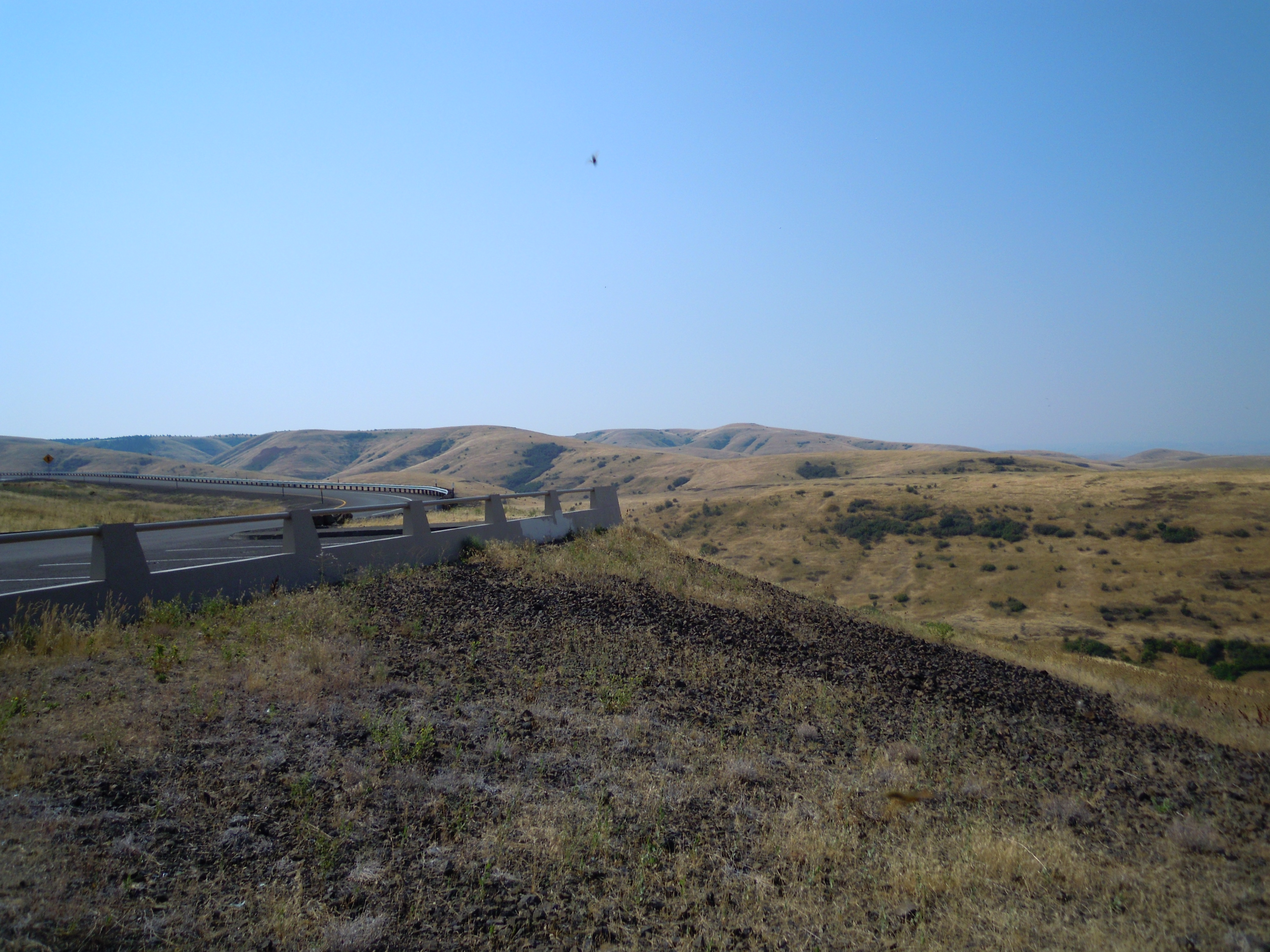
 Once out of the mountains we came into high desert country with scattered sagebrush on rounded hills. The emigrants coming the other way were just beginning to see the occasional tree and a few touches of green after endless dusty expanses that could scarcely support life. Did they know what awaited them in the blue ridges on the horizon? Many carried guidebooks that described the various landmarks along the way. But those guidebooks often glossed over the looming difficulties.
First stop for us on this second day of travel was the remarkable National Historic Oregon Trail Interpretive Center at Baker City, Oregon, in that high desert country—definitely a worthwhile stop for any Oregon Trail history buffs, or anyone with an interest in this era of the nation’s history.
The day was heating up fast, and no shade to park in. Fortunately someone had built shaded areas with tables where we ate lunch. We carried lunch supplies with us. Here, windbreaks gave some protection against the battering winds, but breezes still whipped our hair and grabbed at packages. Then I took my granddaughter Calliope inside to tour the place while my daughter Christiane stayed by the sheltered table with the dog.
The interpretive center offers many life-sized dioramas of typical Oregon Trail scenes that put you right into that world, as well as artifacts and informative presentations. Several of the photos on this post and the previous one show these realistic dioramas, while my first post in the series, “Backtracking the Oregon Trail #1,” includes photos of the interpretive center’s outdoor display of actual covered wagons. The photo of the high desert on this post was taken from our shaded table there.
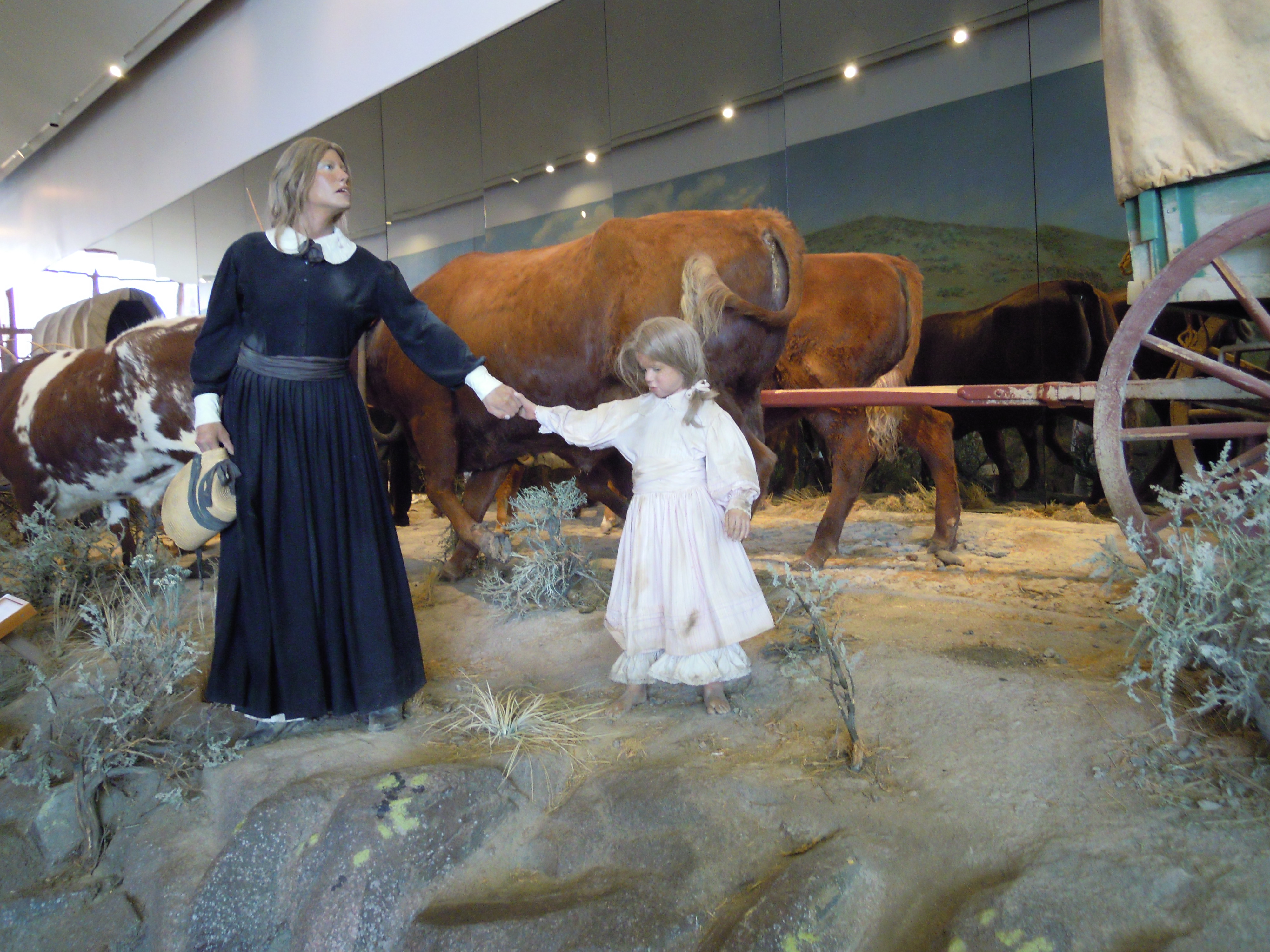
Inside, as I remained watchful of Calliope, I looked upon the diorama of the mother and child (above), and my heart went out to the mothers on that trail. Martha had two little girls to watch out for along that trek. Nora was almost four and Louisa going on two. Little ones can be a handful when you’re stationary, let alone on a trail into the wilderness with all the potential for danger. A child climbing in or out of a moving wagon could get run over and either injured or killed. Many died of cholera, a dread for emigrants of all ages. And Martha had the added burden of being pregnant during the whole trip.
 The animals in the dioramas are real, the handiwork of an expert taxidermist. But, my granddaughter was assured by one of the staff members, the people are not. Even so, these human statues are created with exquisite detail so you can even see the veins in their hands. Wonderful realism.
And you hear the sounds. The creak of wheels on the rocky track. The clip-clop of hooves. The cry of voices. Free your imagination and you’re there on the trail, experiencing, feeling.
I had a pleasant visit with a woman in the office who I’d spoken to earlier by phone and left a copy of my book for them to consider for their gift shop.
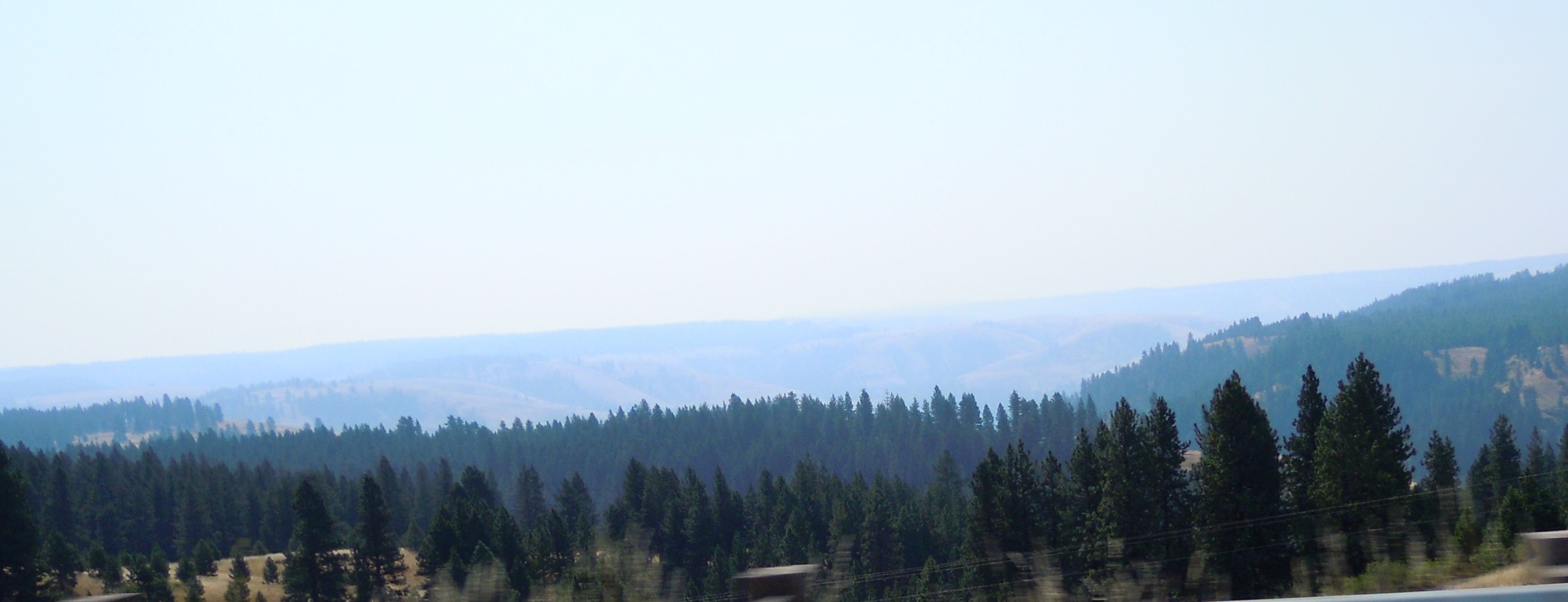
Driving southeast from Baker City, we watched the temperature. It crept up to 101 in the shade and virtually no shade. Yet as the day wore on we appreciated the raw beauty as the sun lowered, casting a smoky glow to paint pinks, golds, and oranges on every ridge.
Bugs splatted the windshield like scattered rain. They must have pestered the weary oxen and the people that trudged through here. And the heat kept bearing down—until evening, when the nights cooled—unlike nights Martha would have remembered back home in Missouri or Illinois.
Pocatello, Idaho, our destination for the night, seemed far away. We’d be coming in after dark once again.
NEXT: A stopover at the Fort Hall replica at Pocatello