Calving Time at Martha’s Farm

Photo I took April 14 in 2018. I love the little white heart on the face of the nearest one.

April is usually the beginning month for calving here, although many farmers choose to calve earlier. The cows on our farm are gentle. They let you walk right through the herd, even when a cow is calving, although I keep an eye out for a nervous mama. They aren’t my cows. Ed and Mary Cooley rent pasture on the farm as they did when my dad was still here. But I get to enjoy the babies. I think these cows are gentle because Ed spends time with them, moving them from pasture to pasture, often daily. And in winter and early spring he adds hay to their pasture for feed.

An hours-old calf gets a lick from its mother on Friday, April 15, 2011. (Credit Image: © Robin Loznak)

The above picture by my son-in-law Robin appeared in my book A Place of Her Own, the story of my great-great-grandmother Martha Maupin who founded this farm in 1868, now a sesquicentennial farm. The picture illustrated a moment described in one of the Interludes in the book that told of my search for Martha’s story. My dad, Gene Fisher, farmed the place for 75 of those 150 years, more than any other owner in the family’s history. The fourth and last Interlude closes with the morning after he died.

The morning broke, bright and sunny. . . . We looked out the kitchen window to the apple tree across the nearby creek. A new black calf stood on wobbly legs beneath the tree, his mother gently licking his back. The first calf of the season had been born in the night. . . . I wished I could share with Martha the hope I found in this place and in the wonderful creatures who lived here with us. After the long dark night, there would be a bright new morning.

And new calves.

(The Globe Pequot Publishing Group, pp. 202-203)

The same little one as pictured at the top . . . with Mama watching. Or coming my way? Here’s looking at you.

Martha’s Farm Featured Again

A new story on the farm’s sesquicentennial status came out in the April edition of the Douglas Electric Company monthly magazine. April was the month my great-great-grandmother Martha Maupin purchased the family farm in 1868.

The story with photos: the book, me with the hills behind, me at five, and Martha’s house she had built for herself and her many children.

Craig Reed, local writer, visited the farm and talked with my daughter Carisa Cegavske and me before writing the cover story which got a nice spread, shown above. The farm would have qualified in 2018 but I didn’t put in the application until 2024.

Martha was the subject of my first published book, pictured in Craig’s story, A Place of Her Own: The Legacy of Oregon Pioneer Martha Poindexter Maupin, published by Globe Pequot Press. I didn’t have to write a book to qualify the farm for sesquicentennial status, but my research for the book certainly helped me put together the extensive information required for the application.

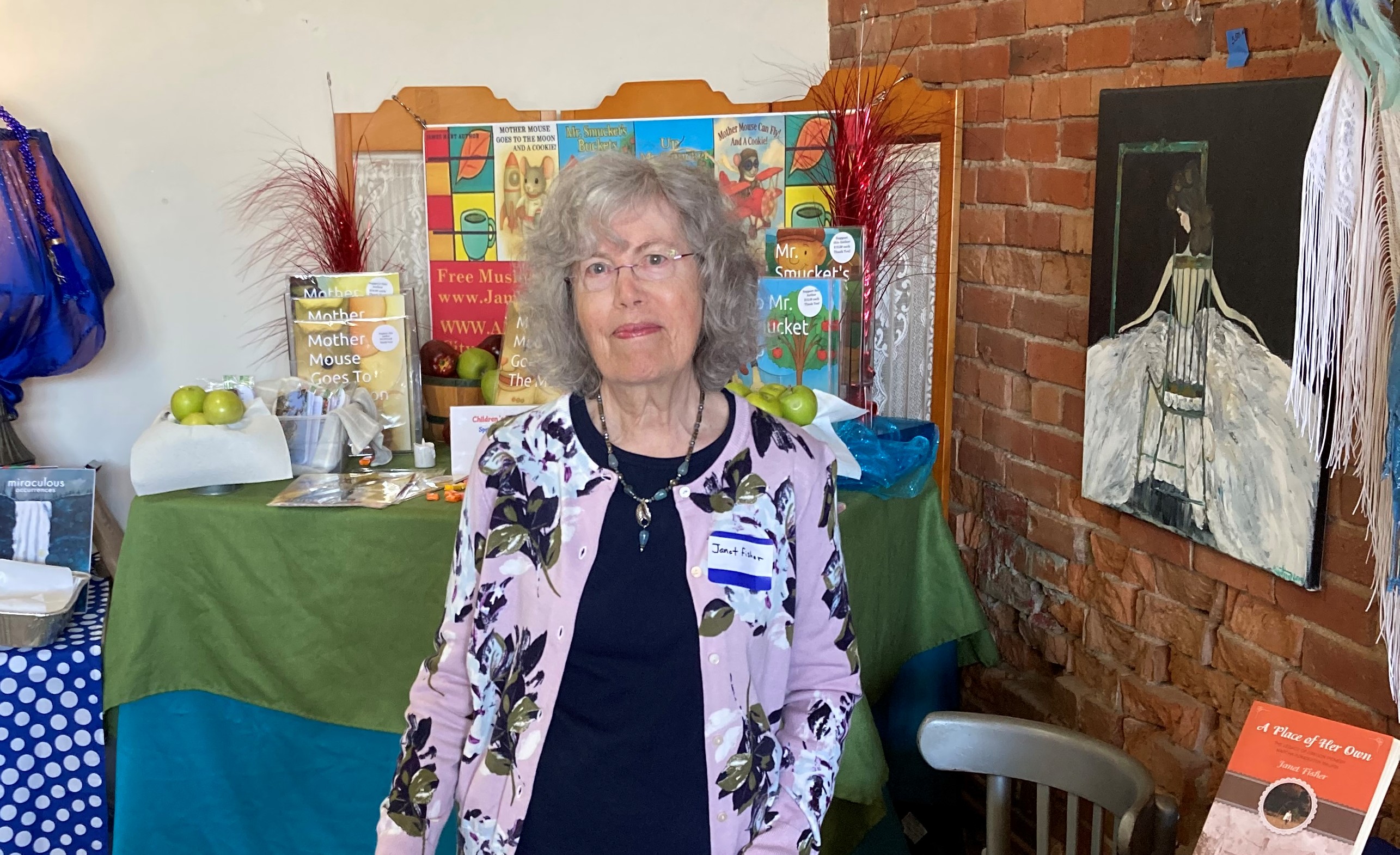
I grew up on this farm. The little girl curtseying in her overalls is me enjoying the freedom I experienced there. When my dad died in 2007 Carisa and her husband Robin Loznak decided to join me in keeping the farm. I had been away all my adult years so it was quite a change from city life I experienced in the interim. Their son Alex Loznak moved there with us, as well as my other daughter, Christiane Cegavske, and her child, Aspen Boutilier. Carisa, Robin and I still live there.

I love the farm’s hills for walking, and the quiet, where I find inspiration to write my books. My whole family loves the beauty of the land, the rich history, the wildlife. Christiane, Aspen and Alex visit as often as they can. That’s easier now for Christiane and Aspen, who lived in Kansas for ten years and now live in Portland, Oregon. Alex took a stint in New York City, then Eugene, Oregon, but he’s in Portland now too.

We all take pride that Martha was the founder of this farm, a woman who dared take on this treasure when it wasn’t all that easy for a woman to do.

Carisa in the purple and me in navy on the cover.

Martha’s Farm Makes the News

With Martha’s Farm gaining Sesquicentennial status it’s making the front page news.

Drew Winkelmaier, reporter for The News-Review in Roseburg, Oregon, came out to the farm in Kellogg last week and put together a nice story for the Sunday edition.

That’s me on the porch, photo by Drew. We talked awhile then went down to the old barn that has stood on the property since the 1930s when my father bought the place from his great-uncle and had the barn built.

From there we visited the hazelnut orchards, our newest crop on the farm, which had been a prune farm since 1895 when Martha’s son Cap planted the first prune orchard.

With the prune market turning iffy and a burgeoning hazelnut market we began making the switch in 2011 when we planted our first hazelnut trees.

Drew’s story delves into the history from our discussion as well as information I had put together for the Oregon Century Farm and Ranch Program, much of it based on my research for the book I wrote about Martha, A Place of Her Own. When I took over the farm in 2008 I became another woman in the family to own the place and thought there might be a story in that. And yes, Martha had far more story than I ever imagined.

My family got together at the Oregon State Fair last Saturday, August 24, when fourteen farms were honored for Century status and two, including ours, for Sesquicentennial status. We received lovely certificates at the presentation when short narratives were read about each of the farms with photos on a screen above the stage.

After that we did what everybody does at the state fair. We visited the animals, including a competition among elegant horses in the historic horse barn. And the poultry and pigs and sheep and goats and cattle. Oh, and the beautiful family of huge black draft horses. Such magnificent creatures! And we saw exhibits of photography and artwork and ate too much fair food.

And on the way out we enjoyed strolling through the rides as the skies darkened and the lights came up.

Exciting times for Martha’s farm.

Martha’s Farm Approved for Sesquicentennial Status

The Martha A. Maupin Farm which I now own has been approved as a Sesquicentennial Farm, having been in the family for 150 years. In fact it reached the 150-year mark in 2018. Martha purchased the farm in 1868. But this year I finally went through the process of applying for the Sesquicentennial status through the Oregon Century Farm & Ranch Program.

The families approved this year will be honored at a ceremony at the Oregon State Fair this month on Saturday, August 24 at 11 am in the Columbia Hall on the staged area. Fourteen families have been approved for Century status and two for Sesquicentennial status for 2024. Photo highlights for each award winner will be presented at the ceremony with a desert reception afterward.

The photo above shows Martha and her family in their early years on the farm in front of the house she had built soon after her 1868 purchase. That’s Martha standing on the front porch, her eldest son Cap on the horse. Cap became part owner with his brother Tom when their mother sold it to them in 1886. Then Cap became sole owner when he bought his brother’s share in 1894. From Cap it went to my father Eugene Fisher, Cap’s great-nephew, and my mother Marian in 1934, then to my sister Nancy and I, and finally to me when I bought my sister’s share in 2008.

Part of the application involved finding the documents to verify all those transitions, which can be a challenge. I had obtained some documents, like Martha’s original purchase, when I researched my book about her, A Place of Her Own.

But I was missing some of the documents, which took me back to the Douglas County, Oregon, County Clerk’s office to find the missing links.

The application also required a two- or three-page narrative of family history, including the transfers from one generation to another. My research for the book helped on the early part of that history. Memory served on later events, but I had to scour some local histories and the newfound documents to bring in the middle. The local histories had also helped with my book research.

Martha’s place has been a Century Farm since the 1960s, and I have been pleased to know that this was one of the few Century Farms in Oregon named for a woman, which seemed especially sweet since I’m the second woman to be its sole owner. Now it’s an Oregon Sesquicentennial Farm named for a woman.

I do love history, so it was an intriguing process, and I have a clearer view now of the farm’s history.

The sample of Martha’s purchase document shows the flowery writing one has to pore through in order to glean what you want to know.

In addition to the legal documents and narrative, the application required maps, and requested photos. I also sent a copy of my book about Martha, which the Program Coordinator said they would be very happy to have.

I’m excited to honor my great-great-grandmother Martha for her historic achievement of founding this treasure when it wasn’t easy for a woman to do such a thing.

Below are a couple of photos from the farm, our new hazelnut orchard and the old 1930s barn that still stands on the hillside, looking down to the river bottom. For more on those hazelnuts, see the story here.

Robin Loznak photo

Hazelnut Time

Remember these little guys? Remember their story, how they were started on Martha and Garrett Maupin’s Donation Land Claim in Lane County to be planted here on Martha’s farm in Douglas County? The story is here. I was working on my great-great-grandmother Martha’s story, A Place of Her Own*, at the time and was sure surprised to find that link.

Well, look at us now (below). These trees are producing nuts that are headed to market.

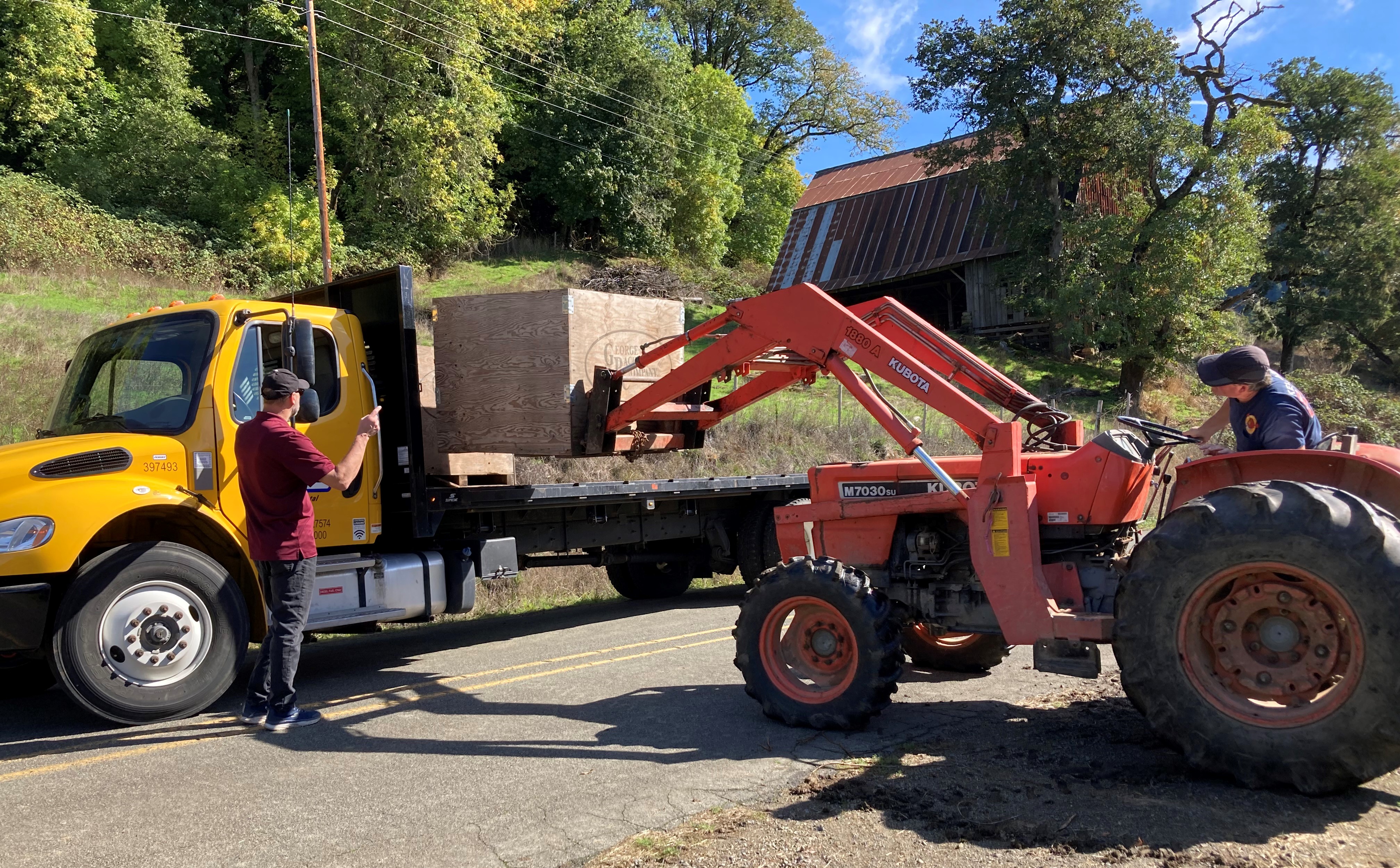
We have a nice coop in our area, the Northwest Hazelnut Company/George Packing Company, Inc. They bring us bins, we fill them, they take them away for processing.

Here my son-in-law Robin Loznak checks out our first bin as we wait for the truck to come pick up our bins. He and my daughter Carisa partner with me on this project. He does most of the work now–mowing and harvesting–although on this first seven acres I spent several summers watering those babies by hand with multiple hoses. I almost knew them by name. I did that until they got too big for me to reach over them and drag the hoses across to the next row. At that point Robin took over the watering with a big water tank drawn by the tractor. He put in the next orchard, 15 acres, and installed a water system for that. This first orchard has dug deep roots by now.

Robin carefully eyes the bin while Troy Mueller from the Northwest Hazelnut /George Packing Company guides him in. The farm’s old 1933 vintage barn can be seen in the background of this photo and the one above it.

A few tidbits for the curious: Oregon grows 99 percent of all the hazelnuts produced in America. Turkey and Italy are the only countries that grow more than we do. Turkey grows by far the most at about 70 percent worldwide. This may be one reason hazelnut farmers are so welcome in the state. Every Oregon hazelnut farmer adds to the state’s market share. Besides just being helpful, friendly people.

Oh, and for people who are wondering. A filbert is just a hazelnut by a different name.

*A Place of Her Own: The Legacy of Oregon Pioneer Martha Poindexter Maupin portrays the story of my remarkable great-great-grandmother who came west over the Oregon Trail. I grew up on this farm Martha bought more than 150 years ago. I’m now the second woman to own and operate this family treasure. I would never have done it without the help of my kids.

Fine Fort Umpqua Days Despite Weather Surprise

Fog and a little smoke from nearby fires cleared early on Saturday morning, the first day of the two-day annual Fort Umpqua Days event in Elkton, Oregon. Lovely weather. Sunny. Soft fluffy clouds. Gentle breezes. And the people came out. My, they did come out! I kept busy up in the vendor area on the hill above the reconstructed fort. So busy I didn’t even get down to the fort itself on the flat below.

In midafternoon I checked my phone for the air quality report, as I’d been doing daily since fires started in the area after a lightning storm several nights before. My phone indicated something to the effect that rain would start in thirty minutes or so. I stared at my phone, glanced up at the blue sky with the white, fluffy clouds.

“That’s ridiculous! It’s a perfect day.”

About twenty minutes or so later a cloud shadowed the ground. Lots of clouds. Gray ones. Enough to cover the sun.

I’m in my booth, with a canopy overhead, but I’m selling books. Rain and books don’t go together. And I had pictures, photographs, on display. Winds picked up. No overhead canopy would protect from blowing raindrops. My son-in-law checked his phone. It’s not just warning about rain. It’s warning about lightning.

All right. That convinced me.

The sprinkles came. About 3 o’clock we started packing up.

That said, even with a short day (vendors usually close at 4), it was an enjoyable time. So many people. So many stories shared. And a little weather excitement to boot. Didn’t see lightning but heard thunder by the time I got home.

Sunday remained clear all day, but quieter–well, except for those booms down at the fort. All in all, a delightful weekend.

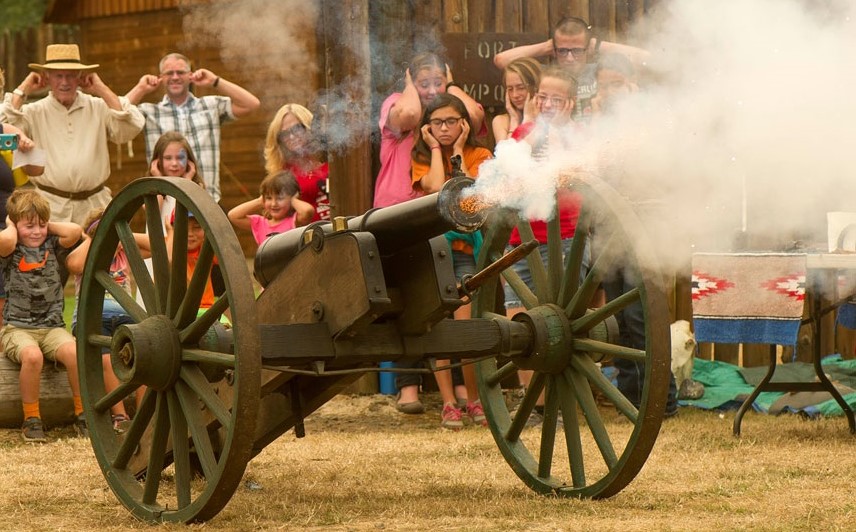
Robin Loznak’s photo again from a former Fort Umpqua Days event

Back to Fort Umpqua Days

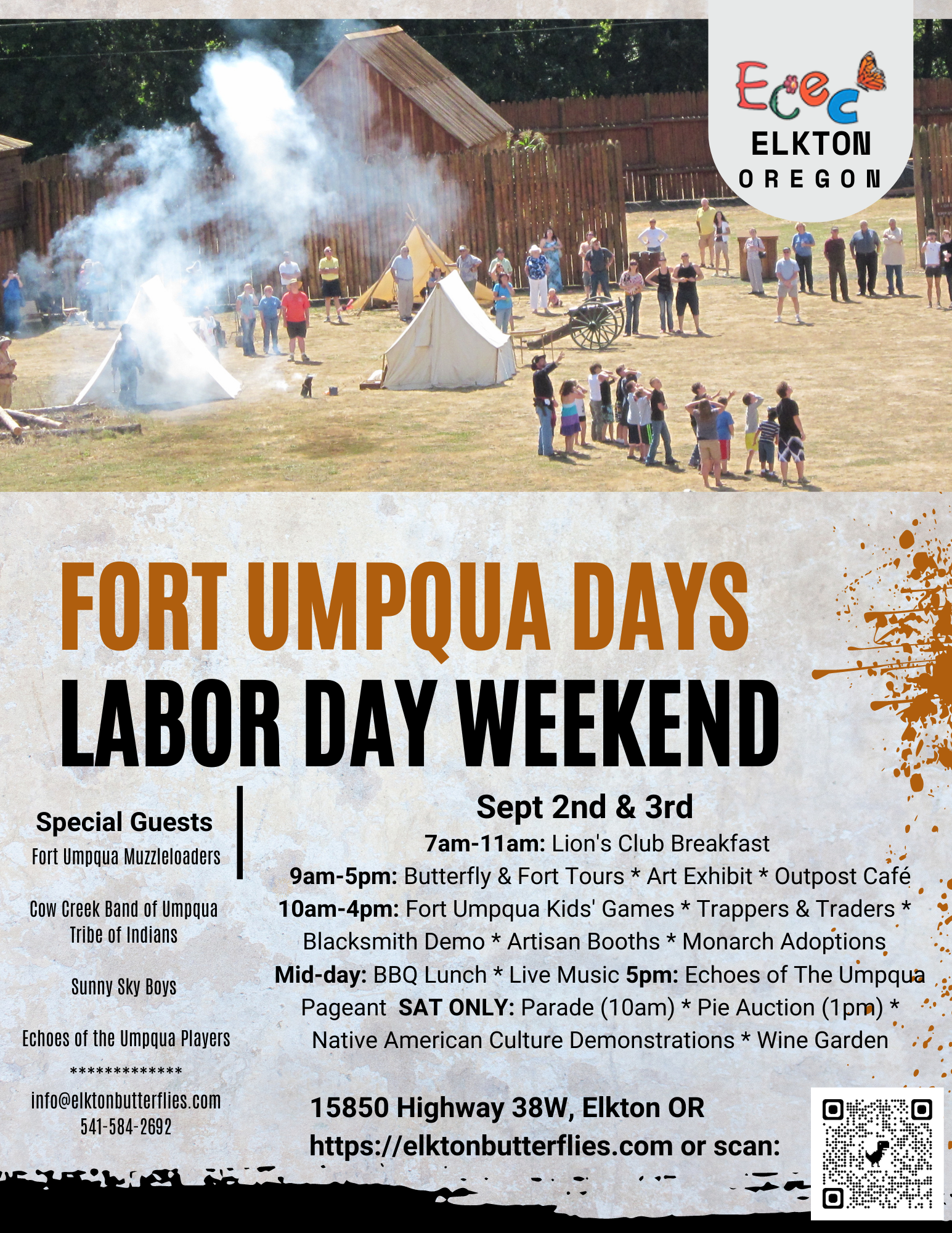
Here’s the poster shared by the Elkton Community Education Center (also known as the butterfly place), whose staff puts on this excellent annual event in Elkton, Oregon, the small town where I went to school in the somewhat distant past. Just a few miles up the road from my great-great-grandmother Martha’s farm.

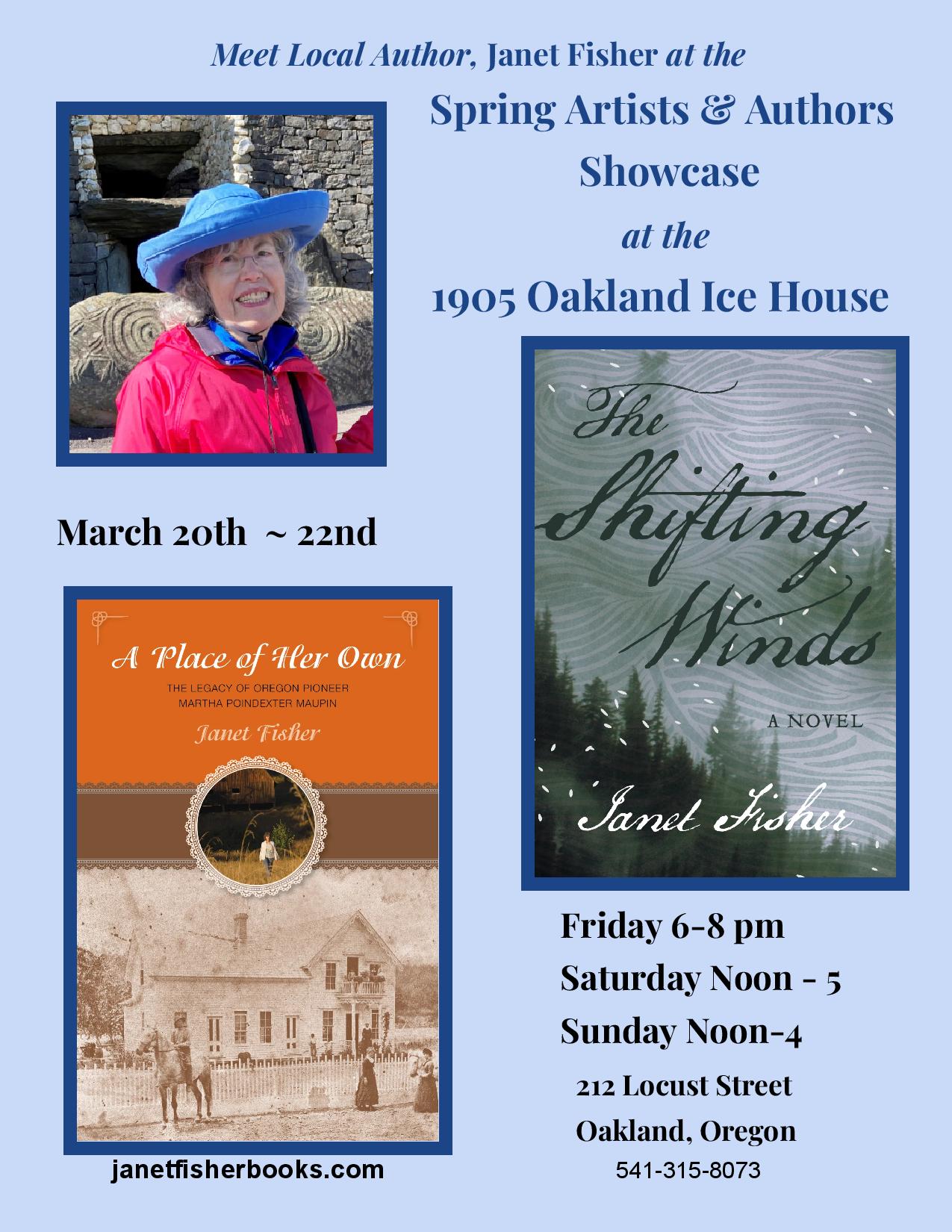
I’ll be at the event as usual with a booth, selling my two books, A Place of Her Own, a creative nonfiction account of Martha’s story, coming west over the Oregon Trail in 1850 and eventually purchasing that farm on her own, and The Shifting Winds, a novel about a young woman whose father brings their family west to Oregon in the 1840s, much to her displeasure. Both women face huge challenges on this formidable frontier.

The Fort Umpqua Days gathering offers folks a glimpse of what life was like for these pioneers and the American mountain men and British fur traders who came before them. Today’s fort was built as a replica of the original with considerable research for accuracy. Volunteers will be on hand to answer questions, and there will be plenty of fun activities for the kids, closing off each evening with a pageant that adds a bit of historical accuracy with a strong touch of humor.

Cannon at Fort Umpqua. Photo by Robin Loznak.

A Fine Fort Umpqua Welcome

Folks showed up with happy faces for the return of Fort Umpqua Days after two years off. One of my favorite things about presenting my books at these events is all the stories I hear. People are curious about my books, of course, which delve into the area’s fascinating history. But so many people have stories of their own that they’re eager to tell. I love hearing these. I came away from this two-day event, head full of so many individual histories. My thanks to all who shared a bit of their worlds.

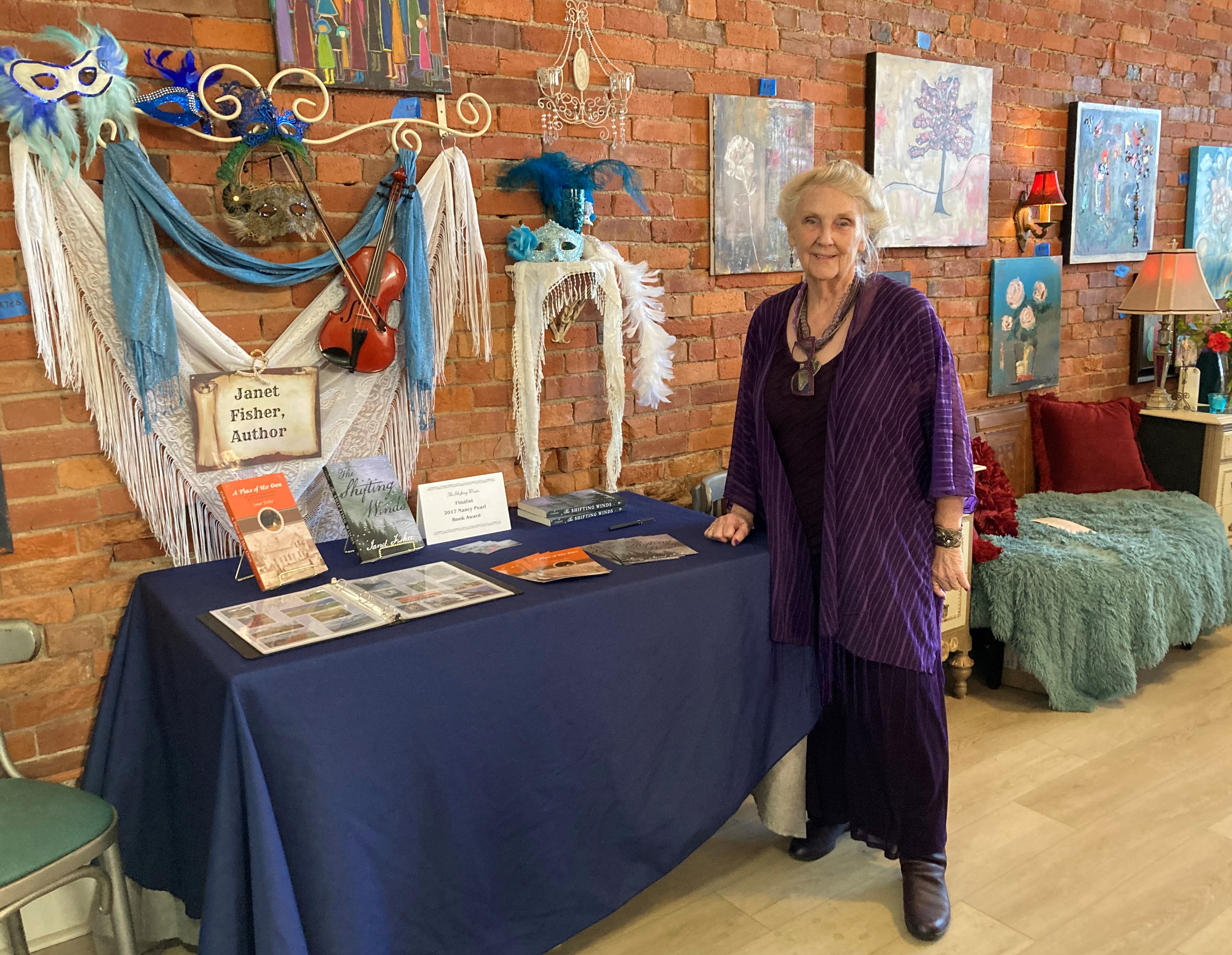
Here I am at my booth on this lovely afternoon. ~ Photo by Robin Loznak.

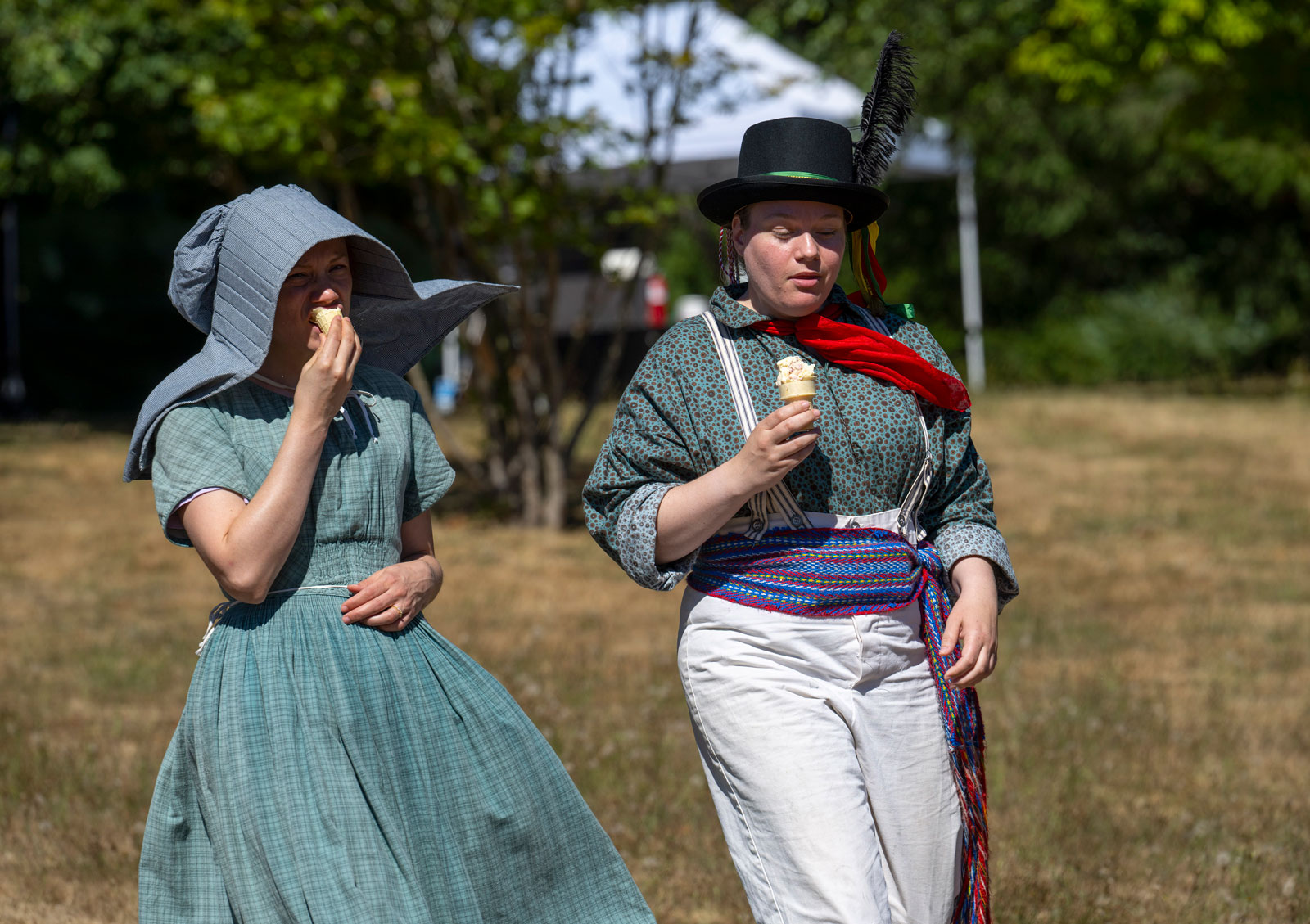
I also love the costumes many people wear for the occasion–the reenactors as well as the actors who perform in the nightly pageant, portraying stories of the era. I was happy to see reenactors Karen “Many Voices” Haas and her husband, Patrick, back again. I met Karen at the last Fort Umpqua Days in 2019 and featured her in a post back then. The two are shown in the previous post. We had a good visit yesterday. They stopped by my booth, looking quite fine, as if they had walked right out of the past.

Robin took a few more photos at the event (shown below). I’ll let his pictures speak for themselves.

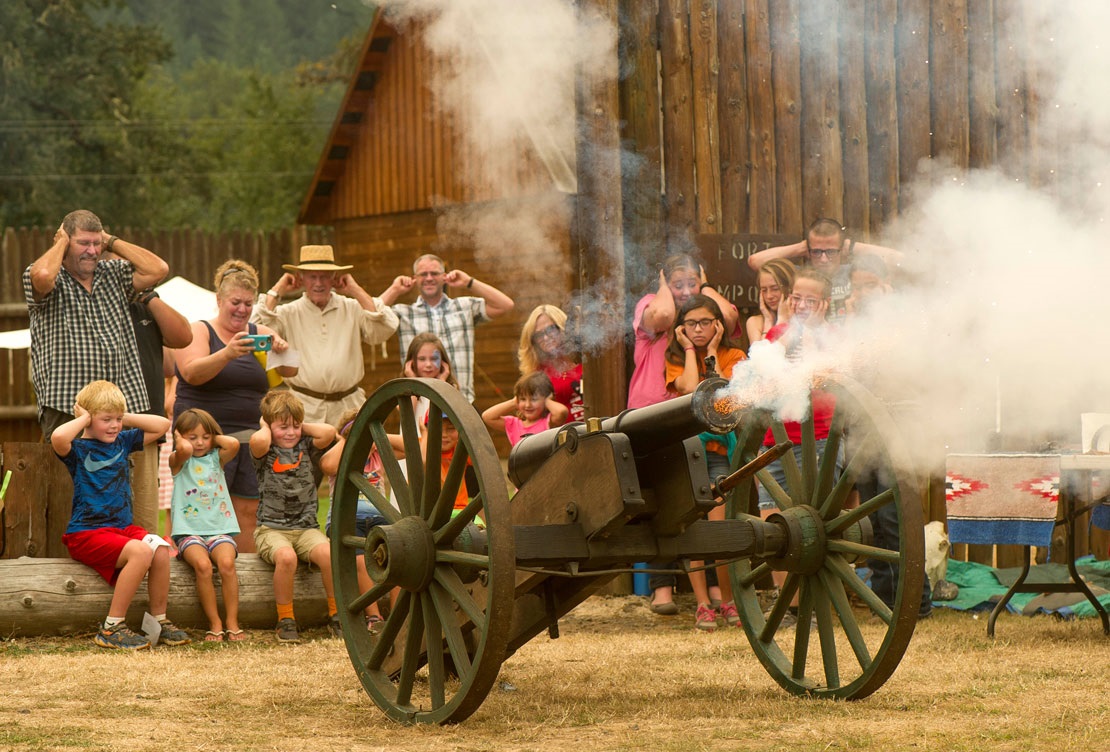
And one more favorite Robin Loznak photo from a past Fort Umpqua Days moment:

BOOM!!!

Stepping Out Again

With hopes of better days as summer approaches, I’ve begun scheduling book events again. First up will be a book signing event hosted by Gail Hoelzle at The Bookmine on Main Street in historic downtown Cottage Grove, a friendly place full of books and flowers and other gift items. It’s the regular Cottage Grove Art Walk held from 6 to 8 pm on each last Friday of the month from April through November.

I’m delighted to be returning to The Bookmine with my books, A Place of Her Own, the story of my great-great-grandmother Martha Maupin who trekked across the Oregon Trail in 1850, and my other Oregon Trail story, The Shifting Winds, a Nancy Pearl Book Award finalist.

Weather permitting we’ll set up a table under cover at the front door of 702 E Main Street pictured above. Whether outdoors or in, the art walk is always a fun event.

A Place of Her Own describes Martha’s incredible journey. She walked the whole 2,000 miles in 1850 from Missouri to Oregon–while pregnant–and that wasn’t the toughest part. They settled first near Eugene City in Lane County, then a hotbed of North-South rivalry. Things got especially hot for my great-great-grandfather, a staunch southern sympathizer, and they fled south to Douglas County–just ahead of the law. He was killed in a wagon accident leaving her with a passel of kids and no means to support them. Determined not to give up she purchased a farm by herself, although her 13-year-old son had to negotiate for a loan because the lender wouldn’t negotiate with a woman. I now own that farm, still in the family for more than 150 years.

The Shifting Winds describes the challenges faced by American pioneer Jennie Haviland, whose family travels the Oregon Trail to Oregon in 1842 during a time when the United States and British both vie for that fertile land. Meanwhile a gentleman working for the British Hudson’s Bay Company vies for Jennie’s hand, while an American mountain man does all he can to disrupt the British guy’s plans. Their story follows the actual history of the American-British conflict leading to the historic meeting at Champoeg that could change everything. Which way will the winds blow?

Martha’s story is true with fictionalized scenes. Jennie’s story is fiction set in a lot of real history.

Historic Words and Fibers

History resonates in every Fort Umpqua Days celebration as people come from many places to share a glance back to the early days of Elkton, Oregon. The reconstructed British Hudson’s Bay Company fort provides a centerpiece for the gathering. This year a number of reenactors came to give the fort even more authenticity.

Reenactor Karen “Many Voices” Haas spinning

In the above photo reenactor Karen Haas, who describes herself as a weaver of words and fibers, spins yarn on a drop spindle while wearing period dress, such as you might have seen in the days of the original Fort Umpqua.

This is the period of my two published books, A Place of Her Own and The Shifting Winds. But the drop spindle is a device so ancient that I describe a character using one in an upcoming book that goes back roughly 3,500 years. I was glad to watch Karen spin with a drop spindle so I could see how she made it spin. This will help me describe how my ancient character spins with hers. More than one of my characters can be called weavers of story and thread. I think they share an affinity with Karen “Many Voices” Haas.

I had a chance to visit with Karen Sunday afternoon when she stopped at my booth where I was selling my books. After I closed up shop I went down to the fort with my daughter Carisa to see some of the reenactors, and there was Karen outside a Hudson’s Bay Company tent (it must have been an HBC tent because they were waving an HBC flag). And she was spinning. We recognized each other and it took me a moment to realize what exactly she was doing. But there it was. She was working a drop spindle. Every once in a while she would put the spindle against her billowy skirt and stroke her hand across it to keep it turning. Then she would reach up again and make sure the yarn was coming out in an even thread. An amazing process. So ancient. So elegant in its simplicity, yet no doubt requiring considerable skill and practice.

With that we wrapped up another Fort Umpqua Days enjoying a delightful glimpse into our past. Thanks to Karen for showing us one significant thread of that story.