Introduction
I recently returned from a road trip with my daughter Christiane and granddaughter Calliope. Christiane got a new job as Assistant Professor at Kansas City Art Institute and was moving back to the Kansas City area. I decided to join her on the drive east to help with my granddaughter, who’s nine years old, then help set up their new house before flying home. On our eastbound route we chose to backtrack Martha’s journey over the Oregon Trail as roads and time allowed.
It took us five days to cross what took five months for my great-great-grandparents Martha and Garrett Maupin. And for my flight home I was in the air about five hours.
I’m adding this new category to my blog to describe our trip, offering related quotes from my book about Martha, A Place of Her Own: The Legacy of Oregon Pioneer Martha Poindexter Maupin, as well as quotes from the diaries of other pioneer women who made that journey. The diaries are taken from a series called Covered Wagon Women, edited by Kenneth L. Holmes. Like Holmes I present these diaries as written, using the spellings and punctuations of the original writers. A few additional sources add information. This is the first of ten posts in our story.
 Day One ~ The Dalles
[T]he heat of the day radiated with scorching fury. . . . Now Martha worried about their own food supply. Her food bags had gone flabby for lack of contents. They’d traded with some Indians–shirts for fish–large dried salmon to add to the meat supply. But they were nearly out of flour. How long until they reached The Dalles, where they might buy more?
—A Place of Her Own: The Legacy of Oregon Pioneer Martha Poindexter Maupin, Janet Fisher. (Guilford, CT, Helena, MT: TwoDot/Globe Pequot Press, 2014), pp. 119-120.
Here the Doct. met us on his way back from the Dalls. . . . He brought some flour, pork, Salt, and saleratus. Prices are coming down at the dalls. flour can be had at 15 cts. Pork at 37½, Salt at 25, Salertus 25, Sugar 25 to 30 . . . Have long been convinced that we are too late to cross the Cascade Mountains with safety so we concluded to leave our cattle and wagon at the Dalls and proceed down by water. . . . Traveled to the Dalls, 5 miles, and found a boat ready for sail
—The diary of Cecelia Adams & Parthenia Blank, in Covered Wagon Women: Diaries and Letters from the Western Trails, 1840-1890. Vol. 5, 1852, The Oregon Trail, Kenneth L. Holmes and David C. Duniway, eds. (Glendale, CA: The Arthur H. Clark Co., 1986), pp. 308, 310.
We this morning sent two of the wagons by the way of the Dalles to be sent to Oregon City by water
—The diary of Abigail Jane Scott, in Covered Wagon Women: Diaries and Letters from the Western Trails, 1840-1890. Vol. 5, 1852, The Oregon Trail, Kenneth L. Holmes and David C. Duniway, eds. (Glendale, CA: The Arthur H. Clark Co., 1986), pp. 129-130.
 We crammed everything into the car that we possibly could, to add to what Christiane had sent by U-Haul pod. Martha and Garrett crammed everything into the wagon they possibly could, and left behind anything that wouldn’t fit or that would be too heavy for the oxen to pull.
Starting out on the main roads, we planned to meet up with Martha and Garrett’s route at The Dalles, Oregon. The Dalles was one of those mileposts for the American emigrants, a place to replenish depleted supplies and to stop and rest before the most harrowing part of the journey. While the Rocky Mountains offered a gentle pass across their summit, the Cascade Mountains did not. The first several wagon trains in the early 1840s stopped well before this rugged range. Wagons were dismantled, broken down, left behind—either at The Dalles or before—and people took boats down the treacherous Columbia River or followed long, perilous trails on horseback over the mountains.
But wagons carried a lot of stuff they wanted. And getting those treasures to the west side without the wagons proved a problem. Some ferried the loaded wagon boxes down the river, or reloaded the goods onto boats. But many wanted to take the wagons west with them. Men decided to cut a road over the Cascades south of Mount Hood. They called it Barlow Road. Not much of a road, but hardy folks like the Maupins took their wagons across the Cascades over it, all the way to their destination in Oregon’s lush Willamette Valley. I had previously visited part of that route just prior to writing Martha’s story, so we bypassed that and went straight toward The Dalles.
We had talked about eating dinner at The Dalles, but were getting hungry before we got there. I couldn’t help being reminded of Martha’s concerns about their food supply before reaching The Dalles. We decided to stop for dinner at Hood River instead. The car has a temperature gauge, and had been warning us, but we were comfortable with the air conditioner blowing. The numbers had hit 98 in Portland, unusually high for that city, and reached 100 by Troutdale on the city’s eastern perimeter. At Hood River it had climbed to 102.
We stepped out of the car. Heat pressed down like a living force. We had Christiane and Calliope’s dog Penny with us. We couldn’t leave the dog in the car, even in the shade. Looking for a place where we could eat outside and tie her next to us, we finally found a possibility. The restaurant had tables on a covered patio and the waitress set a place for us—in the sun! No way could I sit in the sun to eat when it was 102 in the shade. Nor could they promise food in less than 30 to 40 minutes. I figured we’d be cooked ourselves in that amount of time.
Our thoughts of a nice dinner evaporated like water on a sizzling sidewalk. We pushed on to The Dalles. It was drive-through time. Eat in the car with an occasional blast of cool air from the AC.
 Again I thought of Martha and the relentless heat bearing down on her, often without shade except for a little alongside the wagon. No blast of cool air from anywhere. How desperate she must have been for a tree, a stream of water, anything to provide relief. At least, here on the east side of the Cascades it was a dry heat. But when it’s over 100 it still takes your breath away.
Anyway, a quick dinner got us back on the road faster and we drove on toward our first night’s destination in Pendleton, Oregon. It had taken us longer than expected to load up that morning, and the estimated travel times we got online appeared to be a little optimistic. We wouldn’t reach Pendleton before dark. A sense of urgency compelled us. But with the long summer days, we saw most of our route, dark settling just before Pendleton so when we approached it, the town appeared like a jewel of lights nestled in dark velvet.
[The photos for this post were taken outside the National Historic Oregon Trail Interpretive Center in Baker City, Oregon, which we would visit on Day Two. All photos in the series are by the author.]
NEXT: First thing the following morning, we reach the Blue Mountains, the most difficult road the emigrants have seen on their entire journey.
COMMENT
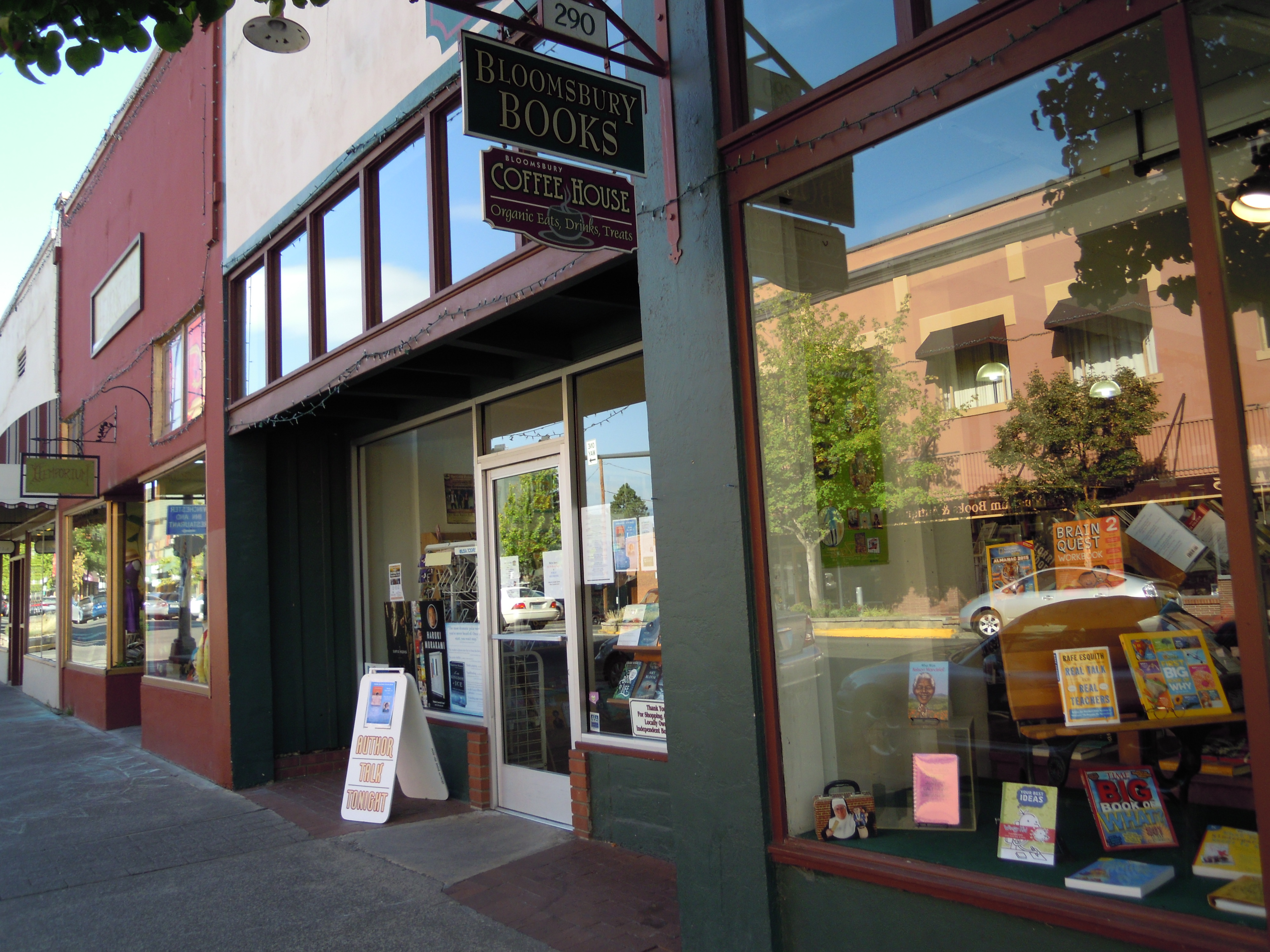 My cousin Carolyn Compton rode down to Ashland with me yesterday for my reading and signing at Bloomsbury Books, right on Ashland’s charming Main Street. Carolyn taught school in Ashland for many years and welcomed the chance to revisit old haunts. I lived there for a short time in the late 90’s.
 A lovely group of people came, a small but enthusiastic gathering. I read a couple of short segments from A Place of Her Own, then sensing those had gone fairly quickly I asked folks if they would like to hear another short segment or chat a bit. A question from the audience sparked a lively chat, and then they asked for more reading. I added an excerpt from the “Oregon Trail” chapter describing the harrowing descent down Laurel Hill on the west side of the Cascade Mountains and received a hearty round of applause–always a pleasure for an author to hear.