Fort Umpqua Days Fun!

Two beautiful days brought good crowds to the Fort Umpqua Days annual celebration in Elkton, Oregon, on Labor Day weekend. People from as far away as Kansas City came by my booth to buy books. I was surprised to learn that my first customers Sunday were from Overland Park, Kansas, a Kansas City suburb about a 10-15-minute drive from my daughter’s home in Fairway.

Pioneers and mountain men roamed the grounds of ECEC, the Elkton Community Education Center where the event took place, and the occasional harrumph of black powder rifles down at the fort ripped through the air, giving us a start.

Fort-Umpqua-Days1At the evening pageant the deputized sheriff caught the suspects in the stagecoach gold robbery, and photographer Robin Loznak caught them on camera as the sheriff led them away. Justice done in the “Mystery on the Elkton Stage,” the 13th annual Echoes of the Umpqua pageant, ably directed by Cathy Byle.

As many as 100 community members work to put on these somewhat historic dramas. I have fun serving on the writing team, but did only a small part this year due to the distractions with my new book coming out. Cathy and Linda Warncke did most of the writing and the actors, kids and adults, brought it to life with their own interpretations, all good for plenty of laughs.

Fort-Umpqua-Days-2It wouldn’t be ECEC without the butterflies, this being the well-known “butterfly place,” and Robin’s gift with wildlife photography led him to the Butterfly Pavilion to capture this shot of a Monarch having a sip.
From the opening parade to the BBQ lunches and music and fishing contest and local craft booths (where I spent the days) to the pageant and activities down at the fort, folks seemed to have a great time.

I was delighted that my writer friend Lynn Ash shared my book-selling booth on Saturday. I sold and signed copies of my Shifting Winds and A Place of Her Own, and Lynn sold and signed her Route from Cultus Lake and Vagabonda. We both had good sales and many wonderful conversations.

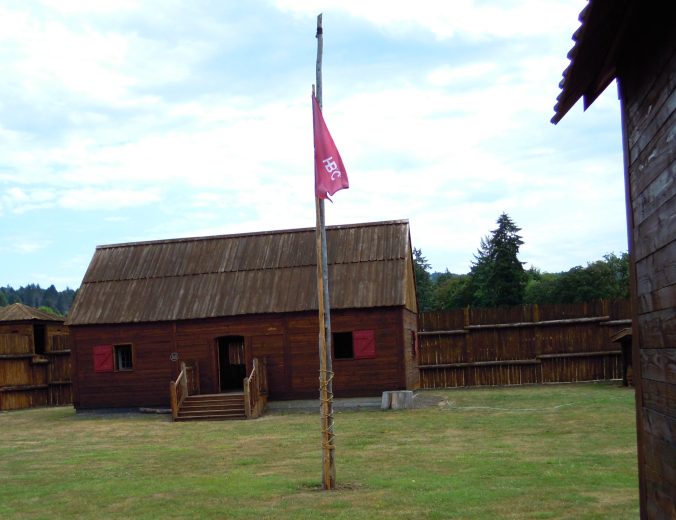
434.fort umpqua interiorFt.Ump.Inside 76So another successful Fort Umpqua Days has come and gone. The fort turns quiet for a little while. The Hudson’s Bay Company flag still flies, but business in the storehouse waits for another day.

Memories dream on after a glimpse into the past, some truer than others.

Ft.Ump.Inside 68COMMENT

Reviving Fort Umpqua

Tomorrow the people of Elkton will bring the old Fort Umpqua back to life with a flourish in their annual Fort Umpqua Days celebration. Folks from around the state and beyond will join in the fun, whether history buffs, reenactors, the simply curious, or those just looking for a good time or a good buy. Welcome to the party.

Ft.Ump.Inside 69Activities in the palisade walls will run from 10 in the morning until 5 in the afternoon on both Saturday and Sunday, September 3 and 4. While things are happening down at the fort, a lively market behind the ECEC library will offer crafts, books, and other items for sale. I’ll be there both days with my books set in the fur trade and pioneer era, and my friend Lynn Ash will join me with her books Saturday.

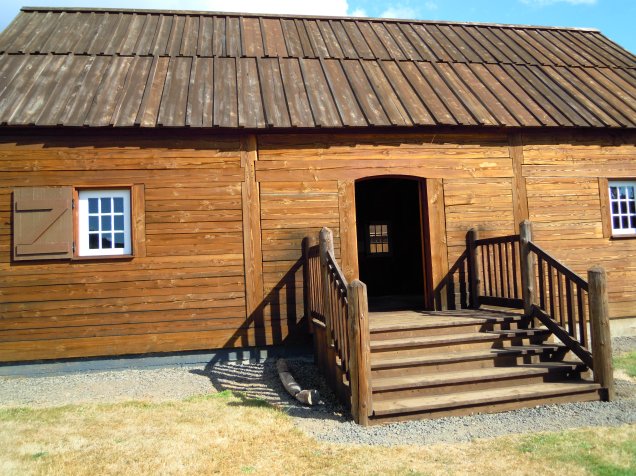
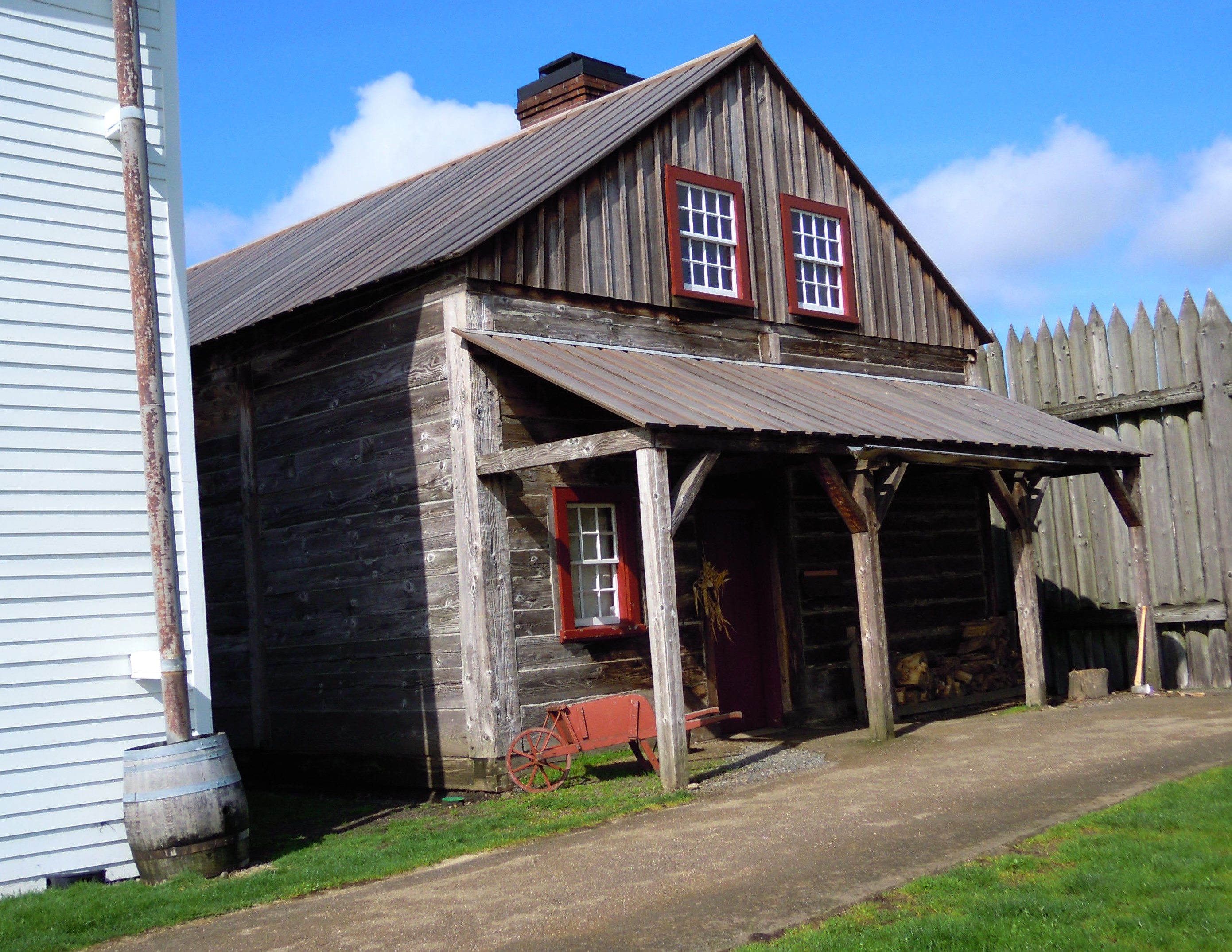
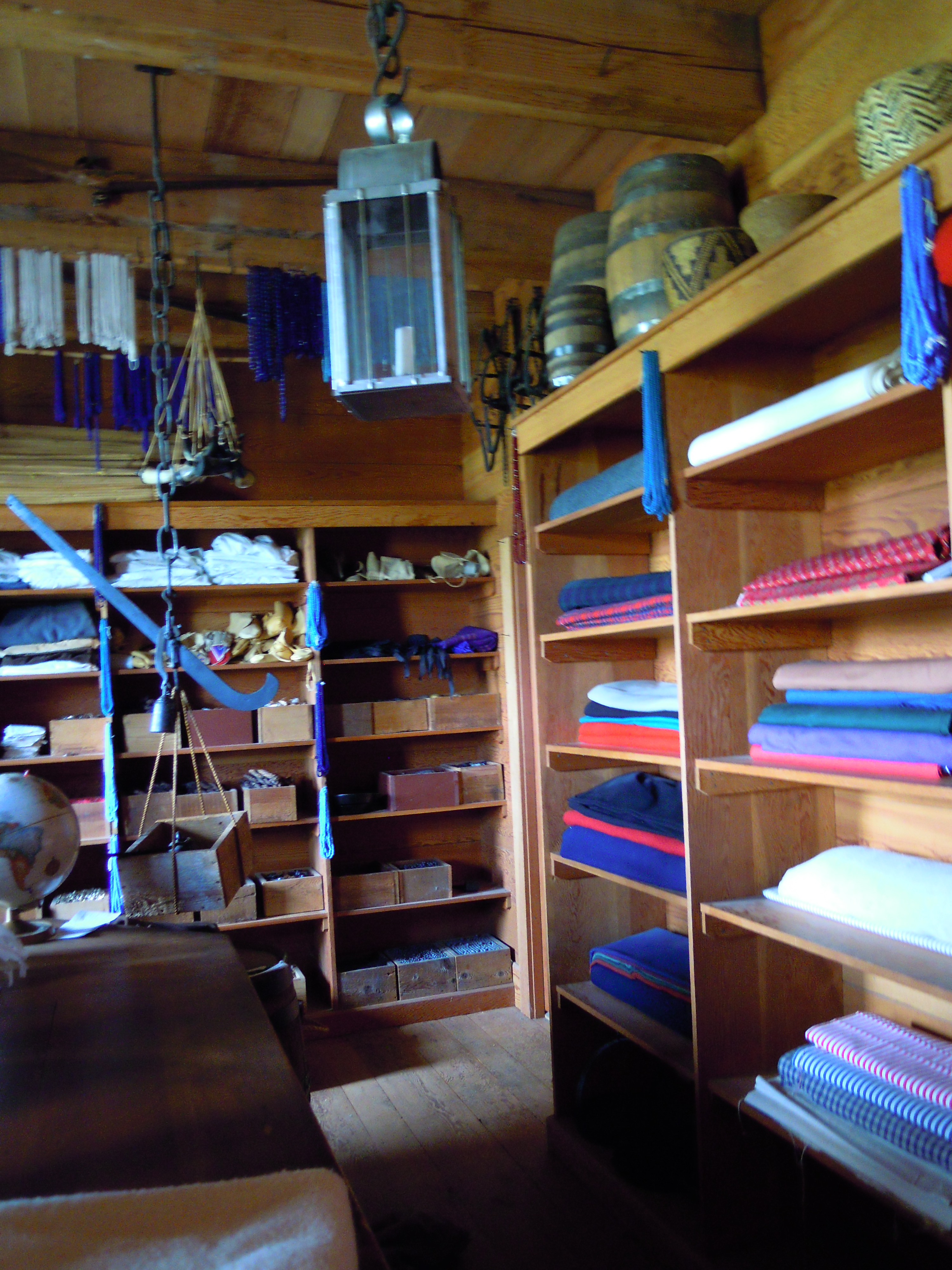
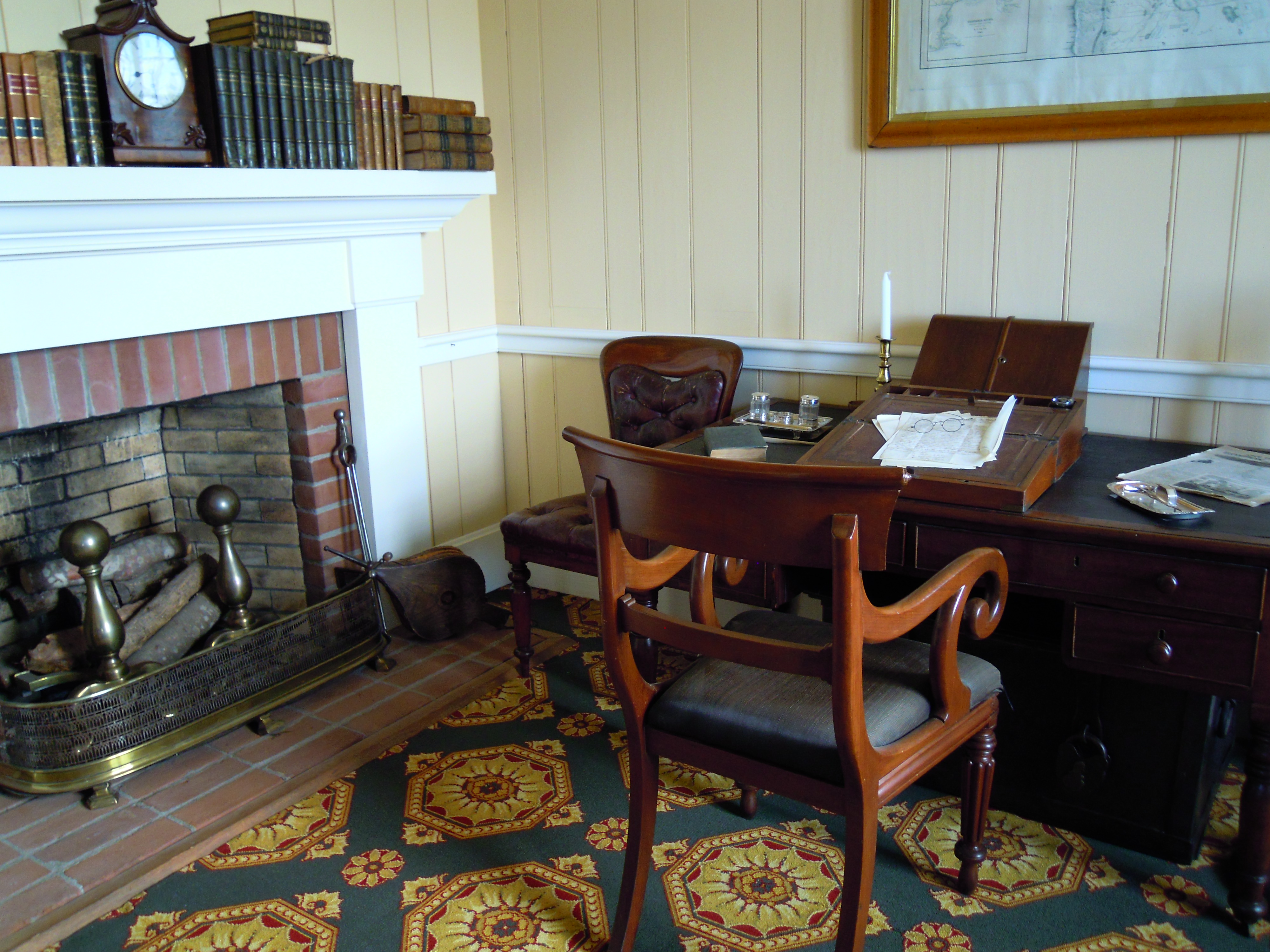
Ft.Ump.Inside 63Something new this year: The second building reconstructed at the fort, shown above, now has furnishings displaying living quarters where the Hudson’s Bay Company men lived. The rustic but comfy interior gives an idea of the kinds of gear they had–the typical Hudson’s Bay Company blanket, animal-skin rug, moccasins.

Ft.Ump.Inside 67The simple table setting illustrates the difference between the simplicity of life here in the southernmost outpost of the Company and the finery back at headquarters.

Ft.Ump.Inside 66No Spode china here, like that enjoyed by the senior officers at Fort Vancouver.

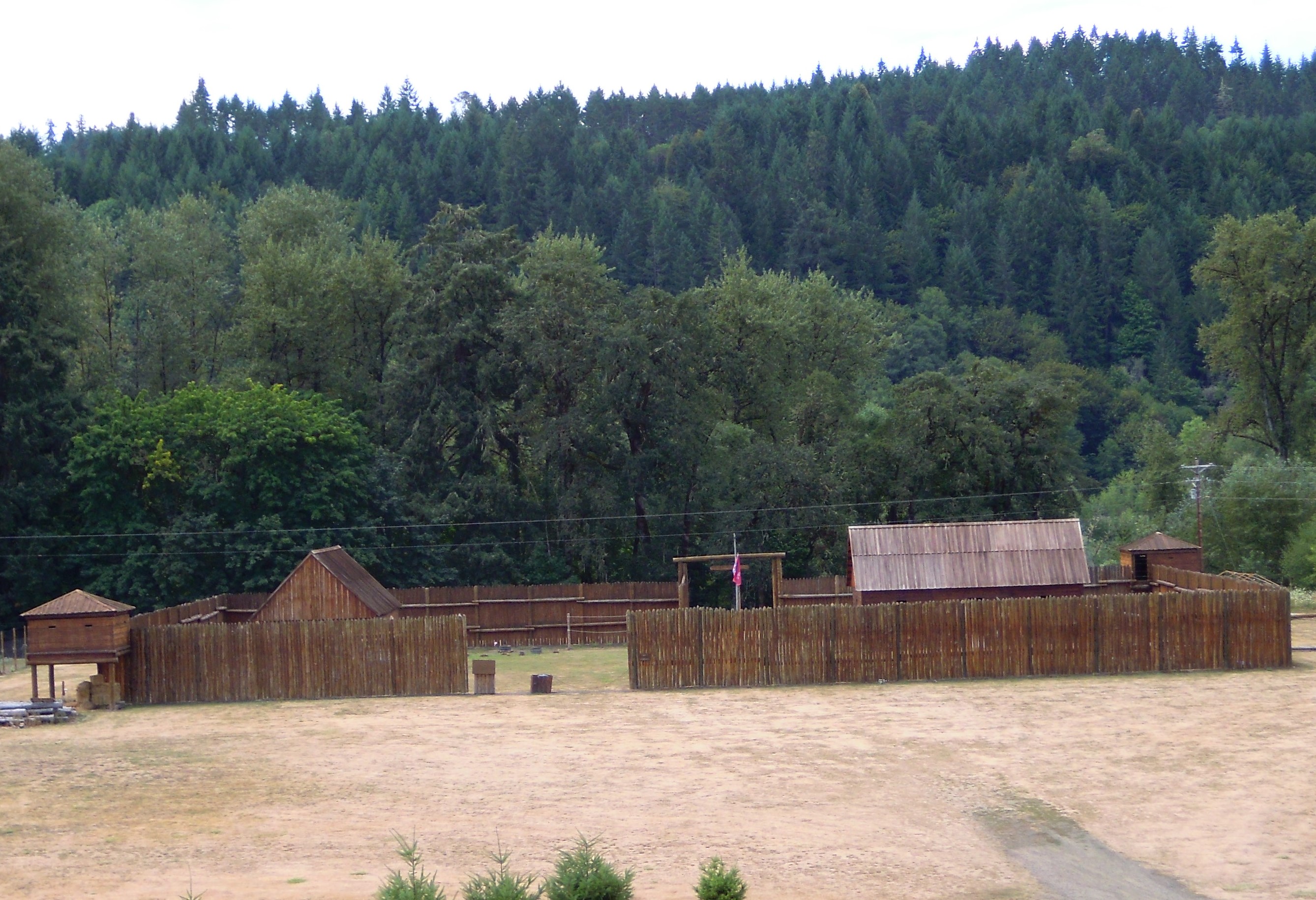
This project in Elkton has been a work in progress for several years, and as I mentioned in a previous post or two the reconstructed fort found its home a little downriver from the original.

When history buffs, modern mountain men, academics, and reenactors began contemplating the project, they discovered that the original site was not available. So this location down the hill from the Elkton Community Education Center was offered as an alternative.

If you drive south from Elkton on Highway 138 you’ll see a historical marker on your right which points out the original location of the fort across the river. The setting has many similarities, and the new site was selected.

Ft.Ump.Inside 77After the palisade walls went up, volunteers constructed the first building, the Company store and storehouse. Come inside and you’ll find the treasure that brought the British Hudson’s Bay Company into the region.

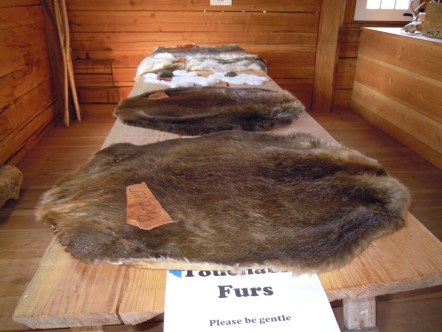
Ft.Ump.Inside 73The beaver pelt.

Ft.Ump.Inside 71There’s a touching table where you can stroke your fingers over the furs and feel how soft they are.

The sad news for the beaver was that his soft inner fur could be made into exquisite felt for the popular hats of the day.

That made the pelts extremely valuable and trappers combed the creeks of the wilderness to find them. Competition grew fierce between the British traders and the American mountain men, and rumors of war stirred as Britain and the United States shared the Oregon Country while London and Washington tried to come to terms on a boundary.

Ft.Ump.Inside 75Trappers, both white and Native American, could trade their furs for goods here in the Company store. Or today you can ask a knowledgeable young helper your questions about the history of the fort and the fur trade. Tomorrow and Sunday they’ll be dressed for the part in period costume, adding to your sense of stepping back in time.

Following the activities at the fort and market each day, the traditional historic pageant will be performed at the amphitheater, both nights. That’s always fun too as we play with history. I have the pleasure of serving on the writing team for that. Others did the lion’s share this time, but I had fun doing my little bit.

For more information on daily activities see the Fort Umpqua Days website.

COMMENT

Fort Umpqua Farming

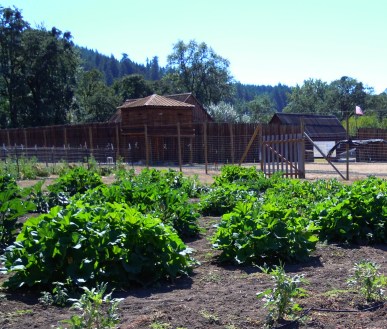
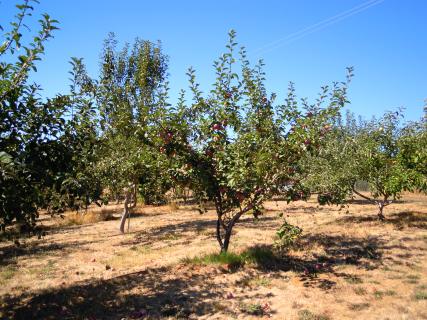
Visitors to the fort during Fort Umpqua Days this coming weekend will be drawn back in history through several activities for children that commemorate the fort’s importance as a historic agricultural site. These children will water the garden, make cornhusk dolls, grind corn, and sort beans from the fort’s gardens of heritage vegetables. And they’ll make apple cider from fruit out of the fort’s heritage orchard.

Ft.Ump.orchard signAs usual they’ll have plenty of 1800s games to play. And after they try samples of tasty food that workers at the original fort might have eaten, they can lead their parents out to take a look at the large gardens and orchards surrounding the reconstructed fort.

My books, The Shifting Winds and A Place of Her Own, tap into this same era, so the celebration has special meaning for me. I won’t get down to the fort during the day between 10 am and 5 pm because I’ll be up near the butterfly pavilion selling books in my booth, offering my own look at these intriguing times. On Saturday my writer friend Lynn Ash will join me to sell her travel memoirs, The Route from Cultus Lake and Vagabonda, describing her own pioneer spirit as she goes camping solo around the country.

Ft.Ump.gardens-1 (2)Like the Fort Vancouver headquarters for the Hudson’s Bay Company fur trade operation in the West, Fort Umpqua was a trading post, not a military fort, although both forts had tall picketed walls for protection. And the people who worked there had to sustain themselves in this wilderness.

The Oregon Country in the 1800s lay far from suppliers in eastern North America and Britain, so the Hudson’s Bay Company’s Dr. John McLoughlin, Chief Factor of this western region, placed self sufficiency high in the order of business. He chose a broad plain north of the Columbia River for the Company headquarters site of Fort Vancouver because he needed a fertile place to grow food to feed employees.

So it’s not strange that when he proposed a site for an outpost in the Umpqua region he wanted a place that could grow orchards and gardens for food.

Ft.Ump.gardens-2 (2)Company trappers in the Umpqua had been using a couple of temporary sites, and in 1832 McLoughlin assigned the French Canadian Jean Baptiste Gagnier to supply those. But McLoughlin sought a more permanent outpost. Gagnier selected a site, but McLoughlin, wanting a second opinion, sent his son-in-law William Glen Rae down to be sure the place had enough suitable land for growing vegetables.

Gagnier had in fact found a lovely open meadow with the fine treelined Umpqua River on one side and scattered oaks and swaths of fir forest crowning the hills on the other. The rich bottomland soil would grow fine vegetables and fruits from orchards and possibly vineyards.

Ft.Ump.orchardRae proceeded with the fort, dubbed Fort Umpqua, and the Company maintained this post for fifteen years, from its construction in 1836 until 1854, their southernmost outpost in the entire Oregon Country.

Once the United States acquired the area after the 1846 boundary settlement with Britain, the British cut back on business south of the new border, but they kept a trader at the site until 1854. The fort burned in 1851, but they stayed on, working out of some kind of structure for three more years. By that time the meadow thrived as an agricultural center.

Of course, all this happened a short distance upriver from the Fort Umpqua structures and plantings you see today. More on that in my next blog post. But that small factoid does nothing to dampen the enthusiasm of the annual Fort Umpqua Days at ECEC, happening this next Saturday and Sunday, September 3 and 4.

Beckham, Stephen Dow. Land of the Umpqua: A History of Douglas County, Oregon. Roseburg, OR: Douglas County Commissioners, 1986.

COMMENT

Black Powder Men

A popular event at Fort Umpqua Days in Elkton, Oregon, is the gathering of black powder men, reenactors who come out with their muzzleloaders to exhibit their prowess at shooting these early weapons and to share stories of historic Fort Umpqua times. That’s Saturday and Sunday, September 3 and 4, and I’ll be there with my own books where you’ll find old-time black powder men, especially in The Shifting Winds. Update: See also a story in the The News-Review about a brigade of reenactors of 19th century trappers who camped at Fort Umpqua last weekend on their way to California as the Hudson’s Bay Company trapping brigades might have done back in the day.
First Mountain Man jpgSome of today’s black powder folks call themselves mountain men, and there may have been a few mountain men who passed by Fort Umpqua in its prime, like this man painted by Andy Thomas, artist, who dubbed him “The First Mountain Man.”

However, the term mountain man generally refers to the American trappers who did in fact work in the mountains, over in the Rockies.

Jed Smith was an early American mountain man who passed through the Umpqua region years before the fort’s construction, when he led an exploratory expedition of fellow trappers from the Rockies west by way of California. Jed didn’t fare well in the Umpqua. The Umpqua Indians attacked him and his men, killing many of them, and stole all their furs. Jed ultimately made his way north to Fort Vancouver, where Dr. McLoughlin treated him hospitably.

Hudson’s Bay Company men recovered Jed’s furs and McLoughlin paid him a fair price for them. Jed so appreciated McLoughlin’s decency he swore he wouldn’t trap in the Oregon Country, leaving beaver there to the British. Although British and America trappers collided occasionally along the Continental Divide that marked the west edge of the undisputed U.S. territory of the Louisiana Purchase, the British for the most part were left alone in the Oregon Country, which was supposed to be jointly occupied by Britain and the United States.

Only when the trade died in the Rockies did American mountain men push on west. That’s when Joe Meek and my fictional Jake Johnston of The Shifting Winds headed to the Willamette to become settlers.

Mt. ManMountain men typically wore buckskins as many black powder reenactors do. So did British trappers who went out with the trapping brigades. Ken Putnam of Drain, Oregon, poses with me in his mountain man garb at the 2015 Fort Umpqua Days.

Frontiersmen who hunted in the wilds found the buckskin, or deerskin, to be sturdy and protective in the rugged brush where they sought game. In the Rockies it had the added advantage of availability. American trappers worked and lived with Native American tribes who wore buckskin themselves, often beautifully crafted by the Indian women who also became wives of many mountain men.

The weapons changed over time. In the early years the muzzleloader would have been a flintlock rifle, perhaps a Kentucky long rifle, but the long barrel proved awkward for the mounted trappers. They soon opted for a shorter barreled half-stock with bigger bore. About the same time this “mountain rifle” became popular the flintlock was being replaced by the percussion rifle, which was easier to load quickly–important when you had only one shot per loading.

Then gunsmiths Jacob and Samuel Hawken came up with the clean-lined plains rifle known as the Hawken rifle, and that became the mountain man’s rifle of choice. My character Jake Johnston takes great pride in his sleek Hawken rifle he brought out of the Rockies with him.

During Fort Umpqua Days you can expect to hear the deep harrumpf of muzzleloading rifles echoing across the hills as modern-day black powder men slip into a past where expertise with those weapons could be a matter of life and death.

COMMENT

HBC Outpost Ready for Celebration

the fort 2 (2)

Nestled on the bank of Oregon’s Umpqua River, this replica of the British Hudson’s Bay Company’s Fort Umpqua will come to life in a couple of weeks for the annual Fort Umpqua Days celebration at Elkton. The event will run all day Saturday and Sunday, September 3 and 4, and I’ll have a booth there to sell my books.

Just last month I stepped into the historic past of the Hudson’s Bay Company’s western headquarters at Fort Vancouver on the Columbia River, touring the commander’s house, among other structures there. So I see this Umpqua outpost with new perspective.

I’ve attended Fort Umpqua Days celebrations every year since I returned to the family farm near Elkton in 2009, joined the writing team for the event’s pageants, and had a booth the last two years there to sell my first book A Place of Her Own. Still, I feel a difference this year after my event at Fort Vancouver in July where I presented my new book The Shifting Winds, which has many scenes at that HBC headquarters.

Before the Fort Vancouver event I wrote a series of posts for this blog called “The TRUE Shifting Winds,” giving an overview of history leading to the days of my book and the fort’s part in it. Fort Umpqua doesn’t appear in the story, but for me the enhanced sense of Hudson’s Bay Company history wraps Fort Umpqua into the fold.

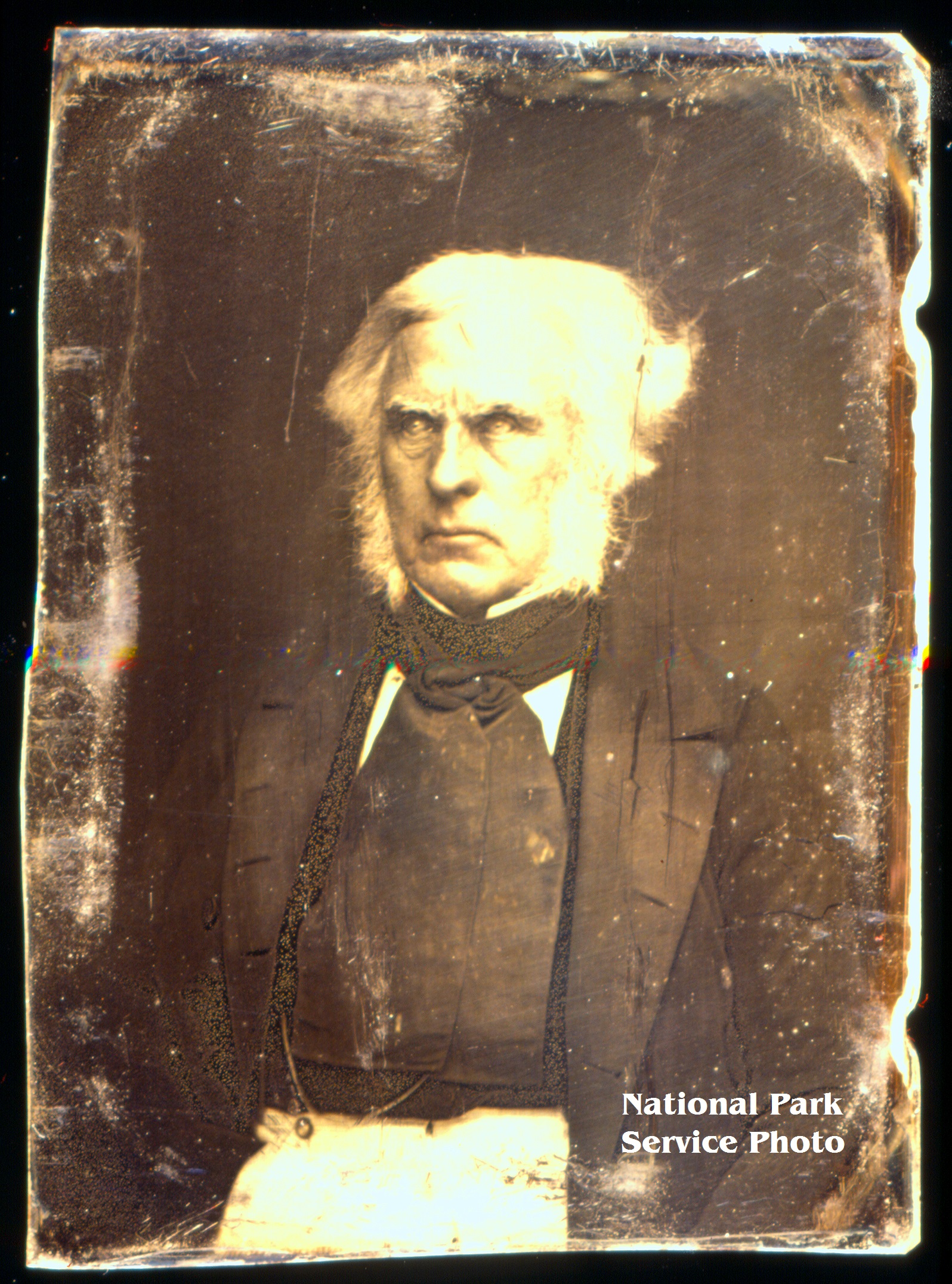
Dr. John McLoughlin, shown in this daguerreotype, commanded the efforts of the British HBC fur trading empire in the Oregon Country. Photo courtesy of National Park Service.

McLoughlin had been at Fort Vancouver only a year or so when he decided to push south through the Umpqua basin with brigades of trappers. Those expeditions into the southern region became annual events–and rather colorful.

Author John A. Hussey quotes Editor Alice Bay Maloney in describing them:

At the head of the brigade rode the leader, a chief trader [or clerk] of the Hudson’s Bay Company, astride a strong limbed Nez Perce horse and armed to the teeth with the best weapons of the day. Directly behind him rode his Indian wife gaily attired in the finest London broadcloth, with a wide-brimmed, feather-trimmed hat atop her wealth of long, shining black hair…. All the men were clad in deerskin….

Hussey adds a description of the brigade by an unnamed priest who wasn’t quite as impressed: “‘The brigade,’ he wrote, ‘is a hideous assemblage of persons of both sexes, devoid of principles and morals,’ and possessed of ‘revolting exteriors.'”

In any case it was during one of these expeditions that members of the brigade selected a site on the Umpqua River they thought would be a good outpost for trade with the local tribes. McLoughlin, concerned about competition from American trappers, wanted to clear the area of beaver and establish a strong foothold.

The Hudson’s Bay Company built Fort Umpqua in 1836, and it served the Company well for more than a decade, even after the boundary settlement between Britain and the United States gave the land to the U.S. in 1846. The photo below shows the interior of the reconstructed Fort Umpqua with the HBC flag flying again.

In the next two weeks I’ll write a few more posts about the Hudson’s Bay Company trade in the Oregon Country and about the reconstruction of their southern outpost as the Fort Umpqua Days celebration nears.

Hussey, John A. Champoeg: Place of Transition. Portland, OR: Oregon Historical Society, 1967.
Maloney, Alice Bay (ed.). Fur Brigade to the Bonaventura, John Works California Expedition, 1832-1833 … San Francisco, CA, 1945.

COMMENT

At the Fair

Janet FairA surge of heat gripped Roseburg during the Douglas County Fair last week, making us authors happy to be in one of the few air-conditioned buildings at the fairgrounds.

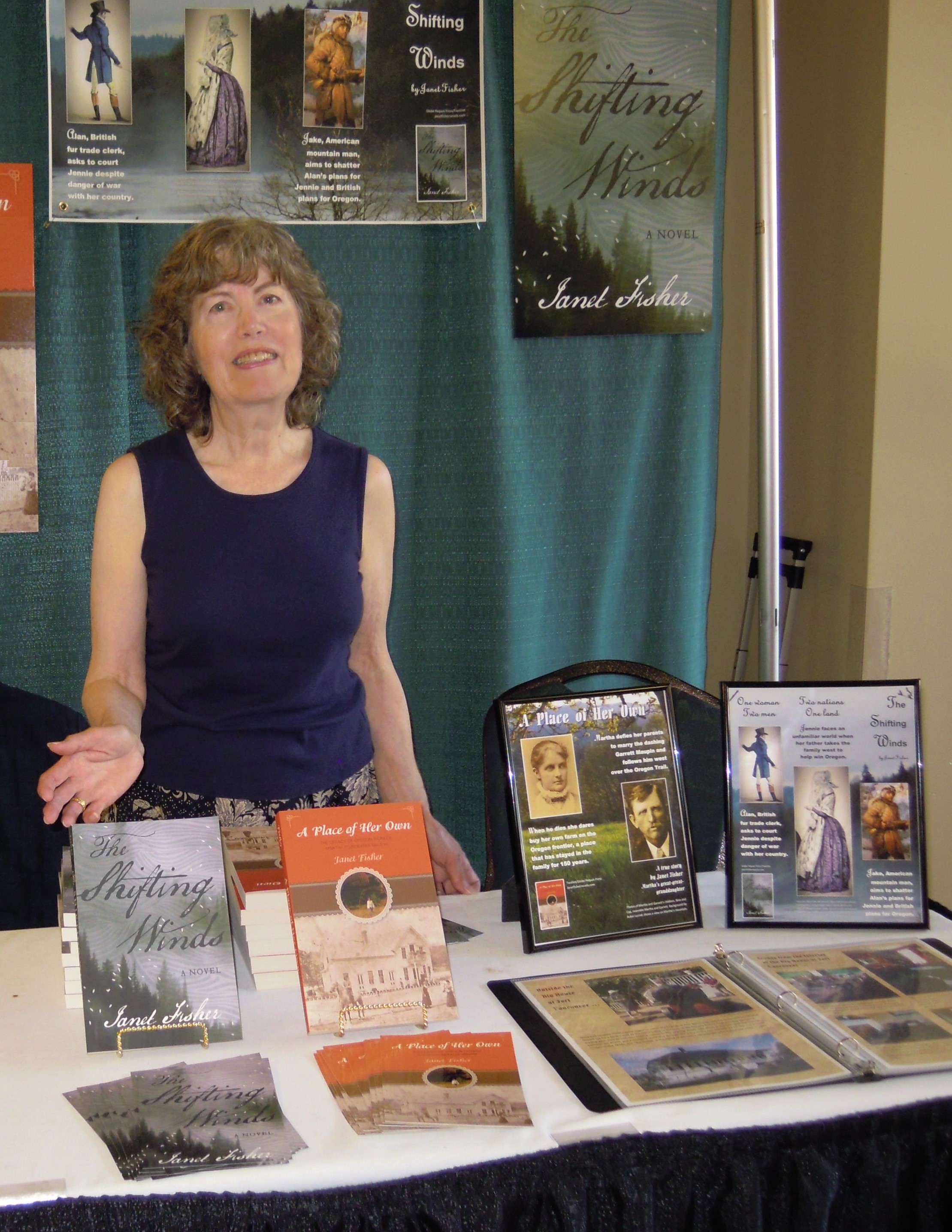
Here I am at the Author Table surrounded by props for my two books, The Shifting Winds and A Place of Her Own, doing my best to keep cool. My expectation of ideal weather didn’t quite work out. The forecast looked good when I promised pleasant days in my last blog post, but by the time the fair started, the numbers had ticked up dramatically. Sorry if I misled anyone.

More traffic than usual passed by our table in the foyer of the Community Hall, I think, as folks sought refuge from temperatures running into the high 90s and 100s.

My writer friends and I had many good conversations with passersby and sold some books. Through banners, posters, and a notebook filled with pictures and brief descriptions, I offered a glimpse into my stories.

After the scorching sun slunk behind the hills, I ventured out for fair food and checking the exhibits. No little piggies this year. Probably a good thing. We might have had cooked piglet. But I enjoyed seeing lots of other animals, as well as all the fine displays of the handiwork of children and adults.

COMMENT

Fair Week!

The Douglas County Fair starts Wednesday this week with rides and fair food and animals and other amazing exhibits–and yes, authors selling and signing our books. It’s a great fair, and the weather promises to be almost perfect. A little hot on Friday, but otherwise ideal. You’ll find us authors the epitome of cool in the air-conditioned foyer of the Community Conference Hall, just to the left as you come in the main gate.

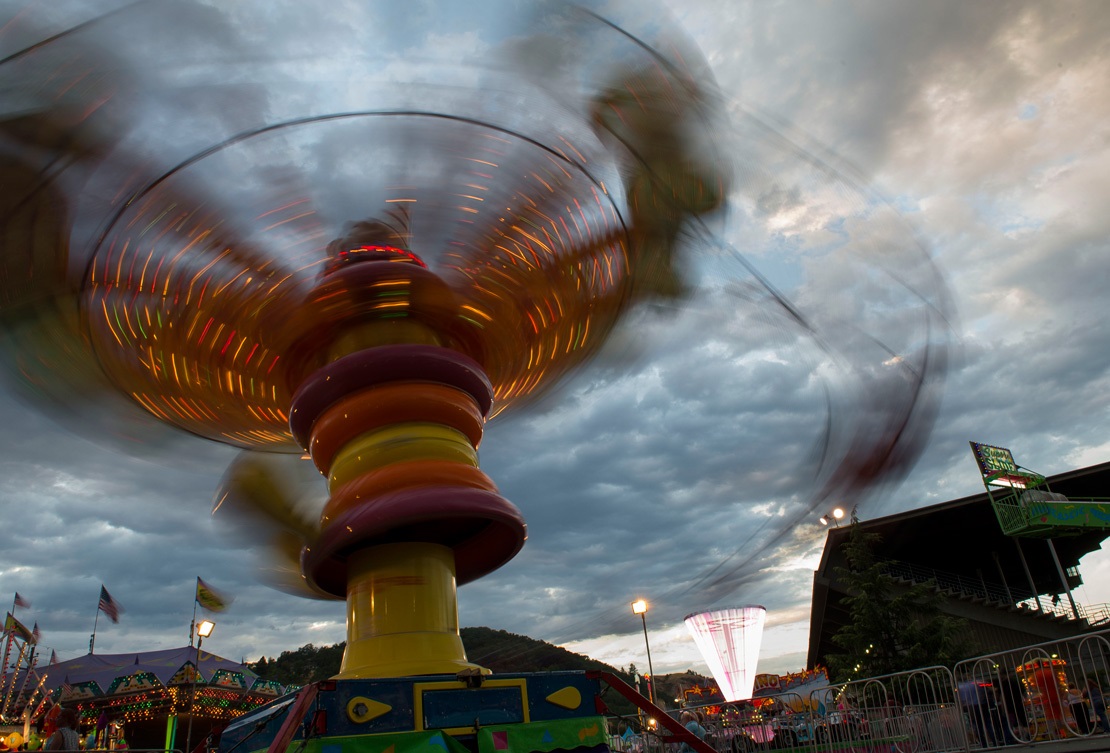
web-County-Fair-rides - 2013Outside, the fairway awaits with scenes at dusk like Robin Loznak’s picture at the Douglas County Fair from a few years ago.

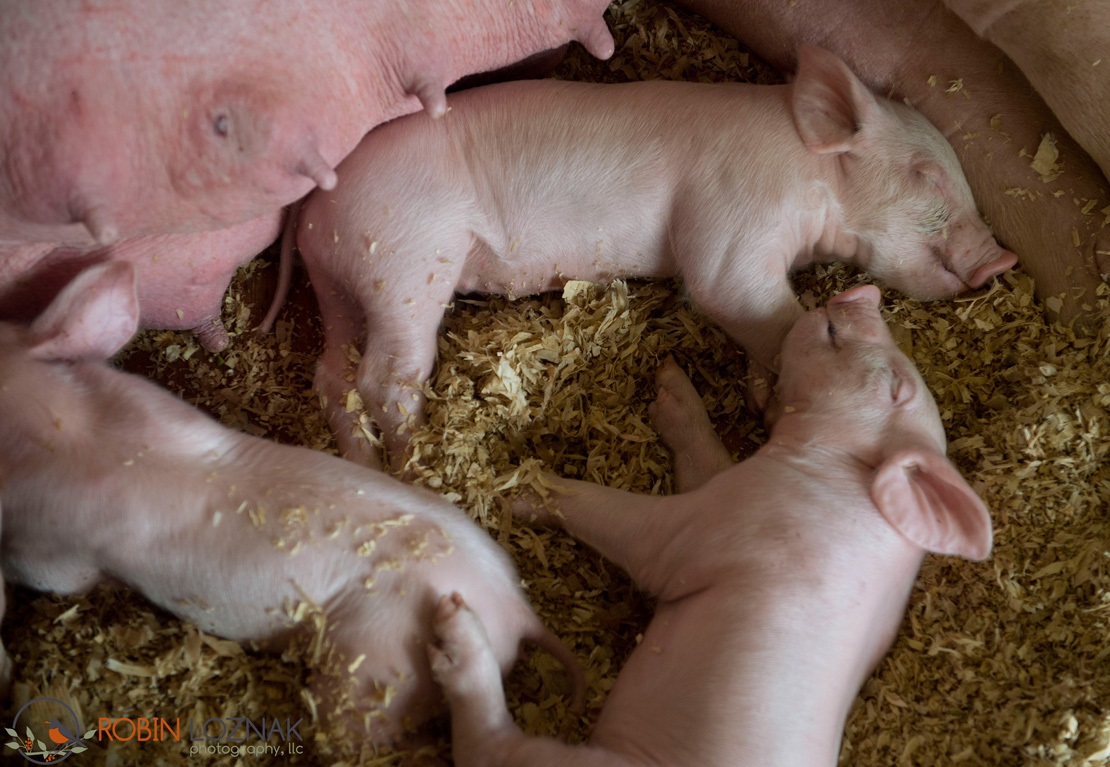
Or you may find piggies like these Robin caught napping at the time. Although a regular attraction at the fair, I can’t promise there will be piggies this year. But there’ll be animals aplenty. For more of Robin’s fair photos that year check here. They’re down a ways, but it’s an entertaining scroll.

web-County-Fair-naptime - 2013I’ll be at the fair all four days this year from 3 to 7 pm, highlighting my new book, The Shifting Winds, with copies also of A Place of Her Own.

My friend A. Lynn Ash from my Eugene writing group will be there Wednesday and Thursday from 3 to 7 with her two travel memoirs, The Route from Cultlus Lake and her latest, Vagabonda. My friend Dianne Carter from my Roseburg writing group will be there all four days with her new debut novel, Misled, Wednesday through Friday from 11 to 3, and Saturday from 3 to 7.

Various members of An Association of Writers, my Roseburg group, will be at the Author Table throughout the four days from 11 in the morning until 7 in the evening. They’ll be selling member anthologies and inviting local writers to join the group. We’ll all be talking writing with whoever wants to chat.

So if you’re looking for cool at the Douglas County Fair this week, check out the Author Table, indoors, first left inside the main gate.

COMMENT

Bloomsbury Event Rescheduled

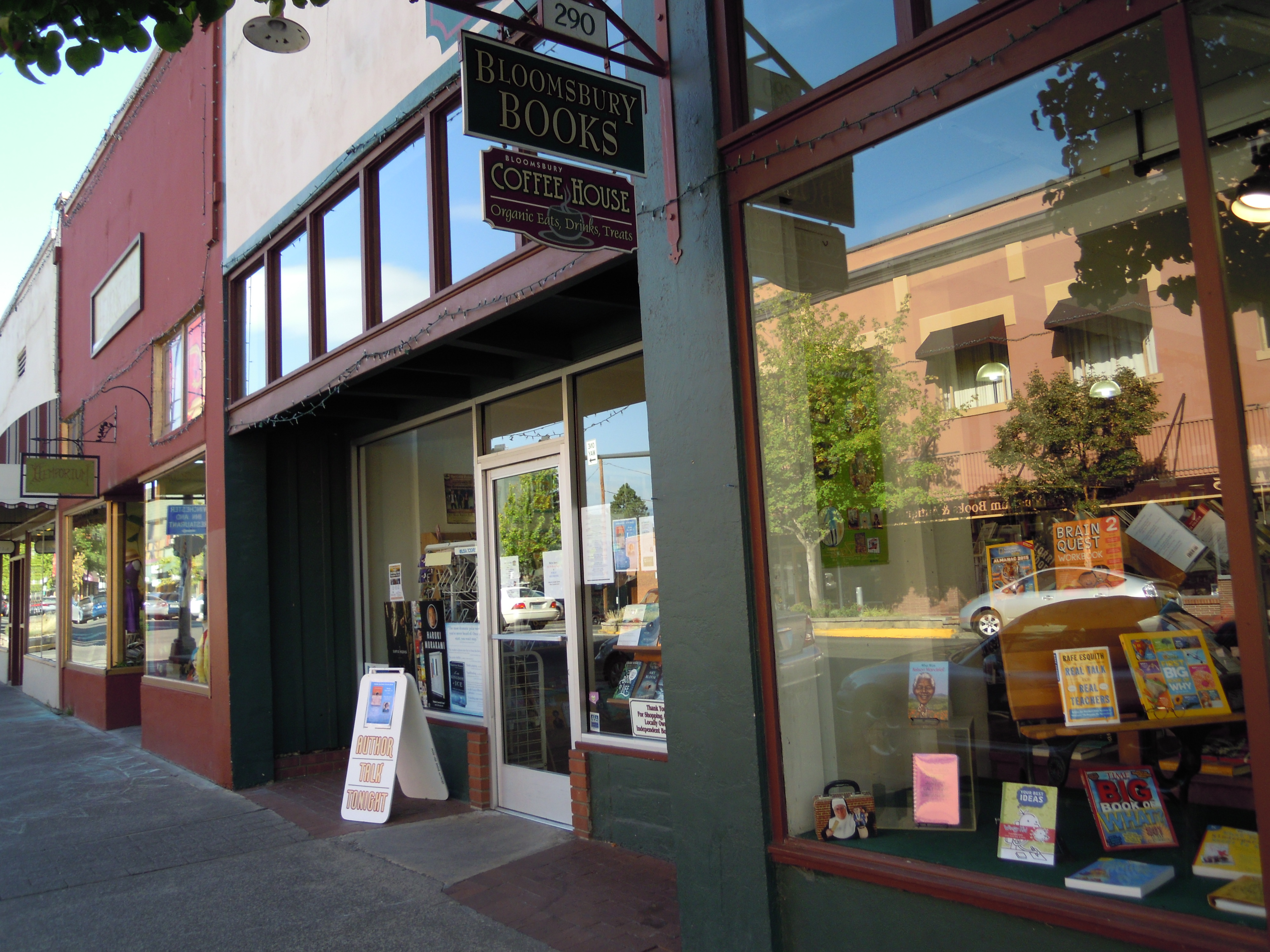
627.ashland outside bloomsburyJust a note to let you know my book signing and reading event at Bloomsbury Books in Ashland has been rescheduled and will now be held on Monday, October 10 from 7 to 8 pm. I previously announced it in “News Briefs” as a September event, but realized it was the same night as the first Presidential Debate. Since that might affect attendance we moved the event ahead to the October date.

It’s always a pleasure to visit Ashland where I used to live back in the 90s. And Bloomsbury Books is a lovely store. Looking forward to it.

COMMENT

Book Event Explores a Living Past

Story and tangible history came together when the Friends of Fort Vancouver and the National Park Service hosted me for a book event at the remarkable re-creation of the historic Hudson’s Bay Company trading post, Fort Vancouver.

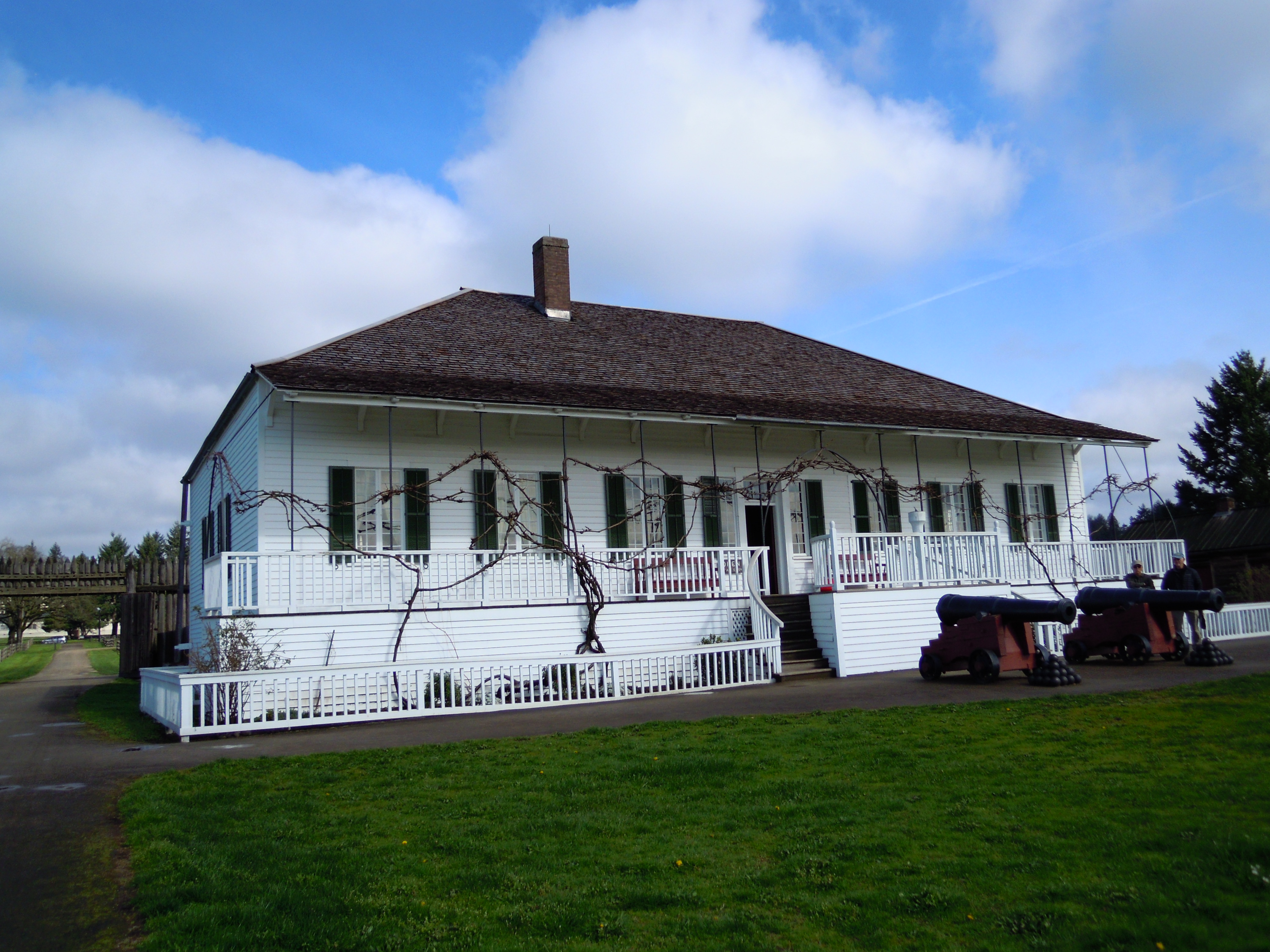
Fort Event Big GunThe event highlighted the actual reconstructed fort with a tour led by Dr. Robert Cromwell, Chief Ranger and Archaeologist, speaking behind the big gun here. Two large cannons stand in front of the elegant Big House, home of the fort’s commander in the days of my book, The Shifting Winds. During the tour I offered a few words on certain scenes from the book which took place at the fort in 1842 and 1843. I’m in the white hat. Photo by Robin Loznak.

The tour brought us into the fort’s living history, and Dr. Cromwell was great. I love this place that makes the past live. I feel a deep connection because my first visit here years ago inspired me to write The Shifting Winds, and making the past live is what I try to do with my historical novels.

Fort Event FlowersDr. Cromwell talked about the impression the house would have made on its 19th century visitors, such a grand structure with its expensive white paint and the big guns facing the front gate, although he noted the guns were spiked so couldn’t fire.

Nevertheless, the effect was no doubt intended to show the power of this British fur trading company that essentially ruled over Oregon at the time of my story.

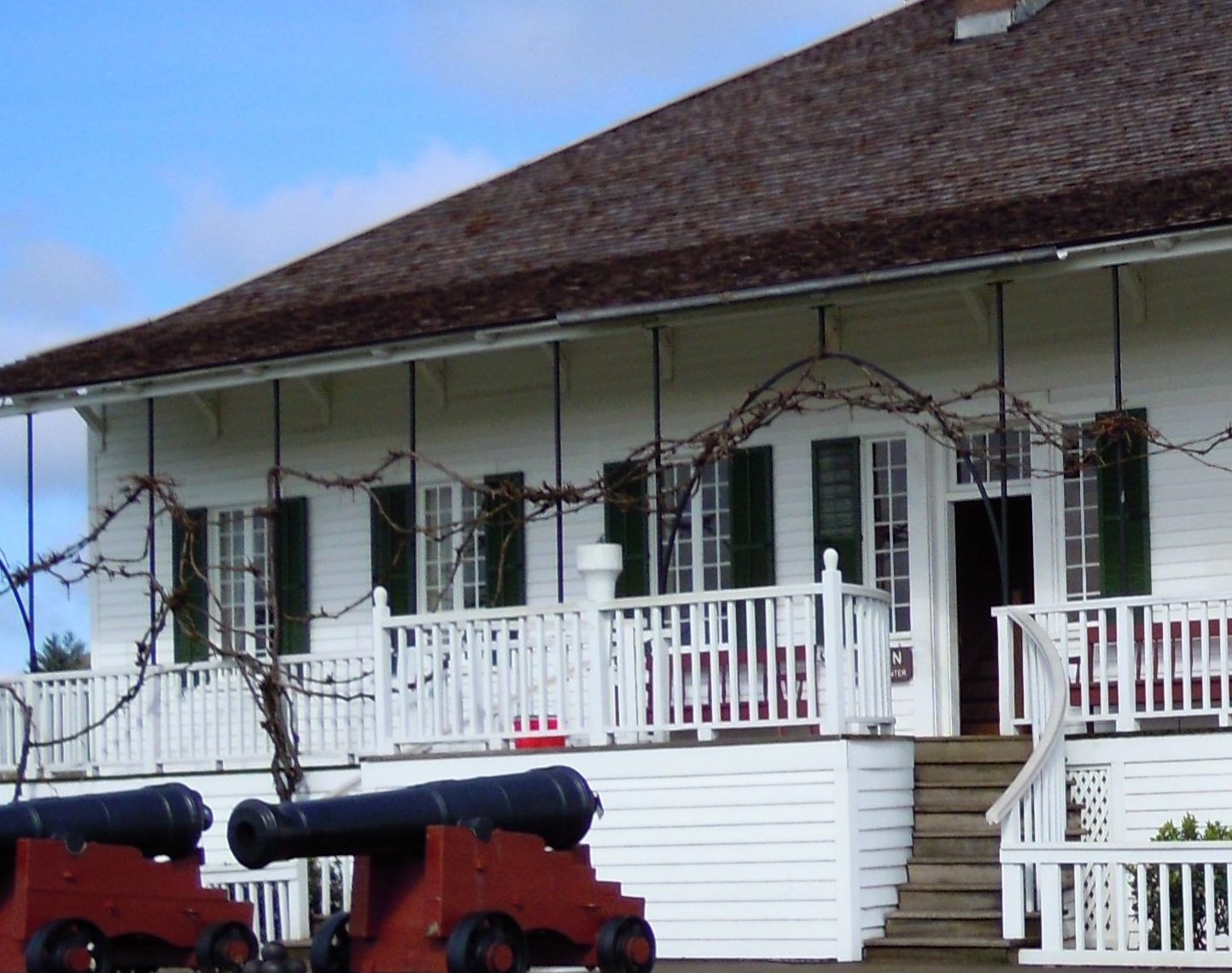
On this July day the lush grapevines draped over the Big House veranda and bright flowers bloomed in front. On my previous visit in March the canes were bare, and there was no sign of flowers. Now huge clusters of grapes hang from these vines.You can also see part of the arbor in the top photo.

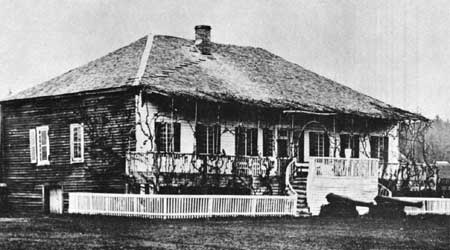
Photos taken of the original Big House in 1860 let researchers know that grapevines twined around metal trellises on the veranda that extends across the entire front of the house.

Fort Vancouver Big House (2)The thumbnail shows the house during my March visit before the greenery leafed out. Quite a change, and probably effective for the south-facing house. In winter when they needed more light the leafless vines let the sun come in, but in summer the leaves provided cooling shade.

Our tour proceeded inside the house so the group could see additional settings of the story and learn more about the fort. Then we moved on to the Indian Trade Store and the Fur Store warehouse to get an idea of the real purpose of this fort. The Hudson’s Bay Company officers and employees may have appreciated the protection of the picketed stockade, but the fort never served as a military post for them. The Company came for the furs, particularly beaver, purely a business venture. But it could be a cutthroat business as they competed against the Americans, who also held an interest in the territory.

Fort Event Ranger & meThe tour ended up at the New Office, above, the closest thing to the setting where my character Alan Radford would have worked. The clerk Alan lived and worked in the Old Office, which hasn’t been reconstructed yet. While Dr. Cromwell looked on, I talked about the scene where Alan invites protagonist Jennie to see his workplace during the Christmas Ball at the fort. Through a bit of byplay between these characters, I slip a little information into the story that gives the reader an idea how the fort functioned and how very isolated they were in this wilderness. Photo by Robin Loznak.

Fort Event Lecture 5 (2)My lecture at the Visitor Center featured photos related to the story, this one showing Fort Hall, another reconstructed fort that became a landmark on the Oregon Trail. My thanks to Ranger and Guide Emily Orvis for setting up the AV tech equipment so it all rolled smoothly, and thanks to my son-in-law Robin Loznak for handling the individual photos while I talked. This shot of me was taken by Benjamin Capps with my camera.

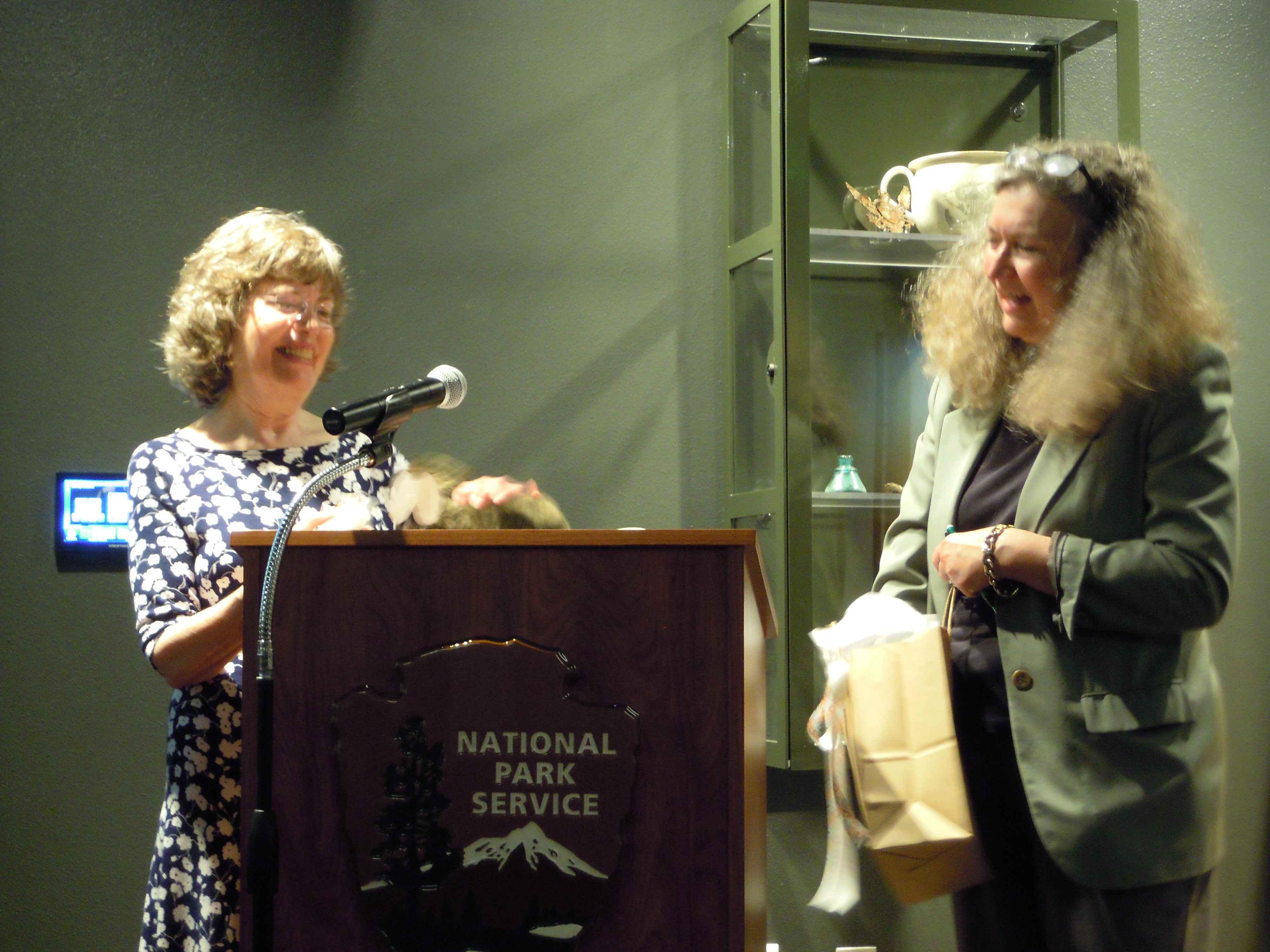
Fort Event Mary & meAfter my talk, Mary Rose, Executive Director of the Friends of Fort Vancouver, surprised me with a bag of thoughtful gifts, from a lovely turtle pin that memorializes the Native American label for the fort area as the “place of the mud turtles,” to Jacobsen sea salt from Oregon’s cold waters at Netarts Bay, to a Russian nesting doll acknowledging Vancouver’s many Russian immigrants, a little stuffed beaver representing the target of the 19th century fur traders, and a 100th anniversary pin commemorating the 100-year birthday of the National Park Service that maintains the site. What a delightful gesture! Photo by Benjamin Capps.

Fort Event Signing 4I arrived early, well before planned activities, which worked out. Tourists were stopping by and several bought my books, even some that hadn’t come for the event, and they were pleased to get personalized signed copies. My thanks to Sales Assistant Madya Panfilio for her enthusiasm in recommending my work. Official signing came after the lecture. Photo at left by Robin Loznak.

Mary Rose also asked me to sign additional books, which are available in the Visitor Center Bookstore.

Mary was the one who arranged my presentation at Fort Vancouver. When she learned about my book The Shifting Winds, she immediately became interested. She read the book, appreciated the accuracy and the story, and discussions led to Saturday’s presentation.

Many thanks to Mary for organizing such a wonderful event. She and the staff at the Visitor Center and the fort did a terrific job. Thanks to them all.

As my grandson Alex said, “They rolled out the red carpet for you, Grandma.” Yes, they did.

Everyone made it a wonderful day and I am most grateful.

COMMENT

The TRUE Shifting Winds ~ 6: Making the Past Live

My presentation in the Visitor Center at Fort Vancouver is just two days away, Saturday, July 16, and with this post I will close out the “TRUE Shifting Winds” series. The event starts at 2 pm, when I’ll give a talk while showing photos related to my book and the fort. I’ll do a couple of short readings from the book, selected from scenes at the fort, and after some Q&A, sign books.

The Visitor Center bookstore will have copies of The Shifting Winds for sale, and also my first book, A Place of Her Own, the story of my own great-great grandmother who came west over the Oregon Trail.

Following the signing I’ll invite attendees to go down to the fort where I’ll lead a tour of places that appear in The Shifting Winds, accompanied by Mary Rose, Executive Director of the Friends of Fort Vancouver. There’s a small fee to get into this National Park Service site, or if you have your own pass, that will work too. If you’re in the vicinity I hope you’ll join us for this walk into the past.

A Reconstructed Fort

Making the past live. Isn’t that what historical novelists do? Make the past live? We try. So we have something in common with those who worked so hard to bring structures and their contents back to life at Fort Vancouver. Even staff members put on the garb and help draw visitors back to an earlier time. And the rangers tell the old stories, like bards.

Fort Vancouver Big House (2)

We historical novelists tell the old stories through the eyes of our fictional and sometimes historic characters. For my part I’ll refer you to my book, The Shifting Winds, with its scenes in the Big House shown above, the Old Office, and the Bachelor’s Quarters, as well as the fort grounds and the dark orchard behind the stockade on a cold night.

Here in my post I offer photos taken on my recent visit to the fort—for illustration—with a little text and tidbits of history to enliven them.

The Big House

The preservation team didn’t have blueprints for the house. They knew what the outside looked like from pictures, but for the inside their only clues were snippets of descriptions and comparisons with managers’ houses at other HBC forts, plus the remains found by archeologists–footings, the base of the chimney, evidence of a cellar.

The cellar probably held the oft mentioned wine and spirits served in the Mess Hall.

Ft.Vanc.Dining long

Gentlemen of the fort ate in the dining room in the Big House, generally called the Mess Hall, making this the center of business as well as social life. Everyone welcomed the arrival of visitors who brought news from other places, breaking the monotony of this isolated post. Many guests–distinguished and not–enjoyed the fine fare, even including soft loaf bread from the fort bakery, along with vegetables from the gardens, game from the hills, fish from the river, and eventually beef when herds grew large enough.

The well-stocked kitchen stood behind the house, connected by a passageway but separate for fire safety. Gentlemen maintained careful military etiquette as to rank, although Chief Factor McLoughlin could use his discretion to make allowances for some, especially Americans, whose rank might be obscure.

The officers of the fort offered the finest hospitality to keep visitors there as long as possible, although some of the gentlemen in the Bachelor’s Quarters, or even the office, might have to give up their rooms to house the guests.

613.Ft.Vanc.McLoughlin Sitting Room

The McLoughlin sitting room, shown above, would be the place where Mrs. McLoughlin took her meals, sometimes with family and friends. Female guests with some status stayed in the Big House, like protagonist Jennie in my story, and she would have eaten her meals here with Mrs. McLoughlin. Only if the doctor missed mealtime in the Mess Hall might he join them. Update: The reconstructed house also has a small dining room for the women on the east side, which would have provided another option for them, but they would not eat in the Mess Hall with the men. That was strictly a male sanctuary.

Most of the women, like Marguerite McLoughlin were at least half Native American. Her mother was Cree. The women wore European dress, but with moccasins and deerskin leggings for riding gentleman fashion, that is, astride.

People who saw the McLoughlins together often commented on the fondness they showed for each other, although some had trouble accepting fur trade marriages. One man made such a fuss, McLoughlin struck him with his gold-headed cane, later apologizing for his outburst. Soon afterward McLoughlin insisted on a civil marriage, and when he later returned to his Catholic faith, the couple was married again in a Catholic ceremony–by then thoroughly wed.

Johnson in his book John McLoughlin comments: “The deference that Mr. McLoughlin showed to his wife in public was the envy of all American wives, who lost no time in citing him to their husbands as an example worthy of emulation.”

McLoughlin’s second-in-command, James Douglas, lived in the other half of the Big House for a time. The rich red of this room is based on a later detailed study conducted to determine the actual colors of rooms at the fort.

Researchers perused books on the subject, visited other forts and inspected bits of painted wood and brick dug up by archeologists on the individual building sites.

In their 2003 report they explain that this red was found on the east side of the building.

Historians believe the east half was the side where the Douglas family lived, so the Douglas sitting room was painted red, a color gaining new popularity at the time.

Beige painted scraps were found on the opposite side, leading to the painting of the McLoughlin sitting room beige, a more conservative color, perhaps reflecting the doctor’s preference. The most common color found was green toward the back of the house, and that was interpreted as an appropriate color for the Mess Hall, the largest room on the main floor. Chair rails were common with the top sometimes painted the same as the bottom, sometimes not. Ceilings were usually white.

Ft.Vanc.McL Bedroom

Bedrooms tended to be in soft, pale colors.

Ft.Vanc.McL Office

Dr. McLoughlin’s personal office, shown above, could be accessed from the McLoughlin sitting room, continuing the same rug design and wall color. His office can also be accessed from the main entryway of the house, on your left as you step in the door. A steep staircase rises directly ahead of the front door.

Some question arose as to the location of the ballroom cited in a number of writings of the time. One remarked: “had a ball in evening upstairs.” Could that have been the Mess Hall, up the long curving outdoor staircase to the veranda? Or would it be upstairs in the ample space between the main floor and the structure’s high roof? The Mess Hall could be the location of parties. Or perhaps a large hall in the long Bachelor’s Quarters.

Hussey in his report seems to lean toward the second story, despite the apparent lack of windows, and I happily adopted the site for the Christmas Ball. Unfortunately that room isn’t open to the public. Still, I had no trouble imagining it. Who needs much description of a vast room when you have candlelight and violin music and swirling dancers in grand ball gowns and dress coats and sparkling eyes?

The Bachelor’s Quarters

This long structure hasn’t been reconstructed yet, so I’ll let my character Jake give you a word picture for that from the pages of The Shifting Winds:

ShiftingWinds cover jpeg

Jake glanced around the stark little room a Company officer had been compelled to give up for him. Company gentlemen might dress well, but they didn’t live so well. A small bed, a simple chest of drawers, a tiny table with a box for a chair, one trunk. That was it for furnishings. A few mementos hung on the walls—tomahawks, feathers, carvings, a couple of paintings.

Like most of the fort buildings, the Bachelor’s Quarters were constructed in the Canadian post-on-sill fashion with sills of heavy, square-sawn timbers lying horizontally between upright grooved posts. Not a bit of paint on the unlined walls. But they did have glass windows.

He peered through the glass at the Big House where they were holding tonight’s party.

The Office

As noted in my last post, only the New Office has been reconstructed, although the Old Office may yet be built because it still stood on the fort grounds in 1845, even after they completed the new. The clerks couldn’t move into the new one because the captain of a visiting ship had taken up residence there.

Fort Vancouver New Office seen from Big House

The New Office can be seen now from the veranda of the Big House, but another building would have partially blocked the view.

The office was the domain of my character, the handsome clerk Alan Radford. I have a scene there when he invites protagonist Jennie to see where he works, offering her a glimpse of his life. He might have worked at a desk like the one, below, part of the furnishings in the reconstructed New Office. Another brief word picture from The Shifting Winds:

“So,” Alan said with a sweeping gesture to embrace the room, “my quarters, my place of work, and the hub of business at Fort Vancouver. What do you think?”

Caught up in his enthusiasm, she laughed. “It looks very . . . businesslike.”

Stark, but neat and orderly, the room had only two tall desks surrounded with several tall stools, the desks piled with books and ledgers and paper tidily stacked, ink bottles and rulers and pens beside them. . . .

Alan took her arm and led her to one of the desks. Laying a hand on the desktop, he gave her a warm smile. “My desk. I spend a lot of time here.”

He lifted a large black book and handed it to her. “Journals. We have to keep daily journals of everything that happens around here—what the men are doing, what the weather is like, who comes and goes.” He raised his brows, eyes alight. “You yourself will be in here, my dear. . . . You know, we almost have to see into the future here when we make our indents.”

“What are indents?”

“Our requests for supplies. The whole process takes so long that—well . . . here it is the end of 1842, and the lists we make now are for the year 1846.”

“Really? Why?”

His eyes smiled, and he swept one arm wide, his voice suddenly charged with drama. “It pleases me you want hear of my travails, m’lady.”

She laughed at his pretense and went along with it. “Kind sir, I want to know everything about you.”

“Ooh. That’s rich. Are you quite sure, m’lady, that you want to know it all?”

More Glimpses of the Past

Ft.Vanc.From Veranda

From the front door of the Big House you can look out on the working Blacksmith Shop at left and the well-stocked Indian Trade Store, straight ahead. And you can visit the Blacksmith Shop and Trade Store (shown below).

As noted in the previous post the Indian Trade Store was moved to this location sometime after my story. At the time of my story it was located across the grounds to the west. Update: Or maybe not. During the Saturday tour with Dr. Bob Cromwell, Chief Ranger and Archeologist, Dr. Cromwell said that the Indian Trade Store had already moved to this new location by the time of my story. Hussey puts the changeover as “sometime between July 1841 and December 1844.” With my story landing right in the middle I had interpreted the location to be as it was in 1841. The reconstruction, set at 1845, could easily locate it for their purposes.

Ft.Vanc.Warehouse

The Fur Store, shown above, stands on that spot today. Update: The Fur Store may have already been in this location at the time of my story (see above).

These are some of the places we’ll see on Saturday when we tour the post, getting a glimpse into a past where people from my book walked, while stepping on ground where a historic character from the book actually trod, the fascinating Dr. John McLoughlin. And so through the creation of story and re-creation of this wonderful fort we endeavor to make the past live.

Thank you for joining me here. If you can, I hope you’ll join me at the fort.

Sources:

Fisher, Janet. The Shifting Winds. Guilford, CT, Helena, MT: TwoDot, Globe Pequot Press, Rowman & Littlefield, 2016.
Hussey, John A. Historical Structures Report Historical Data, Vol. I and II. Denver Service Center, National Park Service, U.S. Department of the Interior, 1972, 1976.
Johnson, Robert C. John McLoughlin: “Father of Oregon.” Portland, OR: Binfords & Mort, 1958.
Langford, Theresa, Scott Langford, and David K. Hansen. Paint at Fort Vancouver National Historic Site: Historical and Archaeological References for Interpretation and Reconstruction. Vancouver, WA: Department of the Interior, National Park Service, Fort Vancouver National Historic Site, 2003.

COMMENT