Book Revisited

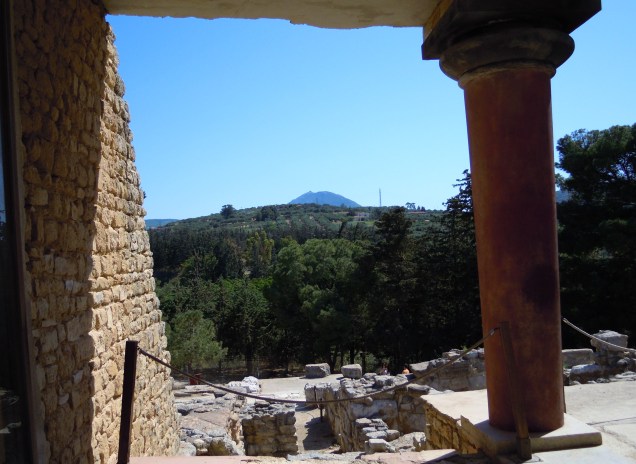
Looking Toward Mount Youktas from the Cretan Ruins of Knossos

The opening scene of one book in my series starts here in this ancient pre-Greek setting, where protagonist Helaina looks out from the temple of Knossos to the sacred mountain of Youktas on the horizon. It’s a critical morning when she will have to leap a fierce bull in a perilous ritual for her people.

It’s a story of poignant desire and guilt, swordplay and valor on land and sea, passionate trysts that must never be told, and a love that won’t let go.

I have declared it finished I don’t know how many times. Every time it has come back wanting. And every time I have dug deeper to make it work. I’ve written five more in the series–taking us from Crete to Ireland and points in between. Those five stand waiting, virtually complete. I think this one is the most difficult because it’s the oldest, but it’s essential to the saga.

In late October my agent called me and we had a brainstorming session over the phone. Out of that, I opened my mind to dramatic changes. Once you start pulling at the threads of a tapestry, huge sections may unravel, leaving the possibility of weaving in new images you never thought would emerge. I threw out whole chapters and wrote new. I brought in new characters, took new pathways.

Creative juices flowed as they hadn’t since the muse whispered most of another to me.

Now I love it more than I ever have, and I’m declaring it ready one more time. Can Helaina leap that bull and carry this story on?

Bull Leap Fresco at Knossos Ruins in Crete

COMMENT

The Trilogy ~ Or First Three

So, here it is–a trilogy–wrapped up with a bow on it. Or first three in the series.

These epic historical novels of adventure and romance bring to life the exotic world of the ancient Greek Isle of Crete, and I’ve been working on the series for many years. They just got a comprehensive update and a new bit of polish.

I thought these books were finished in 2015 when I completed Book Three, Talia’s story, which started out with some special help from my muse, as described in a 2015 blog post. (Note: If you come across one of my posts that Talia’s story was labeled as “fourth in the series,” please note there’s been some juggling and additional stories, so I plan to present Talia’s as the third now. The one that was third will be Book Four. And I don’t know that I’ll separate the first three as a trilogy.)

Anyway, after thinking these three were done, my agent sent me back for changes in Book One, Helaina’s story, the foundational book in the entire project. I talked about that in my last blog post, The Rewrite.

The beauty of writing a series is that you set up your scenario–which in an ancient historical novel means creating a world–and you carry that into the next books. That world becomes familiar and real. I know these characters who walked the earth more than 3,000 years ago. I know the places they walked. I know their children, who grow up and carry their society forward, meeting the challenges of their day. The stories are fictional but the people and places are as true to life as I can make them, based on the archeology and other clues left behind.

The down side of writing a series is that you have to maintain consistency. This can be difficult enough in a large novel. Were her eyes green or blue? Did the ships have oars or just sails? Was the bridge north of town? Or south? What was his father’s name? When you have multiple stories, that consistency has to be maintained through a lot of pages.

Ah! Thank goodness for the search feature. And character notes.

I was particularly aware of this need for consistency when I did dramatic, substantive changes to Book One in the big rewrite. Some of those changes trickled down into the other books. So each of these had to be rewritten, if not perhaps as thoroughly. And they had to be read carefully because sometimes the effect of changes can be subtle.

This latest rewriting project has kept me busy for long days since the big rewrite of Book One, which got underway shortly after Christmas. Kudos to my beta reader Carisa Cegavske for her insightful feedback on all three.

Now it’s a pleasure to see them done–hopefully done, unless my agent recommends more changes. I am so glad she nudged me to the rewriting, because they all feel so much stronger. It’s all part of the process. Write. Rewrite. Feedback. Rewrite again. More feedback. And one more time. And again…

COMMENT

Panel at 2017 Historical Novel Society Conference Portland, Oregon

Four authors of historical fiction with Pacific Northwest settings got together to offer a panel at the 2017 Historical Novel Society Conference held this year in Portland, Oregon. From left to right: me, Kirby Larson, Libbie Hawker, and Janet Oakley. We called it “Historical Fiction through a Pacific Northwest Lens,” which seemed appropriate since the UK-based Historical Novel Society was coming to Portland. They meet in the UK every other year with North American sites in the opposite years.

The idea for our panel started with Janet Oakley and her writer friend in Washington State Carole Dagg. I had met Janet at a couple of PNWA conferences in Seattle, and she invited me to be part of a panel. The three of us put together a proposal which was accepted. We cheered our good fortune. Then Carole learned she’d be unable to attend so Janet found not one replacement but two. And Kirby Larson and Libbie Hawker joined us Janets.

For our session we had a lively discussion about what led us to write about this region and some of the challenges, like writing realistic history without offending 21st-century readers. We also discussed the pleasures of researching and the thrill of discovering actual documents from the times of our stories, about finding the untold stories, about the people who populated this land before the Europeans, and about other facets of history on America’s far northwestern frontier.

As we said in our proposal, “The region holds a unique position as the continent’s last frontier. When nearly every coastline in the world had been mapped, America’s northwest remained a mystery to explorers, a blank wilderness. That untamed edge resonates in the land’s character.”

Libbie served as moderator, and she kept us on our toes with some unexpected questions among the ones planned. We had a good Q & A afterward with an enthusiastic audience. A fun time.

Thanks to Stephanie West Allen for taking the picture.

COMMENT