Just back from a great writers conference in Seattle put on by the Pacific Northwest Writers Association (PNWA). Here I am on the last day with Pam Binder, PNWA President and program director of this annual event. Every year she puts together another fabulous conference with her excellent team.
Pam Binder, PNWA President, conference program director, on the left, me on the right.
When I went downstairs looking for an I-was-there photo to add to my comments on the 2025 conference I was hoping I might find Pam to get her picture, and there she was at the registration desk, happy to oblige. I also wanted to thank her one more time for coming to my rescue in the pitch session.
These conferences offer a chance for authors to meet agents and editors face to face and pitch their projects to them. It’s always upbeat at these PNWA conferences, everybody encouraging each other to do their best. I think that atmosphere starts at the top. An award-winning New York Times bestselling author, Pam knows the business, and she’s always ready to help an author reach the next level.
Bohonagh Stone Circle, West Cork, Ireland
I pitched my newest novel set in ancient Ireland featuring the People of the Stones, those mysterious stone circles and other megaliths scattered across Ireland and Britain’s west coast and on down the Atlantic seaboard.
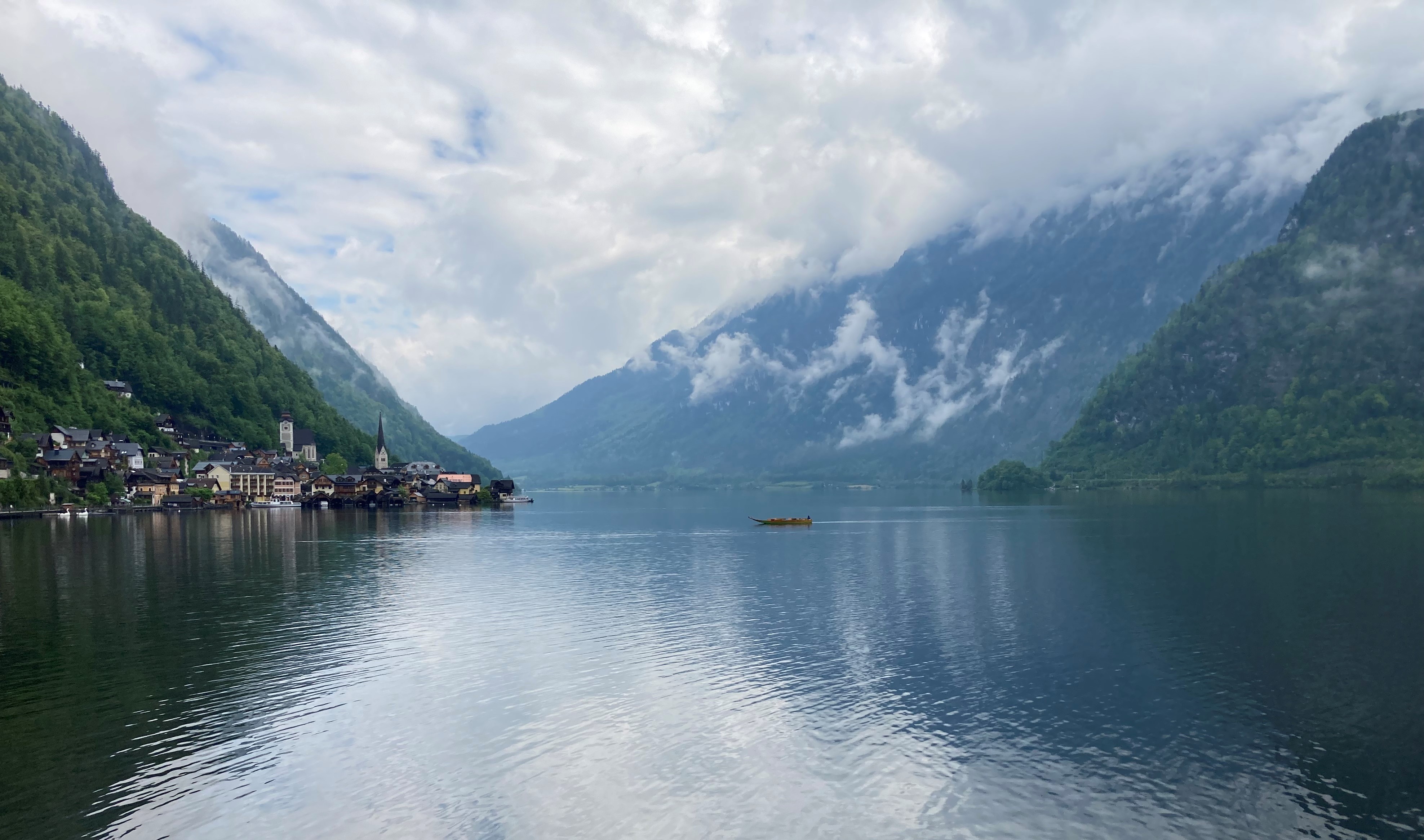
In my story it’s 750 B.C. and the Celts wouldn’t have been in Ireland yet, but we know where they were–in Hallstatt, Austria, so my protagonist has to go there.
The goal for the author pitching an agent or editor is to get a request for material, a few chapters maybe, or 50 pages, or, best of all, the full manuscript. I’m happy to say I got a positive response from every pitch. But it wasn’t entirely simple.
Imagine the setup. All of the authors who’ve signed up for a particular block of time are led into a room where the agents and editors are sitting behind a very long table. The authors get in line for a person they want to pitch to, and each gets four minutes to describe their project and convince that person to ask for part or all of it. At the end of your four minutes a bell rings and you have to skedaddle because you don’t want to crimp the time for the person in line behind you.
So I was pitching one person and we were having an extended conversation when the bell rang. She handed me her business card and said I could stay a bit to finish the conversation because no one was behind me. But then someone did come up behind and I hurried to leave. I went out into the hall and realized I had no idea what the person I just pitched wanted from me. Maybe she told me but in the confusion I didn’t hear it. Did she want to see any of my work? I didn’t know. So in somewhat of a daze I wandered down the hall to the registration desk, where a man asked if he could help me. I saw Pam Binder looking through some papers and said, “I think I need Pam.”
I told her what had happened. She thought about it a minute, then said, “You need to go back in and get in her line again and ask her.”
Pam didn’t send me. She led me. And with her as my escort I did exactly as she said. The person greeted me and answered with enthusiasm, “I want to see the full manuscript. I want to read this.”
Yay! Now, I’m not giving away names. That’s for later, if it works out in the long run. But pitching is a challenge. Encapsulating your book into a few words that pique a desire to read it. And these positive moments are bits of gold. Thank you, Pam.
With hugs to send me off, Pam took this goodbye picture of me in my signature hat.
Happy. Optimistic. Glad for a few more bits of gold.
It’s older than Stonehenge. Older than the pyramids of Egypt. Newgrange. More than 5,000 years ago Neolithic people with only stone tools built this mound with such precision that the rising sun on the morning of the winter solstice would stream down a long, narrow passage to the vaulted chamber of the interior and fill it with light. There beneath a meticulously corbelled roof the bones and ashes of their dead waited.
Two doors enter the passage. The one above receives the sunlight. The one below, partially hidden behind the carved kerbstone, receives the people. I was here with a tour group. I would soon go in.
No one knows what those carved symbols mean, and the guide told us the triple spirals have never been seen anywhere else. We offered our thoughts. I suggested life, death, and rebirth. The people in my stories of ancient Ireland would believe this.
The photo of the upper door was taken for me by a nice, very tall man in my group. I took the lower one. That’s as far in as we were allowed to take pictures. The way is narrow. Sometimes you have to scrunch your elbows in. Sometimes you have to duck under low stone before you enter the inner chamber once visited by the ancients.
I was like a child before Christmas. I barely slept the night before my tour to this amazing site. The tour would also take me to another passage tomb in the same area, Knowth, and to the Hill of Tara. A worrisome drizzle followed our bus as we rolled out of Dublin, first stay on my overseas trip this spring. When I planned the trip I knew I would not rent a car this time, so I chose bases from which I could take tours or just excursions on my own by local bus or train.
I gave myself a day for jet lag and to explore Dublin enough to find my way to the place the tour bus would pick us up the following morning. This was my first tour of the trip. And one of the more important. When I read online about the Newgrange Tours by Mary Gibbons, I knew I wanted to take her tour. It was the right one. No question. But who knew on the 22nd of December when I reserved it what the weather would be on the 19th of April. I just had to hope.
The drizzle let up when we reached the Hill of Tara, the first stop on our tour. But it was blustery out. I had to forego the hat and pull up my hood. I was glad for every layer I wore. I had chosen Tara as an important site in my new book, this place of myths and legends and making of kings. I’d visited Tara once before, some years ago, but I hadn’t retained a good sense of it. Pictures don’t do it justice. They don’t quite show how high it rests over the surrounding plains. I did remember the mound. It’s a passage tomb also, not as large or elaborate as Newgrange, but from the same era. The name “Tara” is apparently later than my story’s time but I use it, as I sometimes do when a place would be difficult to identify for readers without the familiar. I call it Tara Mound for the tomb there, not the Hill of Tara.
Our group trekked across the rich green grass, and over the henges, the circular ditches and rims on the ground where ancient deeds occurred. It was evidently a gathering place for many years, and I used it so in my story. I imagined my character trekking across it with me and heard our excellent guide, Mia Craig, mention to someone that scholars believe Newgrange was only in use for 600 years. That concerned me. I had my people using it much later. When our group began to meet up at the gift shop before moving on to our next stop I saw her standing alone and walked over to ask her about that. She reassured me. “They don’t really know,” she said, “and there’s an old Irish saying, ‘You don’t want to let facts get in the way of a good story.'”
We laughed together. I told her I tried to get things as right as I could, which was why I was back in Ireland. She didn’t think I should worry about using the site for my characters. Of course scholars can interpret the presence of objects. Not so easy to interpret the absence. That’s where I can fill in the gaps with my world-building.
The drizzle came back, windshield wipers on the bus working hard as our tour headed toward Knowth, another intriguing site along the River Boyne, this one with multiple passage tombs like chicks around a mother. But they can tell from its shape that the large mound in the center came after the others because its irregular shape accommodates them.
By the time we got to Knowth, again the rain stopped and we gathered around the local guide, a good-looking man with silver hair and bright blue eyes. He started by asking if anybody had been there before. I raised my hand and said I had been to Newgrange. Twice. He asked when, and I told him. With a twinkle in those blue eyes he suggested I could probably give this talk as well as he. I said only if I could follow an old Irish saying our tour guide just told me about, that you don’t want to let facts get in the way of a good story.
He chuckled and said, “Well, we try to keep to the facts here.”
One of his comments startled me when he told about recent DNA studies which showed that the early Neolithic people who built these tombs came out of Anatolia, people with tawny skin and dark-brown eyes, whereas those who followed came from the steppes of Russia with their pale skin and blue eyes, like his. From my own studies I understood that the early Anatolians were likely worshipers of a Mother Goddess and may have been matriarchal, while those from the northern steppes worshiped sky gods and were patriarchal. My ancient series draws together the worlds of Minoan Crete and Ireland, so when he mentioned Anatolia I recalled reading that DNA evidence shows that the Minoans also came out of Anatolia.
Whoa! Were these people kin? Would their oral histories reflect similarities? It was mythologist Joseph Campbell who inspired me to bring the two islands together when he wrote of a second hearth west of Crete where at the same time as the Minoans the early Irish showed through their myths a similar culture with strong women and the worship of a Mother Goddess. Now the DNA evidence in Ireland appeared to confirm that connection. A thrilling discovery for me.
Next stop on the tour was the Newgrange visitor center. We were getting close to the main show. Drizzle picked up again. The visitor center was wonderful, more elaborate than my last visit. I don’t think there was a center the first time. We just drove up to the site. Now they would take us from the center on special buses on a predetermined schedule. We wore pink bands on our wrists to indicate our time slot. The schedule gave us time for lunch in their pleasant lunch room and to visit the displays. I didn’t want a big meal so I opted for a scrumptious raspberry scone with raspberry jam. They even heated it for me. Wonderfully decadent.
After lunch I especially enjoyed a walk-through at the visitor center where shadowy deer and birds moved among silhouettes of forests. Nice illusion. Among the trees several screens showed films of the three significant passage tombs along the River Boyne–Newgrange, Knowth, and a third that isn’t open to the public, Dowth. The High Tombs of my ancient Irish stories. A drawing portrayed a dog, its appearance based on bones found there. He looked just like the dog in my new story that I imagine resembling an Irish Wolfhound, though the breed is much newer. There he was! My dog Tormey!
We crossed the River Boyne on our walk to the Newgrange buses that would carry us to the site, a skiff of mist in our faces, heavy skies overhead. I had scoured Google maps and online photos, trying to see how big a river this was. Could a person ford it on foot? Or would they need boats or rafts? On that bridge I got my answer. I would keep my character on a boat.
When our bus pulled in to Newgrange the clouds parted like an opening curtain and a bright sun came through. I climbed out of the bus, looked up and saw it, white quartz face aglitter. The marvel that is Newgrange.
This is the place where my Clan of the Grey Wolf lives, their clan mother a dear friend who’s like a second mother to my protagonist Levaen.
The local guide split our group to take half at a time in the passage into the interior of the mound, while the other half were free to wander the site. Just what I had hoped. I wanted to wander around and get the lay of the land. What about my description from a ridge above? Well! There isn’t a ridge above. The mound lies on the ridge itself and the encircling pillar stones are much lower in the back, the kerbstones at the mound’s edge following the downward slope until they are completely covered with turf. The river is visible, but distant. Revisions I’ll need to make.
The mound had long since collapsed when excavations in the 1960s and 70s brought it back to its original state as nearly as could be determined through meticulous study of what they discovered. From my reading it appears that the passage and vault with its corbelled roof were basically intact, although some of the uprights in the passage were leaning and had to be straightened. It’s a bit more complicated, but that seems to be the gist of it. Scholars still argue over the white quartz facing, but they found a pile of the quartz in front that must have been used somehow, and quartz facings from the period have been found on other sites. It certainly offers a dramatic impression.
Finally it was my turn to go in. My heart raced when I stepped inside the narrow passage, scrunched my shoulders, dipped my head. I’m a little claustrophobic, and we were warned about that. But I knew I could do it. I had done it before. Somehow memory slips away and the moment becomes new. I drew a full deep breath when I got through the passage and entered the spacious vault. I looked up at the intricate layers of perfect corbelled stones, each course of slabs partly resting on the one below, up to the capstone high above me. The interior is shaped like a cross with the elongated passage as the shaft, three extensions inside, one to the left, one to the right, one straight ahead, where stone basins held the bones or ashes.
For the tour they turned out the lights and shone a single light down the passageway to represent the rising sun on winter solstice that would fill the chamber with light. In my story that light embraces the spirits in the bones or ashes and carries them out the passage to lift them to the stars where they will await rebirth. Now I felt the wonder of it.
When the tour was over I exclaimed to Mia, our tour guide, “That was the best!”
Every place seems to have a certain personality, a character you can only know in its presence, so when I write a story and spend any amount of time in a particular place I want to reflect the sense of it. That’s why I want to go there, to know it, and thus better knowing it, let my reader know and feel what I felt there.
As my followers may remember I recently completed a historical novel set in ancient Ireland and surrounding lands. I had already visited many of these places when researching the series that’s related to this story, but happenings differ and characters may look at their world from different perspectives. Can she, for instance, see the river from there?
This is Newgrange, the ancient passage tomb built some 5,000 years ago by Neolithic people who walked there long before my characters. It’s older than Stonehenge, older than the pyramids of Egypt. My story opens in 750 BC. And yes, she can see the river from this spot outside the tomb. She won’t try to ford it, though. It’s much too deep and swift. I’ve seen that now. She’ll take a boat across, as I’d written it.
I have visited Newgrange twice before, in 1993 and in 2004, but not only was I working on different stories then, I did not have a digital camera that would allow me to share such a photo here on my website or on other social media. I carried my small Nikon digital camera I took on my 2018 trip and a newer iPhone than I had then. And I sought out better pictures as well as research photos to help me hone my descriptions.
Late last year I began contemplating this trip. I decided I would limit it to Ireland, home of my protagonist, and Hallstatt, Austria, homeland of the proto-Celts, where she spends a considerable amount of time. For quick stops I can take trips by Google Map, but for long stays I want to soak a place in. I had visited the charming village of Hallstatt once before in 2006 when I traveled there with my Austrian friend Tilly. But I was researching a different book then, one that fell by the wayside. Now I wanted to see Hallstatt with the new book in mind.
I had forgotten how steep the mountains, how stark the limestone cliffs, how sparkling the lake. Yes, the quaint houses will ever climb that bluff, the iconic church steeple pierce the sky. But as I wandered the single street, climbed the many steps, found the waterfall I knew was there and included in my story, I enjoyed a sense of it I did not have before.
I didn’t rent a car so in Ireland I picked bases from where I could take tours or just go on my own by bus or train. I started with eight nights in Dublin. Then to Limerick for five nights. And a five-night return to the heart of my story, Rosscarbery, staying at the Rosalithir B&B with my wonderful hosts Catherine and Finbarr O’Sullivan. My third visit with them. The last visit in 2018 had been much too short and left me with critical questions on the setting. The new visit would answer questions I didn’t even know I had. A vital visit for understanding the lay of the land. And the water. The beach.
This was the rugged eastern headland I needed for one of my stories. Golden Eagle Bay in the world of my characters was broader than I thought on my brief stop in 2018. It took me several walks, especially over the newly improved Cliff Walk on the western headland to figure it out. From there I looked back and the setting became quite clear, the revisions I would have to make.
It was moments like this that I confirmed my need for this trip. Yes, it was time to travel again. Yes, I wanted to revisit these special places, but with that discovery and more I found answers to questions I hadn’t thought to ask.
In the next several blog posts I’ll share the journey–from Dublin to Salzburg, Austria, where I stayed a couple of nights on either side of my Hallstatt excursion because of its access to an airport. A lovely spot itself where I stayed in an amazing 17th century seminary converted into a hotel. The adjoining church even had a domed roof.
I’ll add the posts to the new “Going There” list on the sidebar as I publish each one.
With new books on the way, the time had come for a website update. And since I was visiting my webmaster, my daughter Christiane, that worked out well. First, we had to change the release date for The Shifting Winds from April to March, since it’s coming out a month earlier than planned. And we had to show it’s availability for pre-orders. With that done, we added an Excerpt so you can read a few paragraphs of the story. Then there were new books to talk about. Today we added a description.
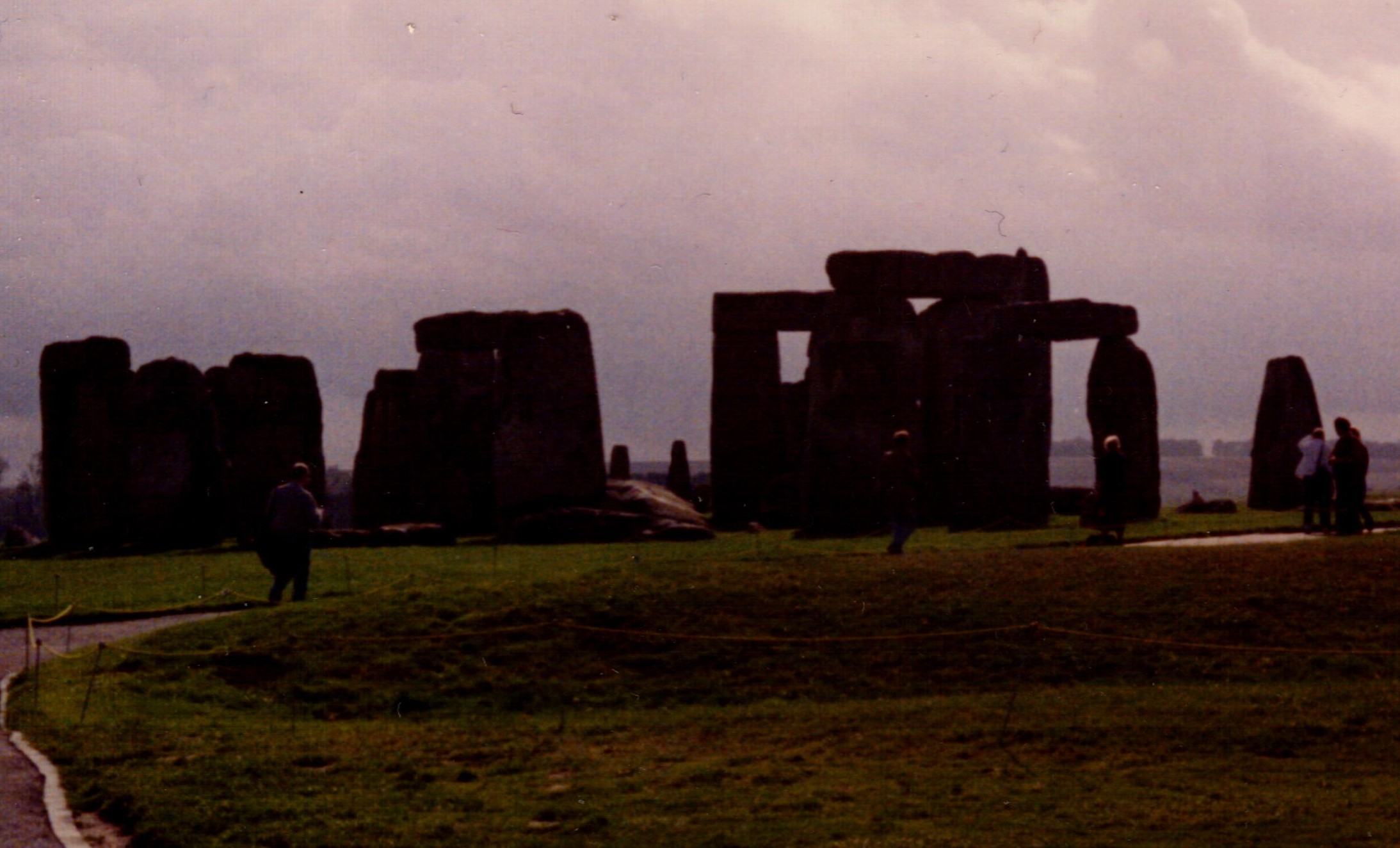
The above photo I took some years ago shows Britain’s famous Stonehenge, which figures in the newest writing project, Book Five of the Golden Isles Series. The book is called Webs of Stone. You’ll find a description on the newly revised Books page. Up until now I’ve shown only five books for the series because I wasn’t sure if I had ideas enough for a book for this 16-year period in Ireland between the end of Book One and the beginning of the final book. That gap parallels events in the Mediterranean at that time, events shown in Book Four, but what was going on in Ireland then? [Note: The Books page has been updated yet again since the writing of this blog post, so the series in late 2022 has eleven titles.]
My muse was slow to visit, but when I took a Thanksgiving trip to Kansas City to visit Christiane and my granddaughter Calliope, inspiration struck. My muse talked to me. It happens in odd ways sometimes. I was searching for a hideout for my outlaw character somewhere north of Stonehenge (which I call the Great Stone Circle of Wessex in the book). And I wanted mountains. Where would I find mountains in England? Would I have to go as far as the Scottish Highlands? That’s a long way from Wessex when you’re walking or riding a pony. And I’d been in the Scottish Highlands. When you’re used to the Cascades and Rockies they seem like rolling hills. Maybe Wales? I’d seen some real mountains there. I clicked the “terrain” figure on Google maps and found the Lakes District in northern England. Then with a click on “street view” I found myself in rugged, craggy, stone-strewn mountains with steep dropoffs down to lovely lakes. Perfect! I could see myself there, my characters. And the story took off in my mind.
The photo above shows another stone circle in near silhouette. This is the circle I chose for the home circle of the Golden Eagle Clan, the central clan for both Book One and Book Five. It’s the Bohonagh Circle near Rosscarbery in Ireland. For me it’s the Golden Eagle Circle. I was lucky enough to spend several days traipsing around these pillars and the vicinity back in 2004 when I traveled to Ireland with my good friend Tilly Engholm. She was my next-door neighbor in Portland then, an avid traveler, and we had a great time on this trip–although as I wandered from circle to circle, she began to weary of stones. Once she sighed and asked, “We’re going to go see more rocks, aren’t we, Janet?” And I had to admit we were. I do love the stone circles and the power I feel in them. Fortunately, Tilly was agreeable.
I wrote Book One, Whisper of Wings, that year. Since then, I’ve spent most of my time focused on Crete, where Books Two through Four are centered. It’s lovely to be experiencing Ireland again–and England, with a few scenes on the coast of Brittany and in what is now Portugal.
I’m excited that a new story is taking off and look forward to immersing myself in it. If you don’t hear from me as often in the next few weeks, that’s where I’ll be–Ireland and the High Lakes and the plains of Wessex and those other places–from roughly 1406 B.C. to 1390 B.C., exploring the mysterious circles and other rocks scattered over the British Isles and Western Europe like interlaced webs of stone.