Stonehenge on My Mind

I’ve been thinking quite a lot about the People of the Stones who walk through my stories of ancient Ireland and its neighboring lands. I’m working on a new novel, a sequel to the one I hope to have published next. Always a time for the stirring of the mind.

This past weekend was the annual Fort Umpqua Days celebration in nearby Elkton, Oregon, so I was there with my booth selling my pioneer stories. I had a notebook on display with photos of pioneers as well as ancient settings and my new business cards illustrating my work “From Pioneers to People of the Stones.”

A boy stopped by and saw a picture of the stone circle at the center of my ancient stories, the Bohonagh Stone Circle in Ireland.

“Stonehenge,” he said, then shook his head when he realized it didn’t look quite like Stonehenge.

I turned the page to show him I did have this picture of the circle he knew. We had quite a conversation, maybe a half hour or so.

He had some imaginative ideas about how the ancient people stood those big stones up there. He knew quite a bit about the site.

He’s ten. I told him he should think about being a writer someday. He smiled. “I write comic strips already.” A budding author. And a delight.

So that night when I was looking for an hour’s entertainment before going to bed I searched my recordings on the DVR and saw OPB’s NOVA presentation on Stonehenge. I’d seen it, but I watched again with keen interest. They showed how the first stones of Stonehenge were the smaller bluestones, not the giant Sarsens. A single ring. Dated at about 3000 B.C. Then the giants went up in 2500 B.C., with their lintels on the top, and the bluestones were moved into the interior. I wanted to argue against those bluestones coming all the way from Wales, some 150 miles away, but the guide I talked to at the site convinced me. Archaeologists had found quarries in the Preseli Hills of Wales with the same kind of stone, and there were no such stones around Stonehenge. They had to have come from Wales.

The smaller bluestones show clearly in this photo, lined up inside the taller sarsens.

Then last night I again wanted an hour’s entertainment. And what should I find but another, newer show about Stonehenge. This one showed the same archaeologist who finally found the exact quarry in Wales these bluestones came out of. Problem was, dating on the site indicated that the quarrying for the bluestones happened in 3300 B.C. The stones went up on the Salisbury plain in 3000 B.C. There was a 300-year gap. Where were these stones during those 300 years?

It wasn’t an easy question to answer, but the archaeologist came to believe the stones had been used for a circle near the quarry, then removed to the location on the Salisbury plain where Stonehenge stands today. Many megaliths stand yet today in the vicinity of the quarry. But how to find where this circle of bluestones stood in that interim? This was a needle-in-a-haystack effort for sure. How do you find something that isn’t there anymore? They had to look for the holes left behind, long since covered over by new soil. With many disappointing tries and the use of overhead imagery they finally found where the stones once stood. They could even see the odd shape of one impression that matched a bluestone now at Stonehenge.

For confirmation they used a dating method I’d never heard of where they dig down to see when the sediment last saw the sun, keeping carefully under cover to avoid any current light. The test showed a date of 3300 B.C. as the construction date on the abandoned site. So the stones went directly from the quarry to this site in Wales and 300 years later were moved to the current site.

Why would they move them? And how? Each stone weighs more than a ton. To show how it was possible they built sledges and had 30 children, 13 years old, try to pull the loaded sledge with ropes. The children managed with apparent ease, drawing the heavy stone uphill. Surely ancient adults could do it. As for the why, we can’t really know. There was no sign of battle to suggest they were escaping attack.

Stonehenge looking southward.

One thought was that the site on the Salisbury plain at that time lay on a swath of glacial channels that aligned with the sun on winter solstice. To these ancient People of the Stones this may have appeared to be an auspicious site.

Moving into the minds of ancients who left no writing behind? Well, that’s the kind of thing we fiction writers do.

Calving Time at Martha’s Farm

Photo I took April 14 in 2018. I love the little white heart on the face of the nearest one.

April is usually the beginning month for calving here, although many farmers choose to calve earlier. The cows on our farm are gentle. They let you walk right through the herd, even when a cow is calving, although I keep an eye out for a nervous mama. They aren’t my cows. Ed and Mary Cooley rent pasture on the farm as they did when my dad was still here. But I get to enjoy the babies. I think these cows are gentle because Ed spends time with them, moving them from pasture to pasture, often daily. And in winter and early spring he adds hay to their pasture for feed.

An hours-old calf gets a lick from its mother on Friday, April 15, 2011. (Credit Image: © Robin Loznak)

The above picture by my son-in-law Robin appeared in my book A Place of Her Own, the story of my great-great-grandmother Martha Maupin who founded this farm in 1868, now a sesquicentennial farm. The picture illustrated a moment described in one of the Interludes in the book that told of my search for Martha’s story. My dad, Gene Fisher, farmed the place for 75 of those 150 years, more than any other owner in the family’s history. The fourth and last Interlude closes with the morning after he died.

The morning broke, bright and sunny. . . . We looked out the kitchen window to the apple tree across the nearby creek. A new black calf stood on wobbly legs beneath the tree, his mother gently licking his back. The first calf of the season had been born in the night. . . . I wished I could share with Martha the hope I found in this place and in the wonderful creatures who lived here with us. After the long dark night, there would be a bright new morning.

And new calves.

(The Globe Pequot Publishing Group, pp. 202-203)

The same little one as pictured at the top . . . with Mama watching. Or coming my way? Here’s looking at you.

Martha’s Farm Featured Again

A new story on the farm’s sesquicentennial status came out in the April edition of the Douglas Electric Company monthly magazine. April was the month my great-great-grandmother Martha Maupin purchased the family farm in 1868.

The story with photos: the book, me with the hills behind, me at five, and Martha’s house she had built for herself and her many children.

Craig Reed, local writer, visited the farm and talked with my daughter Carisa Cegavske and me before writing the cover story which got a nice spread, shown above. The farm would have qualified in 2018 but I didn’t put in the application until 2024.

Martha was the subject of my first published book, pictured in Craig’s story, A Place of Her Own: The Legacy of Oregon Pioneer Martha Poindexter Maupin, published by Globe Pequot Press. I didn’t have to write a book to qualify the farm for sesquicentennial status, but my research for the book certainly helped me put together the extensive information required for the application.

I grew up on this farm. The little girl curtseying in her overalls is me enjoying the freedom I experienced there. When my dad died in 2007 Carisa and her husband Robin Loznak decided to join me in keeping the farm. I had been away all my adult years so it was quite a change from city life I experienced in the interim. Their son Alex Loznak moved there with us, as well as my other daughter, Christiane Cegavske, and her child, Aspen Boutilier. Carisa, Robin and I still live there.

I love the farm’s hills for walking, and the quiet, where I find inspiration to write my books. My whole family loves the beauty of the land, the rich history, the wildlife. Christiane, Aspen and Alex visit as often as they can. That’s easier now for Christiane and Aspen, who lived in Kansas for ten years and now live in Portland, Oregon. Alex took a stint in New York City, then Eugene, Oregon, but he’s in Portland now too.

We all take pride that Martha was the founder of this farm, a woman who dared take on this treasure when it wasn’t all that easy for a woman to do.

Carisa in the purple and me in navy on the cover.

Hazelnut Time

Remember these little guys? Remember their story, how they were started on Martha and Garrett Maupin’s Donation Land Claim in Lane County to be planted here on Martha’s farm in Douglas County? The story is here. I was working on my great-great-grandmother Martha’s story, A Place of Her Own*, at the time and was sure surprised to find that link.

Well, look at us now (below). These trees are producing nuts that are headed to market.

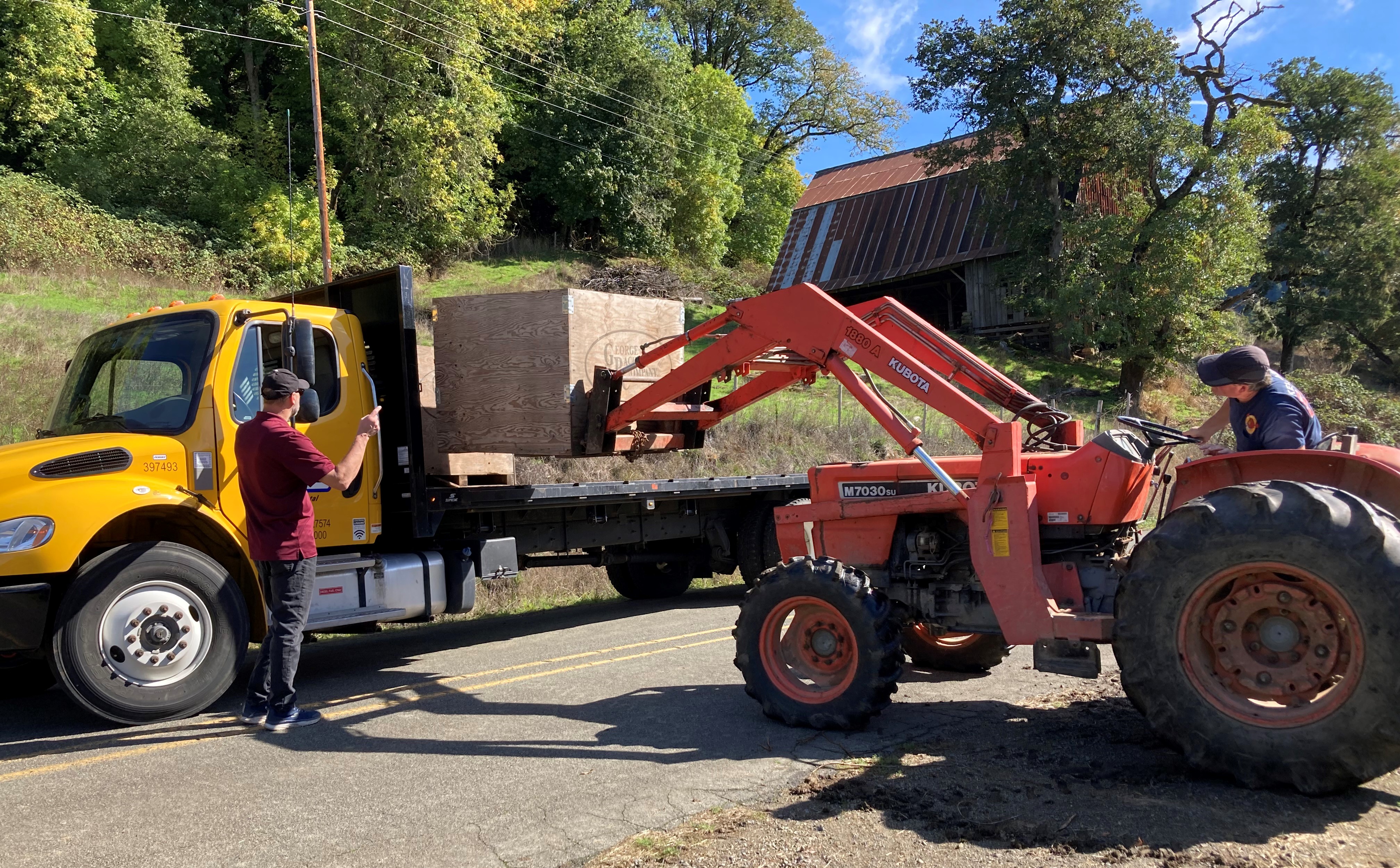
We have a nice coop in our area, the Northwest Hazelnut Company/George Packing Company, Inc. They bring us bins, we fill them, they take them away for processing.

Here my son-in-law Robin Loznak checks out our first bin as we wait for the truck to come pick up our bins. He and my daughter Carisa partner with me on this project. He does most of the work now–mowing and harvesting–although on this first seven acres I spent several summers watering those babies by hand with multiple hoses. I almost knew them by name. I did that until they got too big for me to reach over them and drag the hoses across to the next row. At that point Robin took over the watering with a big water tank drawn by the tractor. He put in the next orchard, 15 acres, and installed a water system for that. This first orchard has dug deep roots by now.

Robin carefully eyes the bin while Troy Mueller from the Northwest Hazelnut /George Packing Company guides him in. The farm’s old 1933 vintage barn can be seen in the background of this photo and the one above it.

A few tidbits for the curious: Oregon grows 99 percent of all the hazelnuts produced in America. Turkey and Italy are the only countries that grow more than we do. Turkey grows by far the most at about 70 percent worldwide. This may be one reason hazelnut farmers are so welcome in the state. Every Oregon hazelnut farmer adds to the state’s market share. Besides just being helpful, friendly people.

Oh, and for people who are wondering. A filbert is just a hazelnut by a different name.

*A Place of Her Own: The Legacy of Oregon Pioneer Martha Poindexter Maupin portrays the story of my remarkable great-great-grandmother who came west over the Oregon Trail. I grew up on this farm Martha bought more than 150 years ago. I’m now the second woman to own and operate this family treasure. I would never have done it without the help of my kids.

Fine Fort Umpqua Days Despite Weather Surprise

Fog and a little smoke from nearby fires cleared early on Saturday morning, the first day of the two-day annual Fort Umpqua Days event in Elkton, Oregon. Lovely weather. Sunny. Soft fluffy clouds. Gentle breezes. And the people came out. My, they did come out! I kept busy up in the vendor area on the hill above the reconstructed fort. So busy I didn’t even get down to the fort itself on the flat below.

In midafternoon I checked my phone for the air quality report, as I’d been doing daily since fires started in the area after a lightning storm several nights before. My phone indicated something to the effect that rain would start in thirty minutes or so. I stared at my phone, glanced up at the blue sky with the white, fluffy clouds.

“That’s ridiculous! It’s a perfect day.”

About twenty minutes or so later a cloud shadowed the ground. Lots of clouds. Gray ones. Enough to cover the sun.

I’m in my booth, with a canopy overhead, but I’m selling books. Rain and books don’t go together. And I had pictures, photographs, on display. Winds picked up. No overhead canopy would protect from blowing raindrops. My son-in-law checked his phone. It’s not just warning about rain. It’s warning about lightning.

All right. That convinced me.

The sprinkles came. About 3 o’clock we started packing up.

That said, even with a short day (vendors usually close at 4), it was an enjoyable time. So many people. So many stories shared. And a little weather excitement to boot. Didn’t see lightning but heard thunder by the time I got home.

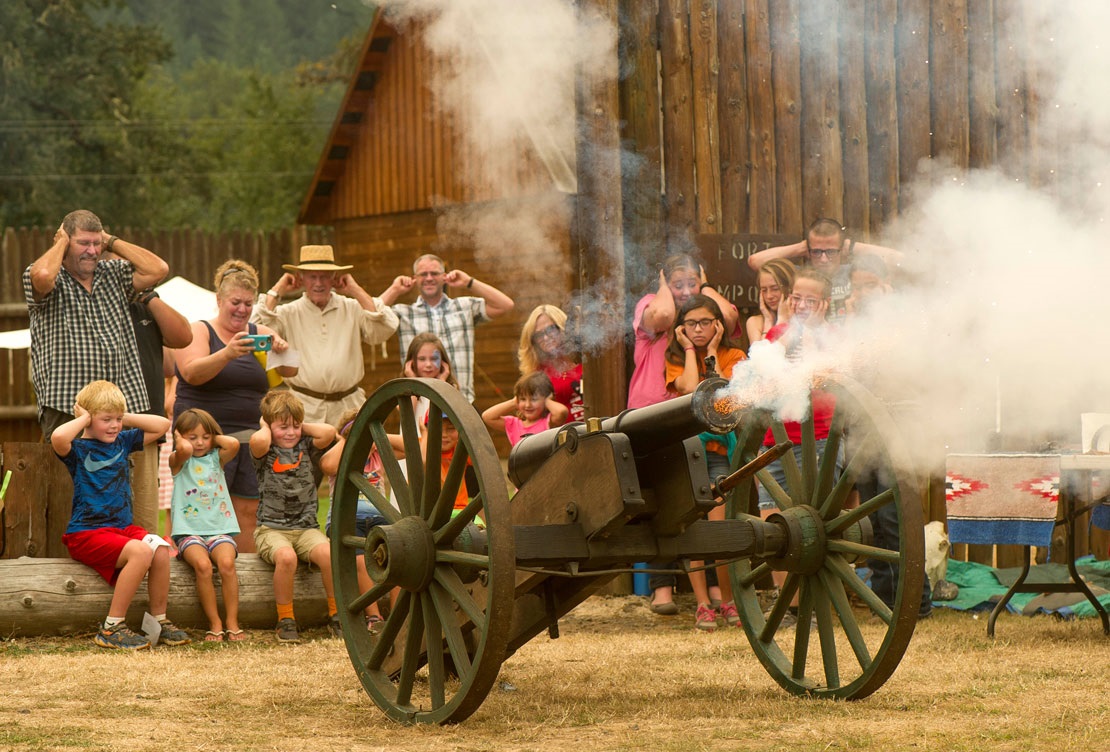
Sunday remained clear all day, but quieter–well, except for those booms down at the fort. All in all, a delightful weekend.

Robin Loznak’s photo again from a former Fort Umpqua Days event

Back to Fort Umpqua Days

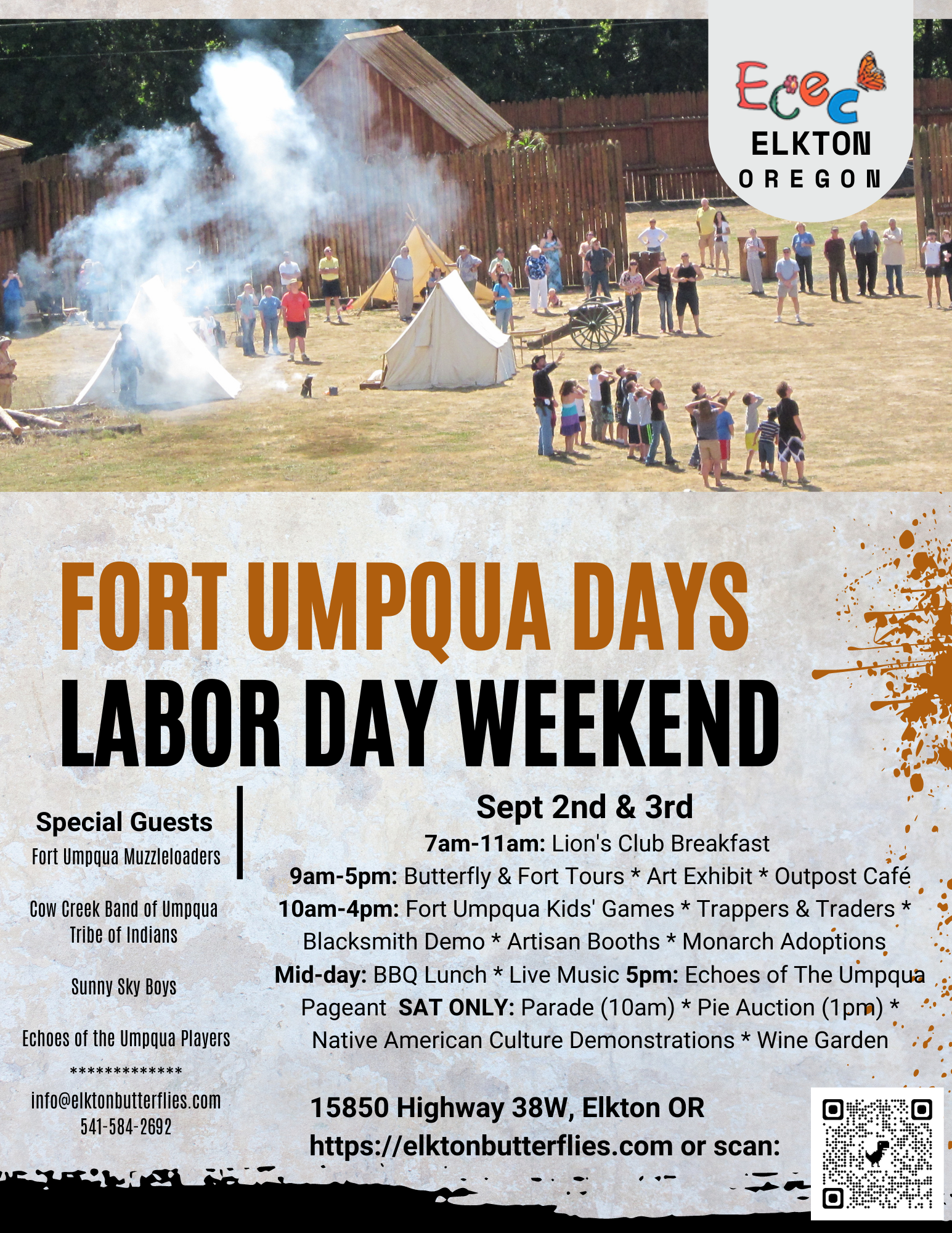
Here’s the poster shared by the Elkton Community Education Center (also known as the butterfly place), whose staff puts on this excellent annual event in Elkton, Oregon, the small town where I went to school in the somewhat distant past. Just a few miles up the road from my great-great-grandmother Martha’s farm.

I’ll be at the event as usual with a booth, selling my two books, A Place of Her Own, a creative nonfiction account of Martha’s story, coming west over the Oregon Trail in 1850 and eventually purchasing that farm on her own, and The Shifting Winds, a novel about a young woman whose father brings their family west to Oregon in the 1840s, much to her displeasure. Both women face huge challenges on this formidable frontier.

The Fort Umpqua Days gathering offers folks a glimpse of what life was like for these pioneers and the American mountain men and British fur traders who came before them. Today’s fort was built as a replica of the original with considerable research for accuracy. Volunteers will be on hand to answer questions, and there will be plenty of fun activities for the kids, closing off each evening with a pageant that adds a bit of historical accuracy with a strong touch of humor.

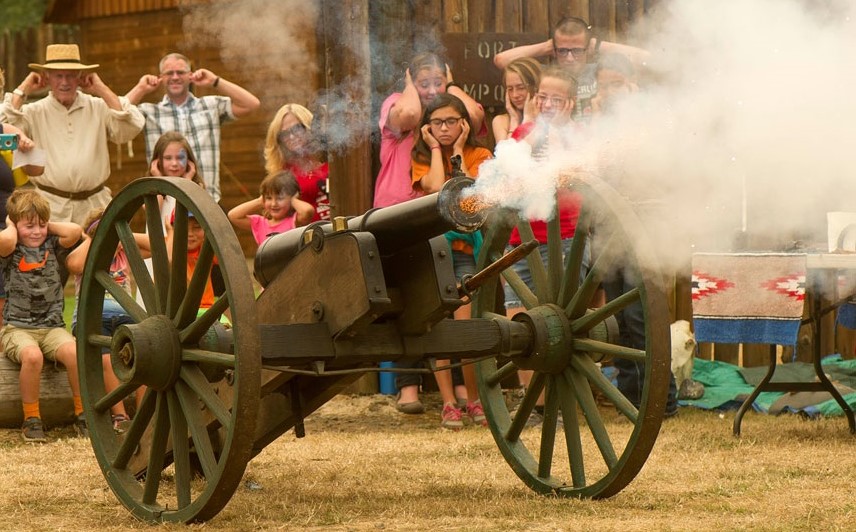
Cannon at Fort Umpqua. Photo by Robin Loznak.

Back to Authors & Artists Fair

The popular Authors & Artists Fair in Eugene, Oregon, is coming up soon, next Saturday, December 10, and I’ll be there again this year selling my Oregon Trail stories–A Place of Her Own and Nancy Pearl Book Award finalist The Shifting Winds. Both books follow my theme, weaving stories of strong women through history. A Place of Her Own portrays my own brave great-great-grandmother who took that formidable trail to a raw frontier. It’s a true story but reads like a novel. The Shifting Winds follows fictional characters into a lot of real history during a critical conflict between the US and Britain over who should win the rich land of Oregon.

I’ll be at the fair in the afternoon only, from 1:30 to 5 pm. It’s a great day for shopping! Check out the poster below for more details.

A Fine Fort Umpqua Welcome

Folks showed up with happy faces for the return of Fort Umpqua Days after two years off. One of my favorite things about presenting my books at these events is all the stories I hear. People are curious about my books, of course, which delve into the area’s fascinating history. But so many people have stories of their own that they’re eager to tell. I love hearing these. I came away from this two-day event, head full of so many individual histories. My thanks to all who shared a bit of their worlds.

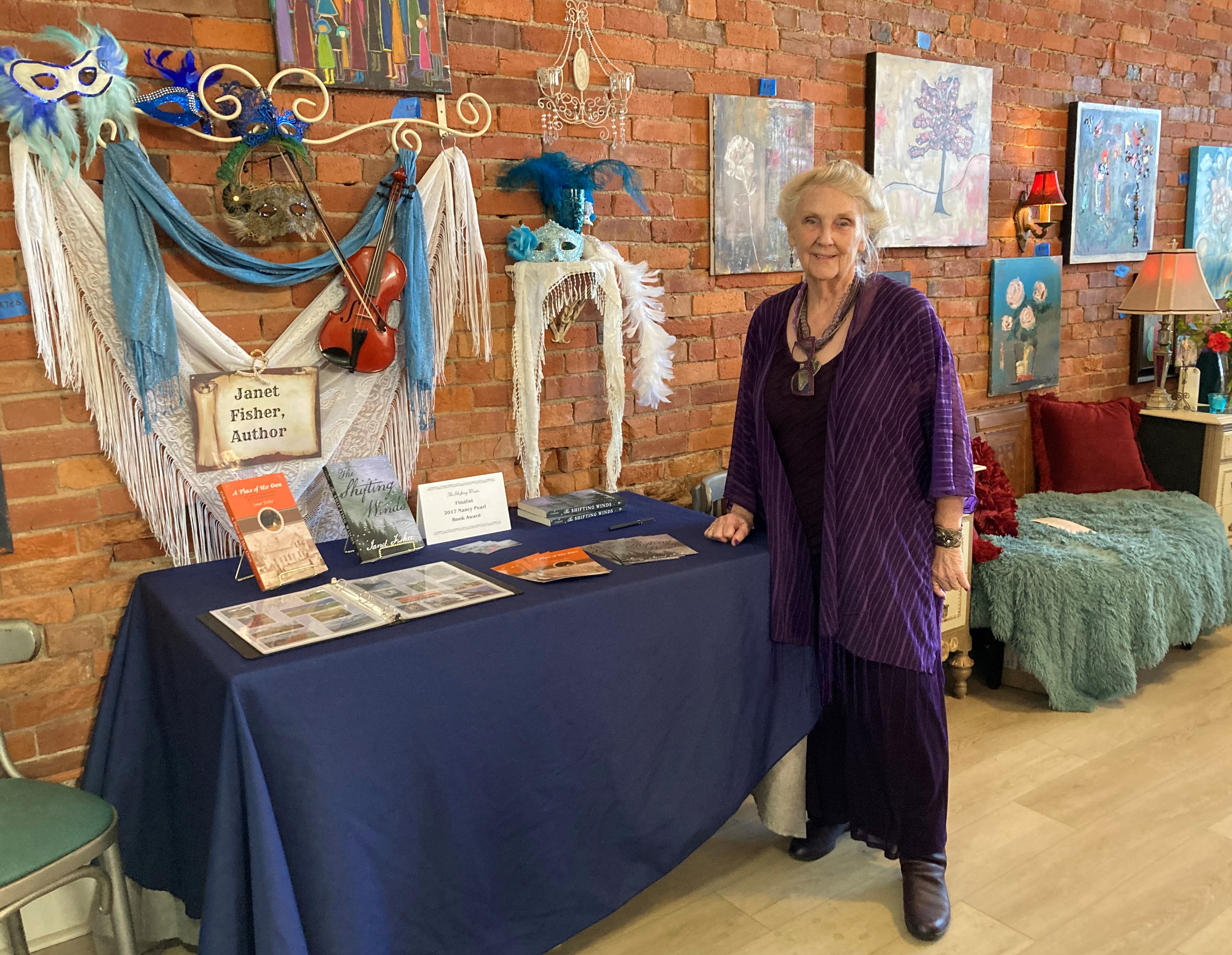
Here I am at my booth on this lovely afternoon. ~ Photo by Robin Loznak.

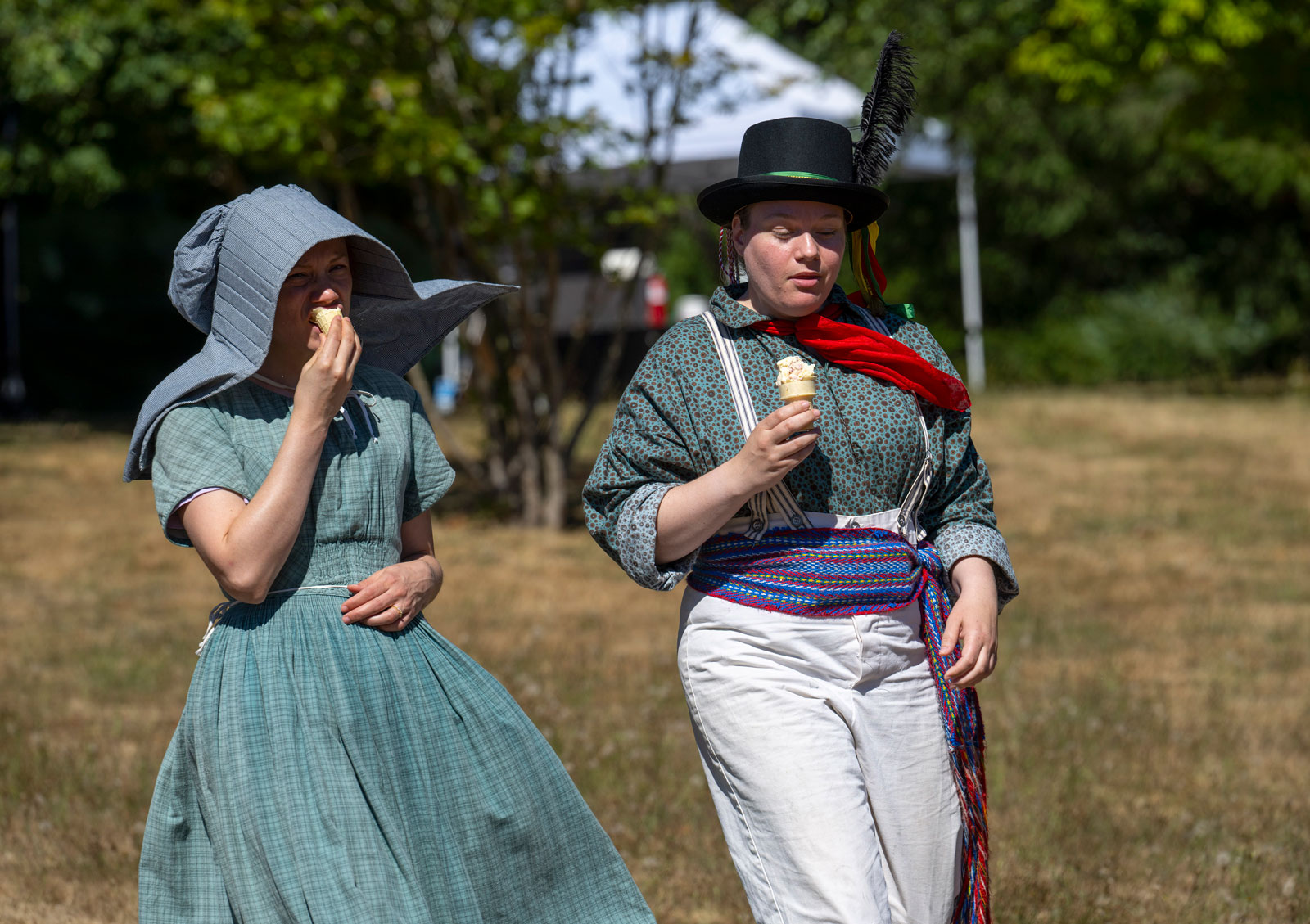
I also love the costumes many people wear for the occasion–the reenactors as well as the actors who perform in the nightly pageant, portraying stories of the era. I was happy to see reenactors Karen “Many Voices” Haas and her husband, Patrick, back again. I met Karen at the last Fort Umpqua Days in 2019 and featured her in a post back then. The two are shown in the previous post. We had a good visit yesterday. They stopped by my booth, looking quite fine, as if they had walked right out of the past.

Robin took a few more photos at the event (shown below). I’ll let his pictures speak for themselves.

And one more favorite Robin Loznak photo from a past Fort Umpqua Days moment:

BOOM!!!

Fort Umpqua Days are Back

Fort Umpqua front gate

Fort Umpqua Days will be back this year after two years off, and that seems worth a celebration.

It all begins on Saturday morning, September 3 at 10 o’clock at the Elkton Community Education Center, 15850 OR-38 W, Elkton, Oregon, west of town.

That’s by the popular Butterfly Pavilion. The fort lies just down the hill. It’s a two-day event from 10 to 4 on both Saturday and Sunday, plus evening performances of the annual “Echoes of The Umpqua Pageant.”

Monarch butterfly – Robin Loznak photo

This Labor Day celebration has become a tradition in small-town Elkton, Oregon, home of the reconstructed Fort Umpqua, the southernmost outpost of the British Hudson’s Bay Company in the 1800s. It will be good to return to that tradition.

Locals and visitors gather on the weekend to enjoy a parade through downtown, a pie auction, BBQ, live music, tours of the wonderful Butterfly Pavilion, and more. I’ll be among the vendors up near the pavilion, where I’ll be selling my books, stories about Oregon’s dramatic history of those days–A Place of Her Own and The Shifting Winds.

From “The First Mountain Man” by Andy Thomas – with permission of the artist

Kids will find plenty of fun, including a voyageur expedition, to see what these fur traders did in the heyday of this fort.

My second book, The Shifting Winds, delves into this era with fictional mountain man Jake Johnston as a good friend of historical mountain man Joe Meek. Both came west to Oregon in the early 1840s after the beaver played out in the Rockies. Once in Oregon they wanted to help their fellow Americans claim the rich Oregon Territory, which was then jointly occupied by the US and Britain.

Folks who reconstructed Fort Umpqua worked diligently to maintain an authentic representation of the original, and people will be on site during the Labor Day event to answer questions.

Reenactors and blacksmiths often attend, showing their work to add more color, and they’re happy to offer information as well.

You might even find a mountain man or two.

Inside Hudson’s Bay Company Store, Fort Umpqua

Remember Karen “Many Voices” Haas who was there for Fort Umpqua Days last time? I was so glad she showed me how she uses a drop spindle. It’s a device that was used for many centuries, millennia even. I have a character in my upcoming historical series spinning thread with a drop spindle some 3,500 years ago. After watching Karen I was better able to describe the process.

Karen using a drop spindle to spin thread, shown here at the fort with her husband Patrick, both in period dress.
Outside Hudson’s Bay Company store, Fort Umpqua
Back gate of Fort Umpqua from the hill above

Stepping Out Again

With hopes of better days as summer approaches, I’ve begun scheduling book events again. First up will be a book signing event hosted by Gail Hoelzle at The Bookmine on Main Street in historic downtown Cottage Grove, a friendly place full of books and flowers and other gift items. It’s the regular Cottage Grove Art Walk held from 6 to 8 pm on each last Friday of the month from April through November.

I’m delighted to be returning to The Bookmine with my books, A Place of Her Own, the story of my great-great-grandmother Martha Maupin who trekked across the Oregon Trail in 1850, and my other Oregon Trail story, The Shifting Winds, a Nancy Pearl Book Award finalist.

Weather permitting we’ll set up a table under cover at the front door of 702 E Main Street pictured above. Whether outdoors or in, the art walk is always a fun event.

A Place of Her Own describes Martha’s incredible journey. She walked the whole 2,000 miles in 1850 from Missouri to Oregon–while pregnant–and that wasn’t the toughest part. They settled first near Eugene City in Lane County, then a hotbed of North-South rivalry. Things got especially hot for my great-great-grandfather, a staunch southern sympathizer, and they fled south to Douglas County–just ahead of the law. He was killed in a wagon accident leaving her with a passel of kids and no means to support them. Determined not to give up she purchased a farm by herself, although her 13-year-old son had to negotiate for a loan because the lender wouldn’t negotiate with a woman. I now own that farm, still in the family for more than 150 years.

The Shifting Winds describes the challenges faced by American pioneer Jennie Haviland, whose family travels the Oregon Trail to Oregon in 1842 during a time when the United States and British both vie for that fertile land. Meanwhile a gentleman working for the British Hudson’s Bay Company vies for Jennie’s hand, while an American mountain man does all he can to disrupt the British guy’s plans. Their story follows the actual history of the American-British conflict leading to the historic meeting at Champoeg that could change everything. Which way will the winds blow?

Martha’s story is true with fictionalized scenes. Jennie’s story is fiction set in a lot of real history.