Event Tonight at the Museum

I’ll be in Roseburg tonight at 6:30 for a reading and signing of my new book The Shifting Winds. I’m looking forward to this event at the Douglas County Museum where this book was essentially born.

900.DCMuseumWhen I decided to write the first of several pioneer/fur trade stories some years ago, I went to see the late George Abdill, first director of this museum, looking for information on my subject. As I noted in an earlier post, he was exactly the right guy to talk to. This was a favorite era of his and his knowledge set my course on these books, including The Shifting Winds. He gave me volumes of information on his own, and directed me to many books and other sources of information. My researches led me not only to the Douglas County Library, but to the Multnomah County and Oregon Historical Society libraries in Portland, the Clackamas Historical Society and McLoughlin House in Oregon City, the backroads around Oregon City, up the river to Champoeg, and to the reconstructed Fort Vancouver in Vancouver, Washington.

George profile jpgPhoto courtesy of Douglas County Museum

I will offer a brief tribute to George tonight, and to his wife, Joyce, who plans to be there and say a few words. Joyce also helped me by connecting me with my first two agents, and those agents gave me a sense of hope that one day I would find the breakthrough I needed to get a publisher. I am thankful to Joyce for that and for her continued encouragement.

Also tonight, with the help of my son-in-law Robin Loznak, I’ll present a running slide show of photos related to the story–Oregon Trail shots taken when I traveled east to Kansas City with my daughter and granddaughter and backtracked that harrowing trail, a few shots at Fort Vancouver the characters visit in the story, as well as pictures of the main setting of Oregon City and a couple of the story’s real-life characters, Joe Meek and Dr. John McLoughlin.  Then, just for fun, we’ll show photos from a signing event I had near the beginning of the Oregon Trail in Lexington, Missouri, when a shirttail cousin, reenactor Robbie Maupin, rode in with a band of Rough Riders to visit the event. The man does know how to make an entrance. In that small town that looked like a place out of the past, these riders helped take us back to a time close to the days of The Shifting Winds.

After the tribute to George and Joyce’s remarks, I’ll do a short reading from The Shifting Winds, then sign some books. I will also have copies of my first book, A Place of Her Own. If you purchased one of these books elsewhere and would like them signed, feel free to bring them and I’ll happily sign them too.

The event will last from 6:30 to 8:30, and folks at the museum will be offering refreshments of cookies and coffee. My thanks to Karen Bratton, Research Librarian and Collections Manager, for setting all this up, and to Museum Director Gardner Chappell. The museum seems a perfect venue for this book, which got its start there.

The event is open to the public. Welcome.

COMMENT


COUNTDOWN – 1 DAY TO LAUNCH

The Elkton Connection

The launch of The Shifting Winds happens in Elkton because it’s my hometown—at least the closest town to the farm where I live. So on this last day of my countdown to launch with historic factoids, I want to bring the history home.

The story of The Shifting Winds does not come this far south, but there is a connection. Chief Factor Dr. John McLoughlin, who we know from the story, sent men to the Umpqua to find a place for a Hudson’s Bay Company post, and Fort Umpqua was built in 1836, a few years prior to our story timeline. The fort became the southernmost outpost of the HBC, and a fine replica, shown below, was built a few years ago a short way downriver from the original site. That replica is on the ECEC grounds, just down the hill from the library where my book launch will take place tomorrow afternoon.

DSCN0429

In more recent years Elkton has been designated an American Viticultural Area, and wine and book signings often go together. So we’ll be serving wine at the launch, compliments of Jim Wood, formerly of Napa Valley and now an Elkton resident. Jim will provide selections from the local Brandborg Winery and Hundredth Valley Winery, as well as from a Napa Valley winery that used grapes from his own Wood family vineyards in Napa Valley. The local Wood family is actively working with vineyards now in the Elkton area. Members of Jim’s immediate family will be on hand along with Jim to help out at the book launch, his son Nathan, Nathan’s friend Casey Zarnes, and Jim’s daughter-in-law Sarah Wood, wife of son Chad. My sincerest thanks for their generosity.

History doesn’t tell us if grapes were grown at the Fort Umpqua outpost, but the first grapes in Oregon were planted back at headquarters in Fort Vancouver in 1825. There’s a fun story about how that happened. At a party in London a lady tucked a few grape seeds and apple seeds in the vest pocket of a gentleman planning to visit the Oregon country, and she suggested he take them to Oregon on his upcoming trip. Depending on which version of the story you read, the gentleman was either HBC Governor George Simpson or his cousin Lieutenant Emilius Simpson. Histories often challenge the researcher with these uncertainties. At any rate, when one of these Mr. Simpsons arrived in Oregon in 1825 he gave Dr. McLoughlin the somewhat dried seeds. Dr. McLoughlin happily planted them, and they grew, becoming the start of Fort Vancouver’s first vineyard, as well as the first apple tree in the region.

Music seems to follow wherever people go, and the American settlers and the British of Fort Vancouver were no exceptions. Violins and guitars and other instruments came over the Oregon Trail, and at Fort Vancouver back in the day you might have heard Scottish melodies mingling with French-Canadian songs, or one of those new waltzes which were still scandalizing some folks in the States—though the dance was popular in Britain and France long before our story and was starting to be accepted in some of the more forward-looking eastern cities in the States. At the book launch party we’ll be privileged to hear Andrew Arriaga, Elkton school music teacher, offering background guitar music. Thanks to Andrew for sharing his wonderful talent with us.

ECECSo, tomorrow it is. The launch of The Shifting Winds, my debut historical novel. That’s Sunday afternoon, March 6, from 2 to 4 in the ECEC Library just west of Elkton, by the butterfly pavilion. Welcome to my celebration!

🙂

COMMENT

COUNTDOWN – 3 DAYS TO LAUNCH

Fort Vancouver

In today’s post counting down to the book launch of The Shifting Winds, we’ll visit the Hudson’s Bay Company’s Fort Vancouver, a thriving center of British civilization in the wilderness of the Oregon Country in the nineteenth century. When the story begins, this fort has been the center of the fur trade in the Pacific Northwest for seventeen years, having been established in 1825. Today, the city of Vancouver, Washington, has grown up around the site, and with archeological investigation and in-depth study of early drawings and descriptions, an elaborate reconstruction project has brought back the palisade walls and many of the buildings, offering a glimpse into the fort’s glory days. It’s now a National Historic Site maintained by the National Park Service.

(Troy Wayrynen/picturesbytroy)

National Park Service photo by Troy Wayrynen

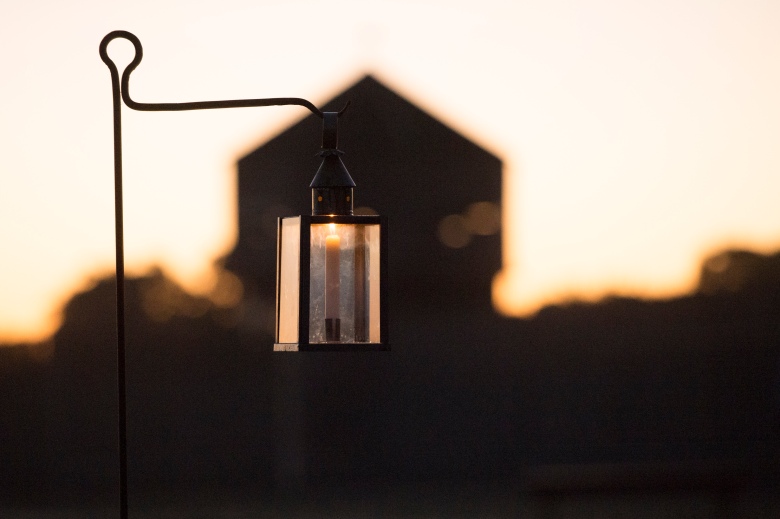
The above photo provides an artistic portrayal of a finely crafted lantern with the fort bastion behind. This fort was no rustic outpost. The commander’s residence, an elegant two-story house which he shared with his second in command, looked like a mansion to protagonist Jennie Haviland. The house included a public sitting room and formal dining hall for gentlemen, where substantial meals were served, sometimes with wine, but no “spiritous liquors.” Within the palisade walls the company was a self-sufficient establishment with workshops for carpenters, blacksmiths, coopers and others, as well as a school house, a chapel, a brick and stone powder house, and more. Outside, farming activities required more employees than the fur enterprise.

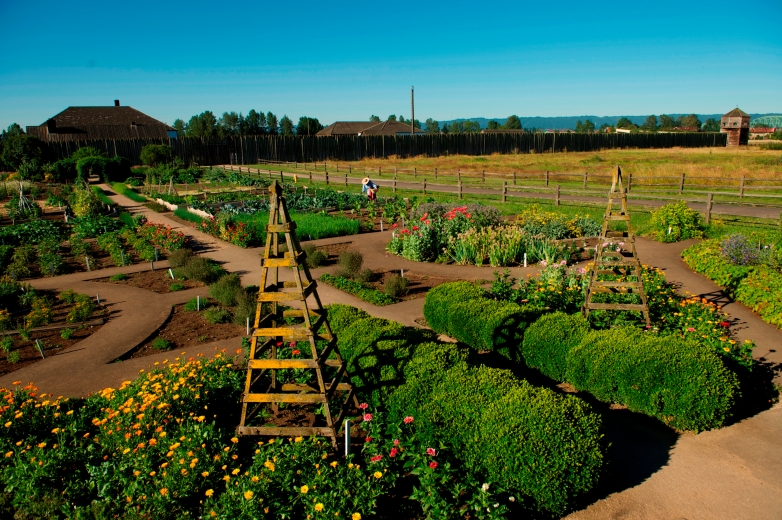
Nancy Funk, wearing period clothing, takes care of a garden at the Fort Vancouver National Historic Site in Vancouver, Washington. (Troy Wayrynen/picturesbytroy)

National Park Service photo by Troy Wayrynen

In the above photo taken at the beautifully reconstructed site, you can see some of the gardens typical of the fort’s past, and behind the gardens, the palisade walls with bastion at the corner. The large hip-roofed building on the far left with the chimney is the Big House where Dr. John McLoughlin lived as Chief Factor of the fort.

When the Company sent Dr. McLoughlin out to the Oregon Country, he selected this site for the Company’s western headquarters because he found a broad fertile plain there and he intended to grow things while conducting the fur trade. Grain, fruits, and vegetables flourished on this land, as well as livestock. He also wanted a site on the north side of the Columbia River because the British had recently made an offer to the United States to resolve a contentious boundary dispute, agreeing to set the boundary between the two nations along the Columbia. That would have essentially given today’s Washington State to the British. I guess we all know that offer was not accepted.

The Company initially built the fort a short distance inland from the final location, but after four years they moved it closer to the river and gradually developed the remarkable establishment it became.

village

National Park Service photo

The Company employed many people, and while some lived inside the fort walls, many more lived in a village just outside. Some of the reconstructed buildings of the village are shown in the above photo.

When Jennie visits the fort in our story, she’s curious about the houses outside the walls and asks her escort Alan Radford about them. He tells her they’re the workmen’s cabins, and she asks, “‘Do you live in one of these cabins?”

“Oh no. I live inside the fort. The gentlemen live inside.’

“‘Oh.’ She puzzled over that. ‘How do you decide?’

“‘Decide?’

“‘Yes. How do you decide who’s a gentleman?’

“‘Well, the officers and clerks are gentlemen, and the common workers are not. It’s simple enough.’”

Jennie finds that surprising but focuses on the fort as the wagon carries them inside. She’s amazed. “‘It’s like a small city right here inside the walls.’

“Lights glittered around her now, twinkling from the many windows of the fort buildings—glass windows, real glass windows. And the buildings! There were real frame buildings. Not simple little crude log cabins like those at Willamette Falls. . . . The frame house directly in front of her . . . had proper white weatherboarded walls, a proper shingled hip roof, shutters beside the tall glass windows, and a wide veranda that crossed the entire front, with a gracefully curved staircase forming a half circle from the veranda to the ground.”

Jennie has been invited to stay in that house, the Big House, as the guest of Dr. and Mrs. McLoughlin, but discussion ensues about where American mountain man Jake Johnston will stay. He has traveled with their party from Willamette Falls for his own reasons. With sudden decisiveness, Dr. McLoughlin says Jake will stay in the Bachelor’s Quarters next to the Big House. But Alan doesn’t appear to like that decision. When he begrudgingly leaves to make arrangements, Jennie quietly asks Jake what’s wrong.

Jake’s response: “‘With Radford? Well, it’s only gentlemen who are allowed to stay inside the fort, and I don’t think Radford considers me a gentleman.’ Jake grinned at her, and her brows rose. She wasn’t sure Jake was a gentleman either, but she was surprised at the rigidity.”

NEXT: Dr. John McLoughlin

COMMENT

COUNTDOWN – 4 DAYS TO LAUNCH

Joe Meek, Mountain Man Extraordinaire

Today on our countdown to launch I want to introduce one of the real historic characters who plays a significant role in my book, mountain man Joe Meek. In the story he’s a good friend of the fictional mountain man Jake Johnston. And when I say character, I do mean.

joe mural smallerPhoto courtesy of Oregon State Archives

The above photo is of a large mural in the Oregon State Capitol building. That’s Joe Meek in the red shirt, rifle in hand, yelling to catch the attention of men mingling around him. An uncertain voice vote has left the historic Champoeg meeting in confusion as to whether the Americans will set up a government and have the protection of law in this isolated land. In order to get a true count, Joe calls out with his immortal words, “Who’s fer a divide?” A hush settles over the crowd, and Joe calls out again. “All fer the report of the committee and an organization, follow me!”

Some thirty years after the days portrayed in The Shifting Winds Joe Meek sat down with author Mrs. Frances Fuller Victor and relayed to her the story of his life as a mountain man and as a settler in Oregon. Her book that came out of these discussions, The River of the West, was published in 1870. The man was an inveterate storyteller, and while some folks in his day suggested the stories may have occasionally stretched, he often enjoyed an appreciative audience. From Victor’s book I gleaned several of Joe’s stories about his exciting days in the Rockies. As indicated in the Afterword of The Shifting Winds, the stories “are as true as Joe chose to make them.”

Whatever the truth of his tales, he found purpose in Oregon. He would become sheriff, then territorial marshal, and he had connections in high places. There was more to Joe than first impressions might suggest.

In Chapter One, just after meeting Jake Johnston, protagonist Jennie Haviland meets Joe:

“Another man approached, dressed almost the same [as Johnston], his dirty buckskins showing more wear, the fringes more ragged, his dark straggly hair longer, and this one had a brushy tangle of beard covering his chin. He stepped up beside the other and stood before her with a broad smile, and she felt herself surrounded by the two of them.”

Jennie’s little brothers dutifully introduce themselves, but thirteen-year-old Eddie can no longer contain his excitement. He turns to Joe.

“‘Are you Joe Meek, the Joe Meek? The famous mountain man in the wax museum in St. Louis fighting the bear?’

“Mr. Meek grinned. ‘One and the same, but don’t ye let that statue fool ye none, boy. Old Joe didn’t lose nary a finger from that ol’ bar, do ye hear, now?’ The man held up both hands, fingers stretched to show he still had all ten.

“‘But did you really fight a bear?’ Eddie asked.

“Mr. Meek began to laugh and slapped the other man on the shoulder. ‘Do ye hear that, Old Jake?’ He was so caught up in laughter he didn’t attempt to speak further.

“Jake Johnston smiled at Eddie. ‘This man has fought more bears than any man I know.’

“Mr. Meek lifted a hand. ‘Why, bar fightin’—that’s what this old coon is famous fer.’”

And the stories go on.

NEXT: Fort Vancouver

COMMENT

COUNTDOWN – 5 DAYS TO LAUNCH

Mountain Men

With five days to go until the launch of The Shifting Winds, today’s post will focus on those intrepid mountain men who went out into the wilds of the Rocky Mountains to trap beaver for the American fur companies in St. Louis. From the early 1820s until 1840 these trappers worked the mountain streams and developed a lifestyle of their own. Company caravans took supplies to the Rockies for an annual summer rendezvous where they traded for beaver the mountain men had gleaned during the year. So the trappers never had to leave the mountains. Some didn’t go home to the States in all that time, maintaining a tenuous link with civilization as they had once known it.

George profile jpgPhotos courtesy of Douglas County Museum

George Abdill may not look like a mountain man in the pictures above and below, but the spirit of a mountain man lived in George’s heart.

Some years ago when I decided to write a book about the American frontier, with mountain men and pioneers and British fur traders, I went to see George Abdill, director of our local Douglas County Museum at the time. George was a man who held in his mind so much information, a person could ask him a question and he would answer with a chapter. When I told him about the setting and characters of my story, he smiled and sat back in his chair, his tone turning wistful. “If I could go back in time and choose what I would like to be, I would be a mountain man.”

George headshot jpgWow! What a great source for these stories!

He’s not wearing buckskins in the photos. He doesn’t have a powder horn and bullet pouch slung over his shoulder. And he’s not carrying a muzzleloader, but he knew how to shoot one and told me how to reload the single-shot weapon on the run while riding full tilt after buffalo. So, imagine him in buckskins, as he could have surely imagined himself.

The mountain men who trapped beaver in the Rocky Mountains generally wore buckskins because these trappers worked in rough country and the durable buckskin protected their own skin, also because they lived and worked with Native Americans who often wore deerskin clothing themselves. Fringes—or whangs—on the outer arm seams and leg seams offered more than style. The fringes helped the garment shed water by acting as wicks, an important feature for men who waded into streams to trap beaver and faced all kinds of weather.

Here’s how protagonist Jennie Haviland sees American mountain man Jake Johnston on first meeting:

“She managed to push back to arm’s length and quickly surveyed him from the smiling face down over the buckskin-covered length of him to the moccasins on his feet. He wore a buckskin shirt, much like their young Indian guide’s—fringed, embroidered, belted at the waist—but unlike the guide he wore long, trim-fitting buckskin breeches with fringes running down the outer seams. He was armed—a knife in a sheath on his belt, a pistol stuck into the belt, and powder horn and bullet pouch slung over his shoulder. With determination, she pushed back harder and he released his grip on her.

“He spoke with a drawl, still smiling. ‘Ma’am, may I have the utmost pleasure and privilege of welcoming you to the fair Willamette Valley? My name is Jacob Obadiah Johnston.’ He backed up a step, sweeping one hand before himself as he gave her a deep bow, the long fringes on his buckskin sleeve swishing with the motion. Standing straight again, he grinned wider. ‘My friends call me Jake. And you would be . . . ?’

“She could only stand and stare . . .”

The Shifting Winds is the fourth pioneer story I wrote, the fourth serious novel, and its pages are infused with the information and spirit provided by mountain man dreamer George Abdill. I wish he were still alive to thank for all the help he gave me.

NEXT: Joe Meek, Mountain Man Extraordinaire

COMMENT

COUNTDOWN – 6 DAYS TO LAUNCH

Willamette Falls

As we continue the countdown to the launch of my new book, The Shifting Winds, today’s historical factoids focus on the developing settlement of Willamette Falls, soon to be named Oregon City, the first Euro-American settlement in Oregon’s Willamette Valley and the destination for many American settlers who would cross the Oregon Trail.

Society208-Clackamas County Historical Society Photo, All Rights Reserved

The above lithograph was created in the 1840s by lithographer J. H. Richardson who traveled to Oregon City during the settlement’s early days, one of several artists sent out to record images of the West during that period. The picture shows the bluff and the heavy forest above, which will become familiar to readers of The Shifting Winds.

A dramatic horseshoe-shaped falls gave the place its first name. Long before the white men came, the remarkable cascade drew Native American tribes like the Clowewallas, one of several Chinookan tribes who found excellent fishing at the site, and it became a place for the tribes to gather for trade. Some said the salmon were so thick a person could walk across the river on the salmons’ backs. Men built scaffolds right in the plunging water and climbed up to use spears and dip nets to catch fish struggling to leap the falls for the great return to their spawning grounds upriver.

When British fur traders entered the region they quickly recognized the potential power of the falls, and in 1829 Dr. John McLoughlin, HBC Chief Factor at nearby Fort Vancouver, laid out a two-square-mile claim at the site. By the time the characters of my story arrive, he’s in the process of building a sawmill on an island there.

The construction work brought HBC employees to the place which they called Willamette Falls. Then Americans began to arrive, and contentions stirred at this focal point, as well as across the Oregon territory. When the story opens in 1842, the Oregon country has been jointly occupied by the British and Americans for almost twenty years, because the two nations still can’t agree on a boundary. The British have been entrenched for years with their fur trading operations, and only a few Americans have trickled in—some missionaries, a few mountain men escaping a dying beaver trade in Rockies, and a scattering of emigrants who’ve come by land and sea.

Protagonist Jennie Haviland isn’t happy her father tore her away from her prestigious academy in Utica, New York, to come to this wilderness, but her one hope is that she’ll find a place she can call home in Willamette Falls. As she and her family follow their Indian guides through the dense woods to an overlook of the mighty cascade, she hopes to get her first view of this town. Awed by the spectacle of the falls, she can’t help admiring the beauty, but she doesn’t see a town, only some shacks on the island and a couple of log cabins with a few outbuildings on the flat bench of land below. Homes of isolated settlers? She turns to her father.

“‘But where is the town? Where’s Willamette Falls?’ She wanted to find the town of proper houses.

“The young guide mumbled to Pa again, and Pa nodded. ‘So that’s it,’ Pa said. ‘That’s our settlement.’

“Jennie scanned the tree-cloaked hills. ‘Where?’

“‘Those cabins are it.’ He pointed to the flat bench of land. . . .

“Jennie darted a quick look at the cabins on the flat, then jerked her head back to stare at Pa. ‘What do you mean?’”

NEXT: Mountain Men

COMMENT

COUNTDOWN – 7 DAYS TO LAUNCH

First Travelers on the Oregon Trail

The launch for my new historical novel, The Shifting Winds, is now seven days away, one week, and I plan to do a blog post each day from now until the day before the event. For each post I’d like to share some historical factoids that relate in some way to the book, from today’s brief overview of the first travelers on the Oregon Trail to bits of information on mountain men, the Hudson’s Bay Company, and other background elements that may work into a tapestry of color surrounding the story.

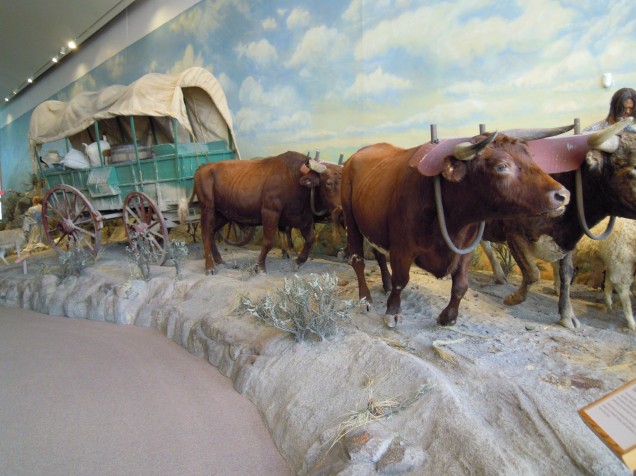
469.diorama oxen & wagonThe photo above was taken at the National Historic Oregon Trail Interpretive Center at Baker City, Oregon, a diorama showing a typical oxen-drawn wagon on the trail west.

Jennie Haviland, protagonist of The Shifting Winds, comes west across the Oregon Trail in 1842 with one of the earliest wagon trains of emigrants from the States. But fur traders first blazed that trail across the continent. As early as 1812 men employed by John Jacob Astor, founder of Fort Astoria, were probably the first white men to locate South Pass, a remarkably gentle passage across the otherwise rugged Rocky Mountains which made it possible for later emigrants to cross the Continental Divide with ease.

Missionaries began to make their way across the trail in the 1830’s, stopping along the way at the Rocky Mountain Rendezvous, the raucous summer gatherings of American mountain men and traders. In the words of mountain man Joe Meek in our story, “My heavens! That was the time fer big doin’s, mind ye, when the company sent out supplies, and after bein’ temperate all year, we let loose a mite, we did. A man would spend mebbe a thousand dollars a day on—” Jennie’s pa interrupts before Joe can say more.

The first white women to cross the trail, missionaries Narcissa Whitman and Eliza Spalding, traveled by wagon in 1836 with their husbands, Marcus Whitman and Henry Spalding. After a few days at the rendezvous, which must have brought a little shock to their sensibilities, they took the wagons as far as Fort Hall in what is now eastern Idaho, the first to take wagons that far. Beyond that point they used pack animals.

481.Ft Hll exterior

The picture above shows the Fort Hall replica my daughter, granddaughter, and I visited when we backtracked the trail taken by our ancestors.

By 1840 as beaver played out in the Rockies, the American mountain men held their last rendezvous and some headed for Oregon. Joe Meek and his friend Robert Newell managed to get three wagons from Fort Hall to Walla Walla, the first to take wagons overland as far as the Columbia River.

As promoters sang the praises of Oregon, hoping to gain the land with settlement, more emigrants dared take the trek. A fair-sized party of seventy or so left the States in 1841, but about half the party went to California, all of them leaving their wagons at Fort Hall.

That brings us to 1842 when just over a hundred emigrants took the journey, the group my fictional Haviland family joined. This group also left the wagons at Fort Hall and went by foot and horseback to the Columbia River, where some proceeded either by boat or raft down the river, while others like the Havilands took horses over the Cascade Mountains.

The story of The Shifting Winds opens as the family approaches their destination, Willamette Falls, soon to be named Oregon City. Jennie expects to see a thriving town there, a semblance of civilization in this godforsaken wilderness, but she has a few surprises in store.

NEXT: Willamette Falls

COMMENT

NEW BOOKS!!!

912.new.booksBoxes of books came today! What a thrill to actually hold one of these real books in my hands and flip through the pages. My good old story I have loved for so long. Now in print so other people can read it and come to know some of my favorite characters. And the books are beautiful! I love what the publisher did with the cover.

My agent emailed me over the weekend to tell me she had gotten her copies, so I suspected mine might come today. I gave a talk at my Roseburg writers’ group this morning and had to leave home before the books came. But when I got back they were waiting on the porch for me. Ah! What a sight!

Checking an old blog post, I see that boxes of my first book came early the month before the release date too. And for those of you who have pre-ordered The Shifting Winds from one of the online outlets, you may actually get your book before March 1. I don’t know, but I think people started getting them earlier last time.

Oh, what fun! This is one of those moments for a writer. Sheer pleasure. I am so looking forward to sharing. 🙂

COMMENT

Book to Launch

My debut historical novel, The Shifting Winds, is about to launch. As you may have seen in the sidebar, I have a couple of book signings scheduled already. The first launch party will be at the Elkton Community Education Center (ECEC) library in Elkton, Oregon, better known as the butterfly place, on Sunday afternoon, March 6, from 2 to 4 pm. Less than two months away now. This is the same place I launched A Place of Her Own two years ago, and everyone there helped me make that a wonderful sendoff for Martha’s story. I look forward to another great beginning this year.

ECEC

The photo above shows the ECEC library building. Elkton is about seven miles from my home on Martha’s Century Farm.

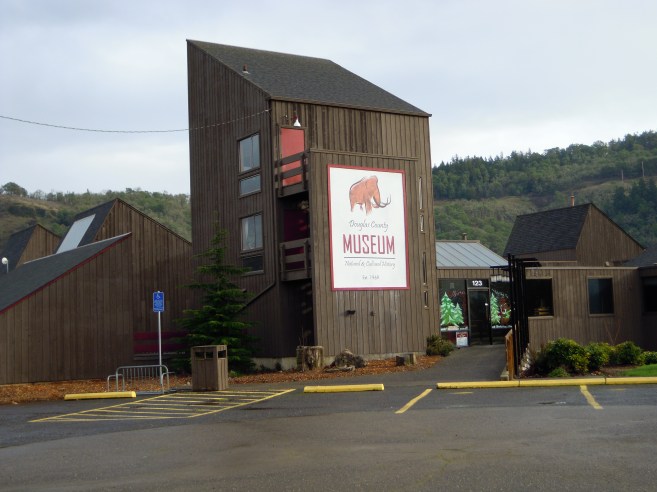
My next party will be later in the week at the Douglas County Museum in Roseburg, Oregon, Thursday evening, March 10, from 6:30 to 8:30 pm. At this event I will offer a tribute to the late George Abdill, former director of the county museum. George offered me considerable information and inspiration for The Shifting Winds, which portrays one of his favorite periods of history when fur traders and pioneers came up against each other on the American frontier of the mid-nineteenth century. And I did have a lot of fun putting this story together.

900.DCMuseum

The Douglas County Museum, shown above, is at the county fairgrounds just south of Roseburg’s downtown.

ShiftingWinds cover jpegI hope many of my local friends will be able to attend one of these opening parties. We’ll have refreshments, readings, signings, and plenty of conversation with book-loving people. In addition to The Shifting Winds, I plan to have copies of A Place of Her Own available.

In the coming days I’ll be adding more events around Oregon and beyond. Those will be listed on the right-hand sidebar as they’re arranged and also on the “Events” page, where you can see not only where we’re going but where we’ve been.

Cheers!!! 🙂

COMMENT

Outtakes #9 – A Place of Her Own

This Outtake reveals another short bit taken from the end of an Oregon Trail scene at the top of p. 124 in A Place of Her Own. The Maupins have survived the precipitous drop down Laurel Hill and have just come into the rich prairies west of the Cascade foothills. The cut is just 176 words, but words are words. And I desperately needed to take more out. At least it gave me more in one fell swoop than the single filler words I snipped throughout the manuscript. Clip…..


The photo above, by Robin Loznak, appears in A Place of Her Own, illustrating Douglas Firs on the family farm. Similar trees of this species would have been growing in the area depicted in this scene, though no doubt larger than these. Pioneers trekking into what is now the State of Oregon found Doug firs some 300 feet tall. Two or three men could lie head-to-foot across the diameter of a stump from one of these giants that might have been as much as 800 years old.

~~~

Near evening a cabin appeared, nestled against a grove of firs at the edge of a broad meadow. The scent of a hearth fire reached Martha’s nose, and she took a long, satisfying breath of it. People began spilling out the cabin door, running toward the wayworn travelers. A man reached them first. He lifted his hat and rubbed a hand across his thin, curly hair. “Welcome to Oregon.”

A united but somewhat ragged thank you answered him back.

He introduced himself and his wife, who came up behind him, and Garrett introduced the family. The woman went straight to Martha and gripped both her hands. “My dear, what a journey for you. When are you due?”

“December.”

The woman smiled and nodded. “Oh, you’ll be settled by then. Come sit a spell and have some supper with us.”

“That’s so nice of you,” Martha said. “You must see a lot of travelers, living here.”

The woman laughed. “We do, and we love it. We all took that trip, God bless us, and we all understand.”

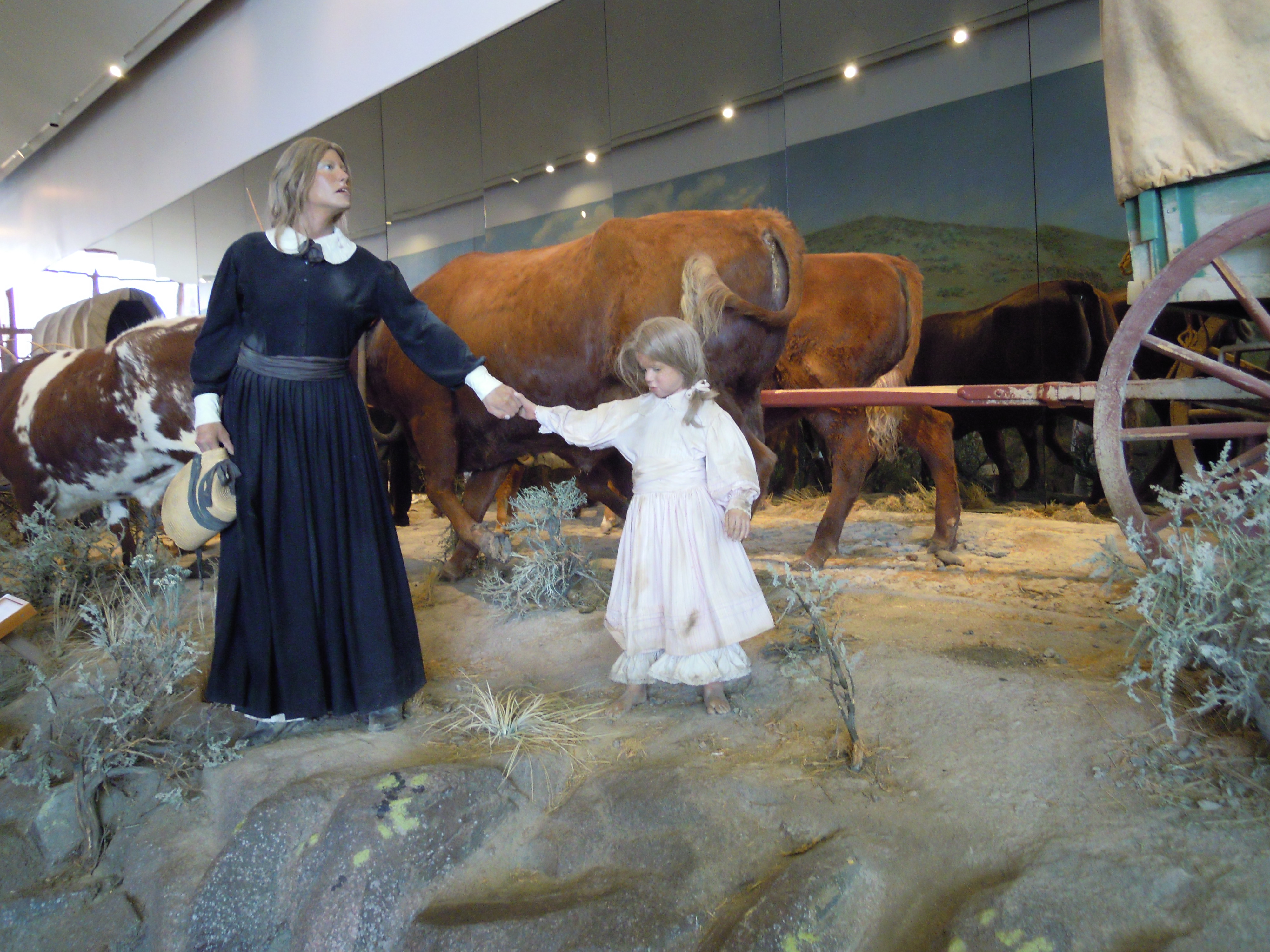
468.diorama mother & childThis photo taken at the Interpretive Center in Baker, Oregon, shows a part of the continuing diorama depicting a wagon train on the Oregon Trail. The woman makes me think of Martha and her little Nora, oldest of her two at the time. My heart tightens as I imagine the strain of traveling that perilous trail with such a precious, vulnerable child. Another even tinier. A third on the way. What a thrill to know in this short Outtake that they have almost made it through. Of course, Martha would have been full in her pregnancy by then.

COMMENT