Next Stop Newport

For my next book event I’ll be heading up the north coast again to speak to the Coast Chapter of Willamette Writers in Newport, Oregon. It’s always nice to visit one of the most beautiful areas in the world.

Photo by Robin Loznak

The above photo was taken a little bit south of Newport as the lowering sun sheens the water below one of Oregon’s historic lighthouses.

My speaking engagement with the Coast Chapter was originally scheduled for last February. In fact, I packed up and headed out that Sunday morning, excited about the trip. I hadn’t gotten far when a spit of snow began to spatter my windshield. I wasn’t too concerned. We don’t get much snow in February and the coast is even less likely to have snow.

That day proved to be an exception. It kept snowing harder. I told myself it wasn’t sticking and I’d get into the temperate coastal zone soon. But it got worse the farther west I drove. Snow did begin sticking. It was not getting better toward the west. I wasn’t set up for snow and finally decided I’d better turn around while I still had hopes of returning home safely.

Happily, we rescheduled. I’ll be there for their September meeting this coming Sunday, the 17th, from 2 to 4 pm at the Newport Public Library, 35 NW Nye Street. And we don’t expect snow.

I’m going to talk about my long road to publication of my two Oregon Trail stories, 2017 Nancy Pearl Book Award Finalist The Shifting Winds, and the one that started it all, A Place of Her Own, with a few words on what’s waiting in the wings. A slideshow will offer a backdrop of photos related to the two books. After some Q&A I’ll have books available to sell and sign. Because I’ll be talking to fellow writers I hope I can offer some ideas and encouragement that might help others on their writing journeys.

I’m also a member of Willamette Writers, which has branches throughout Oregon. When I lived in Portland I met with the Portland chapter and now meet with the Mid-Valley chapter in Eugene.

Thanks to Robin, I have one more photo to share, another of those glorious sunsets on the Oregon coast. Looking forward to my upcoming visit. If you’re in the area, please think about stopping by the Newport library for some book talk in a beautiful place.

Photo by Robin Loznak

COMMENT

Save

Save

Save

Fair Week Continues

Fair week in Douglas County, Oregon, brings out the people and critters and crafts every August. Today we head into the third of four days, expecting a cooler time than the stifling first two.

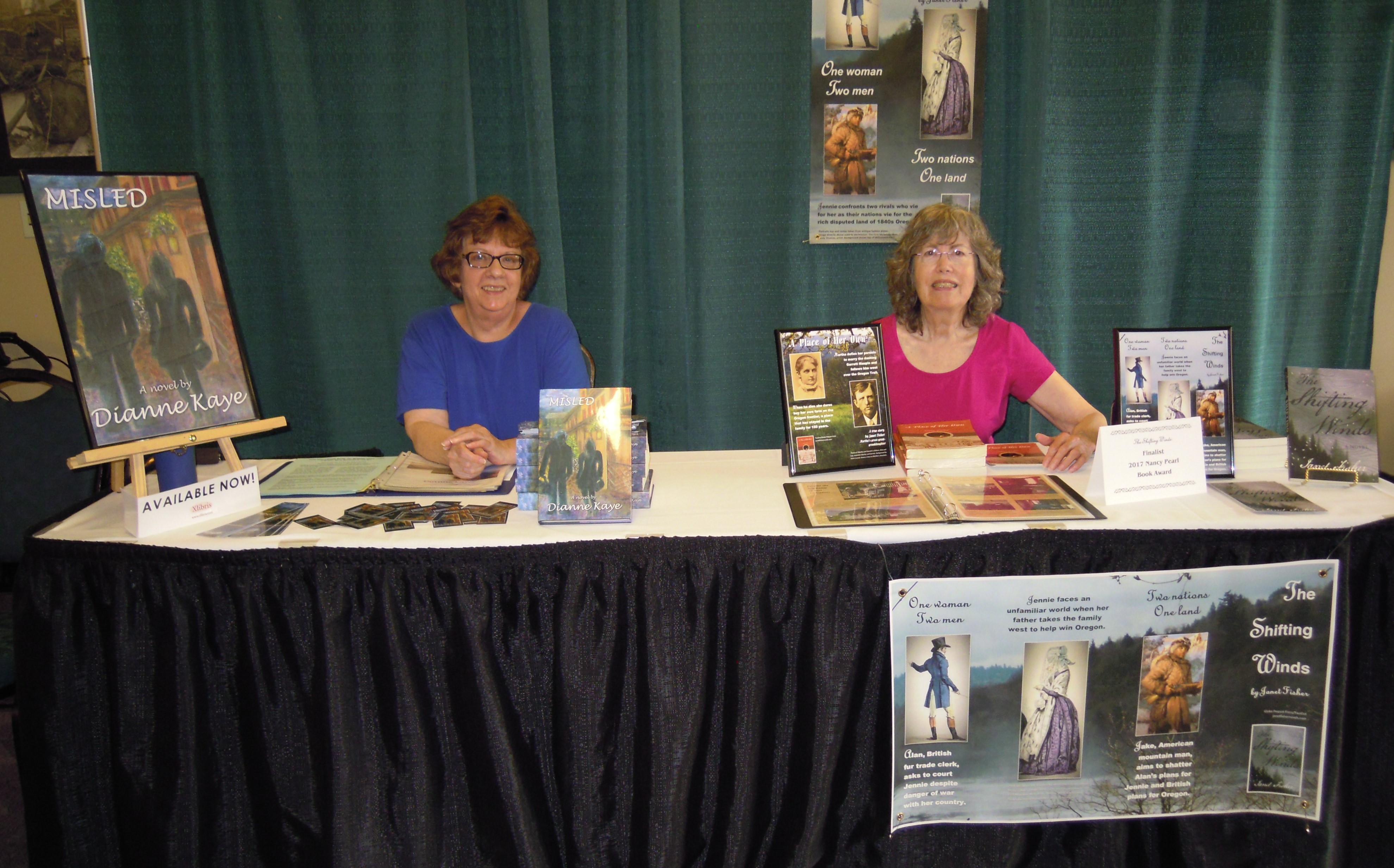
Here author friend Dianne Kaye Carter and I take up our post to sell and sign our books at the Author Table in the foyer of the air-conditioned Conference Hall/Community Hall, first building on your left as you come in the main gate. We’ll be there again this afternoon and tomorrow afternoon, Friday and Saturday, August 11 and 12 from 3 to 7 pm. Dianne is presenting her suspense noel, Misled, and I’m presenting my Oregon Trail stories, A Place of Her Own and 2017 Nancy Pearl Book Award Finalist The Shifting Winds.

Our local AAW writers group will be at the Author Table earlier on these days from morning until 3 o’clock.

Meanwhile, outside, the fair goes on with the usual prize animals that have been a part of county and state fairs for generations.

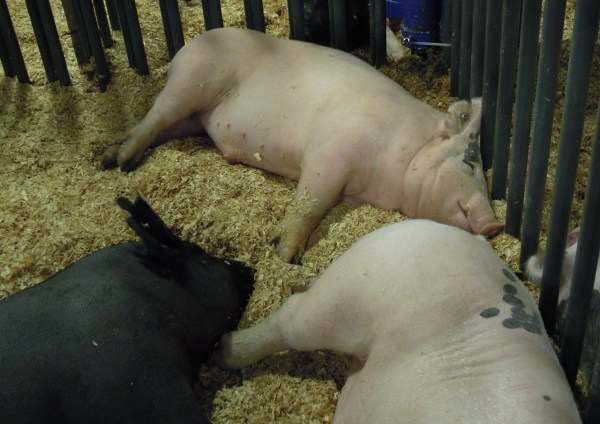
Oblivious to the history these sleepy pigs snooze on an unusually warm evening for Oregon, dreaming of home or juicy corn or whatever else pigs might dream about.

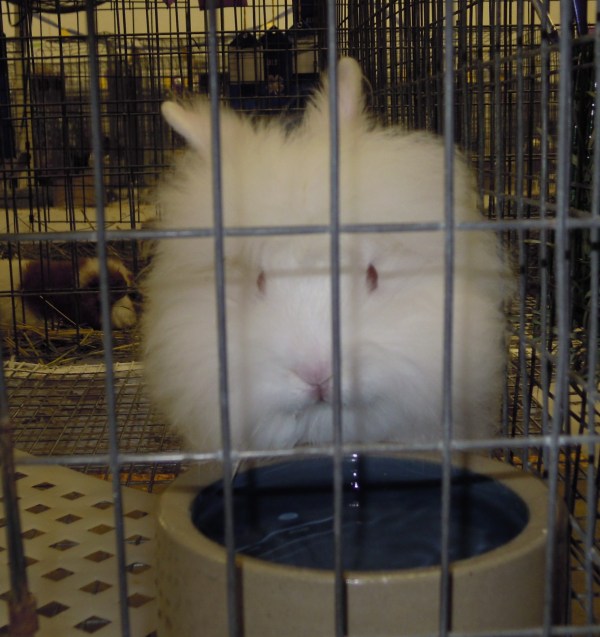
Then there are the bunnies. These incredibly soft, furry critters must wear their warm coats despite the heat, so they need plenty of water.

This fuzzy one glances up from its drink when he sees me with my camera. It gives me that look. “What is that thing in front of your face and why are you staring at me? I don’t know why I must be here. Do you? Can you imagine wearing a suit like mine on a hot August day? Yet I must stay here and be cute and spectacular just so I can maybe win a ribbon. Is that it?”

Of course we know bunnies don’t talk out loud. I remember as a kid when my mother got tired of our noise and we all had to do bunny talk, which meant wiggling our mouths and noses without making a sound. We got very good at it.
This guy is very good at it too.

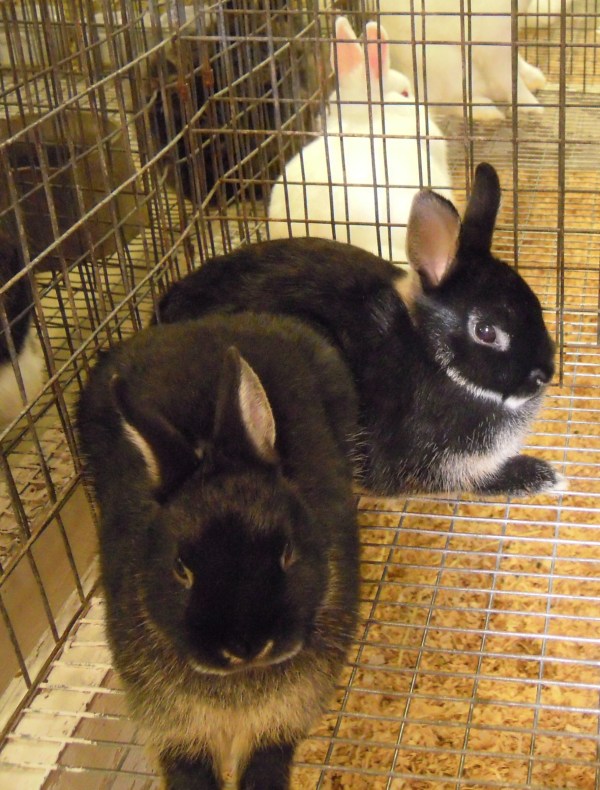
And more bunnies a few cages down.

These are more silky than fluffy. Fingers just want to touch them, but resist.

Whatever farm animals you like, you’ll probably find them, from chickens to horses to cows to sheep and goats and more you may not have imagined.

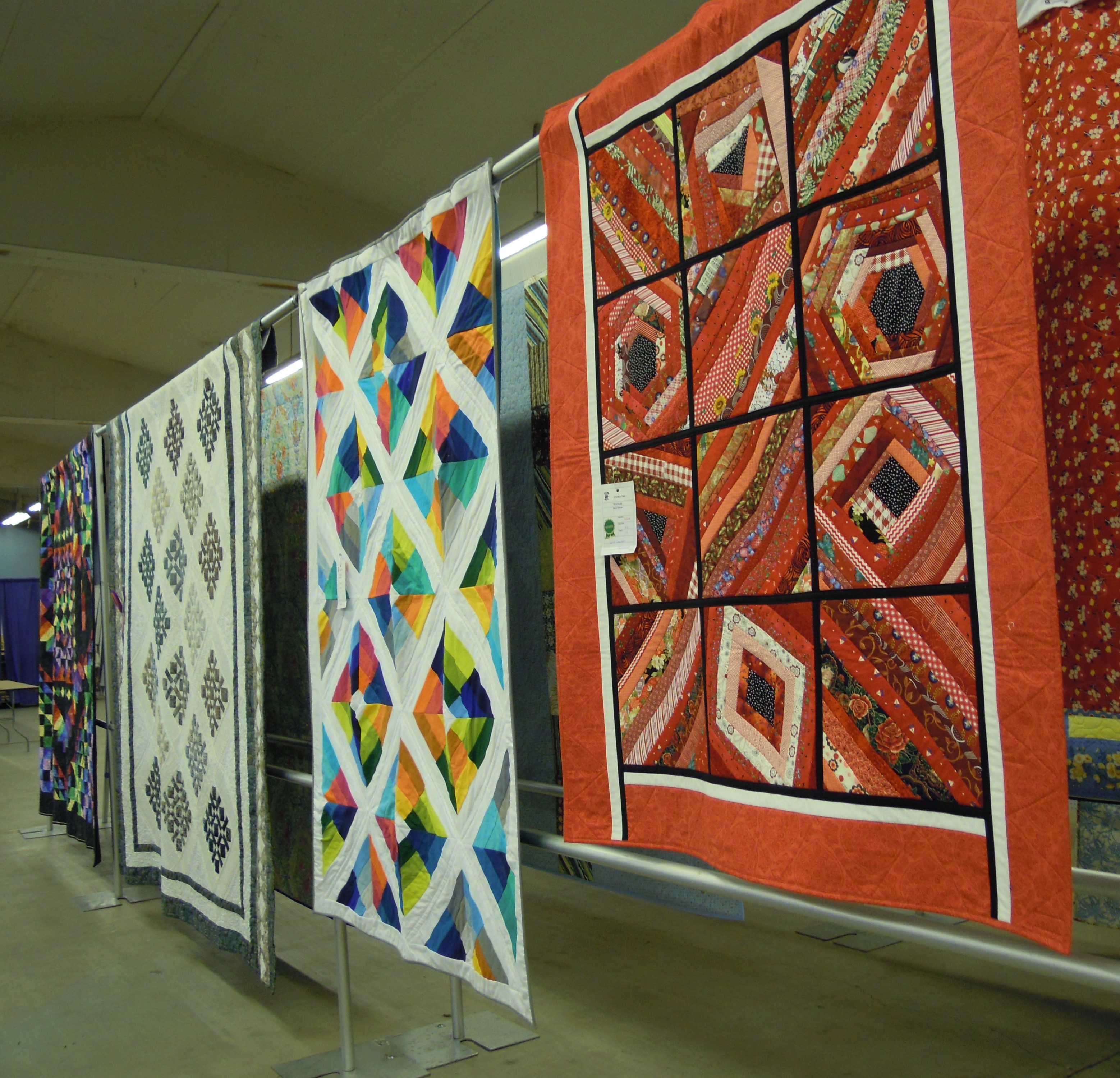
In addition to the animals entered for prizes in the fair, there are the beautiful crafts.

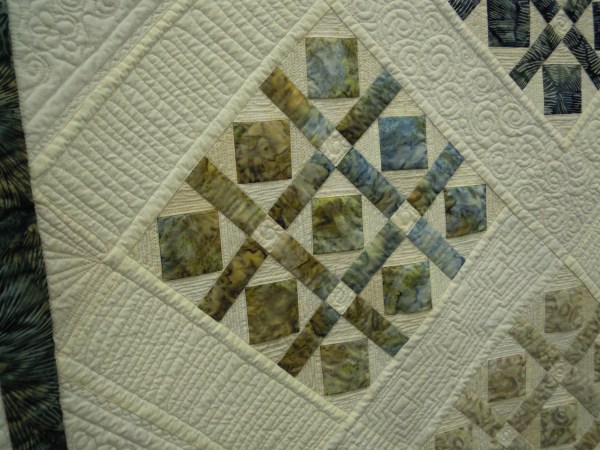
I especially like the quilts. Below are a few fine examples.A closeup shows the intricate stitching of this prize winner by Shirley Pyle of Roseburg.

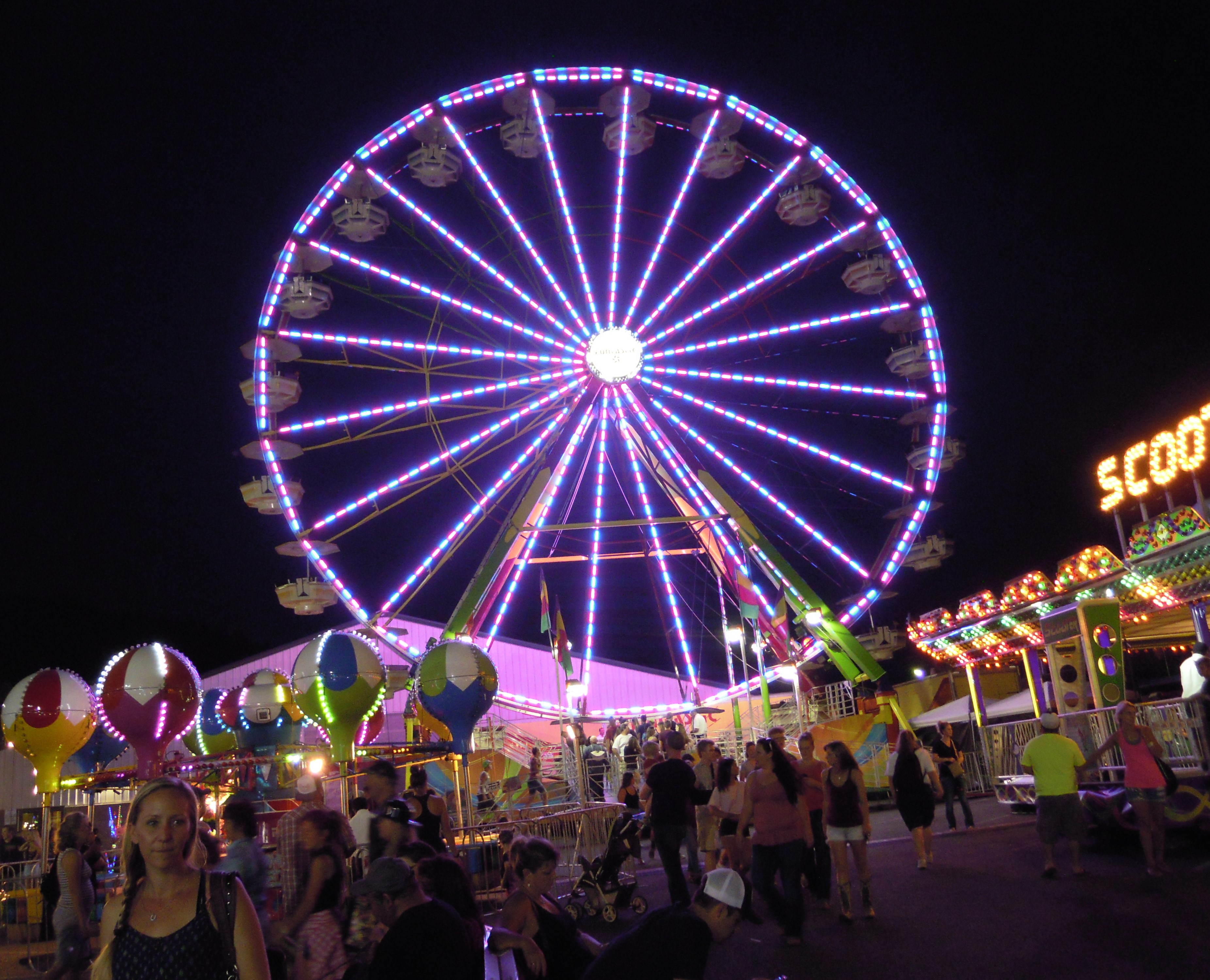
Of course the fair would not be a fair without the rides. Ah, the rides at day’s end when the lights turn bright against the dark night sky. And so we end a busy day with a walk on the runway and the traditional ferris wheel dominating this world of wonder.

Two more days. If you live anywhere close by, come on down. The forecast calls for much pleasanter weather today and tomorrow with temperatures dropping into the 80s with a mix of sun and clouds, then balmy evenings.

COMMENT

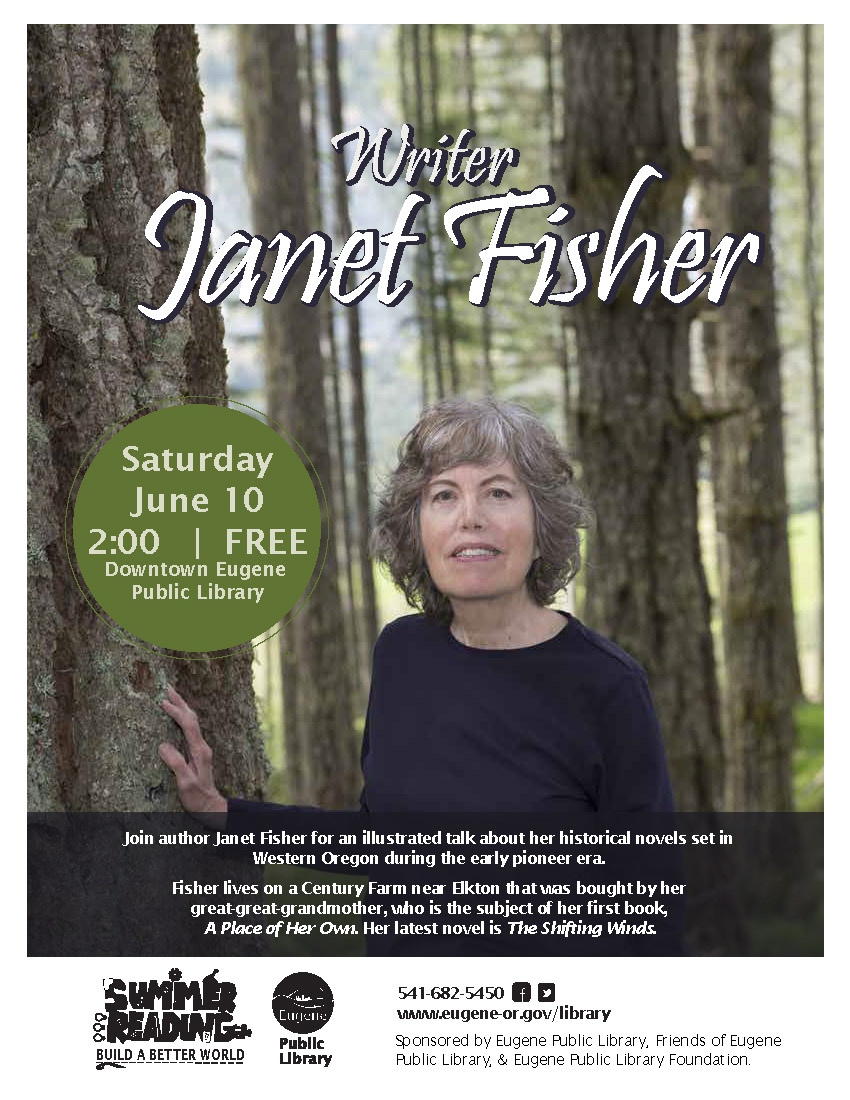
Poster for Eugene Library Gig

The Eugene Public Library provided a poster for my upcoming book talk and slide show there this Sunday, June 10, at 2 pm as part of their summer reading program.

Looking forward to this event at the beautiful library facility at 100 West 10th Avenue in downtown Eugene, Oregon. For more information you can check out my June 2nd post here.

COMMENT

My Talk at Eugene Library Coming Up June 10th

I’m delighted to be speaking about my books at the Eugene Public Library Saturday, June 10, at 2 pm. For folks in the neighborhood I hope you’ll jot it on your calendar and stop by.

It’s a beautiful facility, as shown above, located at 100 West 10th Avenue in downtown Eugene.

During my talk I’ll present a slide show with photos related to my books, illustrating events and scenes to help bring the stories to life. I’ll delve into some of my personal history that led to publication of my first book, A Place of Her Own, and the door that milestone opened to a second book, The Shifting Winds. Both are Oregon Trail stories. A Place of Her Own is the true story of my great-great-grandmother Martha who came west over the trail and dared purchase a farm on her own after she lost her husband.

Not an easy matter for a woman in those days. I grew up on that farm, the Martha A. Maupin Century Farm, and have now returned, so her story touches me on a deep personal level. The book reads like a novel, with interludes describing my search for her, and I’ll talk a little about that search.

The slide show will include old photos like the one of Martha’s daughter who I imagine looks like Martha.

And photos like the one of my book reading in Missouri when my daughter and granddaughter and I backtracked Martha’s footsteps over the Oregon Trail and received a surprising Missouri welcome at the other end.

Publication of Martha’s story led to The Shifting Winds, which I wrote some years before about the same era, a novel with fictional characters who walk through a lot of true history of those early American settlers in the Oregon country.

I’ll discuss how the research for that book helped inform Martha’s story and how research has changed dramatically with the advent of the internet–and how it hasn’t.

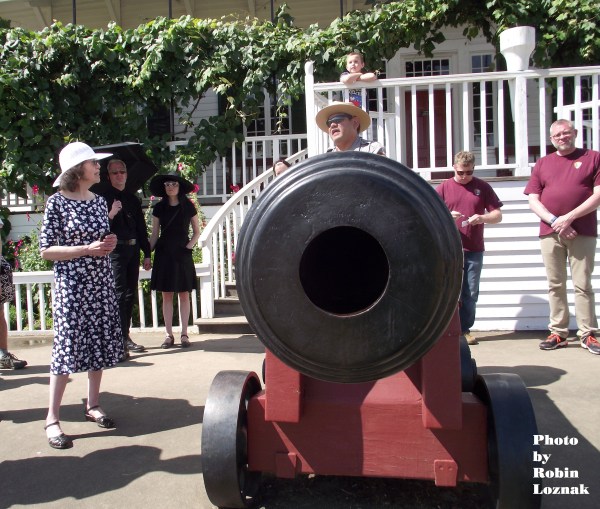
Photos related to Shifting Winds include one taken on the reconstructed site of the British Hudson’s Bay Company Fort Vancouver, where a number of scenes take place. During my reading and signing event at the fort, photographer Robin Loznak looks down the barrel of an HBC big gun in front of the commander’s house, while I stand by in the white hat listening to our tour guide, Dr. Robert Cromwell, Chief Ranger and Archeologist.

Not to worry. The guns were spiked, like the originals.

I’ll do some short readings from both books to provide a bit of flavor. After my presentation the session will be open to Q & A so people can ask what they really want to know about the stories or about the writing process or whatever else comes to mind. I always love the interaction of Q & A so really look forward to that. Afterward books will be available to sell and sign.

COMMENT

Talking Genealogy

I’m happy to be giving a talk about my books this Wednesday, May 10, at the Cottage Grove Genealogical Society meeting at the Cottage Grove Community Center, which shares the Library building at 700 E. Gibbs Avenue. The program starts at 11:30 a.m. in the Shepherd Room with a salad bar lunch, and is open to the public.

This is the same room where I had a speaking engagement with the library in January.

My talk will focus on the search for my great-great-grandmother Martha, the subject of my first book, A Place of Her Own: The Legacy of Oregon Pioneer Martha Poindexter Maupin. The book offers a creative nonfiction account of Martha’s life. Interwoven in this portrayal are four Interludes, which describe my search for her story.

Like many people who begin looking for their ancestors, I knew very little about Martha at the start. As a historical novelist I’m used to the need for research to learn about the settings of my stories, but the research into a real person’s life added another dimension. I want my fictional people to be realistic, but I can create the situations that drive them. With a real person I needed to ferret out the actual events.

I had the advantage of discovering cousins who’d done much of the genealogical work ahead of me, particularly a third cousin on the Maupin side, Linda Maupin Noel. Linda generously copied me on all the information she had gleaned. Then I did some digging on my own.

Wednesday I’ll share some of these efforts, the frustrations and the triumphs.

Along with Martha’s story, I’ll talk a little about my other book, The Shifting Winds, a historical novel set in the same time period, which was written before Martha’s and published after. The research for that one provided a good background for understanding the world in which Martha lived.

COMMENT

Coos Bay Library Presentation

I head back to the beautiful Oregon coast tomorrow, October 6, this time south to Coos Bay for an appearance at the Coos Bay Public Library. The event, open to the public, starts at 7 pm.

coos-bay-boardwalkPhoto Courtesy of the City of Coos Bay

The above photo captures the reflected beauty of a sunrise over Coos Bay’s boardwalk. I hope to explore a little while I’m there.

My presentation will include a short talk, a reading, some Q&A, and book signing, along with a slide show of photos related to my two books, The Shifting Winds and A Place of Her Own. Both are stories delving into Oregon’s pioneer history with a focus on strong women who made the formidable trek over the Oregon Trail to a wilderness across the continent.

If you’re in the Coos Bay vicinity, please join us. The library is located at 525 Anderson Avenue. Here are a few highlights from the slide show:

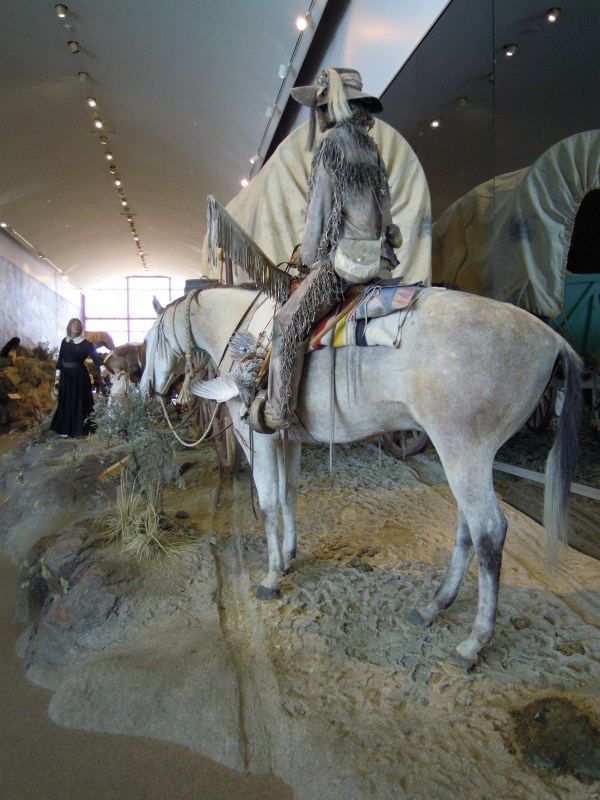
478-ft-hall466-diorama-horse

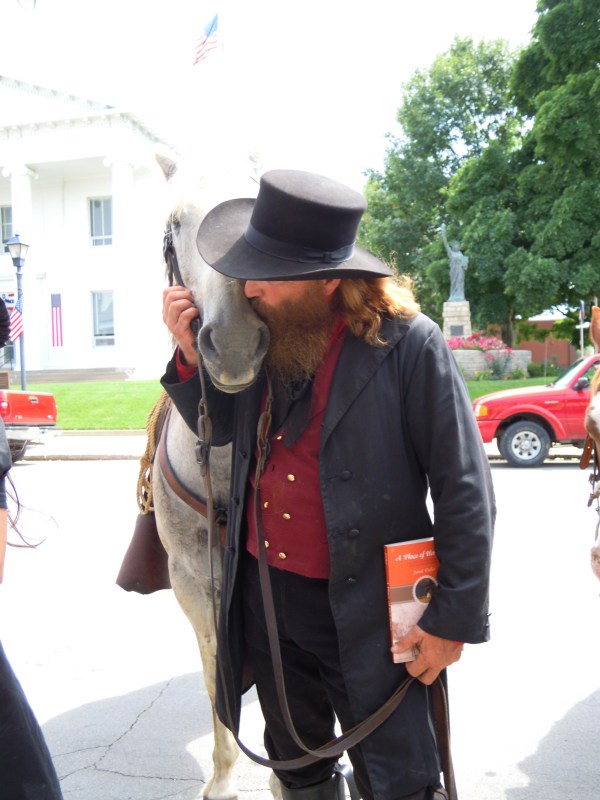
502-painted-wagon-oxen-scotts-bluff-2560-robbie-kissing-toby

600-c-fort-big-gun-signed

COMMENT

Foray Into Florence

So I got on my dusty steed yesterday morning and made for Florence on the Oregon coast for the Florence Festival of Books.

I won’t talk about the accumulation of events that got in the way of an early start, or describe my grumbling over that slow car on the winding coast highway that loomed as the last impediment to my much-desired progress. Could I make it in time to set up before the 10 o’clock opening?

Happily I made it with minutes to spare, although a determined attendee bought both my books before I had entirely arranged my display. She didn’t quibble. Nor did I.

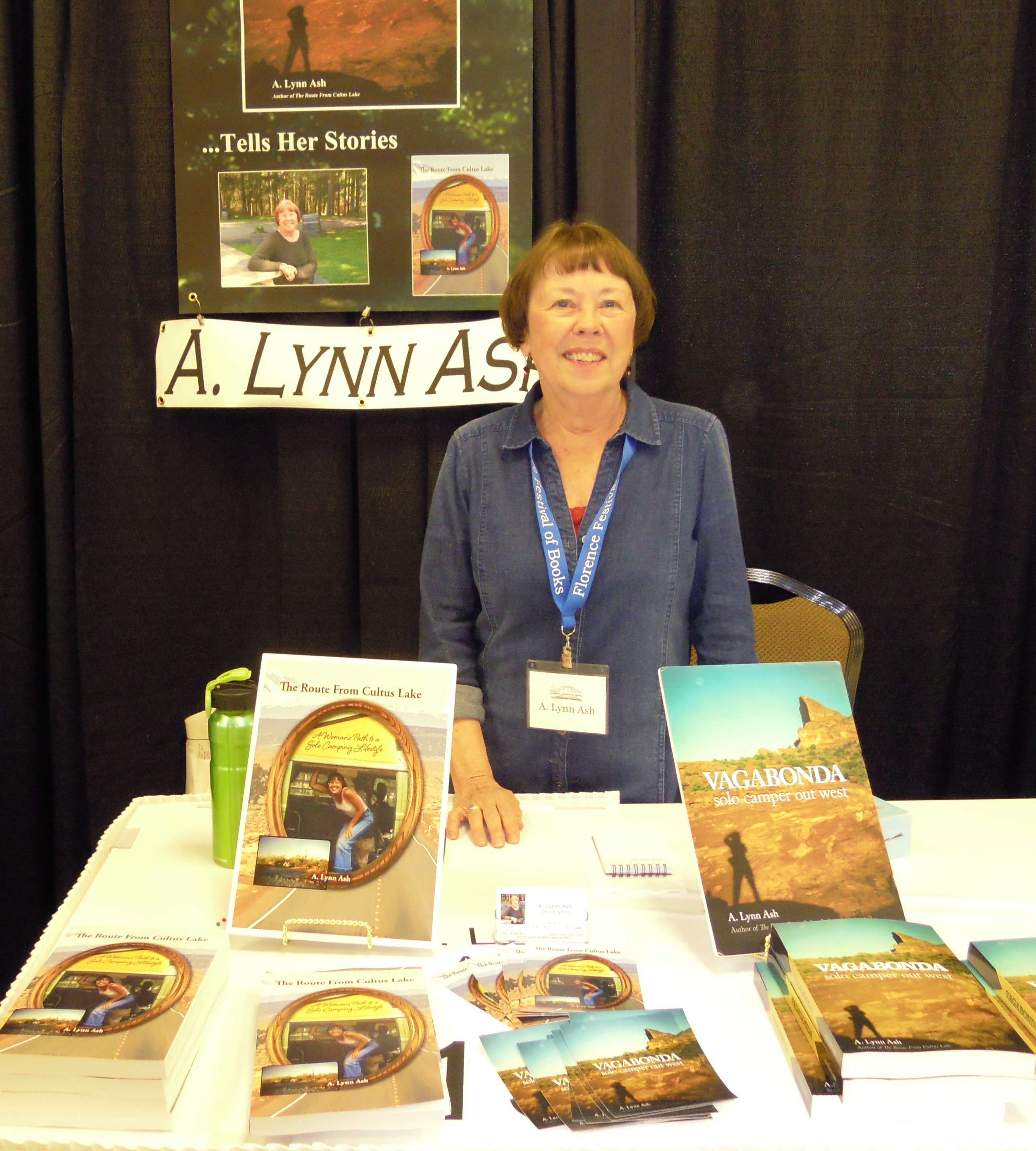
Here we are, my friend Lynn Ash and I, showing our books. We shared a table.

She presented her two memoirs describing her experiences as a solo camper, The Route from Cultus Lake and Vagabonda. I presented my two Oregon Trail stories, A Place of Her Own and The Shifting Winds.

The organizers do a nice job with this event. About 50 individual authors participated, as well as several writers groups and publishers. From 10 o’clock in the morning until 4 in the afternoon we pitched our stories and heard many intriguing tales from people who came by our table, and we signed books for our buyers.

After it was all done, our table cleared, and things packed up, we were ready to kick back.

And I got my clam chowder while watching seals and waterbirds play in the bright-blue Siuslaw estuary as the sun lowered and gilded the Florence bridge. A calming moment before I took my dusty steed on the long, beautiful drive home.

COMMENT

Living in the Past

Oakland, Oregon, will take a bow to its vibrant past tomorrow, Saturday, September 17, from 9 am to 5 pm when the historic town celebrates Living History Day with a focus on the 19th century.

I’ll be there with a table selling my books The Shifting Winds and A Place of Her Own, both set in the 19th-century West. People will get into the spirit of things by donning the typical garb of the day, as shown in these pictures I use to illustrate my characters from Shifting Winds.

25-jennie-brushed-2-titleThat’s m15-ft-vanc-alan-titley protagonist Jennie at right, whose face you can imagine yourself. The young woman’s father brought the family west over the Oregon Trail in 1842, much against her wishes.

The dapper fellow in frock coat and top hat represents the British Hudson’s Bay Company clerk who asks to court her despite rumors of war between their countries.

RawScan.tif, Mon Aug 24, 2015, 9:41:36 AM, 8C, 9000x12000, (0+0), 150%, Repro 2.2 v2, 1/20 s, R60.8, G31.1, B45.6The mountain man, a painting used by permission from artist Andy Thomas, represents the American who aims to shatter Alan’s plans for Jennie and British plans for Oregon.

Their clothing would be typical for the period Oakland plans to celebrate tomorrow.

Oakland history as a town goes back to 1846 when Rev. J. A. Cornwall came west and with another family took refuge from a fierce storm. They built a cabin on Cabin Creek near where Oakland grew up, then left in the spring to continue to their destination in the Willamette Valley.

The town of Oakland was laid out in 1849, first surveyed town in the Umpqua. When the railroad bypassed the old town in 1872, Oakland moved closer to the rail line and the new town became a commercial center.

When my great-great-grandparents, Garrett and Martha Maupin, moved to Douglas County he became a hauler, carrying goods by wagon from Oakland to Scottsburg, where things could be shipped out by boat. Garrett had just left Oakland on one of these treks when a load of wool turned over on him and smothered him. The details of that fateful day are told in my book, A Place of Her Own.

Morning Dresses Sept. 1803Somehow the small town of Oakland always kept one foot in the historic past, even before the reviving of historic structures across the country became popular. So it seems fitting for Oakland to celebrate its colorful past with a Living History Day. Oakland has been living its history for as long as I can remember. I have an Oakland address, although I confess I don’t often visit the town. It’s a little out of the way to get there.

Bypassed yet again, the second time by the Interstate Freeway, Oakland was left to dream of bygone days. The old buildings were maintained, perhaps for lack of need to create bigger and plainer and infinitely uglier new ones. You can walk down the street and feel the past all around you as the charming structures of an earlier time smile back at you.

So pull out the best representation in your closet of something folks might have worn in the 19th century. Ladies might choose something from the slimmer skirts of the early years to the simple calicos of pioneer times to the wide hoops of Civil War and later days.

1800s-wide-skirtsGentlemen, you could choose anything from frock coat and tall hat to buckskins, to jeans and shirts–and yes, they did wear jeans, sometimes called “janes,” even before Mr. Levi came on stage.

Come live in the past with us. I do that often when I walk into my stories. Such an intriguing place to explore, the past. Oakland will have spinning and weaving, blacksmiths, a trapper encampment, Fort Umpqua muzzle loaders, butter making, chuckwagon cooking, children’s activities, and more.

Abe Lincoln will be there. Who’d have guessed? And what’s that? Can-can dancing? Oh my.

Minter, Harold A. Umpqua Valley Oregon and Its Pioneers. Portland, OR: Binfords & Mort, 1967.
Except for Andy Thomas’s painting of the mountain man, all photos on this post are from antique fashion plates.

COMMENT

Book Event Explores a Living Past

Story and tangible history came together when the Friends of Fort Vancouver and the National Park Service hosted me for a book event at the remarkable re-creation of the historic Hudson’s Bay Company trading post, Fort Vancouver.

Fort Event Big GunThe event highlighted the actual reconstructed fort with a tour led by Dr. Robert Cromwell, Chief Ranger and Archaeologist, speaking behind the big gun here. Two large cannons stand in front of the elegant Big House, home of the fort’s commander in the days of my book, The Shifting Winds. During the tour I offered a few words on certain scenes from the book which took place at the fort in 1842 and 1843. I’m in the white hat. Photo by Robin Loznak.

The tour brought us into the fort’s living history, and Dr. Cromwell was great. I love this place that makes the past live. I feel a deep connection because my first visit here years ago inspired me to write The Shifting Winds, and making the past live is what I try to do with my historical novels.

Fort Event FlowersDr. Cromwell talked about the impression the house would have made on its 19th century visitors, such a grand structure with its expensive white paint and the big guns facing the front gate, although he noted the guns were spiked so couldn’t fire.

Nevertheless, the effect was no doubt intended to show the power of this British fur trading company that essentially ruled over Oregon at the time of my story.

On this July day the lush grapevines draped over the Big House veranda and bright flowers bloomed in front. On my previous visit in March the canes were bare, and there was no sign of flowers. Now huge clusters of grapes hang from these vines.You can also see part of the arbor in the top photo.

Photos taken of the original Big House in 1860 let researchers know that grapevines twined around metal trellises on the veranda that extends across the entire front of the house.

Fort Vancouver Big House (2)The thumbnail shows the house during my March visit before the greenery leafed out. Quite a change, and probably effective for the south-facing house. In winter when they needed more light the leafless vines let the sun come in, but in summer the leaves provided cooling shade.

Our tour proceeded inside the house so the group could see additional settings of the story and learn more about the fort. Then we moved on to the Indian Trade Store and the Fur Store warehouse to get an idea of the real purpose of this fort. The Hudson’s Bay Company officers and employees may have appreciated the protection of the picketed stockade, but the fort never served as a military post for them. The Company came for the furs, particularly beaver, purely a business venture. But it could be a cutthroat business as they competed against the Americans, who also held an interest in the territory.

Fort Event Ranger & meThe tour ended up at the New Office, above, the closest thing to the setting where my character Alan Radford would have worked. The clerk Alan lived and worked in the Old Office, which hasn’t been reconstructed yet. While Dr. Cromwell looked on, I talked about the scene where Alan invites protagonist Jennie to see his workplace during the Christmas Ball at the fort. Through a bit of byplay between these characters, I slip a little information into the story that gives the reader an idea how the fort functioned and how very isolated they were in this wilderness. Photo by Robin Loznak.

Fort Event Lecture 5 (2)My lecture at the Visitor Center featured photos related to the story, this one showing Fort Hall, another reconstructed fort that became a landmark on the Oregon Trail. My thanks to Ranger and Guide Emily Orvis for setting up the AV tech equipment so it all rolled smoothly, and thanks to my son-in-law Robin Loznak for handling the individual photos while I talked. This shot of me was taken by Benjamin Capps with my camera.

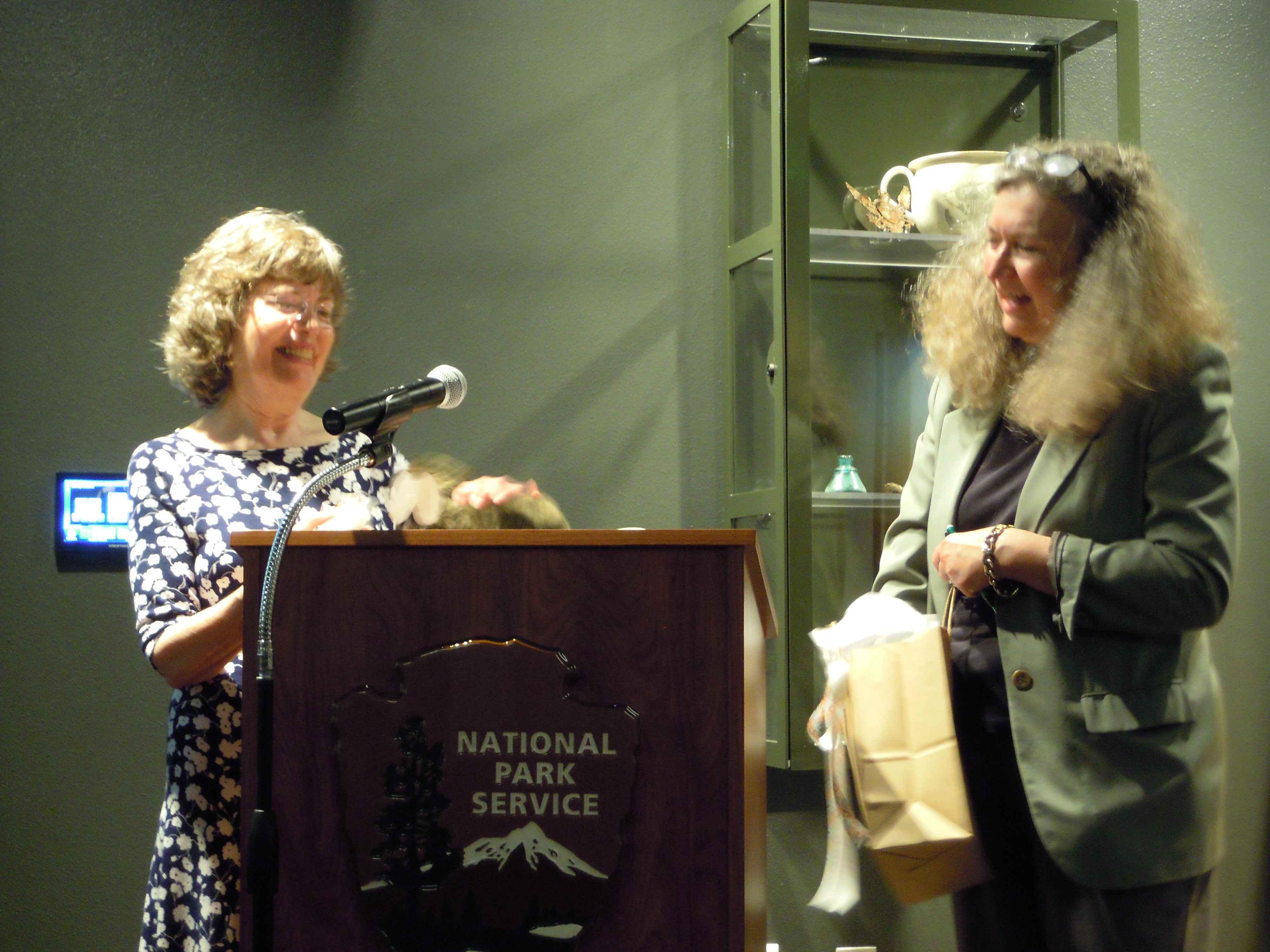
Fort Event Mary & meAfter my talk, Mary Rose, Executive Director of the Friends of Fort Vancouver, surprised me with a bag of thoughtful gifts, from a lovely turtle pin that memorializes the Native American label for the fort area as the “place of the mud turtles,” to Jacobsen sea salt from Oregon’s cold waters at Netarts Bay, to a Russian nesting doll acknowledging Vancouver’s many Russian immigrants, a little stuffed beaver representing the target of the 19th century fur traders, and a 100th anniversary pin commemorating the 100-year birthday of the National Park Service that maintains the site. What a delightful gesture! Photo by Benjamin Capps.

Fort Event Signing 4I arrived early, well before planned activities, which worked out. Tourists were stopping by and several bought my books, even some that hadn’t come for the event, and they were pleased to get personalized signed copies. My thanks to Sales Assistant Madya Panfilio for her enthusiasm in recommending my work. Official signing came after the lecture. Photo at left by Robin Loznak.

Mary Rose also asked me to sign additional books, which are available in the Visitor Center Bookstore.

Mary was the one who arranged my presentation at Fort Vancouver. When she learned about my book The Shifting Winds, she immediately became interested. She read the book, appreciated the accuracy and the story, and discussions led to Saturday’s presentation.

Many thanks to Mary for organizing such a wonderful event. She and the staff at the Visitor Center and the fort did a terrific job. Thanks to them all.

As my grandson Alex said, “They rolled out the red carpet for you, Grandma.” Yes, they did.

Everyone made it a wonderful day and I am most grateful.

COMMENT

The TRUE Shifting Winds ~ 6: Making the Past Live

My presentation in the Visitor Center at Fort Vancouver is just two days away, Saturday, July 16, and with this post I will close out the “TRUE Shifting Winds” series. The event starts at 2 pm, when I’ll give a talk while showing photos related to my book and the fort. I’ll do a couple of short readings from the book, selected from scenes at the fort, and after some Q&A, sign books.

The Visitor Center bookstore will have copies of The Shifting Winds for sale, and also my first book, A Place of Her Own, the story of my own great-great grandmother who came west over the Oregon Trail.

Following the signing I’ll invite attendees to go down to the fort where I’ll lead a tour of places that appear in The Shifting Winds, accompanied by Mary Rose, Executive Director of the Friends of Fort Vancouver. There’s a small fee to get into this National Park Service site, or if you have your own pass, that will work too. If you’re in the vicinity I hope you’ll join us for this walk into the past.

A Reconstructed Fort

Making the past live. Isn’t that what historical novelists do? Make the past live? We try. So we have something in common with those who worked so hard to bring structures and their contents back to life at Fort Vancouver. Even staff members put on the garb and help draw visitors back to an earlier time. And the rangers tell the old stories, like bards.

Fort Vancouver Big House (2)

We historical novelists tell the old stories through the eyes of our fictional and sometimes historic characters. For my part I’ll refer you to my book, The Shifting Winds, with its scenes in the Big House shown above, the Old Office, and the Bachelor’s Quarters, as well as the fort grounds and the dark orchard behind the stockade on a cold night.

Here in my post I offer photos taken on my recent visit to the fort—for illustration—with a little text and tidbits of history to enliven them.

The Big House

The preservation team didn’t have blueprints for the house. They knew what the outside looked like from pictures, but for the inside their only clues were snippets of descriptions and comparisons with managers’ houses at other HBC forts, plus the remains found by archeologists–footings, the base of the chimney, evidence of a cellar.

The cellar probably held the oft mentioned wine and spirits served in the Mess Hall.

Ft.Vanc.Dining long

Gentlemen of the fort ate in the dining room in the Big House, generally called the Mess Hall, making this the center of business as well as social life. Everyone welcomed the arrival of visitors who brought news from other places, breaking the monotony of this isolated post. Many guests–distinguished and not–enjoyed the fine fare, even including soft loaf bread from the fort bakery, along with vegetables from the gardens, game from the hills, fish from the river, and eventually beef when herds grew large enough.

The well-stocked kitchen stood behind the house, connected by a passageway but separate for fire safety. Gentlemen maintained careful military etiquette as to rank, although Chief Factor McLoughlin could use his discretion to make allowances for some, especially Americans, whose rank might be obscure.

The officers of the fort offered the finest hospitality to keep visitors there as long as possible, although some of the gentlemen in the Bachelor’s Quarters, or even the office, might have to give up their rooms to house the guests.

613.Ft.Vanc.McLoughlin Sitting Room

The McLoughlin sitting room, shown above, would be the place where Mrs. McLoughlin took her meals, sometimes with family and friends. Female guests with some status stayed in the Big House, like protagonist Jennie in my story, and she would have eaten her meals here with Mrs. McLoughlin. Only if the doctor missed mealtime in the Mess Hall might he join them. Update: The reconstructed house also has a small dining room for the women on the east side, which would have provided another option for them, but they would not eat in the Mess Hall with the men. That was strictly a male sanctuary.

Most of the women, like Marguerite McLoughlin were at least half Native American. Her mother was Cree. The women wore European dress, but with moccasins and deerskin leggings for riding gentleman fashion, that is, astride.

People who saw the McLoughlin’s together often commented on the fondness they showed for each other, although some had trouble accepting fur trade marriages. One man made such a fuss, McLoughlin struck him with his gold-headed cane, later apologizing for his outburst. Soon afterward McLoughlin insisted on a civil marriage, and when he later returned to his Catholic faith, the couple was married again in a Catholic ceremony–by then thoroughly wed.

Johnson in his book John McLoughlin comments: “The deference that Mr. McLoughlin showed to his wife in public was the envy of all American wives, who lost no time in citing him to their husbands as an example worthy of emulation.”

McLoughlin’s second-in-command, James Douglas, lived in the other half of the Big House for a time. The rich red of this room is based on a later detailed study conducted to determine the actual colors of rooms at the fort.

Researchers perused books on the subject, visited other forts and inspected bits of painted wood and brick dug up by archeologists on the individual building sites.

In their 2003 report they explain that this red was found on the east side of the building.

Historians believe the east half was the side where the Douglas family lived, so the Douglas sitting room was painted red, a color gaining new popularity at the time.

Beige painted scraps were found on the opposite side, leading to the painting of the McLoughlin sitting room beige, a more conservative color, perhaps reflecting the doctor’s preference. The most common color found was green toward the back of the house, and that was interpreted as an appropriate color for the Mess Hall, the largest room on the main floor. Chair rails were common with the top sometimes painted the same as the bottom, sometimes not. Ceilings were usually white.

Ft.Vanc.McL Bedroom

Bedrooms tended to be in soft, pale colors.

Ft.Vanc.McL Office

Dr. McLoughlin’s personal office, shown above, could be accessed from the McLoughlin sitting room, continuing the same rug design and wall color. His office can also be accessed from the main entryway of the house, on your left as you step in the door. A steep staircase rises directly ahead of the front door.

Some question arose as to the location of the ballroom cited in a number of writings of the time. One remarked: “had a ball in evening upstairs.” Could that have been the Mess Hall, up the long curving outdoor staircase to the veranda? Or would it be upstairs in the ample space between the main floor and the structure’s high roof? The Mess Hall could be the location of parties. Or perhaps a large hall in the long Bachelor’s Quarters.

Hussey in his report seems to lean toward the second story, despite the apparent lack of windows, and I happily adopted the site for the Christmas Ball. Unfortunately that room isn’t open to the public. Still, I had no trouble imagining it. Who needs much description of a vast room when you have candlelight and violin music and swirling dancers in grand ball gowns and dress coats and sparkling eyes?

The Bachelor’s Quarters

This long structure hasn’t been reconstructed yet, so I’ll let my character Jake give you a word picture for that from the pages of The Shifting Winds:

ShiftingWinds cover jpeg

Jake glanced around the stark little room a Company officer had been compelled to give up for him. Company gentlemen might dress well, but they didn’t live so well. A small bed, a simple chest of drawers, a tiny table with a box for a chair, one trunk. That was it for furnishings. A few mementos hung on the walls—tomahawks, feathers, carvings, a couple of paintings.

Like most of the fort buildings, the Bachelor’s Quarters were constructed in the Canadian post-on-sill fashion with sills of heavy, square-sawn timbers lying horizontally between upright grooved posts. Not a bit of paint on the unlined walls. But they did have glass windows.

He peered through the glass at the Big House where they were holding tonight’s party.

The Office

As noted in my last post, only the New Office has been reconstructed, although the Old Office may yet be built because it still stood on the fort grounds in 1845, even after they completed the new. The clerks couldn’t move into the new one because the captain of a visiting ship had taken up residence there.

Fort Vancouver New Office seen from Big House

The New Office can be seen now from the veranda of the Big House, but another building would have partially blocked the view.

The office was the domain of my character, the handsome clerk Alan Radford. I have a scene there when he invites protagonist Jennie to see where he works, offering her a glimpse of his life. He might have worked at a desk like the one, below, part of the furnishings in the reconstructed New Office. Another brief word picture from The Shifting Winds:

“So,” Alan said with a sweeping gesture to embrace the room, “my quarters, my place of work, and the hub of business at Fort Vancouver. What do you think?”

Caught up in his enthusiasm, she laughed. “It looks very . . . businesslike.”

Stark, but neat and orderly, the room had only two tall desks surrounded with several tall stools, the desks piled with books and ledgers and paper tidily stacked, ink bottles and rulers and pens beside them. . . .

Alan took her arm and led her to one of the desks. Laying a hand on the desktop, he gave her a warm smile. “My desk. I spend a lot of time here.”

He lifted a large black book and handed it to her. “Journals. We have to keep daily journals of everything that happens around here—what the men are doing, what the weather is like, who comes and goes.” He raised his brows, eyes alight. “You yourself will be in here, my dear. . . . You know, we almost have to see into the future here when we make our indents.”

“What are indents?”

“Our requests for supplies. The whole process takes so long that—well . . . here it is the end of 1842, and the lists we make now are for the year 1846.”

“Really? Why?”

His eyes smiled, and he swept one arm wide, his voice suddenly charged with drama. “It pleases me you want hear of my travails, m’lady.”

She laughed at his pretense and went along with it. “Kind sir, I want to know everything about you.”

“Ooh. That’s rich. Are you quite sure, m’lady, that you want to know it all?”

More Glimpses of the Past

Ft.Vanc.From Veranda

From the front door of the Big House you can look out on the working Blacksmith Shop at left and the well-stocked Indian Trade Store, straight ahead. And you can visit the Blacksmith Shop and Trade Store (shown below).

As noted in the previous post the Indian Trade Store was moved to this location sometime after my story. At the time of my story it was located across the grounds to the west. Update: Or maybe not. During the Saturday tour with Dr. Bob Cromwell, Chief Ranger and Archeologist, Dr. Cromwell said that the Indian Trade Store had already moved to this new location by the time of my story. Hussey puts the changeover as “sometime between July 1841 and December 1844.” With my story landing right in the middle I had interpreted the location to be as it was in 1841. The reconstruction, set at 1845, could easily locate it for their purposes.

Ft.Vanc.Warehouse

The Fur Store, shown above, stands on that spot today. Update: The Fur Store may have already been in this location at the time of my story (see above).

These are some of the places we’ll see on Saturday when we tour the post, getting a glimpse into a past where people from my book walked, while stepping on ground where a historic character from the book actually trod, the fascinating Dr. John McLoughlin. And so through the creation of story and re-creation of this wonderful fort we endeavor to make the past live.

Thank you for joining me here. If you can, I hope you’ll join me at the fort.

Sources:

Fisher, Janet. The Shifting Winds. Guilford, CT, Helena, MT: TwoDot, Globe Pequot Press, Rowman & Littlefield, 2016.
Hussey, John A. Historical Structures Report Historical Data, Vol. I and II. Denver Service Center, National Park Service, U.S. Department of the Interior, 1972, 1976.
Johnson, Robert C. John McLoughlin: “Father of Oregon.” Portland, OR: Binfords & Mort, 1958.
Langford, Theresa, Scott Langford, and David K. Hansen. Paint at Fort Vancouver National Historic Site: Historical and Archaeological References for Interpretation and Reconstruction. Vancouver, WA: Department of the Interior, National Park Service, Fort Vancouver National Historic Site, 2003.

COMMENT