Friendly Gathering at Museum

A friendly gathering came out to the Douglas County Museum for my first Roseburg reading and signing. It’s a lovely venue, and Karen Bratton, Research Librarian and Collections Manager, put together a pleasant setting for this event. Thanks so much, Karen.

People really seemed to enjoy the slide show of photos related to my book The Shifting Winds. My son-in-law Robin Loznak ran that for me. He has been encouraging me to do visuals, and I was glad we had such a fine setup at the museum to show those. Thanks, Robin. It was fun seeing the pictures on the large screen, especially the ones I had taken when backtracking the Oregon Trail with family.

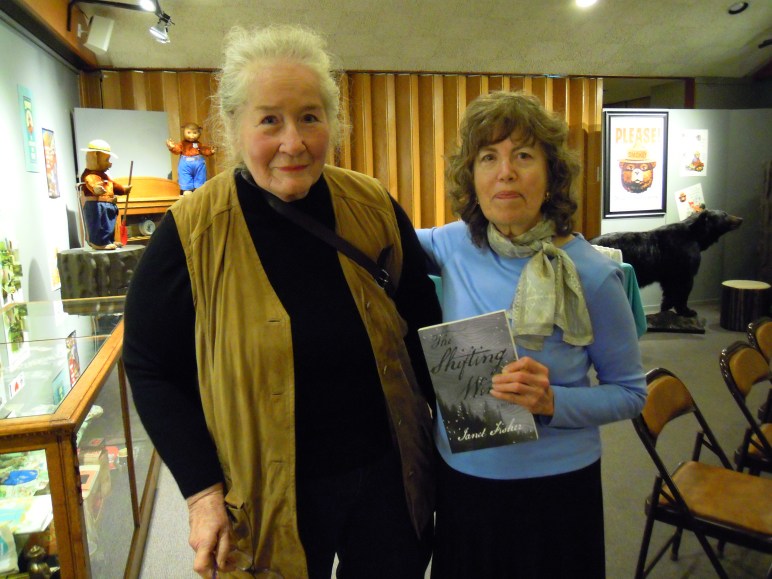
joyce and meThe highlight for me was having Joyce Abdill there, wife of the late George Abdill, the man who’d offered so much information that infused this book. That’s Joyce and me above. George was the first director of this museum where the event was held and my first source for several books I wrote about the pioneer and fur trade era. Joyce shared some stories about George and how they met.

Years ago Joyce also played a part in advancing my writing career, in that she helped me get my first two agents. As a sales rep in the book industry she knew people and helped make those connections. And while those agents did not sell my books, their acceptance of this early work gave me a hope that kept me going until I did finally break through into publication. I very much appreciate Joyce for that and for her encouragement. I was delighted to have her input at this event, not only her prepared remarks but her contributions to the Q & A. And we had a lot of fun chatting. I was glad to introduce her to some of my good friends there.

bear refreshmentsOur room for the event had a historic display of Smokey the Bear items, so as we entered the room we were greeted by a fine specimen of a black bear near the refreshment table. I knew he was there. I had visited a few days before, but I still stopped short when I walked into the room last evening and met him face to face.

But my biggest surprise of the evening was when a couple walked up, and the woman told me she was my roommate our freshman year at Oregon State. She moved to Roseburg a few years ago and had seen news of my books. I hadn’t seen her since we left college.

Robin took the photo of Joyce and me with my camera, and I took the bear shot.

COMMENT

Event Tonight at the Museum

I’ll be in Roseburg tonight at 6:30 for a reading and signing of my new book The Shifting Winds. I’m looking forward to this event at the Douglas County Museum where this book was essentially born.

900.DCMuseumWhen I decided to write the first of several pioneer/fur trade stories some years ago, I went to see the late George Abdill, first director of this museum, looking for information on my subject. As I noted in an earlier post, he was exactly the right guy to talk to. This was a favorite era of his and his knowledge set my course on these books, including The Shifting Winds. He gave me volumes of information on his own, and directed me to many books and other sources of information. My researches led me not only to the Douglas County Library, but to the Multnomah County and Oregon Historical Society libraries in Portland, the Clackamas Historical Society and McLoughlin House in Oregon City, the backroads around Oregon City, up the river to Champoeg, and to the reconstructed Fort Vancouver in Vancouver, Washington.

George profile jpgPhoto courtesy of Douglas County Museum

I will offer a brief tribute to George tonight, and to his wife, Joyce, who plans to be there and say a few words. Joyce also helped me by connecting me with my first two agents, and those agents gave me a sense of hope that one day I would find the breakthrough I needed to get a publisher. I am thankful to Joyce for that and for her continued encouragement.

Also tonight, with the help of my son-in-law Robin Loznak, I’ll present a running slide show of photos related to the story–Oregon Trail shots taken when I traveled east to Kansas City with my daughter and granddaughter and backtracked that harrowing trail, a few shots at Fort Vancouver the characters visit in the story, as well as pictures of the main setting of Oregon City and a couple of the story’s real-life characters, Joe Meek and Dr. John McLoughlin.  Then, just for fun, we’ll show photos from a signing event I had near the beginning of the Oregon Trail in Lexington, Missouri, when a shirttail cousin, reenactor Robbie Maupin, rode in with a band of Rough Riders to visit the event. The man does know how to make an entrance. In that small town that looked like a place out of the past, these riders helped take us back to a time close to the days of The Shifting Winds.

After the tribute to George and Joyce’s remarks, I’ll do a short reading from The Shifting Winds, then sign some books. I will also have copies of my first book, A Place of Her Own. If you purchased one of these books elsewhere and would like them signed, feel free to bring them and I’ll happily sign them too.

The event will last from 6:30 to 8:30, and folks at the museum will be offering refreshments of cookies and coffee. My thanks to Karen Bratton, Research Librarian and Collections Manager, for setting all this up, and to Museum Director Gardner Chappell. The museum seems a perfect venue for this book, which got its start there.

The event is open to the public. Welcome.

COMMENT


COUNTDOWN – 6 DAYS TO LAUNCH

Willamette Falls

As we continue the countdown to the launch of my new book, The Shifting Winds, today’s historical factoids focus on the developing settlement of Willamette Falls, soon to be named Oregon City, the first Euro-American settlement in Oregon’s Willamette Valley and the destination for many American settlers who would cross the Oregon Trail.

Society208-Clackamas County Historical Society Photo, All Rights Reserved

The above lithograph was created in the 1840s by lithographer J. H. Richardson who traveled to Oregon City during the settlement’s early days, one of several artists sent out to record images of the West during that period. The picture shows the bluff and the heavy forest above, which will become familiar to readers of The Shifting Winds.

A dramatic horseshoe-shaped falls gave the place its first name. Long before the white men came, the remarkable cascade drew Native American tribes like the Clowewallas, one of several Chinookan tribes who found excellent fishing at the site, and it became a place for the tribes to gather for trade. Some said the salmon were so thick a person could walk across the river on the salmons’ backs. Men built scaffolds right in the plunging water and climbed up to use spears and dip nets to catch fish struggling to leap the falls for the great return to their spawning grounds upriver.

When British fur traders entered the region they quickly recognized the potential power of the falls, and in 1829 Dr. John McLoughlin, HBC Chief Factor at nearby Fort Vancouver, laid out a two-square-mile claim at the site. By the time the characters of my story arrive, he’s in the process of building a sawmill on an island there.

The construction work brought HBC employees to the place which they called Willamette Falls. Then Americans began to arrive, and contentions stirred at this focal point, as well as across the Oregon territory. When the story opens in 1842, the Oregon country has been jointly occupied by the British and Americans for almost twenty years, because the two nations still can’t agree on a boundary. The British have been entrenched for years with their fur trading operations, and only a few Americans have trickled in—some missionaries, a few mountain men escaping a dying beaver trade in Rockies, and a scattering of emigrants who’ve come by land and sea.

Protagonist Jennie Haviland isn’t happy her father tore her away from her prestigious academy in Utica, New York, to come to this wilderness, but her one hope is that she’ll find a place she can call home in Willamette Falls. As she and her family follow their Indian guides through the dense woods to an overlook of the mighty cascade, she hopes to get her first view of this town. Awed by the spectacle of the falls, she can’t help admiring the beauty, but she doesn’t see a town, only some shacks on the island and a couple of log cabins with a few outbuildings on the flat bench of land below. Homes of isolated settlers? She turns to her father.

“‘But where is the town? Where’s Willamette Falls?’ She wanted to find the town of proper houses.

“The young guide mumbled to Pa again, and Pa nodded. ‘So that’s it,’ Pa said. ‘That’s our settlement.’

“Jennie scanned the tree-cloaked hills. ‘Where?’

“‘Those cabins are it.’ He pointed to the flat bench of land. . . .

“Jennie darted a quick look at the cabins on the flat, then jerked her head back to stare at Pa. ‘What do you mean?’”

NEXT: Mountain Men

COMMENT

COUNTDOWN – 7 DAYS TO LAUNCH

First Travelers on the Oregon Trail

The launch for my new historical novel, The Shifting Winds, is now seven days away, one week, and I plan to do a blog post each day from now until the day before the event. For each post I’d like to share some historical factoids that relate in some way to the book, from today’s brief overview of the first travelers on the Oregon Trail to bits of information on mountain men, the Hudson’s Bay Company, and other background elements that may work into a tapestry of color surrounding the story.

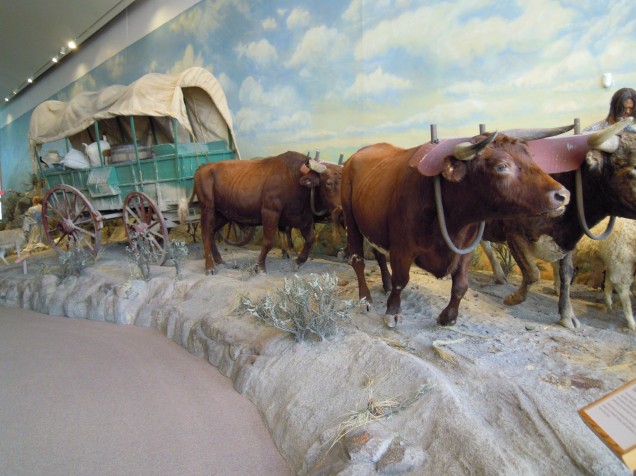
469.diorama oxen & wagonThe photo above was taken at the National Historic Oregon Trail Interpretive Center at Baker City, Oregon, a diorama showing a typical oxen-drawn wagon on the trail west.

Jennie Haviland, protagonist of The Shifting Winds, comes west across the Oregon Trail in 1842 with one of the earliest wagon trains of emigrants from the States. But fur traders first blazed that trail across the continent. As early as 1812 men employed by John Jacob Astor, founder of Fort Astoria, were probably the first white men to locate South Pass, a remarkably gentle passage across the otherwise rugged Rocky Mountains which made it possible for later emigrants to cross the Continental Divide with ease.

Missionaries began to make their way across the trail in the 1830’s, stopping along the way at the Rocky Mountain Rendezvous, the raucous summer gatherings of American mountain men and traders. In the words of mountain man Joe Meek in our story, “My heavens! That was the time fer big doin’s, mind ye, when the company sent out supplies, and after bein’ temperate all year, we let loose a mite, we did. A man would spend mebbe a thousand dollars a day on—” Jennie’s pa interrupts before Joe can say more.

The first white women to cross the trail, missionaries Narcissa Whitman and Eliza Spalding, traveled by wagon in 1836 with their husbands, Marcus Whitman and Henry Spalding. After a few days at the rendezvous, which must have brought a little shock to their sensibilities, they took the wagons as far as Fort Hall in what is now eastern Idaho, the first to take wagons that far. Beyond that point they used pack animals.

481.Ft Hll exterior

The picture above shows the Fort Hall replica my daughter, granddaughter, and I visited when we backtracked the trail taken by our ancestors.

By 1840 as beaver played out in the Rockies, the American mountain men held their last rendezvous and some headed for Oregon. Joe Meek and his friend Robert Newell managed to get three wagons from Fort Hall to Walla Walla, the first to take wagons overland as far as the Columbia River.

As promoters sang the praises of Oregon, hoping to gain the land with settlement, more emigrants dared take the trek. A fair-sized party of seventy or so left the States in 1841, but about half the party went to California, all of them leaving their wagons at Fort Hall.

That brings us to 1842 when just over a hundred emigrants took the journey, the group my fictional Haviland family joined. This group also left the wagons at Fort Hall and went by foot and horseback to the Columbia River, where some proceeded either by boat or raft down the river, while others like the Havilands took horses over the Cascade Mountains.

The story of The Shifting Winds opens as the family approaches their destination, Willamette Falls, soon to be named Oregon City. Jennie expects to see a thriving town there, a semblance of civilization in this godforsaken wilderness, but she has a few surprises in store.

NEXT: Willamette Falls

COMMENT

NEW BOOKS!!!

912.new.booksBoxes of books came today! What a thrill to actually hold one of these real books in my hands and flip through the pages. My good old story I have loved for so long. Now in print so other people can read it and come to know some of my favorite characters. And the books are beautiful! I love what the publisher did with the cover.

My agent emailed me over the weekend to tell me she had gotten her copies, so I suspected mine might come today. I gave a talk at my Roseburg writers’ group this morning and had to leave home before the books came. But when I got back they were waiting on the porch for me. Ah! What a sight!

Checking an old blog post, I see that boxes of my first book came early the month before the release date too. And for those of you who have pre-ordered The Shifting Winds from one of the online outlets, you may actually get your book before March 1. I don’t know, but I think people started getting them earlier last time.

Oh, what fun! This is one of those moments for a writer. Sheer pleasure. I am so looking forward to sharing. 🙂

COMMENT

Outtakes #9 – A Place of Her Own

This Outtake reveals another short bit taken from the end of an Oregon Trail scene at the top of p. 124 in A Place of Her Own. The Maupins have survived the precipitous drop down Laurel Hill and have just come into the rich prairies west of the Cascade foothills. The cut is just 176 words, but words are words. And I desperately needed to take more out. At least it gave me more in one fell swoop than the single filler words I snipped throughout the manuscript. Clip…..


The photo above, by Robin Loznak, appears in A Place of Her Own, illustrating Douglas Firs on the family farm. Similar trees of this species would have been growing in the area depicted in this scene, though no doubt larger than these. Pioneers trekking into what is now the State of Oregon found Doug firs some 300 feet tall. Two or three men could lie head-to-foot across the diameter of a stump from one of these giants that might have been as much as 800 years old.

~~~

Near evening a cabin appeared, nestled against a grove of firs at the edge of a broad meadow. The scent of a hearth fire reached Martha’s nose, and she took a long, satisfying breath of it. People began spilling out the cabin door, running toward the wayworn travelers. A man reached them first. He lifted his hat and rubbed a hand across his thin, curly hair. “Welcome to Oregon.”

A united but somewhat ragged thank you answered him back.

He introduced himself and his wife, who came up behind him, and Garrett introduced the family. The woman went straight to Martha and gripped both her hands. “My dear, what a journey for you. When are you due?”

“December.”

The woman smiled and nodded. “Oh, you’ll be settled by then. Come sit a spell and have some supper with us.”

“That’s so nice of you,” Martha said. “You must see a lot of travelers, living here.”

The woman laughed. “We do, and we love it. We all took that trip, God bless us, and we all understand.”

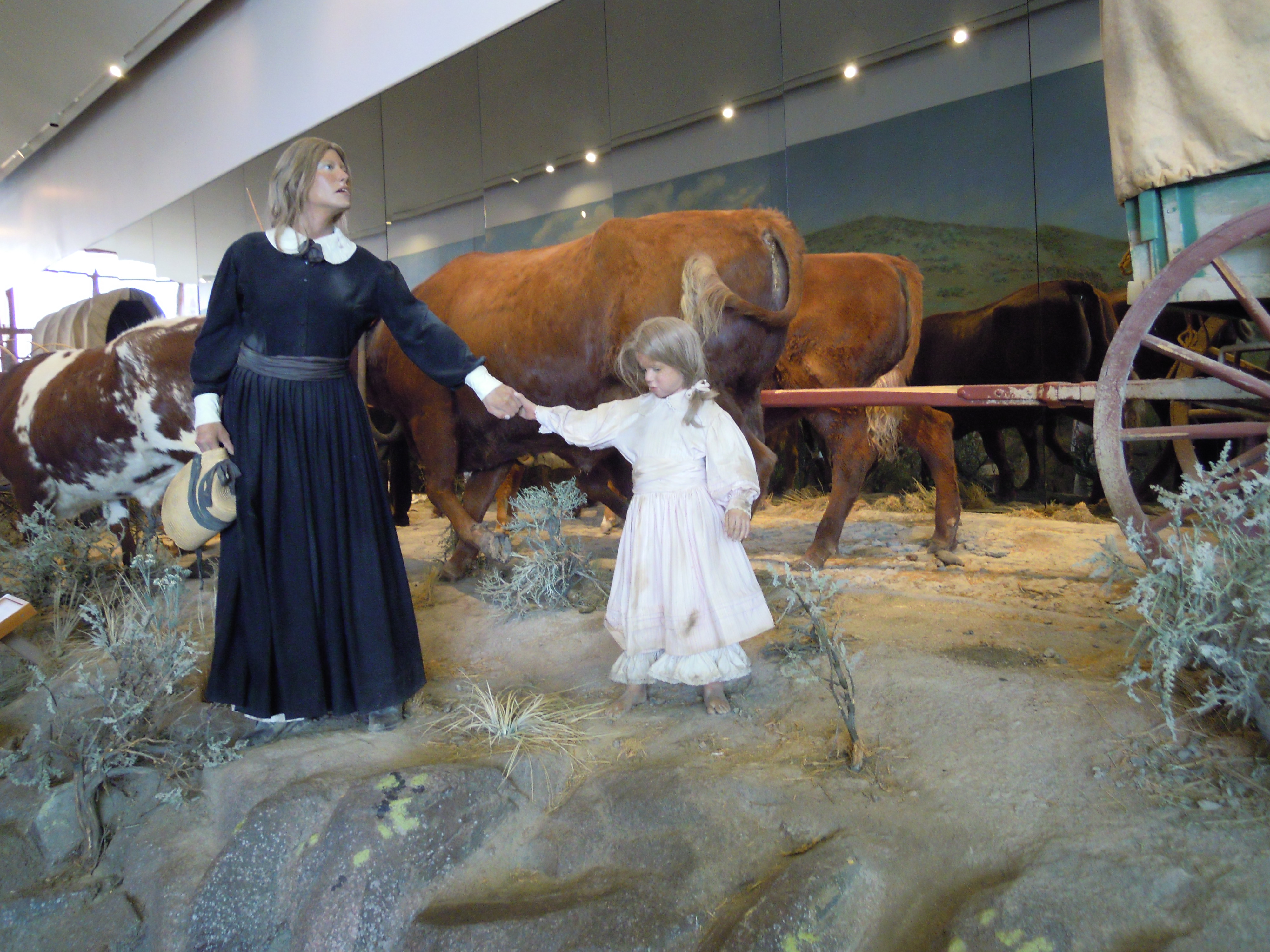
468.diorama mother & childThis photo taken at the Interpretive Center in Baker, Oregon, shows a part of the continuing diorama depicting a wagon train on the Oregon Trail. The woman makes me think of Martha and her little Nora, oldest of her two at the time. My heart tightens as I imagine the strain of traveling that perilous trail with such a precious, vulnerable child. Another even tinier. A third on the way. What a thrill to know in this short Outtake that they have almost made it through. Of course, Martha would have been full in her pregnancy by then.

COMMENT

Outtakes #8 – A Place of Her Own

Returning to my Outtakes series, this post includes another scene slashed from the Oregon Trail chapter of A Place of Her Own, except that a few lines of it were salvaged for a scene that did make the cut. Although there’s some excitement here you may enjoy, I snipped this because I didn’t feel I had an adequate picture of the scene in my mind, and I still needed to trim more words to reach the target word count. This gave me 415. Clip…..

469.diorama oxen & wagonThe photo was taken at the National Historic Oregon Trail Interpretive Center near Baker City, Oregon, one of the fine dioramas inside the center, which gives an authentic impression of that dusty trail.

~~~

Martha stumbled over the rocky road, Nora in one hand, Louisa in the other arm. The wagons jolted, wheels bumping over the rocks. Alkali dust covered everything. Garrett’s growing hair and beard looked white, matted with the white dust. He stopped the oxen and Martha stood where she was, covering her mouth in hopes of drawing clean air, but it didn’t work. Garrett poured water from his pouch onto a cloth, and wiped it over the noses of the oxen, cleaning off a little of the dust.

The animals nodded their massive heads, as if to thank him, and one nuzzled him a little. Old Bob loved to be stroked under his chin, and Garrett obliged for a moment. Zack raised his dust-smudged nose and snorted. He started forward, pushing past Garrett. The loose cattle caught whatever scent Zack smelled and moved ahead with the same urgency, passing Martha and the girls like a stream dividing around three stones.

She heard Garrett’s frantic voice. “Stop them! Don’t let them drink the water. It’s alkali. Stop them!”

“Come on,” Martha said to Nora, dragging her along.

The wagon held back the oxen from going faster than Martha on the rocky path, even with Nora in tow. She contemplated putting the children in the moving wagon, but what if the oxen tipped it over in their frenzy? Careful not to trip on a rock, she ran on. The loose cattle were all ahead now. Larry galloped up, then Newt, hooting and shouting, trying to turn them back. Martha worked her way around the outer edge until she was above the sickly looking water hole. She put the children on a big rock and climbed up after them. The cattle wouldn’t come up here, but she could yell at them from this high place.

She waved her arms and yelled as loud as she could, and the girls did the same, their high-pitched shrieks as loud as her shouts. Garrett was at the water, driving the poor creatures back. So thirsty. So desperate for water. But the alkali water could kill them in a matter of hours. The trail along here was littered with the bones of oxen and fresher dead beasts–along with discarded trunks and furniture . . . and another human grave.

A chill raked Martha despite the heat.

She yelled again, wanting to cry out her own despair, embracing the excuse, until finally the men turned the cattle and managed to move them on.

COMMENT

Outtakes #7 – A Place of Her Own

Continuing the Outtakes of words cut from A Place of Her Own before publication, we come to this short segment, which is an extension of the Oregon Trail scene that ends at the upper third of page 115. Martha knows she’s pregnant by this time, but she isn’t sure Garrett knows. Although I kept a few of these words, I clipped this description of lowering a wagon down a steep hill because there’s another more powerful scene of lowering a wagon down the longer, steeper Laurel Hill on pages 121-122. Also, before visiting the site I didn’t have a clear picture of the setting in mind and decided I’d better leave the scene out. More words cut. Word count dropping, dropping. Clip…..

520.Windlass HillWindlass Hill, the site of this scene, may not look so high or so steep, unless you think of getting a covered wagon down it. I took this photo on our 2014 family trip backtracking the Oregon Trail following the release of the book.

~~~

The higher [Martha] climbed, the more she could see the incredible landscape around them. . . . Garrett caught up with her just as she reached the top, and she stood aside to let him lead. He didn’t say anything. He said little these days that didn’t have to be said, as if the words might drain his energy and he had to save it all for the daily ordeals. She felt something of that herself. She could scarcely catch breath to breathe, let alone use it to talk.

She plodded after him across the high tableland, until the beaten wagon tracks seemed to lead right off into the sky ahead. Garrett stopped the wagon at the edge of the rim, and she hurried to his side. Her heart lunged when she looked down. The land dropped away in front of them in a long, steep bank. Surely he didn’t plan to go down here. But wide scraped tracks led right down the slope to a tree-filled hollow at the bottom.

Garrett unhitched the oxen and began to tie heavy ropes around the wagon’s axles. Larry brought her the children and went to help him. They locked the back wheels by sticking a pole through the spokes from one wheel to the other. Newt held the oxen until Garrett looped the ropes around their yokes. Then with the oxen behind, holding the wagon from falling, the men slowly let out the rope and lowered the cloth-topped vessel down the sandy incline. Martha didn’t think she breathed once until it settled, rocking a little, on the valley floor. But she must have.

“Let’s get down and get on our way,” Garrett said.

Larry motioned for Newt. “We’ll bring the cattle.”

“Help us with the girls first,” Garrett said, “and lead the oxen down. I’d better give Martha a hand.”

When he reached toward her, she took his hand, thankful for his firm grip as they scrambled down the bluff. Did he know the treasure she held inside her? She hadn’t spoken of it yet. Could he tell? If he’d marked the days and noticed her lack of monthlies, maybe he knew. But he hadn’t touched her in that way for so long, how would he? Every night they fell into bed exhausted. Maybe he remembered from before. Maybe he read it in her, the way he read other things of nature.

As soon as he had the oxen hitched again and heard the boys bringing the cattle, he started out once more. Martha had thought they might rest awhile in the pretty hollow, but they had a few hours of daylight. With the girls back in the wagon, she started after him, every step sending up a wave of pain, from her feet feeling every rock through the thinning soles of her boots, up into her ankles and knees.

~~~

517.ash hollow bluffAsh Hollow lay near Windlass Hill, but farther than I imagined when I wrote the scene, and clearly a more rugged drop from the high tableland. Water in the lovely Ash Hollow became known as a source of the dreaded cholera that ravaged emigrants trekking west. The Maupins were lucky to be spared this deadly disease.

COMMENT

Outtakes #6 – A Place of Her Own

This post concludes the opening scene cut from the Oregon Trail chapter of A Place of Her Own, picking up where last week’s post left off and showing one more setback in Martha’s dreams of an idyllic life with Garrett. Martha has just led her eldest brother Ambrose out to the shed where the family’s wagon awaits the long journey west, the cloth cover not yet attached. As noted for Outtakes #5, the scene is divided into two parts due to its length–more than 1,900 words total, the cutting of which helped me in my struggle to reduce the word count for this book. Clip….

464.two wagons


Martha tells her brother about the wagon Garrett built and all that she must do to have it ready for their trip west.

Photo taken by the author at the Interpretive Center at Baker City, Oregon.


Oregon Trail Preparations – Part II

Opening the shed door, she pulled it wide so the sun would cast a light on their prairie ship. The long narrow wagon bed was made of sturdy planks, but not heavy. “It’s tough wood,” she said. “But light enough the oxen can pull it over rough ground, and the yokes are light too.”

He ran his fingers across the joints. “Your husband does fine work.”

A glow flushed her cheeks at his compliment. “He’s particular about it.”

Wooden bows curved up from the wagon bed, ready for the cloth cover. “I have the cover almost done,” she said. “It’ll be two layers, a tougher linen for outside, softer muslin inside.” She showed him her calloused fingers. “It’s not easy to run stitches through that linen. I’ll be glad when it’s done. I’m making pockets on the inside to put things in. There’s so much to carry, but we can’t make it too heavy.”

He nodded. “Lots to think about.”

“Oh yes. Thoughts come to me, even in the night. I have to remember every little thing, this thing and another, and how I’m going to pack it so it’s safe. Ambrose, a person can die out there if they don’t have just what they need.”

“I suppose.”

“I still have to get the food ready and bags to hold it all.” She ticked off the list in her mind–hams and bacon, cheese, rice, coffee, tea, beans, flour, cornmeal, crackers, hard biscuits, lard, dried apples and peaches and prunes. They’d take cows with them and make butter on the way, maybe a couple of chickens in a crate. They’d need pickles to protect them from scurvy on the plains where they’d have no fresh fruits or vegetables. Garrett would bring in game.

She went on. “Besides the food, we need medicines–a box of physic pills, castor oil, peppermint, whiskey.” She also had clothes to make. A new flannel dress, some jeans pants for Garrett. New stockings to knit. More yarn for knitting on the trail. Dresses all cut out for the girls and some muslin shirts for Garrett, ready to pick up and sew when she had a spare moment along the way. Sarah Catherine and her mother had helped. It was good Sarah and young Perry would be staying with their mother.

Ambrose chuckled. “I can see your mind working now. You’ll be all right, Martha. A lot of people are going, and if they can make it you can. You have a good mind.” He rubbed a hand over the wagon’s smooth joints. “And your husband is–well, let’s say if I was going into the wilderness, I’d be happy to be in his company.”

She lifted her chin and glanced out the shed door. “He is a frontiersman, all right. You should see him in his buckskins when he goes out hunting, carrying that long rifle. I don’t remember a time he ever came home empty-handed.”

“You’ll be glad for that out on the prairies.”

Sugar nickered, and Martha went outside to see who she was talking to. The mare stood with head high, ears sharply forward, looking toward the big house. The distant sound of baying hounds echoed through the trees. Riders emerged. Garrett and the boys. Already. “They must have worked things out pretty fast.”

When the three came closer, she frowned. Garrett wasn’t riding with his usual flowing grace. He looked tight, out of rhythm with the horse. Galloping up to the cabin, he pulled his horse up short and swung to the ground, jaw clenched, eyes hard. Without looking at Martha, he led the animal straight to the shed and began unsaddling.

She hurried to his side. “What wrong?”

He kept his eyes on the cinch he was undoing, and his voice rasped with anger. “I’m not going anywhere with that bunch. We aren’t going this year.”

Martha looked at the new wagon, then back at her husband. “What do you mean?”

“Larry and Newt–they’re gonna go this year–just horseback, maybe take a packhorse, maybe not.”

Martha had been working so hard, hurrying to get it all done. She felt as if she’d been running across the grass and tripped on an unseen stone and the ground had come up to hit her in the face. Aware of her brothers walking up behind with their own horses, she turned to see if either of them could make sense of this for her.

Larry spoke before she could ask. “We’ll check out Oregon and let you know what we find.”

“But . . . but what happened with the Ray County company?”

“There were . . .” Larry shrugged. “. . . disagreements.”

“Can’t we find another company?” Martha’s voice rose. “We’ve done so much work to get ready, and with–”

Garrett cut her off. “Then we’ll be good and ready next year.” He gave the horse a rubdown, pulled some hay down from the loft of the shed and piled it on the ground, then stomped away, retreating into the house.

Martha stood staring after him, trying to take in what he’d said. She’d been uncertain about this trip in the first place, wondering about the timing, among so many other doubts. Louisa was a baby. It wouldn’t be easy with a baby as well as a toddler. Nora wouldn’t be three until September. And there was his pa’s estate. How could Garrett leave before that was settled? But when he insisted they would do the trip this year, she’d nursed her own wanderlust and actually developed a growing excitement about it. Now they were just going to drop the plan?

Larry put a hand on her shoulder. “It wouldn’t be good for Garrett to go with that company. They’re a persnickety bunch, all full of dos and don’ts, and you know how Garrett is.”

Newt let out a soft laugh. “I thought he was going to hit that guy when he–”

“Newt.” Larry’s sharp voice stopped his brother.

Martha pinched her brow, lifting her hands. “But can’t we find another company? Can’t we go over to St. Joseph or Independence–one of those jumping off places–like other folks do? Ray County isn’t far, and Garrett thought it’d be good to travel with folks from home, but other people go to those towns and find companies there.”

Larry shook his head, looking at the ground between them. “He seems to have his mind set. Besides, he says he’d better stay on account of the estate. It isn’t quite done yet.”

“The estate?” Martha said. “I asked him about that before and he shrugged it off. Now it’s important? Why? Because he’s mad at somebody?”

Larry’s eyes began to smile. “That’s about it.”

COMMENT

Outtakes #5 – A Place of Her Own

The following is part of a scene that originally opened the Oregon Trail chapter of A Place of Her Own, and now becomes a part of this Outtakes series of scenes cut from the book. The segment shows Martha with her oldest brother Ambrose, who moved from Illinois to Missouri sometime before the 1850 census. It’s a pleasant scene and tells about the preparations for that amazing trek west to Oregon. But altogether it’s over 1,900 words, and it didn’t move the story sufficiently to hold its place. This was the cut that convinced me I could actually trim the book by the necessary 22,000 words. Yay! Clip…..

Note: I’m dividing the scene into Part I and Part II because it’s so long.

464.two wagons


Garrett built a wagon like this for their family, and Martha sewed the cover.

Photo taken by the author at the National Historic Oregon Trail Interpretive Center at Baker City, Oregon.


Oregon Trail Preparations – Part I

Ray County, Missouri, April 1849. Their small Missouri cabin echoed with quiet as Martha sat next to her oldest brother Ambrose before the low fire. Only the steady whisk of the rockers sounded above the soft snap of coals as Ambrose leaned back in Martha’s rocking chair and moved slowly back and forth, while she perched on the edge of a stool and poked at the fire. The homey scent of the hearth wafted through the room.

Garrett had left for town with Larry and Newt, while Ambrose stayed behind with her. “They didn’t need me,” Ambrose said. “I thought this was a good chance to visit with you.”

Garrett and the boys went to talk with some folks who were trying to put together a company from Ray County to travel together to Oregon. Martha was glad Ambrose rode over from Carroll County with the younger two. Although she regretted Doc didn’t join them, she appreciated a chance to spend time with her oldest brother.

Larry and Newt had come to Missouri early this spring, still full of excitement about Oregon. A veritable land of milk and honey, to hear them tell it. Garrett wanted to sell the Missouri place and get on his way. But it wasn’t that easy.

Ambrose and his wife Polly had finally moved to Missouri the year before and lived with their family in the cabin Simpson built for himself on Doc’s second forty over in Carroll County. Oregon fever hadn’t quite hit Doc or Ambrose, but Martha had trouble imagining her next step west without Doc.

Garrett had been working on him. “The future’s in Oregon, Doc. Too many people in Missouri.”

“Well, there’s California.”

Last December when President Polk confirmed rumors about gold in California, Martha had seen the sudden glint in Garrett’s eyes, as if reflecting a bit of that gold.

“Not the best place for families, though,” Doc had said.

Now, glancing at their new baby Louisa in her cradle, born that very month of December, Martha remembered wondering if Garrett might just go without her and the girls. But his talk still focused on Oregon.

She smiled at Ambrose. A soft-spoken man, he exuded a kind of self-assurance that put her at ease, a trace of gray in his beard and hair giving him a distinguished look. “I’m glad you’re here,” she said, meaning it more than she knew how to say. He’d been like a pa to her these last few months, now that their own pa was gone. Heaving a sigh, she stood and looked out the gleaming glass window of her cabin to the pasture where her mare Sugar grazed, Howard’s gift. “I wish I could have been there when Pa went. And Ma, so soon after. Do you think they ever forgave me?”

“They loved you.”

A heavy band seemed to tighten across her chest. “I know, but did they forgive me?”

She turned to see her brother’s gentle expression, the warmth in his eyes, the slightest curve of his lips as he spoke. “It’s hard to say with them. You know they never said a lot about things like that. But you can’t change it now, Martha.”

She looked out at Sugar again. “No.”

“I’ve no doubt Doc thought he was in the right to give your consent. Pa did tell him he had full responsibility for you. I heard him. Now, Pa may not have thought through what that could mean, but he said it.” Ambrose got up and came to her, setting a tender hand on her shoulder. “It isn’t easy to get through life without some trials with those you love. But when it’s done and you can’t do any more about it you can’t dwell on the trials–just the love. Somehow I think they understand now.”

Martha batted her eyes, moist with tears. “You boys all scattered soon after, didn’t you? You came here, now Larry and Newt.”

“And Simpson followed Stephen to Scott County. I don’t know what Ben will do.”

Lifting her shoulders high, then dropping them, Martha turned and grasped Ambrose’s arm. “Let me show you what we’ve done to get ready for Oregon. It’s going to be an amazing trip, Ambrose. I wish you’d think about it.”

He laughed, a hand on his soft beard. “I’ll think about it, but I hear they need a Justice of the Peace in Carroll County, and I think I’ll give that a try for now.”

“Justice of the Peace?” She smiled. “You’d be good at that. Come on outside. I’ll show you the wagon.” She tiptoed over to where the girls were napping–Louisa in the cradle, Nora on the small mat beside. Sleeping soundly. Nodding to Ambrose, she slipped out of the cabin to lead him to the shed out back, leaving the cabin door open so she could hear if the girls woke. “They should sleep awhile longer. Come see. We’ve done a lot of work already.”

Part II next week…

COMMENT