Outtakes #6 – A Place of Her Own

This post concludes the opening scene cut from the Oregon Trail chapter of A Place of Her Own, picking up where last week’s post left off and showing one more setback in Martha’s dreams of an idyllic life with Garrett. Martha has just led her eldest brother Ambrose out to the shed where the family’s wagon awaits the long journey west, the cloth cover not yet attached. As noted for Outtakes #5, the scene is divided into two parts due to its length–more than 1,900 words total, the cutting of which helped me in my struggle to reduce the word count for this book. Clip….

464.two wagons


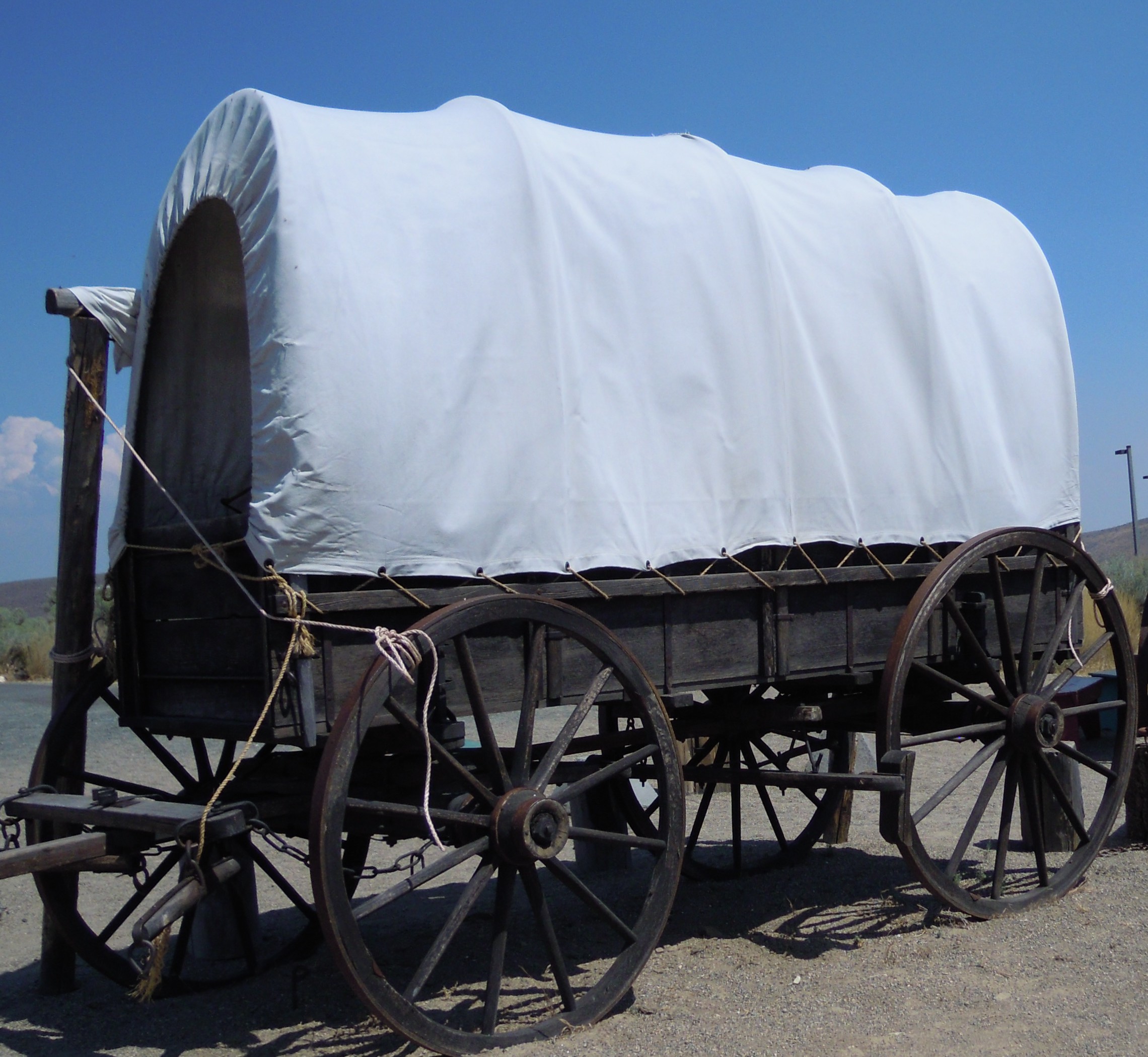
Martha tells her brother about the wagon Garrett built and all that she must do to have it ready for their trip west.

Photo taken by the author at the Interpretive Center at Baker City, Oregon.


Oregon Trail Preparations – Part II

Opening the shed door, she pulled it wide so the sun would cast a light on their prairie ship. The long narrow wagon bed was made of sturdy planks, but not heavy. “It’s tough wood,” she said. “But light enough the oxen can pull it over rough ground, and the yokes are light too.”

He ran his fingers across the joints. “Your husband does fine work.”

A glow flushed her cheeks at his compliment. “He’s particular about it.”

Wooden bows curved up from the wagon bed, ready for the cloth cover. “I have the cover almost done,” she said. “It’ll be two layers, a tougher linen for outside, softer muslin inside.” She showed him her calloused fingers. “It’s not easy to run stitches through that linen. I’ll be glad when it’s done. I’m making pockets on the inside to put things in. There’s so much to carry, but we can’t make it too heavy.”

He nodded. “Lots to think about.”

“Oh yes. Thoughts come to me, even in the night. I have to remember every little thing, this thing and another, and how I’m going to pack it so it’s safe. Ambrose, a person can die out there if they don’t have just what they need.”

“I suppose.”

“I still have to get the food ready and bags to hold it all.” She ticked off the list in her mind–hams and bacon, cheese, rice, coffee, tea, beans, flour, cornmeal, crackers, hard biscuits, lard, dried apples and peaches and prunes. They’d take cows with them and make butter on the way, maybe a couple of chickens in a crate. They’d need pickles to protect them from scurvy on the plains where they’d have no fresh fruits or vegetables. Garrett would bring in game.

She went on. “Besides the food, we need medicines–a box of physic pills, castor oil, peppermint, whiskey.” She also had clothes to make. A new flannel dress, some jeans pants for Garrett. New stockings to knit. More yarn for knitting on the trail. Dresses all cut out for the girls and some muslin shirts for Garrett, ready to pick up and sew when she had a spare moment along the way. Sarah Catherine and her mother had helped. It was good Sarah and young Perry would be staying with their mother.

Ambrose chuckled. “I can see your mind working now. You’ll be all right, Martha. A lot of people are going, and if they can make it you can. You have a good mind.” He rubbed a hand over the wagon’s smooth joints. “And your husband is–well, let’s say if I was going into the wilderness, I’d be happy to be in his company.”

She lifted her chin and glanced out the shed door. “He is a frontiersman, all right. You should see him in his buckskins when he goes out hunting, carrying that long rifle. I don’t remember a time he ever came home empty-handed.”

“You’ll be glad for that out on the prairies.”

Sugar nickered, and Martha went outside to see who she was talking to. The mare stood with head high, ears sharply forward, looking toward the big house. The distant sound of baying hounds echoed through the trees. Riders emerged. Garrett and the boys. Already. “They must have worked things out pretty fast.”

When the three came closer, she frowned. Garrett wasn’t riding with his usual flowing grace. He looked tight, out of rhythm with the horse. Galloping up to the cabin, he pulled his horse up short and swung to the ground, jaw clenched, eyes hard. Without looking at Martha, he led the animal straight to the shed and began unsaddling.

She hurried to his side. “What wrong?”

He kept his eyes on the cinch he was undoing, and his voice rasped with anger. “I’m not going anywhere with that bunch. We aren’t going this year.”

Martha looked at the new wagon, then back at her husband. “What do you mean?”

“Larry and Newt–they’re gonna go this year–just horseback, maybe take a packhorse, maybe not.”

Martha had been working so hard, hurrying to get it all done. She felt as if she’d been running across the grass and tripped on an unseen stone and the ground had come up to hit her in the face. Aware of her brothers walking up behind with their own horses, she turned to see if either of them could make sense of this for her.

Larry spoke before she could ask. “We’ll check out Oregon and let you know what we find.”

“But . . . but what happened with the Ray County company?”

“There were . . .” Larry shrugged. “. . . disagreements.”

“Can’t we find another company?” Martha’s voice rose. “We’ve done so much work to get ready, and with–”

Garrett cut her off. “Then we’ll be good and ready next year.” He gave the horse a rubdown, pulled some hay down from the loft of the shed and piled it on the ground, then stomped away, retreating into the house.

Martha stood staring after him, trying to take in what he’d said. She’d been uncertain about this trip in the first place, wondering about the timing, among so many other doubts. Louisa was a baby. It wouldn’t be easy with a baby as well as a toddler. Nora wouldn’t be three until September. And there was his pa’s estate. How could Garrett leave before that was settled? But when he insisted they would do the trip this year, she’d nursed her own wanderlust and actually developed a growing excitement about it. Now they were just going to drop the plan?

Larry put a hand on her shoulder. “It wouldn’t be good for Garrett to go with that company. They’re a persnickety bunch, all full of dos and don’ts, and you know how Garrett is.”

Newt let out a soft laugh. “I thought he was going to hit that guy when he–”

“Newt.” Larry’s sharp voice stopped his brother.

Martha pinched her brow, lifting her hands. “But can’t we find another company? Can’t we go over to St. Joseph or Independence–one of those jumping off places–like other folks do? Ray County isn’t far, and Garrett thought it’d be good to travel with folks from home, but other people go to those towns and find companies there.”

Larry shook his head, looking at the ground between them. “He seems to have his mind set. Besides, he says he’d better stay on account of the estate. It isn’t quite done yet.”

“The estate?” Martha said. “I asked him about that before and he shrugged it off. Now it’s important? Why? Because he’s mad at somebody?”

Larry’s eyes began to smile. “That’s about it.”
COMMENT

Outtakes #5 – A Place of Her Own

The following is part of a scene that originally opened the Oregon Trail chapter of A Place of Her Own, and now becomes a part of this Outtakes series of scenes cut from the book. The segment shows Martha with her oldest brother Ambrose, who moved from Illinois to Missouri sometime before the 1850 census. It’s a pleasant scene and tells about the preparations for that amazing trek west to Oregon. But altogether it’s over 1,900 words, and it didn’t move the story sufficiently to hold its place. This was the cut that convinced me I could actually trim the book by the necessary 22,000 words. Yay! Clip…..

Note: I’m dividing the scene into Part I and Part II because it’s so long.

464.two wagons


Garrett built a wagon like this for their family, and Martha sewed the cover.

Photo taken by the author at the National Historic Oregon Trail Interpretive Center at Baker City, Oregon.


Oregon Trail Preparations – Part I

Ray County, Missouri, April 1849. Their small Missouri cabin echoed with quiet as Martha sat next to her oldest brother Ambrose before the low fire. Only the steady whisk of the rockers sounded above the soft snap of coals as Ambrose leaned back in Martha’s rocking chair and moved slowly back and forth, while she perched on the edge of a stool and poked at the fire. The homey scent of the hearth wafted through the room.

Garrett had left for town with Larry and Newt, while Ambrose stayed behind with her. “They didn’t need me,” Ambrose said. “I thought this was a good chance to visit with you.”

Garrett and the boys went to talk with some folks who were trying to put together a company from Ray County to travel together to Oregon. Martha was glad Ambrose rode over from Carroll County with the younger two. Although she regretted Doc didn’t join them, she appreciated a chance to spend time with her oldest brother.

Larry and Newt had come to Missouri early this spring, still full of excitement about Oregon. A veritable land of milk and honey, to hear them tell it. Garrett wanted to sell the Missouri place and get on his way. But it wasn’t that easy.

Ambrose and his wife Polly had finally moved to Missouri the year before and lived with their family in the cabin Simpson built for himself on Doc’s second forty over in Carroll County. Oregon fever hadn’t quite hit Doc or Ambrose, but Martha had trouble imagining her next step west without Doc.

Garrett had been working on him. “The future’s in Oregon, Doc. Too many people in Missouri.”

“Well, there’s California.”

Last December when President Polk confirmed rumors about gold in California, Martha had seen the sudden glint in Garrett’s eyes, as if reflecting a bit of that gold.

“Not the best place for families, though,” Doc had said.

Now, glancing at their new baby Louisa in her cradle, born that very month of December, Martha remembered wondering if Garrett might just go without her and the girls. But his talk still focused on Oregon.

She smiled at Ambrose. A soft-spoken man, he exuded a kind of self-assurance that put her at ease, a trace of gray in his beard and hair giving him a distinguished look. “I’m glad you’re here,” she said, meaning it more than she knew how to say. He’d been like a pa to her these last few months, now that their own pa was gone. Heaving a sigh, she stood and looked out the gleaming glass window of her cabin to the pasture where her mare Sugar grazed, Howard’s gift. “I wish I could have been there when Pa went. And Ma, so soon after. Do you think they ever forgave me?”

“They loved you.”

A heavy band seemed to tighten across her chest. “I know, but did they forgive me?”

She turned to see her brother’s gentle expression, the warmth in his eyes, the slightest curve of his lips as he spoke. “It’s hard to say with them. You know they never said a lot about things like that. But you can’t change it now, Martha.”

She looked out at Sugar again. “No.”

“I’ve no doubt Doc thought he was in the right to give your consent. Pa did tell him he had full responsibility for you. I heard him. Now, Pa may not have thought through what that could mean, but he said it.” Ambrose got up and came to her, setting a tender hand on her shoulder. “It isn’t easy to get through life without some trials with those you love. But when it’s done and you can’t do any more about it you can’t dwell on the trials–just the love. Somehow I think they understand now.”

Martha batted her eyes, moist with tears. “You boys all scattered soon after, didn’t you? You came here, now Larry and Newt.”

“And Simpson followed Stephen to Scott County. I don’t know what Ben will do.”

Lifting her shoulders high, then dropping them, Martha turned and grasped Ambrose’s arm. “Let me show you what we’ve done to get ready for Oregon. It’s going to be an amazing trip, Ambrose. I wish you’d think about it.”

He laughed, a hand on his soft beard. “I’ll think about it, but I hear they need a Justice of the Peace in Carroll County, and I think I’ll give that a try for now.”

“Justice of the Peace?” She smiled. “You’d be good at that. Come on outside. I’ll show you the wagon.” She tiptoed over to where the girls were napping–Louisa in the cradle, Nora on the small mat beside. Sleeping soundly. Nodding to Ambrose, she slipped out of the cabin to lead him to the shed out back, leaving the cabin door open so she could hear if the girls woke. “They should sleep awhile longer. Come see. We’ve done a lot of work already.”

Part II next week…

COMMENT

Outtakes #4 – A Place of Her Own

Today’s post continues my series of scenes that were cut from the book A Place of Her Own before its publication. In each of the scenes from my point of view I always started at a particular special place on the farm, where my thoughts would lead me to Martha and her situation. Then I would open Martha’s next chapter in the same location with her remembering back to her story. The editor found this too contrived, which it was. We changed that format. But I still like some of the descriptions of the places, like this one, and I believe my traipsing across the farm to these places, and thinking of Martha at each one, helped me get closer to her, even if many of those descriptions were cut. Clip…..

Janet and William


My kids’ good old dog William resting with me on the bluff.

Photo by Robin Loznak


The bluff, September 2010. I hopped onto the outcropping of large flat boulders overlooking a steep drop to the valley floor. Moss formed a patchy carpet on the stones, tufts of grass filling the crevices. I smiled. The bluff brought back memories of games my sister, Nancy, and I used to play. We would lie down at the edge of the overhang and keep watch on happenings below, filling our minds with imagined danger and excitement.

My daughter Carisa, with me today, stepped up beside me. An entire summer had passed since last I wandered the hills and fields of the farm seeking special places Martha might have walked in order to know this new land of hers.

Now it was fall. The first fall rains had come, but it was supposed to be clearing again, heading into the usual warm Indian summer. Dark gray clouds boiled overhead with a few bits of blue offering promise. Our coats still felt damp from the shower that caught us on our way here. I thought about Martha and the wanderlust that brought her to this place–her husband’s, but probably hers as well. What kind of danger and excitement did she face?

The soft, moist air wrapped around us as we stood on this hillside overlook, screened by the oak and myrtle trees that enclosed the bluff, giving it a pleasant feeling of seclusion, as if we could see out but might be comfortably hidden from any watchers outside. A young twisted oak stood directly out from the rimrock, offering glimpses between its branches of the lower fields and the wide green river flowing gently past. A grassy bench of land swept up from the bluff to the right, while a bank rose sharply behind, adding to our sense of enclosure.

In years past my sister and I used to take a trail to get here, a narrow animal trail that bit into an almost perpendicular hillside on our left. This time Carisa and I had taken the newer, easier route from the other direction, coming up a steep logging road, the Tree Farm Road, where a sign on the gate marked our designation as a certified Tree Farm.

In fact, before I could start the rough draft of this book I had to stop and write a new timber management plan and have the operation reviewed in order to be certified as my father had been. More than once, farm needs would pull me away from this story focused on the farm.

Did Martha come up here? Did she stand on these mossy rocks and contemplate the journey of her life that brought her to this lovely wilderness so terribly far from home? Whatever happened to her parents, Thomas and Maxy Poindexter? I doubt she ever saw them after that trip to Illinois for the birth of Leonora, a birthplace recorded by multiple census records that let me know Martha made the trip to have the child there. . . .

Questions haunted me as I plunged forward with this project. With other books, I’d often had the eerie feeling that stories were coming to me from somewhere–or someone–outside myself. I would set up a framework and ideas would flood in. That feeling hit much stronger this time, as if the messenger were closer to me. I wished whoever was sending these messages would refrain from flooding me with them at four in the morning. But I knew well that state of openness on the edge of sleep before the doubts of an awakened mind rose, letting the stuff of dream and spirit enter in.

COMMENT

Outtakes # 3 – A Place of Her Own

In the third outtake from Martha’s story, A Place of Her Own, the scene takes place at the end of Chapter 5, “Home and War,” showing Martha’s visit back in Illinois with her parents. It’s the good-bye scene with the parents, which I found had many similarities with the greeting scene for that visit, the wording so alike I was struggling to show the difference, then realized I could simply summarize the scene at the beginning of the next chapter and cut 559 more words. And no more struggling over pesky words that wouldn’t come together for me. So, clip…..

Book cover - A Place of Her Own

~~~

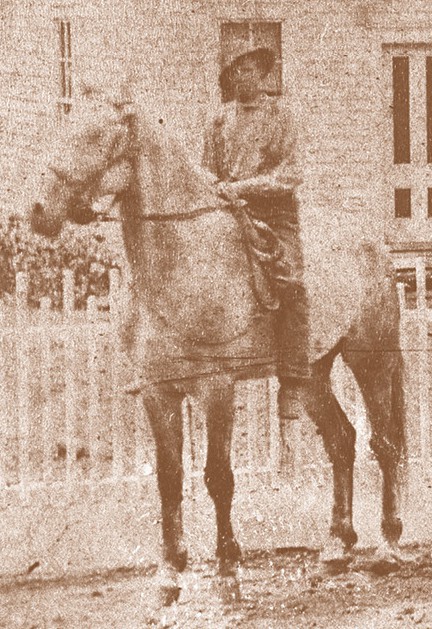
The horse and rider at right will look familiar to folks who’ve seen the book jacket of A Place of Her Own. I pulled this out of the old photo on the cover. It shows Martha and Garrett’s eldest son Cap outside Martha’s house at the farm, and I put it here to reflect an image. In my research I found no photo of Garrett, although military records and family legend describe him well enough that I can easily imagine him resembling Cap. And both men were known to be excellent horsemen. As Martha rides away with Garrett in the scene below, I draw from this image to envision him.

~~~

Garrett could not be held back more than a day and Martha had to face the wrenching pain of separation again, this time with her family, who’d grown even more dear to her during this visit. After tearful good-byes all around to her siblings and their families, she walked with Garrett down the little trail to the small cabin in back, holding Nora tight in her arms.

When Ma opened the door, Martha smiled, wishing for a smile in return and seeing only a flicker. “We have to go now, Ma.” Her mother wouldn’t quite look at her, wouldn’t reveal either warmth or coldness in her clear gray eyes.

“Mam-ma,” Nora said, waving her arms, and Ma reached out to take the child, holding her close and nuzzling the feathery blond hair. Ma took the child to Pa, who was sitting on the bed, and let him hold her.

“How’s my girl,” he said, pulling a handkerchief from his pants pocket to wipe the corner of his eye.

When he looked up at Martha, she sought the flash of warmth she’d seen from time to time, when he seemed to forget how angry he was with her, but like Ma he appeared to be hiding behind a mask, making his face difficult to read. She would have reached down to embrace him, but he held the child as a shield. Finally she took Nora in one arm and patted his shoulder with the other. “Good-bye, Pa.” He looked so weak. Would she ever see him again? But Ma was strong. Maybe another day they’d have time to put their differences behind them.

Garrett spoke up finally, his voice taut. “Good-bye, then.”

Martha gave her ma a one-armed hug, still seeking her eyes, but Ma kept her focus low. For the briefest moment she did look up, and her pain struck Martha. Tears glittered. Martha leaned forward to press a cheek against hers, then drew away. “I love you, Ma–and you, Pa. I . . . really have to go now.” Her voice broke on the last words, and she turned away, following Garrett out to where Newt held their horses.

Garrett mounted first and reached for Nora, perching her on the saddle in front of him. “She’ll be safer here.”

Nora’s shriek rent the air. He tried to soothe her, but she reached for her mother, tears washing her bright red face. She wasn’t having a bit of this arrangement. “I’d better take her with me,” Martha said.

Garrett’s jaw tightened, but he waited for Newt to help Martha onto her sidesaddle, then handed the screaming child to her. Martha did her best to tuck the child on the saddle in front of her. This was going to be a long ride.

They bid Newt good-bye, waved to the others waiting on the porch, and rode out, Nora still shaking with soft sobs. Martha could scarcely contain her own emotions. With every step the horse took, she was moving farther and farther from her beloved family. She looked back once, and blinked at the tears. Would she ever see them again? Ever heal the breach with her beloved ma and pa? Or had time ended all chance of that? She turned and glanced at Garrett, then Nora, ahead to her future, and didn’t want to answer those questions.

COMMENT

Outtakes #2 – A Place of Her Own

Originally I interspersed every one of Martha’s chapters with a short chapter from my own viewpoint, showing my return to the farm as well as my search for Martha. The editor liked my search, but not the return. This is part of an early scene of mine showing my family’s own struggles as we prepared to move to Martha’s farm. In general, I will try to post only the parts of scenes not included in the published version, although sometimes there may be a slight overlap. Thus, the posts may sometimes feel as if they’ve picked up in the middle of a conversation. Clip…..

Outtakes No. 2


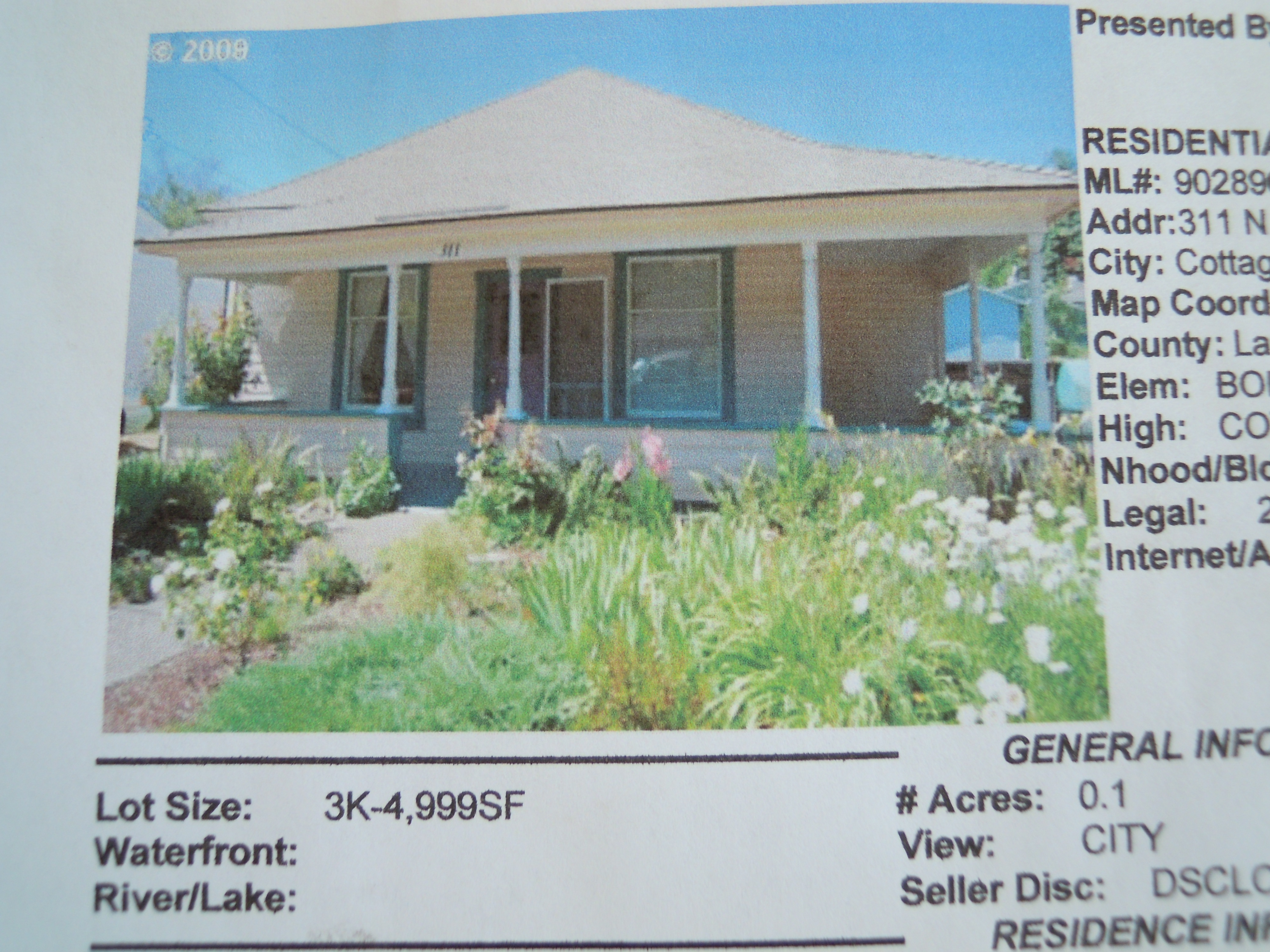
Here’s the Cottage Grove house going on the market.


Before any of us could move here [to the farm] . . . we needed houses to live in. Had I known it would take so long I might have bought a bigger house in Cottage Grove when I moved there a few years ago after it became clear my dad needed me closer. At that time I lived alone and the twelve hundred square feet of my Victorian cottage there seemed perfect for me. After my dad died and we reached a decision that I would keep the farm and Carisa and her family would move here from Montana, we knew we would need a second house and some restoration on the old farmhouse.

Soon after the decision Carisa’s husband, Robin, got a job in Roseburg, a town in somewhat the opposite direction as Cottage Grove. Photojournalism jobs being rare, he felt he should take the job, even though the farmhouse wasn’t ready for them. The builder thought it would take a couple of months to have it done. We decided Carisa’s family could move in with me–the three of them, their two dogs, one cat and one fish. I had already acquired my other daughter’s dog. Robin would commute between Cottage Grove and Roseburg. Surely we could manage for two months.

But the two months stretched longer. I was anxious to get my own house started. Though relatively close, Cottage Grove was still forty miles from the farm, and it wasn’t easy to manage a farm from that distance. Fortunately, someone was close by to look out for things. Ed Cooley, the man who had worked with my dad since the 70s, was still renting cattle pasture from me and helping with the harvests and other tasks. From all those years working beside my dad, he knew more than I ever would about how things worked on this farm. Ed was one good reason my dad was able to stay on the farm into his late years, and one good reason I dared take it on when my dad died.

Anyway, two months in my little cottage became three, four, five. The cottage felt even smaller. Tempers flared. The fish couldn’t take it. He died. I could scarcely think, let alone manage. Having lived alone for almost twenty years I was used to my own space. And my daughter was used to running her own household. She was homeschooling Alex in the large country kitchen, the buffet in there given over to the paraphernalia necessary for that.

For a while we ate dinners in the dining room, which had become their bedroom, but that required folding up their futon every morning. We ended up eating at my little table in the corner of the kitchen, a perfect 30-inch-square table for me, but the four of us had trouble fitting around it.

Alex, at eleven, missed his friends and railed against Grandma’s stricter house rules. Articulate and dramatic, he would explode from time to time. “I can’t live like this anymore.”

Their big golden lab slunk off the couch whenever he saw me, head low, eyes guilty, knowing he wasn’t allowed there. The other little dog never understood. I had to put away all my breakable treasures to protect them from the lively cat that easily jumped to any height indoors.

While we struggled in our cramped space, I also needed to get this Cottage Grove house sold so I could afford to build my new house at the farm. This was summer 2008. House prices were trembling. I felt growing desperation to get mine on the market soon, but knew it wouldn’t show well with our menagerie in it. Finally after seven months, we told the builder my kids were moving into the farmhouse, ready or not. It was time to start the other house. That caused some consternation for the builder, as he contemplated having to work around the family and their menagerie to finish the job, but they made the move. Work soon began on the new house.

I had about three months of quiet in Cottage Grove–if you can count having a house on the market quiet, and running back and forth to a forty-mile-distant farm. Then my other daughter and granddaughter came to live with me. My small cottage became cramped again. We had to scurry every time our real estate agent wanted to show the house, with toys to pick up, the accumulations of too many people stuffed into too-small closets.

Time stretched while the new house on the hill took form. . . . After a year, during the near collapse of the housing market, the Cottage Grove house finally sold. Again I explained to the contractor we were moving in, ready or not. The move happened, and finally, with all my family around me in a lot more space, I was here to enjoy what Martha bought over one hundred forty years ago.

Note: My son-in-law Robin shared the magic of his photography in A Place of Her Own with pictures of the family farm. If you missed the tribute to Robin on my blog, or want to see the post again, click Spotlight on the Photographer to find it.

COMMENT

Outtakes #1 – A Place of Her Own

Outtakes is a new category for my blog, as explained in my most recent post. In the next few weeks I will be posting scenes which were cut from my book A Place of Her Own. I’ll present the cut scenes in order, some from Martha’s chapters, some from mine. This first scene comes right after the ferry crossing of a flooding Missouri River at the end of Chapter One. I cut this scene to keep the story moving quickly toward the meeting of Martha and Garrett. It was an action scene following an action scene. We just had the exciting crossing, which I thought was stronger, and let this one go. It reduced the word count by 752 words. Clip….

outtakes longshot


Scene gets the red-line treatment here in my office.


Martha fought back panic as they raced against the river to load up household goods to take them to higher ground. She and her brothers had been with William and his wife, Eliza, and their family for several days and hadn’t seen a clear day yet. This morning, with the river right at bank full, William’s family had started moving out. They’d taken several loads so far. William’s smaller children and their two dogs were already with friends in town in Carrollton, Carroll County’s foremost town and county seat, which stretched above a soft-edged bluff overlooking the bottoms.

Martha held onto one side of a canvas tarp Eliza was trying to draw over their wagon load, while their nine-year-old son, Will Jr., worked to tie the tarp down. Rain-borne wind grabbed at the billowing canvass and whipped it out of Martha’s grasp. Little Will threw his small weight over it and helped her take hold of her edge again. She could scarcely see for the water dripping down her face.

“That’s good,” Eliza said. “I think we have it.”

Doc and Simpson pulled up their own small cart, and William rushed inside, returning quickly with an armload of blankets and pans.

Distant cries sounded. “Water coming across the bottoms . . . need to get out . . . now!”

William straightened and stared toward the river. “We have to go.”

The animals strained to make their way across the spongy soil. Wheels bogged down, and the men worked to pry them out, while Martha, Eliza and Will tugged at the teams to encourage them forward. Martha glanced back. She could see a thin line of water this side of the trees that had bordered the river. Now the river knew no borders. She took a sudden intake of breath. “How fast will it rise?”

Eliza shook her head. “I don’t know. I’ve never seen it like this.”

They could only progress in stops and starts. Their refuge of soft low hills looked so far. But the river kept closing in. Martha’s heart beat a jolting rhythm. How would they ever outrun the river?

Through driving rain they staggered on, until Martha saw little but the next muddy pool, and the next. Then she realized they were climbing. They had reached the bluffs. Looking up, she saw the growing city of tents being laid out beside Carrollton. She headed straight for their own tent perched near the outer edge. Hope swelled in her and gave her the energy to climb. Daring a glance back, she saw that the river had risen as much as halfway across the bottoms, maybe more. A latent burst of urgency drove her, and she scrambled on up the slope to the tent.

She wanted to crumple onto the ground, but they had work to do. Wagons had to be unpacked, animals tended. But before she put her hand to any of it, clusters of men appeared. Many hands reached out, lifted, carried, tidied. William and her brothers staked out the animals, and William excused himself, ready to walk with Eliza to the home of the friends taking care of their children. Eliza would stay with those friends until this was all over.

Before leaving she grasped Martha’s hand. “Are you sure you won’t go with me and stay in a nice snug house?”

Martha smiled, glancing at the tent, then out at the surging river. “We have a good view from here. Thank you, but I’ll stay.”

Will and his father appeared to be in deep conversation. Then the boy leaped into the air with a shout of joy. “Thanks, Pa!” He ran to the tent, stopped abruptly, and with shoulders high marched inside as if he owned it. Apparently Will Jr. was staying in the tent as well.

Giving Eliza a quick hug, Martha walked back to the tent and sat, just inside the open flap where she could look out and watch the river but still have cover from the rain. Such a spectacle. Logs and debris floated along the surging tide. A house. Some kind of shed. Another house with a rooster and two chickens clutching the top. A barn with a pig waddling back and forth on its flattish roof.

Above the pelting rain she heard the faint sound of the pig’s squeals, punctuated with a rooster’s crow. All the while, the water rose higher until it touched the edge of the bluffs. Would it come even here? Where would she run then?

COMMENT

Outtakes ~ A New Category

Book cover - A Place of Her OwnOuttakes, the clipped segments of film and video sometimes included on DVDs, often provide a laugh, or maybe just a sense of curiosity about a scene that looks pretty good but for some reason got cut. The film was too long. Something had to go. Or it was somehow lacking.

I think I’ve written about the clipping I had to do on my book A Place of Her Own before it could see print. But to recap, my agent was initially concerned about the length of my manuscript, which ran 112,000 words. She told me this type of book should ideally be between 80,000 and 90,000 words. She asked if I could cut it some. I cut it down to 106,000 and was fairly pleased with that. It’s no small task to cut 6,000 words. She politely looked at it, then asked me to go ahead and get it down to 90,000 so we had that as a given before we submitted it to a publisher. Whoa! She was serious about 90,000. That meant a total of 22,000 words. You don’t get 22,000 words out of a document by snipping a word or phrase here and there. That meant some whole scenes had to go. And I had toiled lovingly over every scene.

Well, I did it. I slashed many of my beauties and got it down to 90,000. Then my agent submitted it to an editor. The editor liked it, said it fit her list, but she wouldn’t make an offer the way it was. I had entitled the book Two Women Across Time and had wound my story of returning to our family farm together with Martha’s story of her long road to obtaining that farm. And in my chapters I also described my search for Martha. My chapters were short because I knew my story paled in comparison with Martha’s. But the editor wanted even less of mine. She liked my search for Martha and said if I could come up with a device to show that and not the other, she would be happy to take another look at it.

I told my agent I didn’t think we should walk away from this kind of interest. I wasn’t that wedded to my part. I would cut all the superfluous parts of my chapters and include the description of my search for Martha in several “Interludes.” So I did that. And then–what would you know?–I didn’t have enough words. Sheesh! I was able to bring back some of Martha’s scenes, but not all.

When I chat with people in book club meetings or Q&A sessions after readings, we occasionally talk about the cuts. And sometimes folks wonder if they haven’t missed something. “Do you regret cutting those scenes?” some ask.

Well, no, I don’t.

Painful as it was at the time, I believe my agent and editor were right. I think it’s a much stronger book the way it came out. For every cut there was a reason. Still, some of those scenes were pretty good, and for folks who feel they missed something, I suggested the possibility of putting the slashed scenes on my blog, and I received some strong encouragement to do just that. So in the next several weeks I’m going to share several of those “outtakes” to let you see what you missed. I’ll post the first in a couple of days.

I hope you enjoy these added glimpses into the story and the process.

COMMENT

NEW BOOK DEAL!!

Society208-Photo courtesy of Clackamas County Historical Society, All Rights Reserved

Woo-hoo!! Another book!

I’m thrilled to announce I sold my second book, this one a historical novel of early Oregon. My agent Rita Rosenkranz just closed the deal with the editor of my previous book, Erin Turner of Globe Pequot Press. It will come out in April 2016 under the TwoDot imprint, the same as A Place of Her Own. The photo above is a lithograph by J. H. Richardson showing Oregon City in the 1840s, the primary setting of the new book, tentatively entitled The Shifting Winds.

It’s the story of reluctant Oregon pioneer Jennie Haviland whose father decides, against her wishes, to take the family west to the wilderness of 1842 Oregon. Two men there vie for Jennie, one British, one American, as their two countries vie for the contested Oregon land. But Jennie wants choices of her own.

The Oregon City shown in the lithograph is the hometown Jennie would have known soon after her family arrived at the end of the long Oregon Trail.

I wrote this book some years ago when my focus first turned to stories of Oregon pioneers. After succeeding in selling the story of my pioneer great-great-grandmother, released in 2014, I brought this one out and gave it a polish, hoping my editor would like it too. And yay! She did! It has always been one of my favorites. I had such fun reworking it and look forward to sharing it now with readers.

Although A Place of Her Own reads like fiction it was sold as non-fiction. This new one brings me over to the world of fiction, in this case, fiction set in the midst of historic events with some real people, like legendary mountain man Joe Meek and Hudson’s Bay Company Chief Factor John McLoughlin. It falls solidly into the category of historical fiction.

Please join me in a cheer for book number two!! 🙂 🙂 🙂

COMMENT

Alum Magazine Recognition

718.Oregon Stater Book NotesMy book got notice in the Winter 2015 issue of the Oregon Stater magazine for OSU alums.

A nice surprise when you’re thumbing through a magazine that just arrived in the mail.

I suddenly stopped turning pages. “Whoa! I know that book jacket.”

619.Oregon qtly listTook me a moment to realize it’s an earlier version of the cover with the white ribbon. I don’t know how they acquired that photo, but it’s nice to get the recognition.

I guess I’m what’s called a platypus. I was a beaver for my undergraduate work and a duck for my masters.

The U of O alum magazine, the Oregon Quarterly, gave the book recognition in their Autumn 2014 issue, shown here at right with the brown ribbon that graces the actual book.

I don’t think anyone will mistake the book, whether the ribbon’s white or brown. It’s a pretty distinctive design, thanks to the artists at Globe Pequot Press.

COMMENT

Holiday Time

705.christmas book It’s that time of year, and I’m happy to be joining other authors to celebrate this holiday season with signings of our books.

I’ll be at the Christmas Craft Fair at the Douglas County Fairgrounds on Friday, December 5, from 1 to 5 pm. You’ll find me at the booth for the local Roseburg writers group, An Association of Writers. We’ll be selling an anthology put together by members of the group, as well as books written by individual members. The fair runs for three days, the 5th through the 7th, from 10 am to 8 pm Friday and Saturday and 10 to 4 on Sunday. My book will be on sale all through the craft fair that weekend, but I will only be there the four or so hours on Friday.

On that Sunday, December 7, I’ll be in Portland with my book at the Oregon Historical Society for their 2014 Holiday Cheer signing party, a big event OHS puts on every year. It’s an honor to be included in that party of selected authors. A good venue for my book, a history of an Oregon pioneer.

So whichever event is handier, I hope I’ll see many of you at one place or the other. Books make great gifts. Spread the word and pass the cheer.

Happy Holidays! 🙂

COMMENT