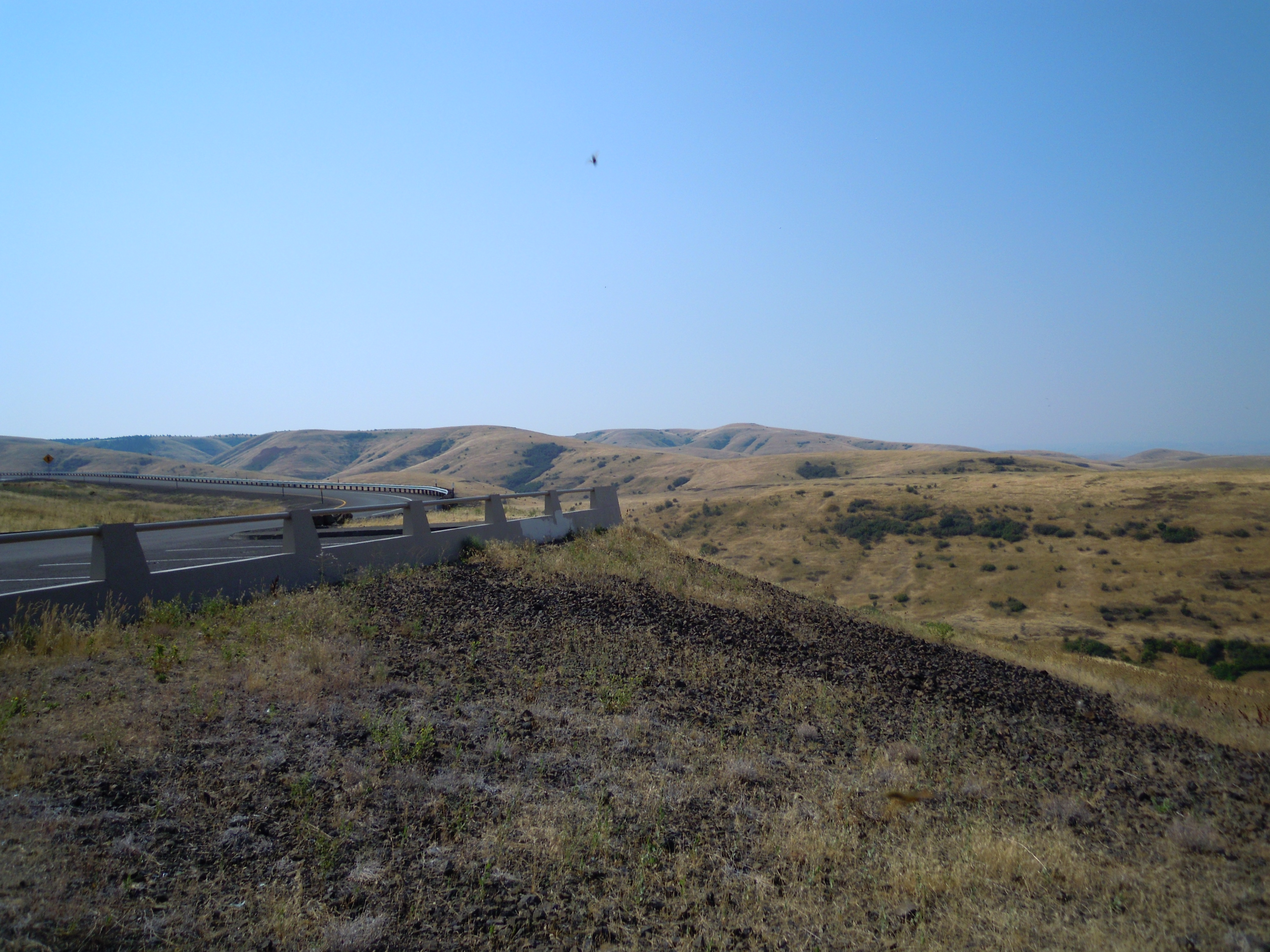
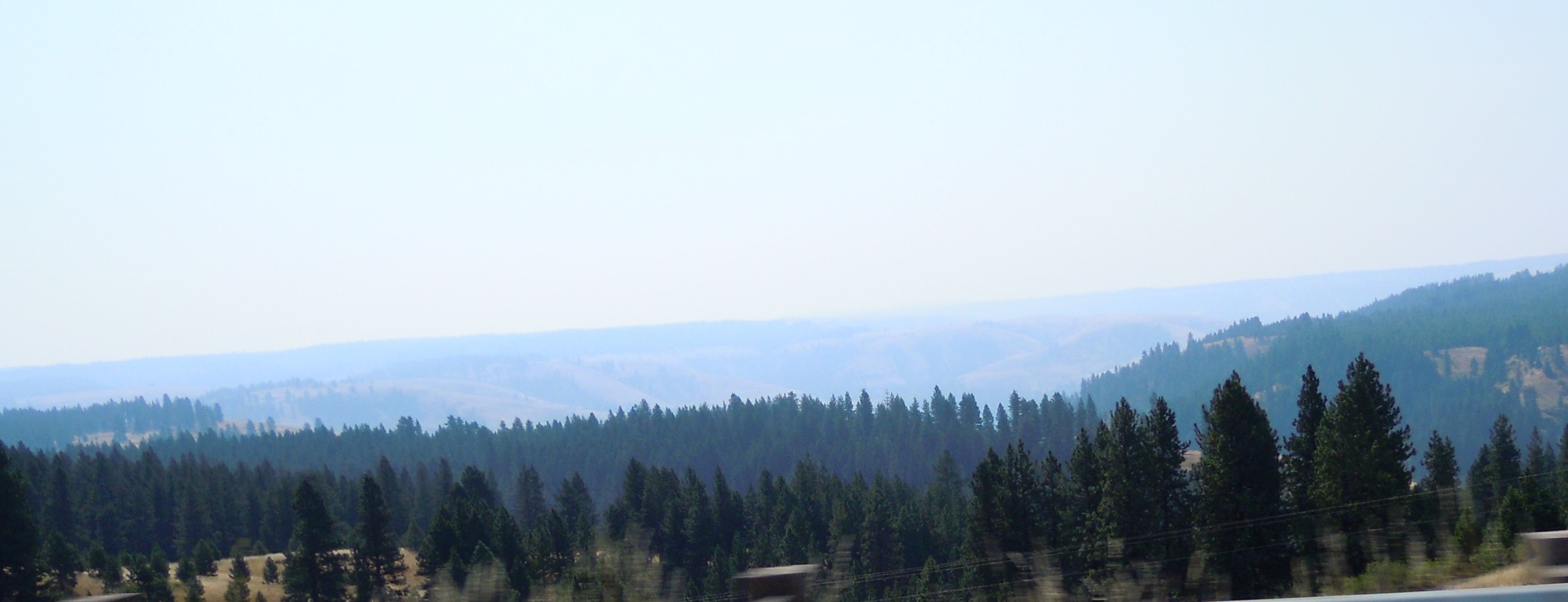
Backtracking the Oregon Trail #8

Day Four ~ The North Platte River

516.north platte westNorth Platte River looking west

Martha looked up the long dry slope they had to climb. Bluffs came right to the river’s edge here, so they couldn’t pass. They had to go around and that meant up. She clasped a child in each hand and started walking. . . .
Thank goodness for the women. What would she do without other women to laugh with and share stories with? Much as she loved Garrett and her brothers, they didn’t see life in quite the same way.
A Place of Her Own: The Legacy of Oregon Pioneer Martha Poindexter Maupin, Janet Fisher. (Guilford, CT, Helena, MT: TwoDot/Globe Pequot Press, 2014), p. 113, 110.

It is singular that on the north side of the Platte here is not a vestige of a tree in sight—save one “Lone Tree” for 200 miles & yet on the South side there is an abundance of Cedar fastened in the rock Bluffs & some Cottonwood. But the feed for cattle to all appearance is much better on the N. side
—The diary of Polly Coon, in Covered Wagon Women: Diaries and Letters from the Western Trails, 1840-1890. Vol. 5, 1852, The Oregon Trail, Kenneth L. Holmes and David C. Duniway, eds. (Glendale, CA: The Arthur H. Clark Co., 1986), p. 191.

13th Monday . . . the road soon leaves the bottom & leads upon the bluffs which are here of a rocky formation which seems to be a mixture of sand & lime In about three miles we came to Ash hollow so called from the ash trees which grow there. We had looked to this place as one where we should have plenty of wood & water . . . The glen is very picturesque rocks rise almost perpendicular two hundred ft or more We had scarcely encamped in a prettier place . . . 
—The diary of Celinda Hines, in Covered Wagon Women: Diaries and Letters from the Western Trails, 1840-1890. Vol. 6, 1853-1854, Kenneth L. Holmes, ed. (Glendale, CA: The Arthur H. Clark Co., 1986), pp. 91-92.

june 23 [Sunday] we camped in ash holler fifteen miles from whare we campe before and their was a tremendous thunder sawer one role after nother till it killed a horse that was onley one rod from our wagon that night Sarah was taken sick we had no super
June 24 we camped on the north fork of the plat river and sarah was very sick . . . I soon saw she would die and she did die before noon o how lonely I felt to think I was all the woman in company and too [sm]all babes left in my care it seams to me as if I would be hapy if I only had one woman with me
—The diary of Sarah Davis, in Covered Wagon Women: Diaries and Letters from the Western Trails, 1840-1890. Vol. 2, 1850, Kenneth L. Holmes, ed. (Glendale, CA: The Arthur H. Clark Co., 1990), pp. 179-180.

July 21. We again are pursuing our teadious journey. For the first 3 miles it was up hill then we came to a ridge. This extended to Ash hollow & when we came to it we found ourselves on the top of a high hill, precipices & deep ravines. In these ravines & on either side of the bluffs are trees growing in crevises, ash & red cedar. It is the most romantic place we have seen yet.
—The diary of Lucena Parsons, in Covered Wagon Women: Diaries and Letters from the Western Trails, 1840-1890. Vol. 2, 1850, Kenneth L. Holmes, ed. (Glendale, CA: The Arthur H. Clark Co., 1990), p. 251.

515.north platte eastNorth Platte River looking east

Martha wouldn’t recognize today’s North Platte River. With passage of the Homestead Act in 1862, people started taking a second look at that land west of Missouri. And completion of the transcontinental railroad in 1869 insured easier transportation to markets.
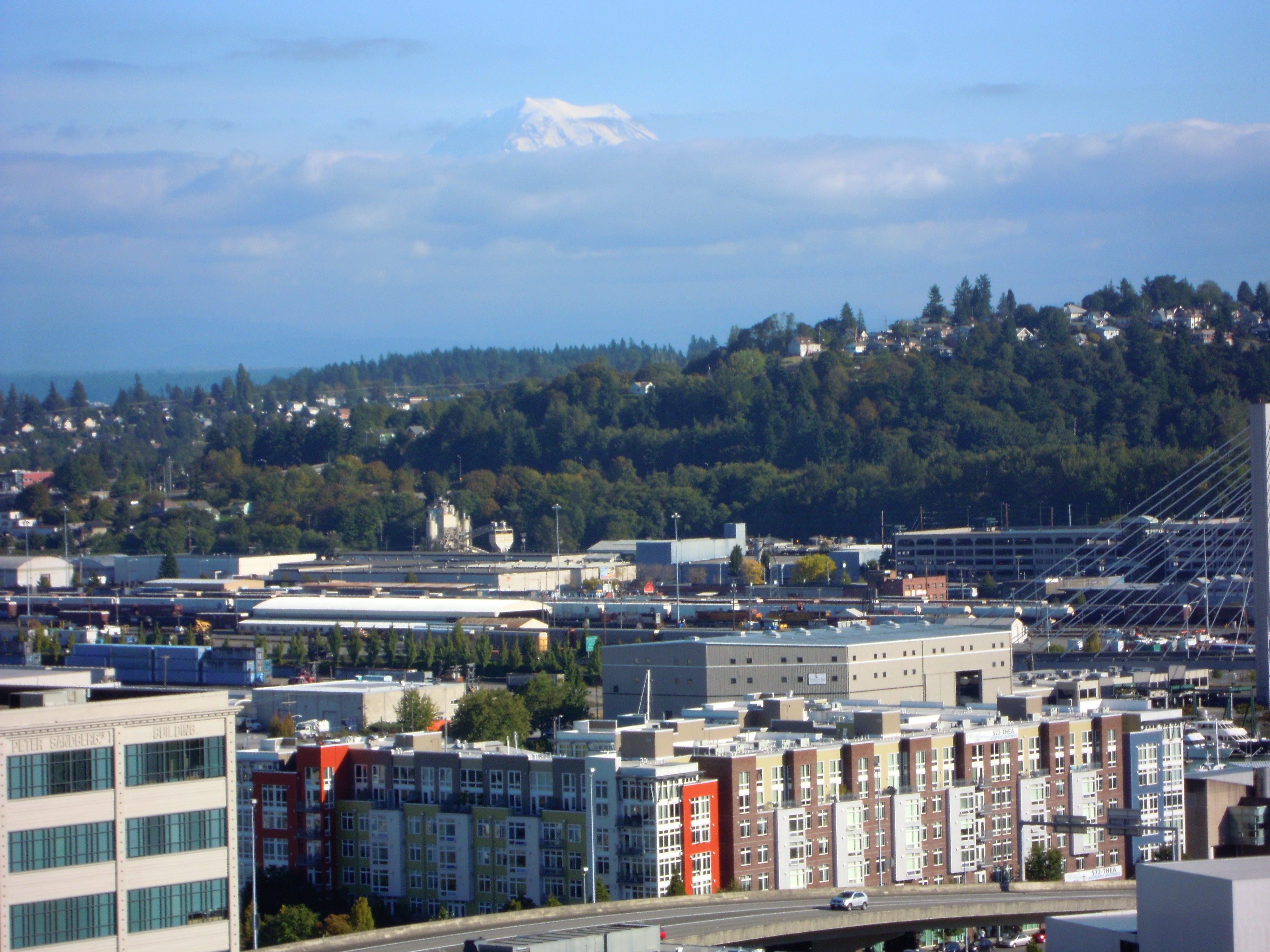
Instead of seeing the Platte River Valley as a long impediment to a West Coast destination, folks began to see the farming possibilities right there. Add more water with irrigation and the possibilities increased dramatically. So farmers came. They dug plows into the rich soil, built irrigation canals—and changed the character of the valley.

As we traveled along the North Platte, I felt the need to conjure up long-departed images. Massive herds of buffalo. Grassy plains. And where exotic trees and shrubs flourish along the riverbanks today, I imagined a land with few trees in sight and scarcely a stick of wood for a campfire. The buffalo herds may have eaten down the grass along the way, but they left a perfectly good substitute for campfire fuel—buffalo chips. Yes, that’s manure. Folks said it didn’t smell so bad and didn’t give the food a bad taste when used for cooking.

517.ash hollow bluffBluff above Ash Hollow

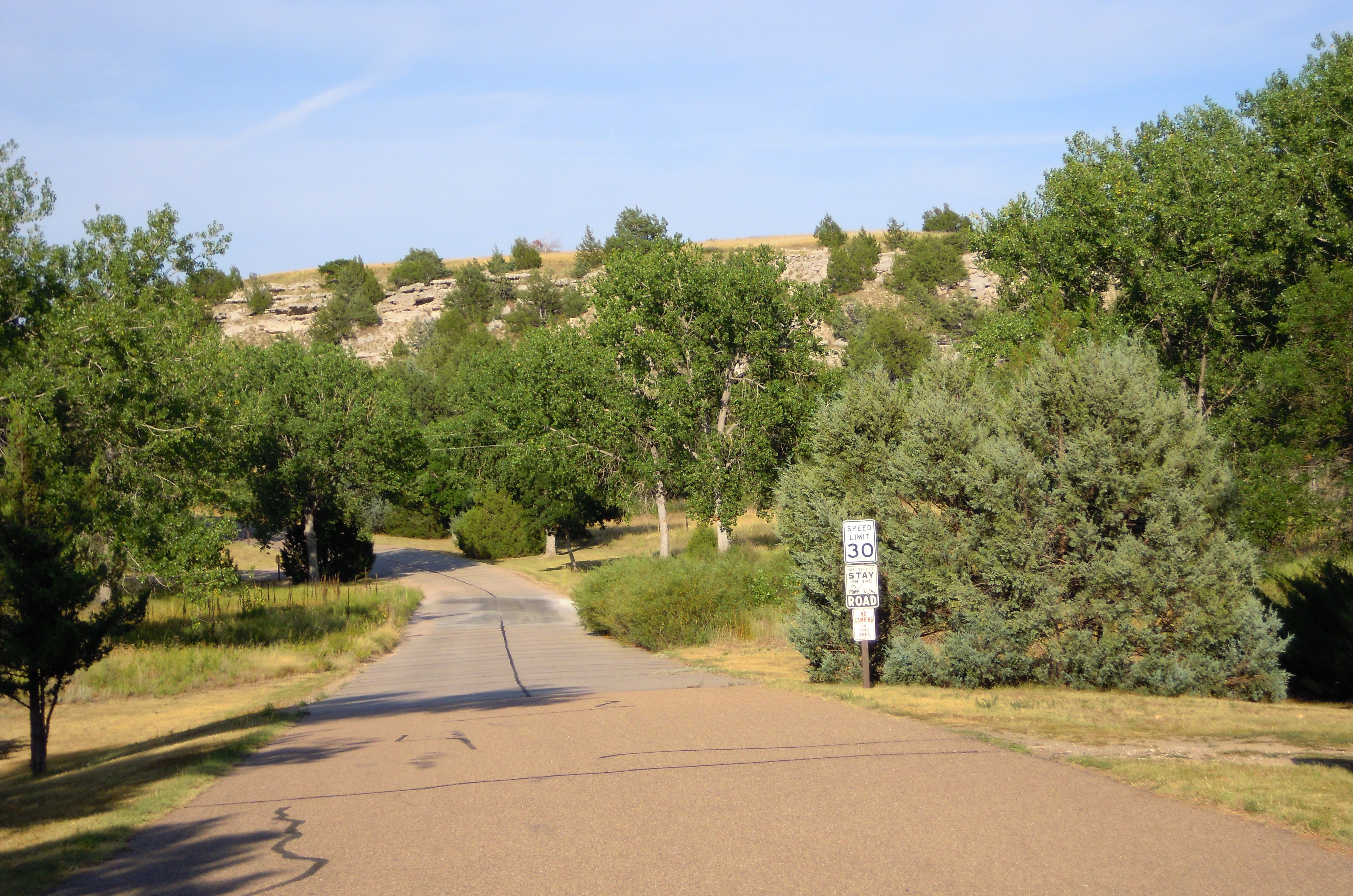
As you drive along the high plateaus you can still see some of the drier landscape the emigrants might have seen. Maybe the soil is too thin up there for farming, so this land has been left to its earlier state. The land has broken away on the edges of some of those plateaus, as if chopped away by a cleaver, baring the rocky interior, like the one overlooking Ash Hollow (above). Soil looks pretty thin at the top.

Before reaching Ash Hollow, most emigrants, traveling on the south bank of the main fork, had to cross the South Platte to make their way over a high plateau to the North Platte where the trail continued. At that river crossing they found that the lazy Platte had turned quite rough, although it was shallow enough to ford. From that harrowing plunge across the water, they met with the strenuous climb to the plateau.

520.Windlass HillWindlass Hill

But after following the trail across that high plateau they found no good way down. The gentlest slope appeared to be Windlass Hill. So they stopped at the top of this hill and lowered the wagons with ropes. There would be worse to come, but anytime you have to lower a wagon with ropes it’s a treacherous undertaking. Quite a bit of excitement after the flat prairie they’d followed for many long days. When they got to the Oregon Cascade Mountains and saw Laurel Hill, though, this one would pale in comparison.

From Windlass Hill they made their way to nearby Ash Hollow where even in that day a refreshing grove of trees awaited them. But the Ash Hollow springs held a deadly secret. In bad cholera years that spring water harbored the lethal cholera bacteria. It could strike with sudden force, killing a healthy person overnight. The diary of Sarah Davis (above) touches my heart on so many levels.

We weren’t able to get into Ash Hollow park but could see a little of it from the gate. The park was closed the day we passed through. I had hoped to meet with someone who would let us in, but we got there too late in the day.

519.bunny windlass hillI don’t know if this is a native bunny species that we saw at Windlass Hill, but we observed many of them and would see them frequently—right outside the door—in Christiane and Calliope’s new home.

We stayed that night in the town of North Platte, Nebraska, which lies just east of where the main Platte River splits into the North Platte and South Platte. We were relieved to get in before dark that evening and rested up for the final day of travel.

Women’s Voices from the Oregon Trail, Susan G. Butruille. (Boise, ID: Tamarack Books, 1993), pp. 165-166.

NEXT: We’ll head over that flat prairie along the main fork of the Platte, then take the shortest route to the Missouri River, back to the Oregon Trail’s beginning.

COMMENT

Backtracking the Oregon Trail #6

Day Four ~ Scotts Bluff

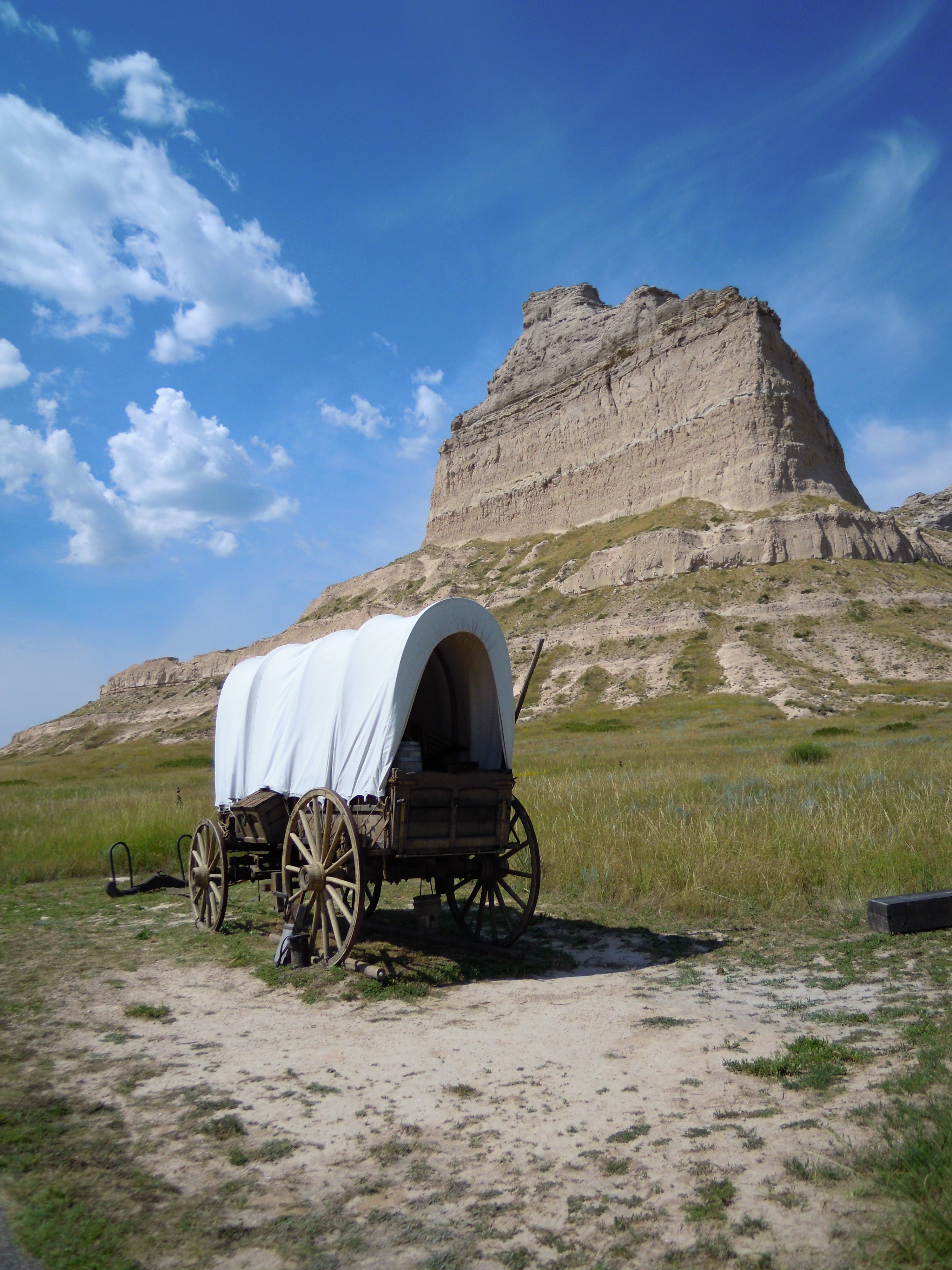
501.one wagon scotts bluffShe walked past natural wonders . . . Chimney Rock . . . Scotts Bluff . . . the Devil’s Gate. The oppressive heat sucked her energy. Dust filled her nose and eyes, even her ears. Sounds dimmed—the creaking wheels. Cattle bawling. Thudding hoofbeats. Ropes squeaking. . . .
A Place of Her Own: The Legacy of Oregon Pioneer Martha Poindexter Maupin, Janet Fisher. (Guilford, CT, Helena, MT: TwoDot/Globe Pequot Press, 2014), p. 116.

June 27 thursday we started on and traveled ten miles and stoped to noon in sight of scots bluffs whare their was plenty of grass for the catle we traveled twenty miles and encamped in sight of scots bluffs right on the plat river and I washed some that evening we had plenty of wolfs to visit us that night
—The diary of Sarah Davis, in Covered Wagon Women: Diaries and Letters from the Western Trails, 1840-1890. Vol. 2, 1850, Kenneth L. Holmes, ed. (Glendale, CA: The Arthur H. Clark Co., 1990), p. 180.

July 28. We currelled last night opposite the most splendid scenery we have met with on our travels. They are sand hills intermixt with rock or a hard substance resembling rock that rise & tower over the other like splendid mansions with numerous chimneys rising to a great hight. They are called Scotts Bluffs . . .
—The diary of Lucena Parsons, in Covered Wagon Women: Diaries and Letters from the Western Trails, 1840-1890. Vol. 2, 1850, Kenneth L. Holmes, ed. (Glendale, CA: The Arthur H. Clark Co., 1990), p. 253.

About noon we stopped nearly opposite the “Scott bluffs” sometimes called capital hills These hills have a truly grand romantic appearance calculated to fill the mind with indescribeble amazement approaching almost to sublimity. There are numerous cedars growing uppon them, which gives them a still more grand appearance.
—The diary of Abigail Jane Scott (entry by Margaret Ann or Maggie because Abigail has cholera), in Covered Wagon Women: Diaries and Letters from the Western Trails, 1840-1890. Vol. 5, 1852, The Oregon Trail, Kenneth L. Holmes and David C. Duniway, eds. (Glendale, CA: The Arthur H. Clark Co., 1986), p. 66.

All day the scenery was most enchanting intirely surpassing in loveliness & originality any thing I had ever beheld. Bluffs the most picuresque and resembling to the life some old castle of ancient times. About noon we came to Scotts Bluff which much resembles an old fortification.
—The diary of Celinda Hines, in Covered Wagon Women: Diaries and Letters from the Western Trails, 1840-1890. Vol. 6, 1853-1854, Kenneth L. Holmes, ed. (Glendale, CA: The Arthur H. Clark Co., 1986), p. 93.

506.scotts bluff visitor ctrDay four brought our backtracking trip right back to the Oregon Trail along famous landmarks for the emigrants on their way west. The emigrants would gauge their progress by the number of days it took them to reach these notable places. On our journey eastward to my daughter Christiane’s new job in Kansas City near the trail’s beginning, we planned to stop at several of these locations, where visitor centers provide information.

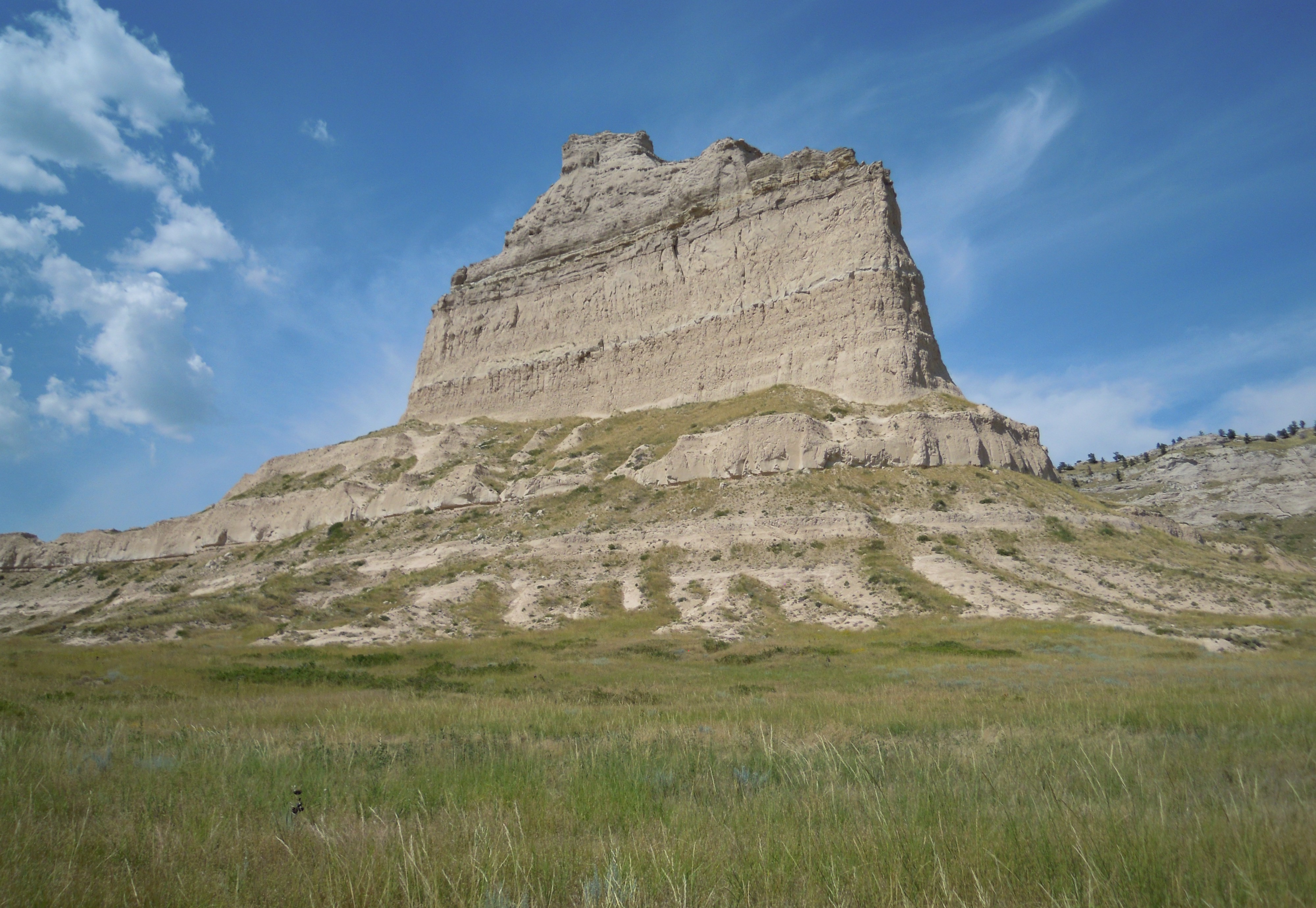
The towering landmark of Scotts Bluff rises like a beacon in the vast high plains of what is now western Nebraska, layers of multicolored sediment marking the deposits placed there by great upheavals of nature over time, water and wind whisking away the edges to let the monument stand high above the surrounding plain and expose its turbulent history.

We watched for the famous bluff out the car window, as those emigrants traveling the Oregon Trail must have watched. Several lesser bluffs rose around us, scattered over the flat. Was that it? No, not prominent enough. Then a sign marked the way, and when we came closer there could be no doubt. Nothing in the area matched the monumental geological feature. The emigrants with their slow travel might have seen it for days, growing slowly larger before them. This was one of the great mileposts. They knew from the guidebooks they carried that reaching this landmark along the North Platte River meant one-third of their trip lay behind them. And what a marvel, seeing it up close!

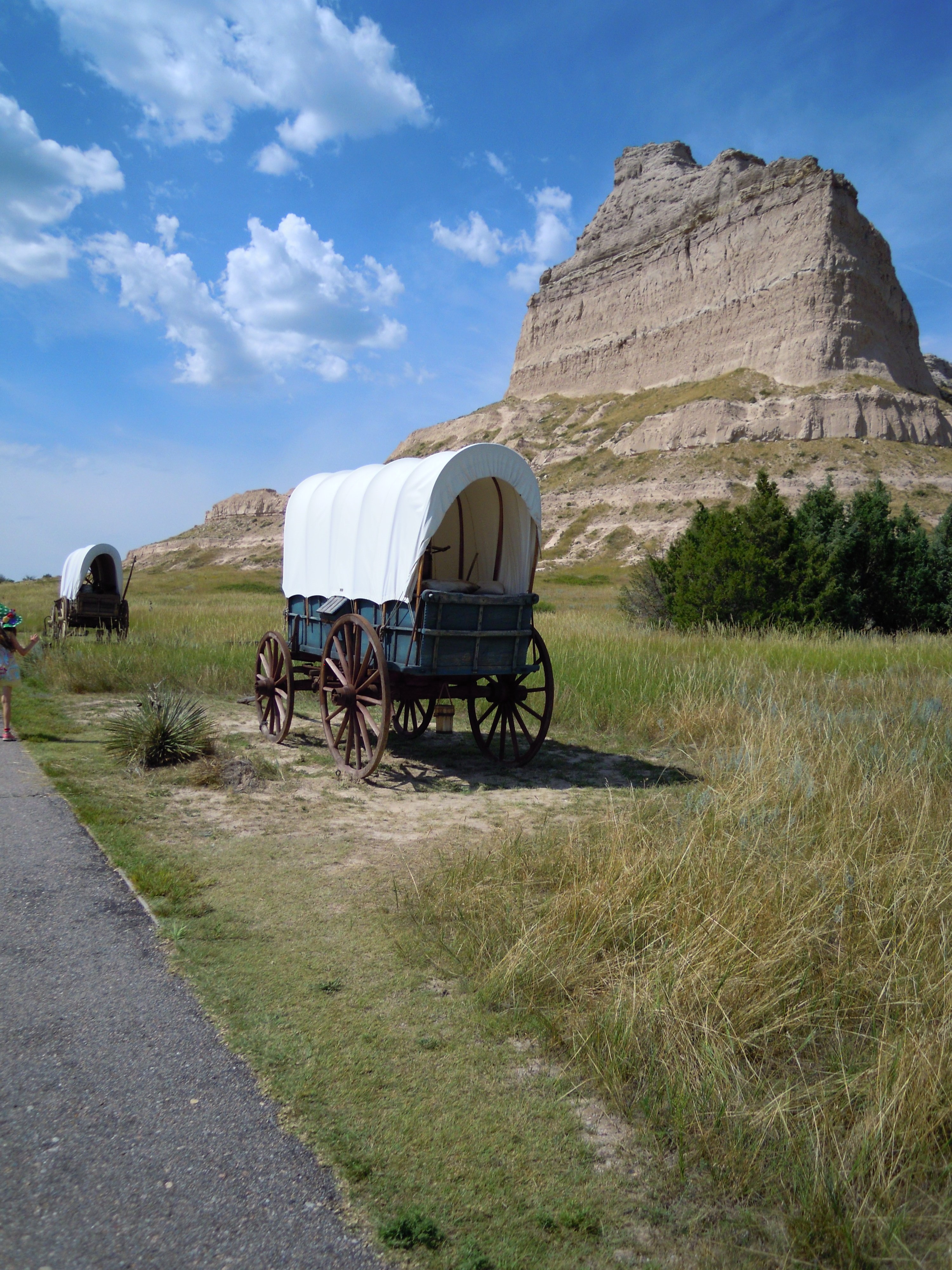
Now a visitor center nestles against the sheer height of Eagle Rock. Between that and Sentinel Rock, three covered wagons appear to roll through a wide gap, following the historic trail.

We stepped out of our air-conditioned car, and the heat struck. The hot weather was back. Not quite 100, but in the high 90s—in the shade. And precious little shade beyond the perimeter of the visitor center, where nice trees provide refreshing cover.

After checking in at the center—and giving them one of my books—we left the trees and started our own trek along the short stretch of the Oregon Trail within the park boundaries.

500.two wagons scotts bluffMy grand-daughter Calliope walks ahead at the far left edge of the scene.

There’s a bit of shade alongside the wagon, but when those wagons rolled, back in the day, the dust must have boiled up around them. A person could have shade with dust or blistering sun without. What a choice!

We reluctantly had to forgo the walk we had intended to make up to the wagon wheel ruts farther up the trail, hoping for another visit sometime on a cooler day or perhaps during the morning or evening hours. Unfortunately our schedule didn’t allow us to wait.

A haunting story tells how the bluff got its name, a story with moving parts that shift like sands along the Platte, depending on who does the telling. But apparently an employee of the American Fur Company named Hiram Scott had served as a clerk with the caravan that brought supplies to trappers at the 1828 Rocky Mountain Rendezvous. On their way home, laden with furs from the mountains, Scott became too ill to ride. So the leader of the caravan put him in a bullhide boat and assigned two men to accompany him more slowly downriver the 60 miles or so to this bluff, where the rest of the men would wait for them.

Somehow the boat overturned, and the three men lost most of their supplies, including food and weapons. Unable to hunt or protect themselves, the two with Scott told him they would hurry on ahead to catch up with their company and return for him. Or they said they would go out and find food and natural medicines to take back to him, according to another version of the tale.

However, when the two reached the bluff they found that the company had gone on ahead, so they decided to abandon poor Scott and push forward as fast as they could, finally catching up with the others in two or three days.

A couple of the women diarists offer a kinder version. Abigail Jane Scott says the sick man requested that his companions abandon him. Celinda Hines brings in a robbery by the Indians, who supposedly wounded Mr. Scott. She says they all knew he wouldn’t last much longer, so Mr. Scott begged his companions to leave him, which they did.

504.scotts bluffAnd so the sand of story shifts. In any case, the next spring when the caravan rolled by the bluff again, men found a grinning skeleton they readily identified as Scott. With remarkable tenacity he had made his way those 60 miles alone, finally to die at the foot of this monument which would thereafter carry his name. The story in its variations was told around many a campfire as others pushed west, passing this magnificent marker.

Scotts Bluff National Monument: Landmark on the Overland Trails, A History and Guide, Dean Knudsen, Historian, National Park Service, pp. 10-13.

—The diary of Abigail Jane Scott, in Covered Wagon Women: Diaries and Letters from the Western Trails, 1840-1890. Vol. 5, 1852, The Oregon Trail, Kenneth L. Holmes and David C. Duniway, eds. (Glendale, CA: The Arthur H. Clark Co., 1986), p. 66.

—The diary of Celinda Hines, in Covered Wagon Women: Diaries and Letters from the Western Trails, 1840-1890. Vol. 6, 1853-1854, Kenneth L. Holmes, ed. (Glendale, CA: The Arthur H. Clark Co., 1986), p. 93.

NEXT: Chimney Rock

COMMENT

Backtracking the Oregon Trail #5

Day Three ~ The High Plains

463.wagons high plainsWind whistled across the high desert. The sun shone warm on her back, not a cloud in the sky. Nights had been cold, though, everything white with frost in the mornings. The acrid smell of sage clutched her nose. She’d been tasting it for days. The scrubby plants dotted the landscape, along with other low, tangled brush, a spare coat of dry grass like a mangy dog’s hair.
A Place of Her Own: The Legacy of Oregon Pioneer Martha Poindexter Maupin, Janet Fisher. (Guilford, CT, Helena, MT: TwoDot/Globe Pequot Press, 2014), p. 116.

Wedns Aug 4 Traveled 8 miles. Came to Soda Springs. laid by the rest of the day. Here is quite a curiosity. The water boils right up out of high rocks in some places and it boils out of the level ground quite . . . high. The water is not so strong but what a person can drink it very well.
—The diary of Martha S. Read, in Covered Wagon Women: Diaries and Letters from the Western Trails, 1840-1890. Vol. 5, 1852, The Oregon Trail, Kenneth L. Holmes and David C. Duniway, eds. (Glendale, CA: The Arthur H. Clark Co., 1986), p. 236.

July 6th We traveled 18 miles through the Pass;; The ascent and descent is very gradual it being impossible to exactly determine where the culminating point is. . . . The next stream we passed was a small one called Pacific Creek The water here runs West while every other stream we have passed runs either (East) or South
—The diary of Abigail Jane Scott, in Covered Wagon Women: Diaries and Letters from the Western Trails, 1840-1890. Vol. 5, 1852, The Oregon Trail, Kenneth L. Holmes and David C. Duniway, eds. (Glendale, CA: The Arthur H. Clark Co., 1986), p. 82.

August 1st Sunday To day we left the waters that flow into the Atlantic and proceed to those of the Pacific We let our cattle feed till about noon and then started on, for the South pass 10 miles distant – It ill comports with the ideas we had formed of a pass through the rocky Mountains, being merely a vast level sandy plain sloping a little each way from the summit and a few hills for we could not call them mountains on each side. Some few snowy peaks in the distance, and this is the South pass through the Rocky mountains
—The diary of Cecelia Adams & Parthenia Blank, in Covered Wagon Women: Diaries and Letters from the Western Trails, 1840-1890. Vol. 5, 1852, The Oregon Trail, Kenneth L. Holmes and David C. Duniway, eds. (Glendale, CA: The Arthur H. Clark Co., 1986), p. 278.

493.mountains to crossAs we continued our journey to Kansas City, retracing the footsteps of our ancestors over the Oregon Trail, I kept picturing Martha, subject of my new book A Place of Her Own, walking this rugged track in 1850 with her husband Garrett Maupin, all their worldly goods packed in an ox-drawn covered wagon. My great-great-grandparents. What hardy souls they were.

Leaving Fort Hall, my daughter, granddaughter, and I struck out eastward toward Soda Springs, where pioneers marveled at natural fountains of soda they could drink like a soda back home. My granddaughter Calliope was determined to buy a soda in the town of Soda Springs. Checking the label she found that the soda came right out of—well, Mexico. But she insisted it was delicious anyway.

Weather had turned cooler today, thankfully, perhaps because we’d moved into higher elevations, or the overall weather patterns had changed. We could enjoy getting out and walking around.

We soon crossed the modern border into Wyoming somewhere near the Oregon Trail with another looming ridge in the near distance. The range extended on either side of the road and looked too wide to go around. We would have to go over.

494.continuing rangeI couldn’t help thinking how the hearts of those pioneer travelers must have sunk, seeing ridges like this ahead of them and wondering what manner of mountains they were coming into now. As we followed the highway into this ridge, the road rose before us and we could hear the subtle change in the laden car’s engine. Imagine taking this step by step, one foot in front of the other, the oxen tugging that laden wagon up a slope with no smooth highway, only a rutted track.

Of course, they were coming the other way. They faced this mountain from the other side. Our uphill slope was their downhill grade. But downhill isn’t so easy either. While there isn’t the tug of hauling weight upward, a decline can be treacherous. A heavy wagon pushing down on you. Rocks in the path ready to trip a person or flip a wagon. Truckers today understand the danger of a runaway vehicle on a steep descent. A runaway wagon could happen too. Mountains, beautiful as they are, must have always evoked dread.

We left the Oregon Trail somewhere in western Wyoming. The main highways in Wyoming veer from that track, and we had limited time. We had a long drive ahead before we reached our day’s destination, and my daughter had meetings scheduled the morning after our scheduled arrival in the Kansas City area at the end of Day 5. We needed to take the fast route across Wyoming. And I do mean fast. Much of Interstate 80 is posted at 80 mph. That does make the miles slip by.

Again I thought of the pioneers who faced other kinds of time constraints. They had to get across the last mountain before winter snows came. They may have had some flexibility of days, but they didn’t dare delay too long.

Years ago when my kids were young our family had taken the more northerly zigzagged route across Wyoming on a road trip with a travel trailer—our version of a covered wagon—and we did our best to follow the Oregon Trail all the way. I well remember the surprising topography of South Pass where the trail crossed the Continental Divide which separates the waters that flow to the Pacific from waters that flow ultimately to the Atlantic. It doesn’t appear mountainous at all. It’s just a slight rise in ground in the midst of a dry plain, dotted with sagebrush and other scrub. Such luck for all who passed that way in the early days that they found this easy crossing through the otherwise craggy mountain range of the Rockies.

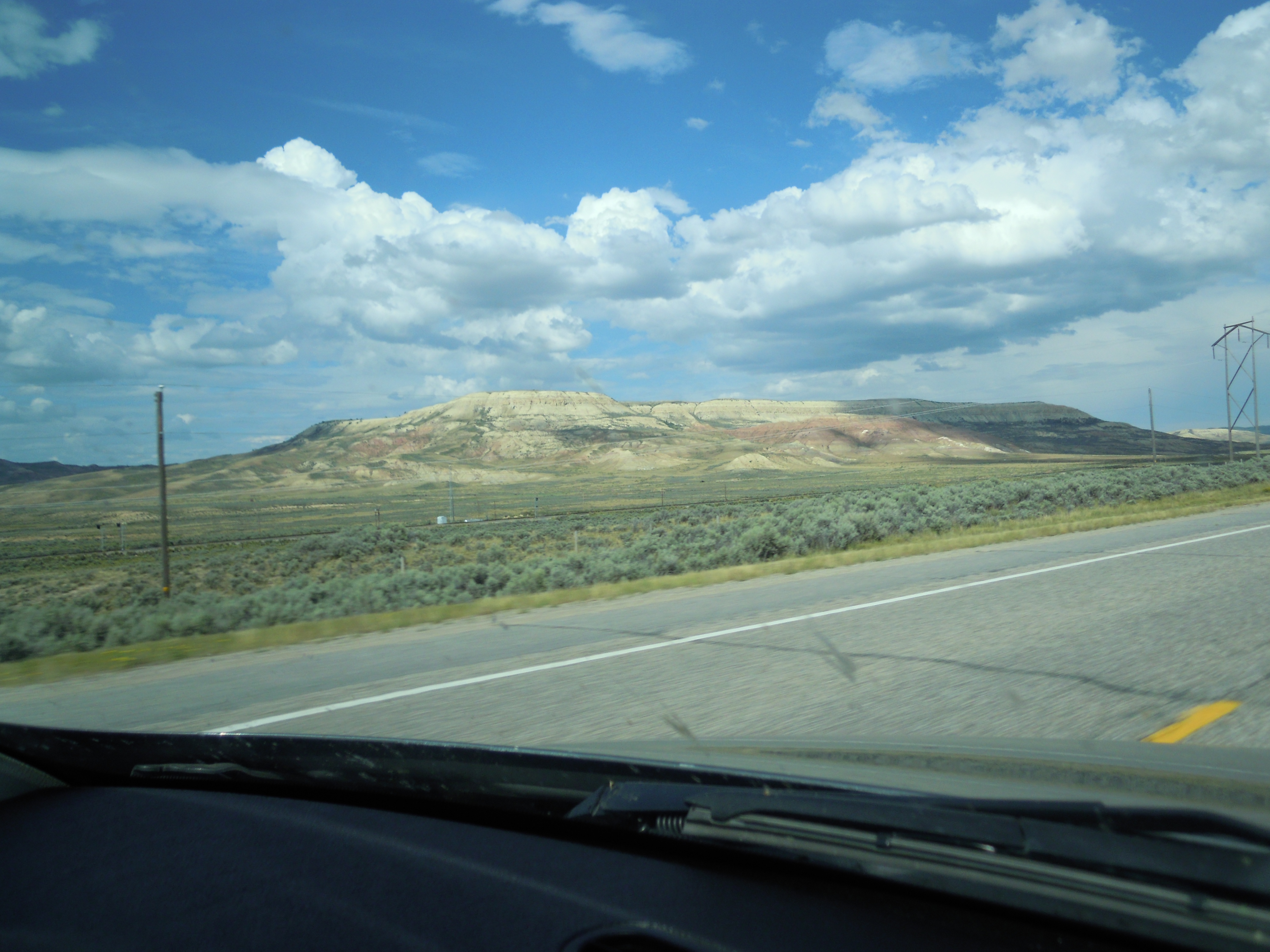
495.sediment on rocksOur crossing of the Continental Divide on Interstate 80 wasn’t much more noticeable. We saw a lot of country like the above, wide flat stretches of sagebrush and dry tufts of grass with multicolored bluffs rising here and there. Barren but beautiful. I liked the soft reds in the bluff above, which I shot while the car surged forward.

497.colored rimrockAnd this formation near Green River, Wyoming, was interesting with its strawberry tint in layer-cake slices. I think I was beginning to get hungry.

After two nights of drive-through fast-food dinners gulped down in the air-conditioned car because it was too hot to leave the dog, we decided this evening we would have a sit-down dinner in a restaurant. The weather had remained pleasant all day. The dinner couldn’t be anything fancy. We were still far from our motel in Laramie and needed something quick. But quick wasn’t in the cards that evening. Food took a long time to reach our table. My daughter, who did the driving, bolted hers down. My granddaughter and I got to-go boxes. And off we went again. So much for a relaxing dinner.

Dark fell much too fast, and it was 10 o’clock by the time we rolled in. I thought about Martha and other emigrants who made those night runs across the desert when the weather became too unmercifully hot to travel in the day. Ours was just a little miscalculation of the time this portion of the drive would take, a late start due to loss of sleep from parties next door, and slow dinner service.

One thing. We slept well this night.

[The wagon photo at the top was taken at the National Historic Oregon Trail Interpretive Center at Baker, Oregon.]

NEXT: Scott’s Bluff, famous landmark of the trail

COMMENT

Both Sides of the Mountain

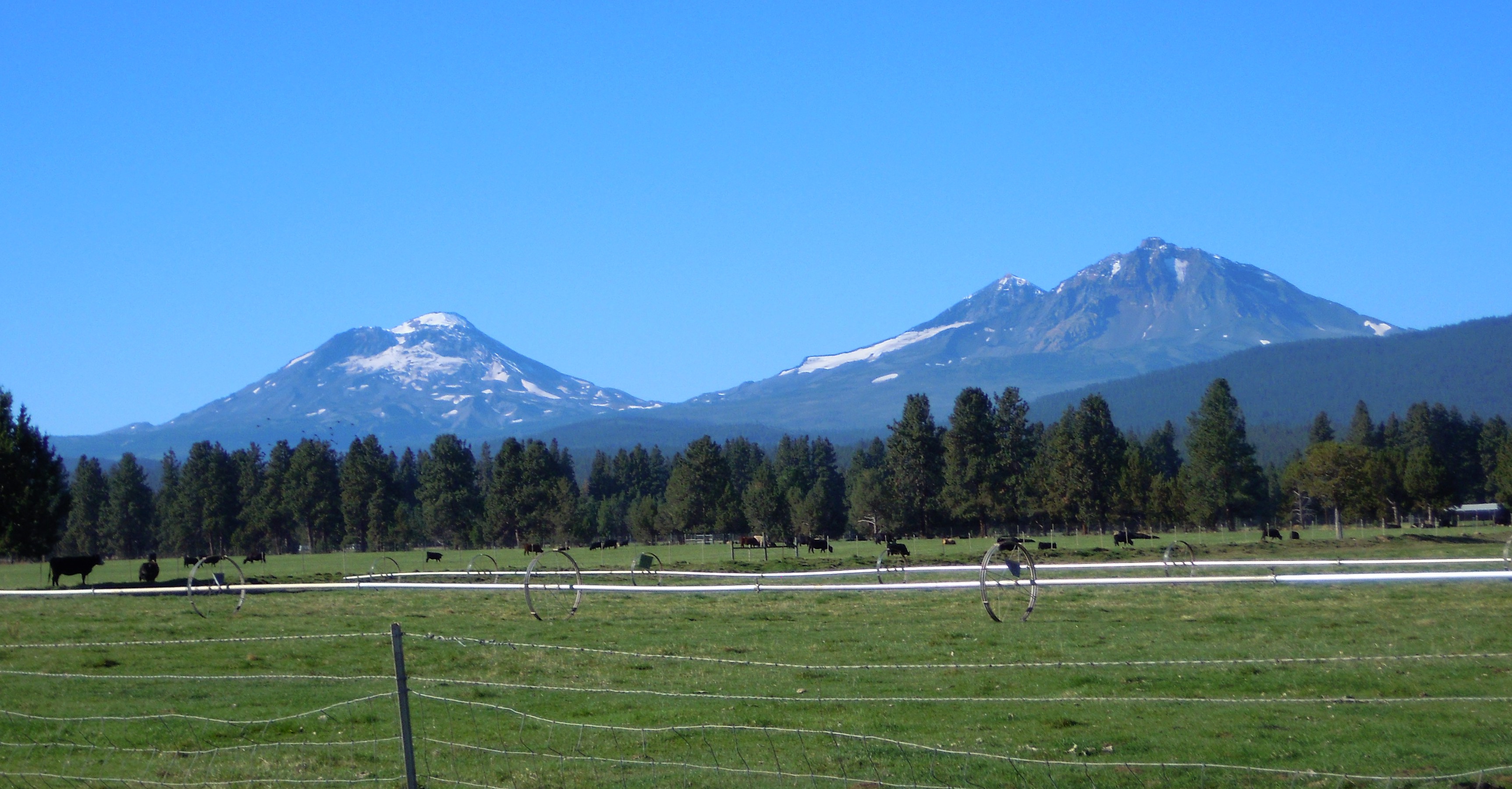
683.sisters at sistersOctober started in a rush of activity with three book events in a row for me on both sides of the Cascade Mountains, the range that neatly divides Oregon into two very different landscapes. On October 2nd I enjoyed a lively discussion with an enthusiastic group at Amanda Bird’s “Lunch With An Author” at her Book Nest store in Springfield on the west side. And on the 3rd and 4th I enjoyed two nights with enthusiastic readers in the Paulina Springs bookstores, one in Sisters and one in Redmond on the east side. The above photo shows the Three Sisters which rise along that central range and overlook the town of Sisters with their proud beauty.

When I left I-5 for Highway 126 on my way to the Book Nest in Springfield I realized I could have just kept going east after lunch and would have ended up at my next location, but I opted to return home for another night in my own bed.

The Book NestAmanda Bird hosts a delightful venue of author lunches at her Book Nest, shown at left. Located in the Indulge! Antiques complex in Springfield, she takes advantage of the restaurant there to serve the lunches. We all sat around a long table, ate delicious food, and talked about my book. She has many regulars who attend these events, and they welcomed me with many thoughtful questions and comments of interest. My thanks to Amanda for the invitation. A fun time!

The next morning I headed eastward into the mountains, taking Highway 58 over the Willamette Pass and up Highway 97 through Bend to Redmond, where I stayed overnight.

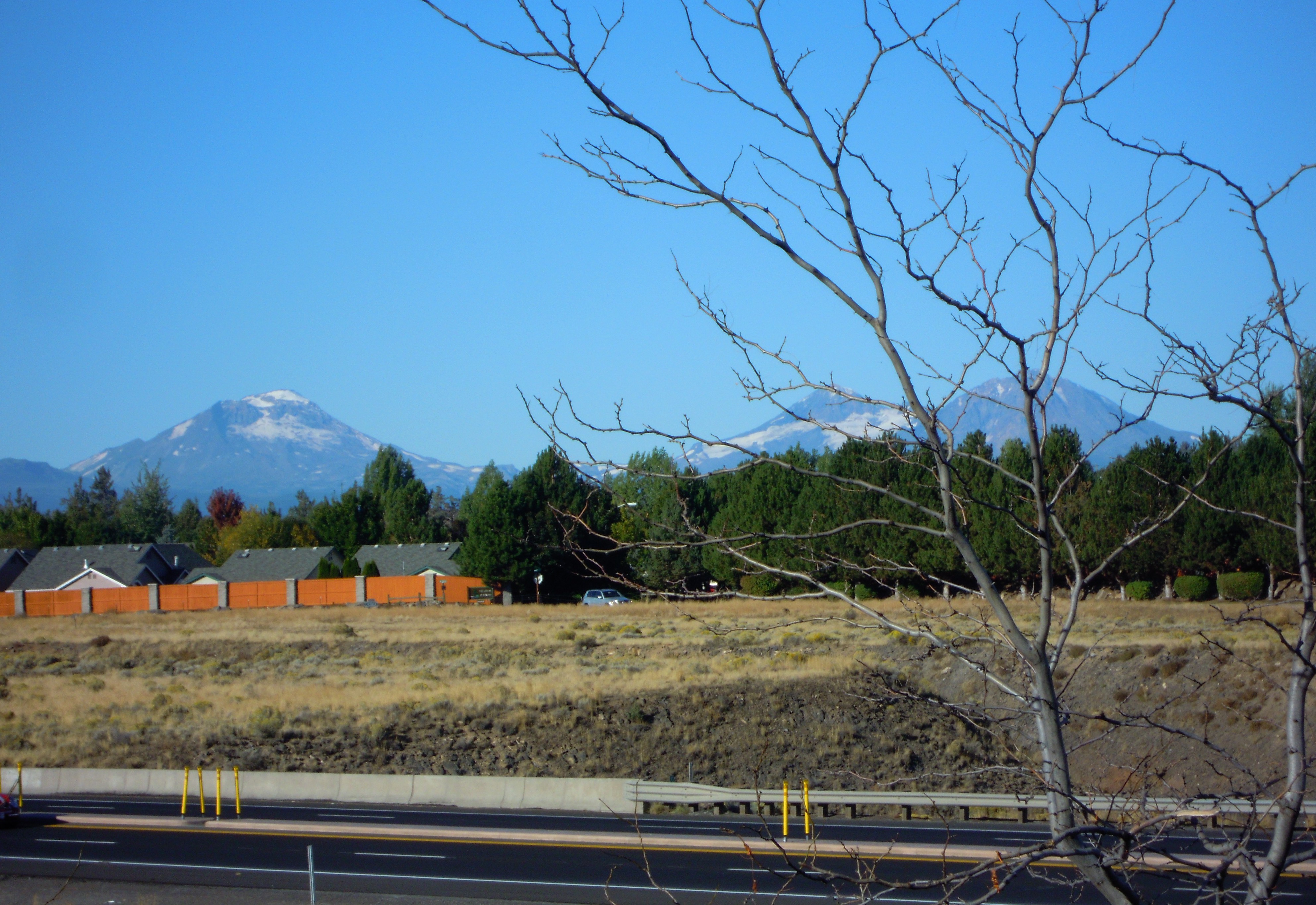
659.room view redmondAnd what do you know but I had another room with a view. Those Three Sisters, even in more distant Redmond, still dominate the skyline. Some trees had already lost leaves, but snow remains sparse on the peaks.

With a quick change of clothes, I drove over to Sisters for the first night’s event with Paulina Springs Books.

657.hood avenueI found the store on Hood Avenue, which is a charming street of art galleries and other shops with a hint of the Old West in their board and batten structures and high storefront faces. Since the event started at 6:30, I got an early dinner in a courtyard restaurant at the Open Door across the street. The evening air lay softly over me as I sat in the courtyard among tall pines and quivering aspen, listening to haunting strains of music that sent my mind back to Martha’s story of love and loss.

656.sisters bookstoreAt the bookstore I was welcomed by Amanda MacNaughton, who’d invited me for the two events at Paulina Springs Books, and Ruth Ann Sparks, who would introduce me to people who attended.

The store has a strong following with their many regular author events. They provide refreshments and a raffle, and Ruth Ann gave me a lovely introduction. After my reading, we had some excellent book talk. A great evening!

Having most of the next day free, I decided to explore the area. I hadn’t been there in years.

660.cline falls lunchFirst, I wanted to see the nearby sights. I opted to grab a takeout sandwich for lunch and carried it with me to Cline Falls State Park, east of town.

A perfect day for lunch by the riverside.

After lunch I noticed Smith Rock State Park on the map north of town and decided to check that out.

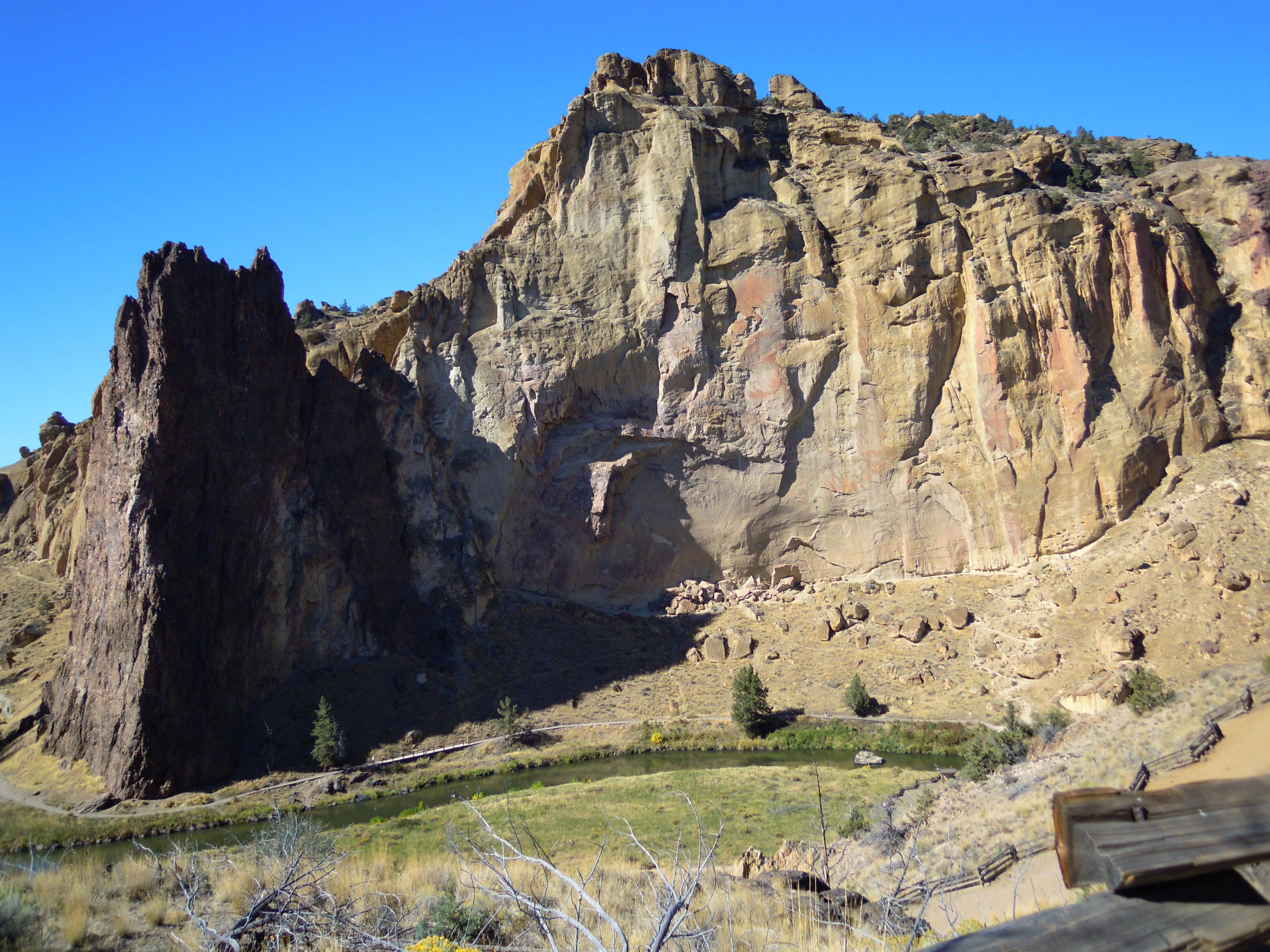
673.smith rock.1Even as I approached the place I realized this was something spectacular. Great spiky rock formations rose from the broad landscape as if set there by mistake.

Volcanic activity had a large part in the overall landscape of Central Oregon, and this accumulation of rock formations resulted from several upheavals about 30 million years ago. Calderas collapsing. Molten rock erupting. Lava flowing. And a river cutting through.

Today it’s a hot spot for rock climbers. And there are many hiking trails. I love a good hike, but took only a short one, given my time limitations. And I’d have preferred my serious hiking boots on the steep gravelly slopes. Fortunately I’d at least thrown in my walking shoes. A fascinating place.

677.smith rock.2680.redmond bookstoreBack in Redmond, I prepared for the next event at Paulina Springs Books’ Redmond store. It’s right downtown on another street of art galleries and restaurants and other shops. Redmond has done a lot with their downtown to give it new life and make it a pleasant walking town.

The bookstore offered refreshments and a raffle here too, but they didn’t expect as many people as at Sisters. We didn’t have quite a full house in Sisters, but a good crowd. Well, in Redmond, the chairs soon filled and Ruth Ann had to scramble to move aside more book stacks and bring out more chairs. For once, Redmond outdid Sisters for numbers. Several had come expecting to hear about Martha’s “place” in Maupin, Oregon, and I had to tell them she never went to Maupin. But the town was named for her husband’s brother Howard, so it was all in the family. They seemed to accept that, and we had another lively Q&A session. Thanks again to Amanda, to Ruth Ann for her friendly introduction, and to Cedar Goslin for rushing out to the car with me for more books when the store ran out–a situation to delight an author. Another outstanding event!

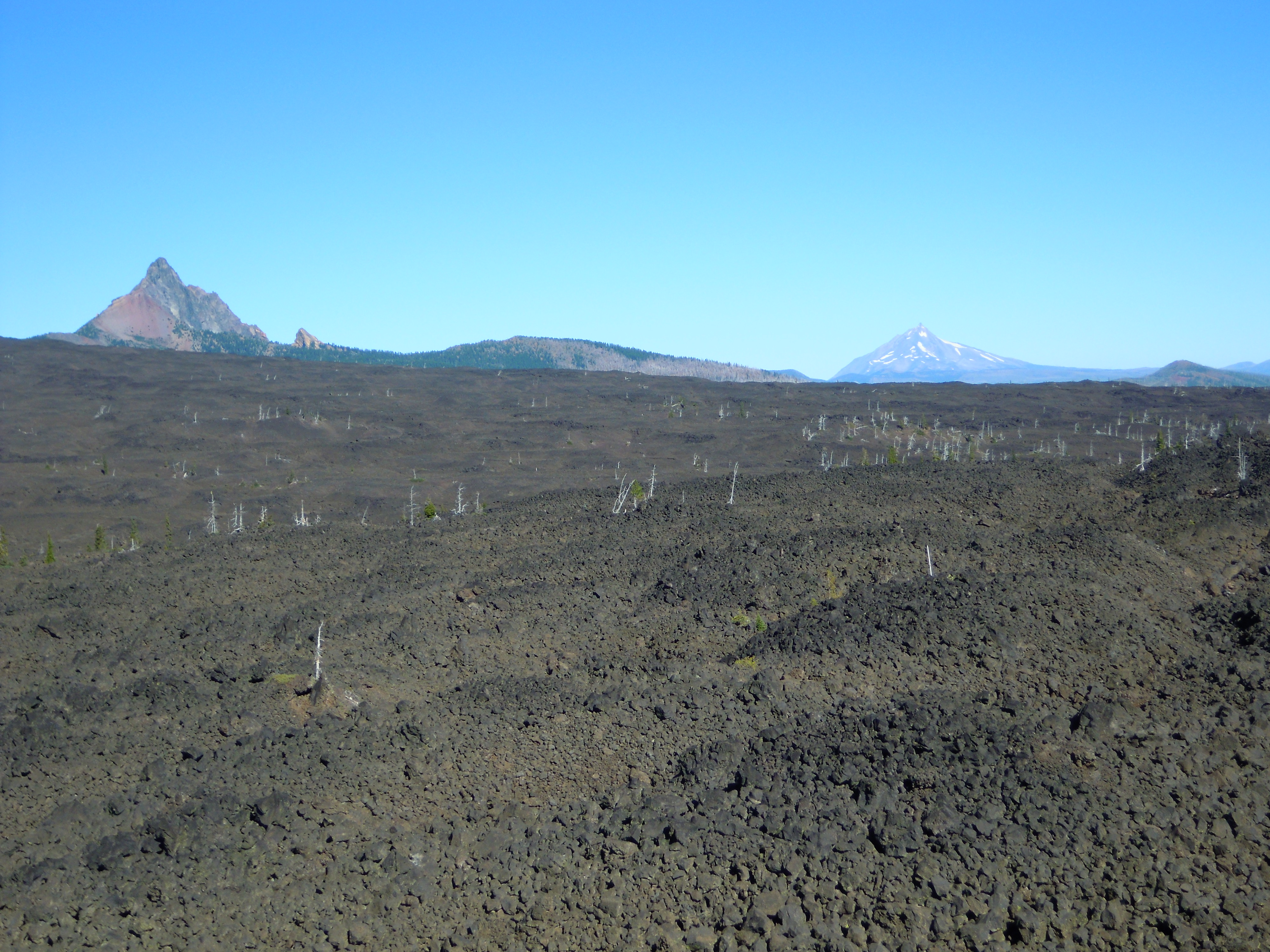
685.mckenzie summit sign688.stark tree in lavaThe next day I set out for a leisurely drive home by way of McKenzie Pass, traveling through open forests of tall Ponderosa pines with their beautiful red jigsaw-puzzle bark and feathery needles, up a winding, narrow highway, to the lava beds on top. Volcanic upheavals sprinkled so much rock.

I could hardly believe the sign that showed tracks where wagons came that way in the 1860s. Right through the lava. The Cascade Mountains offer no easy way across, but this pass presents one of the more demanding routes even today.

Many dead trees scatter across the broad fields of lava. I didn’t find it surprising they were dead, but that many were still standing. They make a stunning impression.


686.lava fields

Beyond the lava beds Mount Washington rises in a jagged point on the left and Mount Jefferson forms a snow-laced cone in the distance on the right.


Turn the other way and you see two of the Three Sisters (below). The South Sister is hiding behind the Middle Sister.

687.sisters from pass

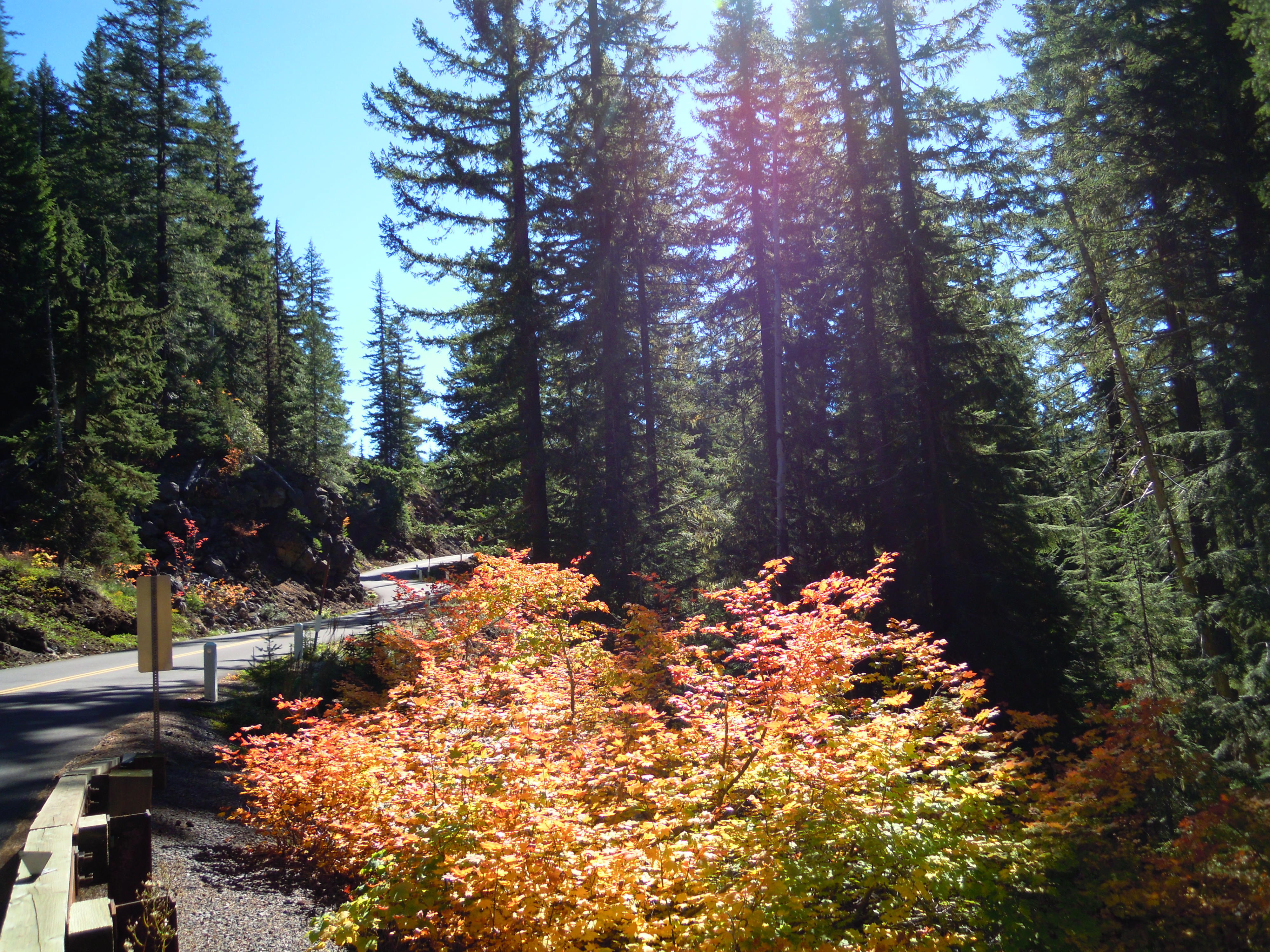
Finally, coming down the twisting route into the thicker woods of the western side of the mountains (below), a spray of sunlight seems to breathe the fire of life into the vine maple.

I take my own deep breath and am content.

689.vine maple mckenzie pass

COMMENT

Backtracking the Oregon Trail #4

Day Three ~ Fort Hall

481.Ft Hll exteriorMartha batted away mosquitoes as she sat in the shade with the girls and several other women and children outside the sturdy structure. Fort Hall. What a relief to find this semblance of civilization so far out in the wilderness. It also meant they’d covered a fair amount of their journey, but when she asked Larry if it would be downhill from here, he wouldn’t answer.
A Place of Her Own: The Legacy of Oregon Pioneer Martha Poindexter Maupin, Janet Fisher. (Guilford, CT, Helena, MT: TwoDot/Globe Pequot Press, 2014), p. 118.

July 23rd We traveled 18 miles;;, twelve and a half miles brought us to fort Hall. . . . This fort is built of sun burnt brick (adobes), It is a rather shabby looking concern, but in case of an attak from without its inmates would be tolerably well protected It has port holes through the walls for the admission of guns,; This fort is now abandond by the government and is occupied by some traders;;
—The diary of Abigail Jane Scott, in Covered Wagon Women: Diaries and Letters from the Western Trails, 1840-1890. Vol. 5, 1852, The Oregon Trail, Kenneth L. Holmes and David C. Duniway, eds. (Glendale, CA: The Arthur H. Clark Co., 1986), p. 94.

[August] 19 Thursday To day came to Fort Hall on snake River and passed it at one in the P.M. It is made of unburnt bricks and is little larger than a good sized barn. It is not now occupied by the soldiers but is used for a trading station. Some 50 or 100 wagons, markd U.S. in large letters stand there rotting. Encamped about 2 miles from the fort on Pannock creek and had very good feed – Made 14m
—The diary of Cecelia Adams & Parthenia Blank, in Covered Wagon Women: Diaries and Letters from the Western Trails, 1840-1890. Vol. 5, 1852, The Oregon Trail, Kenneth L. Holmes and David C. Duniway, eds. (Glendale, CA: The Arthur H. Clark Co., 1986), p. 284.

28th Thursday . . . We almost suffered with dust & want of water Near night we came to the Port Neuf river which we had to ford it is large & deep we had to raise our wagon beds. Ft Hall trading post is near . . . The men from the post came to see us . . .
29 Friday Our road was through sage brush . . . The mosquitoes were very annoying.
—The diary of Celinda Hines, in Covered Wagon Women: Diaries and Letters from the Western Trails, 1840-1890. Vol. 6, 1850, Kenneth L. Holmes, ed. (Glendale, CA: The Arthur H. Clark Co., 1986), p. 106.

474.inside ft hallAnd so continued the journey of my daughter and granddaughter and myself as we retraced the footsteps of our Maupin ancestors who traveled west over the Oregon Trail in 1850. Now we were backtracking the trail, heading east on our way to Kansas City, where my daughter was moving to take a new job.

We got a late start on day three after a rocky night of sleep the night before when our neighbors in the motel made a little too much noise partying. I was reminded of complaints by some emigrants on the Oregon Trail concerned about Indian drums pounding all night, keeping them awake.

To add to our delay, we also had some trouble finding Fort Hall. But once we found it, we took our time to see this fine replica in Pocatello, Idaho.

Fort Hall became another milepost for the weary emigrants trekking across the Oregon Trail. It meant they had come about two-thirds of the way on this incredible journey. Although the fort may have become a little dilapidated, some found comfort in the presence of an actual man-made structure in this wilderness.

The tidy structure today is a replica, built a few miles from the original. The builders did their best to create an authentic reproduction, using plans maintained by the Hudson’s Bay Company. I had a nice chat with the staff people. A man I’d spoken to earlier by phone met me there, and I left them a copy of my book, A Place of Her Own, about my great-great-grandmother Martha Maupin who took that trek west with her husband and their two small daughters.

The original fort came into being somewhat by accident. Nathaniel Wyeth, an American businessman from New England, became interested in the fur trade sometime in the early 1830s. Wyeth visited the annual Rocky Mountain Rendezvous of mountain men, Indians, and traders in 1832. There he negotiated with leaders of the Rocky Mountain Fur Company, one of the American companies that took supplies from St. Louis to the mountains for that annual gathering where they would trade supplies for furs that trappers and Indians had collected during the year. Wyeth offered to bring trade goods to the 1834 rendezvous, hoping to do a good business.

429.palisades like wyeth's - cropHowever, the Rocky Mountain Fur Company had financial difficulties and didn’t accept Wyeth’s goods. With $3,000 worth of supplies on hand and no buyer, Wyeth decided to build a trading post, which he named Fort Hall.

He constructed a wooden fort with palisade walls like those shown here (on the right), put up a handmade American flag, and left a man to run the post.

The British Hudson’s Bay Company didn’t look so kindly upon this American intrusion in the territory they wanted to claim for themselves. They built another fort a few miles downriver, Fort Boise, and soon put Wyeth out of business. By 1837 Wyeth gave up and sold his fort to the HBC at a loss.

The HBC covered the palisade walls with adobe. The place was still in the hands of the HBC in 1850 when Martha saw it, but the HBC abandoned it in 1855 or 1856, according to the Fort Hall Replica website (link below). Butruille (cited below) indicates the U.S. took it over in 1855. However, a couple of diarists (above), writing in 1852, suggest a former U.S. military presence at the time they passed through. Writers of history often disagree, I’ve found, and the diarists may not have been aware of the fort’s history.

In any case, the original was eventually abandoned as it began to crumble, and bits and pieces were carted off for other uses. But residents of the area later decided to replicate it. Since they could not build on the original site they put the structure on a lovely rise in ground at Ross Park in Pocatello.

477.blacksmith shop ft hallChristiane and Calliope and I traipsed through the interior, where many rooms have been set up like the originals. In the above photo of the blacksmith shop you can see the large bellows for raising the fire’s heat, an anvil, and other equipment. A blacksmith shop would have been a welcome convenience for the travelers whose wagons were often in need of considerable repair after so many jolting miles.

We took our time exploring each room and imagining what it must have been like to see Fort Hall in its original state, its adobe walls looming boldly in this land of wild rivers and mountains and plains of sagebrush. It must have looked a little out of place. And yet for people longing for any suggestion of civilization, the sight could well have provided a moment’s sigh of remembrance.

It was almost noon when we left the fort, so we found a nice shady table in Ross Park and ate our lunch before going on our way. A pleasant stop, but we began to feel rushed as we thought of the long road to this night’s destination of Laramie on the far side of Wyoming. We weren’t even out of Idaho yet.

Women’s Voices from the Oregon Trail, Susan G. Butruille. (Boise, ID: Tamarack Books, 1993), pp. 187-189.
http://www.forthall.net/history/index.html

[The small photo of the palisade walls was taken at the replica of Fort Umpqua in Elkton, Oregon, near where Martha Maupin ultimately settled.]

NEXT: Soda Springs and the sagebrush plains of Wyoming

COMMENT

PNBA Tradeshow

645.pnba tradeshowHad a delightful time at the Pacific Northwest Booksellers Association Tradeshow in Tacoma this weekend. Here I’m having fun signing and passing out books to enthusiastic bookstore owners and librarians, who come to these shows looking for good books to promote in their stores or libraries.

I had the honor of being one of the authors featured at several events throughout the weekend. My event was the new Sweet & Greet Party on Saturday evening, where authors stood at tables scribbling their names, greeting the many who came by, and offering signed book copies–also grabbing a quick moment for a taste of one of the sufficiently decadent desserts served at this party. Mm-m. Yum!

The tradeshow program billed our party as “a low-key dessert and coffee affair to introduce booksellers to the new books from about twenty of the more interesting authors at this year’s fall show. The Sweet & Greet is designed as a relaxing way to finish a busy day, offering a wide variety of authors and styles, and a wealth of interesting new books to tantalize your dessert palate.”

I was thrilled at the interest expressed for my book. Many came by looking for it, having read my personal blurb in the program. Others asked me to tell them about the book. I found that the moment I mentioned “Oregon Trail,” eyes lit up. Also, men and women both loved hearing it was about a woman, my own ancestor, and that I own the farm she purchased herself almost 150 years ago.

Such great opportunities for networking and making new friends, many I hope to see again! My thanks to Laura Stanfill for taking the above picture of me. Laura is a novelist, editor, and founder and publisher of Forest Avenue Press in Portland, Oregon. I thoroughly enjoyed getting acquainted with Laura and sharing breakfast a couple of times during the weekend.

The Hotel Murano offered a lovely venue for the show. My room on the 16th Floor looked out toward Mount Rainier, the dome, and the marina.

639.mt.rainier638.tacoma domeThe mountain finally revealed its head on Saturday (above), skimming over the clouds like an island in the sky. A couple of days earlier, the base of this lofty mountain showed itself, while clouds hid the top. I should have taken a picture then and put the two together.

The dome stands out on the Tacoma skyline (right), Rainier just beginning to peek above the clouds to the left of the dome in this shot, still looking more like part of the cloud bank than the magnificent mountain it is.

640.tacoma marinaSwinging the camera just left of the other two photos taken from my room, I looked down on the marina, which was particularly beautiful with the lights after dark. I’d have enjoyed the short walk to the water, but the tradeshow pretty well filled my time. All in all, a fantastic weekend.

A special thanks to my wonderful publisher, Globe Pequot Press, for promoting me as a featured author in this show, especially Shana Capozza, who arranged for my participation, and my publicist Laurie Kenney. And thanks to Thom Chambliss, Executive Director of PNBA, for his encouragement and for patiently explaining the details of this event beforehand. And thanks to my Ashland writer friend Stephanie Bartlett who told me about the tradeshow in the first place. 🙂

I was especially happy to meet my sales rep, Bob Harrison, and the man who will be my sales rep after the first of the year, David Diehl. Both are longtime friends of a local friend of mine who I’ve known for many years, Joyce Ruff Abdill. Joyce was in that business for a long time. She helped me get my first two agents years ago and mentored and encouraged me from the early days of my writing. Small world indeed.

COMMENT

Backtracking the Oregon Trail #3

Day Two ~ The High Desert

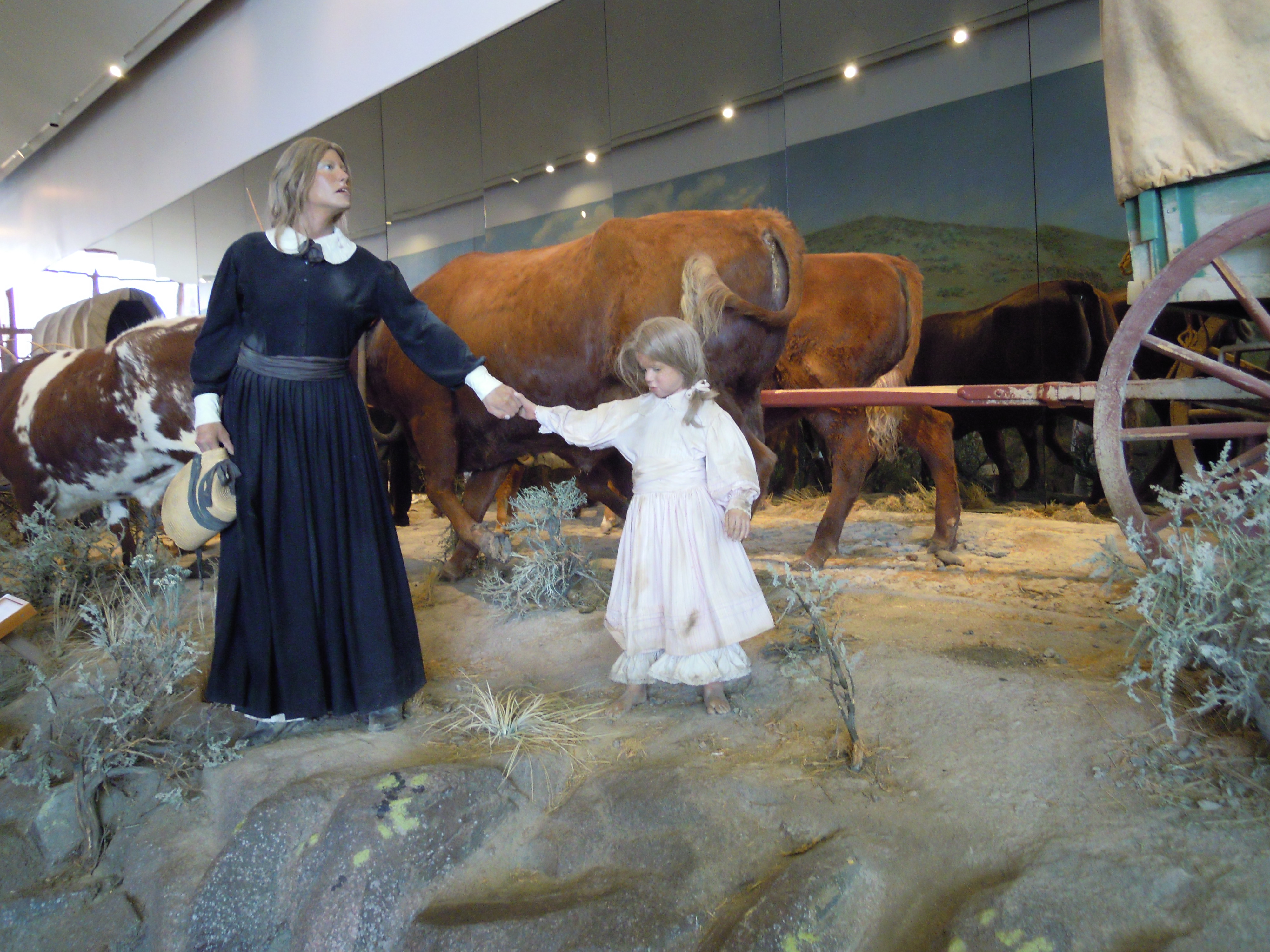
468.diorama mother & childThe tattered wagon covers didn’t look white anymore. Gray dust coated every surface, working its way down into every nook. . . . Animals and people alike looked thin. So little grass. Even when they heard about grass ahead, they’d find much of it eaten off already by the companies that came through before. . . . She was five months pregnant.
A Place of Her Own: The Legacy of Oregon Pioneer Martha Poindexter Maupin, Janet Fisher. (Guilford, CT, Helena, MT: TwoDot/Globe Pequot Press, 2014), pp. 119-120.

Most women who traveled the trail were mothers or soon to be mothers. It was the mothers who, more than anyone, looked both forward and back, remembering home and how it was made. It was the mothers who tried to stretch the protective fabric of home across the 2,000 miles to a new place.
Women’s Voices from the Oregon Trail, Susan G. Butruille. (Boise, ID: Tamarack Books, 1993), p. 89.

13 Saturday Travel 5 miles this morning, then stopt to water at a spring; it is near night we are still traveling on, through dust and sand, and over rocks, until we find water, had none since this morning.
14th Sunday morn, Campt last night after dark after traveling 15 miles in a large bottom, near some puddles of very poor water found out this morning that it needed straining Afternoon, after traveling 10 miles we have campt on the bank of Powder river about 1 oclock another ox sick, we will rest here untill morning
—The diary of Amelia Knight, in Covered Wagon Women: Diaries and Letters from the Western Trails, 1840-1890. Vol. 6, 1853-1854, Kenneth L. Holmes, ed. (Glendale, CA: The Arthur H. Clark Co., 1986), p. 65.

460.high desertOnce out of the mountains we came into high desert country with scattered sagebrush on rounded hills. The emigrants coming the other way were just beginning to see the occasional tree and a few touches of green after endless dusty expanses that could scarcely support life. Did they know what awaited them in the blue ridges on the horizon? Many carried guidebooks that described the various landmarks along the way. But those guidebooks often glossed over the looming difficulties.

First stop for us on this second day of travel was the remarkable National Historic Oregon Trail Interpretive Center at Baker City, Oregon, in that high desert country—definitely a worthwhile stop for any Oregon Trail history buffs, or anyone with an interest in this era of the nation’s history.

The day was heating up fast, and no shade to park in. Fortunately someone had built shaded areas with tables where we ate lunch. We carried lunch supplies with us. Here, windbreaks gave some protection against the battering winds, but breezes still whipped our hair and grabbed at packages. Then I took my granddaughter Calliope inside to tour the place while my daughter Christiane stayed by the sheltered table with the dog.

The interpretive center offers many life-sized dioramas of typical Oregon Trail scenes that put you right into that world, as well as artifacts and informative presentations. Several of the photos on this post and the previous one show these realistic dioramas, while my first post in the series, “Backtracking the Oregon Trail #1,” includes photos of the interpretive center’s outdoor display of actual covered wagons. The photo of the high desert on this post was taken from our shaded table there.

Inside, as I remained watchful of Calliope, I looked upon the diorama of the mother and child (above), and my heart went out to the mothers on that trail. Martha had two little girls to watch out for along that trek. Nora was almost four and Louisa going on two. Little ones can be a handful when you’re stationary, let alone on a trail into the wilderness with all the potential for danger. A child climbing in or out of a moving wagon could get run over and either injured or killed. Many died of cholera, a dread for emigrants of all ages. And Martha had the added burden of being pregnant during the whole trip.

466.diorama horseThe animals in the dioramas are real, the handiwork of an expert taxidermist. But, my granddaughter was assured by one of the staff members, the people are not. Even so, these human statues are created with exquisite detail so you can even see the veins in their hands. Wonderful realism.

And you hear the sounds. The creak of wheels on the rocky track. The clip-clop of hooves. The cry of voices. Free your imagination and you’re there on the trail, experiencing, feeling.

I had a pleasant visit with a woman in the office who I’d spoken to earlier by phone and left a copy of my book for them to consider for their gift shop.

Driving southeast from Baker City, we watched the temperature. It crept up to 101 in the shade and virtually no shade. Yet as the day wore on we appreciated the raw beauty as the sun lowered, casting a smoky glow to paint pinks, golds, and oranges on every ridge.

Bugs splatted the windshield like scattered rain. They must have pestered the weary oxen and the people that trudged through here. And the heat kept bearing down—until evening, when the nights cooled—unlike nights Martha would have remembered back home in Missouri or Illinois.

Pocatello, Idaho, our destination for the night, seemed far away. We’d be coming in after dark once again.

NEXT: A stopover at the Fort Hall replica at Pocatello

COMMENT

Backtracking the Oregon Trail #2

Day Two ~ The Blue Mountains

469.diorama oxen & wagon[The roads] were harder than before. Steeper. Rockier. Dustier. Rivers wilder. There was an occasional tree now, sometimes wooded areas even, with tall conifers and cottonwoods. . . . The trail here was littered with the bones of oxen and fresher dead beasts—along with discarded trunks and furniture—and another human grave. A chill raked Martha despite the heat. The smell of death assaulted her nose.
A Place of Her Own: The Legacy of Oregon Pioneer Martha Poindexter Maupin, Janet Fisher. (Guilford, CT, Helena, MT: TwoDot/Globe Pequot Press, 2014), p. 119.

Sep 3d We came, I think, eleven miles; over the mountains; the scenery was delightful all day but the road was extremely hilly and rough . . .
September 4th We came, I think, fourteen miles this day over the principal range of the Blue mountains, traveling all day through a densely timbered region . . .
—The diary of Abigail Jane Scott, in Covered Wagon Women: Diaries and Letters from the Western Trails, 1840-1890. Vol. 5, 1852, The Oregon Trail, Kenneth L. Holmes and David C. Duniway, eds. (Glendale, CA: The Arthur H. Clark Co., 1986), pp. 121-122.

3d Sunday . . . Traveled along the west side of the valley at foot of mount about 3 miles when we came to a small stream and then commenced ascending the mountain, very steep in many places and continues to ascend for about 6 miles. very hard drive but at the top found the grass burnt off and there was no water, so had to go on till we came to Grand Ronde [River], ten miles, worst hill to go down that we have found yet. long, steep and rocky. . . .
5th Tuesday . . . Hard times. many cattle are failing and all are very poor and a good many get lost among the thick timber. . . . Traveled on about 7 miles on a mountain ridge sometimes on one side sometimes on the other. pretty sidling in places . . . begin to hope we are getting out of the mounts.
—The diary of Cecelia Adams & Parthenia Blank, Covered Wagon Women: Diaries and Letters from the Western Trails, 1840-1890. Vol. 5, 1852, The Oregon Trail, Kenneth L. Holmes and David C. Duniway, eds. (Glendale, CA: The Arthur H. Clark Co., 1986), pp. 302-303.

Tues Sept 21 Traveled 20 miles. . . . Here we commence climbing the Blue Mountains. . . . Had to camp without water. Found hard hills to day and very stony. Saw 5 graves and 5 dead cattle.
—The diary of Martha S. Read, Covered Wagon Women: Diaries and Letters from the Western Trails, 1840-1890. Vol. 5, 1852, The Oregon Trail, Kenneth L. Holmes and David C. Duniway, eds. (Glendale, CA: The Arthur H. Clark Co., 1986), p. 245.

455.road uphill  blue mtsA formidable barrier loomed in front of us as we drove southeast from Pendleton, following the Oregon Trail pretty closely. Rising suddenly from a wide, flat landscape, the ridge looked barren except for a few tree clumps in the hollows. The highway took a wide sweep to zigzag up the hill. You could feel it on the heavily loaded car. Ears popped. My breath caught, imagining wagons rolling down this grade from the other direction.

We soon climbed into rugged timbered mountains. Mostly pines. And worked our way across, with lots of ups and down. Ridge after ridge. These were the Blue Mountains, the worst mountains the emigrants had crossed so far on their entire journey.

You don’t give much thought to those rising and falling grades while driving a car on a smooth highway—although we saw a few cars stopped with raised hoods. But when you let your thoughts drift back to a time when every rise meant a long, hard pull for weary oxen and every drop meant the danger of a wagon rolling out of control—forward or sideways. And every stone on a gravelly track meant the risk of losing a wheel or even overturning the whole vessel. Then the ups and downs become a whole lot more serious.

458.blue mts long view (crop)And think of where they were on that incredible journey. They were nearing the end. They’ve been trudging across a seemingly endless track for almost 2,000 miles. How daunting for them to reach the roughest part now. The oxen are so weary, many are just giving it up. Not enough food. Sore feet. Loads feeling heavier by the day. Now this. They drop and die. And sometimes people do too. Still, in their weariness, some diarists remarked on the splendid beauty of it. The fine timber.

After a long haul across this range we came alongside a gravelly creek which tumbled into a large flat expanse surrounded by a ring of mountains. Out ahead we could see where we would have to climb another ridge. This was the Grande Ronde Valley, admired by many travelers. The name comes from the French grande ronde, meaning “fine large valley” or “big round valley,” so named by the early French-Canadian trappers. A respite before the next rise. The Grande Ronde River mentioned in the above diary flows out of the Blue Mountains.

Our next climb brought us into sparse pine woods, which offered scattered shade amid jutting rock bluffs and scanty tufts of dry grass. This ridge wasn’t nearly as rugged or deep as the last. Reverse the direction of travel and you realize this was only a hint of worse to come for those westbound pioneers. Could they even imagine what was awaiting them in the ridge ahead?

[The photo at the top was taken in the National Historic Oregon Trail Interpretive Center near Baker City, Oregon]

NEXT: A stopover at the interpretive center just outside Baker City, a highlight on our journey

COMMENT


Enjoying Ashland Charm

627.ashland outside bloomsburyMy cousin Carolyn Compton rode down to Ashland with me yesterday for my reading and signing at Bloomsbury Books, right on Ashland’s charming Main Street. Carolyn taught school in Ashland for many years and welcomed the chance to revisit old haunts. I lived there for a short time in the late 90’s.

Now Carolyn lives just across the river from me on Pleasant Plain on the farm where our fathers grew up. As first cousins Carolyn and I share the same relationship with Martha, and she has been a staunch supporter of my work in writing and marketing the book about our brave ancestress.

We arrived in Ashland early enough in the afternoon to wander Main Street for a while, although the 90 plus temperature encouraged us to dip into a cool restaurant before too long. We enjoyed Italian food and ambled back to the bookstore in time for the event.

630.reading ashland bloomsburyA lovely group of people came, a small but enthusiastic gathering. I read a couple of short segments from A Place of Her Own, then sensing those had gone fairly quickly I asked folks if they would like to hear another short segment or chat a bit. A question from the audience sparked a lively chat, and then they asked for more reading. I added an excerpt from the “Oregon Trail” chapter describing the harrowing descent down Laurel Hill on the west side of the Cascade Mountains and received a hearty round of applause–always a pleasure for an author to hear.

Carolyn and I were delighted to see friends from our days in Ashland, Stephanie Bartlett and Mel Ginsberg. Stephanie had helped me with my books when I lived there. I remember a workshop she gave, which provided clues to better writing that I still think about today. And she offered me some particular advice on my book set in Minoan Crete that has seen many reincarnations over time, a book I hope is about ready for print under the current working title, Beyond the Waning Moon. So great to see Stephanie after some sixteen years or so.

An enjoyable day. Thank you, Carolyn, for navigating our way on streets I’d forgotten, for taking the reading picture, for helping carry stuff and setting up a table and pouring wine, but most of all for your good company.

COMMENT

Backtracking the Oregon Trail #1

Introduction

I recently returned from a road trip with my daughter Christiane and granddaughter Calliope. Christiane got a new job as Assistant Professor at Kansas City Art Institute and was moving back to the Kansas City area. I decided to join her on the drive east to help with my granddaughter, who’s nine years old, then help set up their new house before flying home. On our eastbound route we chose to backtrack Martha’s journey over the Oregon Trail as roads and time allowed.

It took us five days to cross what took five months for my great-great-grandparents Martha and Garrett Maupin. And for my flight home I was in the air about five hours.

I’m adding this new category to my blog to describe our trip, offering related quotes from my book about Martha, A Place of Her Own: The Legacy of Oregon Pioneer Martha Poindexter Maupin, as well as quotes from the diaries of other pioneer women who made that journey. The diaries are taken from a series called Covered Wagon Women, edited by Kenneth L. Holmes. Like Holmes I present these diaries as written, using the spellings and punctuations of the original writers. A few additional sources add information. This is the first of ten posts in our story.

462.one lg wagonDay One ~ The Dalles

[T]he heat of the day radiated with scorching fury. . . . Now Martha worried about their own food supply. Her food bags had gone flabby for lack of contents. They’d traded with some Indians–shirts for fish–large dried salmon to add to the meat supply. But they were nearly out of flour. How long until they reached The Dalles, where they might buy more?
A Place of Her Own: The Legacy of Oregon Pioneer Martha Poindexter Maupin, Janet Fisher. (Guilford, CT, Helena, MT: TwoDot/Globe Pequot Press, 2014), pp. 119-120.

Here the Doct. met us on his way back from the Dalls. . . . He brought some flour, pork, Salt, and saleratus. Prices are coming down at the dalls. flour can be had at 15 cts. Pork at 37½, Salt at 25, Salertus 25, Sugar 25 to 30 . . . Have long been convinced that we are too late to cross the Cascade Mountains with safety so we concluded to leave our cattle and wagon at the Dalls and proceed down by water. . . . Traveled to the Dalls, 5 miles, and found a boat ready for sail
—The diary of Cecelia Adams & Parthenia Blank, in Covered Wagon Women: Diaries and Letters from the Western Trails, 1840-1890. Vol. 5, 1852, The Oregon Trail, Kenneth L. Holmes and David C. Duniway, eds. (Glendale, CA: The Arthur H. Clark Co., 1986), pp. 308, 310.

We this morning sent two of the wagons by the way of the Dalles to be sent to Oregon City by water
—The diary of Abigail Jane Scott, in Covered Wagon Women: Diaries and Letters from the Western Trails, 1840-1890. Vol. 5, 1852, The Oregon Trail, Kenneth L. Holmes and David C. Duniway, eds. (Glendale, CA: The Arthur H. Clark Co., 1986), pp. 129-130.

461.circle wagonsWe crammed everything into the car that we possibly could, to add to what Christiane had sent by U-Haul pod. Martha and Garrett crammed everything into the wagon they possibly could, and left behind anything that wouldn’t fit or that would be too heavy for the oxen to pull.

Starting out on the main roads, we planned to meet up with Martha and Garrett’s route at The Dalles, Oregon. The Dalles was one of those mileposts for the American emigrants, a place to replenish depleted supplies and to stop and rest before the most harrowing part of the journey. While the Rocky Mountains offered a gentle pass across their summit, the Cascade Mountains did not. The first several wagon trains in the early 1840s stopped well before this rugged range. Wagons were dismantled, broken down, left behind—either at The Dalles or before—and people took boats down the treacherous Columbia River or followed long, perilous trails on horseback over the mountains.

But wagons carried a lot of stuff they wanted. And getting those treasures to the west side without the wagons proved a problem. Some ferried the loaded wagon boxes down the river, or reloaded the goods onto boats. But many wanted to take the wagons west with them. Men decided to cut a road over the Cascades south of Mount Hood. They called it Barlow Road. Not much of a road, but hardy folks like the Maupins took their wagons across the Cascades over it, all the way to their destination in Oregon’s lush Willamette Valley. I had previously visited part of that route just prior to writing Martha’s story, so we bypassed that and went straight toward The Dalles.

We had talked about eating dinner at The Dalles, but were getting hungry before we got there. I couldn’t help being reminded of Martha’s concerns about their food supply before reaching The Dalles. We decided to stop for dinner at Hood River instead. The car has a temperature gauge, and had been warning us, but we were comfortable with the air conditioner blowing. The numbers had hit 98 in Portland, unusually high for that city, and reached 100 by Troutdale on the city’s eastern perimeter. At Hood River it had climbed to 102.

We stepped out of the car. Heat pressed down like a living force. We had Christiane and Calliope’s dog Penny with us. We couldn’t leave the dog in the car, even in the shade. Looking for a place where we could eat outside and tie her next to us, we finally found a possibility. The restaurant had tables on a covered patio and the waitress set a place for us—in the sun! No way could I sit in the sun to eat when it was 102 in the shade. Nor could they promise food in less than 30 to 40 minutes. I figured we’d be cooked ourselves in that amount of time.

Our thoughts of a nice dinner evaporated like water on a sizzling sidewalk. We pushed on to The Dalles. It was drive-through time. Eat in the car with an occasional blast of cool air from the AC.

464.two wagonsAgain I thought of Martha and the relentless heat bearing down on her, often without shade except for a little alongside the wagon. No blast of cool air from anywhere. How desperate she must have been for a tree, a stream of water, anything to provide relief. At least, here on the east side of the Cascades it was a dry heat. But when it’s over 100 it still takes your breath away.

Anyway, a quick dinner got us back on the road faster and we drove on toward our first night’s destination in Pendleton, Oregon. It had taken us longer than expected to load up that morning, and the estimated travel times we got online appeared to be a little optimistic. We wouldn’t reach Pendleton before dark. A sense of urgency compelled us. But with the long summer days, we saw most of our route, dark settling just before Pendleton so when we approached it, the town appeared like a jewel of lights nestled in dark velvet.

[The photos for this post were taken outside the National Historic Oregon Trail Interpretive Center in Baker City, Oregon, which we would visit on Day Two. All photos in the series are by the author.]

NEXT: First thing the following morning, we reach the Blue Mountains, the most difficult road the emigrants have seen on their entire journey.

COMMENT