Book Event Explores a Living Past

Story and tangible history came together when the Friends of Fort Vancouver and the National Park Service hosted me for a book event at the remarkable re-creation of the historic Hudson’s Bay Company trading post, Fort Vancouver.
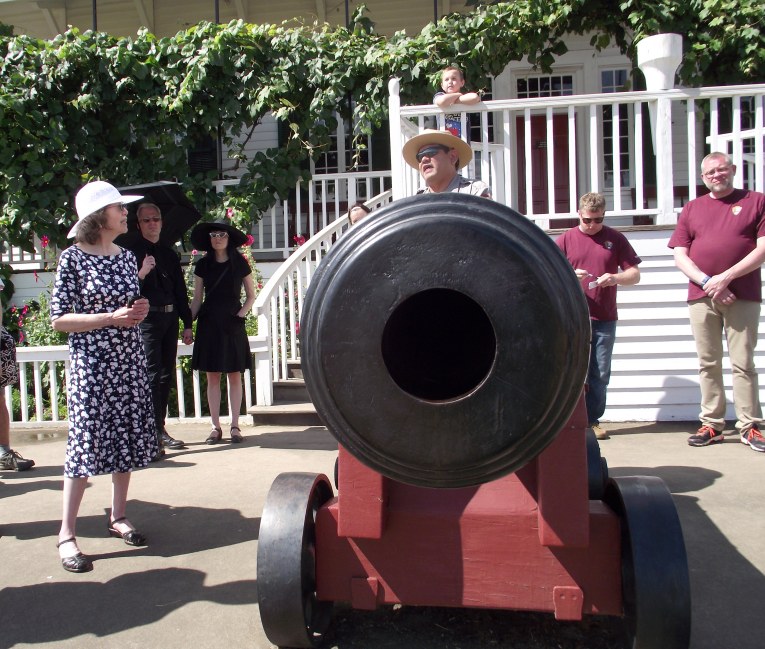
Fort Event Big GunThe event highlighted the actual reconstructed fort with a tour led by Dr. Robert Cromwell, Chief Ranger and Archaeologist, speaking behind the big gun here. Two large cannons stand in front of the elegant Big House, home of the fort’s commander in the days of my book, The Shifting Winds. During the tour I offered a few words on certain scenes from the book which took place at the fort in 1842 and 1843. I’m in the white hat. Photo by Robin Loznak.

The tour brought us into the fort’s living history, and Dr. Cromwell was great. I love this place that makes the past live. I feel a deep connection because my first visit here years ago inspired me to write The Shifting Winds, and making the past live is what I try to do with my historical novels.

Fort Event FlowersDr. Cromwell talked about the impression the house would have made on its 19th century visitors, such a grand structure with its expensive white paint and the big guns facing the front gate, although he noted the guns were spiked so couldn’t fire.

Nevertheless, the effect was no doubt intended to show the power of this British fur trading company that essentially ruled over Oregon at the time of my story.

On this July day the lush grapevines draped over the Big House veranda and bright flowers bloomed in front. On my previous visit in March the canes were bare, and there was no sign of flowers. Now huge clusters of grapes hang from these vines.You can also see part of the arbor in the top photo.

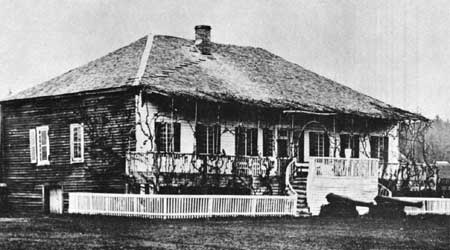
Photos taken of the original Big House in 1860 let researchers know that grapevines twined around metal trellises on the veranda that extends across the entire front of the house.
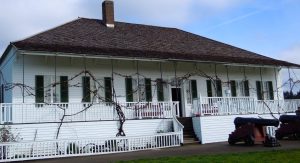
Fort Vancouver Big House (2)The thumbnail shows the house during my March visit before the greenery leafed out. Quite a change, and probably effective for the south-facing house. In winter when they needed more light the leafless vines let the sun come in, but in summer the leaves provided cooling shade.

Our tour proceeded inside the house so the group could see additional settings of the story and learn more about the fort. Then we moved on to the Indian Trade Store and the Fur Store warehouse to get an idea of the real purpose of this fort. The Hudson’s Bay Company officers and employees may have appreciated the protection of the picketed stockade, but the fort never served as a military post for them. The Company came for the furs, particularly beaver, purely a business venture. But it could be a cutthroat business as they competed against the Americans, who also held an interest in the territory.
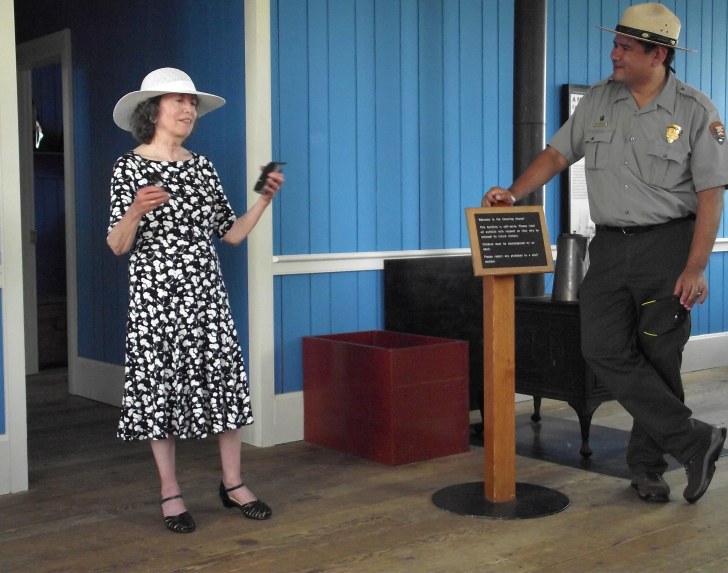
Fort Event Ranger & meThe tour ended up at the New Office, above, the closest thing to the setting where my character Alan Radford would have worked. The clerk Alan lived and worked in the Old Office, which hasn’t been reconstructed yet. While Dr. Cromwell looked on, I talked about the scene where Alan invites protagonist Jennie to see his workplace during the Christmas Ball at the fort. Through a bit of byplay between these characters, I slip a little information into the story that gives the reader an idea how the fort functioned and how very isolated they were in this wilderness. Photo by Robin Loznak.
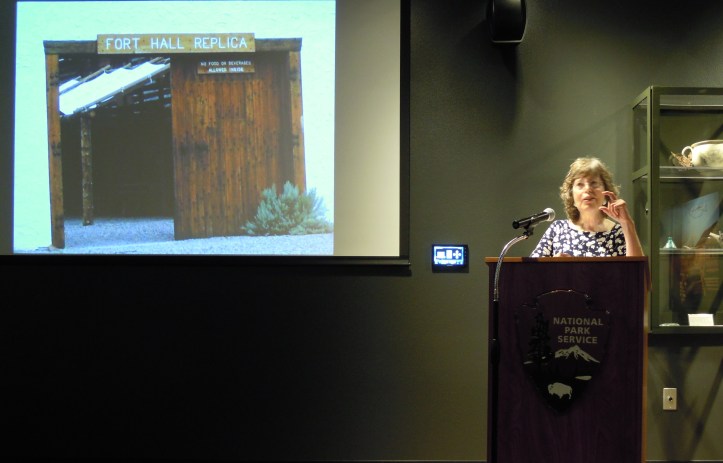
Fort Event Lecture 5 (2)My lecture at the Visitor Center featured photos related to the story, this one showing Fort Hall, another reconstructed fort that became a landmark on the Oregon Trail. My thanks to Ranger and Guide Emily Orvis for setting up the AV tech equipment so it all rolled smoothly, and thanks to my son-in-law Robin Loznak for handling the individual photos while I talked. This shot of me was taken by Benjamin Capps with my camera.
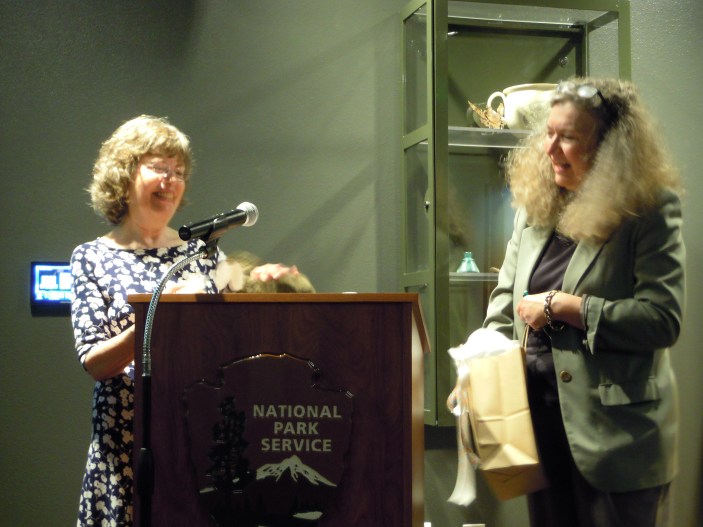
Fort Event Mary & meAfter my talk, Mary Rose, Executive Director of the Friends of Fort Vancouver, surprised me with a bag of thoughtful gifts, from a lovely turtle pin that memorializes the Native American label for the fort area as the “place of the mud turtles,” to Jacobsen sea salt from Oregon’s cold waters at Netarts Bay, to a Russian nesting doll acknowledging Vancouver’s many Russian immigrants, a little stuffed beaver representing the target of the 19th century fur traders, and a 100th anniversary pin commemorating the 100-year birthday of the National Park Service that maintains the site. What a delightful gesture! Photo by Benjamin Capps.
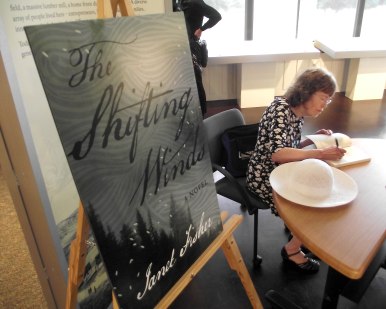
Fort Event Signing 4I arrived early, well before planned activities, which worked out. Tourists were stopping by and several bought my books, even some that hadn’t come for the event, and they were pleased to get personalized signed copies. My thanks to Sales Assistant Madya Panfilio for her enthusiasm in recommending my work. Official signing came after the lecture. Photo at left by Robin Loznak.

Mary Rose also asked me to sign additional books, which are available in the Visitor Center Bookstore.

Mary was the one who arranged my presentation at Fort Vancouver. When she learned about my book The Shifting Winds, she immediately became interested. She read the book, appreciated the accuracy and the story, and discussions led to Saturday’s presentation.

Many thanks to Mary for organizing such a wonderful event. She and the staff at the Visitor Center and the fort did a terrific job. Thanks to them all.

As my grandson Alex said, “They rolled out the red carpet for you, Grandma.” Yes, they did.

Everyone made it a wonderful day and I am most grateful.

COMMENT

The TRUE Shifting Winds ~ 5: Digging Up the Past

I first visited Fort Vancouver some years ago to research a short segment for one of my early attempts at an Oregon Trail novel, and the place put me right back in time. I was so inspired by the authentic reproduction of this historic fort I knew I had to write another book with more scenes set there. That became The Shifting Winds, which I’m honored to be presenting at the fort this Saturday, July 16, at 2 pm.

In this post I want to talk about how this wonderful reconstruction came to be.

Archaeology and Record Keepers

The British Hudson’s Bay Company chose a location on the north bank of the Columbia River for their western headquarters in the Oregon Country because they felt optimistic about Britain holding land on that side of the river once London and Washington agreed on a boundary between the two nations. But in 1824 when Dr. John McLoughlin and his boss Governor George Simpson selected the site, enough uncertainty hung over the region that they didn’t want to make a huge investment.

Also unsure of the friendliness of the local tribes, they erected the first palisade walls about a mile inland, creating a simple fur trading post on a bluff about a mile from the river with bastions on at least two corners, ready to defend themselves against attack.

Several events came together to change their perspective. First, the joint occupancy treaty of 1818 between the British and the United States was extended indefinitely in 1827. The Native Americans proved to be agreeable traders, and the distance from the river proved to be a bloody nuisance.

So in 1828 they pulled up stakes, literally, and moved the whole thing a mile closer to the river to the spot where the reconstructed fort lies today.

Christened in 1829, the new fort would serve the Company for many years. But it didn’t remain static. It kept changing over time like a living, breathing organism that sloughs off old skin while growing new. The fort walls kept moving. The fort doubled in size by 1836. Apparently the officers found their space too small.

They would expand again, moving the south wall farther out—and the east wall—again.

Buildings changed. The first Big House in the original west half began to sag until someone described its condition as so dilapidated it was ready to fall down around them. They rebuilt a new Big House in the east half where you can see it reconstructed today.

So why the reconstruction? Why did the original disappear? And why the constant change?

In short, wood rots—especially in a place where rain soaks the land for more than half the year. And little critters move in to feed on wood fiber.

Constant maintenance was required, and sometimes they just tore down buildings and constructed new. They continually replaced rotting pickets in the stockade and repaired leaky roofs. When the British finally lost the land on which the fort stood—as you must know they did—the Hudson’s Bay Company was allowed to stay on for a while, but they soon began moving the bulk of their business to Fort Victoria. London and Washington had finally agreed on a border in 1846, drawing the line along the 49th parallel, well north of Fort Vancouver, although giving the British Victoria along with the entirety of Vancouver Island.

By 1860 the Company abandoned the fort and the United States Army assumed control. But they found most of the buildings unsuitable for their purposes and in dilapidated condition. In a few years rot and fire destroyed what was left.

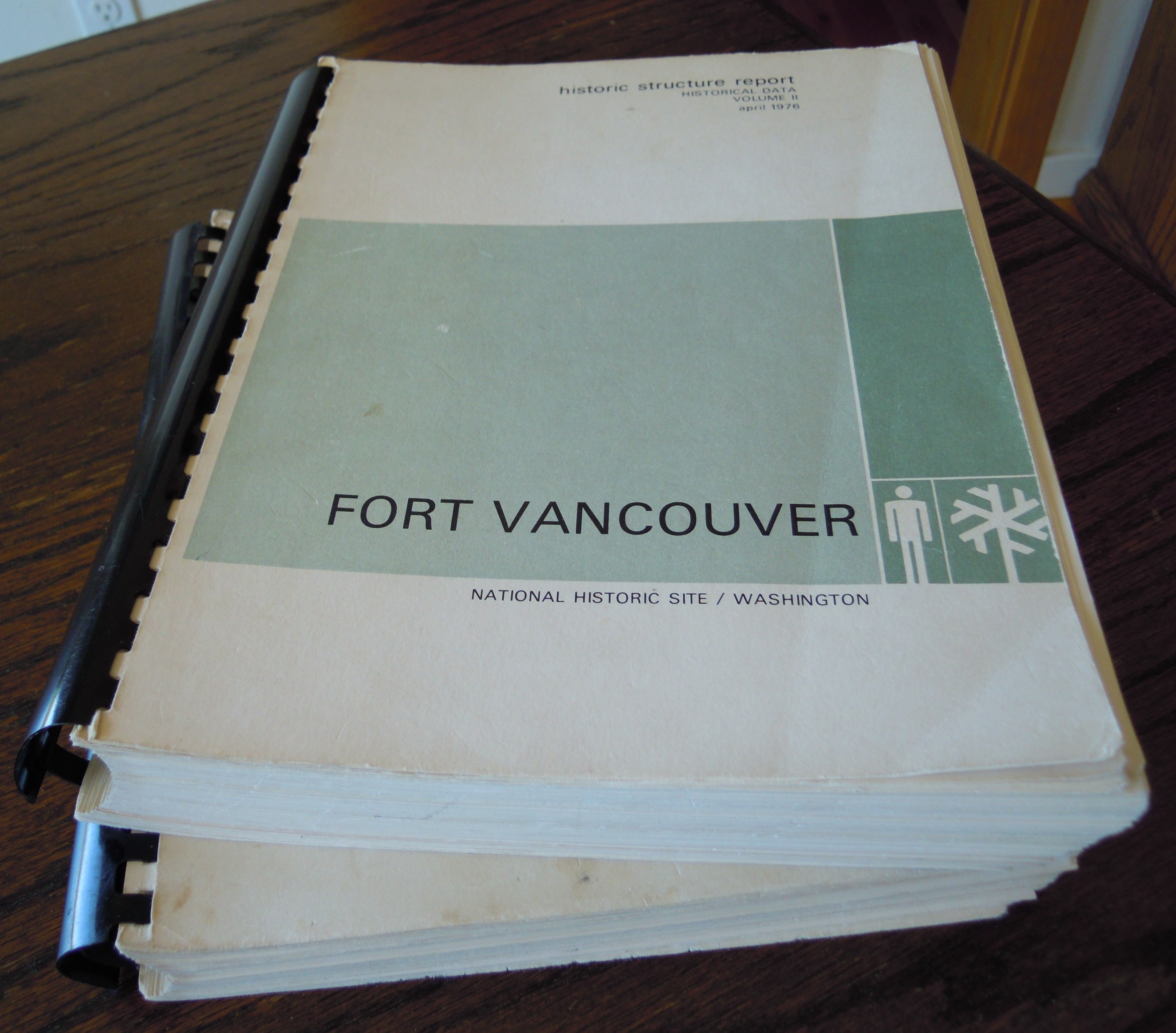
Yet some historians didn’t forget. In the 1940s the National Park Service began exploring the possibility of reconstruction. If they were going to do it they wanted to do it right. On my first visit to the reconstructed fort in the 1980s a curator there loaned me these two large volumes of a “Historic Structures Report” by John A. Hussey and the historic preservation team.

The volumes described the detailed research that went into this re-creation, a wealth of information. When I called about returning the volumes, the curator told me that if I continued to find them useful I should keep them because they had plenty of copies. What a boon to my research!

Now of course the report is online, offering a glimpse of the magnitude of the project. But I have spent many hours poring over the printed books.

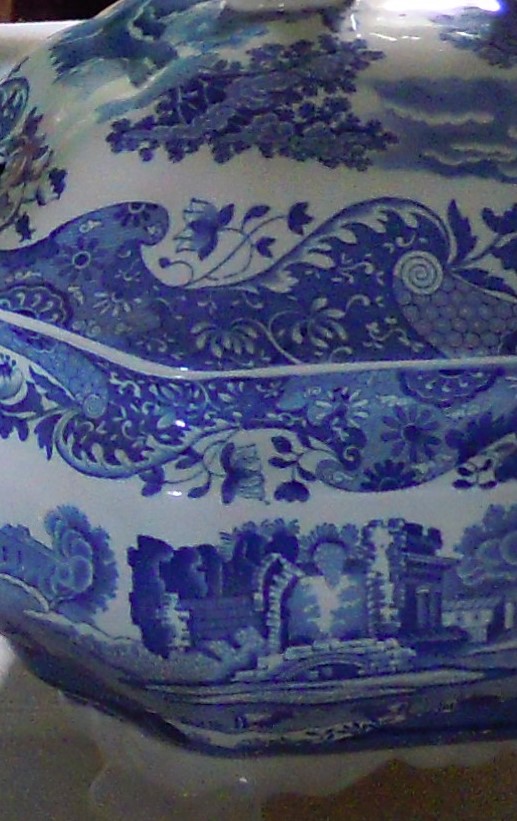
As early as 1947 National Park Service archeologists dug into the soil to find footings of buildings and remains of those moving walls at their various locations. They found tools, pottery, even Spode china on the site of the Big House–something in blue on white, perhaps to match these on display in the Big House dining hall, or Mess Hall, like the one shown here. Meanwhile, researchers looked into records. The Hudson’s Bay Company, still a functioning business in the UK, generously opened their remarkable archives for this study.

The British had kept detailed records.

Researchers were also given access to similar HBC posts, now in Canada, and those were studied and photographed for comparison. The Company tended to follow similar plans from one fort to another, so those helped in decisions about the finer points.

Books written in the day offered observations of the fort. Libraries across the United States and Canada held useful tidbits. Many fort visitors wrote about their impressions, sometimes drawing detailed sketches and maps. These were often dated and helped show the constant rearrangements going on over the fort’s life. Researchers scrutinized maps, drawings, every descriptive statement they could find. Much of that went into this report, along with bits of story that add flavor.

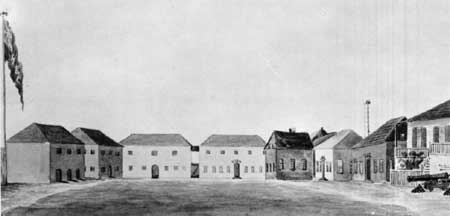
Warre Lithograph-1

The above lithograph was based on a water color by Henry J. Warre painted during his 1845 visit. My thanks to Meagan Huff, assistant curator at the fort, for sending me this copy from the National Park Service collection. She pointed out a change the artists in London made to Warre’s original.

Warre’s original gives us these characters.

Did Warre depict shepherds? Or voyageurs? Perhaps wanting the image more colorful the London artists replaced the original figures in the foreground with Native Americans, but in Plains tribe dress, not realizing that these tribes did not frequent the area.

Because the fort changed so much from year to year, the preservation team needed to pick a date, and they decided to reconstruct to the year 1845. That’s close to the date of my novel, which has scenes at the fort in 1842 and 1843. So as I read the report I had to make careful distinctions between the 1845 fort I saw and the 1842 fort I would describe

For instance, in one scene Dr. McLoughlin and my fictional clerk Alan walk across the grounds from the Big House to the Indian Trade Store in the western courtyard. Today you’ll find that store on the east side, almost straight across from the Big House, a short walk. But in 1842 that store was over in the western side where the Fur Store stands today. A longer stroll.

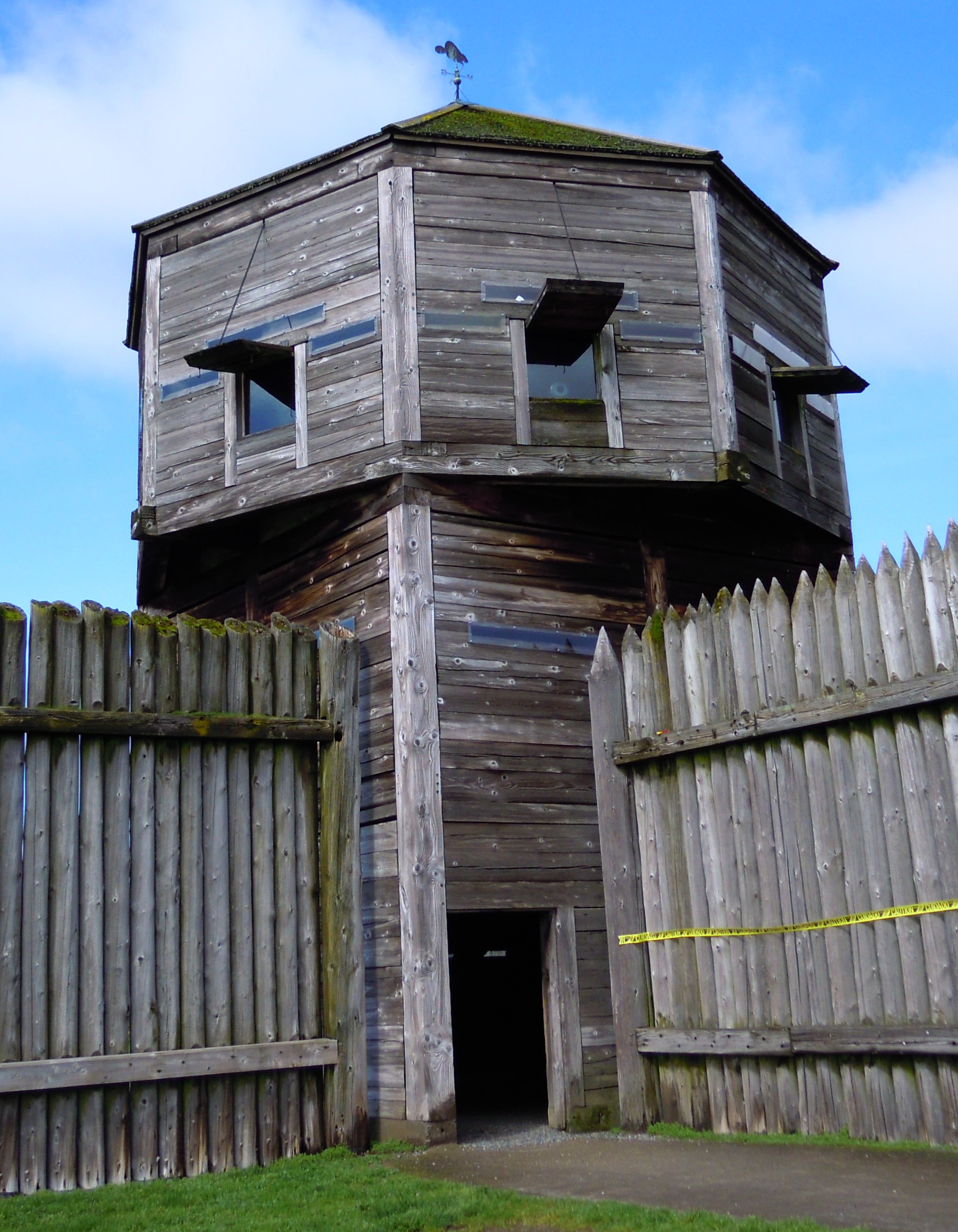
Perhaps the most conspicuous difference would be the bastion you can see in Warre’s 1845 image above. There was no bastion in 1842, so you won’t find reference to a bastion in the book. But I have shown it in blog and Facebook posts because it looks so fort-like. Fort Vancouver was more trading post and supply depot than fortress. Caution required walls but not big guns.

The bastion went up in 1844, not because of danger, but because of protocol.

Hussey relays the story in the report. A ship sailed up the Columbia in 1844 and offered a  7-gun salute. But the fort couldn’t answer the salute because they had no cannons mounted for action.

Although they’d put up bastions on the old fort, they hadn’t bothered with a bastion in the new fort, things being so peaceful. But not to be able to answer a salute—well, that just wouldn’t do. So they built one.

Given the troublesome nature of some of the pesky Americans coming into the country it seemed a good idea anyway.

Another change was the New Office, built in 1845 to replace the Old Office. The Old Office was one of the oldest buildings of the fort, the first thing constructed, given its function so vital to the fort’s purpose. That Old Office still served the fort in 1845, because the new one offered temporary living quarters for a ship captain who stayed on for a while, adding excitement for the gentlemen with his many parties in the new structure. This New Office, or “Counting House” as it was sometimes called, has been reconstructed. The Old Office has not, although perhaps one day it will be. It stood close by its replacement at least until 1847 when the good captain departed. The old building with its dark exterior shows clearly in a water color sketch drawn in 1846 or 1847.

The fort required considerable bookkeeping. Clerks like my fictional Alan Radford generally entered service through apprenticeship, nearly all of them from Britain. Because of the many applicants, family connections helped. These clerks were usually well educated and knew some accounting beforehand. The Company wanted reliable, loyal clerks working in the office, men who would be discreet and keep Company business confidential. These accounting clerks held one of the better paid jobs for gentlemen at the fort.

I took particular interest in the office, given that Alan is a major player in my book. Other buildings of special interest to me were the Big House where Jennie stays during her visit for the Christmas Ball and where the ball takes place, and the Bachelor’s Quarters where American mountain man Jake Johnston stays, having joined the party for his own reasons. Accountants like Alan lived in the office, but most clerks lived in the Bachelor’s Quarters, a long building divided into multiple rooms or apartments. And when gentlemen came to visit, the clerks often got bumped to accommodate the visitors.

However, Alan appeared none too pleased when McLoughlin allowed Jake a room in the Bachelor’s Quarters. When Jennie asked Jake what was wrong with Alan, Jake grinned.

“Well,” he said, “it’s only gentlemen who are allowed to stay inside the fort, and I don’t think Radford considers me a gentleman.”

She wasn’t sure Jake was a gentleman either, but she was surprised at the rigidity.

The Bachelor’s Quarters have not been reconstructed yet either, but the report offers excellent detail.

Fisher, Janet. The Shifting Winds. Guilford, CT, Helena, MT: TwoDot, Globe Pequot Press, Rowman & Littlefield, 2016.
Hussey, John A. Historical Structures Report Historical Data, Vol. I and II. Denver Service Center, National Park Service, U.S. Department of the Interior, 1972, 1976.

Next: Making the Past Live

COMMENT

Fort Vancouver Event Coming Soon

My reading and signing event at the fantastic Fort Vancouver site in Vancouver, Washington, is just three weeks away, Saturday, July 16, starting at 2 o’clock in the afternoon. As mentioned in my March post “Upcoming Book Event at Fort Vancouver,” it was a dream of mine to hold an event at this historic fort for my new historical novel, The Shifting Winds, because the fort plays a significant part in the story. Now that dream is about to happen.

599.Ft.Vanc.Bastion -titleThrough my presentation at the fort Visitor Center–a lecture, a slideshow of related photos, and a tour of the fort–I hope to draw people back to the days of my story. The lecture and book signing will be from 2 to 3:30. Afterward, from 4 to 5 I’ll lead attendees on a tour through the fort and highlight some of the places that appear in my book. The bastion in the fort palisade is shown above.

Several scenes in the story take the reader to this amazing spot of British civilization in a wilderness isolated from all that’s familiar to the young American protagonist, reluctant pioneer Jennie Haviland. And one of the major players, Hudson’s Bay Company clerk Alan Radford, works at the fort.

In the early 1840a when the story takes place, Fort Vancouver stands as the center of the British fur trade in the Pacific Northwest, and American settlers have just begun trickling into the area, hoping to gain the land for the United States. For more than 20 years Britain and the United States have jointly occupied the Oregon Country, unable to come to terms on a boundary between them.

Ft.Vanc.Big House FrontGiven Fort Vancouver’s significance in Western American history, the fort has been faithfully reconstructed as a living representation of the times, including the home of the commanding officer and his second in command, above, which is furnished much as it would have been when Chief Factor Dr. John McLoughlin lived there and essentially ruled the Oregon Territory. The McLoughlin sitting room is shown below.

613.Ft.Vanc.McLoughlin Sitting RoomNow a National Historic Site maintained by the National Park Service, the fort offers visitors a chance to step back in history and see what life was like in the fort’s heyday.

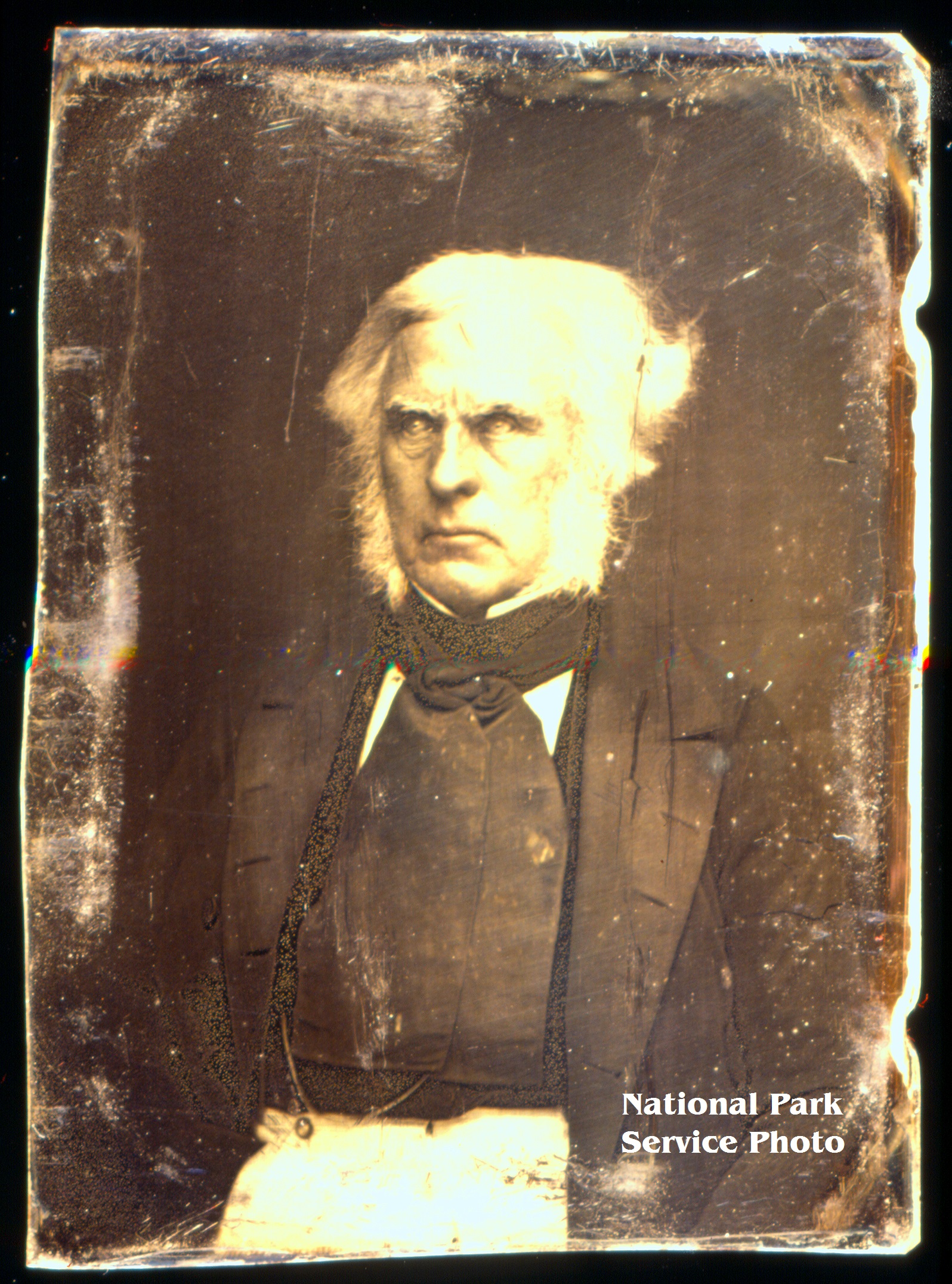
622.John McLoughlin Daguerreotype - creditChief Factor McLoughlin, shown in the daguerreotype, is one of the real characters portrayed in the book (photo courtesy of National Park Service).

My story takes place during the historic time of rising tension between the two nations over this one land. Within that true story of conflict, a fictional clash develops between two men–the British HBC clerk Alan Radford, and American mountain man Jake Johnston–who vie for protagonist Jennie as their nations vie for Oregon.

To find the fort and center, their website offers maps and directions. The Visitor Center, where my event will be held, is at 1501 East Evergreen Boulevard.

The Visitor Center Bookstore will have copies of The Shifting Winds for sale, as well as copies of my previous book, A Place of Her Own.

My thanks to the National Park Service and the Friends of Fort Vancouver for co-hosting the event. And a special thanks to Mary Rose, Executive Director of the Friends of Fort Vancouver National Historic Site, for making the arrangements.

In these next three weeks I plan to offer a series of posts here on my blog to help set the stage for my story and for this event. Because the posts will delve into the historical setting, I’ll call the new series “The True Shifting Winds.”

COMMENT

Pleasant Evening at Bookmine

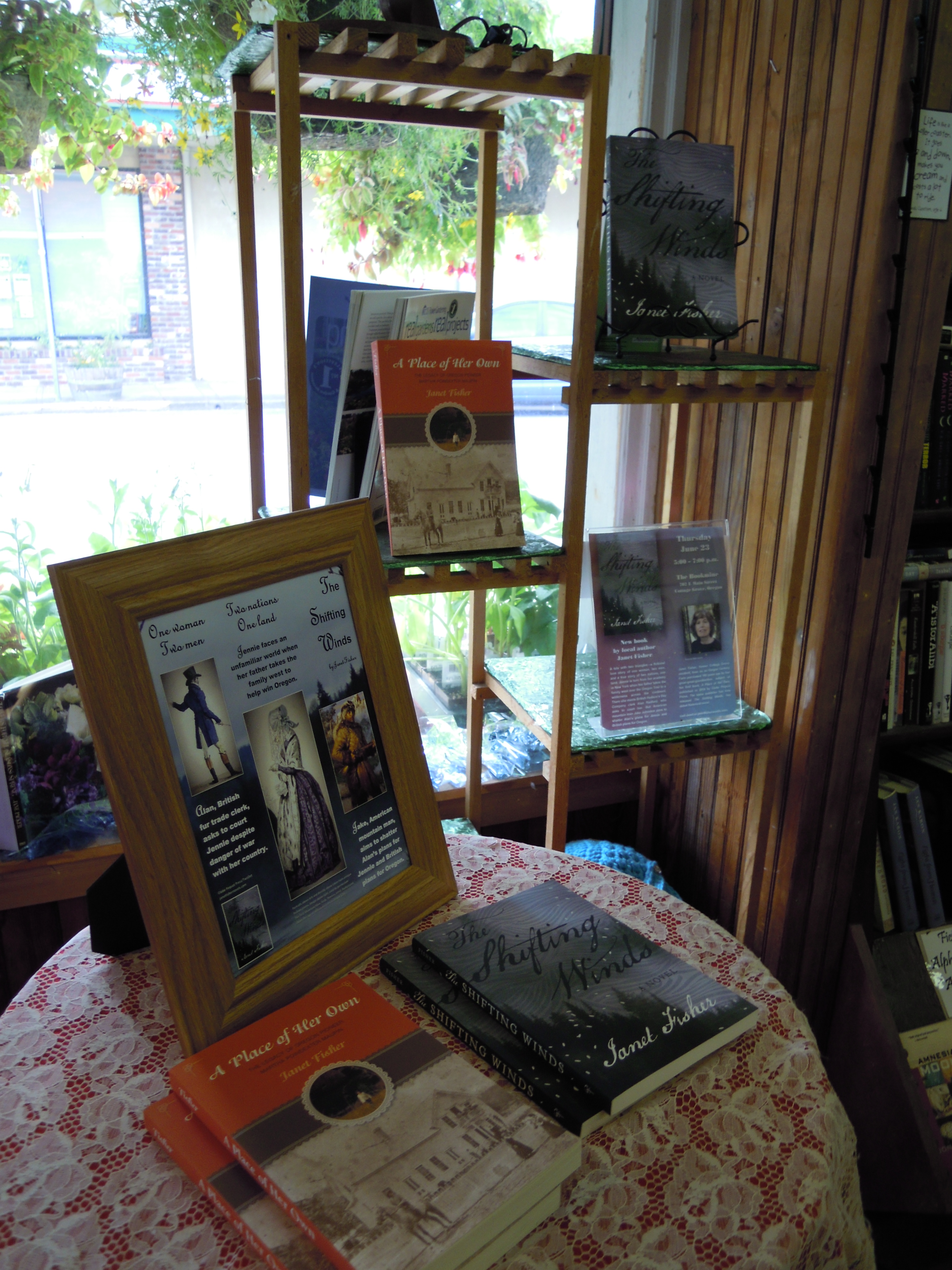
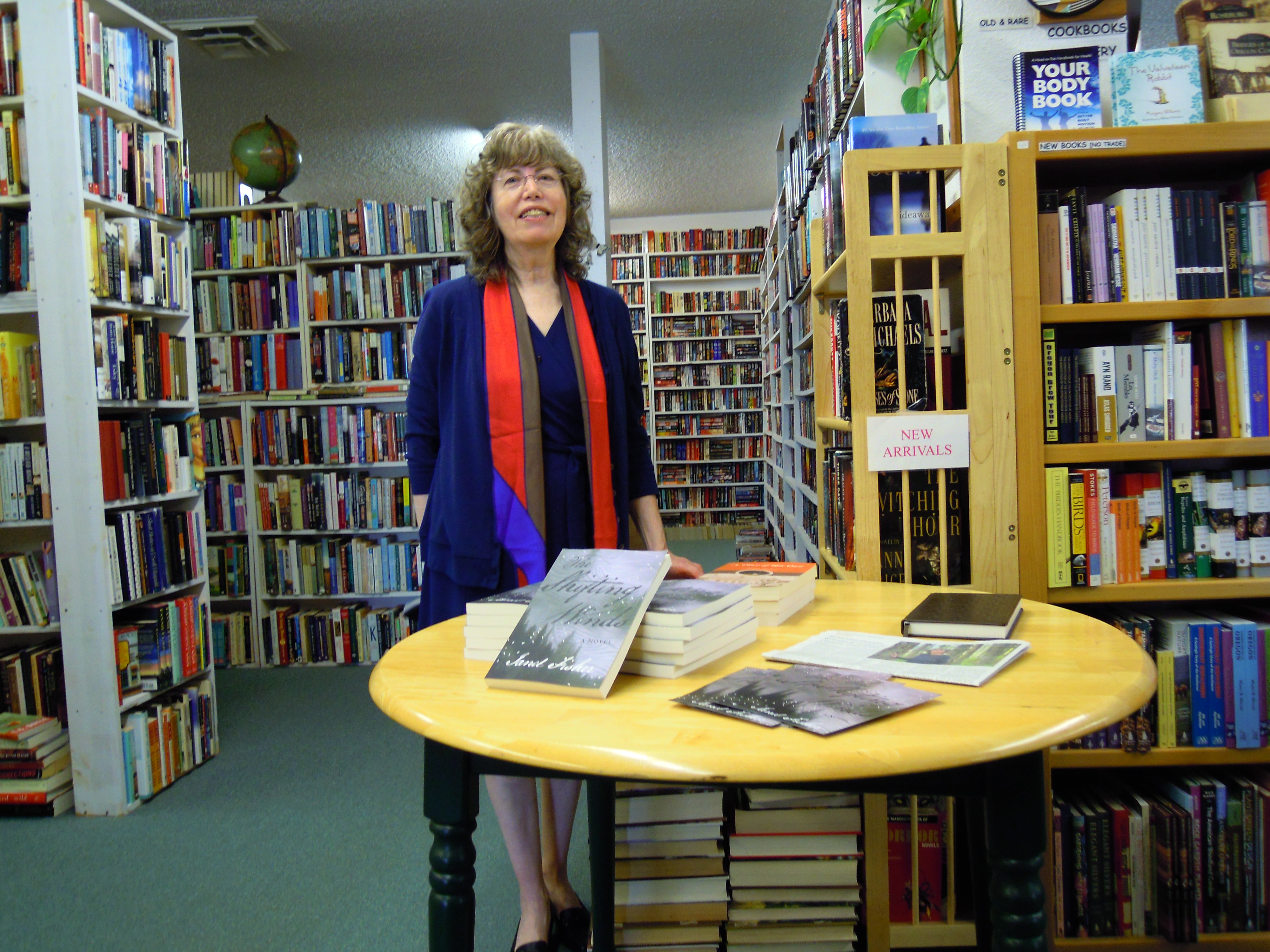
Bookmine encore.1029Gail at The Bookmine in Cottage Grove set up a lovely display for my encore signing and reading party for The Shifting Winds Thursday evening, to which I added my new poster for the book (at left).

We also had copies of my first book, A Place of Her Own, available and actually sold quite a few of them as well. It continues to gain interest.

It was a busy evening with the Farmer’s Market just outside, and several people drifted in to join those who’d come for the event.

Bookmine encore.1040.2

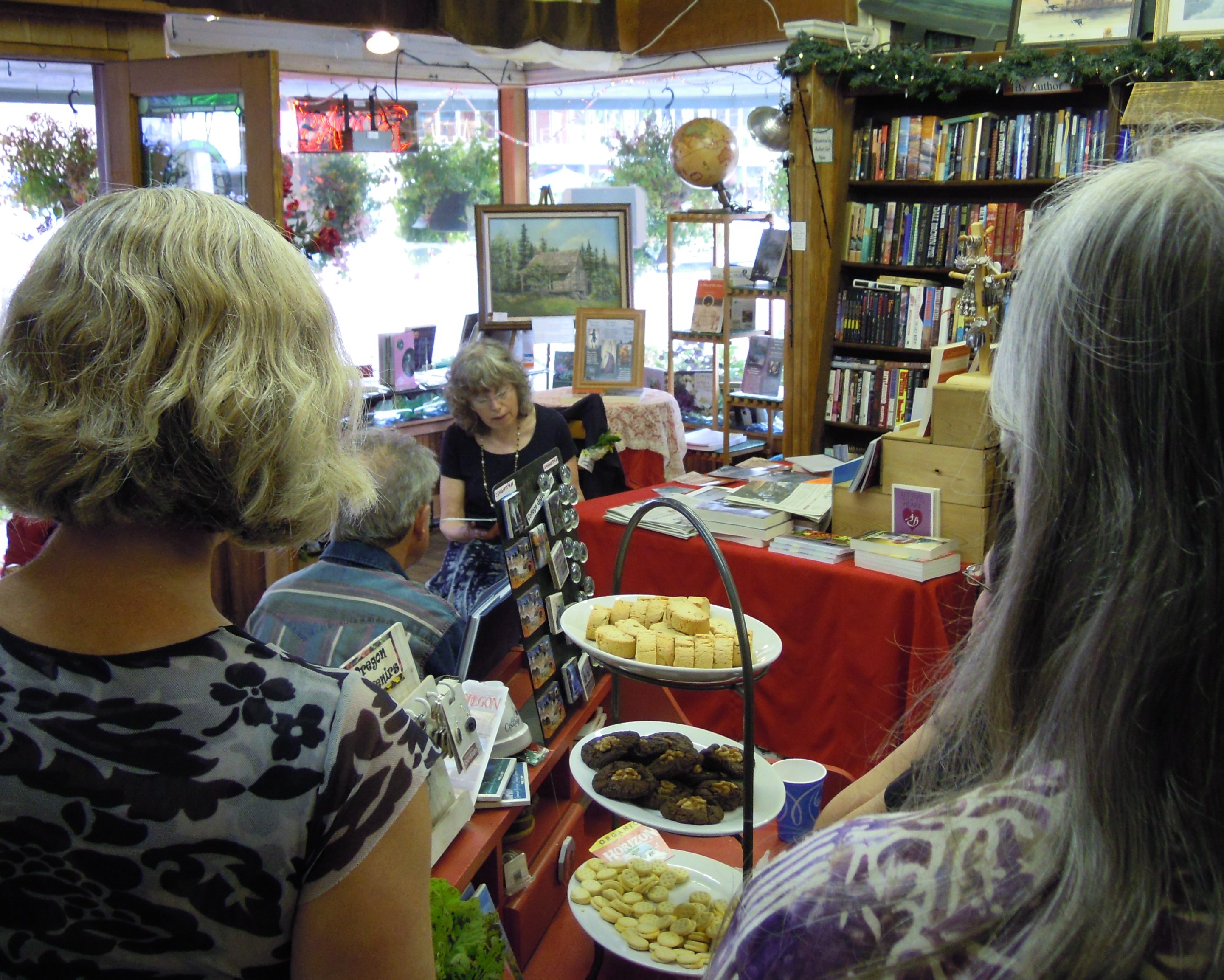
An attentive group stayed for the readings. I chose three short segments, a couple of tense cliff hangers and, for a change of pace, one of Joe Meek’s stories. Joe, a mountain man, is one of the real characters in the book. Gail also offered refreshments, shown in the photo above, so folks nibbled and listened.

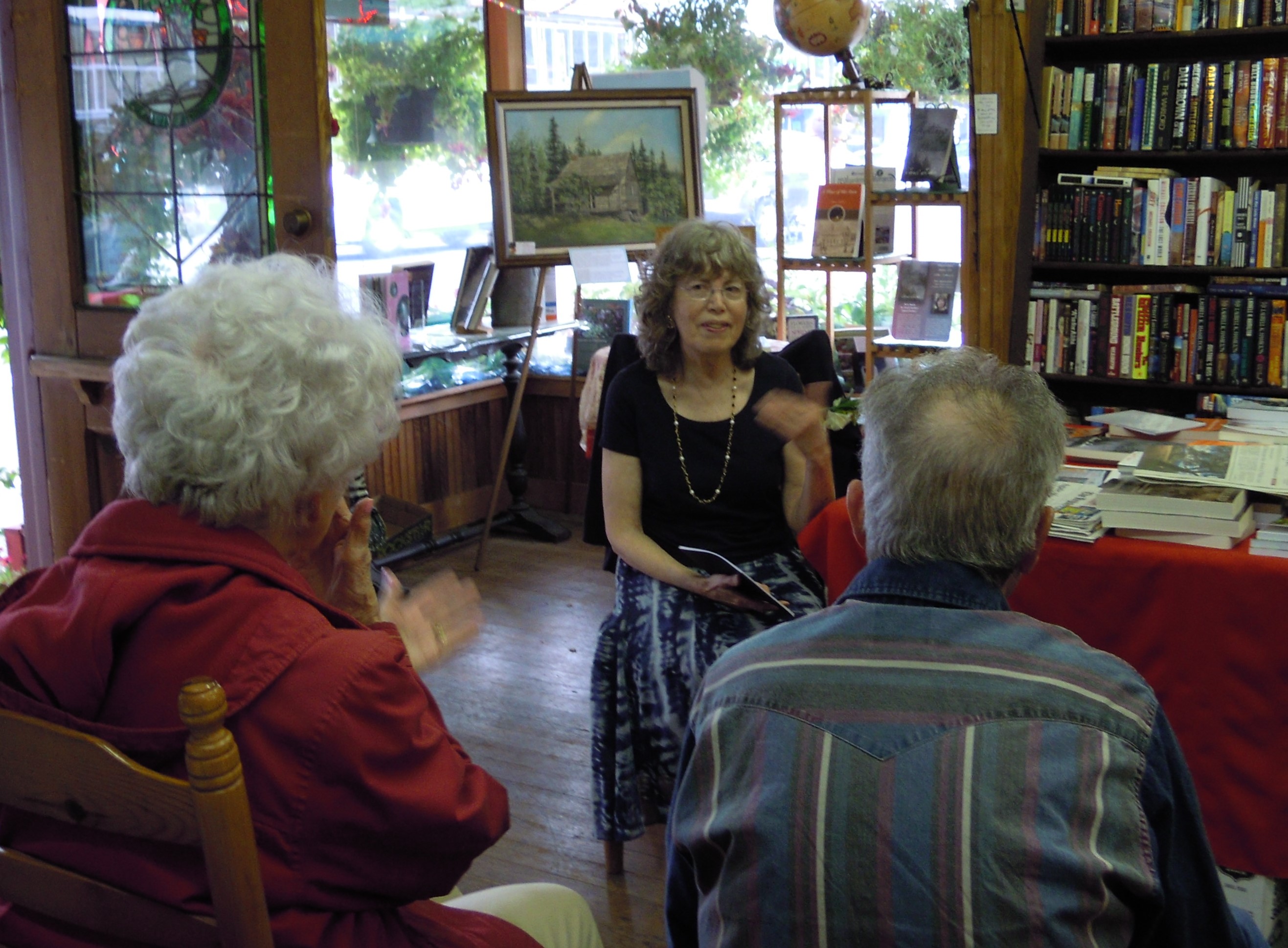
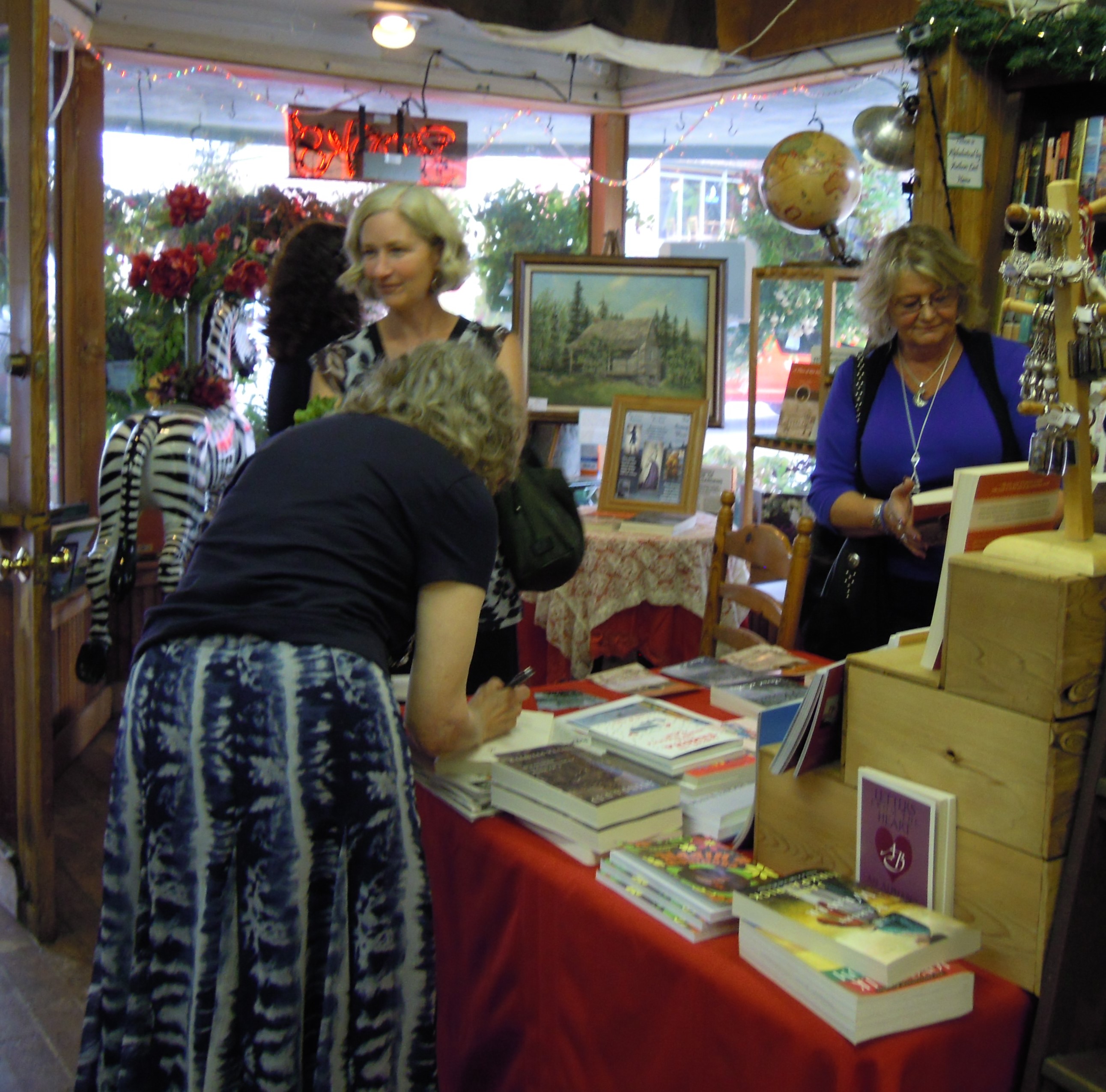
Bookmine encore.1045.2Bookmine encore.1039.2

After the reading we had a few questions. And I signed a few books.

Altogether a pleasant evening. It was nice to have both of my daughters, Carisa and Christiane, and my granddaughter, Calliope, with me.

Thanks to Christiane for taking the pictures.

COMMENT

Bookmine Encore

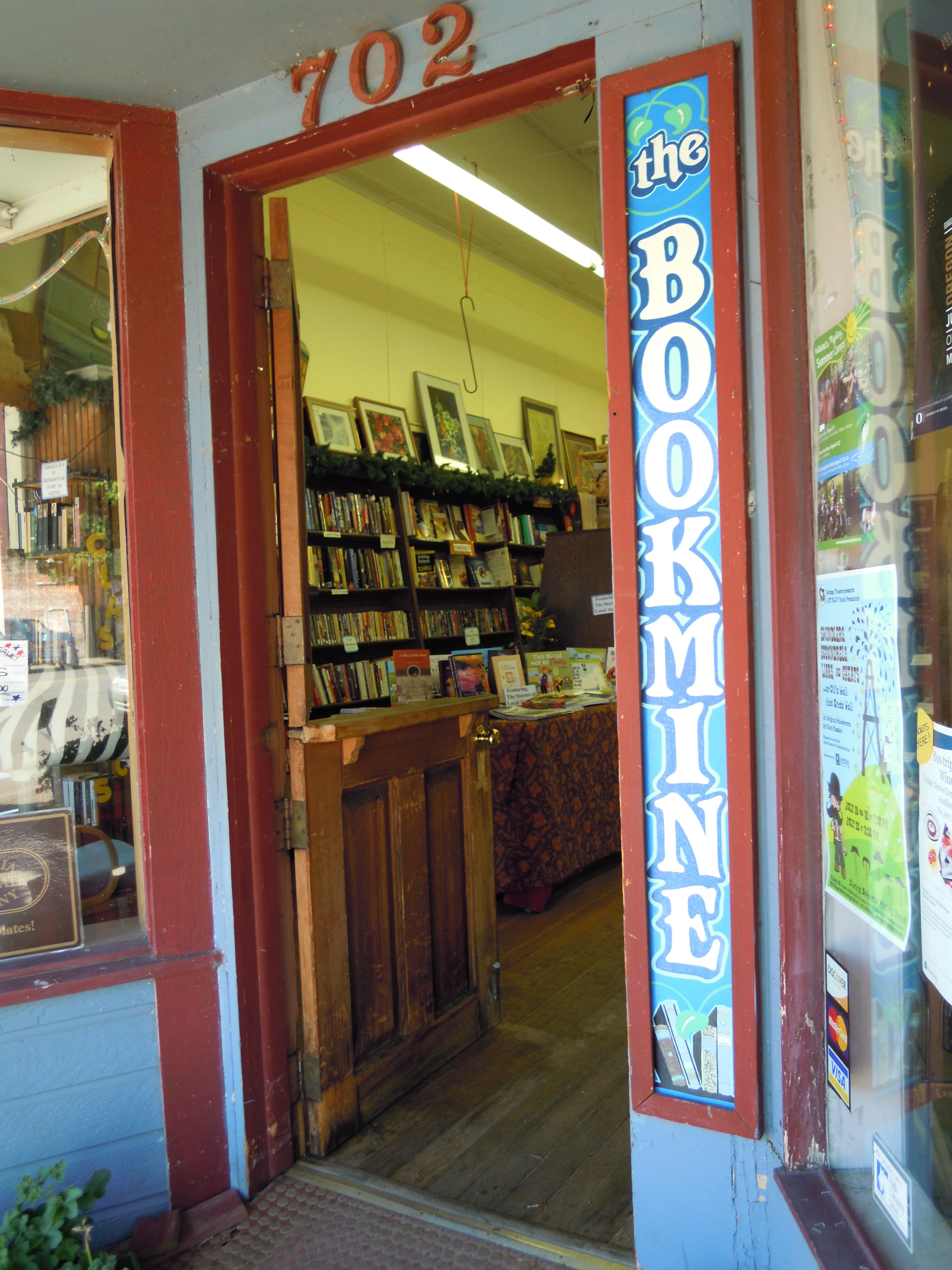
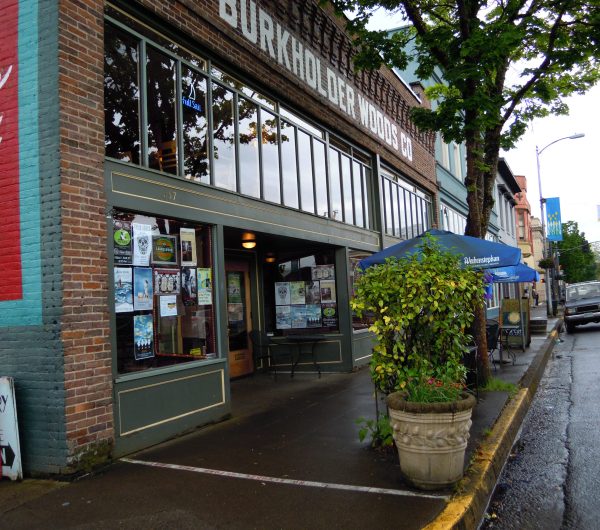
bookmine door with bookA chill breeze swept in through the open doorway of The Bookmine in Cottage Grove the evening of the season’s first Art Walk in April.

I was at this bookstore on Cottage Grove’s historic Main Street to sign and sell my books and had planned to do a reading from my new novel, The Shifting Winds.

Proprietor Gail Hoelzle came over to my table toward the end of the scheduled event and smiled. “I think we should have another event for you, a regular signing and reading.”

That sounded good to me. The Bookmine had hosted me a couple of years earlier with my first book, A Place of Her Own, a very successful event.

“Actually we’ve done quite well this evening,” I told her.

“I know. You sold a lot of books, but you didn’t get to read.”

There never seemed a good time for a reading because the people kept moving through, apparently wanting to visit as many businesses as possible on that chilly day–and maybe to beat the rain, which had threatened all day and finally struck in earnest just before the final hour came to an end.

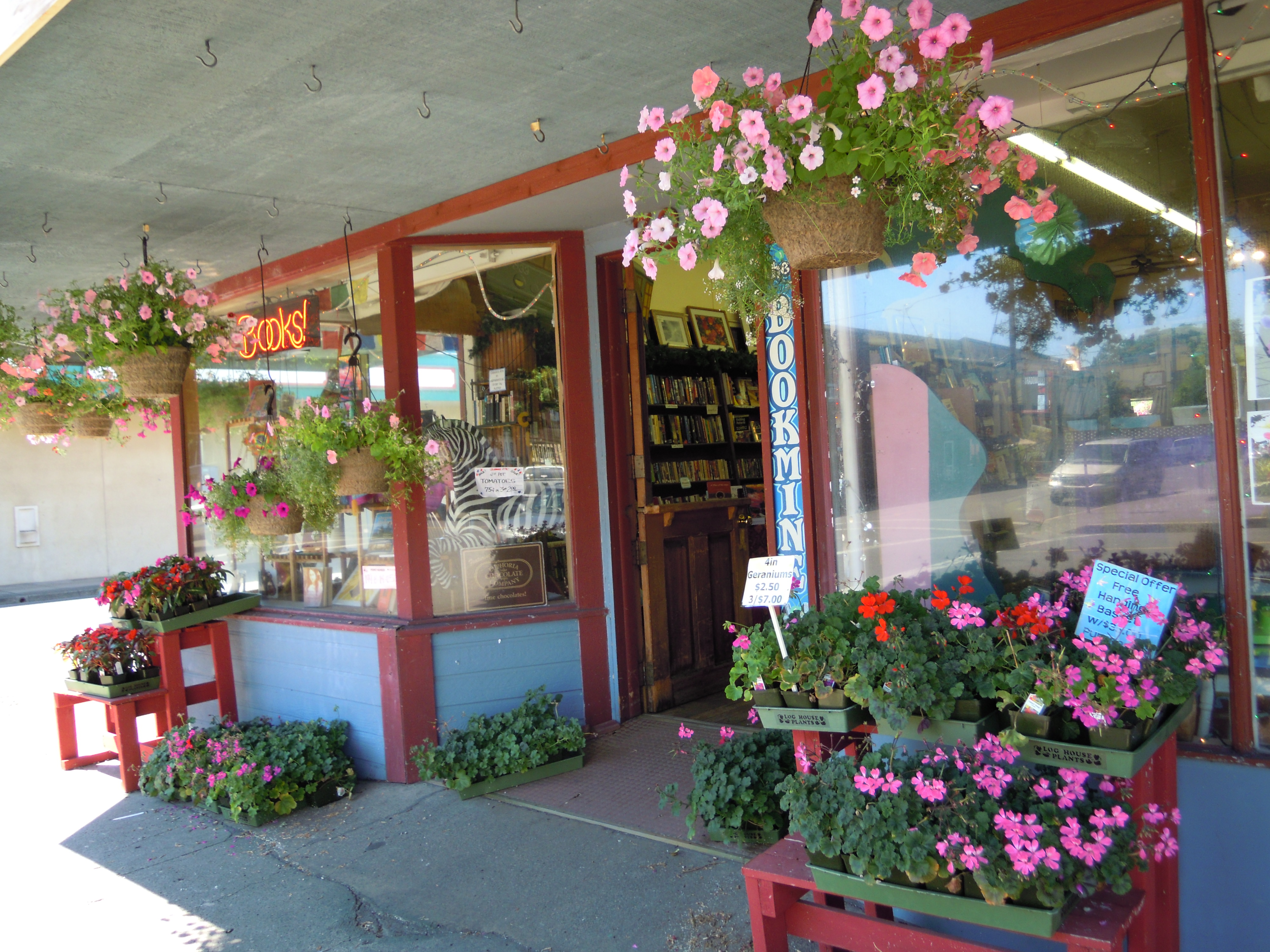
bookmine doorwaySo we’re doing an encore, a regular book signing and reading at The Bookmine, one of my favorite stores. It’s Thursday evening, June 23, from 5 to 7, hopefully a pleasant summer day this time.

COMMENT


Author Gala Reading

The annual Mid-Valley Willamette Writers Author Celebration happens next week when several members are selected to read from their published works. I’m excited to be one of the readers again. At this year’s event I’ll be reading from my new historical novel, The Shifting Winds.

Pulling up some pleasant memories, here’s the group that read in 2014 at the first of these gala events. That time I read from A Place of Her Own, which had just been released.

WW ReadersWhat a fun evening! It was so exciting to be sharing my very first published book. A great time for us all. I developed some lasting friendships from that gathering. We were at Tsunami Books in Eugene, the regular meeting place for the Mid-Valley Willamette Writers, and the gala will be at the same place this year.

Author Gala Poster 2016Here’s the poster for the event. It’s the first Thursday of the month, the usual meeting night for the group, June 2, from 7 to 9 pm.

We’ll have fewer readers this time, including Valerie Brooks, Bill Cameron, Julie Dawn, Sarina Dorie, and me.

As noted on the poster it’s open to the public. The suggested donation is one new or gently used children’s book or a small cash donation in support of the group’s Books for Kids program. Tsunami Books is at 2585 Willamette Street in Eugene.

I’ll be reading the opening scene from The Shifting Winds and introducing one of the real historic characters from my book, Joe Meek, mountain man extraordinaire.

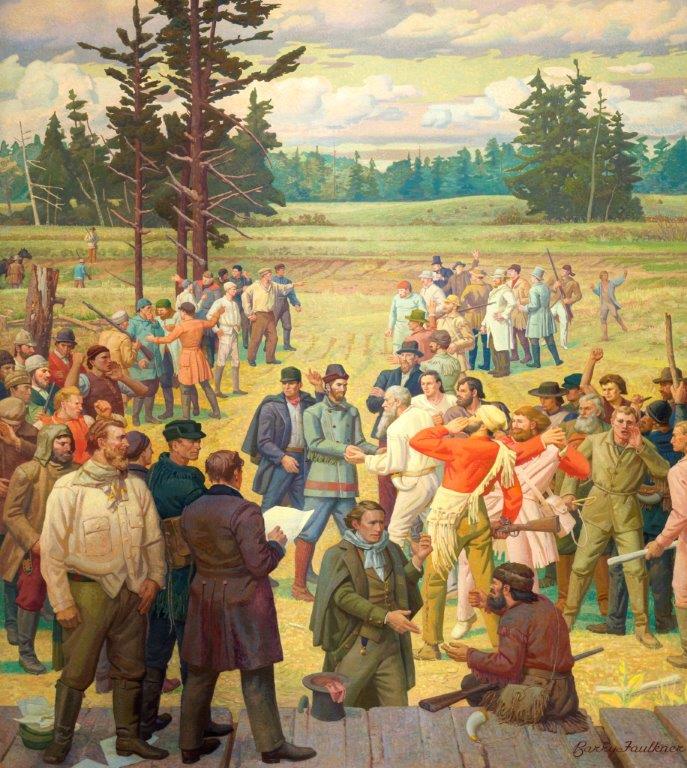
joe mural smallerHere he is portrayed in his immortal role at the gathering of settlers at Champoeg in May 1843, just 173 years ago.

American settlers were hoping for an agreement that would give them the protection of law in this isolated frontier.

When the vote seemed uncertain, the bold mountaineer called out in his booming voice, “Who’s fer a divide?” And the voters lined up to be counted.

This large mural is displayed in the Oregon State Capitol building. That’s Joe in the red shirt toward the front, rifle in hand, calling for the divide.

He was a storyteller at heart, which I guess all of us authors must be too. I look forward to hearing readings from the stories of my fellow Mid-Valley Willamette Writers authors and look forward to sharing my own.

COMMENT

Prose at Poetry Night

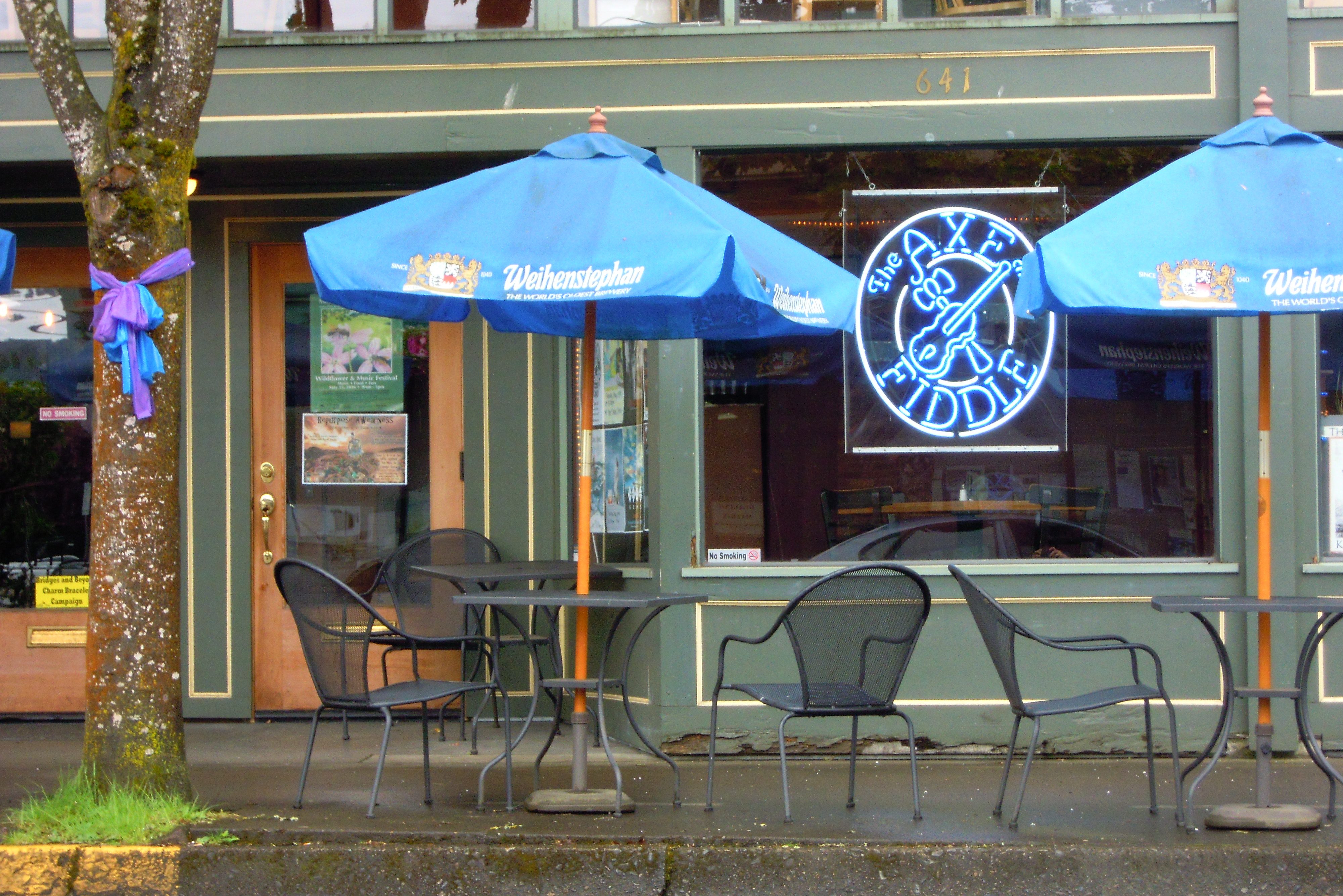
The Axe & Fiddle, a pub in historic downtown Cottage Grove, offers a change of pace this coming Tuesday night, May 17, when the entertainment turns to words. Poetry Night happens just once a month at this restaurant and public house known for its live music and craft brews, full bar, and locally sourced food, and I’m delighted to be their featured guest. But I won’t be reading poetry–or singing it.

1008.Axe&Fid - closeInstead they have asked me to read from my new historical novel about Oregon’s early days, The Shifting Winds. So in keeping with the night’s theme, I’ll select a couple of short excerpts that present a bit of what might be called poetic prose.

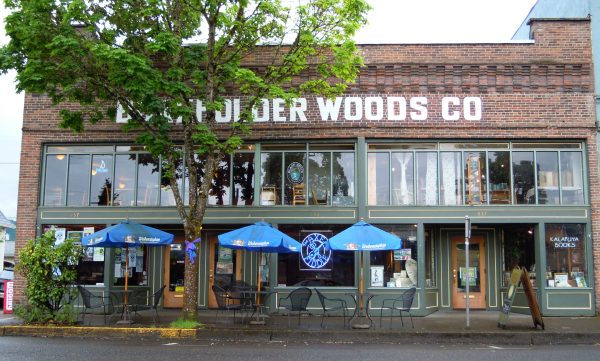
1007.Axe&Fid - longYou’ll find the Axe & Fiddle on Cottage Grove’s historic Main Street on the corner of 7th and Main, next door to Kalapuya Books, the bookstore that presents Poetry Night. The building is shown at right.

The show starts at 7:30 pm and is expected to run until 9:30. They open at 4 pm, so there’s plenty of time to stop in beforehand for dinner or a drink, or both, and the doors are open Tuesdays until midnight.

So what’s poetic prose? To me, it seems to show up in description that paints a scene with a touch of velvet in the words. I’ll read one of those at the event. Then it may be a stretch of the word poetic, but I’d also like to read a segment I’ve never tried for any of my other readings.

1005.Axe&Fid - sideIn this book, although my lead characters are fictional, I also have some real people meandering through the pages. It’s a story with a lot of real history and those people sometimes play their factual parts in the historic scenes.

One of my more colorful real characters is mountain man Joe Meek, and the book includes half a dozen or so stories that Joe actually told to 19th century author Frances Fuller Victor for her 1870 book River of the West about Joe’s life as a fur trapper in the Rockies and his life in western Oregon as a settler. Joe’s speech is a mix of Kentucky, the vernacular of a mountain man, and traces that come from a boy who preferred to play with his father’s slaves rather than go to school. Poetic? Well, he was an inveterate storyteller whose words carry a certain ring.

I’m looking forward to a fun evening at the Axe & Fiddle, a very different venue than I’ve tried before. I’ll have books there for sale, copies of The Shifting Winds and also my previous book, A Place of Her Own. A big thanks to Betsy at Kalapuya Books for the invite.

COMMENT

Spring Art Walk Event

It must be spring! The first Art Walk of the season comes this Friday, April 29, to the charming historic downtown of Cottage Grove. And I’ll be there with my books at The Bookmine from 6 to 8 pm or later. It’s such a great store–a pleasant place to hang out during the Art Walk, or anytime for that matter.

bookmine & bikesThis small Oregon town enjoys the good fortune of having three bookstores within five blocks on Main Street, from The Bookmine at 702 to Kalapuya Books at 637 to Books on Main at 319, and I’m happy to say they all stock my books. They also have a wonderful library a few blocks away (and, yes, my books are there too). A very literary place.

I lived in Cottage Grove for several years before moving to the family farm in Douglas County, and the people of Cottage Grove continue to be supportive. I am most grateful.
The town’s Art Walk happens on the last Friday of the month from April to October. You’ll find food, art, music, a variety of shopping at the local shops, and of course books.

I’ll read a time or two from my new historical novel, The Shifting Winds, and will have that one as well as my first, A Place of Her Own, available for signing. The Shifting Winds is a fictional tale set in a lot of true history. A Place of Her Own is a true story with some creative conjecture. They’re both Oregon Trail stories about strong pioneer women. I’ll be open to informal Q & A as people stop by and to just chatting about the new story and my other work and your own stories.

If you’re in the neighborhood I hope you’ll visit me at The Bookmine.

COMMENT

Gift Shops for Books

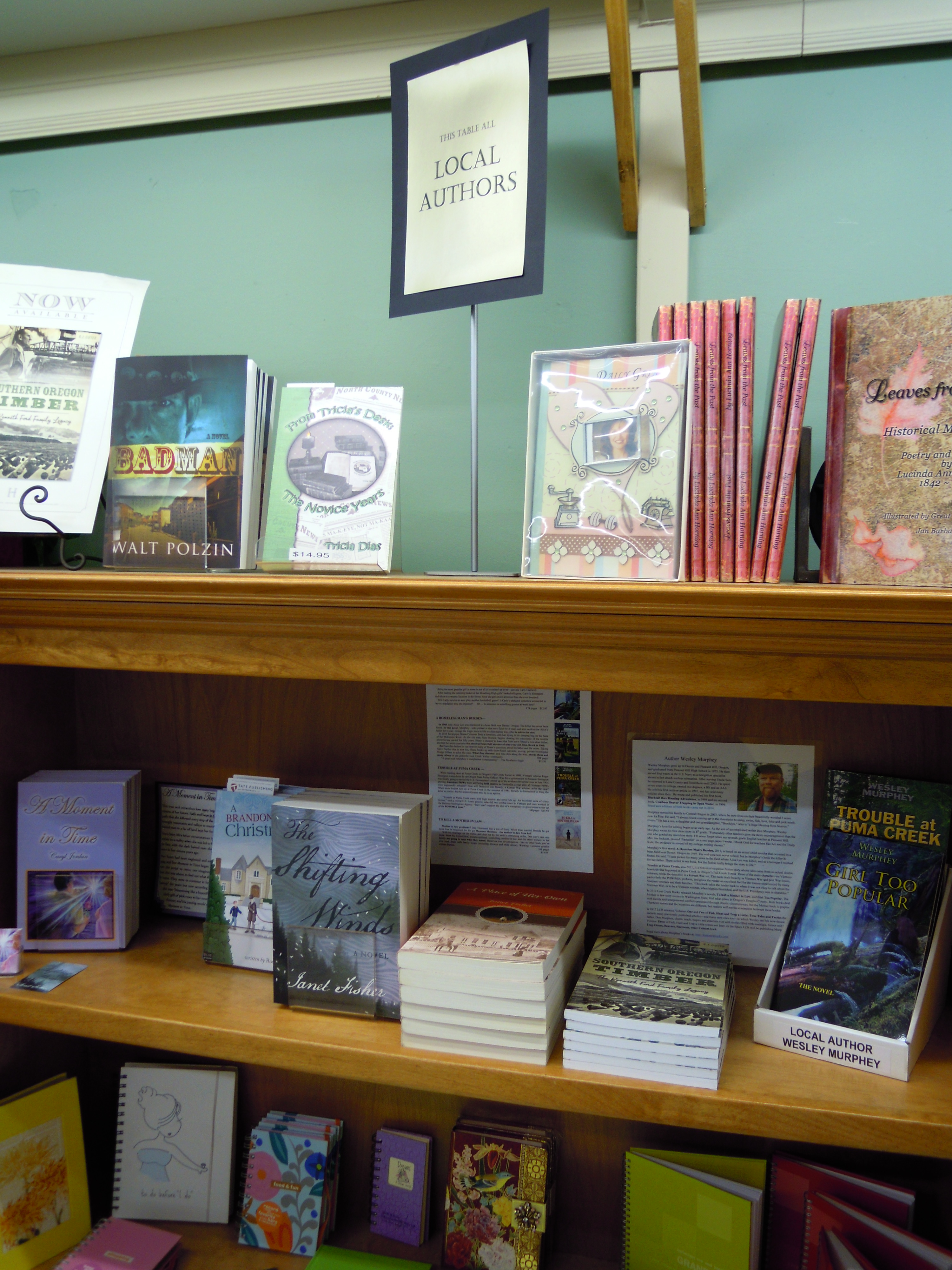
Gift shops and other general merchandise outlets can be great places to find books and often provide nice displays for local authors, like this one at Roseburg Book and Stationery in Roseburg, Oregon, near my home.

Gift shp 4.14.16 Rsbg BkThis store on Roseburg’s downtown Jackson Street has been around for over 100 years, and it has generally been more stationery than book, with a wide selection of office supplies, greeting cards, and gift items.

The place is taking on a new shine under new owner Jason Byers, and they’re now proudly displaying the work of local authors and hosting the occasional signing. This is good for the community and good for the authors to have more exposure. It’s not difficult to find me in the display. And they sell.

Thank you, Roseburg Book and Stationery.

COMMENT

The Delightful Books Gallery

The Books Gallery in Sutherlin offers the most delightful atmosphere for book lovers, and I enjoyed my Saturday afternoon event there surrounded by books with the enticing fragrance of coffee and tea wafting through.

Books Gallery event 2016There are of course more temptations from the Lighthouse Center Bakery to go along with your brew of choice.

As mentioned before, they usually have a puzzle in progress. Somebody finished one today while I was chatting with people who came by for a signed book. For the reading we went into the inner room where several ladies had gotten together for painting in watercolors, and they seemed to enjoy a little storytime too.

Altogether, a most pleasant afternoon.

If you’re ever in Sutherlin and want to while away a little time in a friendly bookstore and relish a good snack or work on a puzzle or check out the other activities offered, the Books Gallery is an excellent choice.

Thanks to my daughter Carisa for taking the picture.

COMMENT