Going There #1: Into Crete’s Ancient Heart

Welcome to the opening day of my journey, which began in Greece on April 24, 2018. Over the next few weeks I’ll share the highlights of that 37-day trip through Greece, Portugal, the UK, and Ireland, where I traveled to research scenes for my upcoming series of epic historical novels. If you read my last two posts, the overview and backstory, you’ll have a better picture of why I went. Now here’s post #1 of the trek.

~ ~ ~

I woke up in the morning in the Greek Isle of Crete after a long, long flight from Eugene, Oregon, via Seattle and London and Athens. Waking in the morning might not seem so remarkable, except that morning in Greece is about 10 hours after morning in Oregon. The flight adds 10 hours to the 24-hour day, so I had leapt a day ahead, and jet lag can do strange things with your sleep patterns. Maybe it was a good thing that I couldn’t sleep on the plane. Some say you get adjusted better that way. In all my travels overseas I don’t remember ever experiencing such a bright-eyed morning on the first day. That turned out to be more important to me than I anticipated.

View from Kastro Hotel in Heraklion, Crete

I checked out the view of the Mediterranean from my hotel balcony and headed downstairs for breakfast. I must say, that breakfast ranked with the best on my trip–lovely Greek pastries, a custardy egg dish, muesli, nuts, fruits, on and on.

My plan for the day was a quick visit to the ruins of Knossos if I felt up to it. One reason for starting the trip in Crete, though it was my farthest point from home, was that it was familiar to me, relatively inexpensive, and I assumed I’d find it easy to deal with a day or two of jet lag there.

I had spent a month in Crete on my first trip to the island, about half of that time in the island’s chief city, Heraklion, and had spent a good part of my second trip centered in Heraklion too. Now, on my third visit, I stepped out onto streets I knew, and I enjoyed getting back in touch with this special place.

Feeling good, I soon headed out for the ruins of the temple (or palace) that graced the ancient city of Knossos on the outskirts of Heraklion. It took me awhile to find the bus. The old bus stop didn’t exist anymore because they had turned the main drag into a pedestrian street. I asked for directions and got many confusing answers. That was familiar too. People so want to help, but communication becomes uncertain when their English is limited and my Greek is almost nonexistent. One woman simply said, “Come. Follow me.” I did. Love it when they do that.

Soon I was on my way, rumbling through the streets of Heraklion on one of their many buses and out to the edge of town to a site that has filled my mind for years as the characters of my books stroll through the corridors and halls and surrounding slopes of that ancient city. Knossos, heart of the early Cretan world. A rush of joy lifted me as I entered the compound.

West Court, Knossos, Crete

I first came out onto the West Court where my first story in Crete opens. I needed to stand on that broad paved courtyard and look around. Could I see what I thought I could from that place? Could I see Mount Youktas on the horizon, the mountain that looks like the face of a reclining person? Were the slopes the way I remembered from my last visit 23 years ago? And from my many recent visits by Google Maps? I stood on the ancient stones and smiled. Yes. I could see the mountain. Rearrange a few trees and I would see it even better. My descriptions held up. I relaxed and let the place wrap around me as it had done so long ago.

View to Mount Youktas from Knossos

I found the spot where I had taken a picture in 1994 that has hung on my wall ever since, an outlook past one of the unique red columns of the site to Mount Youktas beyond the hill of olive groves. This time I took a new picture with the little Nikon digital camera I bought a few years ago to help me illustrate my blog posts.

Note that the column is larger in circumference at the top than at the bottom, a style found throughout Knossos. These pillars once lined corridors and divided rooms. Most of the large ones are red. Others are black with red trim.

I wandered all around the perimeter seeking the settings of many a scene. Some of those scenes grip my heart and I relived them here where they took place, shedding a few tears for my characters.

Since my last visit the throne room has been opened. Such a thrill to see this room I call the receiving room of the High Priestess of Knossos. The alabaster chair gave a clue to researchers that the person who sat on this small chair might be a woman rather than a man, because a woman might more easily fit in that gracefully molded seat.

Visitors aren’t allowed into the room itself. You walk through the anteroom (also described in my stories) and from there you look across a low glass barricade into the inner sanctum. The barricade is low enough to lean over so you get a good feel for it. The space seemed a little smaller than I had imagined from photos but every bit as powerful with the waving swaths of red giving a womb-like impression.

Receiving Room, Knossos

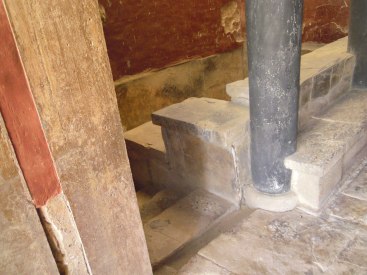
In my stories, and I suspect in reality, this is a sacred room. So much at Knossos shows signs of the people’s appreciation for the sacred. I put this photo on the banner of my Facebook Author Page, and someone asked if the object in front of the chair was a toilet. The Knossians did have flush toilets some 3,500 years ago, with a plumbing system so advanced it wouldn’t be equaled until the 19th century AD. But those toilets were modestly enclosed behind doors. The basin above was interpreted by scholars as a lustral basin for ceremonial bathing. When archeologists dug these objects out of the earth some things were in a jumble and they didn’t know where the basin belonged. On the far side of the room from the alabaster chair, several steps lead to a lower level.

I believe that would be a more likely place for the basin, deeper in the earth, and put it there in my stories. I don’t portray this room in the first part of the book, although there were several lustral basins around the temple, and I managed early on to come up with a steamy scene in one of those.

Steps to Lustral Basin

I depict this room as part of the temple’s reconstruction after a dramatic earthquake. The extension of the room beyond the black pillars tends to create a space both infinite and intimate.

The griffins portrayed on the wall represent three aspects of nature, the eagle’s head for the skies, the lion’s body for the land, the snake’s tail for the deep earth. They were likely considered sacred.

The Knossians seemed to wear their religion comfortably. Frescoes show them enjoying life, sensuous, wearing clothing that clearly reveals their sexuality, but without guile, suggesting a healthy acceptance of this aspect of life. You see no seductive scenes like those found in the Roman ruins of Pompeii. Nor do you see scenes of war and aggression so common in other art of the day. Clearly, Knossos was different. But it would not go unchanged.

I stopped in the afternoon to enjoy a wonderful Greek salad in a restaurant within the compound, perfect fresh-picked tomatoes and Greek olives and more, topped with a thick square of feta cheese, sprinkled with dill and other herbs, and drizzled with Greek olive oil, a delicious sliced baguette on the side.

Grand Staircase and Anteroom, Knossos

Restored, I climbed the grand staircase. The receiving room is just beyond the anteroom on the ground level to the right of the staircase shown above. Then I trudged up the north ramp past the relief fresco of the charging bull. And I peered into column-lined rooms.

Ramp from the North Gate, Knossos

The jet lag I feared didn’t hit. I stayed and saw it all. Sometimes I rested on a low wall and just let the wonder of the place seep in. I took notes. I studied the maps I had copied for the little trip booklet I put together. I imagined scenes and assured myself that I had relayed the sense of place I needed. Unsure of some areas I went back to check them again.

Charging Bull Fresco, Knossos

I began to wonder if I needed to spend another 15 euros for the full second day I had planned for Knossos.

That question of necessity turned out to be a good thing. More on that in the next post.

For this day I felt fully satisfied. Resonant with joy.

Lower Rooms, Knossos

NEXT: Crete in Delight and Distress

Going There: The Backstory

Before I launch into Day One about my recent research trip through Greece and Portugal, the UK and Ireland, it occurs to me that it might help clarify my reasons for this journey and my reasons for writing the ancient historical series if I backtrack to the beginning. My focus on the Greek Isle of Crete started in 1994 when I set out to research a mystery novel on that exotic Mediterranean island. I had been writing books and pursuing publication for about 14 years, without success. I had moved from Roseburg, Oregon, to San Francisco in late 1989, ending a long-term marriage, and I was seeking answers for my life.

During this time I read a New York Times bestselling book by Riane Eisler called The Chalice and the Blade, where she describes nothing less than the overturning of the world’s cultural norms from woman-centered civilizations to a patriarchal world ruled by contentious warriors. I was fascinated. One chapter stood out for me, where she describes Crete as the “essential difference.” Because of its isolation in the Mediterranean Sea, this island remained one of the last holdouts of those woman-centered cultures. Its primary city of Knossos offered stunning revelations about these Bronze Age people when archeologists began uncovering the fabulous ruins some 100 years ago. Eisler describes Crete as the most advanced technological culture ever found where women were not dominated by men. I wanted to see this place.

Room in the Palace/Temple of Knossos

When I visited Knossos and stepped into the partially reconstructed ruins of its central structure, the place seemed to wrap itself around me like a mother’s loving arms. I no longer wanted to write my mystery novel. I wanted to immerse myself in this world and come to know the mystery of the ancients who once thrived there.

Prince of the Lilies Fresco, Knossos

The British archeologist Sir Arthur Evans who uncovered Knossos in the early 1900s was struck by what he found–grand staircases and pillar-lined corridors, technological wonders like flush toilets and an elaborate drainage system, frescoes revealing a free and sensuous lifestyle with women standing proud at the center. He believed he’d found a matriarchy but as a man of his times he thought they needed a king to run it. He saw this as the Palace of King Minos mentioned by Homer and Hesiod. But later scholars suggest it may have been a temple, an idea I adopted for my books, and I drew from one of Eisler’s thoughts on King Minos, depicting him as a Mycenaean warrior with designs on Crete–and a couple of Cretan women.

Part of Knossian Procession Fresco

While in Crete I met a man who helped me understand the attraction, the delight, the frustration that can happen when cultures clash. The experience found its way into my story which opens on this peaceful isle on the day the warriors come.

The frescoes shown here are reproductions of originals that are housed in the excellent Archaeological Museum in nearby Heraklion, Crete, the island’s primary modern city. The bull-leaping fresco appears in the opening scene of my book now called Beyond the Waning Moon. And readers will experience a bull-leaping event in the second scene when the protagonist faces a fierce bull in the court.

Bull-Leaping Fresco, Knossos

I wrote the book and continued editing and revising for several years as I sought its publication. Riane Eisler kindly critiqued the opening and when I addressed her concerns she called the result powerful, responding “Brava!” The novel eventually became a finalist in the Pacific Northwest Writers Association Literary Contest. The next year I found a way to tie the people of Crete to their counterparts in the distant isle of Ireland, another place that had touched me deeply and where I have personal roots.

My search for life’s answers led me to mythologist Joseph Campbell and especially his four-volume work, The Masks of God. My focus riveted on his discussion of Ireland and how he could see behind the Irish myths to a culture of Mother Right, essentially a matriarchy that would have preceded the later patriarchy. As Eisler points out in Chalice and the Blade, this isn’t the flip side of patriarchy where women rule over men but more of an egalitarian society accepting the full worth of both genders. Neither writer suggests any kind of utopia but at least a much more equal situation than we came to know.

I first visited Ireland in 1993 because of my Irish roots and had set one of those mystery novels there. But I wanted to tap into the ancient times that paralleled my Cretan story and find the lost culture of Mother Right, which Campbell talked about.

Rocky Headlands on Irish Coast

The Cretans of the first book in my ancient saga decide to send out a fleet in search of a place the warriors haven’t come. These early Cretans were known as great mariners, their frescoes and other art showing them sailing around the Mediterranean. I figured if they could sail around the eastern Mediterranean they could surely venture to the west and even out through the gate to the Atlantic, as long as they kept the shores in sight. But for a little excitement they get caught in a horrific storm and one ship crashes on the rugged rocks on Ireland’s south coast. Voila! A sequel–albeit loosely tied.

I completed the sequel in 2004 and went back to Ireland in the spring of that year, focused now on stone circles and this rugged south coast near Rosscarbery in County Cork.

Bohonagh Stone Circle Portal, Ireland

I again entered the PNWA literary contest, and this Irish one was a finalist too, just one year after the Cretan book. I thought I was surely on the road to publication then, but could not find an agent for these stories of strong women facing formidable challenges of their time. I began to get discouraged.

My father died in 2007 and I decided to keep the farm founded by my great-great-grandmother Martha in 1868. I left the ancient stories on the shelf and pursued a story about Martha, discovering I had a strong woman in my family who’d faced challenges of her own time. Finally I found an agent, Rita Rosenkranz, who helped me meet my goal of publication with Martha’s story.

But I hadn’t forgotten the ancients. I had a flash of inspiration about the Cretan story and decided to make substantial changes. When I finished those I realized I definitely needed another sequel that would be closely tied. I wanted to launch into it but I had another story set in the same pioneer period as Martha’s story. My agent and I agreed I should take advantage of the publisher’s interest and bring that pioneer story out first.

By the spring of 2014, with the two pioneer stories in the pipeline, I finally had time to draft the closely tied sequel to the Cretan book. By Christmas I was ready to write one more book to continue the ancient line, but it just wasn’t happening until my muse started whispering to me. I told about that experience on a blog post here so won’t repeat it. This fourth book was drafted by the spring of 2015. I had planned to write a fifth that would bring Crete and Ireland back together but realized I had a 16-year gap in the Irish years. Why not fill the gap with another story?

South Gate to Castro do Zambujal, Portugal

Because of all the questions I had left at the end of the first Irish book, I wanted to portray the events of those 16 years. I would take readers to the homeland of the Iberians who’d been capturing slaves off the coast of Ireland. I would show my bad guy in his personal haunts.

But the Iberians couldn’t all be brutes, could they? I learned about their amazing citadel of Zambujal north of today’s Lisbon. They must have enjoyed a sophisticated culture I needed to know more about.

And I would take readers to the Great Isle of Britain where my protagonist runs into some intriguing outlaws in the Lake District of northern England.

I finished the rough draft of the gap story in 2016. Then in 2017 I drafted the sixth book, which took me back to Iberia.

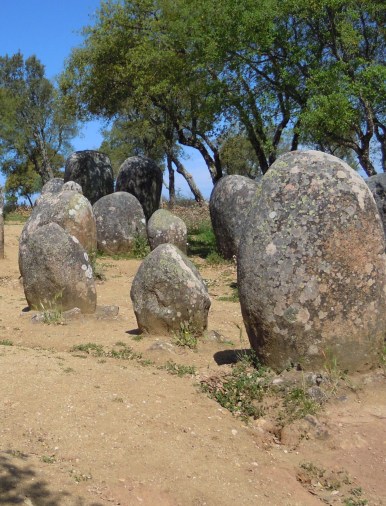
Part of Almendres Cromlech in Cork Forest, Portugal

I had never been to the Iberian peninsula, where there’s a stone circle (or oval) more ancient than the circles of Ireland. I needed to see that, as well as Zambujal. And I had never been to the Lake District in England.

Also, the new books ventured into places in Greece and Ireland I hadn’t visited before. Thus the need for another trip. Once you’ve crossed the pond, that’s the biggest single expense. I decided I might as well put it all together.

So, that’s how the project started and why the extended trip. Next up, I invite you to come with me on my solo journey in Greece and Portugal and my continued trek with writer friend Lynn Ash through the British Isles. I’ll start the next post with Day One in Heraklion, Crete, and the nearby site of Knossos I have come to love.

Bluebells on Mountain in Lake District, England

Going There: Site Research

I’ve just returned from a trip to research sites for my upcoming series set in Greece and Ireland and points in between and will be sharing my adventures on this trek over the next few weeks. I started in the wonderful Greek Isle of Crete where I visited the center of the first stories, the ancient ruins of Knossos.

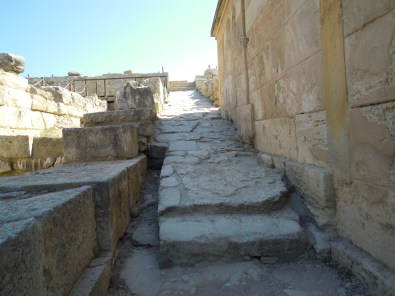
Knossos Portico Steps

This fabulous site was uncovered about 100 years ago after being buried for some 3,000 years. The archeologist restored parts of the buildings, the unique red columns, steps, and rooms, a controversial practice not accepted by today’s archeologists. But the reconstructions do offer a sense of the place I found intriguing. It was a visit to Crete several years ago that started my whole series. When I saw Knossos I knew I wanted to write about these ancient people known today as the Minoans. So I began to write what would become my opening book in a series.

I visited Greece a couple of times before this year’s trip and Stonehenge in England, and visited Ireland a couple of times as well, but as I continue with the series, new books take my characters to different places in these lands, sites I had not seen before, and I wanted to see those places on this trip.

So, why do I go? I could try to create an entire world in my own imagination, with a little help from Google Maps. But if my setting takes the reader to a real place, I’d like to see and feel the place firsthand. Why isn’t my imagination enough? Well, for one thing the natives tend to get annoyed when you misrepresent their landscapes. But there’s more to seeing a place than getting the description right.

I believe every place has a personality that comes out of the nature of the land, the people who touch it and change it. For historicals, can I feel the echoes of people who lived there before? Echoes of events that affected their lives? Maybe. I’d like to believe so. It certainly seems to happen.

Fodhele Beach

Maybe I’m only reflecting my own feelings off the land around me. But what if there’s a resonance reflecting back? I’ll reach for that. Open myself to it. Let it come in, perhaps in the moment I walk in that place, perhaps later as memory and inspiration slip into my mind.

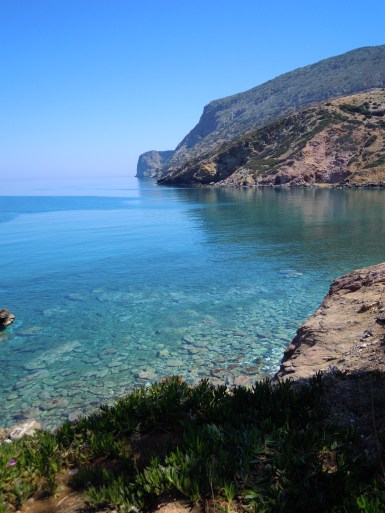
While in Crete I also visited peaceful Fodhele Beach where a battle rages in one of my books. The water is so clear you can see the rocks in the bottom far out from the shore.

From Crete I went on to the Isle of Santorini, officially called Thera or Thira. Anglicized spellings vary in Greece due to the translations from a language with a different alphabet. It’s one of the most beautiful places I’ve ever seen.

Next stop was lovely Nafplio in the Peloponnese peninsula on the Greek mainland. From there I took day trips to the ancient Mycenaean sites of Tiryns and Mycenae itself, home of the warriors who sail to Crete in about 1470 B.C. and change the island forever.

Archeologists at Zambujal

From Greece I flew to Portugal to visit the ancient citadel of Zambujal north of Lisbon and had an amazing experience I’ll talk about in a later post. It had to do with modern-day archeologists working on this site, as shown above.

More wonderful encounters awaited me near Évora in Portugal’s interior.

From Portugal I flew to London’s Heathrow Airport where I met my writer friend, Lynn Ash, who would continue the trek with me.

After a little struggle finding each other (more on that later), we took a bus to the charming town of Amesbury, which is only a couple of miles from the famous stone circle, Stonehenge.

The next day we visited those massive stones, along with a gazillion or so ravens. Caught a couple in my photo. They seemed to add to the haunting aspect of the ancient circle.

Stonehenge and Ravens

From Amesbury we traveled north to the Lake District where we were surprised by the rugged mountains and thrilled to the beauty of the lakes. I got partway up a trail above Buttermere Water, where the outlaws in one of my books hang out. The trail never got much easier than what you see below.

Trail Above Buttermere

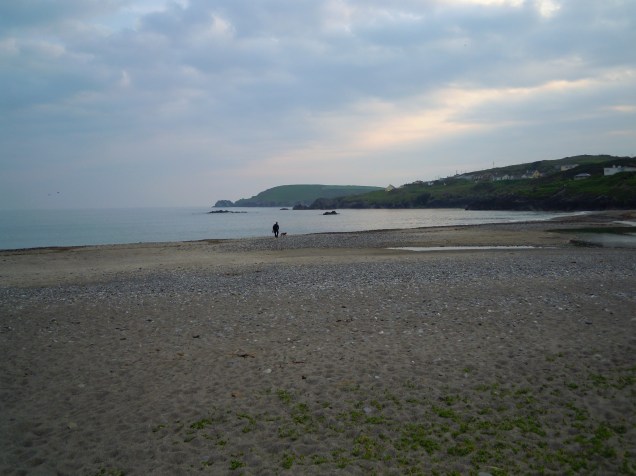
From the lakes we wended our way into Scotland and across to Cairnryan on the coast where we caught the ferry to Ireland, center of my later books, which intertwine with the first three. We finally reached Rosscarbery and the bay I call Golden Eagle Bay for the Golden Eagle Clan of my story whose village lies a short way above this cove.

Golden Eagle Bay

As daylight dimmed on the bay the search for story sites came to a close. I had a much stronger impression of the places I visit in story. It will take time to absorb all I’ve seen, but already these worlds have become clearer in my mind, and I want to pass that clarity on to my readers. From this overview I’ll share the highlights on my blog in more detail in the coming weeks and hope you’ll join me on this trek from Greece to Portugal to the UK to Ireland, 37 days of reaching into the hearts of lands where my characters roam.

Another Book Abloom

I just finished the rough draft of a new novel, a historical to conclude my trilogy set in ancient Ireland. Spring always puts me in mind of things coming to life, so it seems fitting that this book has come to life for me now as my daffodils bloom.

It seems doubly fitting, given the fertile nature of the island of Ireland–or Éire, as I call it in the book.

My friend Tilly Engholm and I visited Ireland a few years ago when I was researching the first in the trilogy. We spent the month of May there, a glorious time. Scenes I came to know then reappear in this new book–and the stones.

The stone circles of the island hold a special place for the clanspeople in my stories, and I needed to visit many circles on our visit. As Tilly and I headed out one day in our rental car, she glanced at me. “We’re going to look at more rocks, aren’t we?”

I laughed. “Yes, we are.”

She took it in good stride, though.

In this book the characters also travel to Iberia, now Portugal, and to Crete and Thera (Santorini), with other stops along the Mediterranean, places of beauty and wonder and peril.

It has been a great ride and I look forward to sharing it with readers.

COMMENT