The TRUE Shifting Winds ~ 2: Fur Traders

As my upcoming July 16 book event at Fort Vancouver nears, this new blog series sets the stage for that historic place and the part it plays in my book The Shifting Winds.

The overview of the true history of the world’s shifting winds continues in this post as the unknown Pacific Northwest keeps luring explorers into the region. Of course, mere curiosity would not compel them like the hopes of gaining a new possession and the riches the land offered. While the glitter of gold may have drawn earlier navigators like the Spanish and Portuguese to the centers of their discoveries, another prize put a gleam in men’s eyes and prompted a race to win the Pacific Northwest territory.

Beaver peltsFur.

The prime fur was beaver like these pelts at right displayed in the reconstructed Fort Vancouver warehouse. Without the fur, Fort Vancouver would not have been. This was the chief bounty, thanks to the beaver hat which became a popular fashion statement in Europe and the States, as traders from two nations pressed for advantage in one land.

The Race for Possession

Thomas Jefferson had been interested in the Pacific Northwest for some time when he took office as President of the United States in 1801, but without a contiguous territory overland he was not ready to consider more than an independent state in the region. Even that he considered to be a hazardous endeavor for the young nation.

1794_Samuel_Dunn_Wall_Map_of_the_World_in_Hemispheres_-_Geographicus_-_World2-dunn-1794This 1794 double hemisphere wall map of the world, or terraqueouis globe, by Samuel Dunn shows the new discoveries and marginal delineations. From Geographicus.

So the maps they are a-changing. It’s beginning to look more familiar.

Jefferson was intrigued by the 1765 report of Major Robert Rogers, who had written of a great “River of the West, or Ouragon River” said to flow west into the Pacific Ocean, a potential northwest passage from the Atlantic to the Pacific. And by 1792 the US navigator Captain Robert Gray had already discovered and named the Columbia River. Soon afterward British Lieutenant William Broughton, under the command of Captain George Vancouver, had sailed some 120 miles upriver.

But the condition of the Columbia beyond that point remained an unknown to these explorers. Was it the River of the West? The Ouragon? Or the Oregon? And would it allow direct transportation—or at least an easy portage—to a navigable river flowing east to the Atlantic, essentially the sought after northwest passage?

1794_Samuel_Dunn_Wall_Map_of_the_World_in_Hemispheres_-_Geographicus_-_World2-dunn-1794 (crop) (4)Zooming in on Dunn’s above map you can see two Rivers of the West flowing into the Pacific. Perhaps folks were still trying to decide, or hedging their bets.

Meanwhile Canadian fur traders had begun to consider the overland route to the Pacific. Alexander Mackenzie, a partner in the Canadian North West Company, became a firm skeptic of the northwest passage after following a large river into the northern interior in hopes of locating the mythical route, only to find that this river emptied into the Arctic. Convinced that no northwest passage for sea vessels existed, he insisted if Canadians wanted to reach the Pacific from Hudson’s Bay they should go overland.

Mackenzie organized an expedition to do just that, intending to cross the Rockies, then go down the River of the West. His party came across a major waterway, which he assumed to be this elusive stream, but he discovered it was not the river dubbed Columbia by the American Captain Gray, but a more northerly river which would be named the Fraser. Mackenzie’s party reached the coast at Port Meares in July 1793 after a harrowing journey, the first transcontinental crossing north of Mexico.

Jefferson must have been pondering all this when the international winds shifted again, and Napoleon’s dilemma became Jefferson’s boon. The United States had been negotiating with France for New Orleans, because the Americans wanted the mouth of the Mississippi. But when the entirety of the Louisiana Territory, once a French possession, was dropped back into Napoleon’s lap through various treaties, he knew he was no longer in a position to protect it, and he greatly feared that his arch enemy, the British, now ensconced in Canada, would ultimately take it from him.

Jefferson was just as fearful at the prospect of the powerful French on his border, but he didn’t want to make this longtime friend an adversary. He was surprised when Napoleon offered to sell the Louisiana Territory to the United States for a song, and suddenly the fledgling US nation nearly doubled its size.
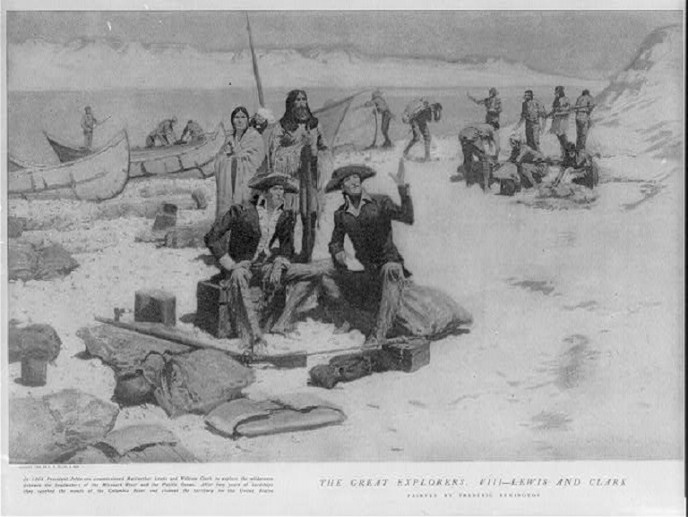
Lewis & Clark 2The Great Explorers – Lewis & Clark: Halftone reproduction of drawing by Frederic Remington in Collier’s Magazine, 1906 May 12, from Library of Congress.

The Americans didn’t know much about the Louisiana Territory, not even the boundaries on the north and south, though its western boundary lay somewhere along the crest of the Rockies. Louisiana now provided that contiguous link with the territory of the west. So Jefferson sent out Meriwether Lewis and William Clark to see what the United States had bought and to explore and map the region. However, he didn’t want them to stop at the western edge of the newly acquired Louisiana, but to continue into the west to explore that land of uncertain possession, including the intriguing river their compatriot Gray had discovered.

Leaving St. Louis in the spring of 1804, Lewis and Clark proceeded up the Missouri River, crossed the Rocky Mountains and came down the Clearwater River to the Snake before making their way into the Columbia River, which they navigated all the way out to Young’s Bay. The Columbia proved to be a magnificent waterway, but not a northwest passage, given the ruggedness of the land between it and the east flowing streams. A young member of the expedition named John Colter would later gain fame for adventures upon his return into the mountains to look for furs, leading many to call him the first mountain man. More about him in the next post.

When Lewis and Clark returned to the States in 1806, Americans became excited about commercial possibilities in the west. Fur dealer John Jacob Astor approached the North West Company about joining forces, but when they refused, he founded his own Pacific Fur Company. He sent out two parties to the Columbia, one by land, led by Wilson Price Hunt, and one by sea aboard the Tonquin.

Men from the Tonquin arrived in the Columbia in March 1811 and set up a trading post on the south bank, naming it Fort Astoria. The overland party straggled in almost a year later after a grueling trek.
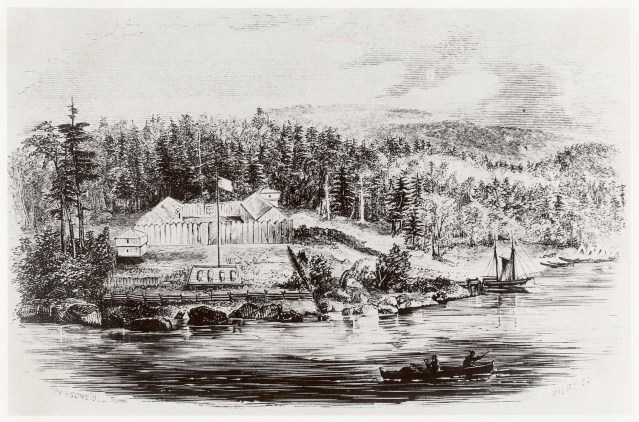
FortAstoria1813The above 1813 sketch of Fort Astoria was created by Gabriel Franchère, one of Astor’s men from the Tonquin, and later published in 1819 with Franchère’s account of the venture.

At about the same time, the Canadian North West Company sent David Thompson over the mountains to establish fur trading posts and continue to the mouth of the Columbia. The Astorians offered Thompson a friendly greeting, but the War of 1812 erupted, putting the men on opposite sides of the conflict. Through a complicated series of events, the fort of Astoria was sold under some duress and turned over to the Canadians. A British warship, the HMS Raccoon, entered the Columbia soon afterward, its captain hoping to capture the fort, but the sale had already occurred.

Author Robert C. Johnson, in his book John McLoughlin, describes the disappointment of the warship’s Captain William Black when he saw Fort Astoria. “‘What! Is this the fort I have heard so much of?’ exclaimed Black. ‘Good God, I could batter it down with a four-pounder in two hours.'” He took possession and renamed it Fort George after the British king.

When this news reached Astor in New York he was not pleased, but the deed was done. Given the remoteness of the fort, its sale and surrender were unknown to negotiators of the Treaty of Ghent ending the war in 1814. The treaty provided that territory and possessions taken by one nation from the other should be restored. Because of this agreement, the British were expected to restore Fort George to the Americans. However, a question remained as to whether the fort was taken or sold. That and other controversies between the nations led to another treaty in 1818 to settle the boundary issues in the region.

Spain and Russia also came into the question, but the United States was haggling with Spain over Florida and didn’t want to press too hard on the southern boundary with Spain, though the line was established the next year at the 42nd parallel. Russia was pushing for a boundary in the north where they would take all territory down to the 51st, but neither Britain or the United States would accept that and finally negotiated it back to 54-40. With Spain and Russia settled, that left the Americans and the British.

The US claim to the territory was founded on Gray’s discovery of the Columbia, the Lewis and Clark expedition, the founding and restoring of Astoria, and the title acquired from Spain. After settling with the Spanish, the United States contended that any rights Spain possessed as a result of discovery had passed to the United States. The British claim was based on early voyages along the northwest coast, land exploration by Mackenzie, North West Company posts on the Columbia and Fraser Rivers, and Broughton’s ascent up the Columbia River.

The 1818 treaty set the boundary between Britain and the United States at the 49th parallel from the Lake of the Woods to the Stony Mountains, the Rockies, each nation ceding some land to make a straight border, but at the Rockies they hit a snag. Americans suggested continuing the 49th parallel to the coast, though many of their countrymen wanted to push the British north all the way to 54-40. Britain wanted the boundary to drop southward and follow the Columbia River so they could retain the lucrative fur trade there. With the two sides unable to agree, the treaty declared that the Oregon territory be jointly occupied between the United States and Britain for 10 years, giving them time to settle on a boundary between them. The treaty allowed both nations the right of settlement and trade, but neither could claim title to the land. Agreement would take much longer than 10 years.

While the Americans and British hassled over the details of negotiation, another virtual war raged between the Montreal-based North West Company and the other major British fur company doing business in the region, the London-based Hudson’s Bay Company, resulting in the deaths of many trappers and traders. To end hostilities the beleaguered companies finally merged in 1821 under the Hudson’s Bay Company.

The history of the restoration of Fort George (Astoria) to the United States seems a little murky. As the 1818 treaty was concluding, a representative of the US government arrived at the fort to receive the fort’s surrender, and the US flag was raised. By some accounts, as soon as the US representative sailed away, the US flag came down. In any case, the Canadian North West Company continued to maintain the post, perhaps for lack of further US action, and when that company ceased to exist, the British Hudson’s Bay Company took it over, more or less by default.

Dr. John McLoughlin, formerly an employee of the North West Company, became a Hudson’s Bay Company man and was assigned in 1824 as commander of the HBC western district. He would soon make a grand entry at Fort George.

Carey, Charles H., LLD. General History of Oregon: Through Early Statehood. Portland, OR: Binfords & Mort, 1971.
Johnson, Robert C. John McLoughlin: “Father of Oregon.” Portland, OR: Binfords & Mort, 1958.
Various websites.

Next: Mountain Men

COMMENT

Fort Vancouver Event Coming Soon

My reading and signing event at the fantastic Fort Vancouver site in Vancouver, Washington, is just three weeks away, Saturday, July 16, starting at 2 o’clock in the afternoon. As mentioned in my March post “Upcoming Book Event at Fort Vancouver,” it was a dream of mine to hold an event at this historic fort for my new historical novel, The Shifting Winds, because the fort plays a significant part in the story. Now that dream is about to happen.

599.Ft.Vanc.Bastion -titleThrough my presentation at the fort Visitor Center–a lecture, a slideshow of related photos, and a tour of the fort–I hope to draw people back to the days of my story. The lecture and book signing will be from 2 to 3:30. Afterward, from 4 to 5 I’ll lead attendees on a tour through the fort and highlight some of the places that appear in my book. The bastion in the fort palisade is shown above.

Several scenes in the story take the reader to this amazing spot of British civilization in a wilderness isolated from all that’s familiar to the young American protagonist, reluctant pioneer Jennie Haviland. And one of the major players, Hudson’s Bay Company clerk Alan Radford, works at the fort.

In the early 1840a when the story takes place, Fort Vancouver stands as the center of the British fur trade in the Pacific Northwest, and American settlers have just begun trickling into the area, hoping to gain the land for the United States. For more than 20 years Britain and the United States have jointly occupied the Oregon Country, unable to come to terms on a boundary between them.

Ft.Vanc.Big House FrontGiven Fort Vancouver’s significance in Western American history, the fort has been faithfully reconstructed as a living representation of the times, including the home of the commanding officer and his second in command, above, which is furnished much as it would have been when Chief Factor Dr. John McLoughlin lived there and essentially ruled the Oregon Territory. The McLoughlin sitting room is shown below.

613.Ft.Vanc.McLoughlin Sitting RoomNow a National Historic Site maintained by the National Park Service, the fort offers visitors a chance to step back in history and see what life was like in the fort’s heyday.

622.John McLoughlin Daguerreotype - creditChief Factor McLoughlin, shown in the daguerreotype, is one of the real characters portrayed in the book (photo courtesy of National Park Service).

My story takes place during the historic time of rising tension between the two nations over this one land. Within that true story of conflict, a fictional clash develops between two men–the British HBC clerk Alan Radford, and American mountain man Jake Johnston–who vie for protagonist Jennie as their nations vie for Oregon.

To find the fort and center, their website offers maps and directions. The Visitor Center, where my event will be held, is at 1501 East Evergreen Boulevard.

The Visitor Center Bookstore will have copies of The Shifting Winds for sale, as well as copies of my previous book, A Place of Her Own.

My thanks to the National Park Service and the Friends of Fort Vancouver for co-hosting the event. And a special thanks to Mary Rose, Executive Director of the Friends of Fort Vancouver National Historic Site, for making the arrangements.

In these next three weeks I plan to offer a series of posts here on my blog to help set the stage for my story and for this event. Because the posts will delve into the historical setting, I’ll call the new series “The True Shifting Winds.”

COMMENT

Stories of Story

I spoke at the Roseburg Rotary Club meeting last night. They invited me to talk about my new book The Shifting Winds, and when I began putting together my speech for this I struggled a bit. What could I say in 20 minutes to give the essence of this full-length novel and still entertain an audience? So I asked myself, what is special about this particular book? Well, for one thing, the historical setting stands out. This story steps back in time to places here in the Pacific Northwest–like Fort Vancouver, a historic site you can visit today. And I had stories about that.

Ft.Vanc.Big House Front (3)The Big House was the home of the commanding officer at the Hudson’s Bay Company’s Fort Vancouver, the western headquarters of the British fur trading empire during the nineteenth century. Much of the fort has been reconstructed on the original site in what is now Vancouver, Washington, with meticulous attention to authenticity.

As I mulled over ways to present this information, the thought came to me that people want to hear stories, so my speech told stories about my story. The Shifting Winds is a historical novel of the 1840s Oregon Territory with a lot of real historical drama set in real places. While it’s often hard to find a historic site unaltered by modernization, the reconstructed Fort Vancouver can take you right back into these early times. Ft.Vanc.Douglas Sitting Room

You can walk into the chief factor’s house where characters from my story walked and see the furnished rooms as they would have appeared in the 1840s.

You can stroll across the grounds where my characters strolled and see the Indian Trade Store and hear the blacksmith’s hammer striking hot metal on the anvil.

So in my speech I told about visiting the fort for research that inspired the book. Then I told about my dream of holding an event at the fort for this newly published book–and how it happened that this dream will come true in July. My stories.

Another way to tell about a book is to read from it. So I did that too. I’ve heard it said that we’re hardwired for stories. It’s how we communicate and our stories tend to have a beginning, a middle, and an end. We expect resolution.

But of course if you want people to read your book, you don’t want to spoil their reading by giving away the end. So you stop short, leaving them guessing. The cliff hanger. This jolts their innate sense of story.

Willamette Falls (2)One of the excerpts I shared in the speech showed my characters trekking up the portage trail around the Willamette Falls. Modernization may have dimmed the glory of these falls in what is now Oregon City, but the power of the water cannot be denied. The thrum rolls through you when you stand nearby, and you can see why the settlers rushed to claim it.

That except follows the protagonist as she tells her suitor good-bye at the head of the falls, then decides to take a walk alone in the woods above town. There’s a reason she’s been warned against going into the woods by herself, and when she comes face to face with danger I choose to leave the vignette hanging. The audience reacted with a burst of groans and uneasy laughter as I had hoped. The tension strikes because we need the satisfying conclusion as part of our sense of story. Resolution.

So throughout the evening we shared story. Even before the meeting when I met my friend Laura Lusa who’d arranged for me to speak, she and I sat down together and shared our stories. “How are you doing?” I ask. She answers with her story. I respond with mine. Unfinished stories. How will they turn out? Will there be resolution?

During Q & A I found myself answering questions with snippets of story. And after my speech people came up to talk to me. They told me their stories–about their pioneer families, their interests in history–and I came to know them a little bit better.

Stories. It’s how we communicate. And perhaps that’s why we so need the complete stories in books. When our own stories lack completion, we answer part of our need by reading a well-crafted book with a beginning, a middle, and a satisfying end. Resolution.

COMMENT

Lovely Afternoon at Tsunami

I was delighted to greet a lovely bunch of friends at Tsunami Books in Eugene on Sunday afternoon for the book signing and reading there for my new historical novel, The Shifting Winds. Most of my special Willamette Writers group came, as well as neighbors and newfound cousins and other wonderful friends.

Tsunami 2016This bookstore is a pleasant venue with the warmth of lots of natural wood and funky chairs and books enough to delight any book lover. The reading was well received with a spirited Q & A afterward. It’s exciting for me to see such keen interest in the history surrounding this story of Oregon’s early pioneers and the fur traders wTsunami with Krisho played such a major role in those days.

Along with friendly book talk, we had Elkton wines from the Brandborg Winery with cheese and crackers.

That’s Kris Jensen from my writers group on the right, getting her book signed.

My thanks to Scott Landfield, proprietor, for the space. Thanks to my daughter Carisa Cegavske and another friend from the writers group, Elizabeth King, for helping with refreshments. Thanks to my son-in-law Robin Loznak for taking pictures. And thanks to everyone for coming out on a fine spring afternoon. It was great seeing you all.

COMMENT


COUNTDOWN – 4 DAYS TO LAUNCH

Joe Meek, Mountain Man Extraordinaire

Today on our countdown to launch I want to introduce one of the real historic characters who plays a significant role in my book, mountain man Joe Meek. In the story he’s a good friend of the fictional mountain man Jake Johnston. And when I say character, I do mean.

joe mural smallerPhoto courtesy of Oregon State Archives

The above photo is of a large mural in the Oregon State Capitol building. That’s Joe Meek in the red shirt, rifle in hand, yelling to catch the attention of men mingling around him. An uncertain voice vote has left the historic Champoeg meeting in confusion as to whether the Americans will set up a government and have the protection of law in this isolated land. In order to get a true count, Joe calls out with his immortal words, “Who’s fer a divide?” A hush settles over the crowd, and Joe calls out again. “All fer the report of the committee and an organization, follow me!”

Some thirty years after the days portrayed in The Shifting Winds Joe Meek sat down with author Mrs. Frances Fuller Victor and relayed to her the story of his life as a mountain man and as a settler in Oregon. Her book that came out of these discussions, The River of the West, was published in 1870. The man was an inveterate storyteller, and while some folks in his day suggested the stories may have occasionally stretched, he often enjoyed an appreciative audience. From Victor’s book I gleaned several of Joe’s stories about his exciting days in the Rockies. As indicated in the Afterword of The Shifting Winds, the stories “are as true as Joe chose to make them.”

Whatever the truth of his tales, he found purpose in Oregon. He would become sheriff, then territorial marshal, and he had connections in high places. There was more to Joe than first impressions might suggest.

In Chapter One, just after meeting Jake Johnston, protagonist Jennie Haviland meets Joe:

“Another man approached, dressed almost the same [as Johnston], his dirty buckskins showing more wear, the fringes more ragged, his dark straggly hair longer, and this one had a brushy tangle of beard covering his chin. He stepped up beside the other and stood before her with a broad smile, and she felt herself surrounded by the two of them.”

Jennie’s little brothers dutifully introduce themselves, but thirteen-year-old Eddie can no longer contain his excitement. He turns to Joe.

“‘Are you Joe Meek, the Joe Meek? The famous mountain man in the wax museum in St. Louis fighting the bear?’

“Mr. Meek grinned. ‘One and the same, but don’t ye let that statue fool ye none, boy. Old Joe didn’t lose nary a finger from that ol’ bar, do ye hear, now?’ The man held up both hands, fingers stretched to show he still had all ten.

“‘But did you really fight a bear?’ Eddie asked.

“Mr. Meek began to laugh and slapped the other man on the shoulder. ‘Do ye hear that, Old Jake?’ He was so caught up in laughter he didn’t attempt to speak further.

“Jake Johnston smiled at Eddie. ‘This man has fought more bears than any man I know.’

“Mr. Meek lifted a hand. ‘Why, bar fightin’—that’s what this old coon is famous fer.’”

And the stories go on.

NEXT: Fort Vancouver

COMMENT

Book to Launch

My debut historical novel, The Shifting Winds, is about to launch. As you may have seen in the sidebar, I have a couple of book signings scheduled already. The first launch party will be at the Elkton Community Education Center (ECEC) library in Elkton, Oregon, better known as the butterfly place, on Sunday afternoon, March 6, from 2 to 4 pm. Less than two months away now. This is the same place I launched A Place of Her Own two years ago, and everyone there helped me make that a wonderful sendoff for Martha’s story. I look forward to another great beginning this year.

ECEC

The photo above shows the ECEC library building. Elkton is about seven miles from my home on Martha’s Century Farm.

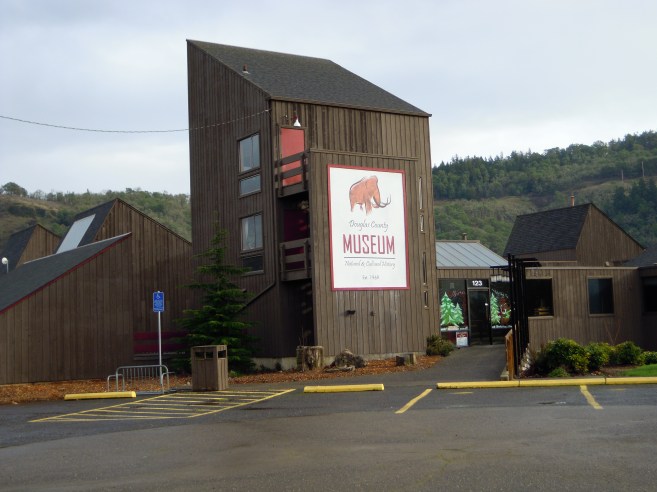
My next party will be later in the week at the Douglas County Museum in Roseburg, Oregon, Thursday evening, March 10, from 6:30 to 8:30 pm. At this event I will offer a tribute to the late George Abdill, former director of the county museum. George offered me considerable information and inspiration for The Shifting Winds, which portrays one of his favorite periods of history when fur traders and pioneers came up against each other on the American frontier of the mid-nineteenth century. And I did have a lot of fun putting this story together.

900.DCMuseum

The Douglas County Museum, shown above, is at the county fairgrounds just south of Roseburg’s downtown.

ShiftingWinds cover jpegI hope many of my local friends will be able to attend one of these opening parties. We’ll have refreshments, readings, signings, and plenty of conversation with book-loving people. In addition to The Shifting Winds, I plan to have copies of A Place of Her Own available.

In the coming days I’ll be adding more events around Oregon and beyond. Those will be listed on the right-hand sidebar as they’re arranged and also on the “Events” page, where you can see not only where we’re going but where we’ve been.

Cheers!!! 🙂

COMMENT