Just back from a great writers conference in Seattle put on by the Pacific Northwest Writers Association (PNWA). Here I am on the last day with Pam Binder, PNWA President and program director of this annual event. Every year she puts together another fabulous conference with her excellent team.
Pam Binder, PNWA President, conference program director, on the left, me on the right.
When I went downstairs looking for an I-was-there photo to add to my comments on the 2025 conference I was hoping I might find Pam to get her picture, and there she was at the registration desk, happy to oblige. I also wanted to thank her one more time for coming to my rescue in the pitch session.
These conferences offer a chance for authors to meet agents and editors face to face and pitch their projects to them. It’s always upbeat at these PNWA conferences, everybody encouraging each other to do their best. I think that atmosphere starts at the top. An award-winning New York Times bestselling author, Pam knows the business, and she’s always ready to help an author reach the next level.
Bohonagh Stone Circle, West Cork, Ireland
I pitched my newest novel set in ancient Ireland featuring the People of the Stones, those mysterious stone circles and other megaliths scattered across Ireland and Britain’s west coast and on down the Atlantic seaboard.
In my story it’s 750 B.C. and the Celts wouldn’t have been in Ireland yet, but we know where they were–in Hallstatt, Austria, so my protagonist has to go there.
The goal for the author pitching an agent or editor is to get a request for material, a few chapters maybe, or 50 pages, or, best of all, the full manuscript. I’m happy to say I got a positive response from every pitch. But it wasn’t entirely simple.
Imagine the setup. All of the authors who’ve signed up for a particular block of time are led into a room where the agents and editors are sitting behind a very long table. The authors get in line for a person they want to pitch to, and each gets four minutes to describe their project and convince that person to ask for part or all of it. At the end of your four minutes a bell rings and you have to skedaddle because you don’t want to crimp the time for the person in line behind you.
So I was pitching one person and we were having an extended conversation when the bell rang. She handed me her business card and said I could stay a bit to finish the conversation because no one was behind me. But then someone did come up behind and I hurried to leave. I went out into the hall and realized I had no idea what the person I just pitched wanted from me. Maybe she told me but in the confusion I didn’t hear it. Did she want to see any of my work? I didn’t know. So in somewhat of a daze I wandered down the hall to the registration desk, where a man asked if he could help me. I saw Pam Binder looking through some papers and said, “I think I need Pam.”
I told her what had happened. She thought about it a minute, then said, “You need to go back in and get in her line again and ask her.”
Pam didn’t send me. She led me. And with her as my escort I did exactly as she said. The person greeted me and answered with enthusiasm, “I want to see the full manuscript. I want to read this.”
Yay! Now, I’m not giving away names. That’s for later, if it works out in the long run. But pitching is a challenge. Encapsulating your book into a few words that pique a desire to read it. And these positive moments are bits of gold. Thank you, Pam.
With hugs to send me off, Pam took this goodbye picture of me in my signature hat.
Happy. Optimistic. Glad for a few more bits of gold.
I’ve been thinking quite a lot about the People of the Stones who walk through my stories of ancient Ireland and its neighboring lands. I’m working on a new novel, a sequel to the one I hope to have published next. Always a time for the stirring of the mind.
This past weekend was the annual Fort Umpqua Days celebration in nearby Elkton, Oregon, so I was there with my booth selling my pioneer stories. I had a notebook on display with photos of pioneers as well as ancient settings and my new business cards illustrating my work “From Pioneers to People of the Stones.”
A boy stopped by and saw a picture of the stone circle at the center of my ancient stories, the Bohonagh Stone Circle in Ireland.
“Stonehenge,” he said, then shook his head when he realized it didn’t look quite like Stonehenge.
I turned the page to show him I did have this picture of the circle he knew. We had quite a conversation, maybe a half hour or so.
He had some imaginative ideas about how the ancient people stood those big stones up there. He knew quite a bit about the site.
He’s ten. I told him he should think about being a writer someday. He smiled. “I write comic strips already.” A budding author. And a delight.
So that night when I was looking for an hour’s entertainment before going to bed I searched my recordings on the DVR and saw OPB’s NOVA presentation on Stonehenge. I’d seen it, but I watched again with keen interest. They showed how the first stones of Stonehenge were the smaller bluestones, not the giant Sarsens. A single ring. Dated at about 3000 B.C. Then the giants went up in 2500 B.C., with their lintels on the top, and the bluestones were moved into the interior. I wanted to argue against those bluestones coming all the way from Wales, some 150 miles away, but the guide I talked to at the site convinced me. Archaeologists had found quarries in the Preseli Hills of Wales with the same kind of stone, and there were no such stones around Stonehenge. They had to have come from Wales.
The smaller bluestones show clearly in this photo, lined up inside the taller sarsens.
Then last night I again wanted an hour’s entertainment. And what should I find but another, newer show about Stonehenge. This one showed the same archaeologist who finally found the exact quarry in Wales these bluestones came out of. Problem was, dating on the site indicated that the quarrying for the bluestones happened in 3300 B.C. The stones went up on the Salisbury plain in 3000 B.C. There was a 300-year gap. Where were these stones during those 300 years?
It wasn’t an easy question to answer, but the archaeologist came to believe the stones had been used for a circle near the quarry, then removed to the location on the Salisbury plain where Stonehenge stands today. Many megaliths stand yet today in the vicinity of the quarry. But how to find where this circle of bluestones stood in that interim? This was a needle-in-a-haystack effort for sure. How do you find something that isn’t there anymore? They had to look for the holes left behind, long since covered over by new soil. With many disappointing tries and the use of overhead imagery they finally found where the stones once stood. They could even see the odd shape of one impression that matched a bluestone now at Stonehenge.
For confirmation they used a dating method I’d never heard of where they dig down to see when the sediment last saw the sun, keeping carefully under cover to avoid any current light. The test showed a date of 3300 B.C. as the construction date on the abandoned site. So the stones went directly from the quarry to this site in Wales and 300 years later were moved to the current site.
Why would they move them? And how? Each stone weighs more than a ton. To show how it was possible they built sledges and had 30 children, 13 years old, try to pull the loaded sledge with ropes. The children managed with apparent ease, drawing the heavy stone uphill. Surely ancient adults could do it. As for the why, we can’t really know. There was no sign of battle to suggest they were escaping attack.
Stonehenge looking southward.
One thought was that the site on the Salisbury plain at that time lay on a swath of glacial channels that aligned with the sun on winter solstice. To these ancient People of the Stones this may have appeared to be an auspicious site.
Moving into the minds of ancients who left no writing behind? Well, that’s the kind of thing we fiction writers do.
It’s older than Stonehenge. Older than the pyramids of Egypt. Newgrange. More than 5,000 years ago Neolithic people with only stone tools built this mound with such precision that the rising sun on the morning of the winter solstice would stream down a long, narrow passage to the vaulted chamber of the interior and fill it with light. There beneath a meticulously corbelled roof the bones and ashes of their dead waited.
Two doors enter the passage. The one above receives the sunlight. The one below, partially hidden behind the carved kerbstone, receives the people. I was here with a tour group. I would soon go in.
No one knows what those carved symbols mean, and the guide told us the triple spirals have never been seen anywhere else. We offered our thoughts. I suggested life, death, and rebirth. The people in my stories of ancient Ireland would believe this.
The photo of the upper door was taken for me by a nice, very tall man in my group. I took the lower one. That’s as far in as we were allowed to take pictures. The way is narrow. Sometimes you have to scrunch your elbows in. Sometimes you have to duck under low stone before you enter the inner chamber once visited by the ancients.
I was like a child before Christmas. I barely slept the night before my tour to this amazing site. The tour would also take me to another passage tomb in the same area, Knowth, and to the Hill of Tara. A worrisome drizzle followed our bus as we rolled out of Dublin, first stay on my overseas trip this spring. When I planned the trip I knew I would not rent a car this time, so I chose bases from which I could take tours or just excursions on my own by local bus or train.
I gave myself a day for jet lag and to explore Dublin enough to find my way to the place the tour bus would pick us up the following morning. This was my first tour of the trip. And one of the more important. When I read online about the Newgrange Tours by Mary Gibbons, I knew I wanted to take her tour. It was the right one. No question. But who knew on the 22nd of December when I reserved it what the weather would be on the 19th of April. I just had to hope.
The drizzle let up when we reached the Hill of Tara, the first stop on our tour. But it was blustery out. I had to forego the hat and pull up my hood. I was glad for every layer I wore. I had chosen Tara as an important site in my new book, this place of myths and legends and making of kings. I’d visited Tara once before, some years ago, but I hadn’t retained a good sense of it. Pictures don’t do it justice. They don’t quite show how high it rests over the surrounding plains. I did remember the mound. It’s a passage tomb also, not as large or elaborate as Newgrange, but from the same era. The name “Tara” is apparently later than my story’s time but I use it, as I sometimes do when a place would be difficult to identify for readers without the familiar. I call it Tara Mound for the tomb there, not the Hill of Tara.
Our group trekked across the rich green grass, and over the henges, the circular ditches and rims on the ground where ancient deeds occurred. It was evidently a gathering place for many years, and I used it so in my story. I imagined my character trekking across it with me and heard our excellent guide, Mia Craig, mention to someone that scholars believe Newgrange was only in use for 600 years. That concerned me. I had my people using it much later. When our group began to meet up at the gift shop before moving on to our next stop I saw her standing alone and walked over to ask her about that. She reassured me. “They don’t really know,” she said, “and there’s an old Irish saying, ‘You don’t want to let facts get in the way of a good story.'”
We laughed together. I told her I tried to get things as right as I could, which was why I was back in Ireland. She didn’t think I should worry about using the site for my characters. Of course scholars can interpret the presence of objects. Not so easy to interpret the absence. That’s where I can fill in the gaps with my world-building.
The drizzle came back, windshield wipers on the bus working hard as our tour headed toward Knowth, another intriguing site along the River Boyne, this one with multiple passage tombs like chicks around a mother. But they can tell from its shape that the large mound in the center came after the others because its irregular shape accommodates them.
By the time we got to Knowth, again the rain stopped and we gathered around the local guide, a good-looking man with silver hair and bright blue eyes. He started by asking if anybody had been there before. I raised my hand and said I had been to Newgrange. Twice. He asked when, and I told him. With a twinkle in those blue eyes he suggested I could probably give this talk as well as he. I said only if I could follow an old Irish saying our tour guide just told me about, that you don’t want to let facts get in the way of a good story.
He chuckled and said, “Well, we try to keep to the facts here.”
One of his comments startled me when he told about recent DNA studies which showed that the early Neolithic people who built these tombs came out of Anatolia, people with tawny skin and dark-brown eyes, whereas those who followed came from the steppes of Russia with their pale skin and blue eyes, like his. From my own studies I understood that the early Anatolians were likely worshipers of a Mother Goddess and may have been matriarchal, while those from the northern steppes worshiped sky gods and were patriarchal. My ancient series draws together the worlds of Minoan Crete and Ireland, so when he mentioned Anatolia I recalled reading that DNA evidence shows that the Minoans also came out of Anatolia.
Whoa! Were these people kin? Would their oral histories reflect similarities? It was mythologist Joseph Campbell who inspired me to bring the two islands together when he wrote of a second hearth west of Crete where at the same time as the Minoans the early Irish showed through their myths a similar culture with strong women and the worship of a Mother Goddess. Now the DNA evidence in Ireland appeared to confirm that connection. A thrilling discovery for me.
Next stop on the tour was the Newgrange visitor center. We were getting close to the main show. Drizzle picked up again. The visitor center was wonderful, more elaborate than my last visit. I don’t think there was a center the first time. We just drove up to the site. Now they would take us from the center on special buses on a predetermined schedule. We wore pink bands on our wrists to indicate our time slot. The schedule gave us time for lunch in their pleasant lunch room and to visit the displays. I didn’t want a big meal so I opted for a scrumptious raspberry scone with raspberry jam. They even heated it for me. Wonderfully decadent.
After lunch I especially enjoyed a walk-through at the visitor center where shadowy deer and birds moved among silhouettes of forests. Nice illusion. Among the trees several screens showed films of the three significant passage tombs along the River Boyne–Newgrange, Knowth, and a third that isn’t open to the public, Dowth. The High Tombs of my ancient Irish stories. A drawing portrayed a dog, its appearance based on bones found there. He looked just like the dog in my new story that I imagine resembling an Irish Wolfhound, though the breed is much newer. There he was! My dog Tormey!
We crossed the River Boyne on our walk to the Newgrange buses that would carry us to the site, a skiff of mist in our faces, heavy skies overhead. I had scoured Google maps and online photos, trying to see how big a river this was. Could a person ford it on foot? Or would they need boats or rafts? On that bridge I got my answer. I would keep my character on a boat.
When our bus pulled in to Newgrange the clouds parted like an opening curtain and a bright sun came through. I climbed out of the bus, looked up and saw it, white quartz face aglitter. The marvel that is Newgrange.
This is the place where my Clan of the Grey Wolf lives, their clan mother a dear friend who’s like a second mother to my protagonist Levaen.
The local guide split our group to take half at a time in the passage into the interior of the mound, while the other half were free to wander the site. Just what I had hoped. I wanted to wander around and get the lay of the land. What about my description from a ridge above? Well! There isn’t a ridge above. The mound lies on the ridge itself and the encircling pillar stones are much lower in the back, the kerbstones at the mound’s edge following the downward slope until they are completely covered with turf. The river is visible, but distant. Revisions I’ll need to make.
The mound had long since collapsed when excavations in the 1960s and 70s brought it back to its original state as nearly as could be determined through meticulous study of what they discovered. From my reading it appears that the passage and vault with its corbelled roof were basically intact, although some of the uprights in the passage were leaning and had to be straightened. It’s a bit more complicated, but that seems to be the gist of it. Scholars still argue over the white quartz facing, but they found a pile of the quartz in front that must have been used somehow, and quartz facings from the period have been found on other sites. It certainly offers a dramatic impression.
Finally it was my turn to go in. My heart raced when I stepped inside the narrow passage, scrunched my shoulders, dipped my head. I’m a little claustrophobic, and we were warned about that. But I knew I could do it. I had done it before. Somehow memory slips away and the moment becomes new. I drew a full deep breath when I got through the passage and entered the spacious vault. I looked up at the intricate layers of perfect corbelled stones, each course of slabs partly resting on the one below, up to the capstone high above me. The interior is shaped like a cross with the elongated passage as the shaft, three extensions inside, one to the left, one to the right, one straight ahead, where stone basins held the bones or ashes.
For the tour they turned out the lights and shone a single light down the passageway to represent the rising sun on winter solstice that would fill the chamber with light. In my story that light embraces the spirits in the bones or ashes and carries them out the passage to lift them to the stars where they will await rebirth. Now I felt the wonder of it.
When the tour was over I exclaimed to Mia, our tour guide, “That was the best!”
Stonehenge impacts. It just does. Despite detractors who want to say this is better, that’s better, you can’t get inside, whatever, there is no other stone circle in the world quite like it. The dressed sarsens with their phenomenal bulk. The horizontal lintels that look as if giants had placed them. The bold position on Britain’s wide Salisbury plain. Power resonates.
Stonehenge
I felt that power as we walked toward the great stones, just as my characters feel it in my stories. Stone circles play a significant role in my series when we visit Ireland, and my Éireann characters of the Irish clans have a fascination with this grand megalith so different from their own village circles. Some of the characters have the opportunity to visit. Others envision it.
The site was carved out about 5,000 years ago when people dug a circular ditch. About 500 years later others erected the first stones. Those were the smaller bluestones, a type of stone not found in this area, but which scholars believe were brought all the way from Wales, a herculean task. The quarry has been located and stone cuts matched, pretty strong evidence. But why? No one knows. The giant sarsens came later, and over time the arrangement of the stones saw several changes.
My writer friend Lynn Ash had joined me on my trip the day before our visit to Stonehenge, and we took the obligatory photos.
Lynn at Stonehenge
Me at Stonehenge, Photo by Lynn
I first saw Stonehenge in 1993 when I was researching another long-abandoned book. That was before the new Visitor Center. You don’t have to pay to see Stonehenge. It’s right out there on the Salisbury plain, visible from the road and from trails that cross the fields. A fence holds you back a ways. But if you want to get as close as Lynn and I are in these photos and experience the Visitor Center (and it is an experience), you pay. Not a small fee. We each paid about $23 for a set time slot to enter, although you can take as long as you want, once inside the compound.
Compared with the wonderful Almendres Cromlech in Portugal (see “Going There #8”), a site that’s free and wide open to whatever the public and weather may do to it, Stonehenge has become a local industry. Yet somehow that doesn’t diminish the experience–when you give yourself to the wonder.
Stonehenge Looking Southward
Ravens Among the Rocks
The Visitor Center is remarkably well done. Most intriguing is the 360-degree theater in the round where you stand in the center of the stones while seasons and centuries pass. That makes up a little for the fact that a rope around the real stones keeps you out of the center (except for special occasions, like the summer solstice, when people are allowed in, which you no doubt have to reserve far in advance).
The theater’s effect offers a dramatic experience. Many other fine exhibits explain the site and display archeological finds. Outdoors, typical houses of the early period have been erected, and you can step inside to see where people slept.
Typical Ancient House
Bed in Ancient House
I’m not sure about that pillow. I’m of the flatter pillow school.
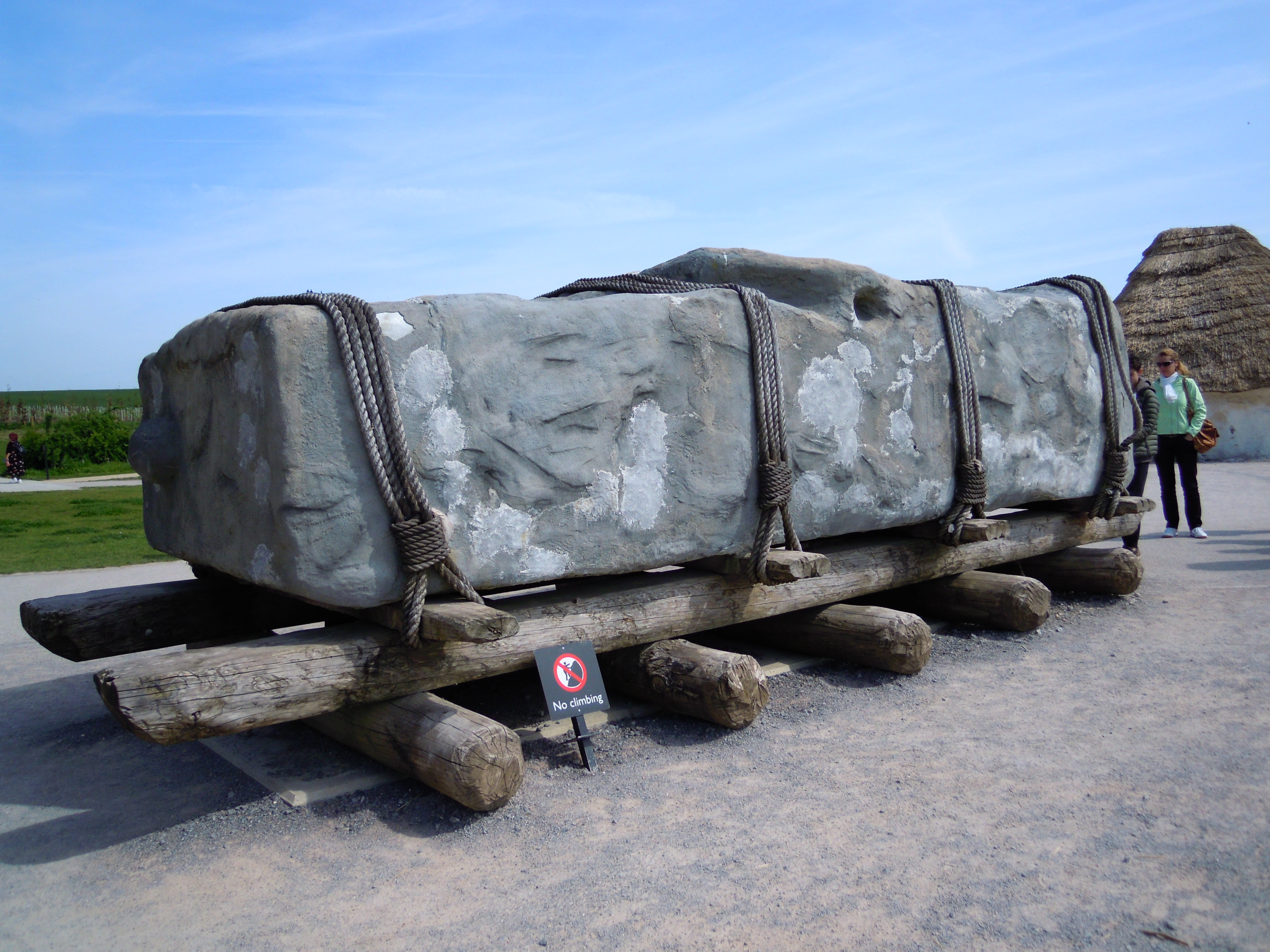
A sample stone below shows how the giant sarsens might have been moved to the site in those long-ago days. I had to tap the stone. It’s plastic but illustrates nonetheless.
Sample Sarsen
Lynn and I opted to walk to and from the circle. The Visitor Center is a little over a mile away, leaving the circle to stand free and open in its grand position. The day was gorgeous, and the easy stroll allowed us a long view of the stones and the effect of the approach–as my characters would have experienced it. We took the road going to the circle and went back to the center on a trail through the field. A lovely walk.
We had contemplated going to Avebury afterward, another wonderful site where the village is set among giant stones and you can touch them. I had been there before and enjoyed not only the stones, but a lovely high tea in the tearoom of an elegant manor, and I had lured Lynn into this trip promising her “scones among the stones.”
Well, we didn’t have a car, and bus connections would have given us more bus time than tea time. Taxis were expensive there, and we were exhausted. Lynn had taken the grueling trip across the pond just the day before our Stonehenge excursion and hadn’t slept on the flight or very much the night before her departure. I had only flown from Lisbon, but our meeting at London’s Heathrow airport hadn’t exactly been a snap.
Lynn had seemed worried about navigating that huge airport, but I had reassured her that my flight would land about an hour before hers and I could be waiting for her when she came off the plane. We had our iPhones in case it took a moment for us to find each other. The best laid plans and all that. My flight was late, very late. Hers was early. When I rushed into the airport, trying to connect with her, I got no answer. I got delayed in a huge line at border control. While moving slowly through that line I tried email, texts, phone. No response.
Friendly airport personnel helped us–more angels. As soon I got free of border control and found my bag I headed for her terminal–just as she headed for mine. We were striding across moving walkways when we looked up and saw each other. What a relief! We had bus tickets to Amesbury, the small town near Stonehenge, and the bus station was right between the terminals. We made it in plenty of time. But the distress took a toll.
Now we’d spent so long at Stonehenge we gave up on Avebury, but as we sat resting in our room at the delightful Fairlawn Hotel in Amesbury we decided to take an evening stroll to Woodhenge, a satellite site within easy walking distance. We were surely up to a pleasant walk out through the edge of the lovely town. We didn’t account for traffic that buzzed along beside us like freeway traffic on a narrow road, so close to the sidewalk I felt as if a wobble would put me right in a car’s path. But we survived to see this unusual site. A quiet, peaceful place.
Me at Woodhenge, Photo by Lynn
Lynn snapped my picture sitting on the concrete stumps where wooden poles once rose.
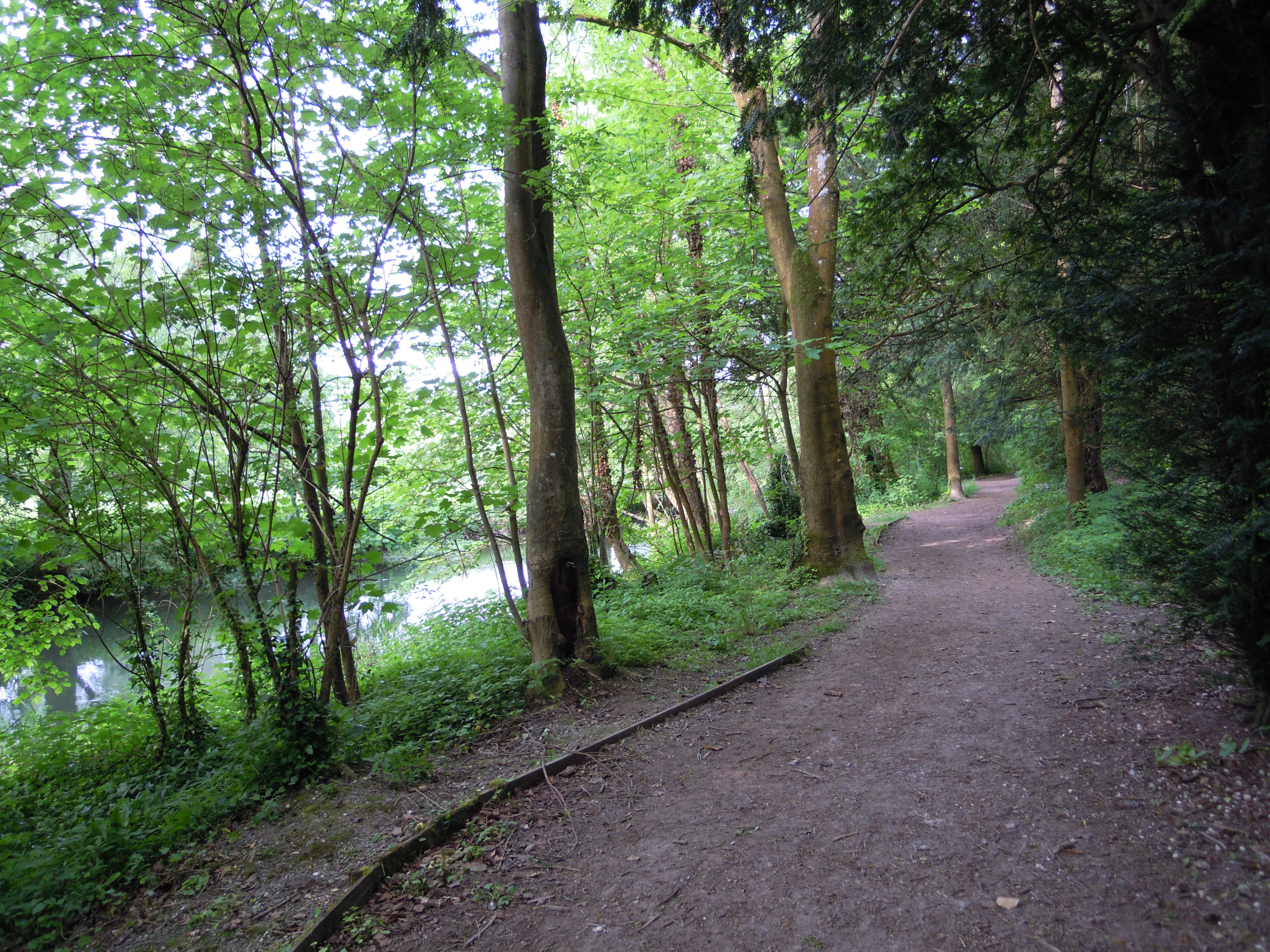
On the way back we took a side path to walk a short way along the famous River Avon. That offered another respite of quiet and peace with a generous touch of beauty.
Path Along the River Avon at Amesbury
Shadow in the Stones
As I put this post together, selecting photos from the many I took, I noticed something in the photo at the top of the post that I hadn’t noticed before–the picture labeled “Stonehenge.” An odd shadow. I give a closer look here. Do you see it? Probably a strange slant of the light against the stones.
But it put me in mind of the shadows that linger across this old world. Sometimes the shadows seem to come alive where the past remains so visible, as in these ancient works in stone. Or the crumbling citadels of Greece and Portugal, where archeologists work to ferret out the hidden secrets.
Bringing the past to life is what I try to do in my stories–whether from our own country’s pioneer past in A Place of Her Own and The Shifting Winds, or in these ancient times of my new series. I would keep searching, keep reaching, trying to see into the shadows to bring out the light of a people who did walk in these places, portrayed as truly as I can through the fictional characters in their imagined lives.