My Muse’s First Draft

Rough Draft - 4.5.15My muse just took me on a wild ride, and here’s the first draft. Done.

I’ve been writing books for many years. None ever caught me quite like this. And I must apologize to my followers for being absent awhile from this blog. I know. I know. You’re supposed to balance things out. Divide your time between writing and blogging and Facebook and marketing and all the rest. People sometimes remark about my discipline as a writer that helps me put out a lot of pages in a short amount of time. It’s not discipline, folks. It’s obsession. And this time, maybe more.

I blogged earlier about the visit of my muse, who began flooding me with ideas for this one in mid-December. I never really got away from it. I piled up notes and finally got them organized, ready to start the first draft in mid-February. I finished this draft March 22. In the last few days I gave it the first readings, one on the computer, one on paper. The photo above shows the first cleaned-up version on paper–not the final draft by any means. But it’s finally something I can hold in my hands.

Did I tell you the story of her name? My muse? I believe I alluded to it. In one post I had talked about changing the name of my character and how that ignited the inspiration for this historical novel of the Greek isle of Crete. I call the character Talia, and when I looked online for the meaning of that name I came up with several meanings like to blossom or bloom. Ah! Did she bloom! But, as I mentioned in my most recent post, one day I checked again for the name’s meaning, a different website. On this new website I learned that Thalia (an alternate spelling) is one of the nine Greek muses. Okay! That did set me back in my chair.

Is she sending me all this? It feels as if the story has come from a source outside myself. And the experience has been intense. I’ve been in this world, caught up in the joys and traumas and fiery conflicts and triumphs and pains, since the middle of December. A fantastic ride.

This is a book in my series from the Minoan world. One reason I could write an epic historical novel so quickly is that most of the research was already done for the earlier books, my scenario already developed. I just had to keep track of the generations and remain consistent–not always easy, but easier than the years of research that went into the first.

And Thalia isn’t done. Even before I finished this book, she started sending scenes for a new one. I’ll get the notes down, but I’m asking her for a brief rest.

COMMENT

First Daffodil ~ First Scenes

DSCN0731It appears to be a time for beginnings. My first daffodil of the season opened up. And I began writing my first scenes for the new novel. I love daffodils because they give me hope of life emerging again in the spring. Now my new book is taking life.

After receiving input from my muse for many weeks, I finally put it all into some semblance of order with an outline. From that I write.

By the way, I found an interesting tidbit of information a short time ago. As mentioned in my last post, all this recent input from my muse started when I changed the name of the protagonist for this new book, which is set in ancient times on the Greek isle of Crete. I usually like to know what the names of my characters mean. It affects my feelings about them. There are many sites you can google for your baby names and some of those offer meanings. I had clicked a few sites already on the new name for the protagonist, but went back to check again and came up with a new site.

This new site told me the name I had chosen, with a slight spelling variation, was the name of one of the nine Greek muses. I did sit back in my seat suddenly, reading that. Who knew? No wonder she’s been sending me material. 🙂

Anyway, I’ve enjoyed the whole process, except for some short nights of sleep. Now I’m thrilled to be writing.

I know some writers claim you have to write every day. It doesn’t really work that way for me. I see each book as a project with different phases, several of which involve writing in some sense–from note taking to revisions. But the most intense phase, the part where I step into the world of my characters and live it through them, is the first rough draft. That’s the real writing part to me. It’s where I am now. And loving it.

Cheers!

COMMENT

A Muse and the Power of Names

721.fog on mountain

My muse has been visiting me for the past three weeks, breathing words and ideas into my mind like fog drifting into the timbered mountains with refreshing beads of vapor. I have experienced creative fever before, but never for this length of time or with this power.

I had the premise for a story in my series set in the days of ancient Minoan Crete. I had written three already and I wondered what I would do this winter—with time to write and no story compelling me. For this one I had a few names brought over from the earlier books, but I didn’t really know most of the characters. The two I knew best had carried another story in the series, and while I’d become so attached to these two that I had trouble leaving them, I knew the next book had to be focused on the new people.

The trigger for my muse came when I was doing a final reading of Book One in the series and came across a family name connected with my new protagonist. It would have been the name of her great-grandmother, and was only mentioned once in the first book. That name touched me, as the name I’d previously given the new character did not.

I decided to rename my protagonist. Logical, I thought, for her mother to name her after an ancestress. And with that change, she went from being a sweet girl, the delight of her mother and her people, to being a young woman who could break men’s hearts—and her own in the process—never intending harm but rushing headlong into life with all its joys and perils. Then, while I was still caught in the excitement of getting acquainted with this intriguing person, I considered another character. I had a minor role for him, although a key role. When I named him he moved into the story with stunning force that changed their world. My muse put the rest together—I think with sheer pleasure.

I’m not ready to reveal those names, but in three weeks’ time I have drawn up an entire storyline. I have over 80 single-spaced pages of notes, a preliminary outline of scenes, and am ready to put together my working outline from which I’ll write the first draft. I expect my muse to continue whispering small thoughts, and the story may shift here and there. They always do.

But I will never doubt the power of names to inspire a story.

COMMENT

Alum Magazine Recognition

718.Oregon Stater Book NotesMy book got notice in the Winter 2015 issue of the Oregon Stater magazine for OSU alums.

A nice surprise when you’re thumbing through a magazine that just arrived in the mail.

I suddenly stopped turning pages. “Whoa! I know that book jacket.”

619.Oregon qtly listTook me a moment to realize it’s an earlier version of the cover with the white ribbon. I don’t know how they acquired that photo, but it’s nice to get the recognition.

I guess I’m what’s called a platypus. I was a beaver for my undergraduate work and a duck for my masters.

The U of O alum magazine, the Oregon Quarterly, gave the book recognition in their Autumn 2014 issue, shown here at right with the brown ribbon that graces the actual book.

I don’t think anyone will mistake the book, whether the ribbon’s white or brown. It’s a pretty distinctive design, thanks to the artists at Globe Pequot Press.

COMMENT

Holiday Cheer at OHS

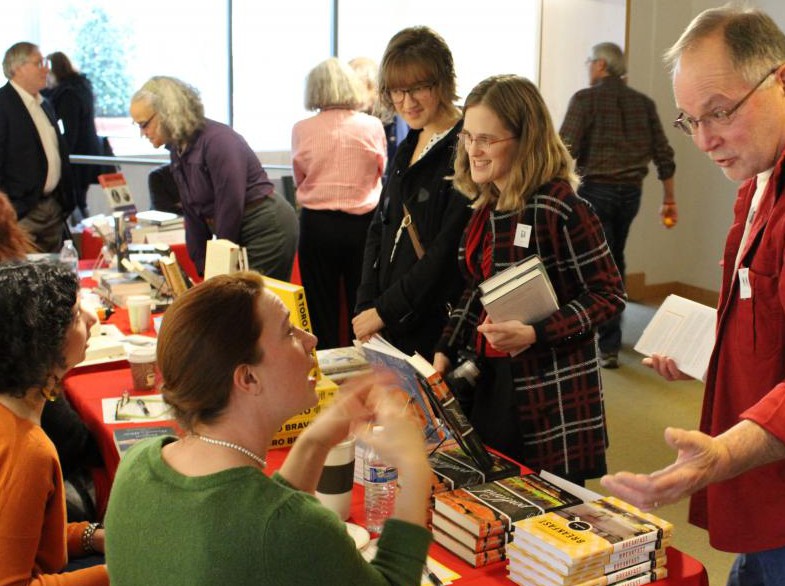
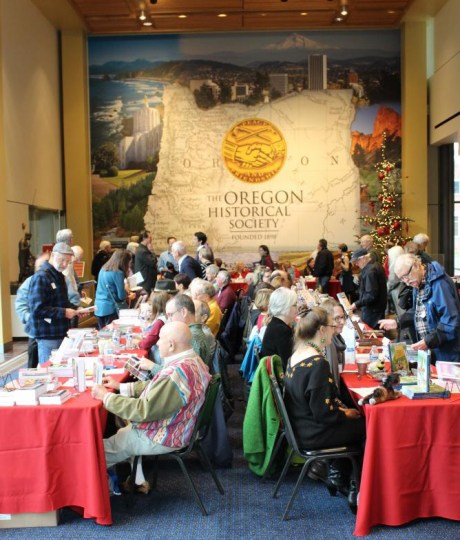
Holiday Cheer 4The Oregon Historical Society in Portland brought in many authors from the local area for their annual Holiday Cheer party last Sunday, a 50-year tradition.

Rachel Randles, OHS Communi-cations and Marketing Manager, who organized this year’s event, said early estimates indicate more than 700 people came to buy books and join in the day’s festivities.

I was delighted to be included among the authors this year to present my recently published history, A Place of Her Own: The Legacy of Oregon Pioneer Martha Poindexter Maupin. It seemed like an excellent venue for my story.Holiday Cheer Display
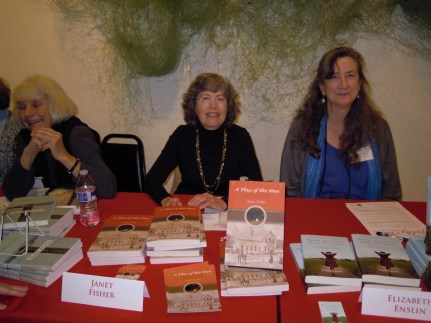
Here I am with other authors at a nonfiction table displaying our books for sale. At the left is Portland author Barbara J. Scot, author of The Nude Beach Notebook, and at right is Elizabeth Enslin from Wallowa County, author of While the Gods Were Sleeping.

My thanks to Portland publisher and author Laura Stanfill, who stopped by and took the above picture with my camera.  I met Laura in Tacoma in September at the Pacific Northwest Booksellers Trade Show. It was great seeing her again.
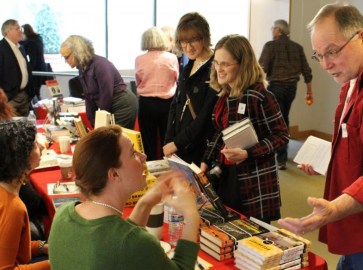
Holiday Cheer 5 - LauraHere’s Laura (at left) in the plaid coat talking with some other authors at the OHS event.

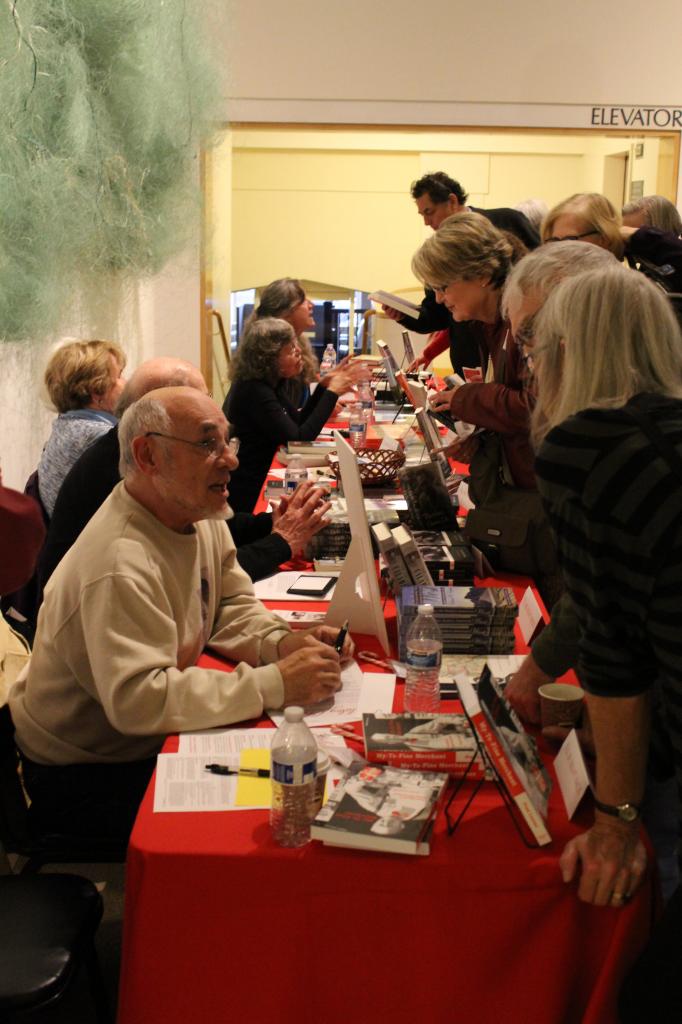
Besides book selling and signing, we had refreshments and entertainment. Before the event started authors were treated to a lovely lunch downstairs, with tasty cookies, muffins, and other treats offered throughout the afternoon.
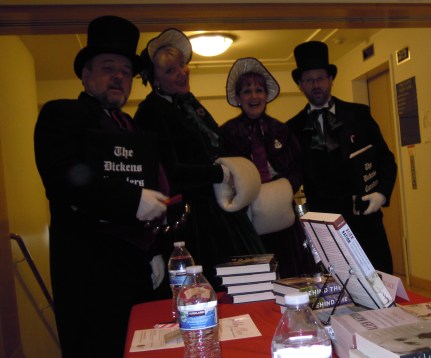
Holiday Cheer CarolersTo add to the festive air, The Dickens Carolers came by and sang a few carols for us. Here they are at our table.

It was a great crowd. I even met some relatives–from the Poindexter side. A delightful Poindexter couple came by to talk about our ancestors going back to George Poingdestre who immigrated to Virginia in 1657 from the Isle of Jersey in the English Channel. The Poindexters were pleased to buy a book. They knew their history, and we had a wonderful visit.
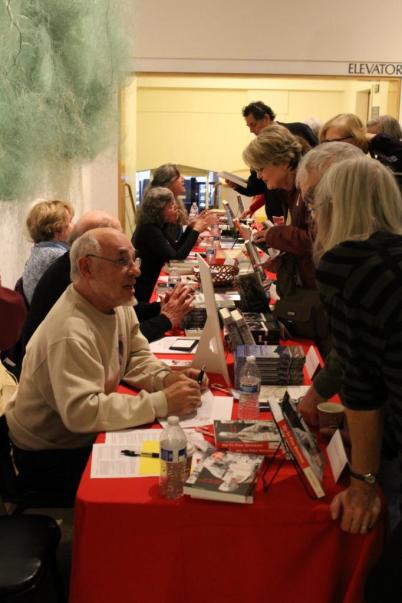
Holiday Cheer 2 I heard many stories from others who stopped by. I’m having a vigorous discussion (at left). When people learn I’ve written a story about a pioneer ancestor, they often want to tell about their own pioneer ancestors, and I enjoy hearing their stories. I hope many of them will get those stories written down while they still have time to talk with the elders who know the history.

All in all, it was a lovely day, and I found considerable enthusiasm for Martha’s story.

Except for the picture Laura took and the one of the carolers, which I took, all others on this post are compliments of the Oregon Historical Society. Rachel sent out a large collection of photos from the event with her thank-you email, offering these glimpses of the day so we authors might use and share them. Many thanks to Rachel and OHS.

Holiday Cheer 3COMMENT

Holiday Time

705.christmas book It’s that time of year, and I’m happy to be joining other authors to celebrate this holiday season with signings of our books.

I’ll be at the Christmas Craft Fair at the Douglas County Fairgrounds on Friday, December 5, from 1 to 5 pm. You’ll find me at the booth for the local Roseburg writers group, An Association of Writers. We’ll be selling an anthology put together by members of the group, as well as books written by individual members. The fair runs for three days, the 5th through the 7th, from 10 am to 8 pm Friday and Saturday and 10 to 4 on Sunday. My book will be on sale all through the craft fair that weekend, but I will only be there the four or so hours on Friday.

On that Sunday, December 7, I’ll be in Portland with my book at the Oregon Historical Society for their 2014 Holiday Cheer signing party, a big event OHS puts on every year. It’s an honor to be included in that party of selected authors. A good venue for my book, a history of an Oregon pioneer.

So whichever event is handier, I hope I’ll see many of you at one place or the other. Books make great gifts. Spread the word and pass the cheer.

Happy Holidays! 🙂

COMMENT

Backtracking the Oregon Trail

Afterword

462.one lg wagonI hope you’ve enjoyed our journey retracing Martha’s footsteps as we backtracked the Oregon Trail. As noted in the beginning it took us five days to cover the miles that took them five months. We streaked across modern highways in an air-conditioned car. Martha walked all the way, one step at a time. She trudged through fantastic mountain scenery and wide lonely prairies and deserts. I’m sure she embraced nature’s wonders while despairing of the next climb, the uncertainty of water and sustenance, the heat and cold.

It was a thrill to see the places again, some for the first time. Certainly I saw landmarks on this trip with new appreciation.

Returning home by air, I happened to notice the Columbia River below me, somewhere near The Dalles where we met Martha coming the other way.

598.columbia river from airYou can see the blue line cutting through the middle of the photo. The highway—and the Oregon Trail—follow it for some distance on the east side of the Cascades.

Years after her long trek Martha marveled at news of the newly built railroad crossing the country. Could she even imagine flying through the sky? About five hours in the air to go the distance that took her five months? I was happy to get home in less than a full day, rather than five long days on the road.

If you missed any post in this series and would like to find it, go to the right-hand side of the page and scroll down to “Categories.” Click on “Backtracking the Oregon Trail” to find them all listed. (Or just scroll down the main page. There aren’t very many intervening posts.)

Thank you for joining us.

COMMENT

At the Literary Salon

710.cg literary salonThis afternoon I went back to the book events after a little time off.

I was pleased to be invited to the first Literary Salon at the Opal Center for Arts & Education in Cottage Grove, Oregon’s historic downtown.

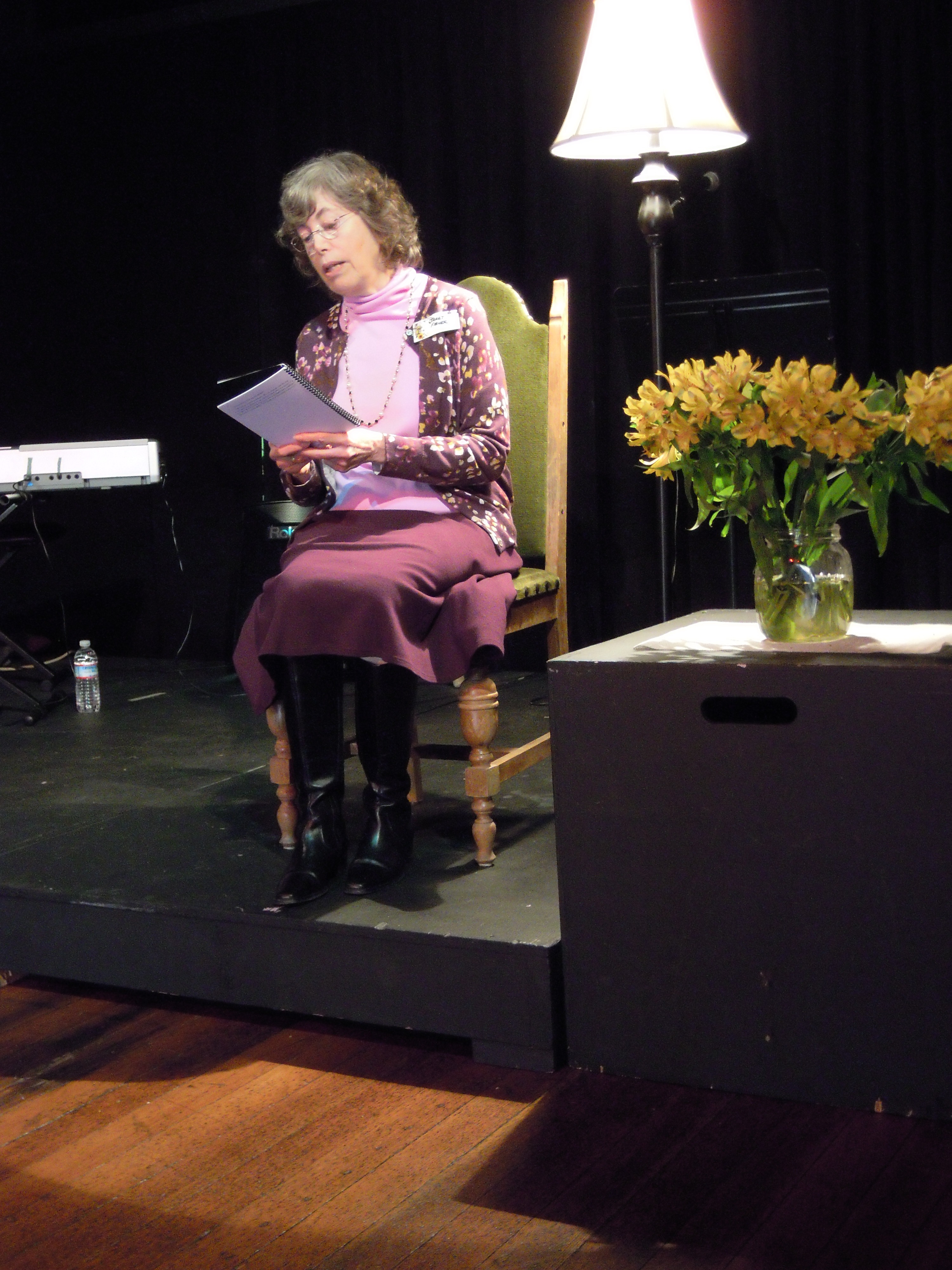
Four local authors–Hal Holbrook, Anastastia Machachek, Theo Czuk, and I–presented our work, each of us taking a turn on stage.

Theo, a composer of music, gave his presentation in song, with a short reading from his first novel, and the rest of us read and discussed our books. Afterward we had a little time for selling and signing.

The event was cosponsored by The Bookmine of Cottage Grove. An enjoyable afternoon with a welcoming crowd! Thanks to Allan and Gail for putting this on, and to Steve for taking the picture.

COMMENT


Backtracking the Oregon Trail #9

Day Five ~ Back to the Beginning

464.two wagonsThe land was mostly dry and dusty. . . . The Platte River making its lazy way between sandy bluffs, curving along a wide swath of bottomland. The shallow stream could sometimes be as much as two miles wide and a few inches deep. . . . Islands and sandbars, quicksand. Muddy, warm.
They were finally on their way. . . . The weight of troubles slipped from her shoulders as she looked west toward a new land and new possibilities. . . .
—A Place of Her Own: The Legacy of Oregon Pioneer Martha Poindexter Maupin, Janet Fisher. (Guilford, CT, Helena, MT: TwoDot/Globe Pequot Press, 2014), pp. 109-110, 104.

Saturday, May 25. Still traveling up the Platte. The road is a little monotonous. The scenery does not change much. The river has a winding course and contains many islands. Some are little more than sand bars, others are covered with low willows. The road is at times along the river bank, and again near the bluffs on our left.
—The diary of Margaret A. Frink, in Covered Wagon Women: Diaries and Letters from the Western Trails, 1840-1890. Vol. 2, 1850, Kenneth L. Holmes, ed. (Glendale, CA: The Arthur H. Clark Co., 1990), p. 89.

Took up camp after dinner & started up the Platte. . . . The road is level being between the bluffs & the river. The Bluffs are very high & picturesque. The river ranks among the first class as to width but is very shallow as indicated by the many islands with which it is filled.
—The diary of Celinda Hines, in Covered Wagon Women: Diaries and Letters from the Western Trails, 1840-1890. Vol. 6, 1853-1854, Kenneth L. Holmes, ed. (Glendale, CA: The Arthur H. Clark Co., 1986), p. 89.

June 17th Traveled near the Platte all day and encamped near it at night. This is a turbid river, no trees of any size to be seen. We make out to use the water by sprinkling in a little corn meal This makes it a little cleaner.
—The diary of Rachel Taylor, in Covered Wagon Women: Diaries and Letters from the Western Trails, 1840-1890. Vol. 6, 1853-1854, Kenneth L. Holmes, ed. (Glendale, CA: The Arthur H. Clark Co., 1986), p. 164.

May 10th [at St. Joseph] Crossed the [Missouri] river without any difficulty . . . The surrounding scenery is delightful The soil is fertile and lacks nothing but improvement to make it one of the first places in the world in agriculture;; My sister and I ascended to the summit of a hill and with the aid of a spy-glass took a farewell view of St. Joe. and the United States.:
—The diary of Abigail Jane Scott, in Covered Wagon Women: Diaries and Letters from the Western Trails, 1840-1890. Vol. 5, 1852, The Oregon Trail, Kenneth L. Holmes and David C. Duniway, eds. (Glendale, CA: The Arthur H. Clark Co., 1986), p. 49.

I could not begin to tell you how many their [are] in St Joseph that are going to Oregon and California but thousands of them it is a sight to se the tents and wagons on the banks of the river and through the country
—The diary of Mary M. Colby, in Covered Wagon Women: Diaries and Letters from the Western Trails, 1840-1890. Vol. 2, 1850, Kenneth L. Holmes, ed. (Glendale, CA: The Arthur H. Clark Co., 1990), p. 48.

462.one lg wagonBy Day Five we had to push forward without delay. We followed the trail a ways, along the main fork of the Platte River, lush and green now with farming, bluffs on either side. You can tell where the river is by the line of trees that marks it.

Martha wouldn’t recognize this any more than she could have recognized the land along the North Platte. She would have remembered a much drier place with fewer trees, and those often limited to the islands of the wide, meandering waterway.

Pushing eastward into the tall grass country, we saw more farms where Martha would recall prairie grasses that could grow six feet tall, and flowers in swashes of color reaching into an arc of blue sky.

509.chimney rock & sunflowersThe native North American prairies west of Missouri changed gradually going westerly—from tall grass to mixed grass to the short grass of the high desert. From the diaries it sounded as if the tall grass had pretty well played out by Fort Kearney, soon after they reached the Platte. Somewhere in there you begin reading about lack of wood and the need for that substitute fuel offered by the buffalo that ranged across the region—buffalo chips. Different companies of wagons spread out so their livestock wouldn’t overgraze along a single track, here where the land stretched wide enough so they could.

I didn’t take any pictures on Day Five, maybe because the landscape seemed monotonous, mostly flat, green, looking nothing like the place described in the diaries. A monotony of a different kind. As we continued eastward the flat land spread farther to the horizon so the bluffs on each side sometimes disappeared in the distance. And a gradual greening occurred the farther east we drove—probably as that earlier vegetation once changed from shorter mixed grasses to the tall prairie grass, going the opposite direction the emigrants were.

The Weston plow, invented in the late 1850s, changed this landscape. Before the Weston, no plow could cut through the tough root system of the tall grasses. But this new plow had the power to turn the turf over. Farming was born in the tall grass prairie. A few industrious souls today are trying to return portions of this land back to its native state, but they have strong competition from agribusiness.

We left the trail around Kearney for the shortest route to our destination, finally reaching the Missouri River and St. Joseph, one of the popular jumping-off places for emigrants embarking upon the Oregon Trail.

463.wagons high plainsFolks couldn’t just march west when they had a mind to. They faced a small window of time when it was advisable to go—to jump off into the wilderness and one of the most profound adventures of their lives. They had to wait until the prairies greened up in the spring to offer feed for their livestock, and they had to cross the last mountain before the winter snows. Towns like St. Joe, Independence, and Westport (which became Kansas City) grew up where people waited, and businessmen set up shops to offer supplies in case folks still needed goods. Business could be brisk while folks waited and shored up the wagons.

Reading the diaries you feel the gradual shift as the bright hope at the outset begins to fade. Exclamations of “beautiful scenery” and “good roads” turn to words like “tedious” and “monotonous.” The good roads turn dusty. The lush grass becomes scanty. The way ahead feels longer, less certain. I am reminded of Joseph Campbell’s heroic journey. Isn’t that the way of every major endeavor? We leave the familiar because something compels us. And if we knew in the beginning how hard the road would be, we might never have the courage to go. Hope compels us, and though things get rough in the middle, we come out on the other side, having triumphed or at least having learned something.

502.painted wagon & oxen scotts bluffNearing the end of our journey we decided to stop in St. Joe for dinner. We were so ready for a decent meal. Our own struggles paled in comparison to those of the intrepid pioneers, but we were anxious for a few of the comforts.

Christiane had hoped to arrive at her house before dark, having rented the place sight unseen, except for pictures.

Maybe with a quick meal we could have made it, but our desire for something better outweighed her plan. We enjoyed a delicious sit-down dinner and reached Kansas City in the dark.

The map of freeways and streets looked as if a drunken spider had gone on a spree and built a crazy web. It took careful watching for signs, but our directions led us right to the house, and we were pleased to see the canopy of large trees in the neighborhood. When we stopped in the driveway and opened the car doors, a strange sound reverberated around us. It seemed almost like an electronic buzz and I wanted whoever was doing it to turn off the music or machine or whatever was making that noise. We were so exhausted we just wanted to go in and make our beds on the floor—to sleep and await the moving pod and real beds the next day. But what was that sound?

We learned there were huge cicadas, and maybe some tree frogs adding to the chorus, and over time we began to get used to them. We could barely hear them inside the house with doors and windows closed. So they didn’t keep us awake. They did make our chirpy critters back home seem like soft crooners.

So our journey ended near where Martha’s started. She began with hopes high, marching out onto the wild prairie. We entered the city—one of those jumping-off places—tracking a wild network of freeways in the dark. But we shared her sense of hope for new adventures and possibilities.

—Scotts Bluff National Monument: Landmark on the Overland Trails, A History and Guide, Dean Knudsen, Historian, National Park Service, pp. 34-36.

—Women’s Voices from the Oregon Trail, Susan G. Butruille. (Boise, ID: Tamarack Books, 1993), pp. 21-22.

NEXT: Afterword

COMMENT

Backtracking the Oregon Trail #8

Day Four ~ The North Platte River

516.north platte westNorth Platte River looking west

Martha looked up the long dry slope they had to climb. Bluffs came right to the river’s edge here, so they couldn’t pass. They had to go around and that meant up. She clasped a child in each hand and started walking. . . .
Thank goodness for the women. What would she do without other women to laugh with and share stories with? Much as she loved Garrett and her brothers, they didn’t see life in quite the same way.
—A Place of Her Own: The Legacy of Oregon Pioneer Martha Poindexter Maupin, Janet Fisher. (Guilford, CT, Helena, MT: TwoDot/Globe Pequot Press, 2014), p. 113, 110.

It is singular that on the north side of the Platte here is not a vestige of a tree in sight—save one “Lone Tree” for 200 miles & yet on the South side there is an abundance of Cedar fastened in the rock Bluffs & some Cottonwood. But the feed for cattle to all appearance is much better on the N. side
—The diary of Polly Coon, in Covered Wagon Women: Diaries and Letters from the Western Trails, 1840-1890. Vol. 5, 1852, The Oregon Trail, Kenneth L. Holmes and David C. Duniway, eds. (Glendale, CA: The Arthur H. Clark Co., 1986), p. 191.

13th Monday . . . the road soon leaves the bottom & leads upon the bluffs which are here of a rocky formation which seems to be a mixture of sand & lime In about three miles we came to Ash hollow so called from the ash trees which grow there. We had looked to this place as one where we should have plenty of wood & water . . . The glen is very picturesque rocks rise almost perpendicular two hundred ft or more We had scarcely encamped in a prettier place . . . 
—The diary of Celinda Hines, in Covered Wagon Women: Diaries and Letters from the Western Trails, 1840-1890. Vol. 6, 1853-1854, Kenneth L. Holmes, ed. (Glendale, CA: The Arthur H. Clark Co., 1986), pp. 91-92.

june 23 [Sunday] we camped in ash holler fifteen miles from whare we campe before and their was a tremendous thunder sawer one role after nother till it killed a horse that was onley one rod from our wagon that night Sarah was taken sick we had no super
June 24 we camped on the north fork of the plat river and sarah was very sick . . . I soon saw she would die and she did die before noon o how lonely I felt to think I was all the woman in company and too [sm]all babes left in my care it seams to me as if I would be hapy if I only had one woman with me
—The diary of Sarah Davis, in Covered Wagon Women: Diaries and Letters from the Western Trails, 1840-1890. Vol. 2, 1850, Kenneth L. Holmes, ed. (Glendale, CA: The Arthur H. Clark Co., 1990), pp. 179-180.

July 21. We again are pursuing our teadious journey. For the first 3 miles it was up hill then we came to a ridge. This extended to Ash hollow & when we came to it we found ourselves on the top of a high hill, precipices & deep ravines. In these ravines & on either side of the bluffs are trees growing in crevises, ash & red cedar. It is the most romantic place we have seen yet.
—The diary of Lucena Parsons, in Covered Wagon Women: Diaries and Letters from the Western Trails, 1840-1890. Vol. 2, 1850, Kenneth L. Holmes, ed. (Glendale, CA: The Arthur H. Clark Co., 1990), p. 251.

515.north platte eastNorth Platte River looking east

Martha wouldn’t recognize today’s North Platte River. With passage of the Homestead Act in 1862, people started taking a second look at that land west of Missouri. And completion of the transcontinental railroad in 1869 insured easier transportation to markets.

Instead of seeing the Platte River Valley as a long impediment to a West Coast destination, folks began to see the farming possibilities right there. Add more water with irrigation and the possibilities increased dramatically. So farmers came. They dug plows into the rich soil, built irrigation canals—and changed the character of the valley.

As we traveled along the North Platte, I felt the need to conjure up long-departed images. Massive herds of buffalo. Grassy plains. And where exotic trees and shrubs flourish along the riverbanks today, I imagined a land with few trees in sight and scarcely a stick of wood for a campfire. The buffalo herds may have eaten down the grass along the way, but they left a perfectly good substitute for campfire fuel—buffalo chips. Yes, that’s manure. Folks said it didn’t smell so bad and didn’t give the food a bad taste when used for cooking.

517.ash hollow bluffBluff above Ash Hollow

As you drive along the high plateaus you can still see some of the drier landscape the emigrants might have seen. Maybe the soil is too thin up there for farming, so this land has been left to its earlier state. The land has broken away on the edges of some of those plateaus, as if chopped away by a cleaver, baring the rocky interior, like the one overlooking Ash Hollow (above). Soil looks pretty thin at the top.

Before reaching Ash Hollow, most emigrants, traveling on the south bank of the main fork, had to cross the South Platte to make their way over a high plateau to the North Platte where the trail continued. At that river crossing they found that the lazy Platte had turned quite rough, although it was shallow enough to ford. From that harrowing plunge across the water, they met with the strenuous climb to the plateau.

520.Windlass HillWindlass Hill

But after following the trail across that high plateau they found no good way down. The gentlest slope appeared to be Windlass Hill. So they stopped at the top of this hill and lowered the wagons with ropes. There would be worse to come, but anytime you have to lower a wagon with ropes it’s a treacherous undertaking. Quite a bit of excitement after the flat prairie they’d followed for many long days. When they got to the Oregon Cascade Mountains and saw Laurel Hill, though, this one would pale in comparison.

From Windlass Hill they made their way to nearby Ash Hollow where even in that day a refreshing grove of trees awaited them. But the Ash Hollow springs held a deadly secret. In bad cholera years that spring water harbored the lethal cholera bacteria. It could strike with sudden force, killing a healthy person overnight. The diary of Sarah Davis (above) touches my heart on so many levels.

We weren’t able to get into Ash Hollow park but could see a little of it from the gate. The park was closed the day we passed through. I had hoped to meet with someone who would let us in, but we got there too late in the day.

519.bunny windlass hillI don’t know if this is a native bunny species that we saw at Windlass Hill, but we observed many of them and would see them frequently—right outside the door—in Christiane and Calliope’s new home.

We stayed that night in the town of North Platte, Nebraska, which lies just east of where the main Platte River splits into the North Platte and South Platte. We were relieved to get in before dark that evening and rested up for the final day of travel.

—Women’s Voices from the Oregon Trail, Susan G. Butruille. (Boise, ID: Tamarack Books, 1993), pp. 165-166.

NEXT: We’ll head over that flat prairie along the main fork of the Platte, then take the shortest route to the Missouri River, back to the Oregon Trail’s beginning.

COMMENT