I’ve been thinking quite a lot about the People of the Stones who walk through my stories of ancient Ireland and its neighboring lands. I’m working on a new novel, a sequel to the one I hope to have published next. Always a time for the stirring of the mind.
This past weekend was the annual Fort Umpqua Days celebration in nearby Elkton, Oregon, so I was there with my booth selling my pioneer stories. I had a notebook on display with photos of pioneers as well as ancient settings and my new business cards illustrating my work “From Pioneers to People of the Stones.”
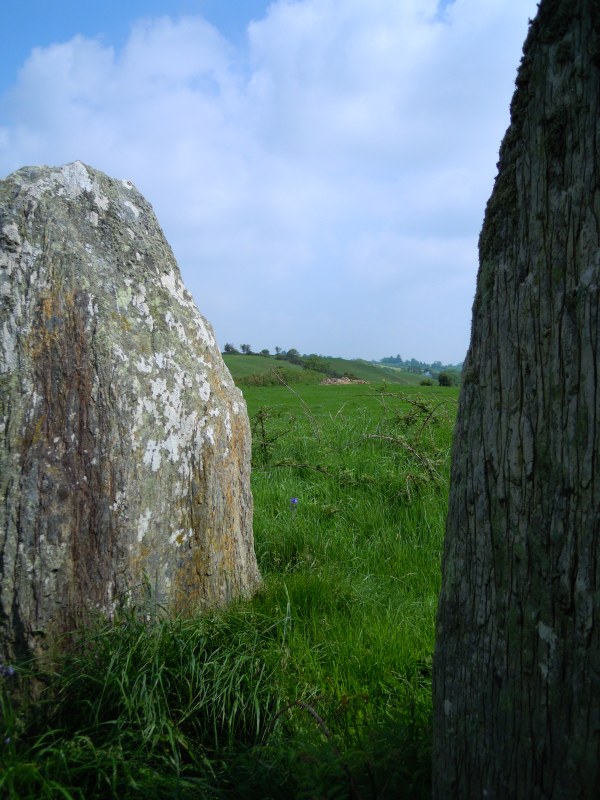
A boy stopped by and saw a picture of the stone circle at the center of my ancient stories, the Bohonagh Stone Circle in Ireland.
“Stonehenge,” he said, then shook his head when he realized it didn’t look quite like Stonehenge.
I turned the page to show him I did have this picture of the circle he knew. We had quite a conversation, maybe a half hour or so.
He had some imaginative ideas about how the ancient people stood those big stones up there. He knew quite a bit about the site.
He’s ten. I told him he should think about being a writer someday. He smiled. “I write comic strips already.” A budding author. And a delight.
So that night when I was looking for an hour’s entertainment before going to bed I searched my recordings on the DVR and saw OPB’s NOVA presentation on Stonehenge. I’d seen it, but I watched again with keen interest. They showed how the first stones of Stonehenge were the smaller bluestones, not the giant Sarsens. A single ring. Dated at about 3000 B.C. Then the giants went up in 2500 B.C., with their lintels on the top, and the bluestones were moved into the interior. I wanted to argue against those bluestones coming all the way from Wales, some 150 miles away, but the guide I talked to at the site convinced me. Archaeologists had found quarries in the Preseli Hills of Wales with the same kind of stone, and there were no such stones around Stonehenge. They had to have come from Wales.
The smaller bluestones show clearly in this photo, lined up inside the taller sarsens.
Then last night I again wanted an hour’s entertainment. And what should I find but another, newer show about Stonehenge. This one showed the same archaeologist who finally found the exact quarry in Wales these bluestones came out of. Problem was, dating on the site indicated that the quarrying for the bluestones happened in 3300 B.C. The stones went up on the Salisbury plain in 3000 B.C. There was a 300-year gap. Where were these stones during those 300 years?
It wasn’t an easy question to answer, but the archaeologist came to believe the stones had been used for a circle near the quarry, then removed to the location on the Salisbury plain where Stonehenge stands today. Many megaliths stand yet today in the vicinity of the quarry. But how to find where this circle of bluestones stood in that interim? This was a needle-in-a-haystack effort for sure. How do you find something that isn’t there anymore? They had to look for the holes left behind, long since covered over by new soil. With many disappointing tries and the use of overhead imagery they finally found where the stones once stood. They could even see the odd shape of one impression that matched a bluestone now at Stonehenge.
For confirmation they used a dating method I’d never heard of where they dig down to see when the sediment last saw the sun, keeping carefully under cover to avoid any current light. The test showed a date of 3300 B.C. as the construction date on the abandoned site. So the stones went directly from the quarry to this site in Wales and 300 years later were moved to the current site.
Why would they move them? And how? Each stone weighs more than a ton. To show how it was possible they built sledges and had 30 children, 13 years old, try to pull the loaded sledge with ropes. The children managed with apparent ease, drawing the heavy stone uphill. Surely ancient adults could do it. As for the why, we can’t really know. There was no sign of battle to suggest they were escaping attack.
Stonehenge looking southward.
One thought was that the site on the Salisbury plain at that time lay on a swath of glacial channels that aligned with the sun on winter solstice. To these ancient People of the Stones this may have appeared to be an auspicious site.
Moving into the minds of ancients who left no writing behind? Well, that’s the kind of thing we fiction writers do.
It’s in Dublin! And I needed to see it! Gold has a place at the heart of my new Irish story. So I set aside a day for this. Welcome to my traipse through Ireland’s glorious golden past.
This intricate gold neck ornament, made in Ireland, comes from the Late Bronze Age, somewhere between 1000 and 500 B.C., during the period of my story.
So much brilliant ancient goldwork has been found in Irish bogs and waters, hoards of it. And the National Museum of Ireland–Archaeology has a dazzling display, including the samples shown in this post. I would spend hours there, stepping into Ireland’s ancient glory.
The lunula goes back to 2300-2000 B.C., named for its crescent moon shape.The museum has many on display, this one showing a good example of the intricate incised markings.
The lunula, like the one above, appears in my story on the necks of clan mothers and future clan mothers in ancient Éire. A lovely ornament made from thin hammered sheets of gold with the incised designs.
When I proceeded to write my newest novel, I first had to decide where to set it. Where did I want to spend the next months, maybe years–at least in story if not in person? The answer came quickly. Ireland.
The next question. When?
I pulled out books and notebooks I’d gathered for other work and began poring through them for intriguing periods in Ireland. One thing jumped out at me. Gold! Historians describe the period around 800 B.C. as a time of a sudden uptick in rich production of gold in Ireland, a veritable revolution in goldwork. This was also a period when the early proto-Celtic culture was thriving in faraway Hallstatt, Austria. I knew how the Irish love their Celts. They wouldn’t be in Ireland in 800 B.C., but could I find a way to bring them into the story?
My decision was soon made. My new book would open during this explosion of fine goldwork, and my protagonist would be a goldsmith–a rare thing for a girl.
So this spring in Dublin I stepped down into the center of the museum where a glittering world of gold surrounded me to learn what goldsmiths were doing in those momentous days.
Gold dress fasteners c. 800-700 B.C.Gold bracelets and dress fastener c. 800-700 B.C.Gold foil-covered sunflower pins c. 800-700 B.C.Gold foil-covered bulla probably worn on a cord around the neck c. 800-700 B.C.Part of a gold bobbin-shaped ear spool possibly to be worn decoratively over the ears c. 800-700 B.C.Lock rings, hair ornaments that appear to be incised, but the lines are made of tiny wires soldered on. c. 800-700 B.C.
The soldered wires in the lock rings are so tiny they barely show in my photos. The enlarged one from the upper left of the photo above it may show the lines better, the curve. Such delicate, intricate work illustrates the fine skill of goldsmiths in this period. If they did this as Levaen did, they hammered the gold into a thin sheet, then rolled from the edge to create the wires and bonded them in place with soldering particles.
This small sample of the museum’s 800-700 B.C. goldwork that fits into my story’s timeline shows no brooch like the one my protagonist Levaen makes in the book, nor did I find anything like it. I began to worry about that, but Carisa, my daughter and beta reader, pointed out that there was no reason Levaen’s fictional goldwork should show up in the Dublin museum, and I remembered that the story presents Levaen’s brooch pattern as special in her own time. What the museum exhibits showed, especially the lock rings with their thin wires, was that the actual goldsmiths of that era were familiar with techniques like the thin wires and soldering Levaen uses to create her brooches.
Going farther back to 1200-1000 B.C. are three twisted gold bracelets and two gold grooved bands.And a gold torc with ribbed rings and bracelets from 1200-1000 B.C.
One exhibit offered a portrayal of how some of these golden objects might have been worn. This illustration features goldwork from the Late Bronze Age, roughly 1000 to 500 B.C., a neck ornament like the one in the photo at the top of the post, along with ear spools of sheet gold, and arm and wrist bracelets pictured above.
Of course these items could have been worn by either men or women or both. There might have been chiefs or chieftainesses. Or perhaps the general public would have donned such brilliance for special occasions. We can only wonder and imagine.
There was so much more gold in the museum’s collection, but some bronze too, that caught my eye.
Swords from 900-500 B.C. Some look like leaf-shaped Hallstatt swords but they’re not labeled as such.
No one knows when the Celts came to Ireland. We only know the language came, so they must have come. But they would not have been in Ireland in any numbers at the time of my story. A few Hallstatt swords possibly came earlier, by trade or other means. Enough to tantalize but not to prove anything.
There’s no intrinsic method of dating metal, so dating depends on surrounding materials that can be dated. In fact, on at least one occasion they found a lunula in a wooden box, which identified the time of its use by testing the wood. Surely a precious object. Dating offered with the museum exhibits of gold and bronze would have been confirmed by surrounding material, but they give a broad span as noted in captions here.
Many objects in the exhibits are labeled as parts of the hoards that included them, deposits placed into bogs or lakes or streams. Why the ancients deposited such hoards, no one knows. Bogs may well have been lakes at the time of the deposits and later dried up, so all deposits may have been placed into the waters. Or some dry or partly drained bogs may have been dug into and the items buried. Were the treasures cached in a time of escape from some crisis? Or were these offerings to their deities? All we can do is guess. We have no writing, no histories, to tell us.
The hoards weren’t all glorious gold. Many practical items were included. A lot of bronze. Practical axe heads, chisels, horns, cauldrons. And swords and spear heads.
Some items are just delightful objects like the one pictured below. I so enjoyed seeing it, I chose to share it here, even though it’s later than my story.
Miniature 7-inch-long gold ship with sailing mast and oars from the 1st century B.C.
Before I launch into Day One about my recent research trip through Greece and Portugal, the UK and Ireland, it occurs to me that it might help clarify my reasons for this journey and my reasons for writing the ancient historical series if I backtrack to the beginning. My focus on the Greek Isle of Crete started in 1994 when I set out to research a mystery novel on that exotic Mediterranean island. I had been writing books and pursuing publication for about 14 years, without success. I had moved from Roseburg, Oregon, to San Francisco in late 1989, ending a long-term marriage, and I was seeking answers for my life.
During this time I read a New York Times bestselling book by Riane Eisler called The Chalice and the Blade, where she describes nothing less than the overturning of the world’s cultural norms from woman-centered civilizations to a patriarchal world ruled by contentious warriors. I was fascinated. One chapter stood out for me, where she describes Crete as the “essential difference.” Because of its isolation in the Mediterranean Sea, this island remained one of the last holdouts of those woman-centered cultures. Its primary city of Knossos offered stunning revelations about these Bronze Age people when archeologists began uncovering the fabulous ruins some 100 years ago. Eisler describes Crete as the most advanced technological culture ever found where women were not dominated by men. I wanted to see this place.
Room in the Palace/Temple of Knossos
When I visited Knossos and stepped into the partially reconstructed ruins of its central structure, the place seemed to wrap itself around me like a mother’s loving arms. I no longer wanted to write my mystery novel. I wanted to immerse myself in this world and come to know the mystery of the ancients who once thrived there.
Prince of the Lilies Fresco, Knossos
The British archeologist Sir Arthur Evans who uncovered Knossos in the early 1900s was struck by what he found–grand staircases and pillar-lined corridors, technological wonders like flush toilets and an elaborate drainage system, frescoes revealing a free and sensuous lifestyle with women standing proud at the center. He believed he’d found a matriarchy but as a man of his times he thought they needed a king to run it. He saw this as the Palace of King Minos mentioned by Homer and Hesiod. But later scholars suggest it may have been a temple, an idea I adopted for my books, and I drew from one of Eisler’s thoughts on King Minos, depicting him as a Mycenaean warrior with designs on Crete–and a couple of Cretan women.
Part of Knossian Procession Fresco
While in Crete I met a man who helped me understand the attraction, the delight, the frustration that can happen when cultures clash. The experience found its way into my story which opens on this peaceful isle on the day the warriors come.
The frescoes shown here are reproductions of originals that are housed in the excellent Archaeological Museum in nearby Heraklion, Crete, the island’s primary modern city. The bull-leaping fresco appears in the opening scene of my book now called Beyond the Waning Moon. And readers will experience a bull-leaping event in the second scene when the protagonist faces a fierce bull in the court.
Bull-Leaping Fresco, Knossos
I wrote the book and continued editing and revising for several years as I sought its publication. Riane Eisler kindly critiqued the opening and when I addressed her concerns she called the result powerful, responding “Brava!” The novel eventually became a finalist in the Pacific Northwest Writers Association Literary Contest. The next year I found a way to tie the people of Crete to their counterparts in the distant isle of Ireland, another place that had touched me deeply and where I have personal roots.
My search for life’s answers led me to mythologist Joseph Campbell and especially his four-volume work, The Masks of God. My focus riveted on his discussion of Ireland and how he could see behind the Irish myths to a culture of Mother Right, essentially a matriarchy that would have preceded the later patriarchy. As Eisler points out in Chalice and the Blade, this isn’t the flip side of patriarchy where women rule over men but more of an egalitarian society accepting the full worth of both genders. Neither writer suggests any kind of utopia but at least a much more equal situation than we came to know.
I first visited Ireland in 1993 because of my Irish roots and had set one of those mystery novels there. But I wanted to tap into the ancient times that paralleled my Cretan story and find the lost culture of Mother Right, which Campbell talked about.
Rocky Headlands on Irish Coast
The Cretans of the first book in my ancient saga decide to send out a fleet in search of a place the warriors haven’t come. These early Cretans were known as great mariners, their frescoes and other art showing them sailing around the Mediterranean. I figured if they could sail around the eastern Mediterranean they could surely venture to the west and even out through the gate to the Atlantic, as long as they kept the shores in sight. But for a little excitement they get caught in a horrific storm and one ship crashes on the rugged rocks on Ireland’s south coast. Voila! A sequel–albeit loosely tied.
I completed the sequel in 2004 and went back to Ireland in the spring of that year, focused now on stone circles and this rugged south coast near Rosscarbery in County Cork.
Bohonagh Stone Circle Portal, Ireland
I again entered the PNWA literary contest, and this Irish one was a finalist too, just one year after the Cretan book. I thought I was surely on the road to publication then, but could not find an agent for these stories of strong women facing formidable challenges of their time. I began to get discouraged.
My father died in 2007 and I decided to keep the farm founded by my great-great-grandmother Martha in 1868. I left the ancient stories on the shelf and pursued a story about Martha, discovering I had a strong woman in my family who’d faced challenges of her own time. Finally I found an agent, Rita Rosenkranz, who helped me meet my goal of publication with Martha’s story.
But I hadn’t forgotten the ancients. I had a flash of inspiration about the Cretan story and decided to make substantial changes. When I finished those I realized I definitely needed another sequel that would be closely tied. I wanted to launch into it but I had another story set in the same pioneer period as Martha’s story. My agent and I agreed I should take advantage of the publisher’s interest and bring that pioneer story out first.
By the spring of 2014, with the two pioneer stories in the pipeline, I finally had time to draft the closely tied sequel to the Cretan book. By Christmas I was ready to write one more book to continue the ancient line, but it just wasn’t happening until my muse started whispering to me. I told about that experience on a blog post here so won’t repeat it. This fourth book was drafted by the spring of 2015. I had planned to write a fifth that would bring Crete and Ireland back together but realized I had a 16-year gap in the Irish years. Why not fill the gap with another story?
South Gate to Castro do Zambujal, Portugal
Because of all the questions I had left at the end of the first Irish book, I wanted to portray the events of those 16 years. I would take readers to the homeland of the Iberians who’d been capturing slaves off the coast of Ireland. I would show my bad guy in his personal haunts.
But the Iberians couldn’t all be brutes, could they? I learned about their amazing citadel of Zambujal north of today’s Lisbon. They must have enjoyed a sophisticated culture I needed to know more about.
And I would take readers to the Great Isle of Britain where my protagonist runs into some intriguing outlaws in the Lake District of northern England.
I finished the rough draft of the gap story in 2016. Then in 2017 I drafted the sixth book, which took me back to Iberia.
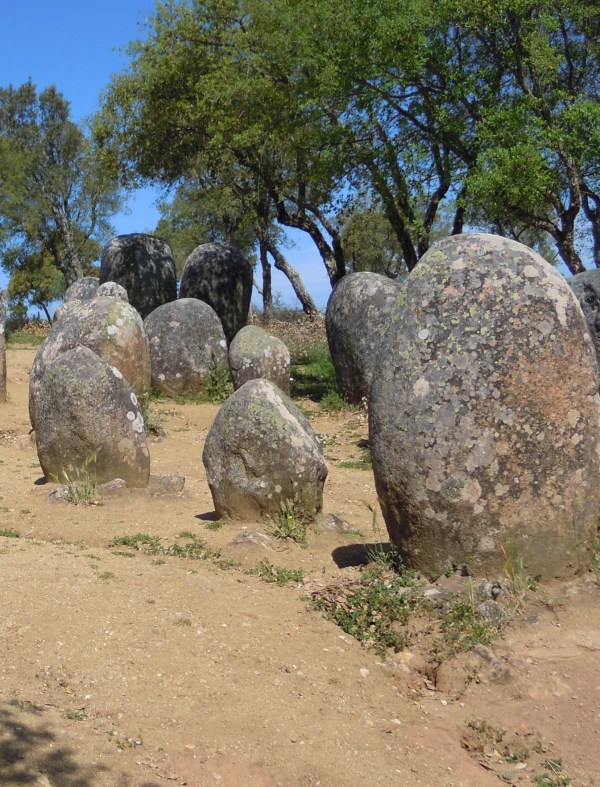
Part of Almendres Cromlech in Cork Forest, Portugal
I had never been to the Iberian peninsula, where there’s a stone circle (or oval) more ancient than the circles of Ireland. I needed to see that, as well as Zambujal. And I had never been to the Lake District in England.
Also, the new books ventured into places in Greece and Ireland I hadn’t visited before. Thus the need for another trip. Once you’ve crossed the pond, that’s the biggest single expense. I decided I might as well put it all together.
So, that’s how the project started and why the extended trip. Next up, I invite you to come with me on my solo journey in Greece and Portugal and my continued trek with writer friend Lynn Ash through the British Isles. I’ll start the next post with Day One in Heraklion, Crete, and the nearby site of Knossos I have come to love.