Going There #3: Gold! Gold! Irish Gold!

It’s in Dublin! And I needed to see it! Gold has a place at the heart of my new Irish story. So I set aside a day for this. Welcome to my traipse through Ireland’s glorious golden past.

This intricate gold neck ornament, made in Ireland, comes from the Late Bronze Age, somewhere between 1000 and 500 B.C., during the period of my story.

So much brilliant ancient goldwork has been found in Irish bogs and waters, hoards of it. And the National Museum of Ireland–Archaeology has a dazzling display, including the samples shown in this post. I would spend hours there, stepping into Ireland’s ancient glory.

The lunula goes back to 2300-2000 B.C., named for its crescent moon shape. The museum has many on display, this one showing a good example of the intricate incised markings.

The lunula, like the one above, appears in my story on the necks of clan mothers and future clan mothers in ancient Éire. A lovely ornament made from thin hammered sheets of gold with the incised designs.

When I proceeded to write my newest novel, I first had to decide where to set it. Where did I want to spend the next months, maybe years–at least in story if not in person? The answer came quickly. Ireland.

The next question. When?

I pulled out books and notebooks I’d gathered for other work and began poring through them for intriguing periods in Ireland. One thing jumped out at me. Gold! Historians describe the period around 800 B.C. as a time of a sudden uptick in rich production of gold in Ireland, a veritable revolution in goldwork. This was also a period when the early proto-Celtic culture was thriving in faraway Hallstatt, Austria. I knew how the Irish love their Celts. They wouldn’t be in Ireland in 800 B.C., but could I find a way to bring them into the story?

My decision was soon made. My new book would open during this explosion of fine goldwork, and my protagonist would be a goldsmith–a rare thing for a girl.

So this spring in Dublin I stepped down into the center of the museum where a glittering world of gold surrounded me to learn what goldsmiths were doing in those momentous days.

Gold dress fasteners c. 800-700 B.C.
Gold bracelets and dress fastener c. 800-700 B.C.
Gold foil-covered sunflower pins c. 800-700 B.C.
Gold foil-covered bulla probably worn on a cord around the neck c. 800-700 B.C.
Part of a gold bobbin-shaped ear spool possibly to be worn decoratively over the ears c. 800-700 B.C.
Lock rings, hair ornaments that appear to be incised, but the lines are made of tiny wires soldered on. c. 800-700 B.C.

The soldered wires in the lock rings are so tiny they barely show in my photos. The enlarged one from the upper left of the photo above it may show the lines better, the curve. Such delicate, intricate work illustrates the fine skill of goldsmiths in this period. If they did this as Levaen did, they hammered the gold into a thin sheet, then rolled from the edge to create the wires and bonded them in place with soldering particles.

This small sample of the museum’s 800-700 B.C. goldwork that fits into my story’s timeline shows no brooch like the one my protagonist Levaen makes in the book, nor did I find anything like it. I began to worry about that, but Carisa, my daughter and beta reader, pointed out that there was no reason Levaen’s fictional goldwork should show up in the Dublin museum, and I remembered that the story presents Levaen’s brooch pattern as special in her own time. What the museum exhibits showed, especially the lock rings with their thin wires, was that the actual goldsmiths of that era were familiar with techniques like the thin wires and soldering Levaen uses to create her brooches.

Going farther back to 1200-1000 B.C. are three twisted gold bracelets and two gold grooved bands.
And a gold torc with ribbed rings and bracelets from 1200-1000 B.C.

One exhibit offered a portrayal of how some of these golden objects might have been worn. This illustration features goldwork from the Late Bronze Age, roughly 1000 to 500 B.C., a neck ornament like the one in the photo at the top of the post, along with ear spools of sheet gold, and arm and wrist bracelets pictured above.

Of course these items could have been worn by either men or women or both. There might have been chiefs or chieftainesses. Or perhaps the general public would have donned such brilliance for special occasions. We can only wonder and imagine.

There was so much more gold in the museum’s collection, but some bronze too, that caught my eye.

Swords from 900-500 B.C. Some look like leaf-shaped Hallstatt swords but they’re not labeled as such.

No one knows when the Celts came to Ireland. We only know the language came, so they must have come. But they would not have been in Ireland in any numbers at the time of my story. A few Hallstatt swords possibly came earlier, by trade or other means. Enough to tantalize but not to prove anything.

There’s no intrinsic method of dating metal, so dating depends on surrounding materials that can be dated. In fact, on at least one occasion they found a lunula in a wooden box, which identified the time of its use by testing the wood. Surely a precious object. Dating offered with the museum exhibits of gold and bronze would have been confirmed by surrounding material, but they give a broad span as noted in captions here.

Many objects in the exhibits are labeled as parts of the hoards that included them, deposits placed into bogs or lakes or streams. Why the ancients deposited such hoards, no one knows. Bogs may well have been lakes at the time of the deposits and later dried up, so all deposits may have been placed into the waters. Or some dry or partly drained bogs may have been dug into and the items buried. Were the treasures cached in a time of escape from some crisis? Or were these offerings to their deities? All we can do is guess. We have no writing, no histories, to tell us.

The hoards weren’t all glorious gold. Many practical items were included. A lot of bronze. Practical axe heads, chisels, horns, cauldrons. And swords and spear heads.

Some items are just delightful objects like the one pictured below. I so enjoyed seeing it, I chose to share it here, even though it’s later than my story.

Miniature 7-inch-long gold ship with sailing mast and oars from the 1st century B.C.

NEXT: Gold Mountains and Memories

Going There #1: Into Ireland’s Ancient Heart

It’s older than Stonehenge. Older than the pyramids of Egypt. Newgrange. More than 5,000 years ago Neolithic people with only stone tools built this mound with such precision that the rising sun on the morning of the winter solstice would stream down a long, narrow passage to the vaulted chamber of the interior and fill it with light. There beneath a meticulously corbelled roof the bones and ashes of their dead waited.

Two doors enter the passage. The one above receives the sunlight. The one below, partially hidden behind the carved kerbstone, receives the people. I was here with a tour group. I would soon go in.

No one knows what those carved symbols mean, and the guide told us the triple spirals have never been seen anywhere else. We offered our thoughts. I suggested life, death, and rebirth. The people in my stories of ancient Ireland would believe this.

The photo of the upper door was taken for me by a nice, very tall man in my group. I took the lower one. That’s as far in as we were allowed to take pictures. The way is narrow. Sometimes you have to scrunch your elbows in. Sometimes you have to duck under low stone before you enter the inner chamber once visited by the ancients.

I was like a child before Christmas. I barely slept the night before my tour to this amazing site. The tour would also take me to another passage tomb in the same area, Knowth, and to the Hill of Tara. A worrisome drizzle followed our bus as we rolled out of Dublin, first stay on my overseas trip this spring. When I planned the trip I knew I would not rent a car this time, so I chose bases from which I could take tours or just excursions on my own by local bus or train.

I gave myself a day for jet lag and to explore Dublin enough to find my way to the place the tour bus would pick us up the following morning. This was my first tour of the trip. And one of the more important. When I read online about the Newgrange Tours by Mary Gibbons, I knew I wanted to take her tour. It was the right one. No question. But who knew on the 22nd of December when I reserved it what the weather would be on the 19th of April. I just had to hope.

The drizzle let up when we reached the Hill of Tara, the first stop on our tour. But it was blustery out. I had to forego the hat and pull up my hood. I was glad for every layer I wore. I had chosen Tara as an important site in my new book, this place of myths and legends and making of kings. I’d visited Tara once before, some years ago, but I hadn’t retained a good sense of it. Pictures don’t do it justice. They don’t quite show how high it rests over the surrounding plains. I did remember the mound. It’s a passage tomb also, not as large or elaborate as Newgrange, but from the same era. The name “Tara” is apparently later than my story’s time but I use it, as I sometimes do when a place would be difficult to identify for readers without the familiar. I call it Tara Mound for the tomb there, not the Hill of Tara.

Our group trekked across the rich green grass, and over the henges, the circular ditches and rims on the ground where ancient deeds occurred. It was evidently a gathering place for many years, and I used it so in my story. I imagined my character trekking across it with me and heard our excellent guide, Mia Craig, mention to someone that scholars believe Newgrange was only in use for 600 years. That concerned me. I had my people using it much later. When our group began to meet up at the gift shop before moving on to our next stop I saw her standing alone and walked over to ask her about that. She reassured me. “They don’t really know,” she said, “and there’s an old Irish saying, ‘You don’t want to let facts get in the way of a good story.'”

We laughed together. I told her I tried to get things as right as I could, which was why I was back in Ireland. She didn’t think I should worry about using the site for my characters. Of course scholars can interpret the presence of objects. Not so easy to interpret the absence. That’s where I can fill in the gaps with my world-building.

The drizzle came back, windshield wipers on the bus working hard as our tour headed toward Knowth, another intriguing site along the River Boyne, this one with multiple passage tombs like chicks around a mother. But they can tell from its shape that the large mound in the center came after the others because its irregular shape accommodates them.

By the time we got to Knowth, again the rain stopped and we gathered around the local guide, a good-looking man with silver hair and bright blue eyes. He started by asking if anybody had been there before. I raised my hand and said I had been to Newgrange. Twice. He asked when, and I told him. With a twinkle in those blue eyes he suggested I could probably give this talk as well as he. I said only if I could follow an old Irish saying our tour guide just told me about, that you don’t want to let facts get in the way of a good story.

He chuckled and said, “Well, we try to keep to the facts here.”

One of his comments startled me when he told about recent DNA studies which showed that the early Neolithic people who built these tombs came out of Anatolia, people with tawny skin and dark-brown eyes, whereas those who followed came from the steppes of Russia with their pale skin and blue eyes, like his. From my own studies I understood that the early Anatolians were likely worshipers of a Mother Goddess and may have been matriarchal, while those from the northern steppes worshiped sky gods and were patriarchal. My ancient series draws together the worlds of Minoan Crete and Ireland, so when he mentioned Anatolia I recalled reading that DNA evidence shows that the Minoans also came out of Anatolia.

Whoa! Were these people kin? Would their oral histories reflect similarities? It was mythologist Joseph Campbell who inspired me to bring the two islands together when he wrote of a second hearth west of Crete where at the same time as the Minoans the early Irish showed through their myths a similar culture with strong women and the worship of a Mother Goddess. Now the DNA evidence in Ireland appeared to confirm that connection. A thrilling discovery for me.

Next stop on the tour was the Newgrange visitor center. We were getting close to the main show. Drizzle picked up again. The visitor center was wonderful, more elaborate than my last visit. I don’t think there was a center the first time. We just drove up to the site. Now they would take us from the center on special buses on a predetermined schedule. We wore pink bands on our wrists to indicate our time slot. The schedule gave us time for lunch in their pleasant lunch room and to visit the displays. I didn’t want a big meal so I opted for a scrumptious raspberry scone with raspberry jam. They even heated it for me. Wonderfully decadent.

After lunch I especially enjoyed a walk-through at the visitor center where shadowy deer and birds moved among silhouettes of forests. Nice illusion. Among the trees several screens showed films of the three significant passage tombs along the River Boyne–Newgrange, Knowth, and a third that isn’t open to the public, Dowth. The High Tombs of my ancient Irish stories. A drawing portrayed a dog, its appearance based on bones found there. He looked just like the dog in my new story that I imagine resembling an Irish Wolfhound, though the breed is much newer. There he was! My dog Tormey!

We crossed the River Boyne on our walk to the Newgrange buses that would carry us to the site, a skiff of mist in our faces, heavy skies overhead. I had scoured Google maps and online photos, trying to see how big a river this was. Could a person ford it on foot? Or would they need boats or rafts? On that bridge I got my answer. I would keep my character on a boat.

When our bus pulled in to Newgrange the clouds parted like an opening curtain and a bright sun came through. I climbed out of the bus, looked up and saw it, white quartz face aglitter. The marvel that is Newgrange.

This is the place where my Clan of the Grey Wolf lives, their clan mother a dear friend who’s like a second mother to my protagonist Levaen.

The local guide split our group to take half at a time in the passage into the interior of the mound, while the other half were free to wander the site. Just what I had hoped. I wanted to wander around and get the lay of the land. What about my description from a ridge above? Well! There isn’t a ridge above. The mound lies on the ridge itself and the encircling pillar stones are much lower in the back, the kerbstones at the mound’s edge following the downward slope until they are completely covered with turf. The river is visible, but distant. Revisions I’ll need to make.

The mound had long since collapsed when excavations in the 1960s and 70s brought it back to its original state as nearly as could be determined through meticulous study of what they discovered. From my reading it appears that the passage and vault with its corbelled roof were basically intact, although some of the uprights in the passage were leaning and had to be straightened. It’s a bit more complicated, but that seems to be the gist of it. Scholars still argue over the white quartz facing, but they found a pile of the quartz in front that must have been used somehow, and quartz facings from the period have been found on other sites. It certainly offers a dramatic impression.

Finally it was my turn to go in. My heart raced when I stepped inside the narrow passage, scrunched my shoulders, dipped my head. I’m a little claustrophobic, and we were warned about that. But I knew I could do it. I had done it before. Somehow memory slips away and the moment becomes new. I drew a full deep breath when I got through the passage and entered the spacious vault. I looked up at the intricate layers of perfect corbelled stones, each course of slabs partly resting on the one below, up to the capstone high above me. The interior is shaped like a cross with the elongated passage as the shaft, three extensions inside, one to the left, one to the right, one straight ahead, where stone basins held the bones or ashes.

For the tour they turned out the lights and shone a single light down the passageway to represent the rising sun on winter solstice that would fill the chamber with light. In my story that light embraces the spirits in the bones or ashes and carries them out the passage to lift them to the stars where they will await rebirth. Now I felt the wonder of it.

When the tour was over I exclaimed to Mia, our tour guide, “That was the best!”

Photo by tour guide Mia Craig

NEXT: The Crossing

Going There 2024 – Overview

Every place seems to have a certain personality, a character you can only know in its presence, so when I write a story and spend any amount of time in a particular place I want to reflect the sense of it. That’s why I want to go there, to know it, and thus better knowing it, let my reader know and feel what I felt there.

As my followers may remember I recently completed a historical novel set in ancient Ireland and surrounding lands. I had already visited many of these places when researching the series that’s related to this story, but happenings differ and characters may look at their world from different perspectives. Can she, for instance, see the river from there?

This is Newgrange, the ancient passage tomb built some 5,000 years ago by Neolithic people who walked there long before my characters. It’s older than Stonehenge, older than the pyramids of Egypt. My story opens in 750 BC. And yes, she can see the river from this spot outside the tomb. She won’t try to ford it, though. It’s much too deep and swift. I’ve seen that now. She’ll take a boat across, as I’d written it.

I have visited Newgrange twice before, in 1993 and in 2004, but not only was I working on different stories then, I did not have a digital camera that would allow me to share such a photo here on my website or on other social media. I carried my small Nikon digital camera I took on my 2018 trip and a newer iPhone than I had then. And I sought out better pictures as well as research photos to help me hone my descriptions.

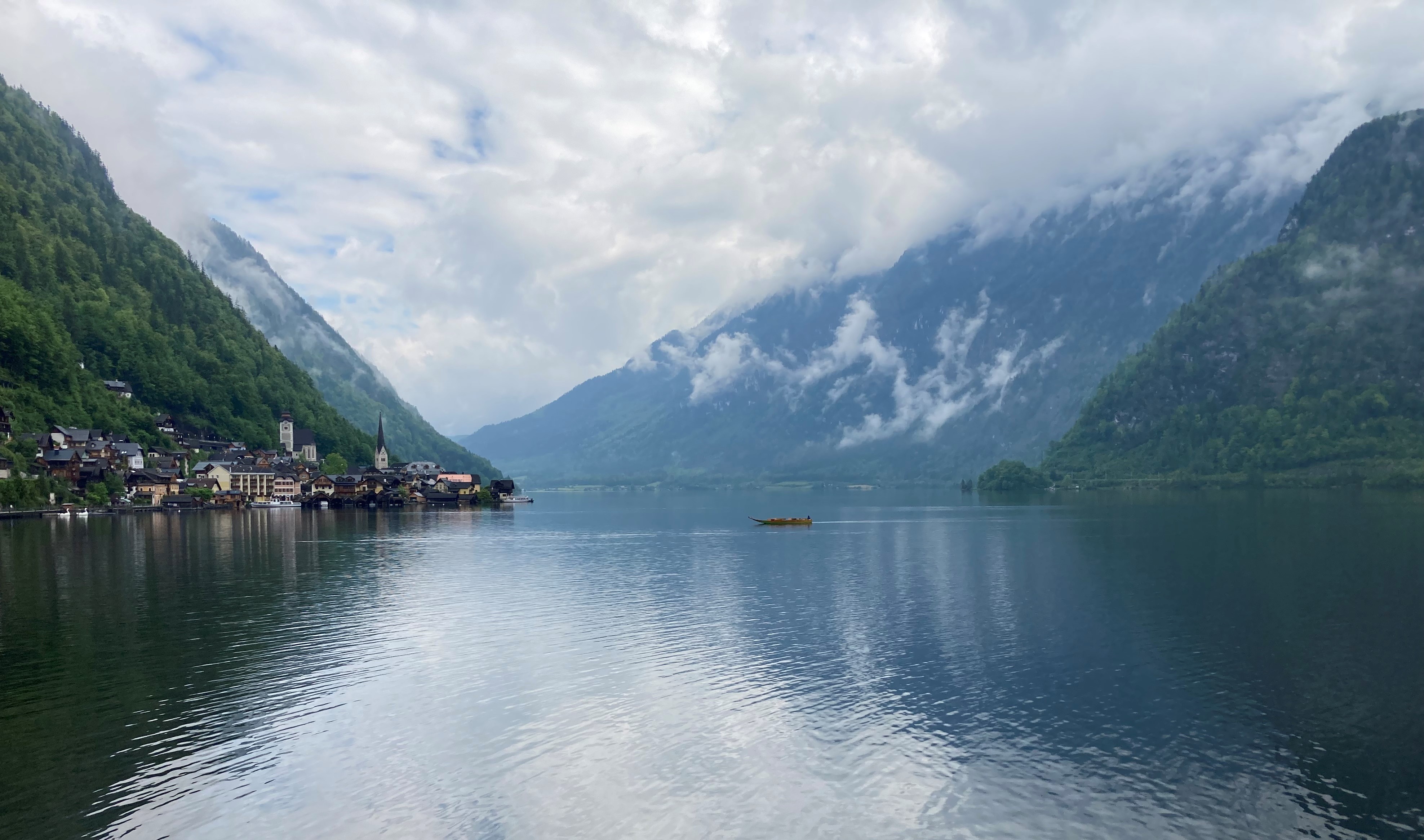
Late last year I began contemplating this trip. I decided I would limit it to Ireland, home of my protagonist, and Hallstatt, Austria, homeland of the proto-Celts, where she spends a considerable amount of time. For quick stops I can take trips by Google Map, but for long stays I want to soak a place in. I had visited the charming village of Hallstatt once before in 2006 when I traveled there with my Austrian friend Tilly. But I was researching a different book then, one that fell by the wayside. Now I wanted to see Hallstatt with the new book in mind.

I had forgotten how steep the mountains, how stark the limestone cliffs, how sparkling the lake. Yes, the quaint houses will ever climb that bluff, the iconic church steeple pierce the sky. But as I wandered the single street, climbed the many steps, found the waterfall I knew was there and included in my story, I enjoyed a sense of it I did not have before.

I didn’t rent a car so in Ireland I picked bases from where I could take tours or just go on my own by bus or train. I started with eight nights in Dublin. Then to Limerick for five nights. And a five-night return to the heart of my story, Rosscarbery, staying at the Rosalithir B&B with my wonderful hosts Catherine and Finbarr O’Sullivan. My third visit with them. The last visit in 2018 had been much too short and left me with critical questions on the setting. The new visit would answer questions I didn’t even know I had. A vital visit for understanding the lay of the land. And the water. The beach.
This was the rugged eastern headland I needed for one of my stories. Golden Eagle Bay in the world of my characters was broader than I thought on my brief stop in 2018. It took me several walks, especially over the newly improved Cliff Walk on the western headland to figure it out. From there I looked back and the setting became quite clear, the revisions I would have to make.

It was moments like this that I confirmed my need for this trip. Yes, it was time to travel again. Yes, I wanted to revisit these special places, but with that discovery and more I found answers to questions I hadn’t thought to ask.

In the next several blog posts I’ll share the journey–from Dublin to Salzburg, Austria, where I stayed a couple of nights on either side of my Hallstatt excursion because of its access to an airport. A lovely spot itself where I stayed in an amazing 17th century seminary converted into a hotel. The adjoining church even had a domed roof.

I’ll add the posts to the new “Going There” list on the sidebar as I publish each one.

Ta-Da!

First one out!

And so we reach the climax of the glacial saga of the enduring golden daffodils on their reluctance to face a chilly approach to spring. Yet they must. Hope reigns after all.

Below, these curious critters look on, perhaps wondering why in the world I would be down on my knees before a flower, not knowing they have become witnesses to a camera’s capture as well as minor characters in the story.

Now, confident in my flowers, I am ready to charge forward with that other saga, my new book. I’m reaching back to ancient Ireland again where a young woman, an Irish goldsmith, takes a perilous journey in search of a forbidden secret held by the Saltlanders, a people who would one day be called the Celts.

Thinking of Ireland

As drought dries the landscape of my Oregon home, turning the green to gold, I dream of the green fields of Ireland.

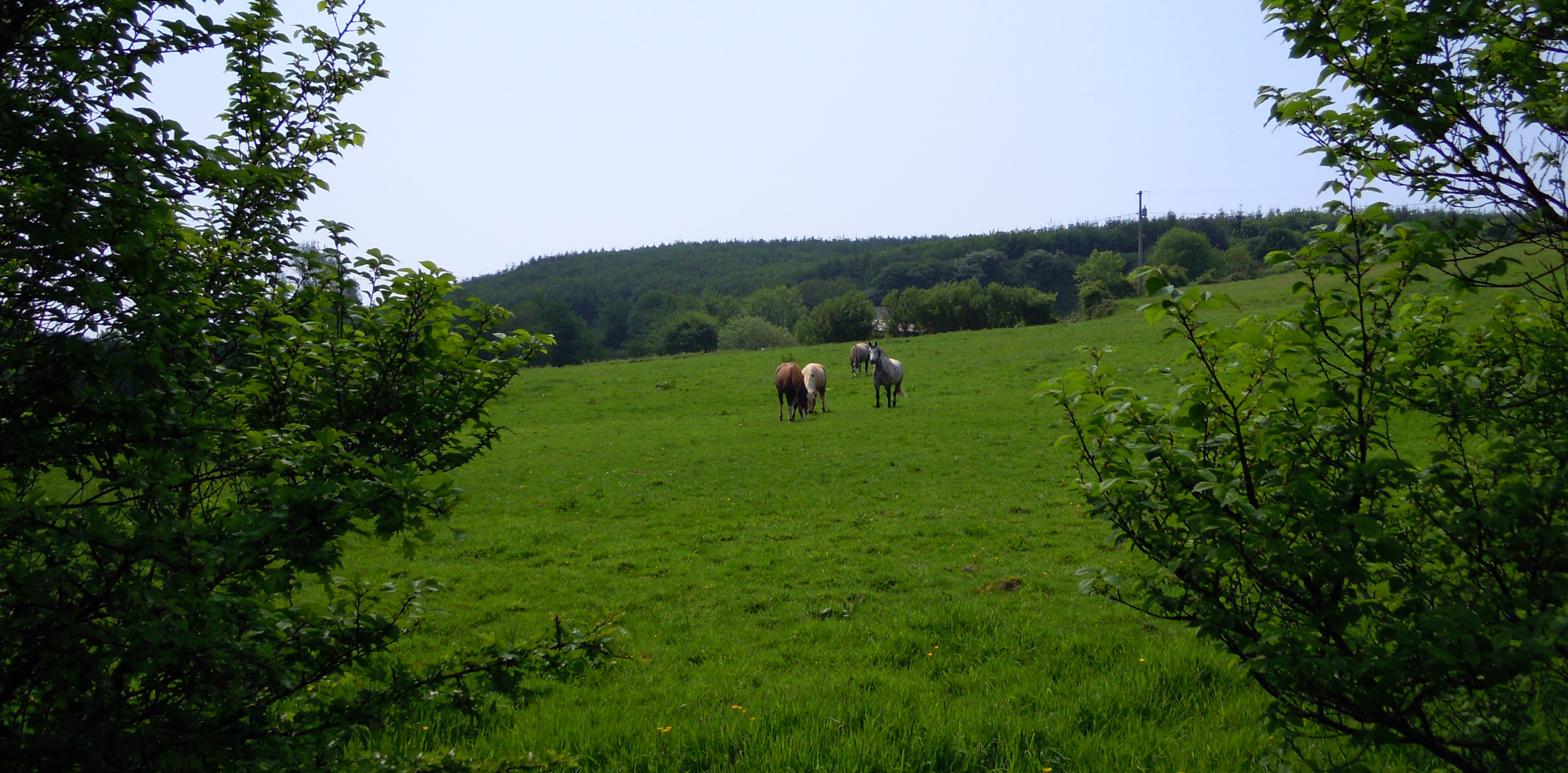
Horses in Ireland’s green fields

One day soon I hope to revisit the magic of Ireland. Meanwhile my books take me there.

My upcoming book series features two island settings–Ireland and Crete. For some time I have started this ancient historical saga in Crete, but I’m bringing Ireland forward now with Whisper of Wings as the opening book, where they call the place by its old name Éire.

Irish clan leader Bria knew only peace before the slave traders came, but she must now learn the grief of bearing weapons of war to save her People of the Stones. The Éireanns play a role in most of the other stories.

I first visited Ireland because of my Irish roots. My DNA shows at least a trickle of Irish blood. I know my maternal grandparents were both part Irish. That was enough for me to adopt the place.

By the next trip I had learned more about the stone circles scattered over Ireland and had drafted Whisper of Wings. One more trip helped answer new questions that came up as the series grew. I see another Irish book in the future, beyond the series–or loosely tied to it. The island shall always hold a special place in my heart. The green and the friendliness of its people and the magic of its ancient monuments refresh my soul.

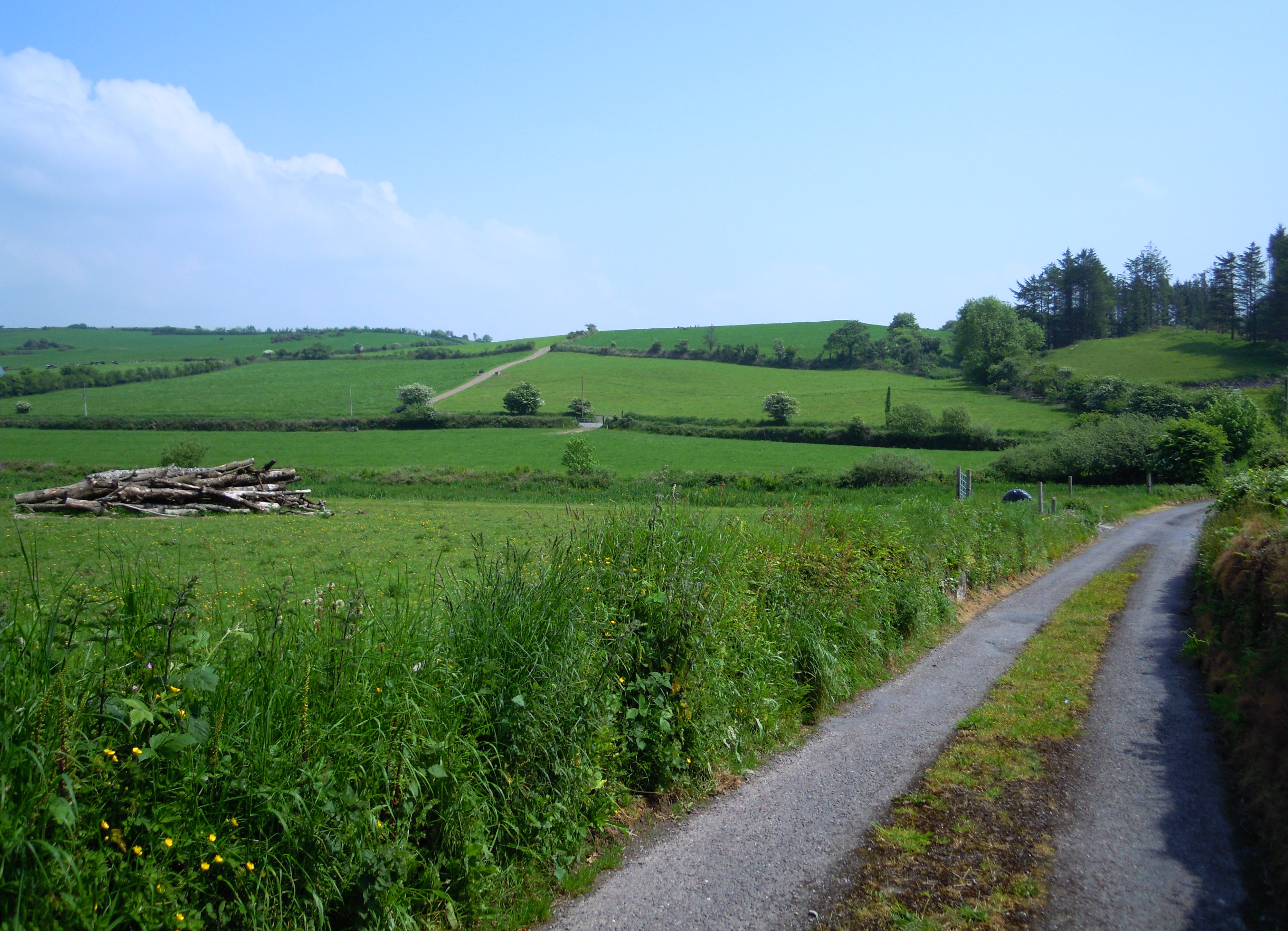
Irish back roads on the way to Bohonagh Stone Circle near Rosscarbery
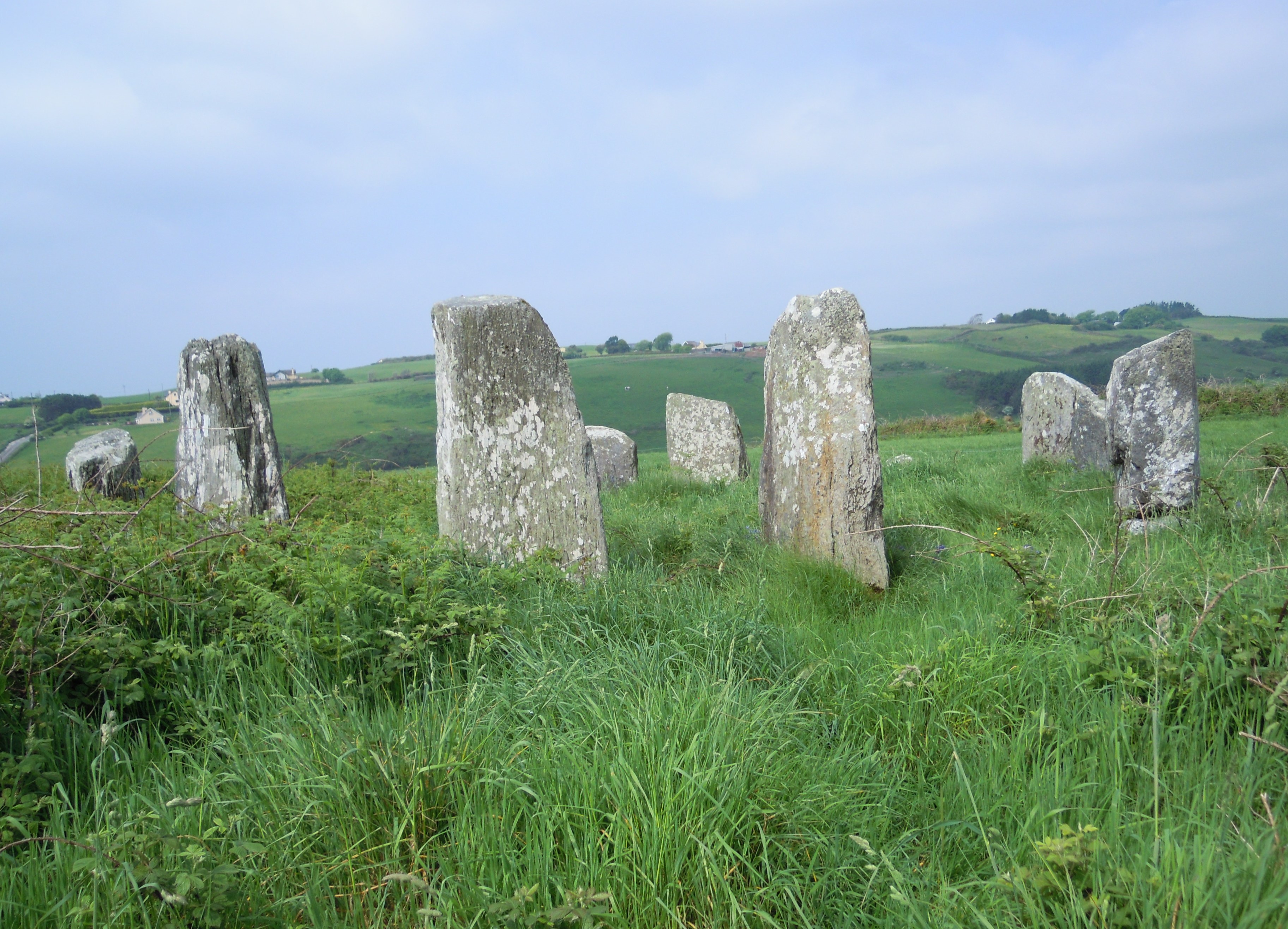
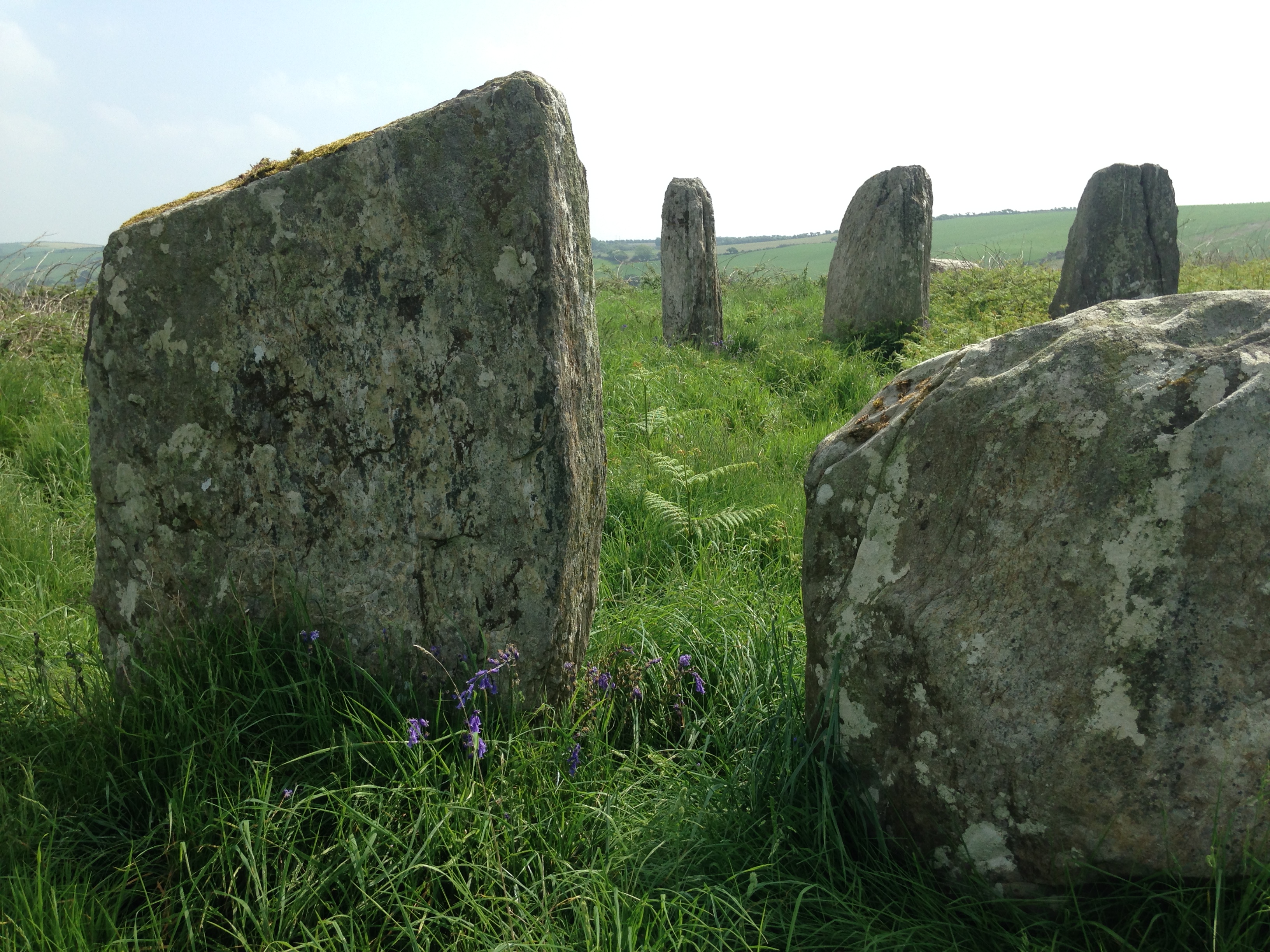
The magic of ancient stones and new spring bluebells at Bohonagh Stone Circle, Ireland

New Book Birthing

The story waits, ready to be written from a skeletal document inside the computer, a hard copy of that framework in the blue notebook shown below. The outline.

In my mind I see not the words but the people and places, like the wondrous temple of Knossos on the Greek island of Crete. And the green fields of Ireland that resemble my own green knolls on this soft May afternoon in Oregon.

The grand pillars of Knossos.

Green fields of Ireland.

The characters are almost as real to me as my neighbors—because I move inside them as I show their story. I laughed with delight when I heard travel guide Rick Steves comment about the ancient Romans. They “were just people, like you and me, without electricity.”

True, they had different customs, but they felt joy and sadness and love and fury just as we do. For me it has always been exciting to imagine what life was like in ancient times—or will be in the future. I love Star Trek too. But these ancient times in these two unique islands caught my heart.

To outline or not to outline?

Authors often hold strong views on that question. Non-outline writers may insist they’d be hemmed in by an outline. Outliners like me can’t imagine drawing all those threads together without one. I would never let the outline stop me from taking new directions. But I’m not just keeping threads together for one book.

This is a series that follows two great families through the generations—the high priestesses and kings of Crete, the clan mothers and chiefs of Éire. This new story begins about 100 years after the opening scenes of Book One in the series. I have to keep track of them all.

Besides consistency, each story requires new research. Scholars keep digging and adding more information. Sometimes I find details—either new or new to me—that affect other stories in the series. For instance when I first started writing about voyages from Crete to Ireland I assumed it would take many months to make the journey. But I found a website where you could enter names of modern ports, designate the speed of travel, and voila. They give you the overall trip time. I had to cut the time dramatically. Of course I had to determine from other sources how fast the ancient ships might go with their single square sails and ranks of oarsmen. I found estimates for similar Viking ships, other estimates for simple rowing, prevailing winds that would increase or decrease the speed.

In other instances when you’re writing a tight storyline where you want a lot to happen in a day you have to figure out what you can fit into that day and roughly what hour events can happen—even though I can’t express time in hours for people who lived by the sun, moon, and stars, not the clock. Another website tells exactly when dawn and dusk happen on any given day in any given setting. It’s not just how fast a ship can go, but a horse, a man, a woman. All these details take time to calculate. I don’t want to stop in the middle of a fast-moving scene to figure it out. So that goes into the outline. From that the rough draft can move swiftly.

Now this new one is ready for me to plunge in and live it as the words flow.

COMMENT

The Silence of Progress

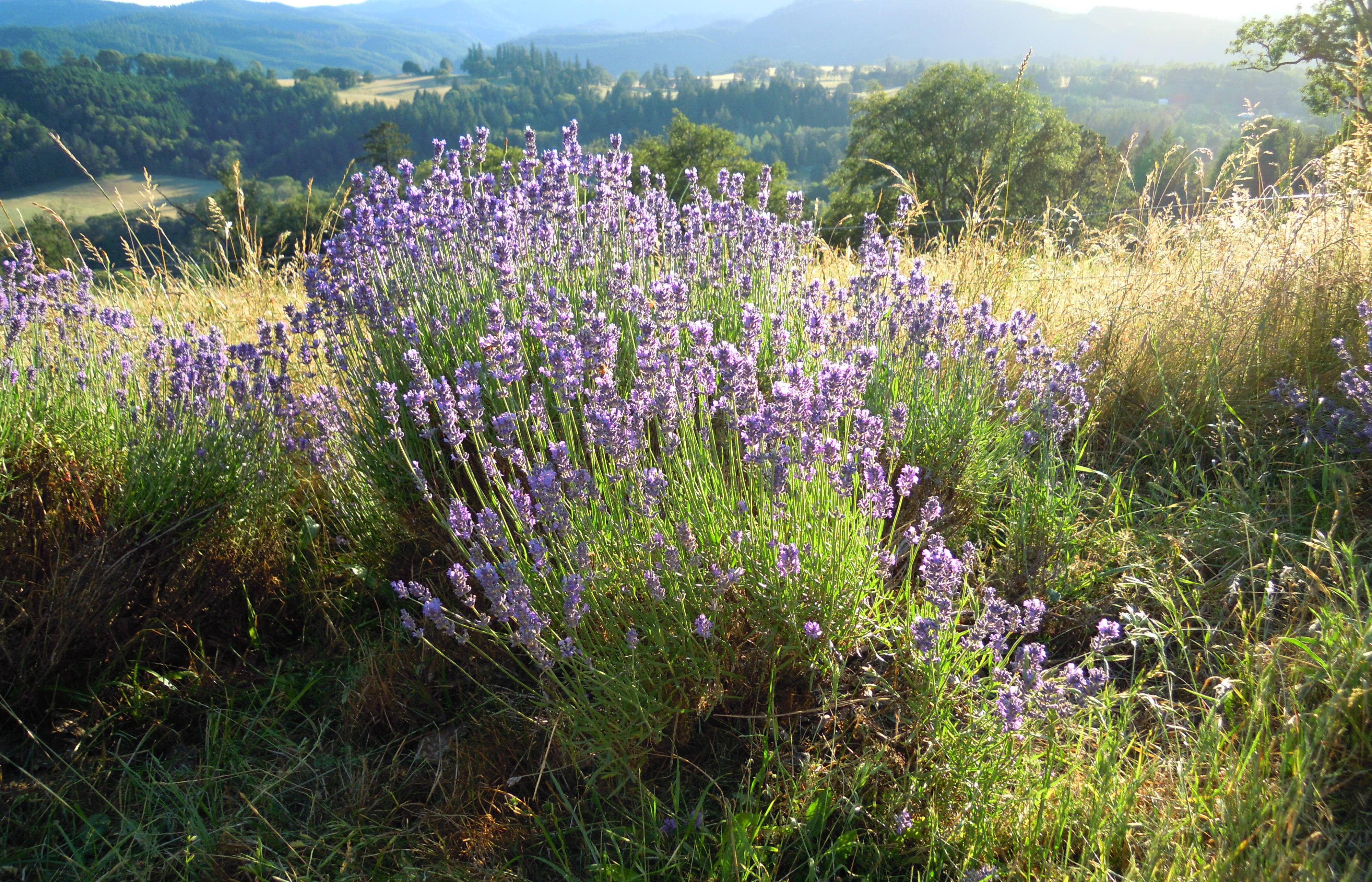
When we’re called to shelter the walls may feel tight. Yet I’m grateful to be able to shelter on our farm. Walks on the mountain have brought daily joy. Spring has come and gone. Summer’s here. The lavender’s in bloom.

I’m also grateful my work is here, and I can immerse myself in that. I’m working on the series, two trilogies, one centered in ancient Minoan Crete, the other in ancient Ireland. They’re complete now. But before my agent sent Book One to a new publishing house recently she suggested I review it.

Review it.

Two simple words. But it meant going through the whole thing. So in silence I entered that world once again–and found places to heighten the tension, smooth the flow. After she sent that off it occurred to me that if I found places to improve in Book One, maybe I’d better review Book Two–which led to reviewing Book Four, one I had recently revised dramatically. And once I read that I thought I’d better make sure the required changes in the opening of Book Five still worked. I got caught up in that story and didn’t really know where to stop, so I read it all. Book Six is a bit long and I think I should see if I could trim it a little–which will require a full read. But I got to thinking about Book Three, which I had skipped because it has always read so well, thanks to my muse who breathed so much of that story into my ear. What if I could make it just a bit better? I reviewed it. No big changes but worth the read.

Because I have been so deep into this, I haven’t been on social media much. It’s in the silence that I make progress.

COMMENT

Going There: Postscript

We flew out of Shannon airport on our homeward-bound journey. Lynn and I had bought our tickets separately so we weren’t seated together. For the Shannon-Philadelphia leg of the trip I took my seat by the window and a couple of young Irishmen sat beside me. They were on their way to San Francisco, a place where I had lived for eight years. So as the plane lifted off I left their world as they looked forward to visiting mine. They had both just turned 21. Their boisterous excitement was infectious and I laughed with them, caught in their delight.

Me with Irish Travelers Stephen Kelliher (center) and David Harnett (right)

My trip wasn’t quite over. Setbacks awaited me in Los Angeles when our Philadelphia-LA plane landed late in LAX, where we had a short connection. Seated in the very last row, I had trouble getting past the other passengers, and we had long lines and two slow buses across the tarmac to reach my gate. Lynn was well ahead of me.

By the time I found my gate, panting from my run, there were no passengers left, just an attendant standing alone at the gate. She asked me if I was Janet Fisher. Hopeful they were waiting for me, I answered yes in a gasping voice. She phoned the plane and shook her head at me. “They’ve already left. You’re too late.”  No! That couldn’t be. “My friend is already on the plane,” I told her. “I have to be on that plane.”

The phone rang. The pilot had agreed to open the door for me. The plane hadn’t actually pulled away. I broke into tears. The attendant led me to the plane’s door. Once inside, I stumbled down the aisle as passengers applauded with smiling faces. Lynn was beaming and gave me a big hug when I sat down, still crying softly. She had begged them to wait, certain I was coming.

Exhausted, I settled back in the seat for the last leg of our journey, slowly recovering from that arduous finale to a long and wonderful trip—37 days of exploring the world of my ancient series.

Port of Tiryns (Nafplio, Greece)

Outlaw Hideout (Buttermere, Lake District, England)

During those 37 days I became steeped in the past, as I sought the places that define these stories.

Alabaster Chair, Knossos (Crete)

Golden Eagle Circle (Bohonagh, near Rosscarbery, Ireland)

I had the good fortune of meeting several archeologists whose work takes them into the ancient times. And others who simply love their history.

Fábio and Sónia, Archeologists at Zambujal, Unexpected Guides (Portugal)

Mário, Archeologist, Guide on Megalithic Tour at Almendres Cromlech (Portugal)

I felt the raw edge of cultures different from my own and the universal embrace of friendly people.

Streets of Fira, Santorini (Greece)

Catherine and Me at Drombeg Circle (near Rosscarbery, Ireland), photo by Lynn

I immersed myself in the book settings and felt my characters walking along these places. As I walked with them I remembered their tears and joys. My own tears came, and my joy.

Headland at Fodhele Beach (Crete, Greece)

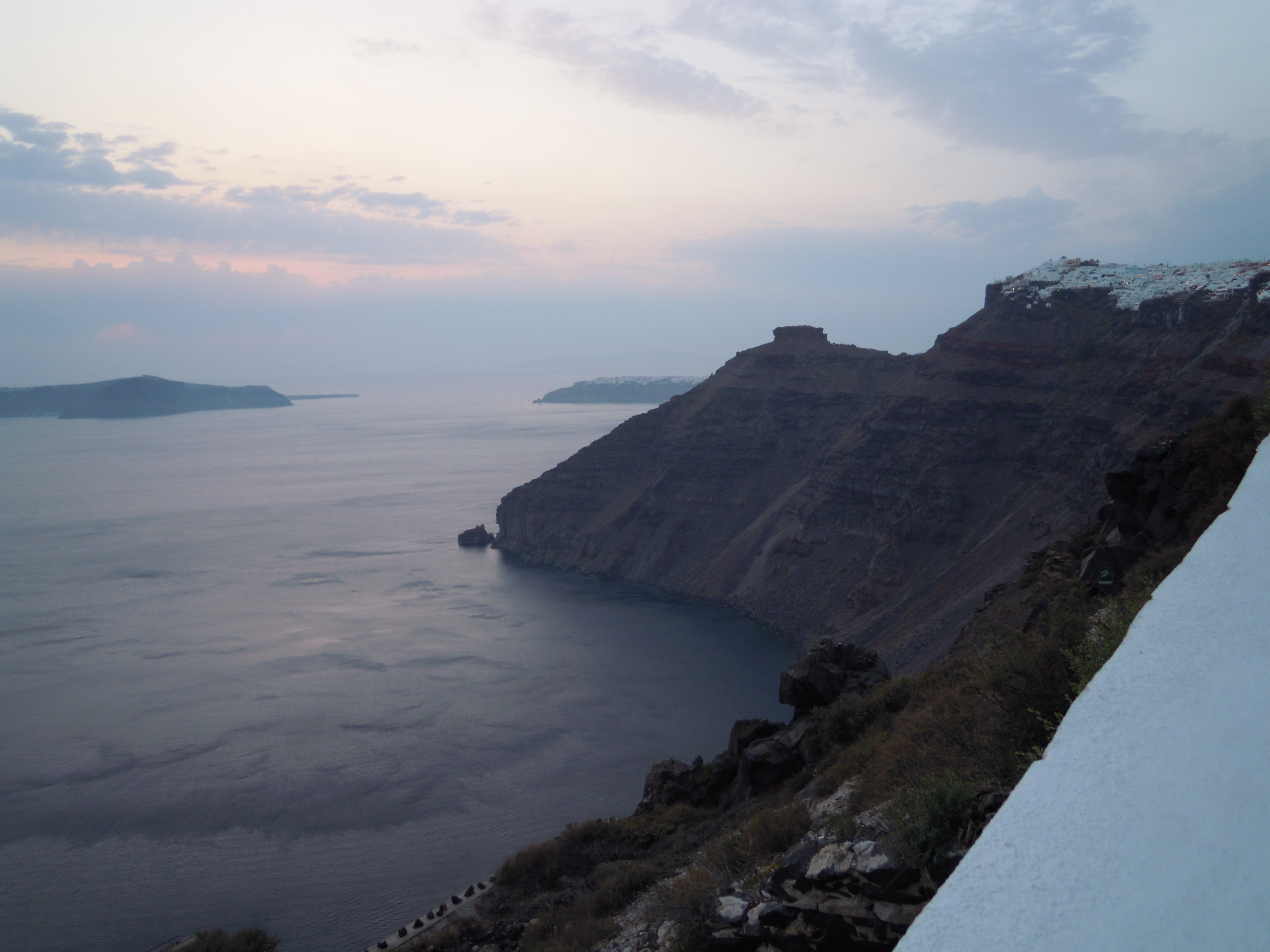
Santorini Evening (Greece)

The novels will be richer for the experience.

Going There #7: The Magic of Zambujal

What was the best part of my recent trip to Greece, Portugal, the UK, and Ireland?

Zambujal!

People have asked me the question, and that has to be my answer. Out of many remarkable experiences this one stands out for the majesty of the site–and for the unexpected thrill.

Ancient Towers of Zambujal

Imagine these towers whole. Step back 3,000 or 4,000, maybe even 5,000 years and imagine the watchful warriors of western Iberia holding power over a vast region from this lofty citadel overlooking the rolling hills and the sea north of today’s Lisbon, Portugal. Iberian characters in my series ruled here about 3,400 years ago.

Even the name sounds exotic, magical, pronounced zam´-boo-zhol.

I learned about this mysterious citadel when I was well into writing my fifth book in the series. Some of my main characters live on the south shore of Ireland, where warriors from Iberia have been stealing their children for slaves. I set up my fictional scenario in the beginning with only two tribes of Iberia being advanced enough to have seagoing ships that could reach Ireland, one on Iberia’s west coast (now in Portugal), one on the east (now in Spain). Imagine my surprise when I kept digging for information and learned that scholars believe there actually were only two city-states in the Iberian peninsula that enjoyed advanced civilizations during the period of my stories, one on the west coast, one east. When I read that I sat back in my chair. I had just made that up and it turned out to be true. Hm-m… Okay then.

The western culture was centered at Castro do Zambujal, the formidable citadel shown here. It had become a major setting for my books, and I needed to see this place. After leaving Greece this was the first research stop on my itinerary in Portugal.

Stones of Zambujal Ruin on Grassy Hill

I booked a room at Torres Vedras, the modern city nearest to Zambujal. Unable to find information beforehand on how to visit the site, which lay in the countryside a few miles from town, I inquired at the hotel desk soon after my arrival. The young woman at the desk said I would probably have to take a taxi out there, but she could arrange that with a young driver who spoke excellent English. She didn’t know of any tours but suggested I ask at the museum across the square.

At the museum I asked the woman at the entrance if they had any tours to Zambujal. “Oh, no!” she said. “You can’t go to Zambujal now. The archeologists are working there. You’ll have to come back in September.”

I bent toward her, insistent. “That’s not going to work. I came here all the way from the US. I can’t come back in September. I need to see it now.”

I told her about my books and that I needed to see and feel this place and its setting so I could describe it. A man stepped up and I repeated my situation to him. We began talking about the importance of the site. Somewhere in there he stepped away and returned to tell me he had phoned Sónia Cravo, the head of the archeological project there.

He said I could take a taxi out to the edge of the site, take my pictures, and leave. Sónia might be willing to see me for a moment. She might not. I agreed. At least I would see the setting.

The man, perhaps sensing my disappointment, led me into the museum to show me a model of the site and pictures and many artifacts found there–pottery, tools, weapons, gold, and more. They did have a fine exhibit on Zambujal, and he was obviously quite proud of it. He introduced himself as Carlos, and we talked about the history, sharing our enthusiasm for that.

Model of Zambujal at Museum

Back at the hotel I learned that the young taxi driver who spoke English was not available. An older man would drive me out to Zambujal. He didn’t speak English but the woman at the hotel would explain everything to him before we left. We agreed on a price for him to take me there, wait a few minutes while I took pictures, then return.

Wind whipped the car, carrying droplets of mist, as he drove over the green slopes and up the steep incline to the lofty site where archeologists in bright vests scrambled over the ancient stonework.

Archeologists at Zambujal

We parked nearby and a fellow strode toward us. I got out to explain that Carlos from the museum had said I could come take a few pictures. “Could I talk to Sónia?” I asked.

He left, and soon an attractive woman in a bright vest stepped across a rocky path toward me, dark hair blowing in the steady wind. She greeted me and I told her I was researching for my books with settings at Zambujal. A young man in a vest approached and she smiled. “Fábio speaks good English. He will go with us so he can explain.” She had been concerned about her own English. That was her hesitation in seeing me.

Fábio’s face lit up when he welcomed me, introducing himself as Fábio Rocha. “Fábio means wall and Rocha means rock,” he said, “wall from the rocks. What could I be but an archeologist?”

We all laughed. They began showing me the perimeter of the site where low rocks marked the line of the outer walls, and we took pictures of each other.

Fábio and Sónia, Archeologists at Zambujal, My Unexpected Guides
Me by a Zambujal Tower, Photo by Fábio

The wind never stopped, although thankfully the drizzle did.

As they led me through the site, pointing out the bases of the round towers and other features, they talked about their work there and I described my stories and how I hoped to use this setting, wondering if my ideas fit into the reality of their findings. They occasionally spoke together in Portuguese, and he relayed what she was saying. I showed them a photo I had just taken of the model at the museum, and they told me how the current walls fit into that whole.

They wished they could show me the inside, which they said was the most interesting, but that seemed to be off limits. Then Sónia rushed away. Fábio said she was going to see if the local authority would allow them to take me inside. Sónia hurried back, face aglow. They could take me in. We were all excited.

By that time they had been with me for almost half an hour. I glanced occasionally at my taxi driver who was strolling back and forth by his car, but I couldn’t give this up now.

South Gate into Zambujal

They led me through the main South Gate into the interior of Zambujal. I felt like an honored guest. The gate gave me a sense of the restrictive nature of the place with its thick high walls and narrow passageway. I imagined my antagonist strutting into his domain, and my protagonist running down a narrow corridor, buffeted between her desires and fears.

Once inside, Fábio offered me a hand. “These rocks aren’t steady,” he said. Not only had I stepped into the inner workings of the archeological project, some of the surfaces were a bit challenging. We climbed to the top of a wall–wide by the standards of most walls, but narrow when you start walking across and look down on both sides. I readily grabbed a helpful hand.

Inner Walls, Zambujal

We came out on top of walls overlooking the inner sanctum where the ancient Iberians had created loopholes for archers to shoot through, still plainly visible. This would have been the citadel’s last defense, where the elites could hole up if attackers ever managed to storm the outer walls. More walls were added over the years in several phases. It was amazing to see this enclosure still so complete after thousands of years.

By the time we left the interior Sónia and Fábio had been with me almost an hour. I thanked them profusely for the time they were giving me. Fábio said, “Why do we do this work if we don’t share it with the people? This is why we do it.” I so appreciated that sentiment, and their generosity.

Sónia Overlooks Walls of Zambujal

We exchanged contact information and they invited me to write and ask if I have any questions. When I did write to thank them they wrote me back and repeated that kind offer. I was thrilled. I gained so much in that time with them, between the feel of the place and the discussion of where my story fit in. But their warmth surrounded me as well. I felt a little sorry my Iberians were the bad guys, although Sónia and Fábio laughed about that, and I assured them there would be good people there too.

The last picture on the site shows Sónia looking across the walls to the hilly countryside below–and my taxi waiting. Fábio said you could see the ocean from there on a clear day. At the time of my story the sea filled one of the valleys and formed a narrow bay that came close to Zambujal, where it might have offered shelter for ships.

I apologized to the taxi driver for my long stay and promised I would pay more than we agreed. The numbers had ticked up on his meter. Although he didn’t speak English, he understood.

Back in Torres Vedras we settled on a price that made us both happy. It had been worth every euro.

I also went back to the museum to thank Carlos for his help, and he was delighted to hear about my wonderful tour.

Zambujal shall always remain for me a magic place.

Carlos Anunciação at Torres Vedras Museum

NEXT: Falling Back in Time

Going There: The Backstory

Before I launch into Day One about my recent research trip through Greece and Portugal, the UK and Ireland, it occurs to me that it might help clarify my reasons for this journey and my reasons for writing the ancient historical series if I backtrack to the beginning. My focus on the Greek Isle of Crete started in 1994 when I set out to research a mystery novel on that exotic Mediterranean island. I had been writing books and pursuing publication for about 14 years, without success. I had moved from Roseburg, Oregon, to San Francisco in late 1989, ending a long-term marriage, and I was seeking answers for my life.

During this time I read a New York Times bestselling book by Riane Eisler called The Chalice and the Blade, where she describes nothing less than the overturning of the world’s cultural norms from woman-centered civilizations to a patriarchal world ruled by contentious warriors. I was fascinated. One chapter stood out for me, where she describes Crete as the “essential difference.” Because of its isolation in the Mediterranean Sea, this island remained one of the last holdouts of those woman-centered cultures. Its primary city of Knossos offered stunning revelations about these Bronze Age people when archeologists began uncovering the fabulous ruins some 100 years ago. Eisler describes Crete as the most advanced technological culture ever found where women were not dominated by men. I wanted to see this place.

Room in the Palace/Temple of Knossos

When I visited Knossos and stepped into the partially reconstructed ruins of its central structure, the place seemed to wrap itself around me like a mother’s loving arms. I no longer wanted to write my mystery novel. I wanted to immerse myself in this world and come to know the mystery of the ancients who once thrived there.

Prince of the Lilies Fresco, Knossos

The British archeologist Sir Arthur Evans who uncovered Knossos in the early 1900s was struck by what he found–grand staircases and pillar-lined corridors, technological wonders like flush toilets and an elaborate drainage system, frescoes revealing a free and sensuous lifestyle with women standing proud at the center. He believed he’d found a matriarchy but as a man of his times he thought they needed a king to run it. He saw this as the Palace of King Minos mentioned by Homer and Hesiod. But later scholars suggest it may have been a temple, an idea I adopted for my books, and I drew from one of Eisler’s thoughts on King Minos, depicting him as a Mycenaean warrior with designs on Crete–and a couple of Cretan women.

Part of Knossian Procession Fresco

While in Crete I met a man who helped me understand the attraction, the delight, the frustration that can happen when cultures clash. The experience found its way into my story which opens on this peaceful isle on the day the warriors come.

The frescoes shown here are reproductions of originals that are housed in the excellent Archaeological Museum in nearby Heraklion, Crete, the island’s primary modern city. The bull-leaping fresco appears in the opening scene of my book now called Beyond the Waning Moon. And readers will experience a bull-leaping event in the second scene when the protagonist faces a fierce bull in the court.

Bull-Leaping Fresco, Knossos

I wrote the book and continued editing and revising for several years as I sought its publication. Riane Eisler kindly critiqued the opening and when I addressed her concerns she called the result powerful, responding “Brava!” The novel eventually became a finalist in the Pacific Northwest Writers Association Literary Contest. The next year I found a way to tie the people of Crete to their counterparts in the distant isle of Ireland, another place that had touched me deeply and where I have personal roots.

My search for life’s answers led me to mythologist Joseph Campbell and especially his four-volume work, The Masks of God. My focus riveted on his discussion of Ireland and how he could see behind the Irish myths to a culture of Mother Right, essentially a matriarchy that would have preceded the later patriarchy. As Eisler points out in Chalice and the Blade, this isn’t the flip side of patriarchy where women rule over men but more of an egalitarian society accepting the full worth of both genders. Neither writer suggests any kind of utopia but at least a much more equal situation than we came to know.

I first visited Ireland in 1993 because of my Irish roots and had set one of those mystery novels there. But I wanted to tap into the ancient times that paralleled my Cretan story and find the lost culture of Mother Right, which Campbell talked about.

Rocky Headlands on Irish Coast

The Cretans of the first book in my ancient saga decide to send out a fleet in search of a place the warriors haven’t come. These early Cretans were known as great mariners, their frescoes and other art showing them sailing around the Mediterranean. I figured if they could sail around the eastern Mediterranean they could surely venture to the west and even out through the gate to the Atlantic, as long as they kept the shores in sight. But for a little excitement they get caught in a horrific storm and one ship crashes on the rugged rocks on Ireland’s south coast. Voila! A sequel–albeit loosely tied.

I completed the sequel in 2004 and went back to Ireland in the spring of that year, focused now on stone circles and this rugged south coast near Rosscarbery in County Cork.

Bohonagh Stone Circle Portal, Ireland

I again entered the PNWA literary contest, and this Irish one was a finalist too, just one year after the Cretan book. I thought I was surely on the road to publication then, but could not find an agent for these stories of strong women facing formidable challenges of their time. I began to get discouraged.

My father died in 2007 and I decided to keep the farm founded by my great-great-grandmother Martha in 1868. I left the ancient stories on the shelf and pursued a story about Martha, discovering I had a strong woman in my family who’d faced challenges of her own time. Finally I found an agent, Rita Rosenkranz, who helped me meet my goal of publication with Martha’s story.

But I hadn’t forgotten the ancients. I had a flash of inspiration about the Cretan story and decided to make substantial changes. When I finished those I realized I definitely needed another sequel that would be closely tied. I wanted to launch into it but I had another story set in the same pioneer period as Martha’s story. My agent and I agreed I should take advantage of the publisher’s interest and bring that pioneer story out first.

By the spring of 2014, with the two pioneer stories in the pipeline, I finally had time to draft the closely tied sequel to the Cretan book. By Christmas I was ready to write one more book to continue the ancient line, but it just wasn’t happening until my muse started whispering to me. I told about that experience on a blog post here so won’t repeat it. This fourth book was drafted by the spring of 2015. I had planned to write a fifth that would bring Crete and Ireland back together but realized I had a 16-year gap in the Irish years. Why not fill the gap with another story?

South Gate to Castro do Zambujal, Portugal

Because of all the questions I had left at the end of the first Irish book, I wanted to portray the events of those 16 years. I would take readers to the homeland of the Iberians who’d been capturing slaves off the coast of Ireland. I would show my bad guy in his personal haunts.

But the Iberians couldn’t all be brutes, could they? I learned about their amazing citadel of Zambujal north of today’s Lisbon. They must have enjoyed a sophisticated culture I needed to know more about.

And I would take readers to the Great Isle of Britain where my protagonist runs into some intriguing outlaws in the Lake District of northern England.

I finished the rough draft of the gap story in 2016. Then in 2017 I drafted the sixth book, which took me back to Iberia.

Part of Almendres Cromlech in Cork Forest, Portugal

I had never been to the Iberian peninsula, where there’s a stone circle (or oval) more ancient than the circles of Ireland. I needed to see that, as well as Zambujal. And I had never been to the Lake District in England.

Also, the new books ventured into places in Greece and Ireland I hadn’t visited before. Thus the need for another trip. Once you’ve crossed the pond, that’s the biggest single expense. I decided I might as well put it all together.

So, that’s how the project started and why the extended trip. Next up, I invite you to come with me on my solo journey in Greece and Portugal and my continued trek with writer friend Lynn Ash through the British Isles. I’ll start the next post with Day One in Heraklion, Crete, and the nearby site of Knossos I have come to love.

Bluebells on Mountain in Lake District, England