The TRUE Shifting Winds ~ 6: Making the Past Live

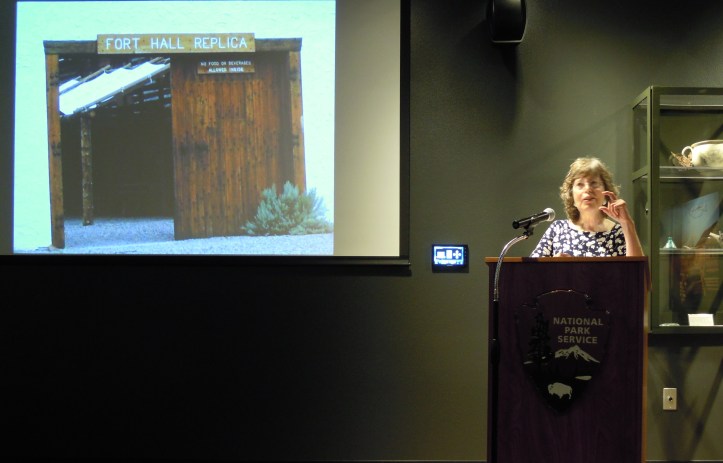
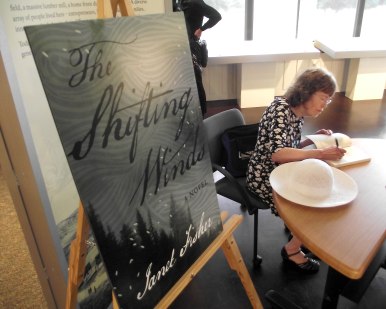
My presentation in the Visitor Center at Fort Vancouver is just two days away, Saturday, July 16, and with this post I will close out the “TRUE Shifting Winds” series. The event starts at 2 pm, when I’ll give a talk while showing photos related to my book and the fort. I’ll do a couple of short readings from the book, selected from scenes at the fort, and after some Q&A, sign books.

The Visitor Center bookstore will have copies of The Shifting Winds for sale, and also my first book, A Place of Her Own, the story of my own great-great grandmother who came west over the Oregon Trail.

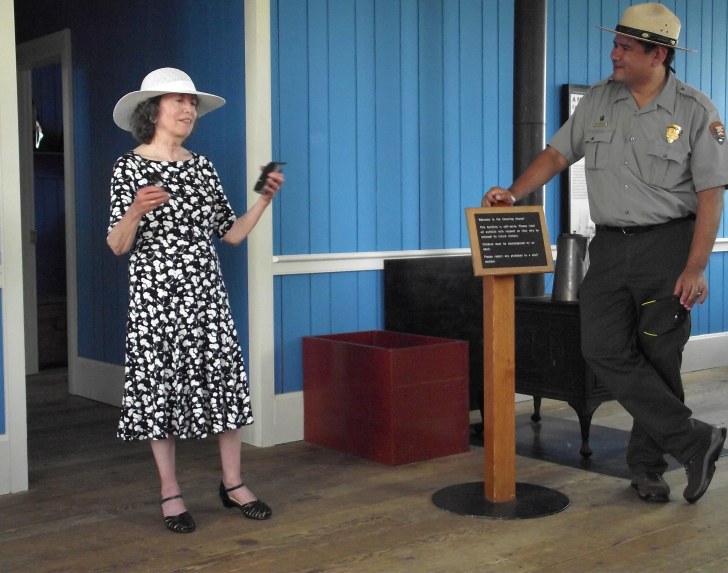
Following the signing I’ll invite attendees to go down to the fort where I’ll lead a tour of places that appear in The Shifting Winds, accompanied by Mary Rose, Executive Director of the Friends of Fort Vancouver. There’s a small fee to get into this National Park Service site, or if you have your own pass, that will work too. If you’re in the vicinity I hope you’ll join us for this walk into the past.

A Reconstructed Fort

Making the past live. Isn’t that what historical novelists do? Make the past live? We try. So we have something in common with those who worked so hard to bring structures and their contents back to life at Fort Vancouver. Even staff members put on the garb and help draw visitors back to an earlier time. And the rangers tell the old stories, like bards.

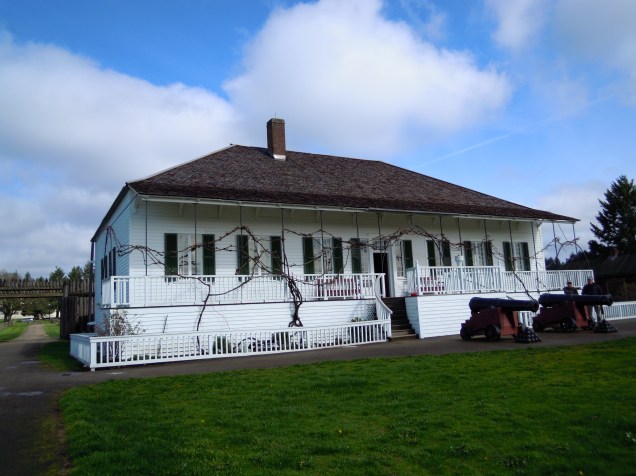
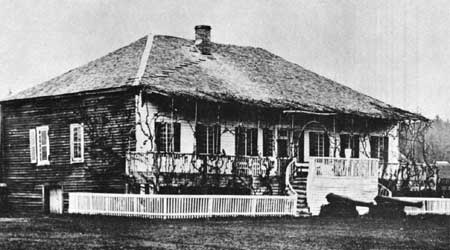
Fort Vancouver Big House (2)

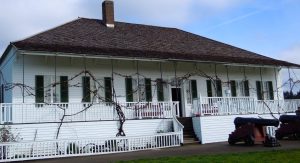
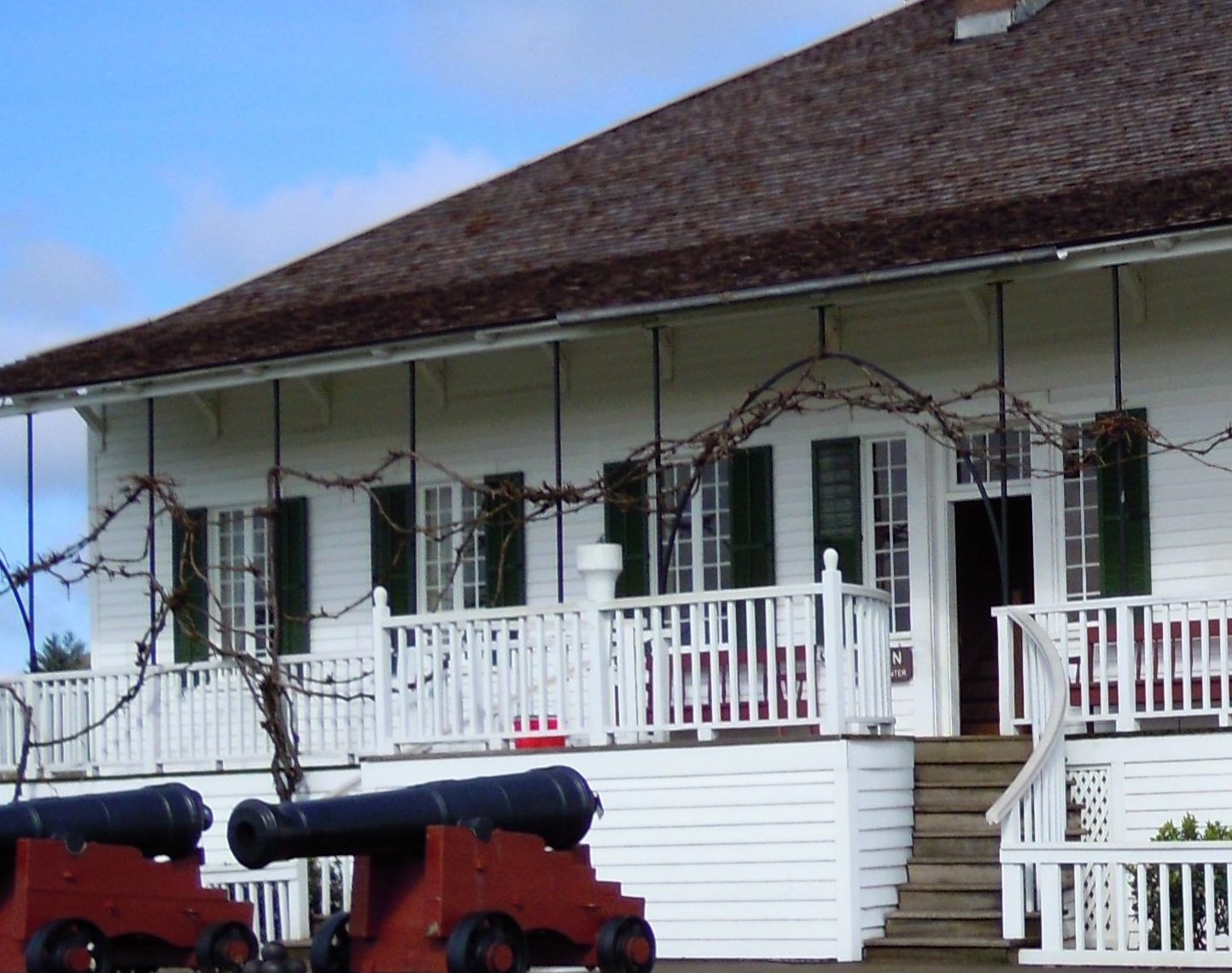
We historical novelists tell the old stories through the eyes of our fictional and sometimes historic characters. For my part I’ll refer you to my book, The Shifting Winds, with its scenes in the Big House shown above, the Old Office, and the Bachelor’s Quarters, as well as the fort grounds and the dark orchard behind the stockade on a cold night.

Here in my post I offer photos taken on my recent visit to the fort—for illustration—with a little text and tidbits of history to enliven them.

The Big House

The preservation team didn’t have blueprints for the house. They knew what the outside looked like from pictures, but for the inside their only clues were snippets of descriptions and comparisons with managers’ houses at other HBC forts, plus the remains found by archeologists–footings, the base of the chimney, evidence of a cellar.

The cellar probably held the oft mentioned wine and spirits served in the Mess Hall.

Ft.Vanc.Dining long

Gentlemen of the fort ate in the dining room in the Big House, generally called the Mess Hall, making this the center of business as well as social life. Everyone welcomed the arrival of visitors who brought news from other places, breaking the monotony of this isolated post. Many guests–distinguished and not–enjoyed the fine fare, even including soft loaf bread from the fort bakery, along with vegetables from the gardens, game from the hills, fish from the river, and eventually beef when herds grew large enough.

The well-stocked kitchen stood behind the house, connected by a passageway but separate for fire safety. Gentlemen maintained careful military etiquette as to rank, although Chief Factor McLoughlin could use his discretion to make allowances for some, especially Americans, whose rank might be obscure.

The officers of the fort offered the finest hospitality to keep visitors there as long as possible, although some of the gentlemen in the Bachelor’s Quarters, or even the office, might have to give up their rooms to house the guests.

613.Ft.Vanc.McLoughlin Sitting Room

The McLoughlin sitting room, shown above, would be the place where Mrs. McLoughlin took her meals, sometimes with family and friends. Female guests with some status stayed in the Big House, like protagonist Jennie in my story, and she would have eaten her meals here with Mrs. McLoughlin. Only if the doctor missed mealtime in the Mess Hall might he join them. Update: The reconstructed house also has a small dining room for the women on the east side, which would have provided another option for them, but they would not eat in the Mess Hall with the men. That was strictly a male sanctuary.

Most of the women, like Marguerite McLoughlin were at least half Native American. Her mother was Cree. The women wore European dress, but with moccasins and deerskin leggings for riding gentleman fashion, that is, astride.

People who saw the McLoughlin’s together often commented on the fondness they showed for each other, although some had trouble accepting fur trade marriages. One man made such a fuss, McLoughlin struck him with his gold-headed cane, later apologizing for his outburst. Soon afterward McLoughlin insisted on a civil marriage, and when he later returned to his Catholic faith, the couple was married again in a Catholic ceremony–by then thoroughly wed.

Johnson in his book John McLoughlin comments: “The deference that Mr. McLoughlin showed to his wife in public was the envy of all American wives, who lost no time in citing him to their husbands as an example worthy of emulation.”

McLoughlin’s second-in-command, James Douglas, lived in the other half of the Big House for a time. The rich red of this room is based on a later detailed study conducted to determine the actual colors of rooms at the fort.

Researchers perused books on the subject, visited other forts and inspected bits of painted wood and brick dug up by archeologists on the individual building sites.

In their 2003 report they explain that this red was found on the east side of the building.

Historians believe the east half was the side where the Douglas family lived, so the Douglas sitting room was painted red, a color gaining new popularity at the time.

Beige painted scraps were found on the opposite side, leading to the painting of the McLoughlin sitting room beige, a more conservative color, perhaps reflecting the doctor’s preference. The most common color found was green toward the back of the house, and that was interpreted as an appropriate color for the Mess Hall, the largest room on the main floor. Chair rails were common with the top sometimes painted the same as the bottom, sometimes not. Ceilings were usually white.

Ft.Vanc.McL Bedroom

Bedrooms tended to be in soft, pale colors.

Ft.Vanc.McL Office

Dr. McLoughlin’s personal office, shown above, could be accessed from the McLoughlin sitting room, continuing the same rug design and wall color. His office can also be accessed from the main entryway of the house, on your left as you step in the door. A steep staircase rises directly ahead of the front door.

Some question arose as to the location of the ballroom cited in a number of writings of the time. One remarked: “had a ball in evening upstairs.” Could that have been the Mess Hall, up the long curving outdoor staircase to the veranda? Or would it be upstairs in the ample space between the main floor and the structure’s high roof? The Mess Hall could be the location of parties. Or perhaps a large hall in the long Bachelor’s Quarters.

Hussey in his report seems to lean toward the second story, despite the apparent lack of windows, and I happily adopted the site for the Christmas Ball. Unfortunately that room isn’t open to the public. Still, I had no trouble imagining it. Who needs much description of a vast room when you have candlelight and violin music and swirling dancers in grand ball gowns and dress coats and sparkling eyes?

The Bachelor’s Quarters

This long structure hasn’t been reconstructed yet, so I’ll let my character Jake give you a word picture for that from the pages of The Shifting Winds:

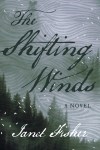
ShiftingWinds cover jpeg

Jake glanced around the stark little room a Company officer had been compelled to give up for him. Company gentlemen might dress well, but they didn’t live so well. A small bed, a simple chest of drawers, a tiny table with a box for a chair, one trunk. That was it for furnishings. A few mementos hung on the walls—tomahawks, feathers, carvings, a couple of paintings.

Like most of the fort buildings, the Bachelor’s Quarters were constructed in the Canadian post-on-sill fashion with sills of heavy, square-sawn timbers lying horizontally between upright grooved posts. Not a bit of paint on the unlined walls. But they did have glass windows.

He peered through the glass at the Big House where they were holding tonight’s party.

The Office

As noted in my last post, only the New Office has been reconstructed, although the Old Office may yet be built because it still stood on the fort grounds in 1845, even after they completed the new. The clerks couldn’t move into the new one because the captain of a visiting ship had taken up residence there.

Fort Vancouver New Office seen from Big House

The New Office can be seen now from the veranda of the Big House, but another building would have partially blocked the view.

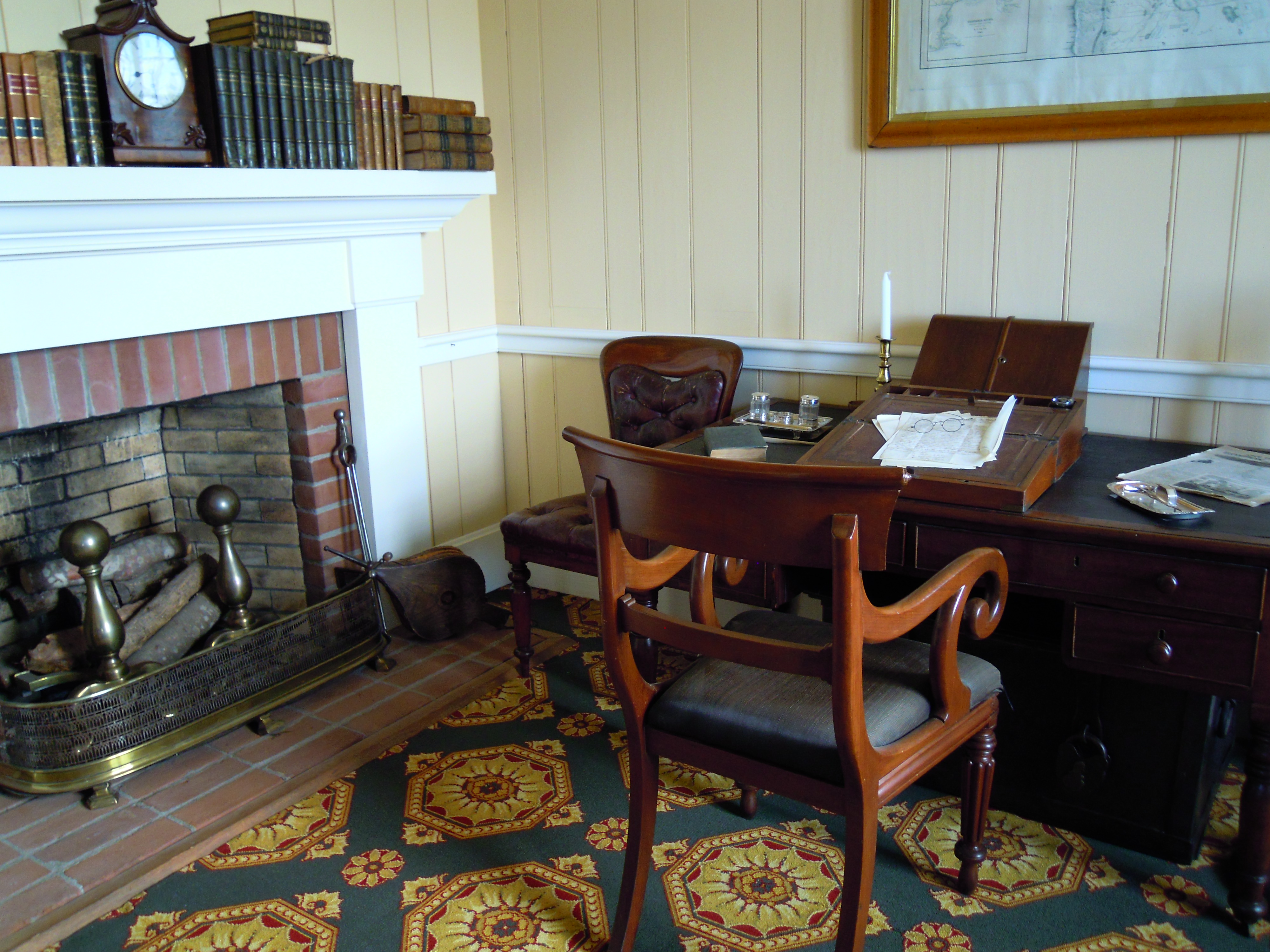
The office was the domain of my character, the handsome clerk Alan Radford. I have a scene there when he invites protagonist Jennie to see where he works, offering her a glimpse of his life. He might have worked at a desk like the one, below, part of the furnishings in the reconstructed New Office. Another brief word picture from The Shifting Winds:

“So,” Alan said with a sweeping gesture to embrace the room, “my quarters, my place of work, and the hub of business at Fort Vancouver. What do you think?”

Caught up in his enthusiasm, she laughed. “It looks very . . . businesslike.”

Stark, but neat and orderly, the room had only two tall desks surrounded with several tall stools, the desks piled with books and ledgers and paper tidily stacked, ink bottles and rulers and pens beside them. . . .

Alan took her arm and led her to one of the desks. Laying a hand on the desktop, he gave her a warm smile. “My desk. I spend a lot of time here.”

He lifted a large black book and handed it to her. “Journals. We have to keep daily journals of everything that happens around here—what the men are doing, what the weather is like, who comes and goes.” He raised his brows, eyes alight. “You yourself will be in here, my dear. . . . You know, we almost have to see into the future here when we make our indents.”

“What are indents?”

“Our requests for supplies. The whole process takes so long that—well . . . here it is the end of 1842, and the lists we make now are for the year 1846.”

“Really? Why?”

His eyes smiled, and he swept one arm wide, his voice suddenly charged with drama. “It pleases me you want hear of my travails, m’lady.”

She laughed at his pretense and went along with it. “Kind sir, I want to know everything about you.”

“Ooh. That’s rich. Are you quite sure, m’lady, that you want to know it all?”

More Glimpses of the Past

Ft.Vanc.From Veranda

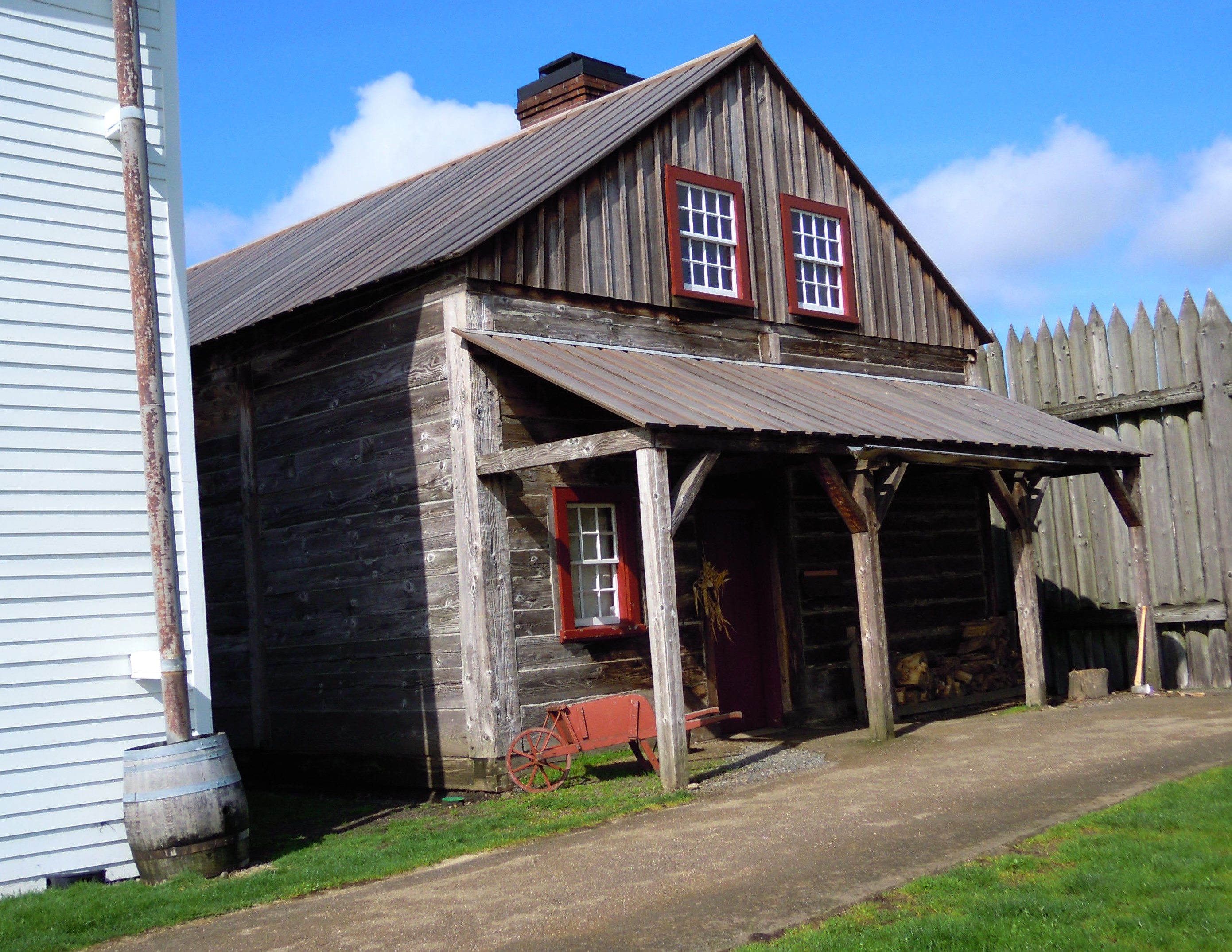
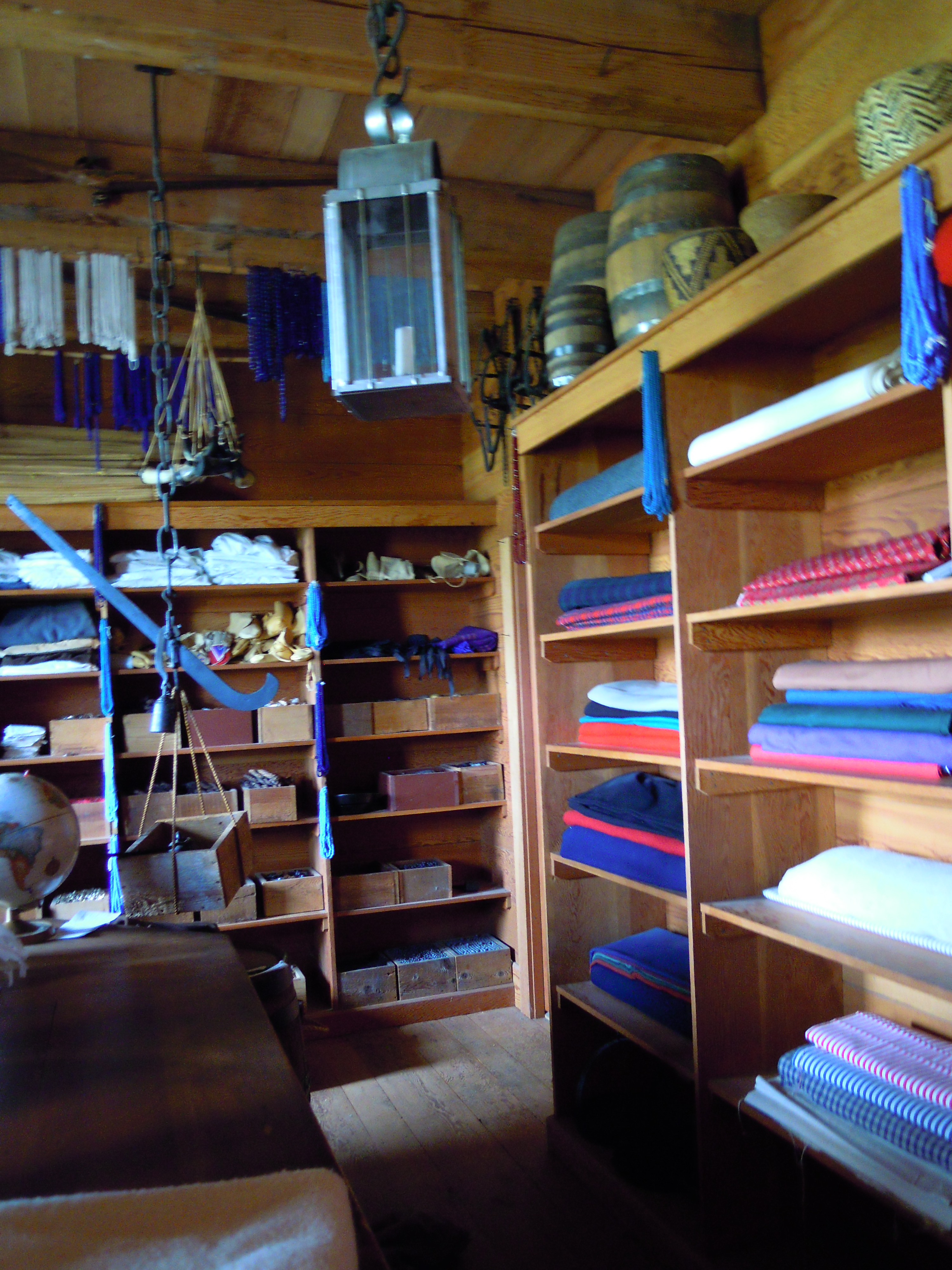
From the front door of the Big House you can look out on the working Blacksmith Shop at left and the well-stocked Indian Trade Store, straight ahead. And you can visit the Blacksmith Shop and Trade Store (shown below).

As noted in the previous post the Indian Trade Store was moved to this location sometime after my story. At the time of my story it was located across the grounds to the west. Update: Or maybe not. During the Saturday tour with Dr. Bob Cromwell, Chief Ranger and Archeologist, Dr. Cromwell said that the Indian Trade Store had already moved to this new location by the time of my story. Hussey puts the changeover as “sometime between July 1841 and December 1844.” With my story landing right in the middle I had interpreted the location to be as it was in 1841. The reconstruction, set at 1845, could easily locate it for their purposes.

Ft.Vanc.Warehouse

The Fur Store, shown above, stands on that spot today. Update: The Fur Store may have already been in this location at the time of my story (see above).

These are some of the places we’ll see on Saturday when we tour the post, getting a glimpse into a past where people from my book walked, while stepping on ground where a historic character from the book actually trod, the fascinating Dr. John McLoughlin. And so through the creation of story and re-creation of this wonderful fort we endeavor to make the past live.

Thank you for joining me here. If you can, I hope you’ll join me at the fort.

Sources:

Fisher, Janet. The Shifting Winds. Guilford, CT, Helena, MT: TwoDot, Globe Pequot Press, Rowman & Littlefield, 2016.
Hussey, John A. Historical Structures Report Historical Data, Vol. I and II. Denver Service Center, National Park Service, U.S. Department of the Interior, 1972, 1976.
Johnson, Robert C. John McLoughlin: “Father of Oregon.” Portland, OR: Binfords & Mort, 1958.
Langford, Theresa, Scott Langford, and David K. Hansen. Paint at Fort Vancouver National Historic Site: Historical and Archaeological References for Interpretation and Reconstruction. Vancouver, WA: Department of the Interior, National Park Service, Fort Vancouver National Historic Site, 2003.

COMMENT

The TRUE Shifting Winds ~ 5: Digging Up the Past

I first visited Fort Vancouver some years ago to research a short segment for one of my early attempts at an Oregon Trail novel, and the place put me right back in time. I was so inspired by the authentic reproduction of this historic fort I knew I had to write another book with more scenes set there. That became The Shifting Winds, which I’m honored to be presenting at the fort this Saturday, July 16, at 2 pm.

In this post I want to talk about how this wonderful reconstruction came to be.

Archaeology and Record Keepers

The British Hudson’s Bay Company chose a location on the north bank of the Columbia River for their western headquarters in the Oregon Country because they felt optimistic about Britain holding land on that side of the river once London and Washington agreed on a boundary between the two nations. But in 1824 when Dr. John McLoughlin and his boss Governor George Simpson selected the site, enough uncertainty hung over the region that they didn’t want to make a huge investment.

Also unsure of the friendliness of the local tribes, they erected the first palisade walls about a mile inland, creating a simple fur trading post on a bluff about a mile from the river with bastions on at least two corners, ready to defend themselves against attack.

Several events came together to change their perspective. First, the joint occupancy treaty of 1818 between the British and the United States was extended indefinitely in 1827. The Native Americans proved to be agreeable traders, and the distance from the river proved to be a bloody nuisance.

So in 1828 they pulled up stakes, literally, and moved the whole thing a mile closer to the river to the spot where the reconstructed fort lies today.

Christened in 1829, the new fort would serve the Company for many years. But it didn’t remain static. It kept changing over time like a living, breathing organism that sloughs off old skin while growing new. The fort walls kept moving. The fort doubled in size by 1836. Apparently the officers found their space too small.

They would expand again, moving the south wall farther out—and the east wall—again.

Buildings changed. The first Big House in the original west half began to sag until someone described its condition as so dilapidated it was ready to fall down around them. They rebuilt a new Big House in the east half where you can see it reconstructed today.

So why the reconstruction? Why did the original disappear? And why the constant change?

In short, wood rots—especially in a place where rain soaks the land for more than half the year. And little critters move in to feed on wood fiber.

Constant maintenance was required, and sometimes they just tore down buildings and constructed new. They continually replaced rotting pickets in the stockade and repaired leaky roofs. When the British finally lost the land on which the fort stood—as you must know they did—the Hudson’s Bay Company was allowed to stay on for a while, but they soon began moving the bulk of their business to Fort Victoria. London and Washington had finally agreed on a border in 1846, drawing the line along the 49th parallel, well north of Fort Vancouver, although giving the British Victoria along with the entirety of Vancouver Island.

By 1860 the Company abandoned the fort and the United States Army assumed control. But they found most of the buildings unsuitable for their purposes and in dilapidated condition. In a few years rot and fire destroyed what was left.

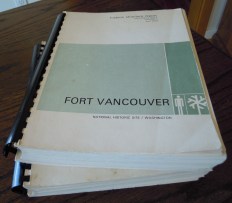
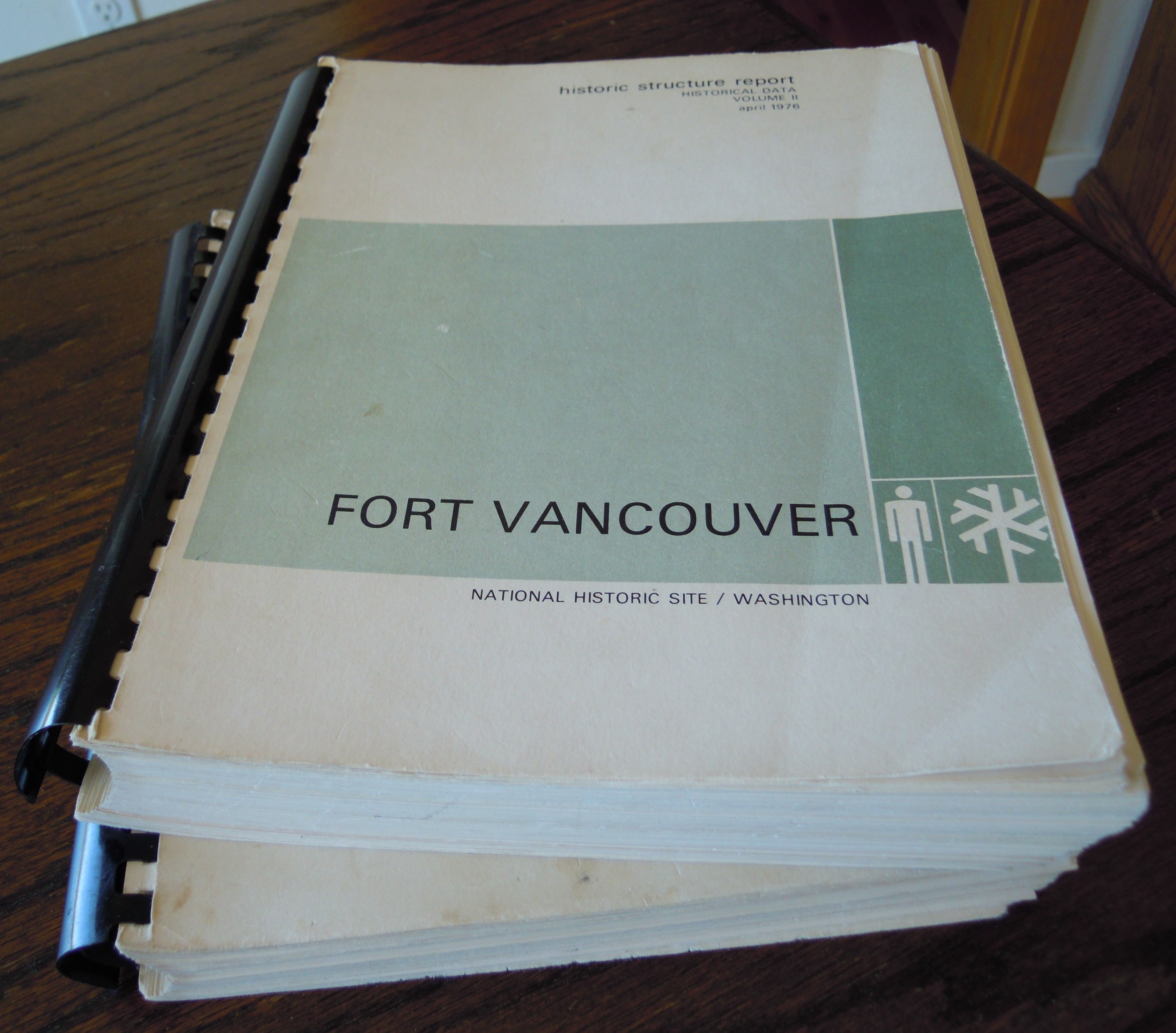
Yet some historians didn’t forget. In the 1940s the National Park Service began exploring the possibility of reconstruction. If they were going to do it they wanted to do it right. On my first visit to the reconstructed fort in the 1980s a curator there loaned me these two large volumes of a “Historic Structures Report” by John A. Hussey and the historic preservation team.

The volumes described the detailed research that went into this re-creation, a wealth of information. When I called about returning the volumes, the curator told me that if I continued to find them useful I should keep them because they had plenty of copies. What a boon to my research!

Now of course the report is online, offering a glimpse of the magnitude of the project. But I have spent many hours poring over the printed books.

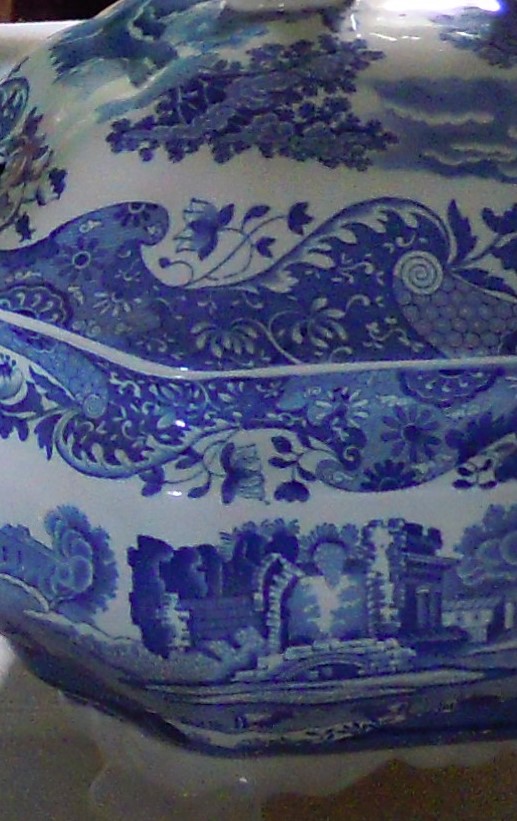
As early as 1947 National Park Service archeologists dug into the soil to find footings of buildings and remains of those moving walls at their various locations. They found tools, pottery, even Spode china on the site of the Big House–something in blue on white, perhaps to match these on display in the Big House dining hall, or Mess Hall, like the one shown here. Meanwhile, researchers looked into records. The Hudson’s Bay Company, still a functioning business in the UK, generously opened their remarkable archives for this study.

The British had kept detailed records.

Researchers were also given access to similar HBC posts, now in Canada, and those were studied and photographed for comparison. The Company tended to follow similar plans from one fort to another, so those helped in decisions about the finer points.

Books written in the day offered observations of the fort. Libraries across the United States and Canada held useful tidbits. Many fort visitors wrote about their impressions, sometimes drawing detailed sketches and maps. These were often dated and helped show the constant rearrangements going on over the fort’s life. Researchers scrutinized maps, drawings, every descriptive statement they could find. Much of that went into this report, along with bits of story that add flavor.

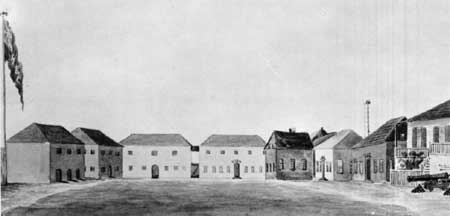
Warre Lithograph-1

The above lithograph was based on a water color by Henry J. Warre painted during his 1845 visit. My thanks to Meagan Huff, assistant curator at the fort, for sending me this copy from the National Park Service collection. She pointed out a change the artists in London made to Warre’s original.

Warre’s original gives us these characters.

Did Warre depict shepherds? Or voyageurs? Perhaps wanting the image more colorful the London artists replaced the original figures in the foreground with Native Americans, but in Plains tribe dress, not realizing that these tribes did not frequent the area.

Because the fort changed so much from year to year, the preservation team needed to pick a date, and they decided to reconstruct to the year 1845. That’s close to the date of my novel, which has scenes at the fort in 1842 and 1843. So as I read the report I had to make careful distinctions between the 1845 fort I saw and the 1842 fort I would describe

For instance, in one scene Dr. McLoughlin and my fictional clerk Alan walk across the grounds from the Big House to the Indian Trade Store in the western courtyard. Today you’ll find that store on the east side, almost straight across from the Big House, a short walk. But in 1842 that store was over in the western side where the Fur Store stands today. A longer stroll.

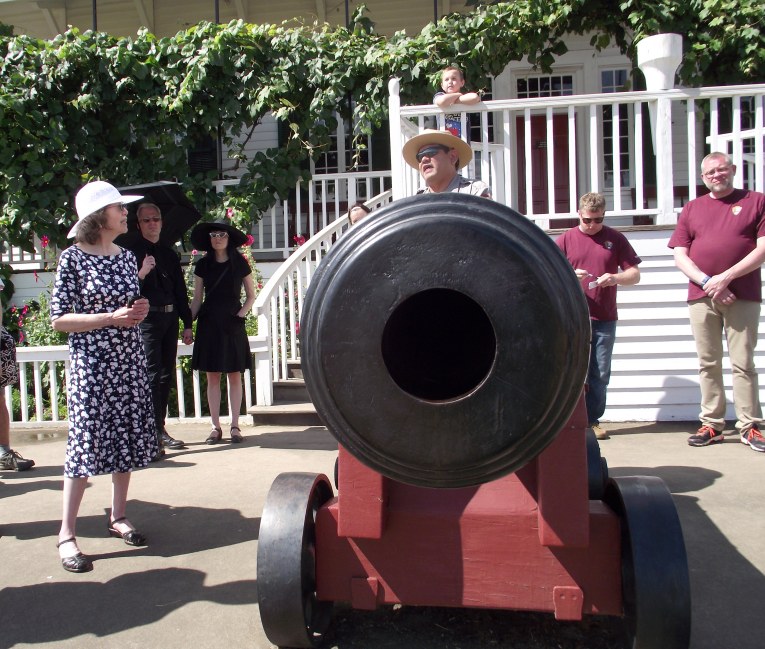
Perhaps the most conspicuous difference would be the bastion you can see in Warre’s 1845 image above. There was no bastion in 1842, so you won’t find reference to a bastion in the book. But I have shown it in blog and Facebook posts because it looks so fort-like. Fort Vancouver was more trading post and supply depot than fortress. Caution required walls but not big guns.

The bastion went up in 1844, not because of danger, but because of protocol.

Hussey relays the story in the report. A ship sailed up the Columbia in 1844 and offered a  7-gun salute. But the fort couldn’t answer the salute because they had no cannons mounted for action.

Although they’d put up bastions on the old fort, they hadn’t bothered with a bastion in the new fort, things being so peaceful. But not to be able to answer a salute—well, that just wouldn’t do. So they built one.

Given the troublesome nature of some of the pesky Americans coming into the country it seemed a good idea anyway.

Another change was the New Office, built in 1845 to replace the Old Office. The Old Office was one of the oldest buildings of the fort, the first thing constructed, given its function so vital to the fort’s purpose. That Old Office still served the fort in 1845, because the new one offered temporary living quarters for a ship captain who stayed on for a while, adding excitement for the gentlemen with his many parties in the new structure. This New Office, or “Counting House” as it was sometimes called, has been reconstructed. The Old Office has not, although perhaps one day it will be. It stood close by its replacement at least until 1847 when the good captain departed. The old building with its dark exterior shows clearly in a water color sketch drawn in 1846 or 1847.

The fort required considerable bookkeeping. Clerks like my fictional Alan Radford generally entered service through apprenticeship, nearly all of them from Britain. Because of the many applicants, family connections helped. These clerks were usually well educated and knew some accounting beforehand. The Company wanted reliable, loyal clerks working in the office, men who would be discreet and keep Company business confidential. These accounting clerks held one of the better paid jobs for gentlemen at the fort.

I took particular interest in the office, given that Alan is a major player in my book. Other buildings of special interest to me were the Big House where Jennie stays during her visit for the Christmas Ball and where the ball takes place, and the Bachelor’s Quarters where American mountain man Jake Johnston stays, having joined the party for his own reasons. Accountants like Alan lived in the office, but most clerks lived in the Bachelor’s Quarters, a long building divided into multiple rooms or apartments. And when gentlemen came to visit, the clerks often got bumped to accommodate the visitors.

However, Alan appeared none too pleased when McLoughlin allowed Jake a room in the Bachelor’s Quarters. When Jennie asked Jake what was wrong with Alan, Jake grinned.

“Well,” he said, “it’s only gentlemen who are allowed to stay inside the fort, and I don’t think Radford considers me a gentleman.”

She wasn’t sure Jake was a gentleman either, but she was surprised at the rigidity.

The Bachelor’s Quarters have not been reconstructed yet either, but the report offers excellent detail.

Fisher, Janet. The Shifting Winds. Guilford, CT, Helena, MT: TwoDot, Globe Pequot Press, Rowman & Littlefield, 2016.
Hussey, John A. Historical Structures Report Historical Data, Vol. I and II. Denver Service Center, National Park Service, U.S. Department of the Interior, 1972, 1976.

Next: Making the Past Live

COMMENT

Fort Vancouver Event Coming Soon

My reading and signing event at the fantastic Fort Vancouver site in Vancouver, Washington, is just three weeks away, Saturday, July 16, starting at 2 o’clock in the afternoon. As mentioned in my March post “Upcoming Book Event at Fort Vancouver,” it was a dream of mine to hold an event at this historic fort for my new historical novel, The Shifting Winds, because the fort plays a significant part in the story. Now that dream is about to happen.

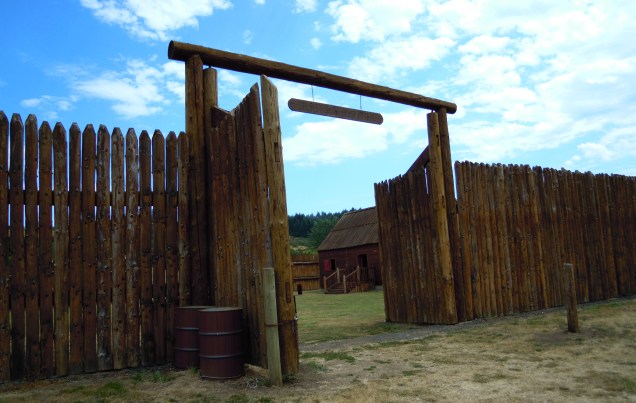
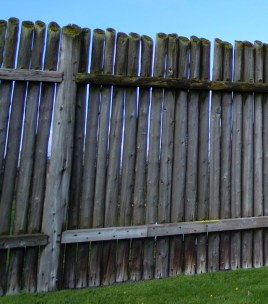
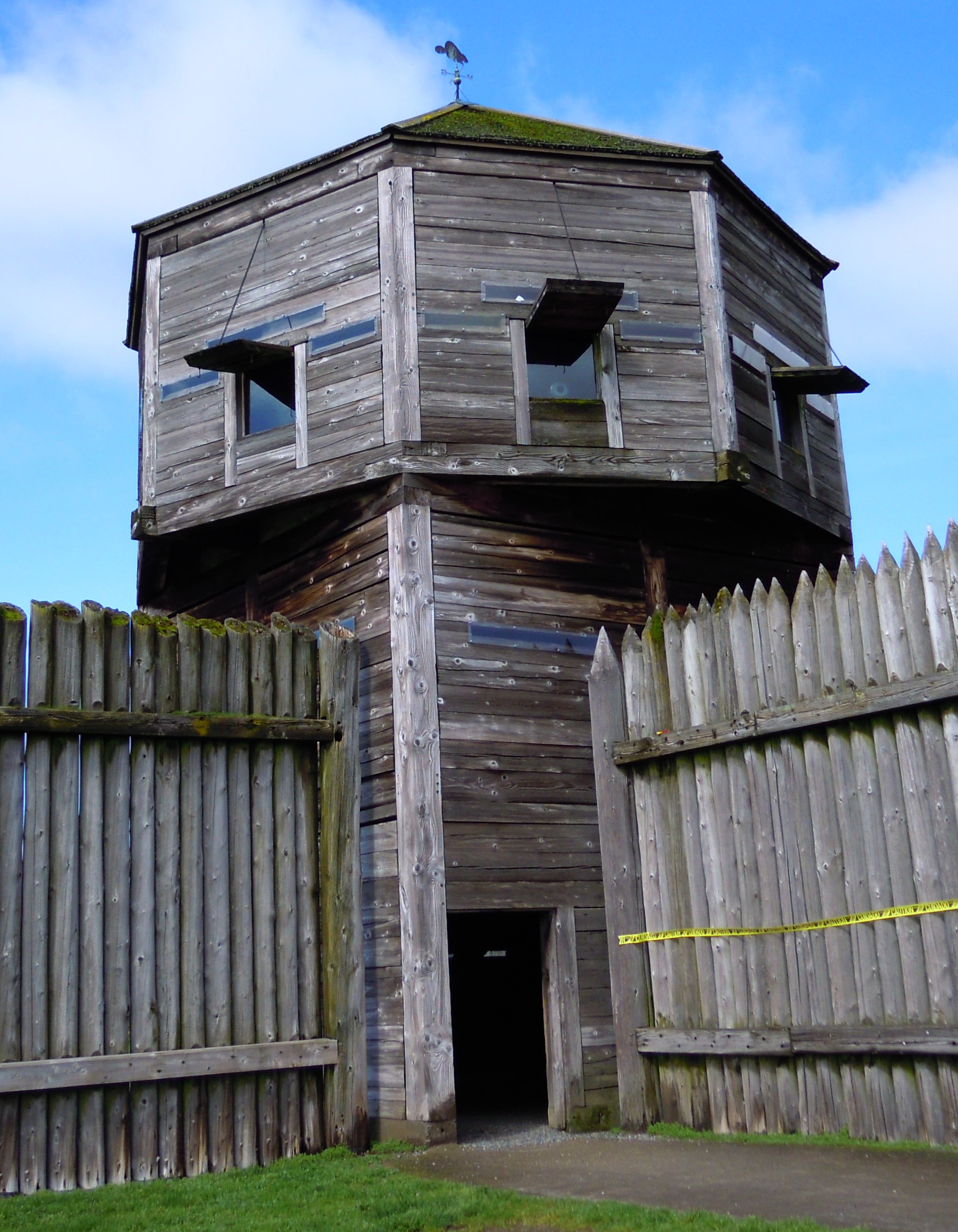
599.Ft.Vanc.Bastion -titleThrough my presentation at the fort Visitor Center–a lecture, a slideshow of related photos, and a tour of the fort–I hope to draw people back to the days of my story. The lecture and book signing will be from 2 to 3:30. Afterward, from 4 to 5 I’ll lead attendees on a tour through the fort and highlight some of the places that appear in my book. The bastion in the fort palisade is shown above.

Several scenes in the story take the reader to this amazing spot of British civilization in a wilderness isolated from all that’s familiar to the young American protagonist, reluctant pioneer Jennie Haviland. And one of the major players, Hudson’s Bay Company clerk Alan Radford, works at the fort.

In the early 1840a when the story takes place, Fort Vancouver stands as the center of the British fur trade in the Pacific Northwest, and American settlers have just begun trickling into the area, hoping to gain the land for the United States. For more than 20 years Britain and the United States have jointly occupied the Oregon Country, unable to come to terms on a boundary between them.

Ft.Vanc.Big House FrontGiven Fort Vancouver’s significance in Western American history, the fort has been faithfully reconstructed as a living representation of the times, including the home of the commanding officer and his second in command, above, which is furnished much as it would have been when Chief Factor Dr. John McLoughlin lived there and essentially ruled the Oregon Territory. The McLoughlin sitting room is shown below.

613.Ft.Vanc.McLoughlin Sitting RoomNow a National Historic Site maintained by the National Park Service, the fort offers visitors a chance to step back in history and see what life was like in the fort’s heyday.

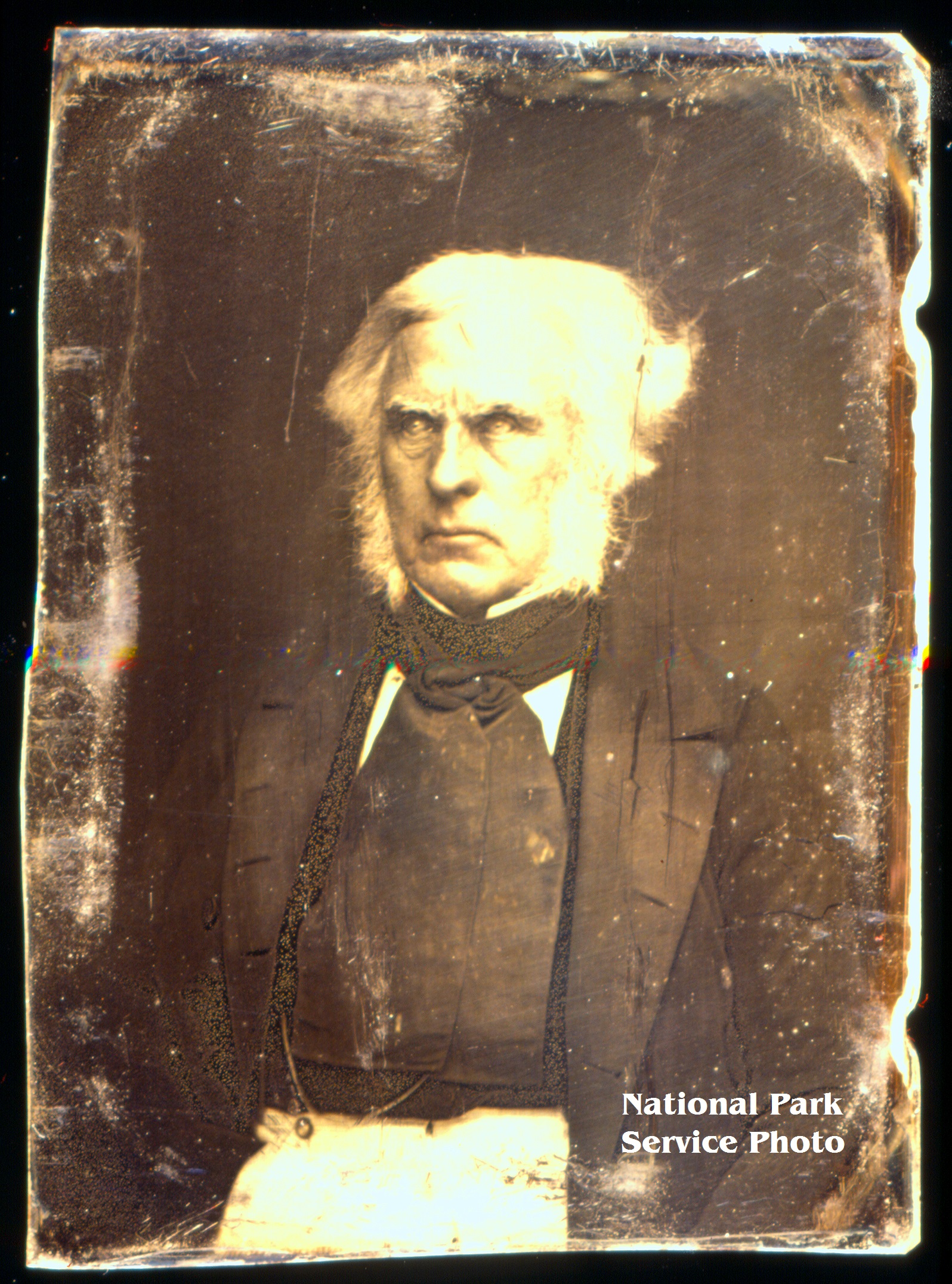
622.John McLoughlin Daguerreotype - creditChief Factor McLoughlin, shown in the daguerreotype, is one of the real characters portrayed in the book (photo courtesy of National Park Service).

My story takes place during the historic time of rising tension between the two nations over this one land. Within that true story of conflict, a fictional clash develops between two men–the British HBC clerk Alan Radford, and American mountain man Jake Johnston–who vie for protagonist Jennie as their nations vie for Oregon.

To find the fort and center, their website offers maps and directions. The Visitor Center, where my event will be held, is at 1501 East Evergreen Boulevard.

The Visitor Center Bookstore will have copies of The Shifting Winds for sale, as well as copies of my previous book, A Place of Her Own.

My thanks to the National Park Service and the Friends of Fort Vancouver for co-hosting the event. And a special thanks to Mary Rose, Executive Director of the Friends of Fort Vancouver National Historic Site, for making the arrangements.

In these next three weeks I plan to offer a series of posts here on my blog to help set the stage for my story and for this event. Because the posts will delve into the historical setting, I’ll call the new series “The True Shifting Winds.”

COMMENT

Pleasant Evening at Bookmine

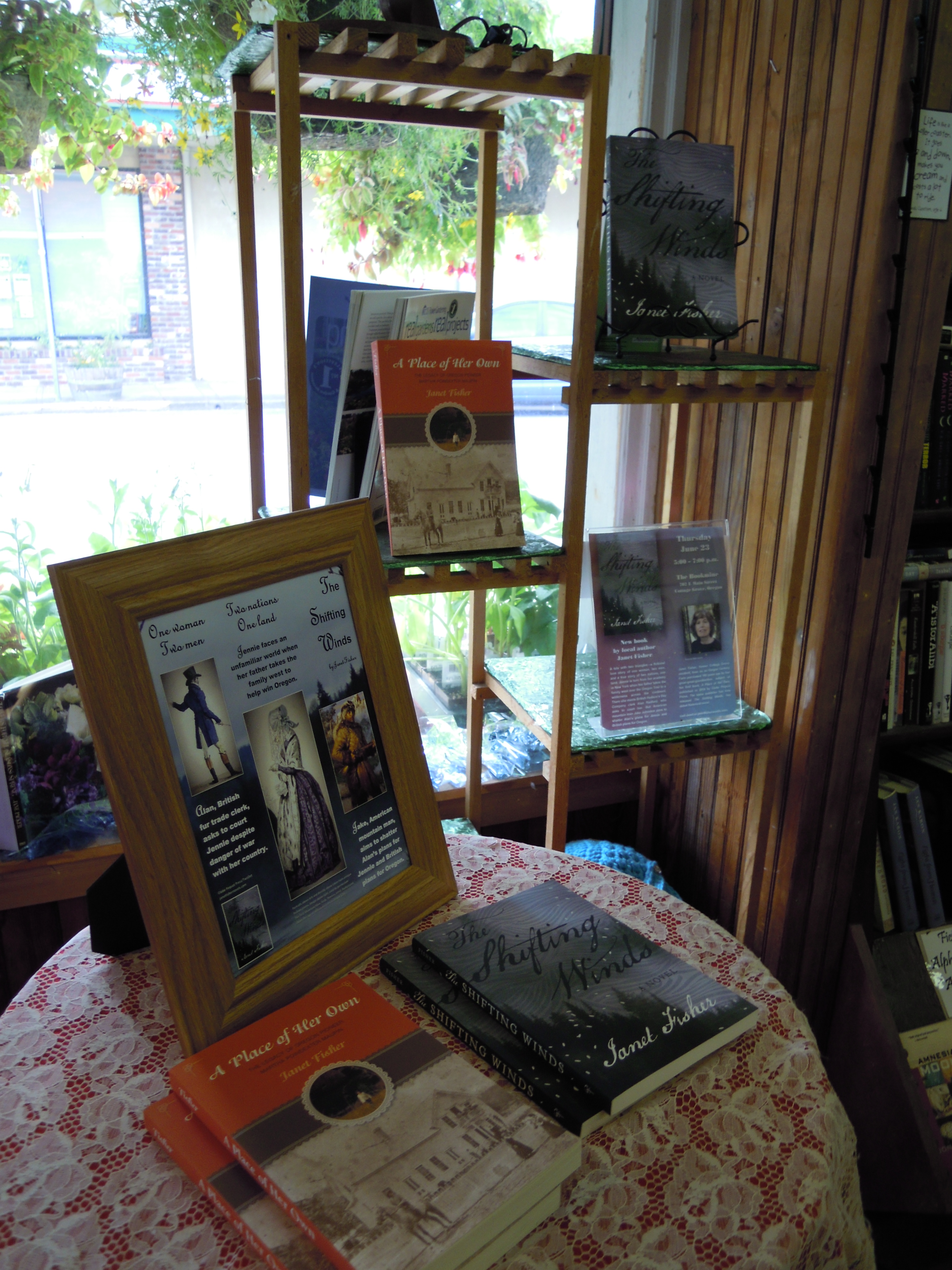
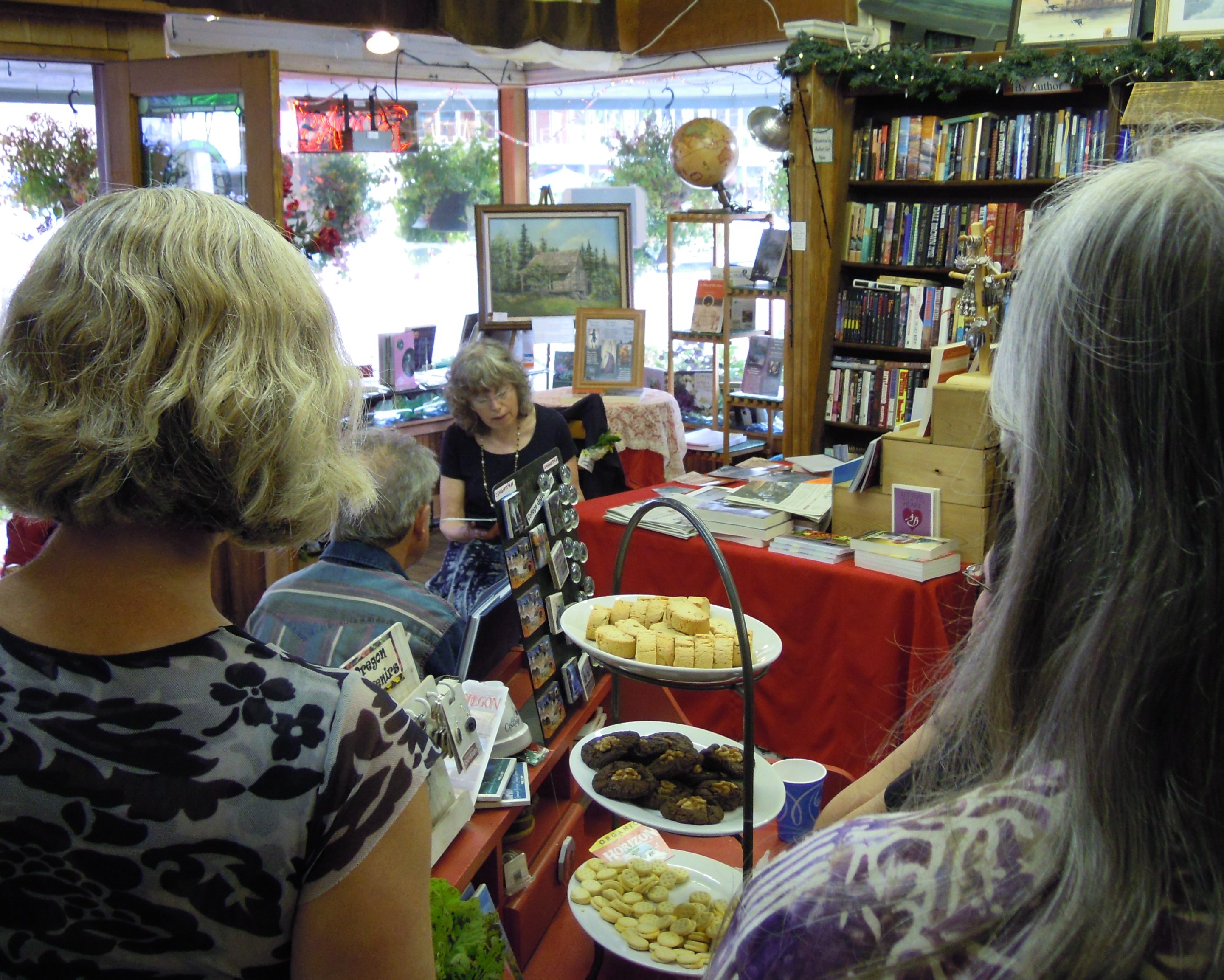
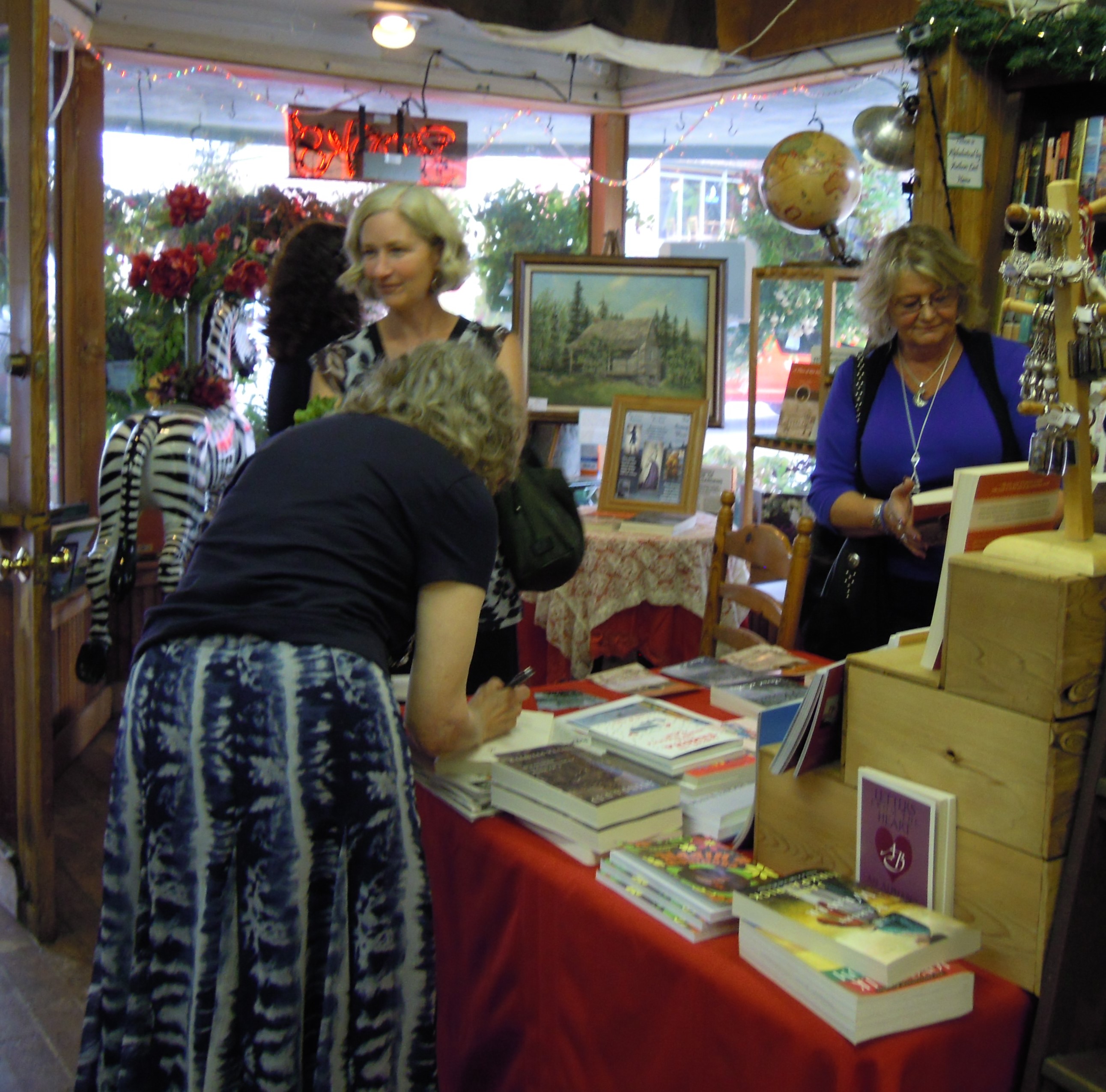
Bookmine encore.1029Gail at The Bookmine in Cottage Grove set up a lovely display for my encore signing and reading party for The Shifting Winds Thursday evening, to which I added my new poster for the book (at left).

We also had copies of my first book, A Place of Her Own, available and actually sold quite a few of them as well. It continues to gain interest.

It was a busy evening with the Farmer’s Market just outside, and several people drifted in to join those who’d come for the event.

Bookmine encore.1040.2

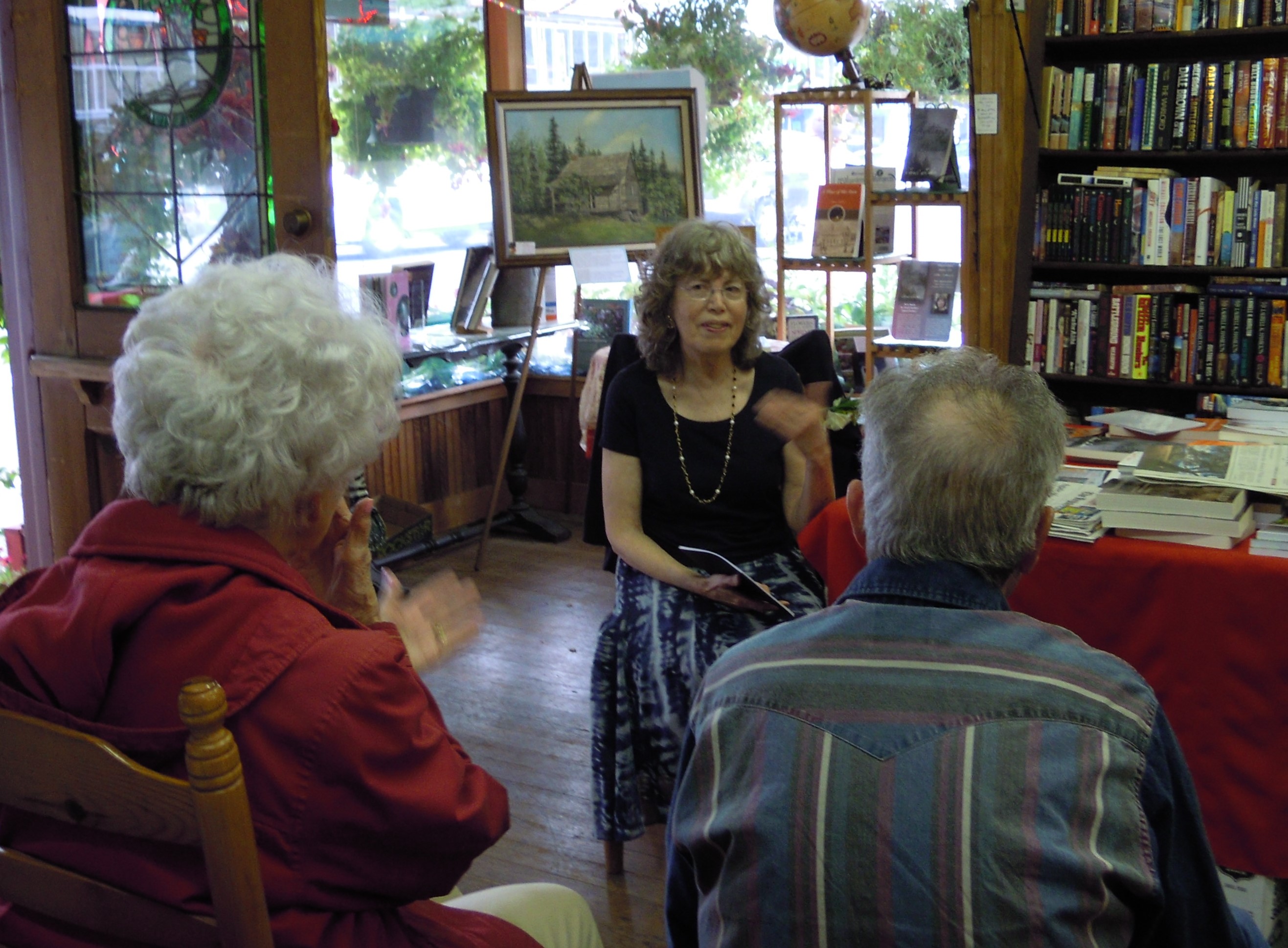
An attentive group stayed for the readings. I chose three short segments, a couple of tense cliff hangers and, for a change of pace, one of Joe Meek’s stories. Joe, a mountain man, is one of the real characters in the book. Gail also offered refreshments, shown in the photo above, so folks nibbled and listened.

Bookmine encore.1045.2Bookmine encore.1039.2

After the reading we had a few questions. And I signed a few books.

Altogether a pleasant evening. It was nice to have both of my daughters, Carisa and Christiane, and my granddaughter, Calliope, with me.

Thanks to Christiane for taking the pictures.

COMMENT

Spring Art Walk Event

It must be spring! The first Art Walk of the season comes this Friday, April 29, to the charming historic downtown of Cottage Grove. And I’ll be there with my books at The Bookmine from 6 to 8 pm or later. It’s such a great store–a pleasant place to hang out during the Art Walk, or anytime for that matter.

bookmine & bikesThis small Oregon town enjoys the good fortune of having three bookstores within five blocks on Main Street, from The Bookmine at 702 to Kalapuya Books at 637 to Books on Main at 319, and I’m happy to say they all stock my books. They also have a wonderful library a few blocks away (and, yes, my books are there too). A very literary place.

I lived in Cottage Grove for several years before moving to the family farm in Douglas County, and the people of Cottage Grove continue to be supportive. I am most grateful.

The town’s Art Walk happens on the last Friday of the month from April to October. You’ll find food, art, music, a variety of shopping at the local shops, and of course books.

I’ll read a time or two from my new historical novel, The Shifting Winds, and will have that one as well as my first, A Place of Her Own, available for signing. The Shifting Winds is a fictional tale set in a lot of true history. A Place of Her Own is a true story with some creative conjecture. They’re both Oregon Trail stories about strong pioneer women. I’ll be open to informal Q & A as people stop by and to just chatting about the new story and my other work and your own stories.

If you’re in the neighborhood I hope you’ll visit me at The Bookmine.

COMMENT

Lovely Crowd at Annie’s

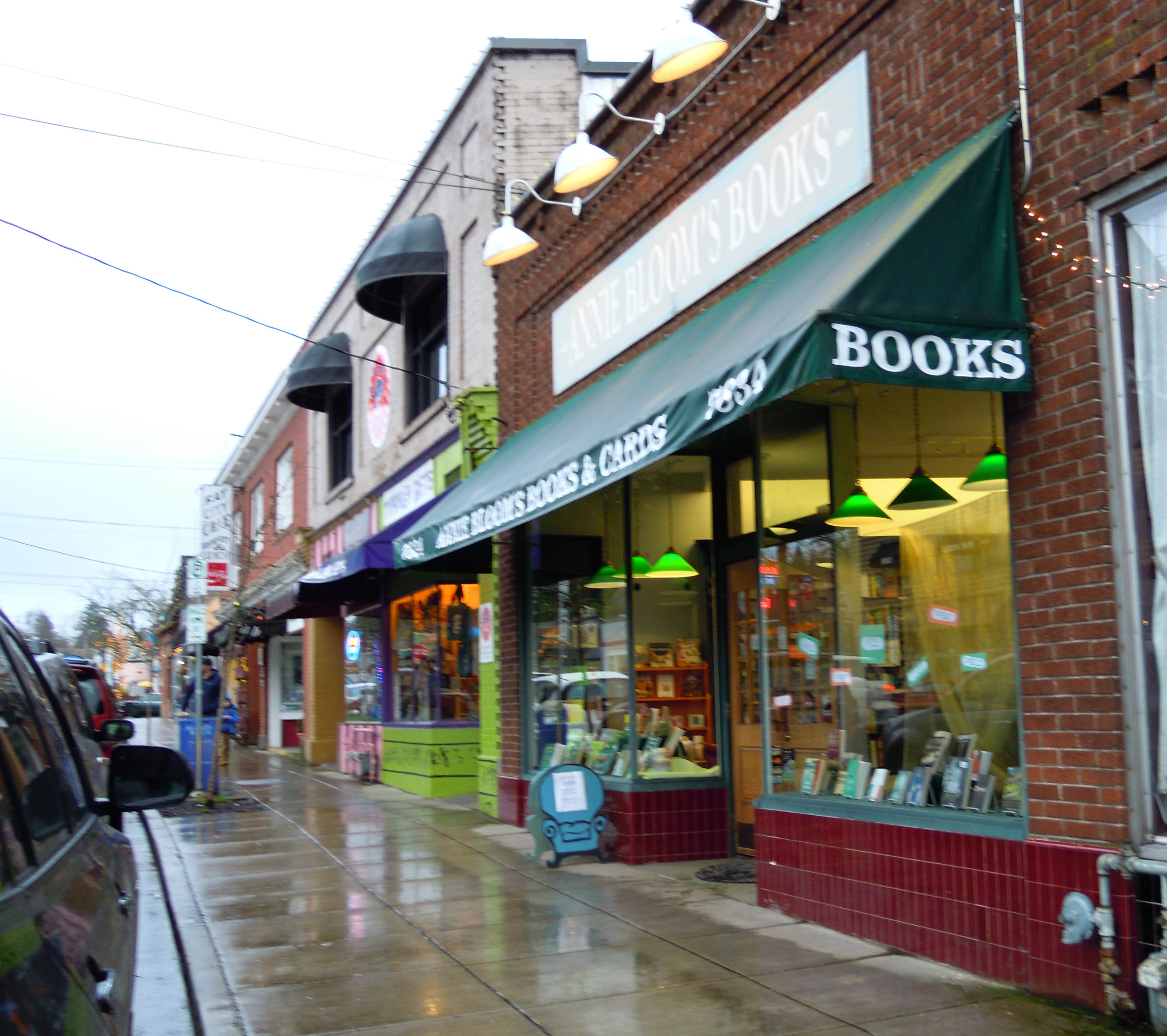
A lovely crowd turned out for my book reading and signing at Annie Bloom’s Books in Portland. It was such a cold, rainy evening. Icy rain hammered me as I drove into the city. I wondered if anyone would come out on such a night. But Portlanders don’t let anything like a little rain stop them. The people came.

Annie's 3.15.16Here is Annie’s as I arrived early on that wet evening. But a warm welcome awaited inside.

Molly Bloom, the silky black cat who rules the store, soon made her presence known, and I was determined to get her picture this time. I never got my own picture of her last time I had an event there with my first book, A Place of Her Own. So I must confess the rest of my pictures of the event are of Molly. None of the crowd. None of me speaking. Just Molly.

Annie's.Molly hidingShe seemed a little shy at first. “I’m not quite ready to go out there yet.” I knew the feeling. Here she has tucked herself under the table where I sat to do my reading, a little different from other venues where I usually stand. But it was pleasant, conversational.

I do want to thank my cousin-in-law Judy Fisher, who helped with serving wine after my presentation. She and my cousin Jack came over from Lake Oswego, and it was great to see them. And a special thanks to Stephanie, the human at Annie’s who handled the event and introduced me.

I had some surprises. A friend who had known my father came. She had worked with him when he served on the State Board of Education years ago, and even had dinner once at my parents’ house at the farm. Also in attendance was someone who had worked on the archeological digs at Champoeg, a significant locale in the story of The Shifting Winds.

Annie's.Molly checkingMolly kept busy before we started. “I just need to check something over here in the stacks.”

As I began to do my reading Molly started working the crowd in earnest. She traipsed around the chairs. She paused for gentle strokes on her silky fur. She leaped into laps. My camera was on the corner of my table. I considered stopping midsentence to get a better picture, but decided that would break the flow, and it was an intense scene. I could have asked someone beforehand to do pictures, but didn’t. Even with Molly’s antics the reading was well received.

And we had a great Q & A. Many of the people knew the history that surrounds my story, so we had a vibrant interaction. Quite a few were interested in A Place of Her Own too. All in all, a delightful event. And afterward Molly was all worn out.

Annie's.Molly sleepingSigh. “It’s a big job running an event like this. But I am content. It went well.”

My thanks to everyone at Annie’s. This was my go-to bookstore when I lived in Portland, just up the street, and I always love going back there. It’s such a pleasure to be able to share my own work in this warm and friendly place. Like Molly, I was content.

NEXT UP: News on an exciting upcoming event.

COMMENT


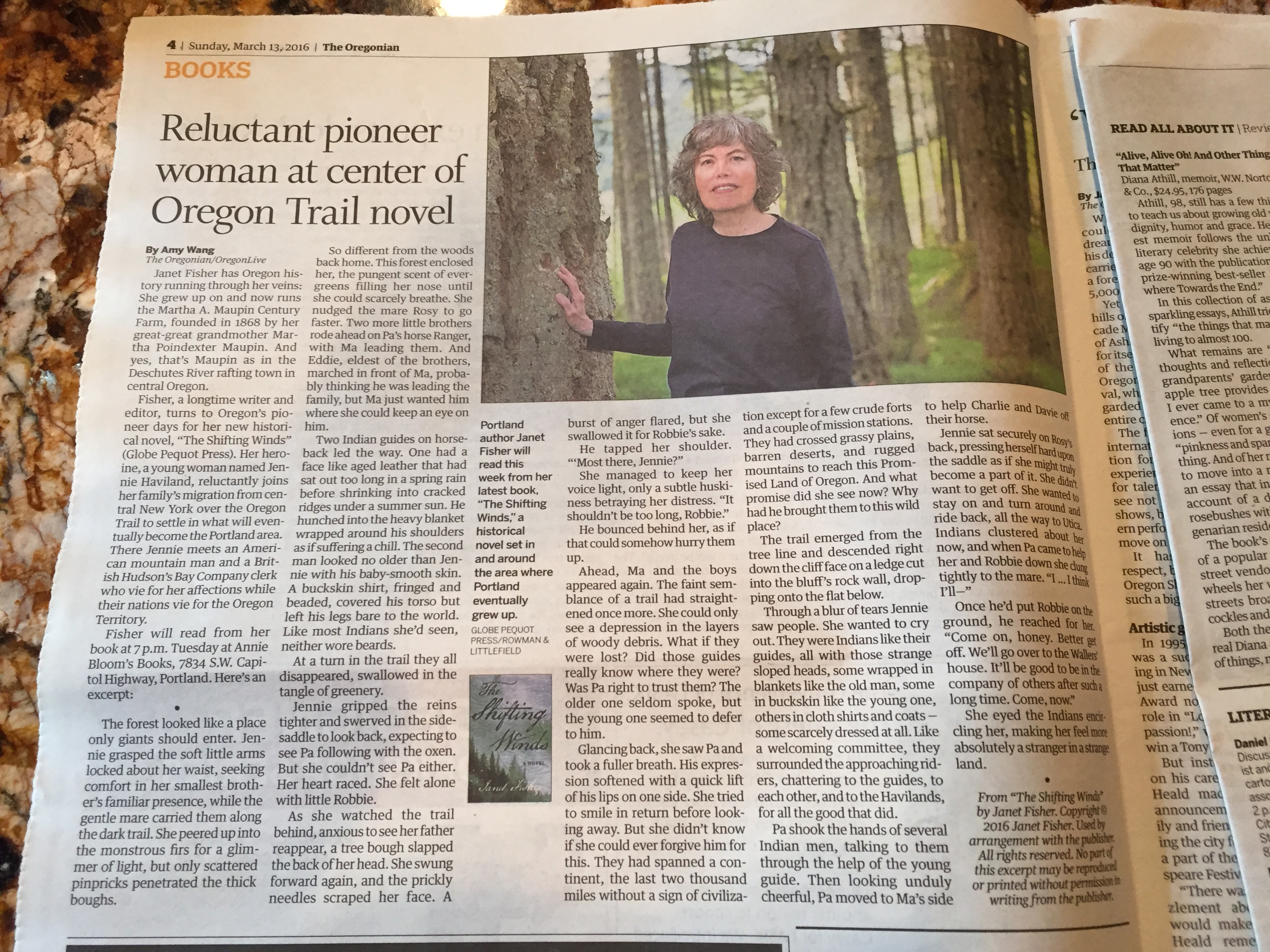
Oregonian Feature on Shifting Winds

Woo-hoo! The Oregonian, Portland’s longtime newspaper of note, did a terrific feature on The Shifting Winds. The article went up online last week, and is in today’s print version. You can find the online feature here.

And here’s a photo of the print version, below. A nice spread.

Oregonian.Diane.DunasPhoto by Diane Dunas

My daughter Carisa called this morning to tell me my friend Diane Dunas had posted the above picture of the article on Facebook, and Diane kindly sent me a copy of her photo to share here.

The story of The Shifting Winds is set in and around the area where Portland eventually grew up, and I’ll be holding an event next week at Annie Bloom’s Books in Portland. So it’s a great match. And excellent timing. The Oregonian not only covers the Portland area but reaches readers throughout the state. Very exciting!!

🙂

UPDATE: Amy Wang, who wrote the article, clarified that it’s a feature, not a review, so I’m editing accordingly. Either way, it’s super.

COMMENT

Event Tonight at the Museum

I’ll be in Roseburg tonight at 6:30 for a reading and signing of my new book The Shifting Winds. I’m looking forward to this event at the Douglas County Museum where this book was essentially born.

900.DCMuseumWhen I decided to write the first of several pioneer/fur trade stories some years ago, I went to see the late George Abdill, first director of this museum, looking for information on my subject. As I noted in an earlier post, he was exactly the right guy to talk to. This was a favorite era of his and his knowledge set my course on these books, including The Shifting Winds. He gave me volumes of information on his own, and directed me to many books and other sources of information. My researches led me not only to the Douglas County Library, but to the Multnomah County and Oregon Historical Society libraries in Portland, the Clackamas Historical Society and McLoughlin House in Oregon City, the backroads around Oregon City, up the river to Champoeg, and to the reconstructed Fort Vancouver in Vancouver, Washington.

George profile jpgPhoto courtesy of Douglas County Museum

I will offer a brief tribute to George tonight, and to his wife, Joyce, who plans to be there and say a few words. Joyce also helped me by connecting me with my first two agents, and those agents gave me a sense of hope that one day I would find the breakthrough I needed to get a publisher. I am thankful to Joyce for that and for her continued encouragement.

Also tonight, with the help of my son-in-law Robin Loznak, I’ll present a running slide show of photos related to the story–Oregon Trail shots taken when I traveled east to Kansas City with my daughter and granddaughter and backtracked that harrowing trail, a few shots at Fort Vancouver the characters visit in the story, as well as pictures of the main setting of Oregon City and a couple of the story’s real-life characters, Joe Meek and Dr. John McLoughlin.  Then, just for fun, we’ll show photos from a signing event I had near the beginning of the Oregon Trail in Lexington, Missouri, when a shirttail cousin, reenactor Robbie Maupin, rode in with a band of Rough Riders to visit the event. The man does know how to make an entrance. In that small town that looked like a place out of the past, these riders helped take us back to a time close to the days of The Shifting Winds.

After the tribute to George and Joyce’s remarks, I’ll do a short reading from The Shifting Winds, then sign some books. I will also have copies of my first book, A Place of Her Own. If you purchased one of these books elsewhere and would like them signed, feel free to bring them and I’ll happily sign them too.

The event will last from 6:30 to 8:30, and folks at the museum will be offering refreshments of cookies and coffee. My thanks to Karen Bratton, Research Librarian and Collections Manager, for setting all this up, and to Museum Director Gardner Chappell. The museum seems a perfect venue for this book, which got its start there.

The event is open to the public. Welcome.

COMMENT


COUNTDOWN – 3 DAYS TO LAUNCH

Fort Vancouver

In today’s post counting down to the book launch of The Shifting Winds, we’ll visit the Hudson’s Bay Company’s Fort Vancouver, a thriving center of British civilization in the wilderness of the Oregon Country in the nineteenth century. When the story begins, this fort has been the center of the fur trade in the Pacific Northwest for seventeen years, having been established in 1825. Today, the city of Vancouver, Washington, has grown up around the site, and with archeological investigation and in-depth study of early drawings and descriptions, an elaborate reconstruction project has brought back the palisade walls and many of the buildings, offering a glimpse into the fort’s glory days. It’s now a National Historic Site maintained by the National Park Service.

(Troy Wayrynen/picturesbytroy)

National Park Service photo by Troy Wayrynen

The above photo provides an artistic portrayal of a finely crafted lantern with the fort bastion behind. This fort was no rustic outpost. The commander’s residence, an elegant two-story house which he shared with his second in command, looked like a mansion to protagonist Jennie Haviland. The house included a public sitting room and formal dining hall for gentlemen, where substantial meals were served, sometimes with wine, but no “spiritous liquors.” Within the palisade walls the company was a self-sufficient establishment with workshops for carpenters, blacksmiths, coopers and others, as well as a school house, a chapel, a brick and stone powder house, and more. Outside, farming activities required more employees than the fur enterprise.

Nancy Funk, wearing period clothing, takes care of a garden at the Fort Vancouver National Historic Site in Vancouver, Washington. (Troy Wayrynen/picturesbytroy)

National Park Service photo by Troy Wayrynen

In the above photo taken at the beautifully reconstructed site, you can see some of the gardens typical of the fort’s past, and behind the gardens, the palisade walls with bastion at the corner. The large hip-roofed building on the far left with the chimney is the Big House where Dr. John McLoughlin lived as Chief Factor of the fort.

When the Company sent Dr. McLoughlin out to the Oregon Country, he selected this site for the Company’s western headquarters because he found a broad fertile plain there and he intended to grow things while conducting the fur trade. Grain, fruits, and vegetables flourished on this land, as well as livestock. He also wanted a site on the north side of the Columbia River because the British had recently made an offer to the United States to resolve a contentious boundary dispute, agreeing to set the boundary between the two nations along the Columbia. That would have essentially given today’s Washington State to the British. I guess we all know that offer was not accepted.

The Company initially built the fort a short distance inland from the final location, but after four years they moved it closer to the river and gradually developed the remarkable establishment it became.

village

National Park Service photo

The Company employed many people, and while some lived inside the fort walls, many more lived in a village just outside. Some of the reconstructed buildings of the village are shown in the above photo.

When Jennie visits the fort in our story, she’s curious about the houses outside the walls and asks her escort Alan Radford about them. He tells her they’re the workmen’s cabins, and she asks, “‘Do you live in one of these cabins?”

“Oh no. I live inside the fort. The gentlemen live inside.’

“‘Oh.’ She puzzled over that. ‘How do you decide?’

“‘Decide?’

“‘Yes. How do you decide who’s a gentleman?’

“‘Well, the officers and clerks are gentlemen, and the common workers are not. It’s simple enough.’”

Jennie finds that surprising but focuses on the fort as the wagon carries them inside. She’s amazed. “‘It’s like a small city right here inside the walls.’

“Lights glittered around her now, twinkling from the many windows of the fort buildings—glass windows, real glass windows. And the buildings! There were real frame buildings. Not simple little crude log cabins like those at Willamette Falls. . . . The frame house directly in front of her . . . had proper white weatherboarded walls, a proper shingled hip roof, shutters beside the tall glass windows, and a wide veranda that crossed the entire front, with a gracefully curved staircase forming a half circle from the veranda to the ground.”

Jennie has been invited to stay in that house, the Big House, as the guest of Dr. and Mrs. McLoughlin, but discussion ensues about where American mountain man Jake Johnston will stay. He has traveled with their party from Willamette Falls for his own reasons. With sudden decisiveness, Dr. McLoughlin says Jake will stay in the Bachelor’s Quarters next to the Big House. But Alan doesn’t appear to like that decision. When he begrudgingly leaves to make arrangements, Jennie quietly asks Jake what’s wrong.

Jake’s response: “‘With Radford? Well, it’s only gentlemen who are allowed to stay inside the fort, and I don’t think Radford considers me a gentleman.’ Jake grinned at her, and her brows rose. She wasn’t sure Jake was a gentleman either, but she was surprised at the rigidity.”

NEXT: Dr. John McLoughlin

COMMENT

COUNTDOWN – 5 DAYS TO LAUNCH

Mountain Men

With five days to go until the launch of The Shifting Winds, today’s post will focus on those intrepid mountain men who went out into the wilds of the Rocky Mountains to trap beaver for the American fur companies in St. Louis. From the early 1820s until 1840 these trappers worked the mountain streams and developed a lifestyle of their own. Company caravans took supplies to the Rockies for an annual summer rendezvous where they traded for beaver the mountain men had gleaned during the year. So the trappers never had to leave the mountains. Some didn’t go home to the States in all that time, maintaining a tenuous link with civilization as they had once known it.

George profile jpgPhotos courtesy of Douglas County Museum

George Abdill may not look like a mountain man in the pictures above and below, but the spirit of a mountain man lived in George’s heart.

Some years ago when I decided to write a book about the American frontier, with mountain men and pioneers and British fur traders, I went to see George Abdill, director of our local Douglas County Museum at the time. George was a man who held in his mind so much information, a person could ask him a question and he would answer with a chapter. When I told him about the setting and characters of my story, he smiled and sat back in his chair, his tone turning wistful. “If I could go back in time and choose what I would like to be, I would be a mountain man.”

George headshot jpgWow! What a great source for these stories!

He’s not wearing buckskins in the photos. He doesn’t have a powder horn and bullet pouch slung over his shoulder. And he’s not carrying a muzzleloader, but he knew how to shoot one and told me how to reload the single-shot weapon on the run while riding full tilt after buffalo. So, imagine him in buckskins, as he could have surely imagined himself.

The mountain men who trapped beaver in the Rocky Mountains generally wore buckskins because these trappers worked in rough country and the durable buckskin protected their own skin, also because they lived and worked with Native Americans who often wore deerskin clothing themselves. Fringes—or whangs—on the outer arm seams and leg seams offered more than style. The fringes helped the garment shed water by acting as wicks, an important feature for men who waded into streams to trap beaver and faced all kinds of weather.

Here’s how protagonist Jennie Haviland sees American mountain man Jake Johnston on first meeting:

“She managed to push back to arm’s length and quickly surveyed him from the smiling face down over the buckskin-covered length of him to the moccasins on his feet. He wore a buckskin shirt, much like their young Indian guide’s—fringed, embroidered, belted at the waist—but unlike the guide he wore long, trim-fitting buckskin breeches with fringes running down the outer seams. He was armed—a knife in a sheath on his belt, a pistol stuck into the belt, and powder horn and bullet pouch slung over his shoulder. With determination, she pushed back harder and he released his grip on her.

“He spoke with a drawl, still smiling. ‘Ma’am, may I have the utmost pleasure and privilege of welcoming you to the fair Willamette Valley? My name is Jacob Obadiah Johnston.’ He backed up a step, sweeping one hand before himself as he gave her a deep bow, the long fringes on his buckskin sleeve swishing with the motion. Standing straight again, he grinned wider. ‘My friends call me Jake. And you would be . . . ?’

“She could only stand and stare . . .”

The Shifting Winds is the fourth pioneer story I wrote, the fourth serious novel, and its pages are infused with the information and spirit provided by mountain man dreamer George Abdill. I wish he were still alive to thank for all the help he gave me.

NEXT: Joe Meek, Mountain Man Extraordinaire

COMMENT