Going There 2024 – Reflections

Where the story comes to life . . .

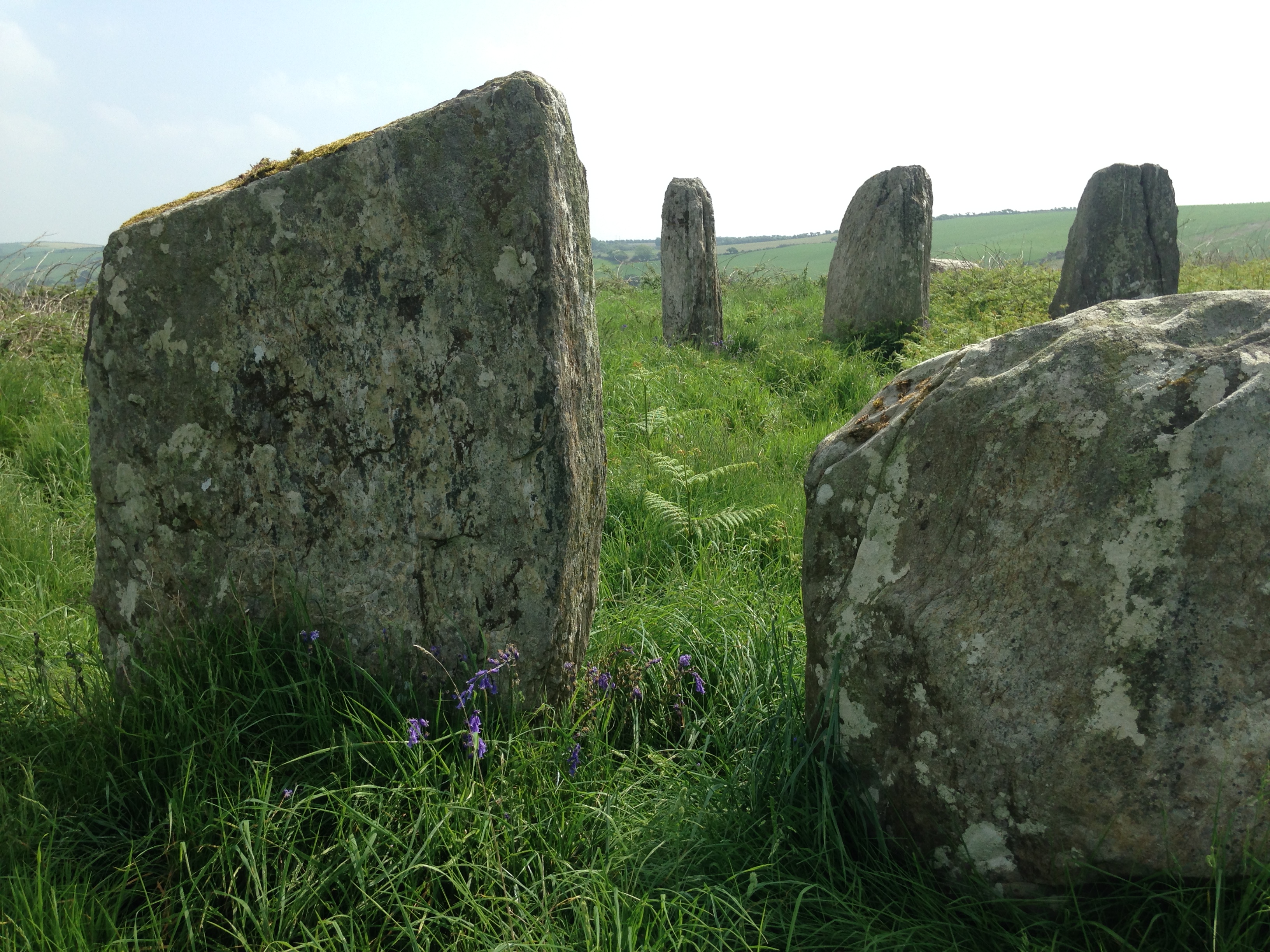
The photo above brings stone and sea together, the upper line of the stone echoing that notch where the sea gleams bright blue when the air is right. This is one of the pillars in the Bohonagh circle near Rosscarbery, Ireland, sacred circle of the protagonist’s clan in my story.

With this last post in my “Going There 2024” series I’d like to reflect on the highlights of my recent trip to immerse myself in the main settings of my upcoming historical novel. More than anywhere I went it was Rosscarbery on the southern coast of Ireland where my story lived. I had time to wander by myself there and let it all soak in.

I passed a few people when I went down to the beach below but for the most part it was a solitary stroll. There I learned about beach grass on that Irish coast–unlike Oregon’s tall beach grass that found its way into my Irish story and has to be replaced with the low grasses I noticed here.

This is why I “go there.” It’s part of my work as an author. To see the places, and feel them, and try to get it right, so I can bring the reader into these worlds with me when they read the words of my books.

My explorations showed me the lay of the land along the bayshore, which will help with my descriptions. The stunning beauty of an afternoon sunlight on the water might come into a scene.

And the circle? There wasn’t another soul where I climbed to the circle and stepped inside to experience it and imagine how it must have been when musicians played and people danced. Or when they came alone to pray, stepping inside through the portal stones, honoring their Great Ancestress, Grand Mother of them all.

The next most critical site where I could feel my story come alive was at Newgrange. The lofty passage tomb with its own partial circle of stones. The incredible passageway where the light of the winter solstice sunrise shines all the way down to the inner chamber with its meticulous corbelled roof, filling the chamber with light.

I learned that the tomb did not lie in front of the ridge as I had described it, but actually crowned the ridge, the back side having sloughed down the hill behind so it covered some of the surrounding kerbstones and standing stones. The archaeologist who restored the monument brought it back as near as possible to what it was when my characters walked down the long, narrow passage into the vault, and I of course thought of them when I walked inside myself.

Back in Dublin I marveled at the goldwork produced during the time of my protagonist, a young woman goldsmith, as I walked through the remarkable array of gold displayed in the National Museum of Ireland – Archaeology. Here’s just one example of a collection there from about 800 to 700 B.C.

On another excursion I saw more clearly the rugged stones of the great rock, the outcrop of the Rock of Cashel that stands bold upon a broad green plain. I could better describe it now after climbing up those knobby limestone walls myself–not the walls built by men on top of the rock but those left by nature long before, the only walls my characters would have seen.

And when I left Ireland for Hallstatt I would see and learn more. Why Hallstatt when my story is about ancient Ireland? Because of the Celts. Yes, when we think of the Celts we may well think of Ireland. But at the time of my story there wouldn’t have been any Celts in Ireland yet. Not in any numbers anyway. Their homeland in 750 B.C. would have been in Hallstatt, Austria. So to bring the Celts into my story we go there. And I followed.

I had visited this remarkable place once before. But with this visit I would refresh my mind’s image of the brilliant water of that lake between steeper slopes and more massive cliffs than I remembered. I thrilled to the play of light on the water. Was it something different in the skies this time? Or the brush of wind that came with unsettled weather? Or was it always so and I forgot?

It took me awhile to find the waterfall I describe in my story. But there it was above the museum, fog hiding the higher slopes.

I reached the falls at last and will show it more clearly now in the description. Back down on the lake’s edge, I got a better sense of the sheer drops on those bold mountains where my characters walk.

In the Hallstatt Museum I saw a Hallstatt sword, like those I describe in my story. Here’s the real thing, which had been found just up those mountains. I could almost hear the swish of bronze slicing the air.

So much. I left these amazing places, my head full of images, words. How to describe? How to take the images from my head and put them into the words that will let the reader see and feel. Ah! The challenge, the joy, for every writer.

Out of the many experiences I had on my trip this spring of 2024, these are the ones that stand out to me, highlights that will surely affect the work. The journey gave me so much. People along the way offered so much. I am ever grateful.

As I continue to absorb the wonder, may these memories reflect in the pages. Story came to life here.

NOTE: This concludes the “2024 Going There” series. I’ll keep the list of titles on the sidebar so you can navigate the stories whenever you might like. I’ve had fun reliving the moments and hope you’ve enjoyed sharing some of them with me. I’ll continue to post snapshots from the trip on social media now and then. I love hearing your thoughts. Thanks so much.

Going There #9: Rooms with a View

Yes, of course, there are views, and then there are views. But I have stayed in many a hotel where you’re lucky to have a street to look at. On this trip to Ireland and Austria I stayed in six hotels and five had something interesting out the window. I did not request a view. None of these offered the option.

So, welcome to my tour with a view in mind.

At the Castle Hotel in Dublin my room was on the fourth floor–which meant the fifth, because they start counting one up from the ground floor. A small room, it had all I needed and was fresh and clean. When I peered out the window I smiled.

As buildings go, that was pretty spectacular. It’s the Abbey Presbyterian Church, a stone Gothic Revival structure built in 1862 to 1864. A bird perched on the top right peak as I took the picture, and I later noticed the green nest hunkered below, where birds fluttered in and out from time to time. During my stay when I retreated to the room to put my feet up I took pleasure in the strength of those fine walls and the artistic design. And the birds.

Next stop in Limerick my room at the Old Quarter Townhouse was big enough for a party. It was new and modern–or at least modernized. I looked out the window there and spread my arms, hands uplifted.

There seemed to be a theme here. This one is Saint Michael’s Catholic Church, a limestone structure originally constructed in 1779 to 1781, remodeled in 1805, then rebuilt again in the Italianate style in 1881. This too became a pleasant outlook in the changing lights during my time in Limerick.

On my return to Rosscarbery Catherine O’Sullivan at the familiar Rosalithir B&B happily welcomed me to my newly remodeled room. Everything crisp and bright. And I was so happy to get a front room. The house is on a farm in the middle of green pastures, so all the rooms look out on lovely scenes, framed by the graceful windows and drapes, but the front room looks toward that special notch where the sea glistens blue when the sun is right.

Open the windows and lean out and you see even more.

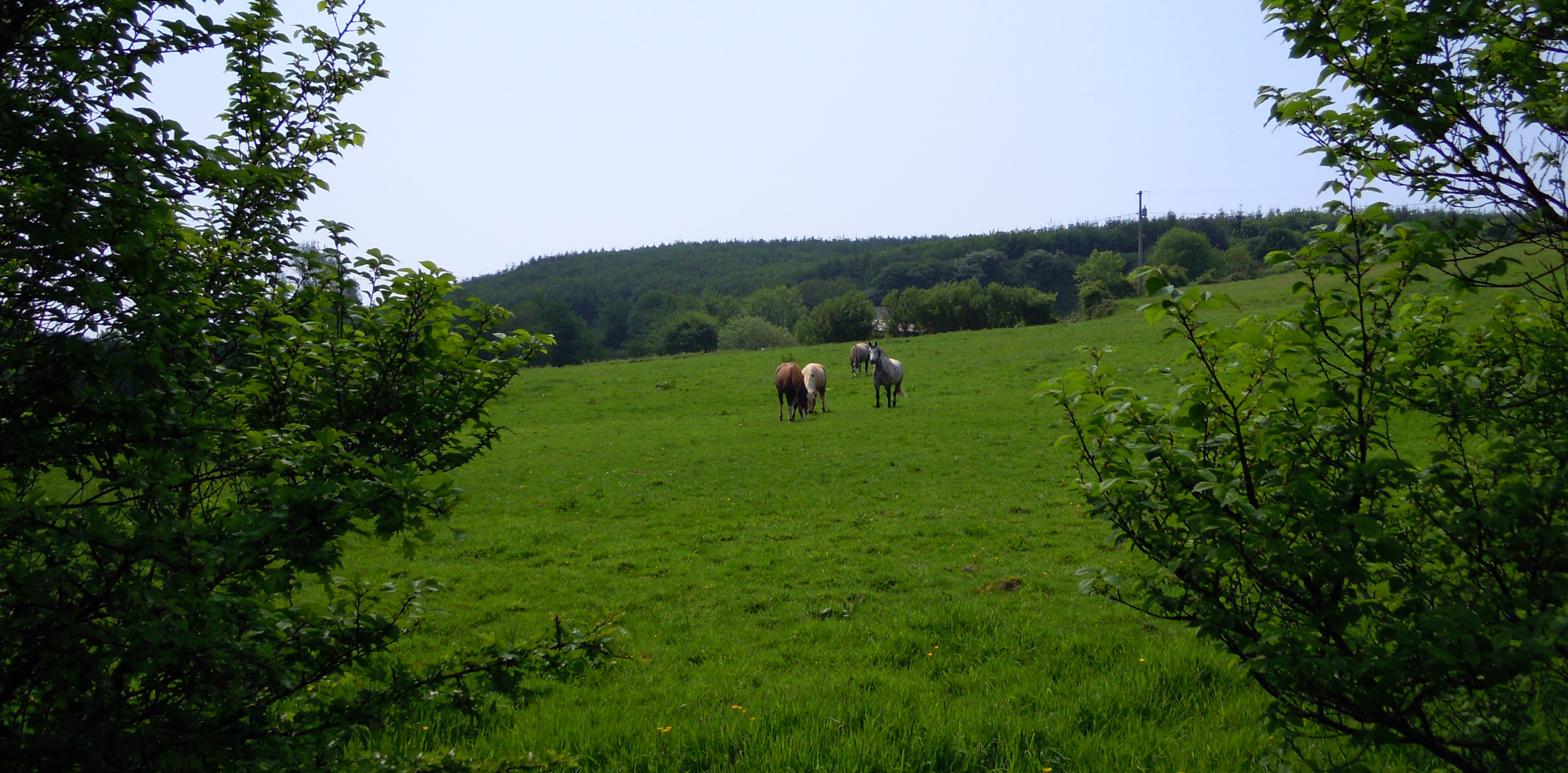
I peered across the attractive yard wall, past the ancient wall of stone, and out over the wide green pasture to the gap in the bluff that opens to the glimmering sea in the notch. A lovely outlook, much the same as my story characters of the Golden Eagle Clan see from their sacred stone circle, shown below. And from their village one ridge over from the other outlook below, where you can see the gap in the bluff beyond the horse pen.

I felt at home.

In Salzburg I stayed in the guest house in a seminary, Gästehaus im Priesterseminar, which has a historic connection with the adjoining church. Through large windows along the hallway to my room I could see the grand rooftop of that church.

These are domes of the Holy Trinity Church, which borders the seminary on one side, built between 1694 and 1702 to connect with the seminary. So not the view from the room, but from the hall on the way to the room.

From the window in my room I could see this.

It’s the former Palais Überacker built in 1732 by the Counts of Überacker because they wanted a residence close to court, the Mirabell Palace being a very short walk away. It’s just a bank now, but the renovation kept most of the Baroque facade, offering a pleasant outlook from my lovely pristine room.

Last but surely not least was Hallstatt. I knew my hotel there was right on the lake. But not every room could look toward the water. And I didn’t know whether mine would. As noted above there was no option to select a view. So when I stepped into the room my jaw dropped. This was my first sight of the outlook I would have.

The lake! The private deck! I rushed to the door onto the deck and went out.

I could see it all. The shimmering water. The fairytale village. The sheer mountains framing the scene. I could see it from my private deck. From my bed. In daylight and dark.

A room with a view. Ah yes. I loved every view. From Dublin to Limerick to Rosscarbery to Salzburg to this of Hallstatt. And I will treasure the memories like a string of cherished jewels.

NEXT: Reflections

Going There #7: Angels

I dedicate this post to my writer friend Elizabeth King. I was telling her about the many times I’ve been rescued by people on my trips just when I needed them most. I call them my angels. She told me about a time she and her husband were traveling and found themselves in a terrible predicament. A man offered to help, and after he resolved everything Elizabeth happened to see the man’s name. His name was Angelo.

~ ~ ~

So, after my wonderful stay in Rosscarbery at Catherine and Finbarr’s B&B, my next stop on this trip was Salzburg. Pictures of the hotel there looked amazing and I was looking forward to that.

It’s a renovated seminary turned into a guest house. The Gästehaus im Priesterseminar. When I saw a picture on a booking site I knew I wanted to stay there. The domes aren’t on the guest house itself, I learned, but on the connected Holy Trinity Church. And while Salzburg itself doesn’t figure in my stories it was close to the more remote Hallstatt, which does.

Salzburg was a long road from Rosscarbery. Bus or train to Dublin, which could take all day. Flight from Dublin to Salzburg the next day with a brief layover in Frankfurt. My concerns about that short layover niggled at me after seeing the confusing monstrosity of the Frankfurt airport on the original flight from home. I flew Lufthansa, a German airline, and their hub was Frankfurt. I likened the place to nightmares where I walk and walk, upstairs, downstairs, around and around, and never find the place I’m looking for.

Even the road to Dublin looked long. I had a return bus ticket as far as Cork, but there I would have to transfer. Catherine recommended a particular bus from Cork. It was faster than others and would let me off on one of those quays in Dublin where I would know exactly where I was and could walk to my hotel up familiar O’Connell Street. However, this bus line didn’t go into the Cork bus station, leaving instead from a simple bus stop across the river. Another of those streetside stops for long-haul buses. She did her best to give me directions, with a map. I hoped I could find it.

After hugs and warm good-byes I was on my way, looking back from the bus to the lovely lagoon of Rosscarbery, a place of so many memories.

On the way to Cork the bus had several stops. At Bandon a lot of people got on, and a nice-looking woman sat by me. We struck up a conversation. Where are you headed? How are you getting there? That kind of thing. I did express a little concern about the change in Cork. By the time we reached Cork we had covered many subjects, a most enjoyable visit. So when the bus pulled into the station she told me she would show me the way to my next bus stop. Much relieved, I went down to drag my bag out of the luggage bay underneath the bus. I thought she would point me in the right direction.

No. She introduced me to her husband, Dermot, who had taken a seat farther back, and her husband’s brother, John, the brother’s wife, Mary, and told me her own name, Catherine. Another Catherine! They were the O’Donovans and they were headed my way. They didn’t just show me. They escorted me.

They whisked me right through that bus station, out across the street shown below, across the bridge over the River Lee just beyond that street, down the angled lane on the far side that Catherine tried to tell me about, and right to the bus stop I was looking for, chatting and laughing with me all the way.

View toward the River Lee from Cork bus station (2018 photo)

We were exchanging names and contact information when the bus pulled up. Angels. All four O’Donovans. Angels to help me. Just when I needed them.

~ ~ ~

For the next day, second leg of the long road to Salzburg, I had paid extra for a seat near the front on the flight from Dublin to Frankfurt on account of that short layover. My hopes for an early landing didn’t happen, and when the plane did land they drove and drove until I thought we must be circling the entire massive airport. I checked the time when the plane pulled to a stop on the tarmac (not at a gate, but I remembered a bus had picked passengers up on my previous landing there). I had ten minutes until my next plane started boarding. I wasn’t feeling easy.

We waited and waited for the airplane doors to open. Someone announced that they were waiting for somebody to bring the stairs so we could deplane. Then they announced that a stairs had been brought to the rear door so they would start letting people out the back. So much for my seat close to the front. By the time the front door opened it was still quicker for me to go that way. But by then my next flight was boarding. As I left the plane I mentioned that to one of the friendly flight attendants. He smiled. “You’ll make it.” I clung to those words.

When I entered the terminal I came to a crowd of travelers (probably all those people who deplaned from the rear) wending their way through zigzag lines toward Passport Control stations, the lines barely moving. I knew what the expression “her heart sank” means. Worries flooded my mind. Reception at my Salzburg guest house would close at 4 pm. If I didn’t make this flight I would be late and I’d have go through some rigamarole to get my key. Well, I could figure that out. But what if I couldn’t get another flight that day? I would miss my reservation altogether. And I had reserved another room in Hallstatt for the next night and I already had so little time there. I might not get there at all and that was my whole reason for going to Austria.

In my rising despair I exclaimed, “My plane is boarding now!”

Someone heard me and echoed my words. “Her plane is boarding now!” The person made way for me. And the echo continued up the line. “Her plane is boarding now!” And they moved aside, one after the other, each encouraging the next person to make way. “Her plane is boarding now!” And the way opened all through that zigzag line. In moments I had reached the head of the line to the Passport Control stations, and the people ushered me forward. “There’s an open one.”

I went to that station and held out my passport, telling the official, “My plane is boarding now.” But the official in the station shook her head, her voice stern. “I am in control here.” She pointed to someone near me and said to me. “That person is ahead of you. You will wait.” I stepped back, stunned.

But the people were not having it. “Here,” they said. “This one’s open.” They ushered me to a different station and the official there hastily did what she had to do and let me through.

Still, I had so little time before my boarding gate would close. I located the departures board to make sure of my gate and, finding it listed, rushed ahead. Despite my early impressions of this airport I found the usual signage. Like every airport, once you know your gate you just follow the letters to the concourse and then the numbers. I was headed for gate 69. I think it was Z69. I don’t remember now. I didn’t take time to check my phone but about the time I got to the 50s I saw a big clock. I had 5 minutes before my gate closed. The 50s seemed to take forever. When I finally saw my gate 69 it was a long way down the concourse and another clock showed I now had 2 minutes. I wondered if it was even possible to go that far in 2 minutes. I don’t know if I made it in time or if they saw this frantic-looking woman rushing toward them and waited, but they did let me through.

If all those wonderful people hadn’t helped me through Passport Control I would never have made it onto that plane. Angels, yes! So many angels.

I reached my guest house in the seminary in plenty of time and they welcomed me in, one leading me first through the beautiful cloister courtyard.

That night as I lay in my narrow bed in my lovely pristine room, I heaved a sigh. “A whole host of angels came to help me this time.” And sudden tears rose.

NEXT: Hallstatt of the Celts

Going There #3: Gold! Gold! Irish Gold!

It’s in Dublin! And I needed to see it! Gold has a place at the heart of my new Irish story. So I set aside a day for this. Welcome to my traipse through Ireland’s glorious golden past.

This intricate gold neck ornament, made in Ireland, comes from the Late Bronze Age, somewhere between 1000 and 500 B.C., during the period of my story.

So much brilliant ancient goldwork has been found in Irish bogs and waters, hoards of it. And the National Museum of Ireland–Archaeology has a dazzling display, including the samples shown in this post. I would spend hours there, stepping into Ireland’s ancient glory.

The lunula goes back to 2300-2000 B.C., named for its crescent moon shape. The museum has many on display, this one showing a good example of the intricate incised markings.

The lunula, like the one above, appears in my story on the necks of clan mothers and future clan mothers in ancient Éire. A lovely ornament made from thin hammered sheets of gold with the incised designs.

When I proceeded to write my newest novel, I first had to decide where to set it. Where did I want to spend the next months, maybe years–at least in story if not in person? The answer came quickly. Ireland.

The next question. When?

I pulled out books and notebooks I’d gathered for other work and began poring through them for intriguing periods in Ireland. One thing jumped out at me. Gold! Historians describe the period around 800 B.C. as a time of a sudden uptick in rich production of gold in Ireland, a veritable revolution in goldwork. This was also a period when the early proto-Celtic culture was thriving in faraway Hallstatt, Austria. I knew how the Irish love their Celts. They wouldn’t be in Ireland in 800 B.C., but could I find a way to bring them into the story?

My decision was soon made. My new book would open during this explosion of fine goldwork, and my protagonist would be a goldsmith–a rare thing for a girl.

So this spring in Dublin I stepped down into the center of the museum where a glittering world of gold surrounded me to learn what goldsmiths were doing in those momentous days.

Gold dress fasteners c. 800-700 B.C.
Gold bracelets and dress fastener c. 800-700 B.C.
Gold foil-covered sunflower pins c. 800-700 B.C.
Gold foil-covered bulla probably worn on a cord around the neck c. 800-700 B.C.
Part of a gold bobbin-shaped ear spool possibly to be worn decoratively over the ears c. 800-700 B.C.
Lock rings, hair ornaments that appear to be incised, but the lines are made of tiny wires soldered on. c. 800-700 B.C.

The soldered wires in the lock rings are so tiny they barely show in my photos. The enlarged one from the upper left of the photo above it may show the lines better, the curve. Such delicate, intricate work illustrates the fine skill of goldsmiths in this period. If they did this as Levaen did, they hammered the gold into a thin sheet, then rolled from the edge to create the wires and bonded them in place with soldering particles.

This small sample of the museum’s 800-700 B.C. goldwork that fits into my story’s timeline shows no brooch like the one my protagonist Levaen makes in the book, nor did I find anything like it. I began to worry about that, but Carisa, my daughter and beta reader, pointed out that there was no reason Levaen’s fictional goldwork should show up in the Dublin museum, and I remembered that the story presents Levaen’s brooch pattern as special in her own time. What the museum exhibits showed, especially the lock rings with their thin wires, was that the actual goldsmiths of that era were familiar with techniques like the thin wires and soldering Levaen uses to create her brooches.

Going farther back to 1200-1000 B.C. are three twisted gold bracelets and two gold grooved bands.
And a gold torc with ribbed rings and bracelets from 1200-1000 B.C.

One exhibit offered a portrayal of how some of these golden objects might have been worn. This illustration features goldwork from the Late Bronze Age, roughly 1000 to 500 B.C., a neck ornament like the one in the photo at the top of the post, along with ear spools of sheet gold, and arm and wrist bracelets pictured above.

Of course these items could have been worn by either men or women or both. There might have been chiefs or chieftainesses. Or perhaps the general public would have donned such brilliance for special occasions. We can only wonder and imagine.

There was so much more gold in the museum’s collection, but some bronze too, that caught my eye.

Swords from 900-500 B.C. Some look like leaf-shaped Hallstatt swords but they’re not labeled as such.

No one knows when the Celts came to Ireland. We only know the language came, so they must have come. But they would not have been in Ireland in any numbers at the time of my story. A few Hallstatt swords possibly came earlier, by trade or other means. Enough to tantalize but not to prove anything.

There’s no intrinsic method of dating metal, so dating depends on surrounding materials that can be dated. In fact, on at least one occasion they found a lunula in a wooden box, which identified the time of its use by testing the wood. Surely a precious object. Dating offered with the museum exhibits of gold and bronze would have been confirmed by surrounding material, but they give a broad span as noted in captions here.

Many objects in the exhibits are labeled as parts of the hoards that included them, deposits placed into bogs or lakes or streams. Why the ancients deposited such hoards, no one knows. Bogs may well have been lakes at the time of the deposits and later dried up, so all deposits may have been placed into the waters. Or some dry or partly drained bogs may have been dug into and the items buried. Were the treasures cached in a time of escape from some crisis? Or were these offerings to their deities? All we can do is guess. We have no writing, no histories, to tell us.

The hoards weren’t all glorious gold. Many practical items were included. A lot of bronze. Practical axe heads, chisels, horns, cauldrons. And swords and spear heads.

Some items are just delightful objects like the one pictured below. I so enjoyed seeing it, I chose to share it here, even though it’s later than my story.

Miniature 7-inch-long gold ship with sailing mast and oars from the 1st century B.C.

NEXT: Gold Mountains and Memories

Thinking of Ireland

As drought dries the landscape of my Oregon home, turning the green to gold, I dream of the green fields of Ireland.

Horses in Ireland’s green fields

One day soon I hope to revisit the magic of Ireland. Meanwhile my books take me there.

My upcoming book series features two island settings–Ireland and Crete. For some time I have started this ancient historical saga in Crete, but I’m bringing Ireland forward now with Whisper of Wings as the opening book, where they call the place by its old name Éire.

Irish clan leader Bria knew only peace before the slave traders came, but she must now learn the grief of bearing weapons of war to save her People of the Stones. The Éireanns play a role in most of the other stories.

I first visited Ireland because of my Irish roots. My DNA shows at least a trickle of Irish blood. I know my maternal grandparents were both part Irish. That was enough for me to adopt the place.

By the next trip I had learned more about the stone circles scattered over Ireland and had drafted Whisper of Wings. One more trip helped answer new questions that came up as the series grew. I see another Irish book in the future, beyond the series–or loosely tied to it. The island shall always hold a special place in my heart. The green and the friendliness of its people and the magic of its ancient monuments refresh my soul.

Irish back roads on the way to Bohonagh Stone Circle near Rosscarbery
The magic of ancient stones and new spring bluebells at Bohonagh Stone Circle, Ireland