I’ve been thinking quite a lot about the People of the Stones who walk through my stories of ancient Ireland and its neighboring lands. I’m working on a new novel, a sequel to the one I hope to have published next. Always a time for the stirring of the mind.
This past weekend was the annual Fort Umpqua Days celebration in nearby Elkton, Oregon, so I was there with my booth selling my pioneer stories. I had a notebook on display with photos of pioneers as well as ancient settings and my new business cards illustrating my work “From Pioneers to People of the Stones.”
A boy stopped by and saw a picture of the stone circle at the center of my ancient stories, the Bohonagh Stone Circle in Ireland.
“Stonehenge,” he said, then shook his head when he realized it didn’t look quite like Stonehenge.
I turned the page to show him I did have this picture of the circle he knew. We had quite a conversation, maybe a half hour or so.
He had some imaginative ideas about how the ancient people stood those big stones up there. He knew quite a bit about the site.
He’s ten. I told him he should think about being a writer someday. He smiled. “I write comic strips already.” A budding author. And a delight.
So that night when I was looking for an hour’s entertainment before going to bed I searched my recordings on the DVR and saw OPB’s NOVA presentation on Stonehenge. I’d seen it, but I watched again with keen interest. They showed how the first stones of Stonehenge were the smaller bluestones, not the giant Sarsens. A single ring. Dated at about 3000 B.C. Then the giants went up in 2500 B.C., with their lintels on the top, and the bluestones were moved into the interior. I wanted to argue against those bluestones coming all the way from Wales, some 150 miles away, but the guide I talked to at the site convinced me. Archaeologists had found quarries in the Preseli Hills of Wales with the same kind of stone, and there were no such stones around Stonehenge. They had to have come from Wales.
The smaller bluestones show clearly in this photo, lined up inside the taller sarsens.
Then last night I again wanted an hour’s entertainment. And what should I find but another, newer show about Stonehenge. This one showed the same archaeologist who finally found the exact quarry in Wales these bluestones came out of. Problem was, dating on the site indicated that the quarrying for the bluestones happened in 3300 B.C. The stones went up on the Salisbury plain in 3000 B.C. There was a 300-year gap. Where were these stones during those 300 years?
It wasn’t an easy question to answer, but the archaeologist came to believe the stones had been used for a circle near the quarry, then removed to the location on the Salisbury plain where Stonehenge stands today. Many megaliths stand yet today in the vicinity of the quarry. But how to find where this circle of bluestones stood in that interim? This was a needle-in-a-haystack effort for sure. How do you find something that isn’t there anymore? They had to look for the holes left behind, long since covered over by new soil. With many disappointing tries and the use of overhead imagery they finally found where the stones once stood. They could even see the odd shape of one impression that matched a bluestone now at Stonehenge.
For confirmation they used a dating method I’d never heard of where they dig down to see when the sediment last saw the sun, keeping carefully under cover to avoid any current light. The test showed a date of 3300 B.C. as the construction date on the abandoned site. So the stones went directly from the quarry to this site in Wales and 300 years later were moved to the current site.
Why would they move them? And how? Each stone weighs more than a ton. To show how it was possible they built sledges and had 30 children, 13 years old, try to pull the loaded sledge with ropes. The children managed with apparent ease, drawing the heavy stone uphill. Surely ancient adults could do it. As for the why, we can’t really know. There was no sign of battle to suggest they were escaping attack.
Stonehenge looking southward.
One thought was that the site on the Salisbury plain at that time lay on a swath of glacial channels that aligned with the sun on winter solstice. To these ancient People of the Stones this may have appeared to be an auspicious site.
Moving into the minds of ancients who left no writing behind? Well, that’s the kind of thing we fiction writers do.
Here on a lonely hill, where silence echoes and all is near forgotten, a memory whispers. Here the center of my Éireann world lives.
~ ~ ~
If Ireland holds the place as the heart of my stories, and it does, then Rosscarbery on Ireland’s south coast must be the heart of the heart. Just up the hill above that charming town lies this ancient circle of stones, sacred center of the clan of my protagonist. I have named her people the Clan of the Golden Eagle, and this land has been their ancestral home for generations.
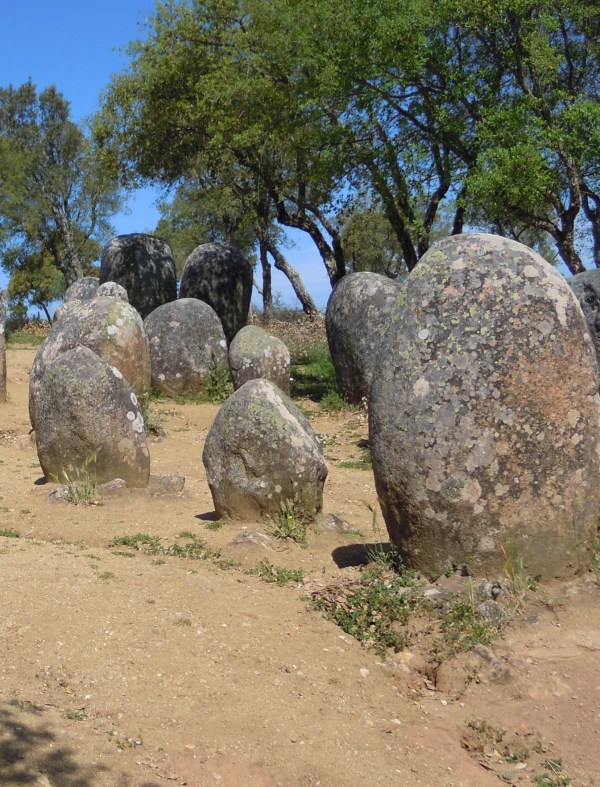
These mysterious circles of stone dating back thousands of years can be found up and down the Atlantic seaboard–across Ireland, Britain, France, Portugal, and Africa. The most famous would be Stonehenge in England. To my knowledge no others bear the horizontal lintels like Stonehenge. The circles range in size. I visited one in Portugal, the Cromlech of Almendres, with almost 100 stones, dating from about 4000 to 6000 B.C. Another, the Castlerigg Circle in northern England set among a ring of mountains, dates from about 3000 B.C.
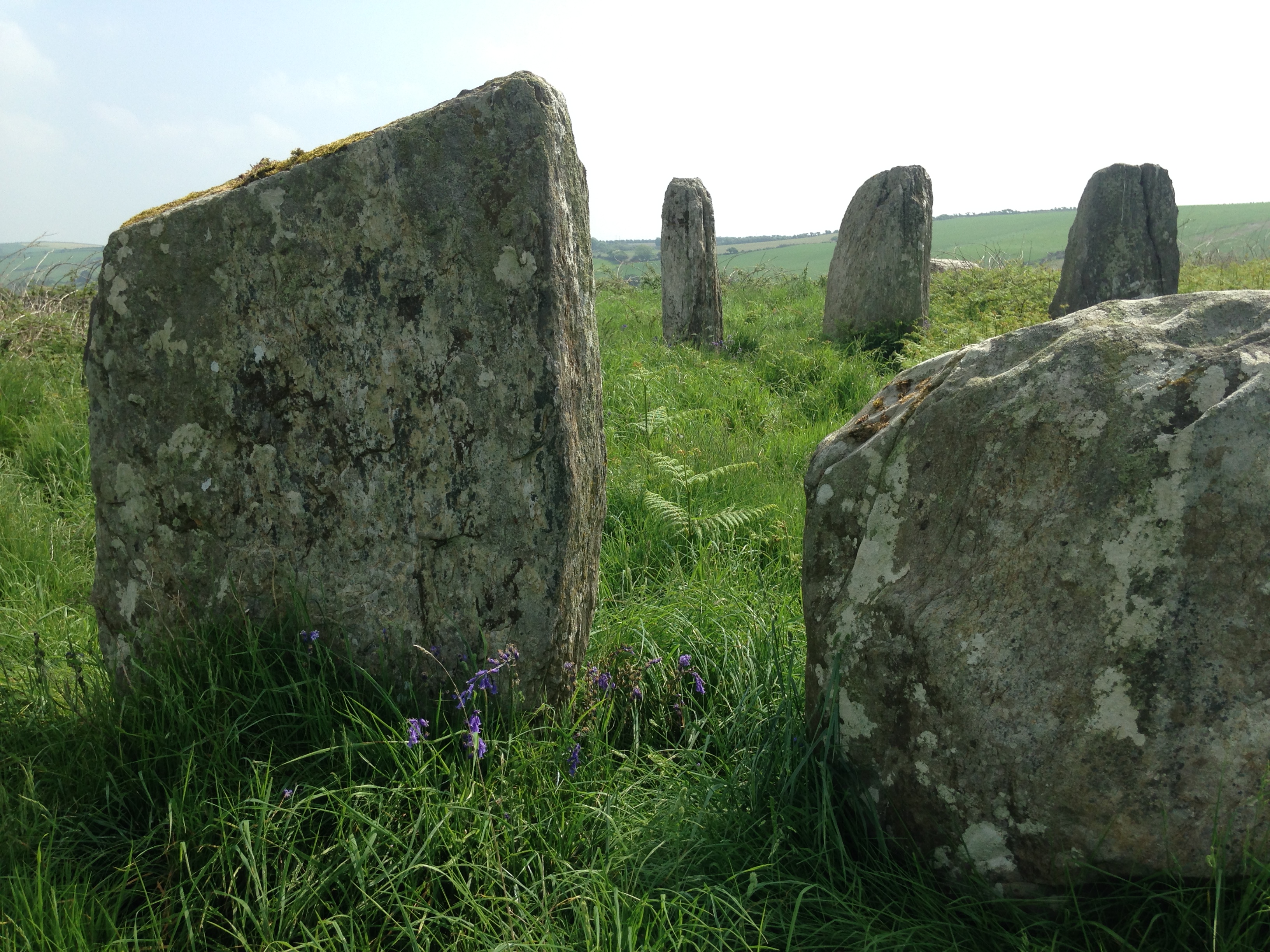
But this circle of stone caught my heart in ways I can’t explain. It has stood on this hill overlooking the south coast of Ireland since about 1500 B.C., now called Bohonagh Circle. Why these rings of raw stone stand where they do no one today really knows. Scholars believe they marked the passing seasons of the sun. Others suggest they were places of celebration, for dancing and connecting with the gods and goddesses the people revered, perhaps places that drew together the powers of earth and sky.
Catherine and Finbarr O’Sullivan, my wonderful hosts at the Rosalithir B&B in Rosscarbery, wished me well when I set off to see the circle on my first day this trip. A bright sunny morning. Catherine made sure I took a snack of her delicious soda bread and some fruit, which would tide me over until dinner. This was my third visit with Catherine and Finbarr. They weren’t just hosts. They were friends now.
It’s a fair walk over pleasant back roads. Then the familiar track up the hill, the stones beyond my sight until at last I began to see the tops like fingers lifted to the sky. Remembrance flooded me. Not only my own former visits. But the many scenes in my stories as my characters approached this sacred place. I left the track for the green field as the stones came into full view. They seemed to draw me. I barely felt the grass beneath my feet. Once there, I honored the tall portals, both higher than my reach, and stepped inside.
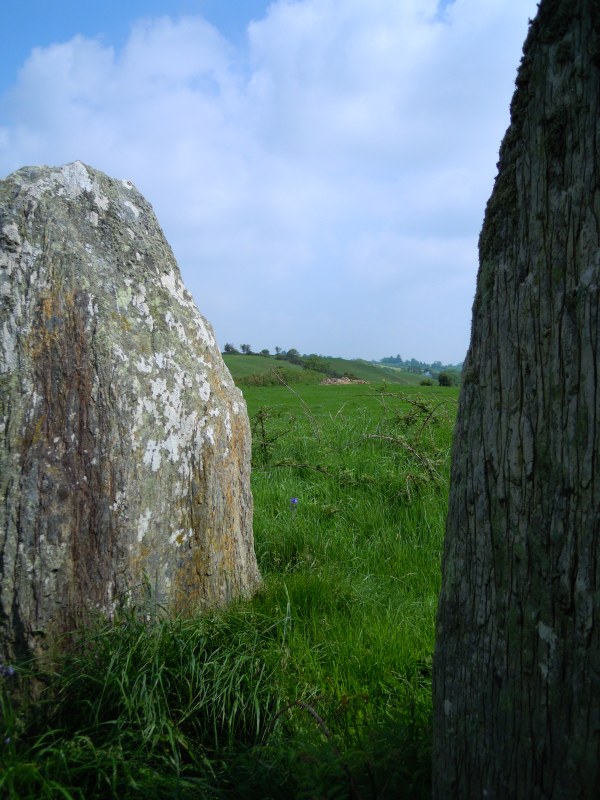
Turning, I looked out through the portal stones and felt a sense that I had come home again. A little breathless still, I was looking for better pictures than I’d taken on earlier visits and nature gave me that. The clouds on this day! Oh my! The clouds!
I stayed and wandered in and out, soaking in the feel of the circle, the surroundings. I especially like the way one stone sits in line with a slope of the vee that opens to the blue sea in the distance. I don’t think that was by accident. Clouds kept boiling in, adding to a sense of awe. After touching each stone with the reverence such a place evokes, I finally walked away, my heart full. On the way downhill I stopped to look back, wondering if I would ever see them again.
The sight of them beneath the towering clouds nearly took my breath.
~ ~ ~
Another day I went down to the bay below the circle, called by my protagonist’s clan their Golden Eagle Bay. Today’s Rosscarbery Bay. I still had questions about the beach. And what’s more, this visit revealed answers to questions I didn’t even know to ask. That made my return particularly important. On my first trip I had traipsed around the shoreline but memory and tiny photos didn’t offer a good sense of the lay of the land there. The few minutes I had on that beach last visit only confused me further. This time I spent a full day exploring the shore.
I had a fairly good sense of the western headland, but I was unsure of the east side of the bay. When I stepped out on a rocky point at the east side of a strand where I thought the bay ended, the point felt way too small for some of the scenes I had written.
There were some good rocky outlying islands to crack up a ship, but there was no room for a battle scene. It wasn’t until I climbed partway up the newly improved Cliff Walk over the western headland that I could look back and see it clearly.
The photo above shows it. That little rocky point jutting into the bay wasn’t big enough to call a headland at all. It did break up two strands, which have separate names today, Owenahincha Strand on the near side from where I took the picture and Little Island Strand on the other. But the photo also shows the only point that could reasonably be called a headland on the east side, a long and bold promontory reaching deep into the bay–beyond the second strand. It’s called today Cloghna Head. Together with the headland where I stood, these are the arms that embrace the full bay.
I continued my stroll over the Cliff Walk to the next beach, mulling all this over. It’s a beautiful walk, with nice new wooden railing and some paving, overlooking broad stretches of water and a small woodland full of bluebells.
I had planned to call Finbarr to pick me up on that next beach when I was done with the Cliff Walk, as he’d suggested. He and Catherine insisted they drive me to and from the beach because they didn’t want me to walk across the dangerous highway that separated it from the B&B. But now I knew I had to go back to where I started and check out the bold promontory of Cloghna Head, which I now saw was the eastern headland of the full bay.
As I trekked over the grass above the bayshore toward that eastern headland I became aware of something quite unfamiliar. I had walked along sandy trails cut through the grass but I happened to step onto the grass itself. My foot didn’t sink deep into the thick grass as expected but teetered on a thick spongy mass of interlaced grasses. I had never experienced anything quite like it. Because I couldn’t maintain a solid stride I quickly moved back onto one of the sand trails people had cut into that thick mass.
I later mentioned this to Finbarr and he said that’s the way beach grass grows there. It helps prevent erosion along the beaches. I told him on the Oregon coast we had tall grasses along the sandy shore. He said that those tall grasses perform the same function. And I, knowing tall grasses, had written such shores into my Irish beaches. I would need to take out that tall grass in my stories in many places. You need to get it right for the locals. And I almost didn’t.
I walked close to Cloghna Head to get a better sense of it but didn’t walk onto the top. I was particularly interested in those sheer cliffs down to the jagged rocks below and how they might work into a dramatic scene. I didn’t think about the grass on that promontory until later. But Finbarr assured me that the broad grassy top there also has the thick spongy beach grass. Other grass, away from the shore, he called pasture grass. As a farmer, raising cattle, he knew these things. I was so glad he cleared that up for me.
~ ~ ~
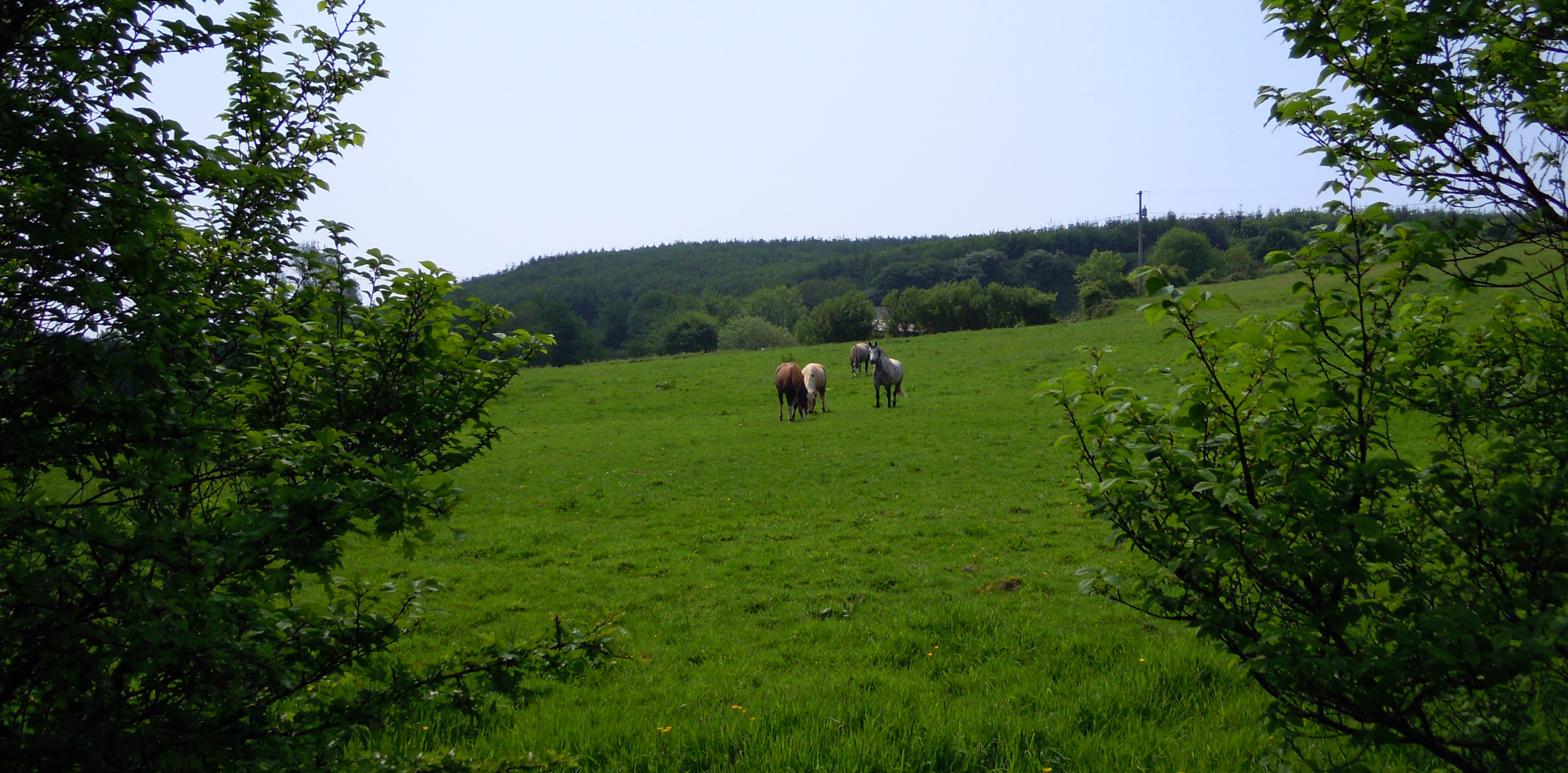
I would take more walks during my visit, got lost once on a rainy walk, then came upon the B&B quite by surprise. Irish luck again. And I explored several back roads, meeting horses and dogs and friendly people, including Tara and her beautiful Irish Cob mare with the distinctive feathering above the hooves–named Sootie for her black coat, Tara said.
With each walk, each day, I got a better sense of the place that I knew would show up in my descriptions. And my memories. Helping my Éireann world live. A wondrous visit to a wonderful place.
As drought dries the landscape of my Oregon home, turning the green to gold, I dream of the green fields of Ireland.
Horses in Ireland’s green fields
One day soon I hope to revisit the magic of Ireland. Meanwhile my books take me there.
My upcoming book series features two island settings–Ireland and Crete. For some time I have started this ancient historical saga in Crete, but I’m bringing Ireland forward now with Whisper of Wings as the opening book, where they call the place by its old name Éire.
Irish clan leader Bria knew only peace before the slave traders came, but she must now learn the grief of bearing weapons of war to save her People of the Stones. The Éireanns play a role in most of the other stories.
I first visited Ireland because of my Irish roots. My DNA shows at least a trickle of Irish blood. I know my maternal grandparents were both part Irish. That was enough for me to adopt the place.
By the next trip I had learned more about the stone circles scattered over Ireland and had drafted Whisper of Wings. One more trip helped answer new questions that came up as the series grew. I see another Irish book in the future, beyond the series–or loosely tied to it. The island shall always hold a special place in my heart. The green and the friendliness of its people and the magic of its ancient monuments refresh my soul.
Irish back roads on the way to Bohonagh Stone Circle near RosscarberyThe magic of ancient stones and new spring bluebells at Bohonagh Stone Circle, Ireland
Before I launch into Day One about my recent research trip through Greece and Portugal, the UK and Ireland, it occurs to me that it might help clarify my reasons for this journey and my reasons for writing the ancient historical series if I backtrack to the beginning. My focus on the Greek Isle of Crete started in 1994 when I set out to research a mystery novel on that exotic Mediterranean island. I had been writing books and pursuing publication for about 14 years, without success. I had moved from Roseburg, Oregon, to San Francisco in late 1989, ending a long-term marriage, and I was seeking answers for my life.
During this time I read a New York Times bestselling book by Riane Eisler called The Chalice and the Blade, where she describes nothing less than the overturning of the world’s cultural norms from woman-centered civilizations to a patriarchal world ruled by contentious warriors. I was fascinated. One chapter stood out for me, where she describes Crete as the “essential difference.” Because of its isolation in the Mediterranean Sea, this island remained one of the last holdouts of those woman-centered cultures. Its primary city of Knossos offered stunning revelations about these Bronze Age people when archeologists began uncovering the fabulous ruins some 100 years ago. Eisler describes Crete as the most advanced technological culture ever found where women were not dominated by men. I wanted to see this place.
Room in the Palace/Temple of Knossos
When I visited Knossos and stepped into the partially reconstructed ruins of its central structure, the place seemed to wrap itself around me like a mother’s loving arms. I no longer wanted to write my mystery novel. I wanted to immerse myself in this world and come to know the mystery of the ancients who once thrived there.
Prince of the Lilies Fresco, Knossos
The British archeologist Sir Arthur Evans who uncovered Knossos in the early 1900s was struck by what he found–grand staircases and pillar-lined corridors, technological wonders like flush toilets and an elaborate drainage system, frescoes revealing a free and sensuous lifestyle with women standing proud at the center. He believed he’d found a matriarchy but as a man of his times he thought they needed a king to run it. He saw this as the Palace of King Minos mentioned by Homer and Hesiod. But later scholars suggest it may have been a temple, an idea I adopted for my books, and I drew from one of Eisler’s thoughts on King Minos, depicting him as a Mycenaean warrior with designs on Crete–and a couple of Cretan women.
Part of Knossian Procession Fresco
While in Crete I met a man who helped me understand the attraction, the delight, the frustration that can happen when cultures clash. The experience found its way into my story which opens on this peaceful isle on the day the warriors come.
The frescoes shown here are reproductions of originals that are housed in the excellent Archaeological Museum in nearby Heraklion, Crete, the island’s primary modern city. The bull-leaping fresco appears in the opening scene of my book now called Beyond the Waning Moon. And readers will experience a bull-leaping event in the second scene when the protagonist faces a fierce bull in the court.
Bull-Leaping Fresco, Knossos
I wrote the book and continued editing and revising for several years as I sought its publication. Riane Eisler kindly critiqued the opening and when I addressed her concerns she called the result powerful, responding “Brava!” The novel eventually became a finalist in the Pacific Northwest Writers Association Literary Contest. The next year I found a way to tie the people of Crete to their counterparts in the distant isle of Ireland, another place that had touched me deeply and where I have personal roots.
My search for life’s answers led me to mythologist Joseph Campbell and especially his four-volume work, The Masks of God. My focus riveted on his discussion of Ireland and how he could see behind the Irish myths to a culture of Mother Right, essentially a matriarchy that would have preceded the later patriarchy. As Eisler points out in Chalice and the Blade, this isn’t the flip side of patriarchy where women rule over men but more of an egalitarian society accepting the full worth of both genders. Neither writer suggests any kind of utopia but at least a much more equal situation than we came to know.
I first visited Ireland in 1993 because of my Irish roots and had set one of those mystery novels there. But I wanted to tap into the ancient times that paralleled my Cretan story and find the lost culture of Mother Right, which Campbell talked about.
Rocky Headlands on Irish Coast
The Cretans of the first book in my ancient saga decide to send out a fleet in search of a place the warriors haven’t come. These early Cretans were known as great mariners, their frescoes and other art showing them sailing around the Mediterranean. I figured if they could sail around the eastern Mediterranean they could surely venture to the west and even out through the gate to the Atlantic, as long as they kept the shores in sight. But for a little excitement they get caught in a horrific storm and one ship crashes on the rugged rocks on Ireland’s south coast. Voila! A sequel–albeit loosely tied.
I completed the sequel in 2004 and went back to Ireland in the spring of that year, focused now on stone circles and this rugged south coast near Rosscarbery in County Cork.
Bohonagh Stone Circle Portal, Ireland
I again entered the PNWA literary contest, and this Irish one was a finalist too, just one year after the Cretan book. I thought I was surely on the road to publication then, but could not find an agent for these stories of strong women facing formidable challenges of their time. I began to get discouraged.
My father died in 2007 and I decided to keep the farm founded by my great-great-grandmother Martha in 1868. I left the ancient stories on the shelf and pursued a story about Martha, discovering I had a strong woman in my family who’d faced challenges of her own time. Finally I found an agent, Rita Rosenkranz, who helped me meet my goal of publication with Martha’s story.
But I hadn’t forgotten the ancients. I had a flash of inspiration about the Cretan story and decided to make substantial changes. When I finished those I realized I definitely needed another sequel that would be closely tied. I wanted to launch into it but I had another story set in the same pioneer period as Martha’s story. My agent and I agreed I should take advantage of the publisher’s interest and bring that pioneer story out first.
By the spring of 2014, with the two pioneer stories in the pipeline, I finally had time to draft the closely tied sequel to the Cretan book. By Christmas I was ready to write one more book to continue the ancient line, but it just wasn’t happening until my muse started whispering to me. I told about that experience on a blog post here so won’t repeat it. This fourth book was drafted by the spring of 2015. I had planned to write a fifth that would bring Crete and Ireland back together but realized I had a 16-year gap in the Irish years. Why not fill the gap with another story?
South Gate to Castro do Zambujal, Portugal
Because of all the questions I had left at the end of the first Irish book, I wanted to portray the events of those 16 years. I would take readers to the homeland of the Iberians who’d been capturing slaves off the coast of Ireland. I would show my bad guy in his personal haunts.
But the Iberians couldn’t all be brutes, could they? I learned about their amazing citadel of Zambujal north of today’s Lisbon. They must have enjoyed a sophisticated culture I needed to know more about.
And I would take readers to the Great Isle of Britain where my protagonist runs into some intriguing outlaws in the Lake District of northern England.
I finished the rough draft of the gap story in 2016. Then in 2017 I drafted the sixth book, which took me back to Iberia.
Part of Almendres Cromlech in Cork Forest, Portugal
I had never been to the Iberian peninsula, where there’s a stone circle (or oval) more ancient than the circles of Ireland. I needed to see that, as well as Zambujal. And I had never been to the Lake District in England.
Also, the new books ventured into places in Greece and Ireland I hadn’t visited before. Thus the need for another trip. Once you’ve crossed the pond, that’s the biggest single expense. I decided I might as well put it all together.
So, that’s how the project started and why the extended trip. Next up, I invite you to come with me on my solo journey in Greece and Portugal and my continued trek with writer friend Lynn Ash through the British Isles. I’ll start the next post with Day One in Heraklion, Crete, and the nearby site of Knossos I have come to love.
I just finished the rough draft of a new novel, a historical to conclude my trilogy set in ancient Ireland. Spring always puts me in mind of things coming to life, so it seems fitting that this book has come to life for me now as my daffodils bloom.
It seems doubly fitting, given the fertile nature of the island of Ireland–or Éire, as I call it in the book.
My friend Tilly Engholm and I visited Ireland a few years ago when I was researching the first in the trilogy. We spent the month of May there, a glorious time. Scenes I came to know then reappear in this new book–and the stones.
The stone circles of the island hold a special place for the clanspeople in my stories, and I needed to visit many circles on our visit. As Tilly and I headed out one day in our rental car, she glanced at me. “We’re going to look at more rocks, aren’t we?”
I laughed. “Yes, we are.”
She took it in good stride, though.
In this book the characters also travel to Iberia, now Portugal, and to Crete and Thera (Santorini), with other stops along the Mediterranean, places of beauty and wonder and peril.
It has been a great ride and I look forward to sharing it with readers.
With new books on the way, the time had come for a website update. And since I was visiting my webmaster, my daughter Christiane, that worked out well. First, we had to change the release date for The Shifting Winds from April to March, since it’s coming out a month earlier than planned. And we had to show it’s availability for pre-orders. With that done, we added an Excerpt so you can read a few paragraphs of the story. Then there were new books to talk about. Today we added a description.
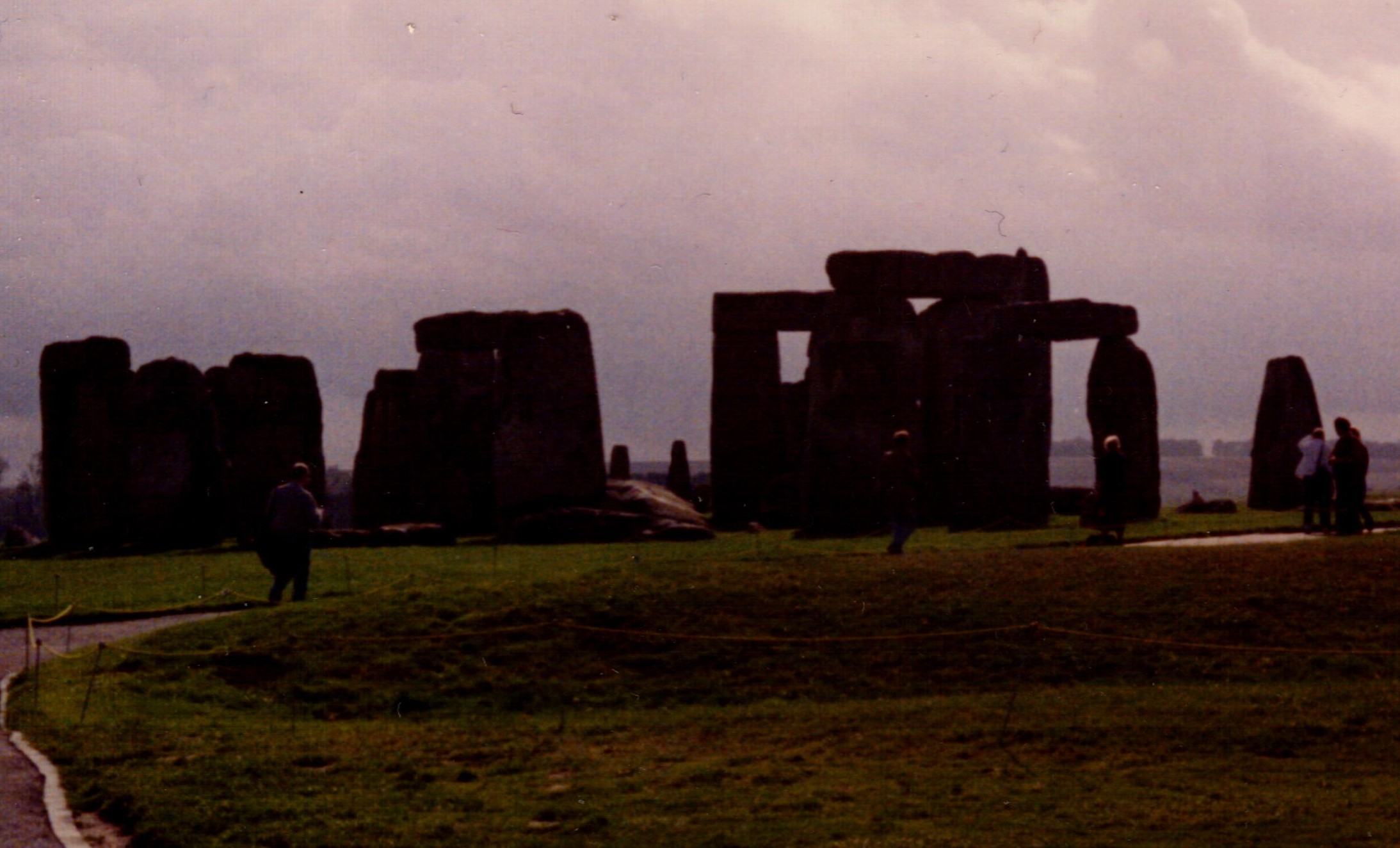
The above photo I took some years ago shows Britain’s famous Stonehenge, which figures in the newest writing project, Book Five of the Golden Isles Series. The book is called Webs of Stone. You’ll find a description on the newly revised Books page. Up until now I’ve shown only five books for the series because I wasn’t sure if I had ideas enough for a book for this 16-year period in Ireland between the end of Book One and the beginning of the final book. That gap parallels events in the Mediterranean at that time, events shown in Book Four, but what was going on in Ireland then? [Note: The Books page has been updated yet again since the writing of this blog post, so the series in late 2022 has eleven titles.]
My muse was slow to visit, but when I took a Thanksgiving trip to Kansas City to visit Christiane and my granddaughter Calliope, inspiration struck. My muse talked to me. It happens in odd ways sometimes. I was searching for a hideout for my outlaw character somewhere north of Stonehenge (which I call the Great Stone Circle of Wessex in the book). And I wanted mountains. Where would I find mountains in England? Would I have to go as far as the Scottish Highlands? That’s a long way from Wessex when you’re walking or riding a pony. And I’d been in the Scottish Highlands. When you’re used to the Cascades and Rockies they seem like rolling hills. Maybe Wales? I’d seen some real mountains there. I clicked the “terrain” figure on Google maps and found the Lakes District in northern England. Then with a click on “street view” I found myself in rugged, craggy, stone-strewn mountains with steep dropoffs down to lovely lakes. Perfect! I could see myself there, my characters. And the story took off in my mind.
The photo above shows another stone circle in near silhouette. This is the circle I chose for the home circle of the Golden Eagle Clan, the central clan for both Book One and Book Five. It’s the Bohonagh Circle near Rosscarbery in Ireland. For me it’s the Golden Eagle Circle. I was lucky enough to spend several days traipsing around these pillars and the vicinity back in 2004 when I traveled to Ireland with my good friend Tilly Engholm. She was my next-door neighbor in Portland then, an avid traveler, and we had a great time on this trip–although as I wandered from circle to circle, she began to weary of stones. Once she sighed and asked, “We’re going to go see more rocks, aren’t we, Janet?” And I had to admit we were. I do love the stone circles and the power I feel in them. Fortunately, Tilly was agreeable.
I wrote Book One, Whisper of Wings, that year. Since then, I’ve spent most of my time focused on Crete, where Books Two through Four are centered. It’s lovely to be experiencing Ireland again–and England, with a few scenes on the coast of Brittany and in what is now Portugal.
I’m excited that a new story is taking off and look forward to immersing myself in it. If you don’t hear from me as often in the next few weeks, that’s where I’ll be–Ireland and the High Lakes and the plains of Wessex and those other places–from roughly 1406 B.C. to 1390 B.C., exploring the mysterious circles and other rocks scattered over the British Isles and Western Europe like interlaced webs of stone.